


 Скачать презентацию Commonwealth of Massachusetts Executive Office of Health and
5419a9513fba6a05aa6aeb2de38b3e11.ppt
- Количество слайдов: 40
 Commonwealth of Massachusetts Executive Office of Health and Human Services Chapter 257 of the Acts of 2008 Provider Information and Dialogue Session: Adult Long Term Care June 20, 2012 www. mass. gov/hhs/chapter 257 eohhspospolicyoffice@state. ma. us
 Agenda • Chapter 257 of the Acts of 2008 • Overview of Adult Long Term Care Services • Definition and Overview of Programs • Residential Rate Precepts • Review of Preliminary Occupancy Survey Results • Updated Draft model Budget Framework • Breakout Discussions • Timeline and Key Milestones 2
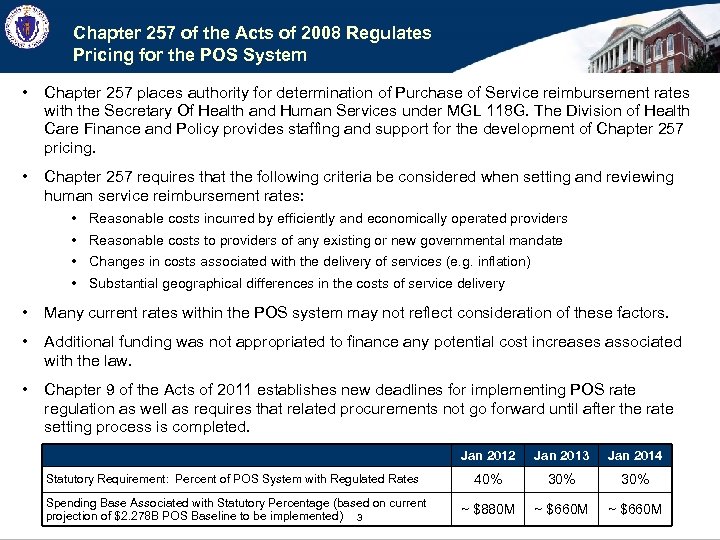 Chapter 257 of the Acts of 2008 Regulates Pricing for the POS System • Chapter 257 places authority for determination of Purchase of Service reimbursement rates with the Secretary Of Health and Human Services under MGL 118 G. The Division of Health Care Finance and Policy provides staffing and support for the development of Chapter 257 pricing. • Chapter 257 requires that the following criteria be considered when setting and reviewing human service reimbursement rates: • Reasonable costs incurred by efficiently and economically operated providers • Reasonable costs to providers of any existing or new governmental mandate • Changes in costs associated with the delivery of services (e. g. inflation) • Substantial geographical differences in the costs of service delivery • Many current rates within the POS system may not reflect consideration of these factors. • Additional funding was not appropriated to finance any potential cost increases associated with the law. • Chapter 9 of the Acts of 2011 establishes new deadlines for implementing POS rate regulation as well as requires that related procurements not go forward until after the rate setting process is completed. Jan 2012 Statutory Requirement: Percent of POS System with Regulated Rates Spending Base Associated with Statutory Percentage (based on current projection of $2. 278 B POS Baseline to be implemented) 3 Jan 2014 40% 30% ~ $880 M ~ $660 M
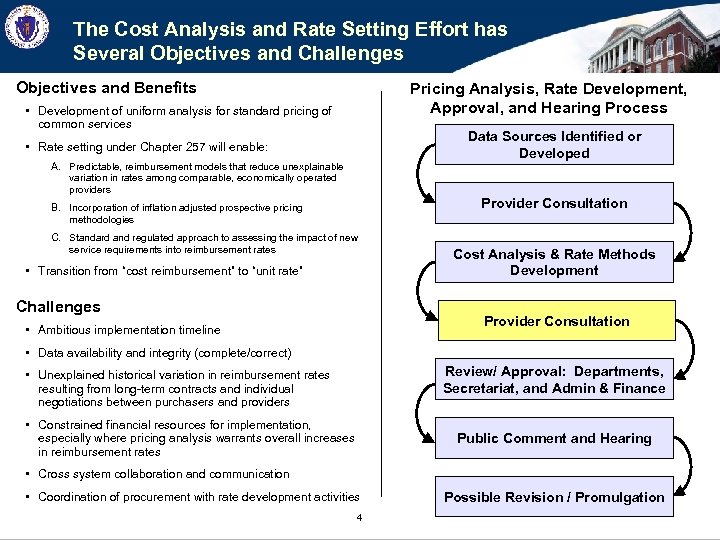 The Cost Analysis and Rate Setting Effort has Several Objectives and Challenges Objectives and Benefits Pricing Analysis, Rate Development, Approval, and Hearing Process • Development of uniform analysis for standard pricing of common services Data Sources Identified or Developed • Rate setting under Chapter 257 will enable: A. Predictable, reimbursement models that reduce unexplainable variation in rates among comparable, economically operated providers Provider Consultation B. Incorporation of inflation adjusted prospective pricing methodologies C. Standard and regulated approach to assessing the impact of new service requirements into reimbursement rates • Transition from “cost reimbursement” to “unit rate” Challenges Cost Analysis & Rate Methods Development Provider Consultation • Ambitious implementation timeline • Data availability and integrity (complete/correct) Review/ Approval: Departments, Secretariat, and Admin & Finance • Unexplained historical variation in reimbursement rates resulting from long-term contracts and individual negotiations between purchasers and providers • Constrained financial resources for implementation, especially where pricing analysis warrants overall increases in reimbursement rates Public Comment and Hearing • Cross system collaboration and communication • Coordination of procurement with rate development activities 4 Possible Revision / Promulgation
 Agenda • Chapter 257 of the Acts of 2008 • Overview of Adult Long Term Care Services • Definition and Overview of Programs • Residential Rate Precepts • Review of Preliminary Occupancy Survey Results • Updated Draft model Budget Framework • Breakout Discussions • Timeline and Key Milestones 5
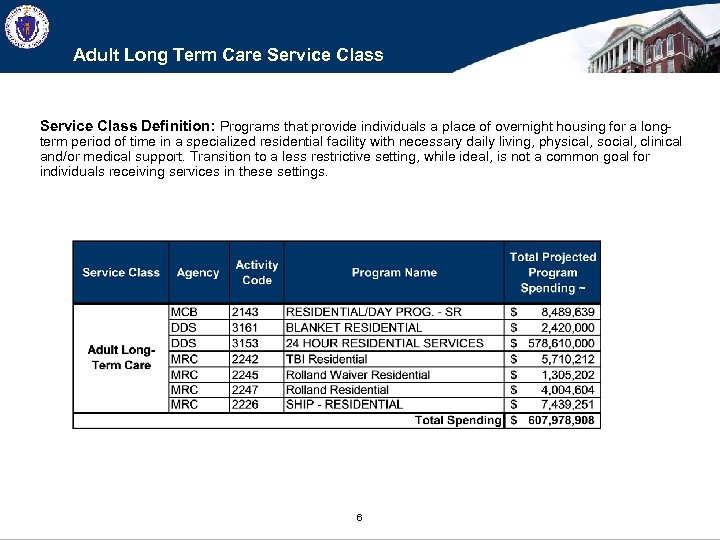 Adult Long Term Care Service Class Definition: Programs that provide individuals a place of overnight housing for a long- term period of time in a specialized residential facility with necessary daily living, physical, social, clinical and/or medical support. Transition to a less restrictive setting, while ideal, is not a common goal for individuals receiving services in these settings. 6
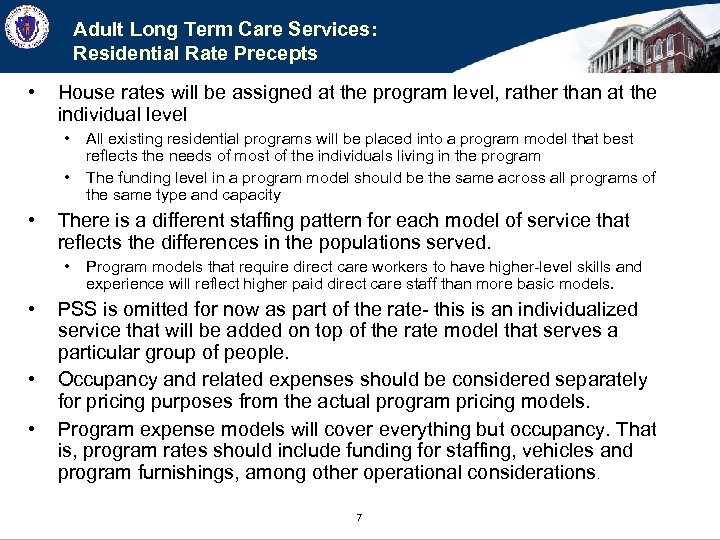 Adult Long Term Care Services: Residential Rate Precepts • House rates will be assigned at the program level, rather than at the individual level • • • There is a different staffing pattern for each model of service that reflects the differences in the populations served. • • All existing residential programs will be placed into a program model that best reflects the needs of most of the individuals living in the program The funding level in a program model should be the same across all programs of the same type and capacity Program models that require direct care workers to have higher-level skills and experience will reflect higher paid direct care staff than more basic models. PSS is omitted for now as part of the rate- this is an individualized service that will be added on top of the rate model that serves a particular group of people. Occupancy and related expenses should be considered separately for pricing purposes from the actual program pricing models. Program expense models will cover everything but occupancy. That is, program rates should include funding for staffing, vehicles and program furnishings, among other operational considerations. 7
 Agenda • Chapter 257 of the Acts of 2008 • Overview of Adult Long Term Care Services • Definition and Overview of Programs • Residential Rate Precepts • Review of Preliminary Occupancy Survey Results • Updated Draft model Budget Framework • Breakout Discussions • Timeline and Key Milestones 8
 EOHHS Occupancy Survey Background • The 2012 EOHHS Occupancy Survey gathered information on the occupancy costs for the Adult Long Term Residences. The data collected will inform the pricing structure and rates to be developed for the facility component of Adult Long Term Residential services. • The 2012 Occupancy Survey was electrically submitted to over 200 Residential providers. • The data from 2012 Occupancy Survey represents the responses from over 1, 400 caregiver sites across Massachusetts. • Survey Gizmo was the survey tool used to administer the survey. 9
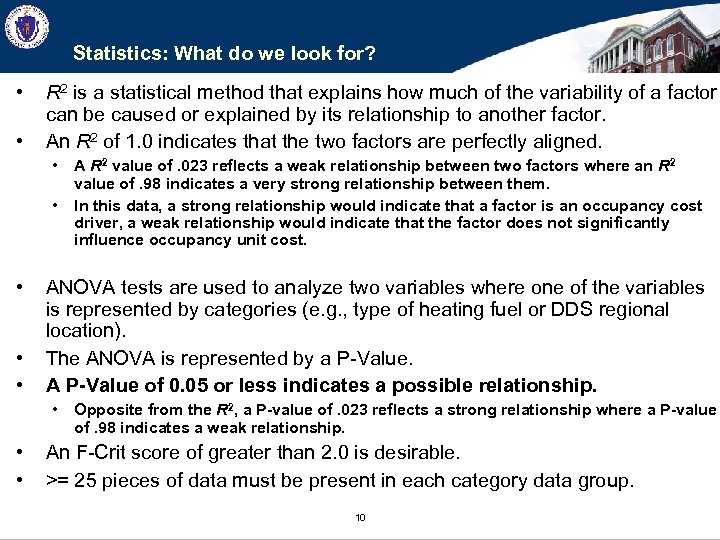 Statistics: What do we look for? • • R 2 is a statistical method that explains how much of the variability of a factor can be caused or explained by its relationship to another factor. An R 2 of 1. 0 indicates that the two factors are perfectly aligned. • • • ANOVA tests are used to analyze two variables where one of the variables is represented by categories (e. g. , type of heating fuel or DDS regional location). The ANOVA is represented by a P-Value. A P-Value of 0. 05 or less indicates a possible relationship. • • • A R 2 value of. 023 reflects a weak relationship between two factors where an R 2 value of. 98 indicates a very strong relationship between them. In this data, a strong relationship would indicate that a factor is an occupancy cost driver, a weak relationship would indicate that the factor does not significantly influence occupancy unit cost. Opposite from the R 2, a P-value of. 023 reflects a strong relationship where a P-value of. 98 indicates a weak relationship. An F-Crit score of greater than 2. 0 is desirable. >= 25 pieces of data must be present in each category data group. 10
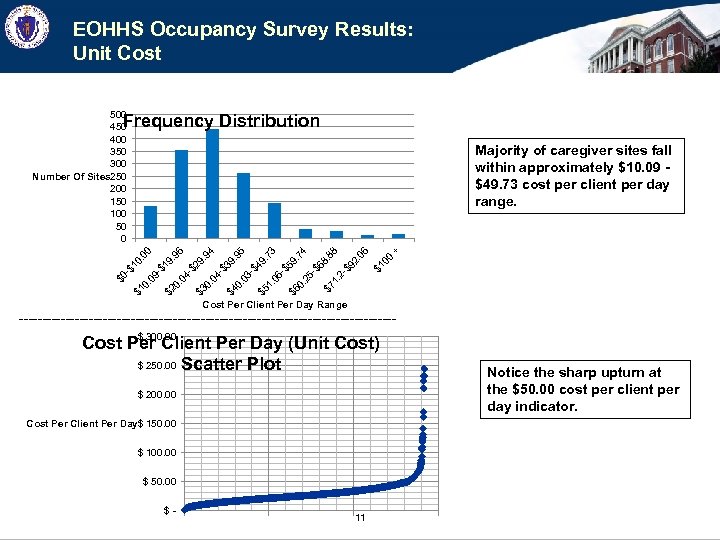 EOHHS Occupancy Survey Results: Unit Cost 500 450 400 350 300 Number Of Sites 250 200 150 100 50 0 Frequency Distribution + 00 $1 . 0 6 88 2$9 2 68. $7 1. -$ 74 25 59. $6 0. -$ 06 $5 1. $4 0. 0 3 - $4 9. 7 3 95 39. -$ 94 04 29. $3 0. -$ 96 04 19. $2 0. -$ 09 $1 0. $0 -$ 10. 00 Majority of caregiver sites fall within approximately $10. 09 - $49. 73 cost per client per day range. Cost Per Client Per Day Range ----------------------------------------$ 300. 00 Cost Per Client Per Day (Unit Cost) $ 250. 00 Scatter Plot $ 200. 00 Cost Per Client Per Day$ 150. 00 $ 100. 00 $ 50. 00 $ - 11 Notice the sharp upturn at the $50. 00 cost per client per day indicator.
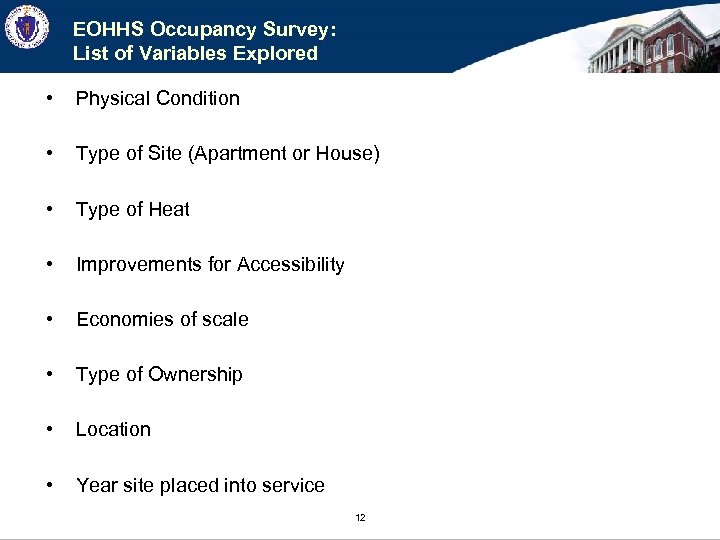 EOHHS Occupancy Survey: List of Variables Explored • Physical Condition • Type of Site (Apartment or House) • Type of Heat • Improvements for Accessibility • Economies of scale • Type of Ownership • Location • Year site placed into service 12
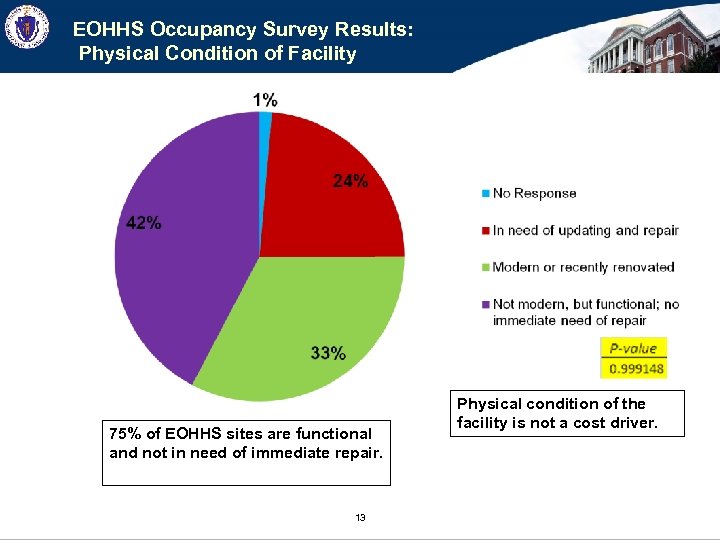 EOHHS Occupancy Survey Results: Physical Condition of Facility 75% of EOHHS sites are functional and not in need of immediate repair. 13 Physical condition of the facility is not a cost driver.
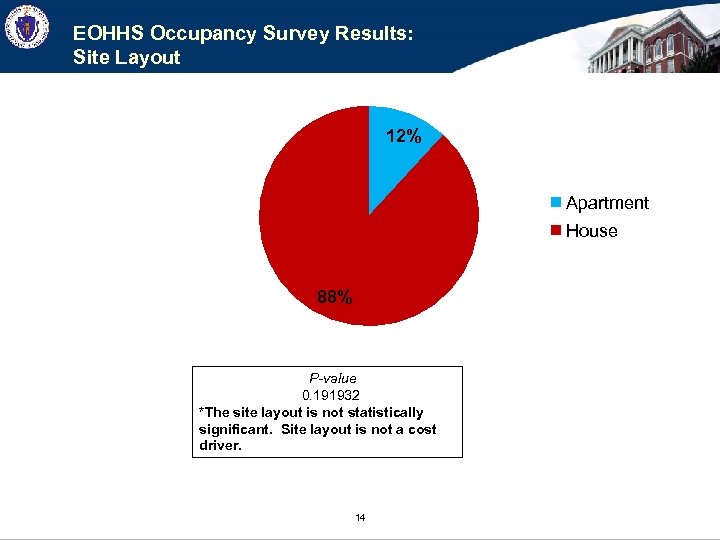 EOHHS Occupancy Survey Results: Site Layout 12% Apartment House 88% P-value 0. 191932 *The site layout is not statistically significant. Site layout is not a cost driver. 14
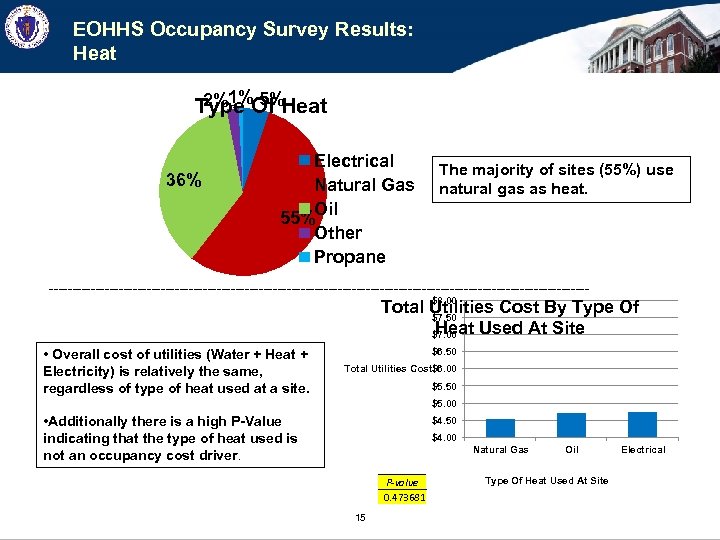 EOHHS Occupancy Survey Results: Heat 2%1% 5% Type Of Heat 36% Electrical Natural Gas Oil 55% Other Propane The majority of sites (55%) use natural gas as heat. ---------------------------------------------------------- $8. 00 Total Utilities Cost By Type Of $7. 50 Heat Used At Site $7. 00 • Overall cost of utilities (Water + Heat + Electricity) is relatively the same, regardless of type of heat used at a site. $6. 50 Total Utilities Cost $6. 00 $5. 50 $5. 00 • Additionally there is a high P-Value indicating that the type of heat used is not an occupancy cost driver. $4. 50 $4. 00 Natural Gas P-value 0. 473681 15 Oil Type Of Heat Used At Site Electrical
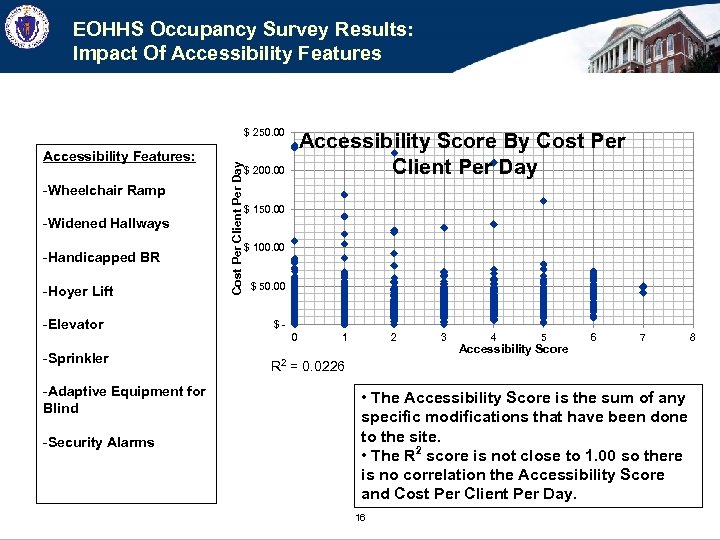 EOHHS Occupancy Survey Results: Impact Of Accessibility Features: -Wheelchair Ramp -Widened Hallways -Handicapped BR -Hoyer Lift -Elevator -Sprinkler -Adaptive Equipment for Blind -Security Alarms Cost Per Client Per Day $ 250. 00 Accessibility Score By Cost Per Client Per Day $ 200. 00 $ 150. 00 $ 100. 00 $ 50. 00 $ 0 1 2 3 4 5 Accessibility Score 6 7 8 R 2 = 0. 0226 • The Accessibility Score is the sum of any specific modifications that have been done to the site. • The R 2 score is not close to 1. 00 so there is no correlation the Accessibility Score and Cost Per Client Per Day. 16
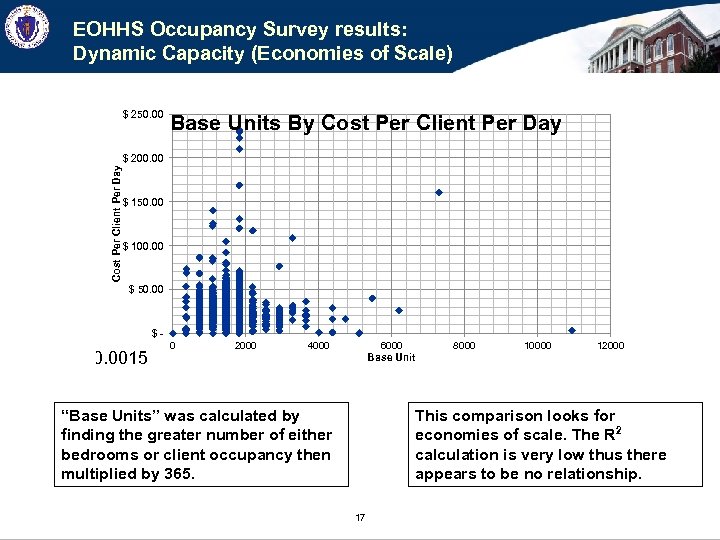 EOHHS Occupancy Survey results: Dynamic Capacity (Economies of Scale) $ 250. 00 Base Units By Cost Per Client Per Day $ 200. 00 $ 150. 00 $ 100. 00 $ 50. 00 $ - R 2 = 0. 0015 0 2000 4000 6000 Base Unit “Base Units” was calculated by finding the greater number of either bedrooms or client occupancy then multiplied by 365. 8000 10000 12000 This comparison looks for economies of scale. The R 2 calculation is very low thus there appears to be no relationship. 17
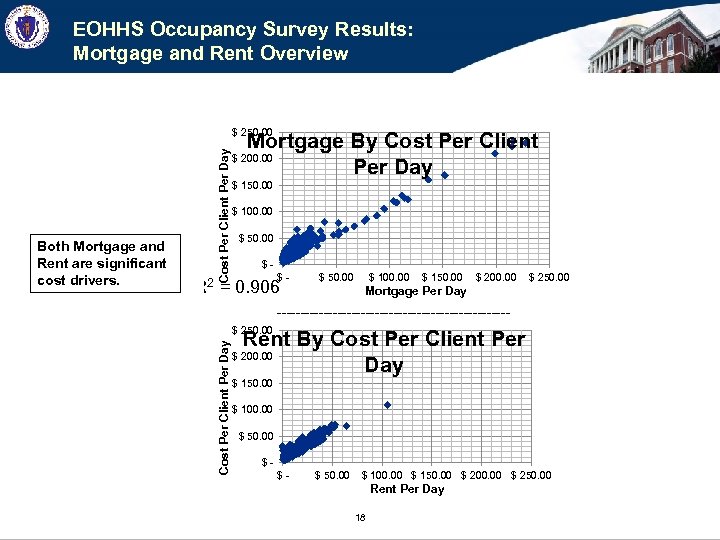 EOHHS Occupancy Survey Results: Mortgage and Rent Overview Mortgage By Cost Per Client Per Day $ 200. 00 $ 150. 00 $ 100. 00 $ 50. 00 $ $ - R 2 = 0. 906 $ 50. 00 $ 100. 00 $ 150. 00 $ 200. 00 $ 250. 00 Mortgage Per Day -------------------------$ 250. 00 Cost Per Client Per Day Both Mortgage and Rent are significant cost drivers. Cost Per Client Per Day $ 250. 00 Rent By Cost Per Client Per $ 200. 00 Day $ 150. 00 $ 100. 00 $ 50. 00 $ $ - $ 50. 00 $ 100. 00 $ 150. 00 $ 200. 00 $ 250. 00 Rent Per Day 18
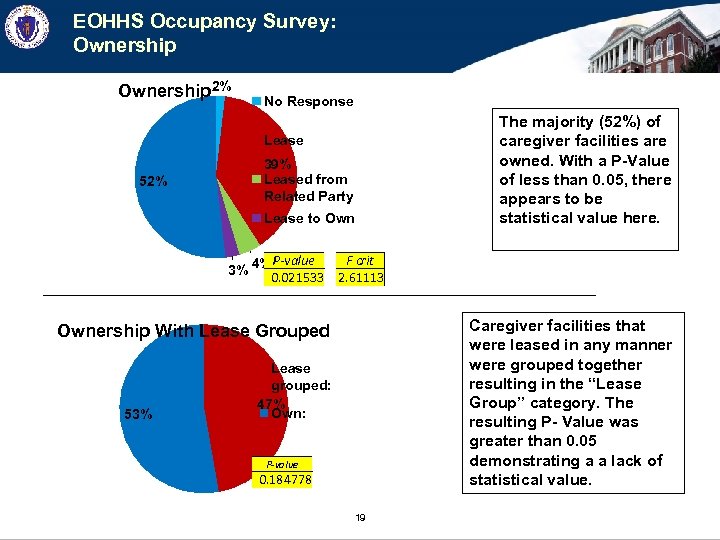 EOHHS Occupancy Survey: Ownership 2% No Response Lease 52% 39% Leased from Related Party Lease to Own The majority (52%) of caregiver facilities are owned. With a P-Value of less than 0. 05, there appears to be statistical value here. F crit 4% P-value 3% 0. 021533 2. 61113 ____________________________________ Caregiver facilities that were leased in any manner were grouped together resulting in the “Lease Group” category. The resulting P- Value was greater than 0. 05 demonstrating a a lack of statistical value. Ownership With Lease Grouped 53% Lease grouped: 47% Own: P-value 0. 184778 19
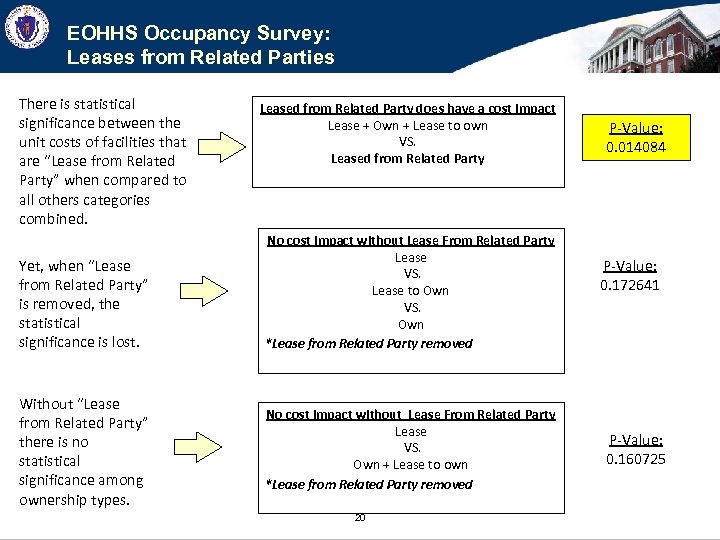 EOHHS Occupancy Survey: Leases from Related Parties There is statistical significance between the unit costs of facilities that are “Lease from Related Party” when compared to all others categories combined. Yet, when “Lease from Related Party” is removed, the statistical significance is lost. Without “Lease from Related Party” there is no statistical significance among ownership types. Leased from Related Party does have a cost impact Lease + Own + Lease to own VS. Leased from Related Party No cost impact without Lease From Related Party Lease VS. Lease to Own VS. Own *Lease from Related Party removed No cost impact without Lease From Related Party Lease VS. Own + Lease to own *Lease from Related Party removed 20 P-Value: 0. 014084 P-Value: 0. 172641 P-Value: 0. 160725
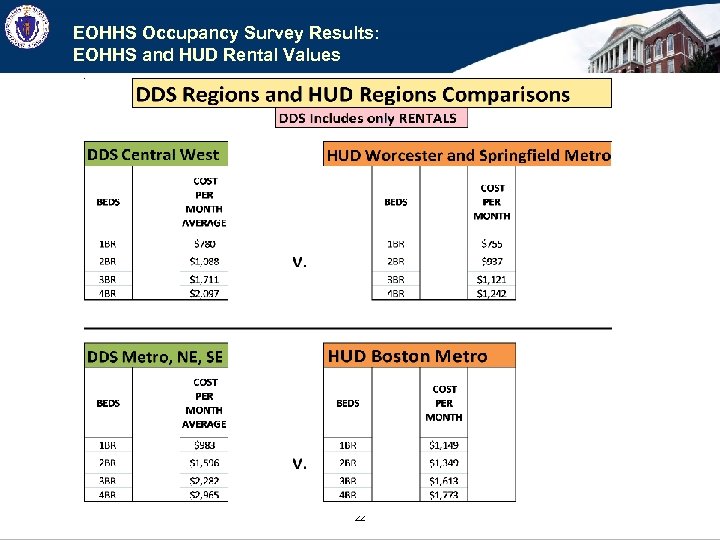
 EOHHS Occupancy Survey Results: EOHHS and HUD Rental Values - The EOHHS/HCFP/DDS/MCB/MRC team used the data to compare the monthly rental values of DDS residences with regionallyequivalent HUD rental allowances. - The analysis took an “apples to apples” approach; additional amenities provided and factored into EOHHS site cost were removed to align HUD payments to those paid by DDS regions for the closet comparison possible. - EOHHS spends more on rental costs per client than HUD does. 21
 EOHHS Occupancy Survey Results: EOHHS and HUD Rental Values 22
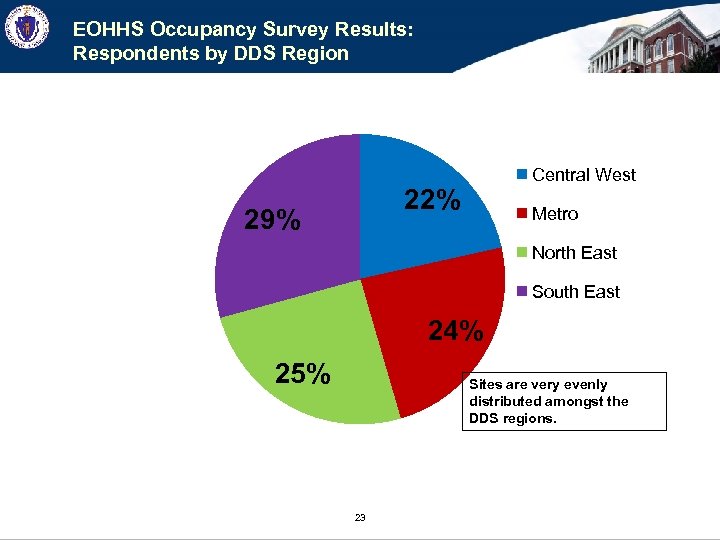 EOHHS Occupancy Survey Results: Respondents by DDS Region Central West 22% 29% Metro North East South East 24% 25% Sites are very evenly distributed amongst the DDS regions. 23
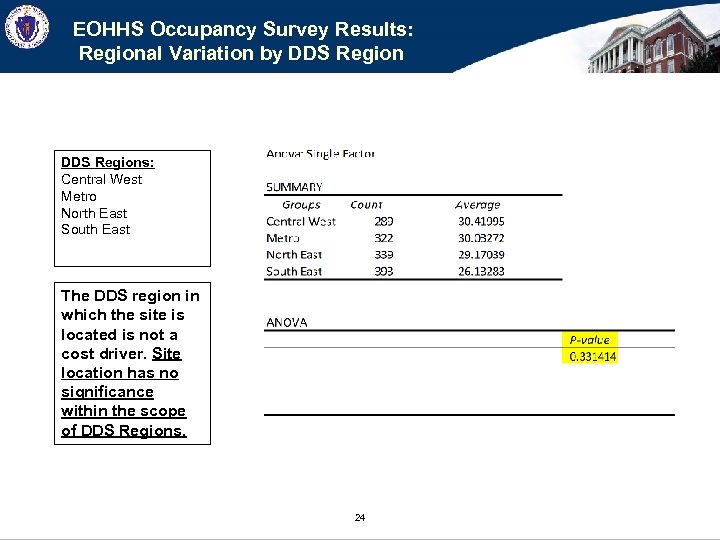 EOHHS Occupancy Survey Results: Regional Variation by DDS Regions: Central West Metro North East South East The DDS region in which the site is located is not a cost driver. Site location has no significance within the scope of DDS Regions. 24
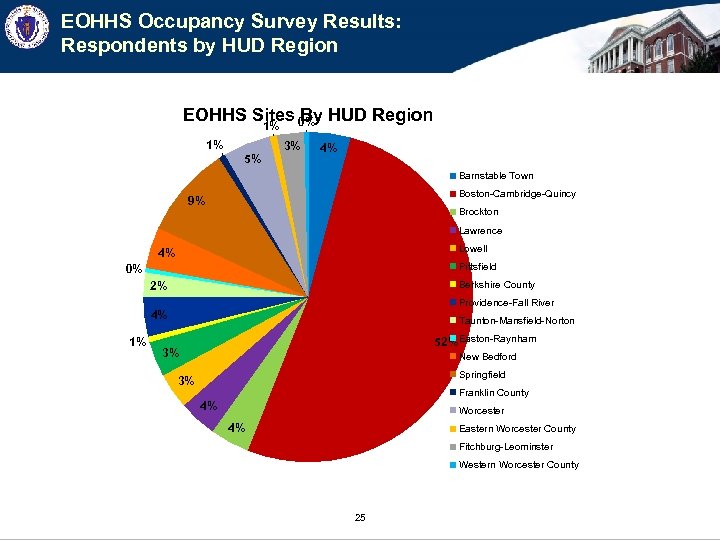 EOHHS Occupancy Survey Results: Respondents by HUD Region EOHHS Sites By HUD Region 0% 1% 1% 5% 3% 4% Barnstable Town Boston-Cambridge-Quincy 9% Brockton Lawrence Lowell 4% Pittsfield 0% Berkshire County 2% Providence-Fall River 4% 1% Taunton-Mansfield-Norton 52%Easton-Raynham 3% New Bedford Springfield 3% Franklin County 4% Worcester 4% Eastern Worcester County Fitchburg-Leominster Western Worcester County 25
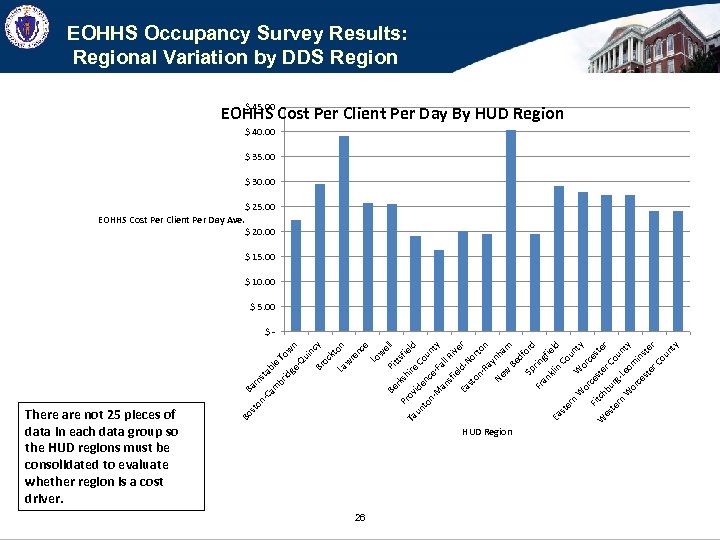 EOHHS Occupancy Survey Results: Regional Variation by DDS Region $ 45. 00 EOHHS Cost Per Client Per Day By HUD Region $ 40. 00 $ 35. 00 $ 30. 00 $ 25. 00 EOHHS Cost Per Client Per Day Ave. $ 20. 00 $ 15. 00 $ 10. 00 $ 5. 00 rn Ba Bo There are not 25 pieces of data in each data group so the HUD regions must be consolidated to evaluate whether region is a cost driver. st o n. C am st ab l br e To id ge wn -Q ui n Br cy oc kt La on w re nc e Lo w el l Be Pi tts rk f P s Ta rov hire ield id un en Cou to c n n. M e-Fa ty an l sfi l Ri v el d- er Ea No st on r -R ton ay Ne nh am w Be df Sp ord ri Fr an ngfi el kli Ea d n st Co er un n W ty W o or ce rces F te W itch ste r. C r es bu te rn rg-L oun ty e W or om in ce s st er ter Co un ty $- HUD Region 26
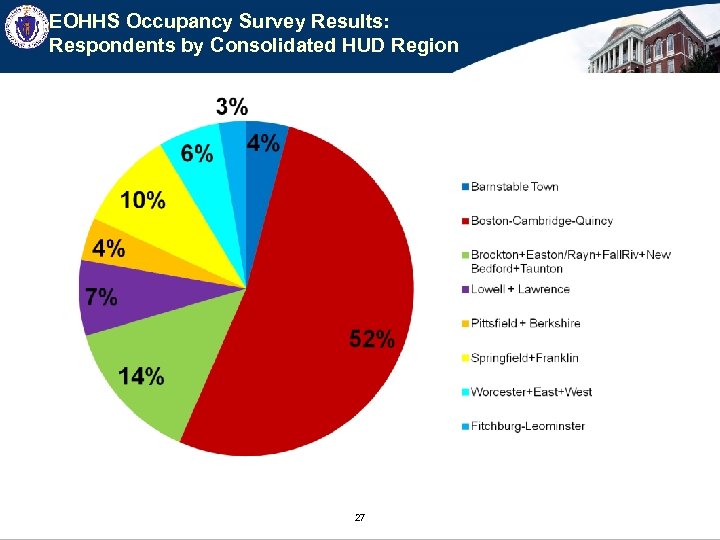 EOHHS Occupancy Survey Results: Respondents by Consolidated HUD Region 27
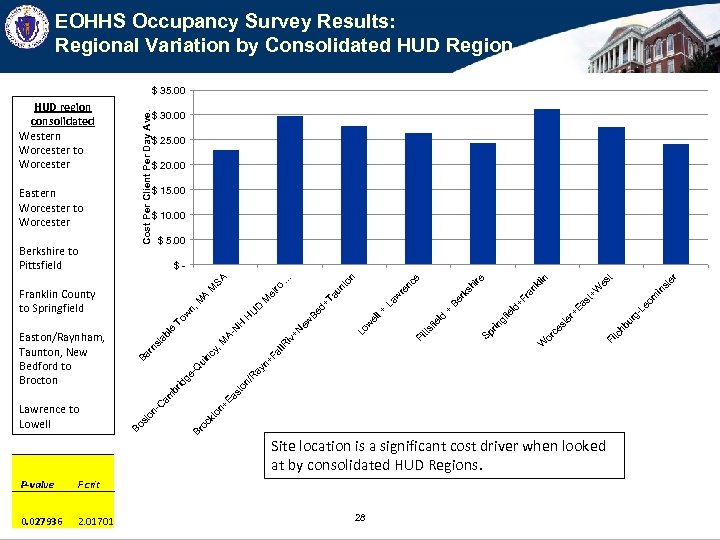 EOHHS Occupancy Survey Results: Regional Variation by Consolidated HUD Region $ 20. 00 $ 15. 00 $ 10. 00 $ 5. 00 P-value 2. 01701 om Le Fi tc hb ce st ur g- er + ie gf rin Sp on + kt oc 28 in st es +W st Ea +F ld B + ld fie tts Ea am st on br id /R ay ge -Q ui n+ Pi t lin nk ra sh er k re aw L l + iv Fa ll. R M y, nc ire nc e on +N ew w el U H H N A- Lo D Be d+ M Ta et ro un t . . . SA n, w e To ab l rn st Ba C Br Site location is a significant cost driver when looked at by consolidated HUD Regions. F crit 0. 027936 on - Lawrence to Lowell Bo st Easton/Raynham, Taunton, New Bedford to Brocton M A M Franklin County to Springfield er $ Berkshire to Pittsfield $ 25. 00 or Eastern Worcester to Worcester $ 30. 00 W HUD region consolidated Western Worcester to Worcester Cost Per Client Per Day Ave. $ 35. 00
 EOHHS Occupancy Survey Results: Year Site was Placed Into Service Cost per client per day increases slightly in more recently opened sites. 29
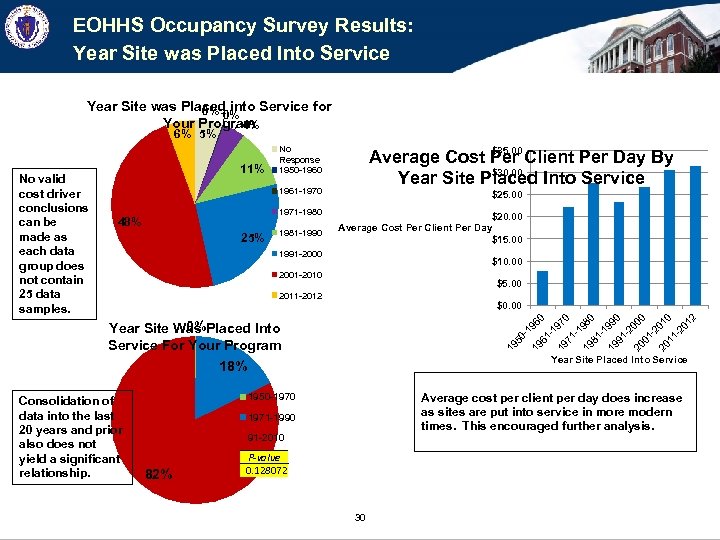 EOHHS Occupancy Survey Results: Year Site was Placed Into Service Year Site was Placed into Service for 0% 0% Your Program 4% 6% 5% 1961 -1970 $20. 00 Average Cost Per Client Per Day $15. 00 1991 -2000 $10. 00 2001 -2010 $5. 00 2011 -2012 01 0 -2 20 010 11 -2 01 2 20 0 -2 00 91 19 0 -1 99 81 0 Average cost per client per day does increase as sites are put into service in more modern times. This encouraged further analysis. 1950 -1970 1971 -1990 91 -2010 82% -1 98 Year Site Placed Into Service 18% Consolidation of data into the last 20 years and prior also does not yield a significant relationship. 19 19 50 -1 96 0% Year Site Was Placed Into Service For Your Program 71 0 $0. 00 19 25% 1981 -1990 -1 97 1971 -1980 48% $25. 00 61 11% $35. 00 Average Cost Per Client Per Day By $30. 00 Year Site Placed Into Service 19 No valid cost driver conclusions can be made as each data group does not contain 25 data samples. No Response 1950 -1960 P-value 0. 128072 30
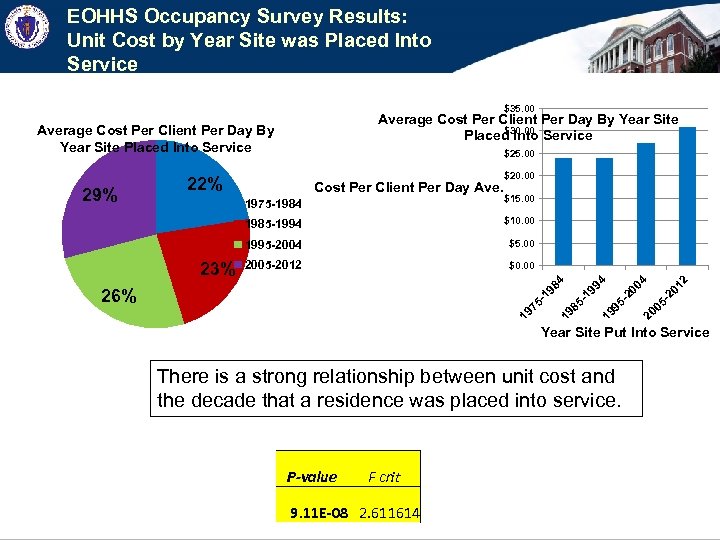 EOHHS Occupancy Survey Results: Unit Cost by Year Site was Placed Into Service $35. 00 Average Cost Per Client Per Day By Year Site $30. 00 Placed Into Service Average Cost Per Client Per Day By Year Site Placed Into Service 22% Cost Per Client Per Day Ave. $20. 00 $0. 00 4 -2 01 19 85 -1 98 19 75 26% 20 05 2005 -2012 2 $5. 00 -2 00 1995 -2004 4 $10. 00 4 1985 -1994 23% $15. 00 19 95 1975 -1984 -1 99 29% $25. 00 Year Site Put Into Service There is a strong relationship between unit cost and the decade that a residence was placed into service. P-value F crit 9. 11 E-08 31 2. 611614
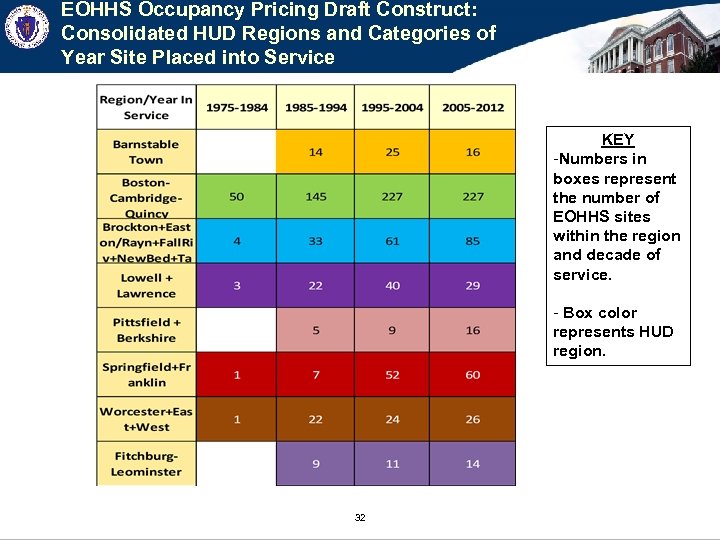 EOHHS Occupancy Pricing Draft Construct: Consolidated HUD Regions and Categories of Year Site Placed into Service KEY -Numbers in boxes represent the number of EOHHS sites within the region and decade of service. - Box color represents HUD region. 32
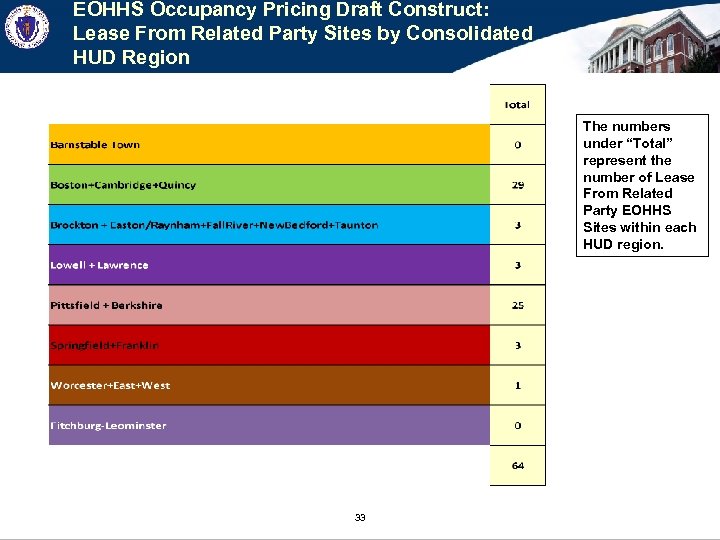 EOHHS Occupancy Pricing Draft Construct: Lease From Related Party Sites by Consolidated HUD Region The numbers under “Total” represent the number of Lease From Related Party EOHHS Sites within each HUD region. 33
 Agenda • Chapter 257 of the Acts of 2008 • Overview of Adult Long Term Care Services • Definition and Overview of Programs • Residential Rate Precepts • Review of Preliminary Occupancy Survey Results • Updated Draft model Budget Framework • Breakout Discussions • Timeline and Key Milestones 34
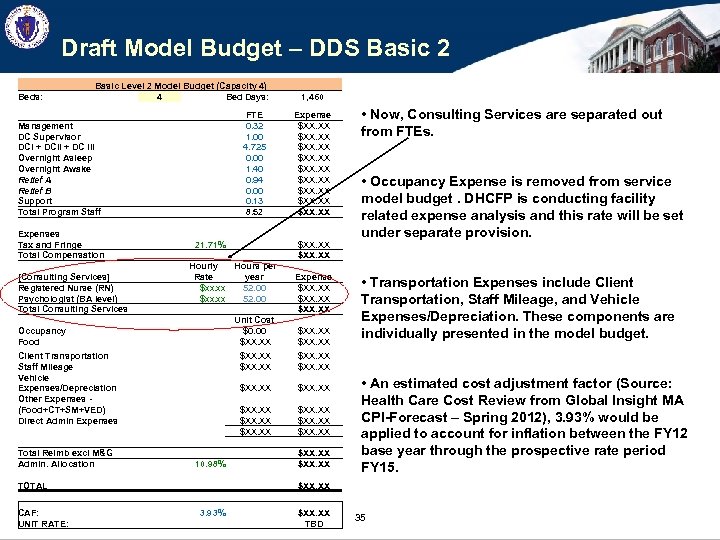 Draft Model Budget – DDS Basic 2 Beds: Basic Level 2 Model Budget (Capacity 4) 4 Bed Days: Management DC Supervisor DCI + DCII + DC III Overnight Asleep Overnight Awake Relief A Relief B Support Total Program Staff Expenses Tax and Fringe Total Compensation [Consulting Services] Registered Nurse (RN) Psychologist (BA level) Total Consulting Services FTE 0. 32 1. 00 4. 725 0. 00 1. 40 0. 94 0. 00 0. 13 8. 52 Occupancy Food 21. 71% Hourly Hours per Rate year $xx. xx 52. 00 Unit Cost $0. 00 $XX. XX Client Transportation Staff Mileage Vehicle Expenses/Depreciation Other Expenses - (Food+CT+SM+VED) Direct Admin Expenses 1, 460 Expense $XX. XX $XX. XX Expense $XX. XX $XX. XX • Occupancy Expense is removed from service model budget. DHCFP is conducting facility related expense analysis and this rate will be set under separate provision. • Transportation Expenses include Client Transportation, Staff Mileage, and Vehicle Expenses/Depreciation. These components are individually presented in the model budget. $XX. XX • Now, Consulting Services are separated out from FTEs. Total Reimb excl M&G Admin. Allocation 10. 98% $XX. XX TOTAL $XX. XX CAF: UNIT RATE: 3. 93% $XX. XX TBD • An estimated cost adjustment factor (Source: Health Care Cost Review from Global Insight MA CPI-Forecast – Spring 2012), 3. 93% would be applied to account for inflation between the FY 12 base year through the prospective rate period FY 15. 35
 Agenda • Chapter 257 of the Acts of 2008 • Overview of Adult Long Term Care Services • Definition and Overview of Programs • Residential Rate Precepts • Review of Preliminary Occupancy Survey Results • Updated Draft model Budget Framework • Breakout Discussions • Timeline and Key Milestones 36
 Staffing, Models and Occupancy: Provider Break -Out Groups • DDS, MCB and MRC will now lead break out group discussions to gather your feedback on the proposed programs, models and occupancy approach. Among other items, these groups will touch upon: • What aspects of these proposed programs and structures appear most adaptable for general use? • What is your general reaction to the occupancy construct? • Are the resources assigned to each model in line with the needs of the clients that would be in those model’s homes? 37
 Agenda • Chapter 257 of the Acts of 2008 • Overview of Adult Long Term Care Services • Definition and Overview of Programs • Residential Rate Precepts • Review of Preliminary Occupancy Survey Results • Updated Draft model Budget Framework • Breakout Discussions • Timeline and Key Milestones 38
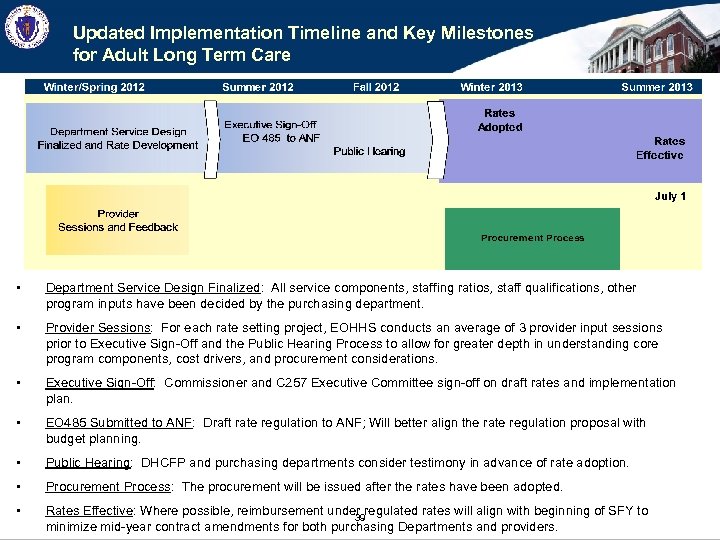 Updated Implementation Timeline and Key Milestones for Adult Long Term Care July 1 • Department Service Design Finalized: All service components, staffing ratios, staff qualifications, other program inputs have been decided by the purchasing department. • Provider Sessions: For each rate setting project, EOHHS conducts an average of 3 provider input sessions prior to Executive Sign-Off and the Public Hearing Process to allow for greater depth in understanding core program components, cost drivers, and procurement considerations. • Executive Sign-Off: Commissioner and C 257 Executive Committee sign-off on draft rates and implementation plan. • EO 485 Submitted to ANF: Draft rate regulation to ANF; Will better align the rate regulation proposal with budget planning. • Public Hearing: DHCFP and purchasing departments consider testimony in advance of rate adoption. • Procurement Process: The procurement will be issued after the rates have been adopted. • Rates Effective: Where possible, reimbursement under regulated rates will align with beginning of SFY to 39 minimize mid-year contract amendments for both purchasing Departments and providers.
 Questions/Feedback Please Email Questions & Comments to: eohhspospolicyoffice@state. ma. us Please Visit the Chapter 257 Website: www. mass. gov/hhs/chapter 257 40