


 Скачать презентацию Common law precedent Introduction introduction
87b2901bfc1579cb598c314b0cd10918.ppt
- Количество слайдов: 85
 Common law & precedent
 Introduction
 introduction: common law • A term: – describing law which is common throughout the land – describing judge-made law, or precedent (cf. statute law) • Allen C (1964) Law in the Making. Oxford University Press – distinguishing law applied in the common law courts from that applied in the Chancery Court (equity) – distinguishing systems without a codified base
 introduction: common law • Precedent – law found in courts’ decisions – modern law is based heavily on legislation, but legislation once played a secondary role to ‘judgemade law’ – when writing essays and answering problem questions: • a key skill you must develop is the ability to identify precedents which support your argument
 introduction: common law • Some branches of our law are almost entirely the product of the decisions of judges – their reasoned judgments have been reported in various law reports for nearly 700 years • Other branches of law are based on statutes – but, case law has played an important part in the interpretation of those statutes (e. g. environmental law) (Cross R, and Harris J (1991) Precedent in English Law. Clarendon Press, Oxford. )
 introduction: common law • Llewellyn K (1996) The Bramble bush. Oceana Publications, New York. – Differences between statutes and the law of case decisions: – Case decisions • (Radical shifts are unusual) • A judge makes his rule in and around a specific case (and looking backward) • His rule is commonly good sense, and very narrow • Any innovation is confined regularly within rather narrow limits (partly by the practice of trying hard to square the new decision with old law • Case law rules are applied as if they had always been the law • Case law is flexible round the edges – the rules are commonly somewhat uncertain in their wording, and not too easy to make definite
 introduction: common law • Llewellyn K (1996) The Bramble bush. Oceana Publications, New York. – Differences between statutes and the law of case decisions: – Statute law • Statutes are made relatively in the large, to cover wider sweeps, and looking forward • They apply only to event and transactions occurring after they come into force • They are recognised machinery for readjustment of the law • They represent not single disputes, but whole classes of disputes • They are political, not judicial in their nature
 introduction: common law • In law, precedent – has a meaning similar to its everyday use – relates to how later cases are affected by previous cases – is based on a general principle – a rule of law – that like should be treated alike (uniformity / certainty) – may be binding or persuasive (depends on the court hierarchy and the circumstances of the case) – can be avoided in a case that demonstrates sufficient differences
 precedent: wide view • A wide formulation – the idea that it is desirable that similar cases should be decided in a similar way – the principle that consistency is an important aspect of justice – improved efficiency – once a point of law has been decided it can be subsequently applied (no need for re-argument) – judicial comity –mutual respect that judges have for their colleagues
 precedent: wide view ex Lord Chancellor, Lord Mac. Kay: ‘Who Makes the Law’ (1987) The Times, 3 December “A scheme of precedent is clearly capable of providing important benefits. It assists litigants to assess the nature and scope of legal obligations and, to the extent that it enables them to predict the likely outcome of disputes, it restricts the scope of litigation. By allowing the vast bulk of disputes to be settled in the shadow of the law, a system of precedent prevents the legal apparatus from becoming clogged by a myriad of single instances. It reflects a basic principle of the administrations of justice that like cases should be treated alike and therefore generates a range of expectations from different participants in the legal process. Rules of law based on a system of precedent are therefore likely to exhibit characteristics of certainty, consistency and uniformity”
 precedent: narrow view • A narrow formulation – courts may regard themselves as being bound by earlier decisions – peculiar to English Law (and some common law jurisdictions) – encapsulated by the doctrine of stare rationibus decidendis – or, stare decisis – all courts bind other lower courts, and some courts may bind themselves – vertical and horizontal dimensions of precedent
 precedent: a cautionary note • The decision of a case can mean different things – ‘Bill’ won and ‘Ben’ lost – subject to an appeal, Bill and Ben are bound by the decision – res judicata: a matter adjudicated upon – In the context of legal analysis, a decision is something wider – the reasoning process that went into the decision – why did Bill win?
 The development of case law principles
 development of case law Mac. Cormick N (1987) ‘Why Cases have Rationes and What These Are’, in Goldstein L (ed) Precedent in Law. Clarendon Press, Oxford. “To understand case law…. is to understand how it is that particular decisions by particular judges concerning particular parties to particular cases can be used in the construction of general rules applying to the actions and transactions of persons at large”
 development of case law • Principles of law derive from observing a line of cases on a specific topic • Principles do not develop unless claimants bring cases • A judge in each case draws on the principles established in earlier cases • This can make the development of the law piecemeal (case by case) • Lord Wright (in 1938) described how judges: “proceed from case to case, like the ancient Mediterranean mariners, hugging the coast from point to point, and avoiding the dangers of the open sea”
 development of case law • Holland J, and Webb J (2006) Learning Legal Rules, Oxford University Press. • Imagine: – a case in 1920 decided that any person selling parrots was under an implied contractual duty to ensure the parrot could talk – lawyers immediately think of wider ramifications: • does this principle apply if the seller informed the customer that the parrot couldn’t talk? • does this principle apply to related birds (budgerigars)? • wide still, is there a general principle to be found which might mean that a similar duty – standards of health – might apply to other animals?
 development of case law – This simple case may eventually be seen as producing a more general principle on the duties of sellers towards buyers: a duty to deal in good faith! – Eventually, a textbook writer may sum up the case law in one general statement on the duties owned by vendors of goods – On reflection, we might find that one case concerning a mute parrot is now applied to all cases on defective merchandise – This process of moving from specific disputes to the development of general rules (i. e. precedents) which are then applicable to a wider range of cases, is central to common law reasoning • Dead snails and exploding underpants – Donoghue v Stevenson [1932] AC 562 – Grant v Australian Knitting Mills [1936] AC
 The elements of precedent ratio & obiter
 precedent: the elements • Ratio decidendi: the reason(s) for the decision – vital element of the decision – discovering the ratio decidendi can be anything but easy! • Obiter dictum: things said ‘by the way’ – not a vital part of the decision – does not bind future courts – persuasive properties: significance of these statements often depends on who made them and where
 precedent: the elements • The distinction between ratio decidendi and obiter dictum is an old one • As long ago as 1673 Vaughan CJ said: “An opinion given in court, if not necessary to the judgment given of record, but that it might have been as well given if no such, or a contrary had been broach’d, is no judicial opinion; but a mere gratis dictum”
 Ratio decidendi
 ratio • Cross R (1977) Precedent in English Law. Clarendon Press, Oxford. “Any rule of law expressly or impliedly treated by the judge as a necessary step in reaching his decision, having regard to the line of reasoning adopted by him” The art of interpretation • Salmond J (1924) Jurisprudence. Seventh Edition. “A precedent, therefore, is any judicial decision which contains in itself a principle. The underlying principle which thus forms its authoritative element is often termed the ration decidendi. The concrete decision is binding between the parties to it, but it is the abstract ratio decidendi which alone has the force of law as regards the world at large”
 ratio • Gray J (1921) The Nature and Sources of the Law. Second Edition “It must be observed that at the Common Law not every opinion expressed by a judge forms a Judicial Precedent. In order that an opinion may have the weight of a precedent, two things must concur: it must be, in the first place, an opinion given by a judge, and, in the second place, it must be an opinion the formation of which is necessary for the decision of a particular case; in other words, it must not be obiter dictum. ” • Goodhart A (1930) ‘Determining the Ratio Decidendi of a Case’. Yale Law Journal 40, 161 -183. – With the possible exception of the legal term “malice”, it is the most misleading expression in English law
 ratio • It is, in part, the notion of ratio which gives the current English system of precedent it relatively strict character – Being required to look at previous cases for ideas on how to deal with a new case is in itself something that reduces the range of options which is open to a judge – But, as cases grow so the range of cases grow – If a judge can choose amongst different (previous) decisions, and amongst different parts of different decisions, then a skilful or knowledgeable judge (or lawyer) will find it easier to find previous judgments which justify any decision they wish to arrive at • But, the use of ratio calls for a much more precise use of previous cases • Its not about finding arguments that we find useful, but about looking at past cases for lines of reasoning that are binding
 ratio • If the facts of cases were identical, our task would be easy: but they’re not – facts change from case to case • We must show that two - or more - cases are sufficiently similar to illustrate the same principle so that the doctrine of precedent can be applied • Comparing facts is important, but we must also try to see if the reasoning in the earlier case can be applied to the new set of facts in our case – lawyers cite cases to give authority to their argument – “is there a case that provides authority for the point I want to make? ”
 ratio • Holland Webb’s Zebras on the North Circular – case 1: a man driving a Ford Mondeo runs over an old lady using a zebra crossing: the man is held liable in negligence – case 2: a woman driving a BMW runs over an old man who was crossing the road • Should the woman in case 2 be found liable?
 ratio • Don’t jump to conclusions…. . – it’s not enough to say “it’s obvious”: it might not be! • you may see a knight move and conclude that all chess pieces move in an ‘L’ shape! – it’s not enough to say that case 2 is the same as case 1 (with no explanation) – you must ask: “why was the man liable in case 1? ” • there may be a law against driving Ford Mondeos (I would argue there should be!) • there may be a law against running people over on zebra crossings (but not on any other part of the road) • what was the whether like? how fast was the man driving in case 1?
 Finding the ratio
 finding the ratio • Referring to the work of Sir John Salmond and Professor John Chipman Gray, Arthur Goodhart says: “Both the learned authors, on reaching this point of safety, stop. Having explained to the student that it is necessary to find the ratio decidendi of the case they make no further attempt to state any rules by which it can be determined. ” Goodhart A (1930) ‘Determining the Ratio Decidendi of a Case’. Yale Law Journal 40, 161 -183.
 finding the ratio • It can be difficult – judgements can be long • A judge in a later case may perceive the principle (ratio) that is to be derived from the earlier case as something different from that which the original judge intended – why do you shop at the local mall rather than use the town centre? • You won’t find the sentence: “here’s my ratio…. ” • It’s a matter of skill and interpretation built on experience
 finding the ratio • Goodhart A (1931) Essays in Jurisprudence and the Common Law. Cambridge University Press – [t]o determine the principle of a case the first and must essential step is…. what were the material facts on which the judge based his conclusion” – Common law legal reasoning is always reasoning about something: it is never reasoning about an abstract concept – Rations are statements of reasons about the law in relation to a particular set of facts – Goodhart’s phrase ‘material facts’ is an important part of his theory of how to identify his ratio – Facts are material when they are vital to the legal decision – Once the material immaterial facts are established, the ratio of the case is the conclusion based on the material facts
 finding the ratio • Goodhart A (1931) Essays in Jurisprudence and the Common Law. Cambridge University Press “[T]he final step is to determine whether or not it is a binding precedent for some succeeding case in which the facts are prima facie similar. This involves a double analysis. We must first state the material facts in the precedent case and then attempt to find the materials ones in the second one. If these are identical, then the first case is a binding precedent for the second, and the court must reach the same conclusion as it did in the first one”
 finding the ratio • Some of Goodhart’s suggestions are problematic • Stone J (1959) ‘The Ratio of the Ratio Decidendi’. Modern Law Review 22(6), 597. – “there will often be the gravest doubt as to what facts the precedent court ‘explicitly or implicitly’ ‘determined’ to be material” – If we cannot know, with certainty, what a material fact is how, when this lies at the centre of Goodhart’s thesis, are we to use the method? • See also: • Montrose J (1957) ‘Ratio Decedendi and the House of Lords’. Modern law Review 20, 124 • Simpson A (1957) ‘The Ratio Decedendi of a Case’. Modern Law Review 20, 413 • Andrews N (1985) ‘Reporting case law: unreported cases, the definition of a ratio and the criteria for reporting decision’. Legal Studies 5, 205.
 finding the ratio • Cross R (1977) Precedent in English Law. Clarendon Press, Oxford. “It is impossible to devise formulae for determining the ratio decidendi of a case” • Twining W, and Miers D (1999) How to do things with rules. Weidenfeld Nicolson, London. – “Talk of finding the ratio decidendi of a case obscures the fact that the process of interpreting cases is not like a hunt for buried treasure, but typically involves an element of choice from a range of possibilities”
 finding the ratio • You have to ask “why did the outcome happened? ” • It involves some sort of explanation of the case • You’re looking for the legal reasoning, coupled with your view of the facts that are material • The ratio should be expressed as a principle possessing generality: capable of being applied later • Remember, legal reasoning which does not decide the case cannot be ratio (it will be obiter) • You may have multiple or inconclusive rationes • Chaplin v Boys [1971] AC 256: where the HL agreed on the result, but were faced with three possible grounds for reaching their decision • Read the case Headnote – but don’t rely on it, as it can be misleading!
 Obiter dictum
 obiter • Cross R (1977) Precedent in English Law. Clarendon Press, Oxford. It “is a truism…. that dicta are of varying degrees of persuasiveness …Dicta of the highest degree of persuasiveness may often, for all practical purposes, be indistinguishable from pronouncements which must be treated as ratio. ” • Mac. Cormick, Legal Reasoning and Legal Theory: “statements of opinion upon the law and its values and principles in their bearing on the instant decision, statements which in some way go beyond the point or points necessary to be settled in deciding the case. ”
 obiter • The main difference between obiter and ratio – Courts must follow a ratio (whether they like it or not) – Obiter statements are reflection on the law – (Like the work of academic lawyers), they may convince others by their logic or their rhetoric – They are capable of being persuasive in the sense that anyone’s argument is capable of being persuasive
![obiter • W B Anderson & Sons v Rhodes ([1967] 2 All ER 850),](https://present5.com/presentation/87b2901bfc1579cb598c314b0cd10918/image-39.jpg "obiter • W B Anderson & Sons v Rhodes ([1967] 2 All ER 850),") obiter • W B Anderson & Sons v Rhodes ([1967] 2 All ER 850), Cairns J: “[w]hen all five members of the House of Lords have all said, after close examination of the authorities, that a certain type of tort exists, I think that judge of first instance should proceed on the basis that it does exist’
obiter • W B Anderson & Sons v Rhodes ([1967] 2 All ER 850), Cairns J: “[w]hen all five members of the House of Lords have all said, after close examination of the authorities, that a certain type of tort exists, I think that judge of first instance should proceed on the basis that it does exist’
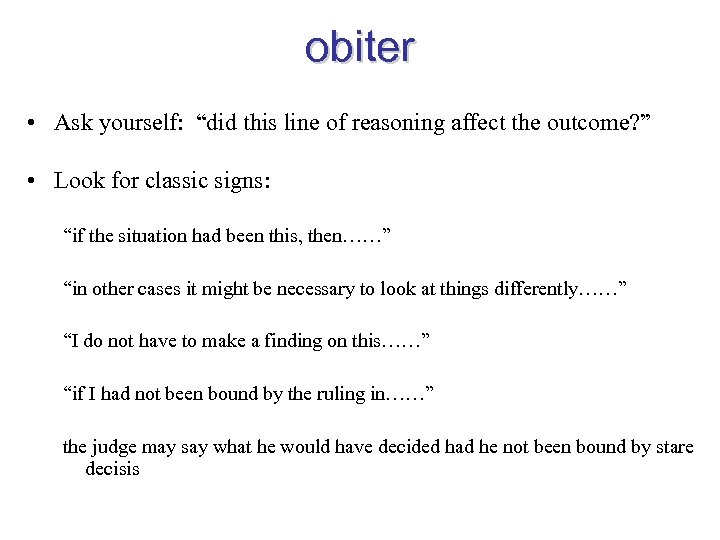 obiter • Ask yourself: “did this line of reasoning affect the outcome? ” • Look for classic signs: “if the situation had been this, then……” “in other cases it might be necessary to look at things differently……” “I do not have to make a finding on this……” “if I had not been bound by the ruling in……” the judge may say what he would have decided had he not been bound by stare decisis
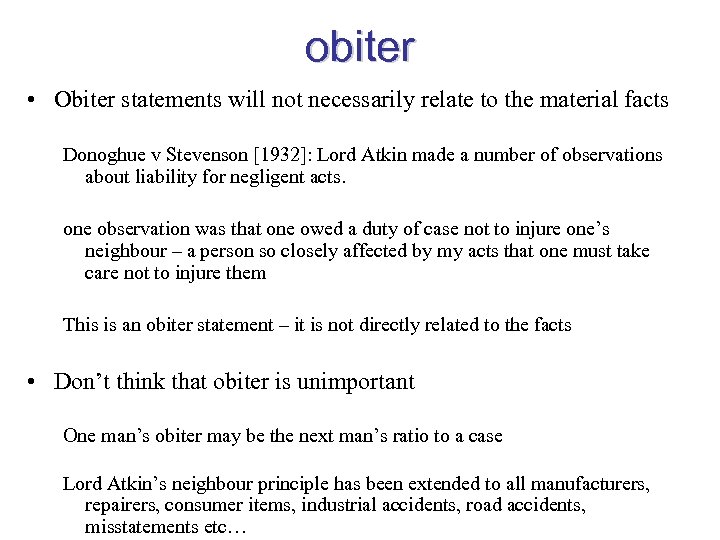 obiter • Obiter statements will not necessarily relate to the material facts Donoghue v Stevenson [1932]: Lord Atkin made a number of observations about liability for negligent acts. one observation was that one owed a duty of case not to injure one’s neighbour – a person so closely affected by my acts that one must take care not to injure them This is an obiter statement – it is not directly related to the facts • Don’t think that obiter is unimportant One man’s obiter may be the next man’s ratio to a case Lord Atkin’s neighbour principle has been extended to all manufacturers, repairers, consumer items, industrial accidents, road accidents, misstatements etc…
![obiter • R. v Gotts (Benjamin) [1992] 2 A. C. 412 • Duress is](https://present5.com/presentation/87b2901bfc1579cb598c314b0cd10918/image-42.jpg "obiter • R. v Gotts (Benjamin) [1992] 2 A. C. 412 • Duress is") obiter • R. v Gotts (Benjamin) [1992] 2 A. C. 412 • Duress is not available as a defence to a charge of attempted murder. • ‘A’ pleaded not guilty to a charge of attempted murder and sought to raise a defence of duress. • The trial judge ruled that this defence was not available on such a charge. • Conviction was upheld by the Court of Appeal • HL: on a matter of policy the defence of duress is not available to a charge of attempted murder • Dicta of Lord Griffiths in R. v. Howe [1987] C. L. Y. 800 applied
obiter • R. v Gotts (Benjamin) [1992] 2 A. C. 412 • Duress is not available as a defence to a charge of attempted murder. • ‘A’ pleaded not guilty to a charge of attempted murder and sought to raise a defence of duress. • The trial judge ruled that this defence was not available on such a charge. • Conviction was upheld by the Court of Appeal • HL: on a matter of policy the defence of duress is not available to a charge of attempted murder • Dicta of Lord Griffiths in R. v. Howe [1987] C. L. Y. 800 applied
 Law reporting
 law reporting • Approximately, 200, 000 cases are dealt with each year, but only about 25, 000 are reported • Law reporting dates back to medieval times with the publication of the Year Books in Anglo-Norman • A landmark in the history of law reporting occurred in 1865 when the Inns of Court set up the Council of Law Reporting • Popular reports are the Weekly Law Reports, the All England Law Reports and the Times Law Reports
 The courts
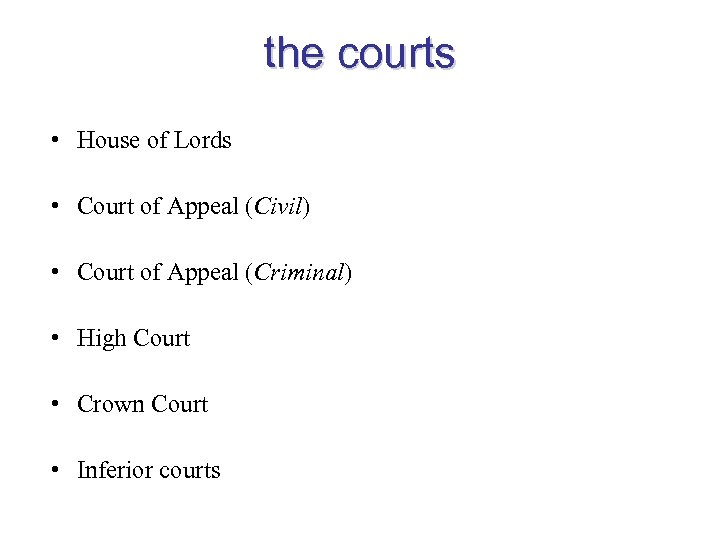 the courts • House of Lords • Court of Appeal (Civil) • Court of Appeal (Criminal) • High Court • Crown Court • Inferior courts
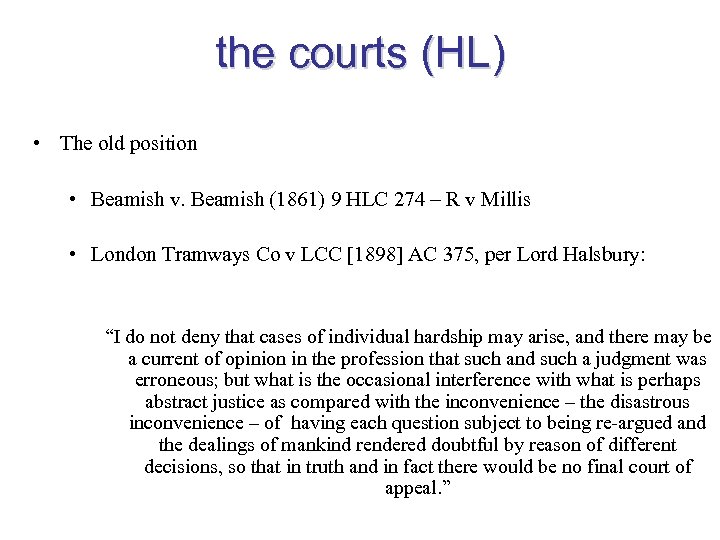 the courts (HL) • The old position • Beamish v. Beamish (1861) 9 HLC 274 – R v Millis • London Tramways Co v LCC [1898] AC 375, per Lord Halsbury: “I do not deny that cases of individual hardship may arise, and there may be a current of opinion in the profession that such and such a judgment was erroneous; but what is the occasional interference with what is perhaps abstract justice as compared with the inconvenience – the disastrous inconvenience – of having each question subject to being re-argued and the dealings of mankind rendered doubtful by reason of different decisions, so that in truth and in fact there would be no final court of appeal. ”
![the courts (HL) • The Practice Statement [1966] 1 WLR 1234 “… Too rigid](https://present5.com/presentation/87b2901bfc1579cb598c314b0cd10918/image-48.jpg "the courts (HL) • The Practice Statement [1966] 1 WLR 1234 “… Too rigid") the courts (HL) • The Practice Statement [1966] 1 WLR 1234 “… Too rigid adherence to precedent may lead to injustice in a particular case and also unduly restrict the proper development of the law. They propose therefore to modify their present practice and, while treating former decisions of this House as normally binding, to depart from a previous decision when it appears right to do so…” “…This announcement is not intended to affect the use of precedent elsewhere than in this House. ”
the courts (HL) • The Practice Statement [1966] 1 WLR 1234 “… Too rigid adherence to precedent may lead to injustice in a particular case and also unduly restrict the proper development of the law. They propose therefore to modify their present practice and, while treating former decisions of this House as normally binding, to depart from a previous decision when it appears right to do so…” “…This announcement is not intended to affect the use of precedent elsewhere than in this House. ”
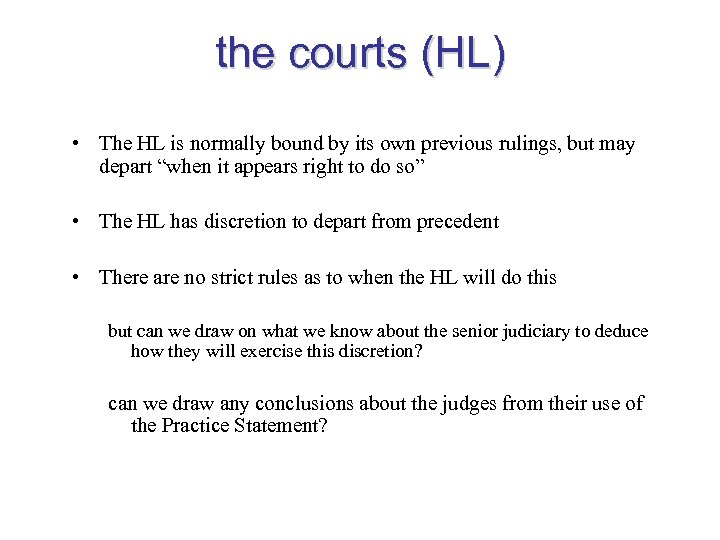 the courts (HL) • The HL is normally bound by its own previous rulings, but may depart “when it appears right to do so” • The HL has discretion to depart from precedent • There are no strict rules as to when the HL will do this but can we draw on what we know about the senior judiciary to deduce how they will exercise this discretion? can we draw any conclusions about the judges from their use of the Practice Statement?
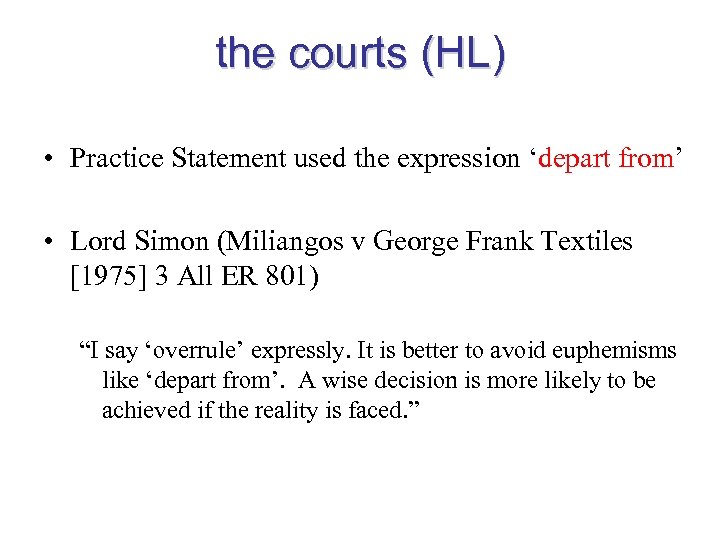 the courts (HL) • Practice Statement used the expression ‘depart from’ • Lord Simon (Miliangos v George Frank Textiles [1975] 3 All ER 801) “I say ‘overrule’ expressly. It is better to avoid euphemisms like ‘depart from’. A wise decision is more likely to be achieved if the reality is faced. ”
 the courts (HL) • The practice statement: civil cases confidence and accountability Conway v Rimmer [1967] 2 All ER 1260: where the Lords departed from Duncan v Cammel Laird [1942] 1 All ER 587 liability to a child trespasser British Railways Board v Herrington [1972] 1 All ER 749: where the Lords departed from Addie v Dumbreck [1929] AC 358
![the courts (HL) • British Railways Board v Herrington [1972] 1 All ER 749](https://present5.com/presentation/87b2901bfc1579cb598c314b0cd10918/image-52.jpg "the courts (HL) • British Railways Board v Herrington [1972] 1 All ER 749") the courts (HL) • British Railways Board v Herrington [1972] 1 All ER 749 – While an occupier does not owe the same duty of care to a trespasser which he owes to a visitor, he owes a trespasser a duty to take such steps as common sense or common humanity would dictate, to exclude or warn or otherwise, within reasonable and practicable limits, reduce or avert a danger. – An electrified railway line owned by the BRB ran through National Trust property (open to the public). – Fences in poor condition (children had been seen on the line) – P, aged 6, was injured when he stepped onto the line having got through the broken part of the fence (claimed damages for negligence) – HL: the rule in Addie v Dumbreck had been rendered obsolete by changes in physical and social conditions, and no longer provided an exclusive or comprehensive statement of the occupier's duty towards a trespasser (defendants were in breach of their duty)
the courts (HL) • British Railways Board v Herrington [1972] 1 All ER 749 – While an occupier does not owe the same duty of care to a trespasser which he owes to a visitor, he owes a trespasser a duty to take such steps as common sense or common humanity would dictate, to exclude or warn or otherwise, within reasonable and practicable limits, reduce or avert a danger. – An electrified railway line owned by the BRB ran through National Trust property (open to the public). – Fences in poor condition (children had been seen on the line) – P, aged 6, was injured when he stepped onto the line having got through the broken part of the fence (claimed damages for negligence) – HL: the rule in Addie v Dumbreck had been rendered obsolete by changes in physical and social conditions, and no longer provided an exclusive or comprehensive statement of the occupier's duty towards a trespasser (defendants were in breach of their duty)
 the courts (HL) • Lord Reid: – “…it appears to me that no satisfactory solution can be found without a reexamination of the whole problem and a reconsideration by this House of its decision in Addie’s case……we are confronted with the choice of following Addie and putting the clock back or drastically modifying the Addie rules. It has been suggested that such a modification can be achieved…without actually overruling any part of the decision. I do not think that is possible…” • Lord Diplock: – “…It takes account, as this House as the final expositor of the Common Law should always do, of changes in social attitudes, circumstances and general public sentiment”
 the courts (HL) • Judgement awards in sterling – Miliangos v George Frank Textiles [1976]: dealing with Havana Railways [1960] 2 All ER 332 – The HL decided that an English court could give judgement expressed in a foreign currency, notwithstanding the decision to the contrary in the earlier case – Lord Wilberforce: “…once a clear conclusion is reached as to what the law now ought to be, declaration of it by this House is appropriate. The law on this topic is judge-made; it has been built up over the years from case to case. It is entirely within this House’s duty … to give the law a new direction in a particular case where, on principle and in reason, it appears right to do so. I cannot accept the suggestion that because a rule is long-established only legislation can change it… – Lord Cross: “I ask myself whethere has been any change of circumstances since 1961 sufficiently great to justify us in saying that the rule which in the Havana case was accepted by all sides without question and which formed an essential foundation for the judgments delivered ought now to be considered to be no longer an existing rule of our law…”
 the courts (HL) • The practice statement: criminal cases • “especial need for certainty” • it is unfair to create criminal liability on a retrospective basis • Shaw v DPP [1961] 2 All ER 446 • the ‘Ladies Directory’ • ‘conspiracy to corrupt public morals’ • many people thought that, given the opportunity, the HL would depart from this decision • R v Knuller [1972] 3 WLR 143 • the ‘International Times’ • a seven member HL decided to follow Shaw
 the courts (HL) • 4 judges stated that departing in a criminal case could only happen with ‘very good reason’ • 3 judges said that need for certainty overrode the issue of how mistaken the previous decision was – could be used if real uncertainty as to whether offence exists at all • Lord Reid (who had dissented in Shaw): • “…our change of practice in no longer regarding previous decisions of this House as absolutely binding does not mean that whenever we think a previous decision was wrong we should reverse it. In the general interest of certainty in the law we must be sure that there is some very good reason before we so act. ”
 the courts (HL) • The Criminal Attempts Act 1981 • “A person may be guilty of attempting to commit an offence even though the facts are such that the commission of the offence is impossible. ” • Anderton v Ryan [1985] 2 All ER 355 • widely believed that this decision resulted from the House’s failure to properly understand s 1 of the Criminal Attempts At 1981 • R v Shivpuri – possession of ‘powder’ • Lord Bridge “if a serious error embodied in a decision of this House has distorted the law, the sooner it is corrected the better” • no one could have relied on the decision • otherwise 1981 Act rendered meaningless
 the courts (HL) • When to use the Practice Direction? • Food Corporation of India v Antclizo Shipping [1988] 2 All ER 513: • if the reasoning and decision are both wrong • if it would directly affect the case in hand • Lord Reid in Jones v S of S for SS [1972] 1 All ER 145: considered Re Dowling [1967] 1 AC 725 • “…the typical case for reconsidering an old decision is where some broad issue is involved, and it should only be in rare cases that we should reconsider questions of statutes. . . ”
![the courts (HL) • Khawaja v Secretary of State for the Home Dept [1983]](https://present5.com/presentation/87b2901bfc1579cb598c314b0cd10918/image-59.jpg "the courts (HL) • Khawaja v Secretary of State for the Home Dept [1983]") the courts (HL) • Khawaja v Secretary of State for the Home Dept [1983] 1 All ER 765 • Lord Scarman • “the House must be satisfied not only that adherence to the precedent would involve the risk of injustice and obstruct the proper development of the law, but also that a judicial departure by the House from the precedent is the safe and appropriate way of remedying the injustice and developing the law. The possibility that legislation may be the better course is one which, though not mentioned in the statement, is one which the House will not overlook… Provided, however, due attention is paid to the dangers of uncertainty on certain branches of the law (especially the criminal law) the House, as it has already in a number of cases made clear, will if it thinks it right, depart from a previous decision whether the decision is ancient or modern and whether the point of law arises on the construction of a statute or in the judge-made common law or equity. ”
the courts (HL) • Khawaja v Secretary of State for the Home Dept [1983] 1 All ER 765 • Lord Scarman • “the House must be satisfied not only that adherence to the precedent would involve the risk of injustice and obstruct the proper development of the law, but also that a judicial departure by the House from the precedent is the safe and appropriate way of remedying the injustice and developing the law. The possibility that legislation may be the better course is one which, though not mentioned in the statement, is one which the House will not overlook… Provided, however, due attention is paid to the dangers of uncertainty on certain branches of the law (especially the criminal law) the House, as it has already in a number of cases made clear, will if it thinks it right, depart from a previous decision whether the decision is ancient or modern and whether the point of law arises on the construction of a statute or in the judge-made common law or equity. ”
 the courts (CA) • Court of Appeal (Civil/criminal) • to what extent is the CA bound to follow the decisions of the HL? • the per incuriam campaign • the ‘lapsed rule’ campaign • cessante ratione legis, cessat ipsa lex – with the reason for the rule ceasing, the law itself no longer exists • to what extent is the CA bound by its own previous decision? • • • Young v Bristol Aeroplane Co. Ltd [1944] KB 718 (Lord Green) Laid down the general rule that the CA is generally bound by its own decisions choosing between its own conflicting decisions its own rule has overruled expressly or impliedly by the HL decisions made per incuriam • Criminal cases (more relaxed!)
 the courts • High Court • Crown Court • Inferior courts (county/magistrates) • The European Court of Justice
 avoiding precedents
 affirmed & reversed • Both refer to the judgment of the appeal court in respect of the judgment of a lower court and in respect of the same case • Affirmed: the appeal court agrees and confirms the judgment • Reversed: the appeal court disagrees and overturns the judgment • Neither denote an issue of precedent • Both could be used in conjunction with another term relating to a previous case
 approved, overruled, distinguished, disapproved • Where a court considers a precedent which is relevant but not binding (e. g. from a lower court or obiter) • Approved: the court agrees with the precedent and follows it • Overruled: the court considers the precedent is wrong and therefore should be abandoned • Distinguished: a precedent that would otherwise cover the case is different in some material way • Disapproved: a less drastic alternative - the effect of expressing such dissent is to weaken the authority of the earlier case
 pros and cons
 pros • Notions of equity/justice: similar cases should be treated in the same way • Can bring about law reform much quicker than the Parliamentary process • Promotes certainty • Relies on the idea of decisions being promoted from the top of the system: decisions, which are made by the ‘best’ judges, are perpetuated and guide the lower courts • Makes life easier for lawyers!!
 cons • Makes life harder for lawyers! • Does it work properly? • May impede the proper development of the law • Places undue stress on the past
 cons • Bad rulings are perpetuated - fixity • Judges can only rule on the cases before them • Do we trust the judges? • Gives false appearance of coherence to the system • Legitimacy problem: judges are unelected and therefore not accountable to public. Unlike governments and MPs, they cannot be removed by ordinary people • Unlike Parliament, courts do not act on their own initiative – they do nothing until called upon by a case. Such a case may not arise
 cons • Precedent can have drawbacks if judges feel bound to follow a previous case even if this means that a later decision seems unjust. • Goff LJ in Elliot v C (A Minor) [1983] 2 All ER 1005: • “…although, of course, the courts of this country are bound by the doctrine of precedent, sensibly interpreted, nevertheless it would be irresponsible for judges to act as automata, rigidly applying authorities without regard for consequences. ” • In this case, the CA reluctantly followed the authority of a previous case (R v Caldwell [1981] ) and upheld the conviction of a 14 year old girl with learning difficulties for criminal damage, even though she herself could not have appreciated the risk her actions posed.
 The process of common law reasoning ‘think like a lawyer’
 think like a lawyer • It is said that: “A legal system is a ‘closed logical system’ in which correct legal decisions can be deduced by logical means from predetermined legal rules without reference to social aims, policies, moral standards…. • Hart H (1958) ‘Positivism and the Separation of Law and Morals’. Harvard Law Review 71, 593. – If true, then the essence of a legal system can be said to lie in its form of reasoning – …. when judges give judgment, and when lawyers argue before the courts, they do so in a distinctive manner.
 think like a lawyer: law and logic • A lengthy controversy over the relationship between law and logic and the extent to which legal decisions derive from logical processes • At times, lawyers have sought to reject what is seen as the rigid inflexibility inherent in logical reasoning in favour of flexibility and discretion • As the American Supreme Court Judge, eminent writer and proponent of Legal Realism, Oliver Wendel Holmes expressed it: “The life of the law has not been logic, it has been experience” (1881: The Common Law) • Here, law is no more than a mechanism for solving particular problems and judges should operate in such as way as to ensure the best possible result even if this involves ignoring previously established rules
 law and logic • At other times, the courts have appeared to base and justify their decisions on the working out of deterministic formal rules of law Categorised in phrases such as ‘The law is the Law’ and ‘The Law must run its course’ • The suggestion behind such expressions of the Declaratory Theory of Law is that the judge is no more than the mouthpiece of an autonomous legal system that, through legal training, he is able to access (but not influence) • If this was true, then the logical conclusion is that judges could be replaced by a computerised expert system, which could be programmed to make decisions on the basis of a strict application of general rules For those interested in the possibility of developing computer models of judicial reasoning: see http: //webjcli. ncl. ac. uk/1998/issue 3/allen 3. html
 law and logic • What is (logical) reasoning? – Deductive logic – Inductive logic – Reasoning by analogy or example
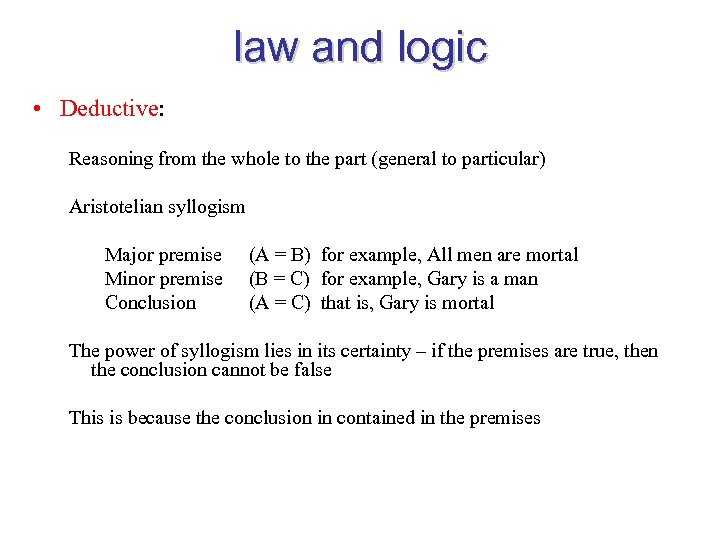 law and logic • Deductive: Reasoning from the whole to the part (general to particular) Aristotelian syllogism Major premise Minor premise Conclusion (A = B) for example, All men are mortal (B = C) for example, Gary is a man (A = C) that is, Gary is mortal The power of syllogism lies in its certainty – if the premises are true, then the conclusion cannot be false This is because the conclusion in contained in the premises
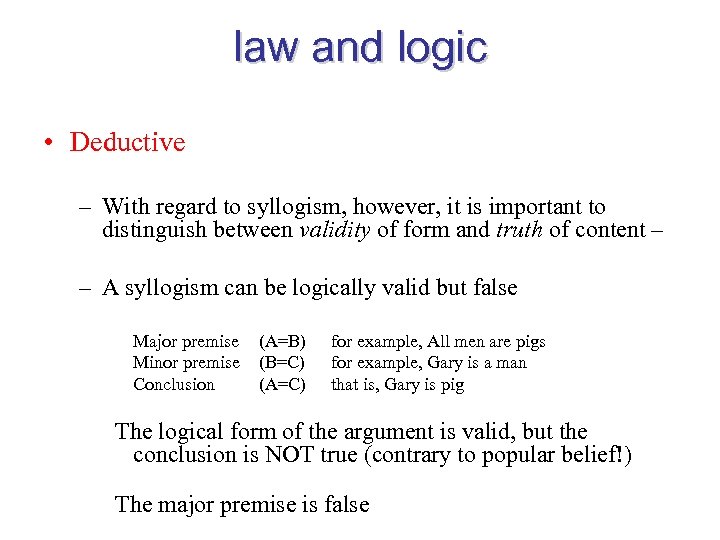 law and logic • Deductive – With regard to syllogism, however, it is important to distinguish between validity of form and truth of content – – A syllogism can be logically valid but false Major premise Minor premise Conclusion (A=B) (B=C) (A=C) for example, All men are pigs for example, Gary is a man that is, Gary is pig The logical form of the argument is valid, but the conclusion is NOT true (contrary to popular belief!) The major premise is false
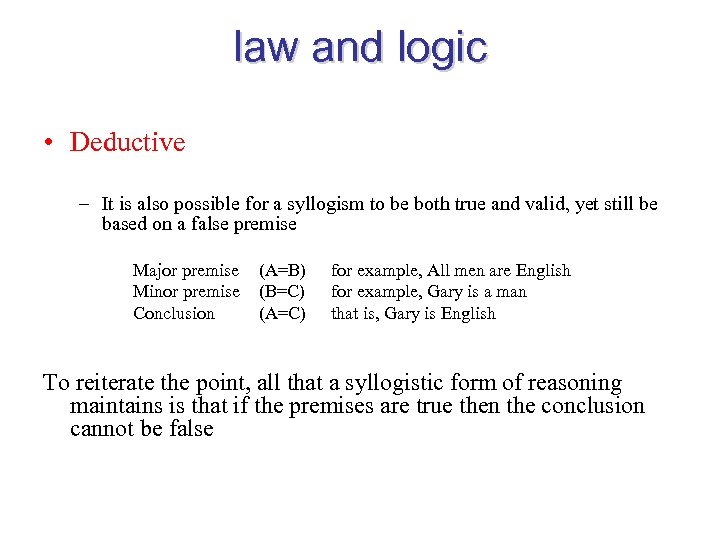 law and logic • Deductive – It is also possible for a syllogism to be both true and valid, yet still be based on a false premise Major premise Minor premise Conclusion (A=B) (B=C) (A=C) for example, All men are English for example, Gary is a man that is, Gary is English To reiterate the point, all that a syllogistic form of reasoning maintains is that if the premises are true then the conclusion cannot be false
 law and logic • Inductive – The second classic form of reasoning – arguing from the part to the whole (particular to general) – It is less certain in its conclusion that deductive logic – e. g. • The sun has always risen in the east • Therefore, the sun will rise in the east tomorrow – If the premise is true, then the conclusion is probable true, but not 100% necessarily so because the conclusion is not contained in the premise (but is a projection from it) – From experience, we can expect the sun to rise in the east tomorrow, but there is the possibility, no matter how small, that something might happen to the sun or the earth
 law and logic • Analogy or example – Reasoning from the part to the part • Wood floats on water • Plastic is like wood • Therefore, plastic floats on water – The truth of the conclusion depends completely on the accuracy of the analogy
 law and logic • The operation of the rules of precedent appears, at first sight, to involve a similar operation of deductive logic – the judge merely applies the legal principle in the precedent to the facts in hand to determine the outcome of the case – Precedent: – Instant case: – Therefore: in case ‘x’ involving particular circumstances, legal principle ‘y’ was applied leading to conclusion ‘z’ in case ‘w’ similar circumstance to those in ‘x’ have occurred principle ‘y’ must be applied to reach a conclusion similar to ‘z’ • But, a closer examination of the actual procedure involved in precedent reveals that it is not totally accurate to categorise precedent as a form of deductive reasoning
 law and logic • It is unlikely that judges will find identical cases, so they will need to find ‘analogous’ case and use its reasoning to decide the case before them • The use of analogy is prone to the difficulties identified – the accuracy of the analogy determines the validity of the conclusion • A further reason why the operation of precedent cannot simply be considered as a n example of deductive reasoning relates to the process through which the precedent is determined once the analogous case has been selected – The binding element is the ratio decidendi – In delivering his decision, the judge does not separate the ratio from other obiter statements • The determination of the ratio and thus the precedent in a previous case may be seen as a process of inductive reasoning, in that the judge in the present case derives the general principle of the ratio from the particular facts of the previous case • This move from the particular to the general is by its nature inductive
 law and logic • Some critics have gone so far as to deny the existence of legal reasoning altogether as a method of determining decisions, and have suggested that references to such are no more than a means of justifying the social and political decisions that judges are called upon to make • It is not suggested that legal reasoning does not employ the use of logic, but neither can it be asserted that it is only a matter of logic • Perhaps the only conclusion that can be reached is that legal reasoning as exercised by the judiciary is an amalgam – – Part deductive Part inductive Part reasoning by analogy Added to this personal intuition and personal prejudice
 think like a lawyer Vandevelde K (1996) Thinking as a Lawyer. Westview Press, Boulder. “The lawyer synthesizes the new rule by a method similar to the logical process of induction. Induction is a method of reasoning that, in essence, proceeds to the particular to the general. For example, after tasting several raisins and finding them that each of them is sweet, one may reason by induction that all raisins taste sweet. Induction produces a conclusion that is probable, though not certain. No matter how many raisins one eats, the possibility always exists that the next one may taste different from the others”
 think like a lawyer Vandevelde K (1996) Thinking as a Lawyer. Westview Press, Boulder. • Courts formulate rules of law by a process that is inductive in form • If a number of cases have been decided in which a particular right or duty was found to exist, then the court may conclude that the same right or duty exists in similar cases • By studying several particular instances, the court formulates a general rule • …induction does not compel a particular conclusion but can only suggest that the conclusion is probable
 think like a lawyer? Think on! • Kelman has argued that traditional accounts of common law reasoning are ways of protecting a hierarchical relationship between academics and students and well-established and fledgling lawyers “Only by creating a technical fog to obscure the true concerns [of law], concerns of which they have nothing much to say that would make them to stand out, have the masters been able to make the initiates bow, scrape, and believe themselves to be deeply unfit and inferior” – (Kelman M (1984) ‘Trashing’. Stanford Law Review 36, 293)