 Скачать презентацию Committed to Connecting the World 2008 Global Event
bbfb90cfd444af1cf344ad1df8b62daa.ppt
- Количество слайдов: 16



Committed to Connecting the World 2008 Global Event on Measuring the Information Society Revision of core indicators A 1 -A 12: infrastructure & access Geneva, 27 May 2008 Vanessa Gray <gray@itu. int> STAT/POL/BDT International Telecommunication Union
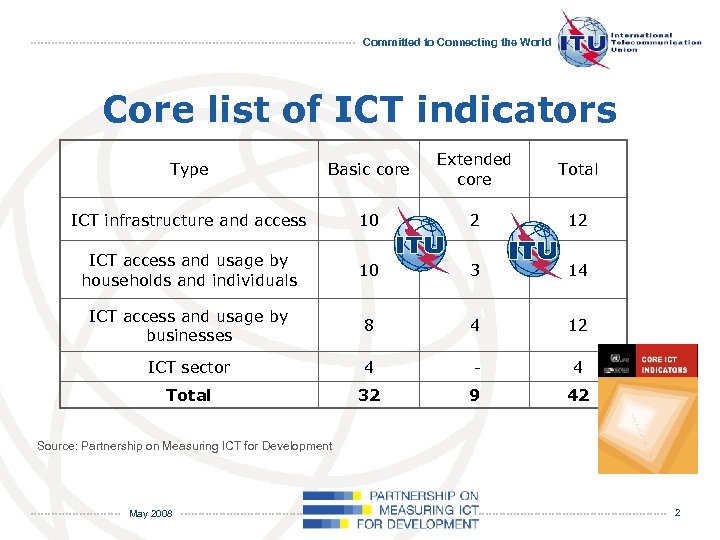
Committed to Connecting the World Core list of ICT indicators Type Basic core Extended core Total ICT infrastructure and access 10 2 12 ICT access and usage by households and individuals 10 3 14 ICT access and usage by businesses 8 4 12 ICT sector 4 - 4 Total 32 9 42 Source: Partnership on Measuring ICT for Development May 2008 2
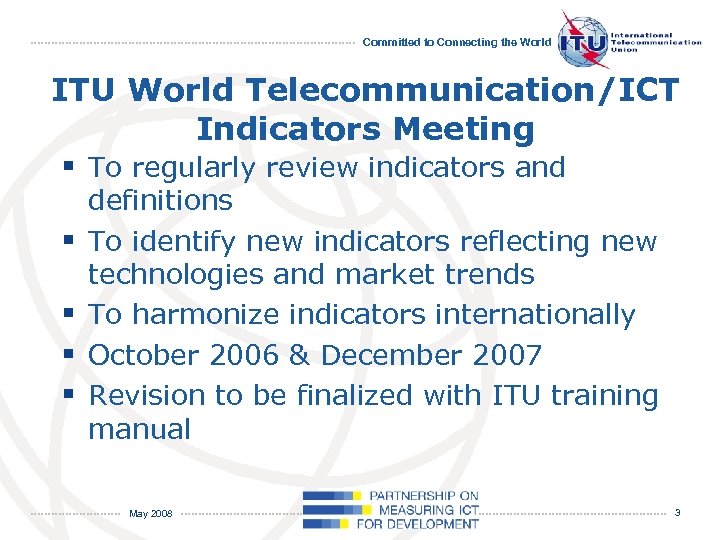
Committed to Connecting the World ITU World Telecommunication/ICT Indicators Meeting § To regularly review indicators and § § definitions To identify new indicators reflecting new technologies and market trends To harmonize indicators internationally October 2006 & December 2007 Revision to be finalized with ITU training manual May 2008 3
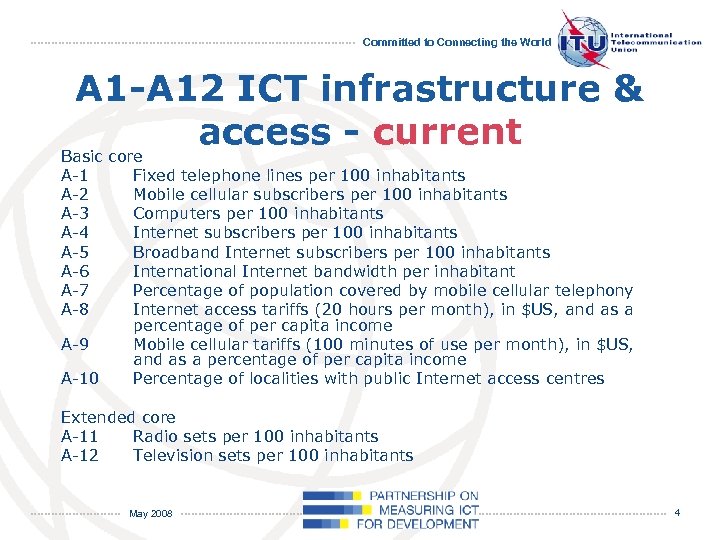
Committed to Connecting the World A 1 -A 12 ICT infrastructure & access - current Basic core A-1 A-2 A-3 A-4 A-5 A-6 A-7 A-8 A-9 A-10 Fixed telephone lines per 100 inhabitants Mobile cellular subscribers per 100 inhabitants Computers per 100 inhabitants Internet subscribers per 100 inhabitants Broadband Internet subscribers per 100 inhabitants International Internet bandwidth per inhabitant Percentage of population covered by mobile cellular telephony Internet access tariffs (20 hours per month), in $US, and as a percentage of per capita income Mobile cellular tariffs (100 minutes of use per month), in $US, and as a percentage of per capita income Percentage of localities with public Internet access centres Extended core A-11 Radio sets per 100 inhabitants A-12 Television sets per 100 inhabitants May 2008 4
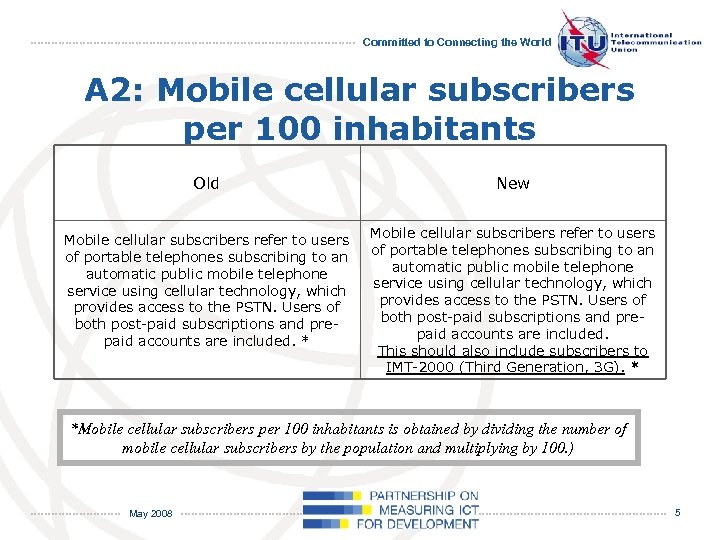
Committed to Connecting the World A 2: Mobile cellular subscribers per 100 inhabitants Old Mobile cellular subscribers refer to users of portable telephones subscribing to an automatic public mobile telephone service using cellular technology, which provides access to the PSTN. Users of both post-paid subscriptions and prepaid accounts are included. * New Mobile cellular subscribers refer to users of portable telephones subscribing to an automatic public mobile telephone service using cellular technology, which provides access to the PSTN. Users of both post-paid subscriptions and prepaid accounts are included. This should also include subscribers to IMT-2000 (Third Generation, 3 G). * *Mobile cellular subscribers per 100 inhabitants is obtained by dividing the number of mobile cellular subscribers by the population and multiplying by 100. ) May 2008 5
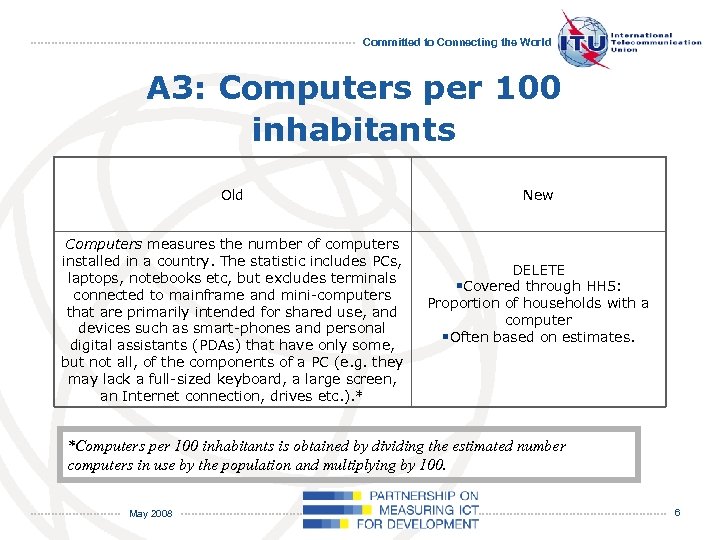
Committed to Connecting the World A 3: Computers per 100 inhabitants Old Computers measures the number of computers installed in a country. The statistic includes PCs, laptops, notebooks etc, but excludes terminals connected to mainframe and mini-computers that are primarily intended for shared use, and devices such as smart-phones and personal digital assistants (PDAs) that have only some, but not all, of the components of a PC (e. g. they may lack a full-sized keyboard, a large screen, an Internet connection, drives etc. ). * New DELETE §Covered through HH 5: Proportion of households with a computer §Often based on estimates. *Computers per 100 inhabitants is obtained by dividing the estimated number computers in use by the population and multiplying by 100. May 2008 6
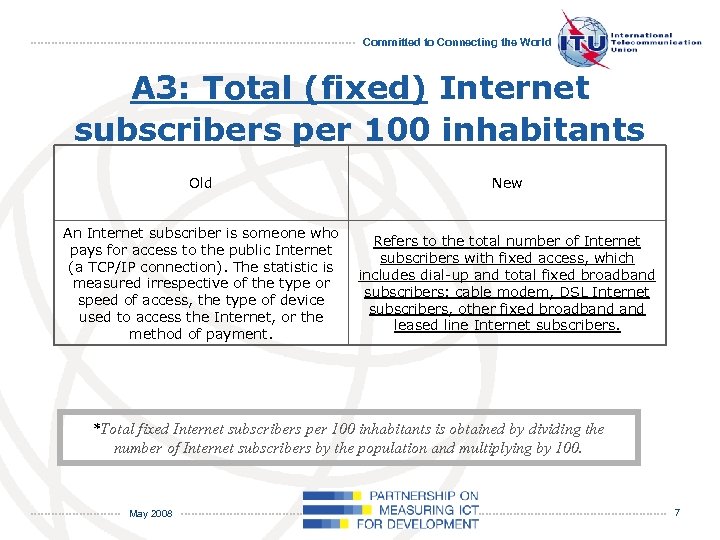
Committed to Connecting the World A 3: Total (fixed) Internet subscribers per 100 inhabitants Old New An Internet subscriber is someone who pays for access to the public Internet (a TCP/IP connection). The statistic is measured irrespective of the type or speed of access, the type of device used to access the Internet, or the method of payment. Refers to the total number of Internet subscribers with fixed access, which includes dial-up and total fixed broadband subscribers: cable modem, DSL Internet subscribers, other fixed broadband leased line Internet subscribers. *Total fixed Internet subscribers per 100 inhabitants is obtained by dividing the number of Internet subscribers by the population and multiplying by 100. May 2008 7
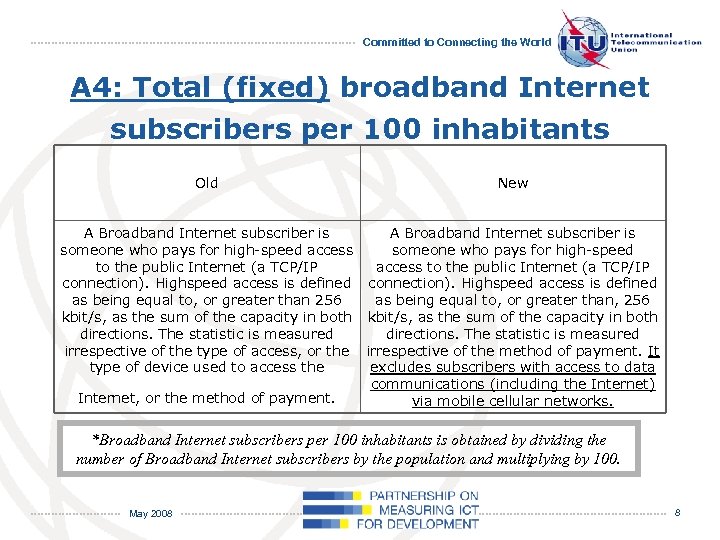
Committed to Connecting the World A 4: Total (fixed) broadband Internet subscribers per 100 inhabitants Old New A Broadband Internet subscriber is someone who pays for high-speed access to the public Internet (a TCP/IP connection). Highspeed access is defined as being equal to, or greater than 256 kbit/s, as the sum of the capacity in both directions. The statistic is measured irrespective of the type of access, or the type of device used to access the A Broadband Internet subscriber is someone who pays for high-speed access to the public Internet (a TCP/IP connection). Highspeed access is defined as being equal to, or greater than, 256 kbit/s, as the sum of the capacity in both directions. The statistic is measured irrespective of the method of payment. It excludes subscribers with access to data communications (including the Internet) via mobile cellular networks. Internet, or the method of payment. *Broadband Internet subscribers per 100 inhabitants is obtained by dividing the number of Broadband Internet subscribers by the population and multiplying by 100. May 2008 8
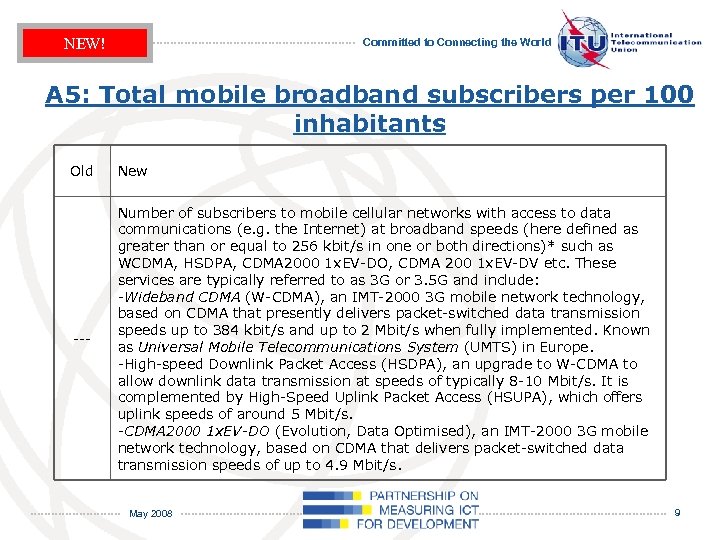
NEW! Committed to Connecting the World A 5: Total mobile broadband subscribers per 100 inhabitants Old New --- Number of subscribers to mobile cellular networks with access to data communications (e. g. the Internet) at broadband speeds (here defined as greater than or equal to 256 kbit/s in one or both directions)* such as WCDMA, HSDPA, CDMA 2000 1 x. EV-DO, CDMA 200 1 x. EV-DV etc. These services are typically referred to as 3 G or 3. 5 G and include: -Wideband CDMA (W-CDMA), an IMT-2000 3 G mobile network technology, based on CDMA that presently delivers packet-switched data transmission speeds up to 384 kbit/s and up to 2 Mbit/s when fully implemented. Known as Universal Mobile Telecommunications System (UMTS) in Europe. -High-speed Downlink Packet Access (HSDPA), an upgrade to W-CDMA to allow downlink data transmission at speeds of typically 8 -10 Mbit/s. It is complemented by High-Speed Uplink Packet Access (HSUPA), which offers uplink speeds of around 5 Mbit/s. -CDMA 2000 1 x. EV-DO (Evolution, Data Optimised), an IMT-2000 3 G mobile network technology, based on CDMA that delivers packet-switched data transmission speeds of up to 4. 9 Mbit/s. May 2008 9
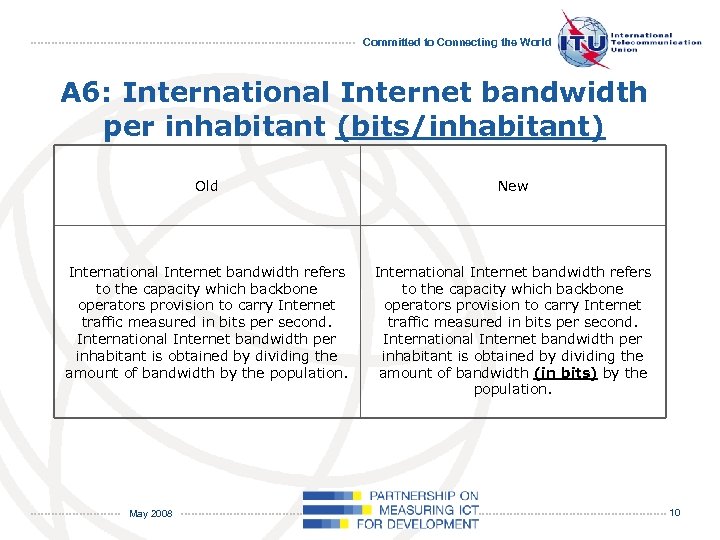
Committed to Connecting the World A 6: International Internet bandwidth per inhabitant (bits/inhabitant) Old New International Internet bandwidth refers to the capacity which backbone operators provision to carry Internet traffic measured in bits per second. International Internet bandwidth per inhabitant is obtained by dividing the amount of bandwidth by the population. International Internet bandwidth refers to the capacity which backbone operators provision to carry Internet traffic measured in bits per second. International Internet bandwidth per inhabitant is obtained by dividing the amount of bandwidth (in bits) by the population. May 2008 10
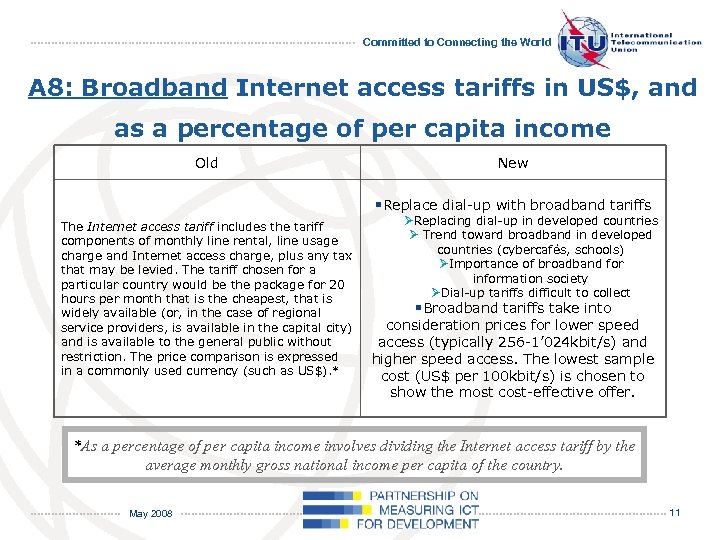
Committed to Connecting the World A 8: Broadband Internet access tariffs in US$, and as a percentage of per capita income Old New §Replace dial-up with broadband tariffs The Internet access tariff includes the tariff components of monthly line rental, line usage charge and Internet access charge, plus any tax that may be levied. The tariff chosen for a particular country would be the package for 20 hours per month that is the cheapest, that is widely available (or, in the case of regional service providers, is available in the capital city) and is available to the general public without restriction. The price comparison is expressed in a commonly used currency (such as US$). * ØReplacing dial-up in developed countries Ø Trend toward broadband in developed countries (cybercafés, schools) ØImportance of broadband for information society ØDial-up tariffs difficult to collect §Broadband tariffs take into consideration prices for lower speed access (typically 256 -1’ 024 kbit/s) and higher speed access. The lowest sample cost (US$ per 100 kbit/s) is chosen to show the most cost-effective offer. *As a percentage of per capita income involves dividing the Internet access tariff by the average monthly gross national income per capita of the country. May 2008 11
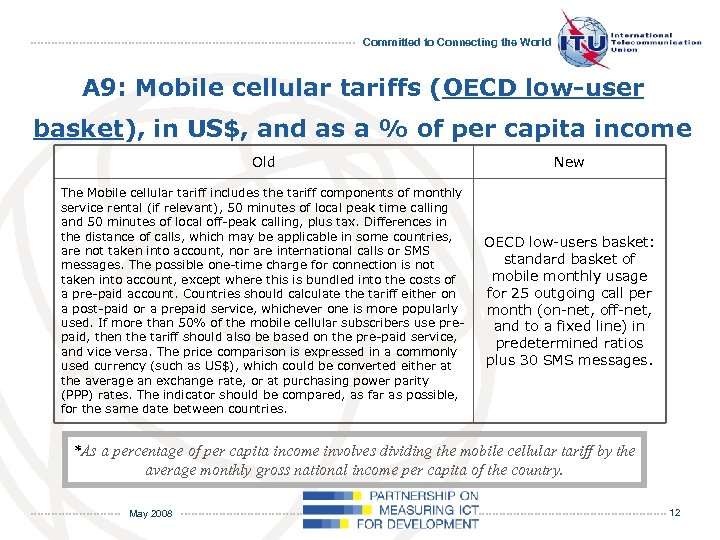
Committed to Connecting the World A 9: Mobile cellular tariffs (OECD low-user basket), in US$, and as a % of per capita income Old New The Mobile cellular tariff includes the tariff components of monthly service rental (if relevant), 50 minutes of local peak time calling and 50 minutes of local off-peak calling, plus tax. Differences in the distance of calls, which may be applicable in some countries, are not taken into account, nor are international calls or SMS messages. The possible one-time charge for connection is not taken into account, except where this is bundled into the costs of a pre-paid account. Countries should calculate the tariff either on a post-paid or a prepaid service, whichever one is more popularly used. If more than 50% of the mobile cellular subscribers use prepaid, then the tariff should also be based on the pre-paid service, and vice versa. The price comparison is expressed in a commonly used currency (such as US$), which could be converted either at the average an exchange rate, or at purchasing power parity (PPP) rates. The indicator should be compared, as far as possible, for the same date between countries. OECD low-users basket: standard basket of mobile monthly usage for 25 outgoing call per month (on-net, off-net, and to a fixed line) in predetermined ratios plus 30 SMS messages. *As a percentage of per capita income involves dividing the mobile cellular tariff by the average monthly gross national income per capita of the country. May 2008 12
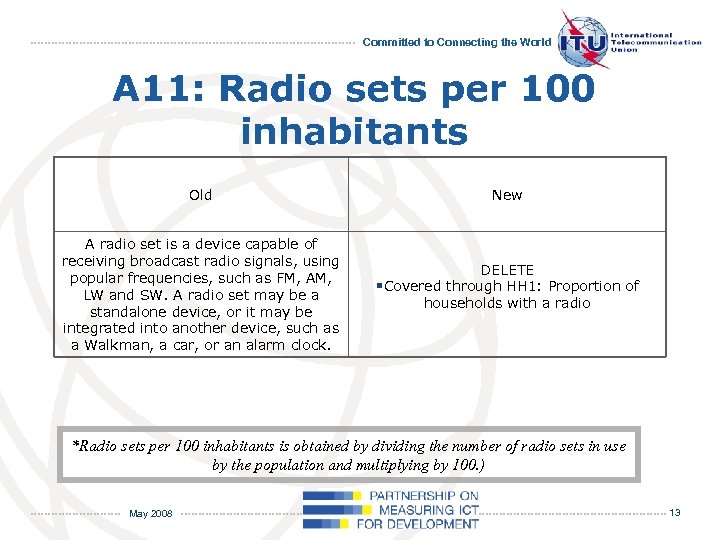
Committed to Connecting the World A 11: Radio sets per 100 inhabitants Old A radio set is a device capable of receiving broadcast radio signals, using popular frequencies, such as FM, AM, LW and SW. A radio set may be a standalone device, or it may be integrated into another device, such as a Walkman, a car, or an alarm clock. New DELETE §Covered through HH 1: Proportion of households with a radio *Radio sets per 100 inhabitants is obtained by dividing the number of radio sets in use by the population and multiplying by 100. ) May 2008 13
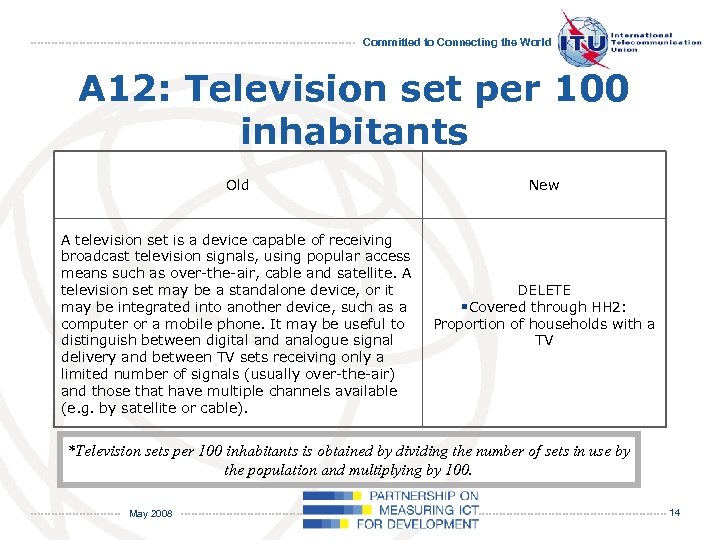
Committed to Connecting the World A 12: Television set per 100 inhabitants Old A television set is a device capable of receiving broadcast television signals, using popular access means such as over-the-air, cable and satellite. A television set may be a standalone device, or it may be integrated into another device, such as a computer or a mobile phone. It may be useful to distinguish between digital and analogue signal delivery and between TV sets receiving only a limited number of signals (usually over-the-air) and those that have multiple channels available (e. g. by satellite or cable). New DELETE §Covered through HH 2: Proportion of households with a TV *Television sets per 100 inhabitants is obtained by dividing the number of sets in use by the population and multiplying by 100. May 2008 14
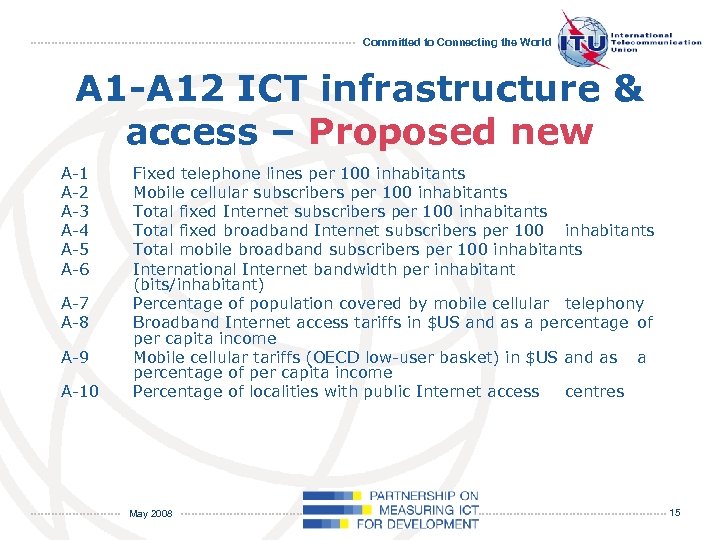
Committed to Connecting the World A 1 -A 12 ICT infrastructure & access – Proposed new A-1 A-2 A-3 A-4 A-5 A-6 A-7 A-8 A-9 A-10 Fixed telephone lines per 100 inhabitants Mobile cellular subscribers per 100 inhabitants Total fixed Internet subscribers per 100 inhabitants Total fixed broadband Internet subscribers per 100 inhabitants Total mobile broadband subscribers per 100 inhabitants International Internet bandwidth per inhabitant (bits/inhabitant) Percentage of population covered by mobile cellular telephony Broadband Internet access tariffs in $US and as a percentage of per capita income Mobile cellular tariffs (OECD low-user basket) in $US and as a percentage of per capita income Percentage of localities with public Internet access centres May 2008 15
Committed to Connecting the World Thank you www. itu. int/ITU-D/ict/partnership/index. html gray@itu. int May 2008 16
Скачать презентацию Committed to Connecting the World 2008 Global Event
bbfb90cfd444af1cf344ad1df8b62daa.ppt