 Скачать презентацию Commissioning EMMA Susan Smith STFC Daresbury Laboratory FFAG
877d24ca257f8ea388e9ba5c78369593.ppt
- Количество слайдов: 40



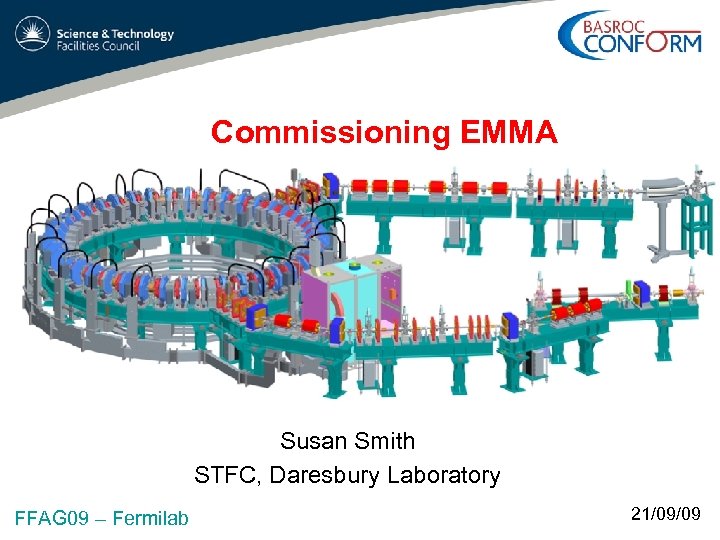
Commissioning EMMA Susan Smith STFC, Daresbury Laboratory FFAG 09 – Fermilab 21/09/09
• • Introduction Preparing ALICE for EMMA – Simulations – Set-up • The ALICE to EMMA injection line – Design – Commissioning – Diagnostic measurements • • Injection into EMMA commissioning – – • • First steps Establishing orbits Characterise and optimise lattice Towards acceleration Extraction line Modelling Programme Summary Content
EMMA Beam Commissioning Team • EMMA Physics Commissioning Coordinator – Bruno Muratori • ALICE Physics Coordinator – Yuri Saveliev • DL based physicists – Cockcroft Institute Universities & ASTe. C (DL) • CONFORM groups – Adams Institute, Imperial College, ASTe. C (RAL) • Other UK university groups • International collaborators – Scott Berg, Carol Johnstone, Eberhard Keil, Shane Koscielniak, François Méot, Dejan Trbojevic and others. . .
What is Commissioning? • Preparing the accelerator for beam – set-up DAQ & controls & hardware – set-up diagnostic devices required • Getting beam into the accelerator • Making sure all desired properties are achieved – Set-up the accelerator (orbit correction, dispersion-free sections, setting desired optics, phases on cavities etc. ) – Characterise the bunch • Making all the desired measurements • Set-up accelerator for particular experiments – Injection at different energies – Phase space painting – Extraction, acceleration etc. Extensive simulations of the accelerator, beam physics, the diagnostics and the controls algorithms will be needed!

ALICE COMMISSIONING FOR EMMA
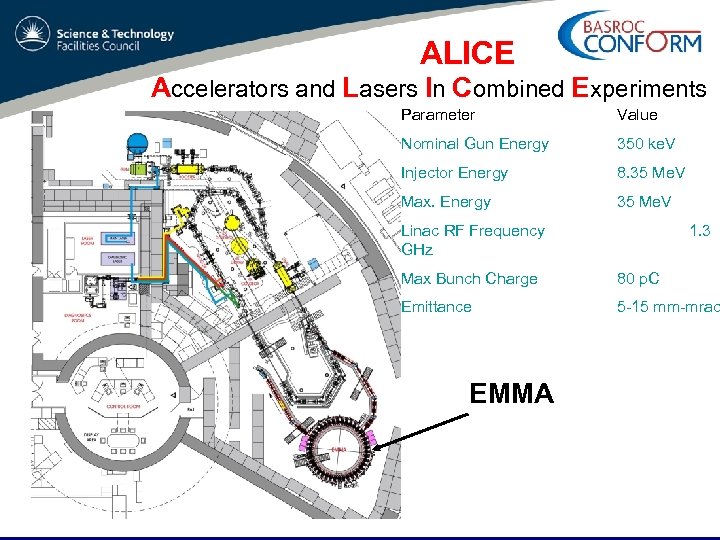
ALICE Accelerators and Lasers In Combined Experiments Parameter Value Nominal Gun Energy 350 ke. V Injector Energy 8. 35 Me. V Max. Energy 35 Me. V Linac RF Frequency GHz 1. 3 Max Bunch Charge 80 p. C Emittance 5 -15 mm-mrad EMMA
Prepare ALICE as Injector for EMMA • Optimise ALICE energy from 10 to 20 Me. V • Bunch length: ~ 10 ps rms – Minimise space charge effects but allow painting of longitudinal phase space • Energy spread: < 50 ke. V rms – better defined beam for painting – prolong coherent behaviour • Bunch charge: 15 – 30 p. C – reduce collective effects (e. g space charge)&beam loading – Reasonable beam diagnostics (e. g. BPMs) • Normalised transverse emittance: 5 - 10 µm – Minimise space charge effects – Have a reasonably well defined beam for painting
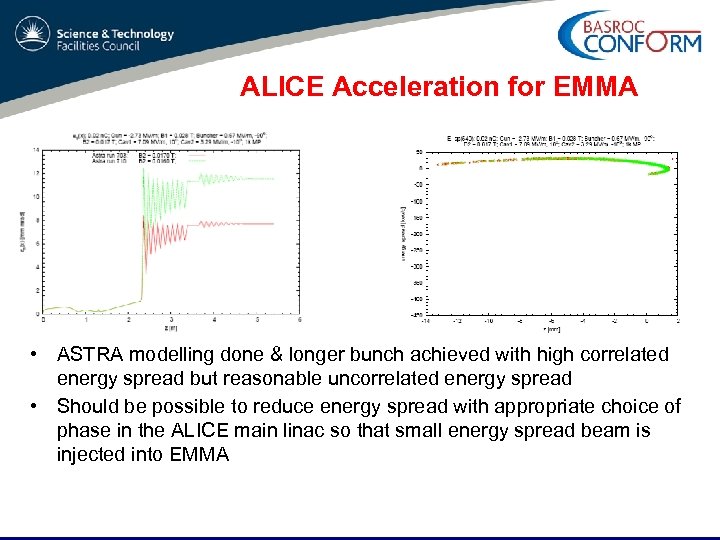
ALICE Acceleration for EMMA • ASTRA modelling done & longer bunch achieved with high correlated energy spread but reasonable uncorrelated energy spread • Should be possible to reduce energy spread with appropriate choice of phase in the ALICE main linac so that small energy spread beam is injected into EMMA
ALICE for EMMA Commissioning • Set the ALICE injector up for an appropriate booster beam energy (6 – 8 Me. V) at 1 – 2 bunch charges (15 – 30 p. C) • Characterise and optimise the beam in the ALICE injector for energy spread, emittance and bunch length etc. • Set 3 -4 injection energies in the range 10 to 20 Me. V from LINAC and characterise with ALICE diagnostics ALICE for EMMA commissioning can start now!
ALICE TO EMMA INJECTION LINE
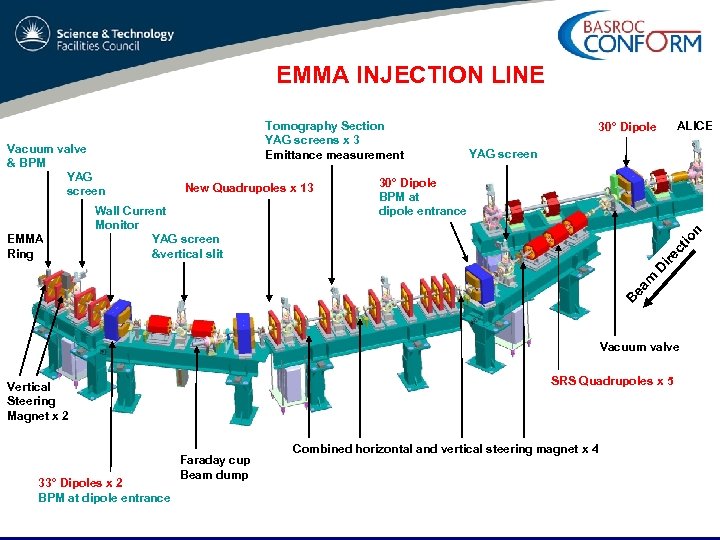
EMMA INJECTION LINE 30° Dipole BPM at dipole entrance ct io n Wall Current Monitor YAG screen &vertical slit YAG screen B ea m D EMMA Ring New Quadrupoles x 13 ALICE 30° Dipole ire Vacuum valve & BPM YAG screen Tomography Section YAG screens x 3 Emittance measurement Vacuum valve SRS Quadrupoles x 5 Vertical Steering Magnet x 2 33° Dipoles x 2 BPM at dipole entrance Faraday cup Beam dump Combined horizontal and vertical steering magnet x 4
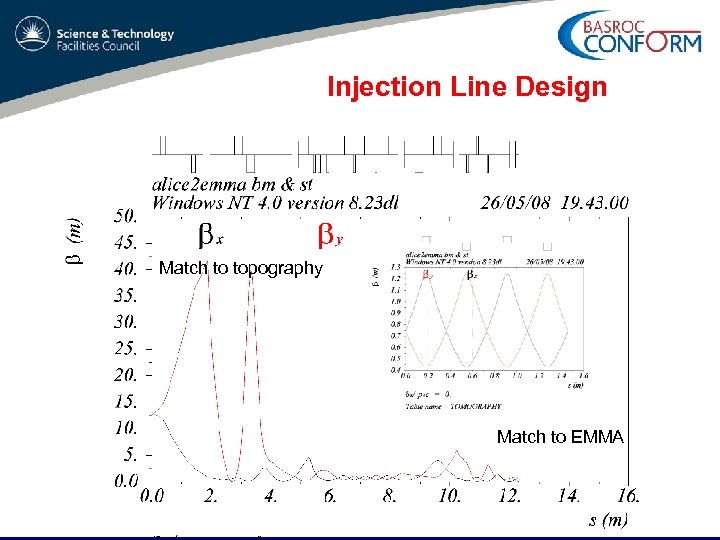
Injection Line Design Match to topography Match to EMMA
Injection Line Commissioning • Hardware commissioning • Commission line at single energy – Trajectory correction – Diagnostic commissioning and tests of prototype • BPMs and Wall Current Monitor • Set up and match the optics ** see next slides • Beam characterisation (full 6 D) (re-optimise ALICE if necessary) – Bunch length / Charge / Emittance / Energy spread • Repeat for all combinations of energy and bunch charge
Injection Line Optics Set-Up • Dogleg & dispersion – Iterative procedure setting two external quads – then central – then repeat • Matching to tomography – Not trivial & very sensitive even in initial tracking models → scan quadrupoles to map trends • Last dispersive section and setting Dx & D’x – Tomography helps keep the beam small – Dedicated model with some quads off – Measure dispersion in two places → derivative known – Turn quads to nominal model value → Dx & D’x should be close to desired value. . . Septum modelling required
Measurements in Injection Line • Emittance – Tomography section – Quadrupole scans • Bunch length – Zero cross method with 2 nd linac cavity used as a buncher and YAG screen in dogleg • Charge – Faraday cup after 1 st dipole of arc or tomography section • Energy & Energy spread – Slit & YAG in last dispersive section
EMMA INJECTION
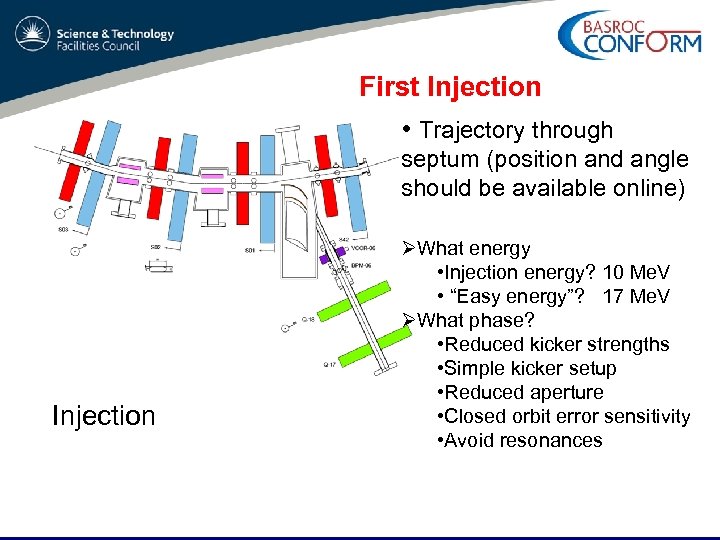
First Injection • Trajectory through septum (position and angle should be available online) Injection ØWhat energy • Injection energy? 10 Me. V • “Easy energy”? 17 Me. V ØWhat phase? • Reduced kicker strengths • Simple kicker setup • Reduced aperture • Closed orbit error sensitivity • Avoid resonances

EMMA COMMISSIONING
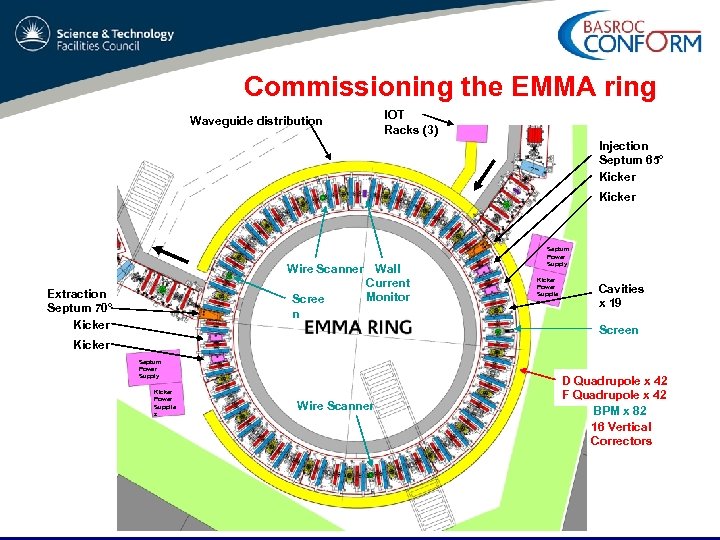
Commissioning the EMMA ring Waveguide distribution IOT Racks (3) Injection Septum 65° Kicker Wire Scanner Wall Current Monitor Scree n Extraction Septum 70° Kicker Septum Power Supply Kicker Power Supplie s Cavities x 19 Screen Kicker Septum Power Supply Kicker Power Supplie s Wire Scanner D Quadrupole x 42 F Quadrupole x 42 BPM x 82 16 Vertical Correctors
First Steps • Conditions for first injection into EMMA – Start with easier energy (probably 17 -18 Me. V) – Start with a reasonable charge (20 p. C) – Set chosen septum & kicker values, at a chosen tune? – Measure injection energy to within 50 ke. V • Inject beam – no acceleration – Establish complete orbit of ring • use BPMs, screens, wire monitors etc. as beam detector • steer using injection magnet parameters (kickers), vertical steers and quad position to thread beam around
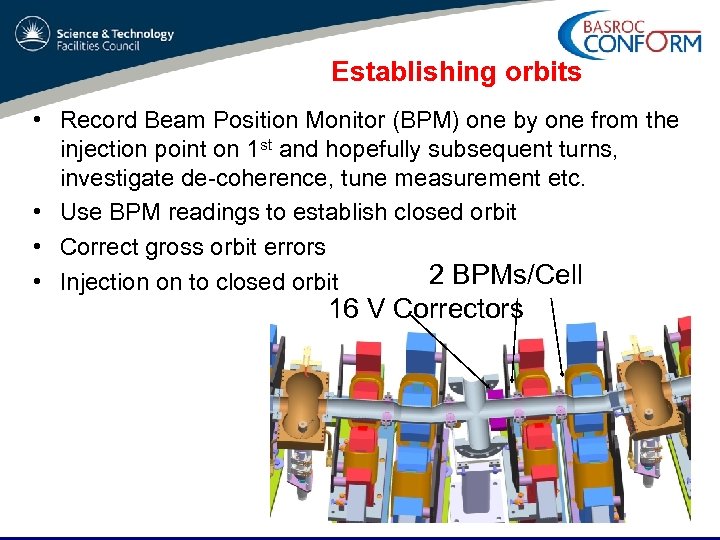
Establishing orbits • Record Beam Position Monitor (BPM) one by one from the injection point on 1 st and hopefully subsequent turns, investigate de-coherence, tune measurement etc. • Use BPM readings to establish closed orbit • Correct gross orbit errors 2 BPMs/Cell • Injection on to closed orbit 16 V Correctors
Characterise and optimise lattice • Interpretation of BPMs before and after beam decoherence – Not all identical & only symmetry every other cell – Important to model all BPM readings → GPT / other • Measure and characterise tunes (see previous) • Measurement of time of flight – Change frequency until no synchrotron oscillations seen – Frequency then translates into TOF – Hence find minimum & shape of TOF • • Orbit measurement and correction using algorithms Orbit response matrix analysis Establish desired lattice Make first estimate of acceptance
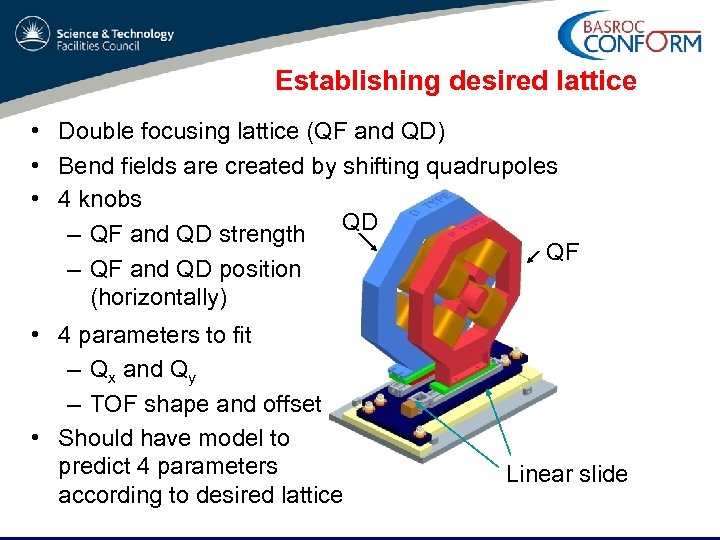
Establishing desired lattice • Double focusing lattice (QF and QD) • Bend fields are created by shifting quadrupoles • 4 knobs – QF and QD strength QD QF – QF and QD position (horizontally) • 4 parameters to fit – Qx and Qy – TOF shape and offset • Should have model to predict 4 parameters according to desired lattice Linear slide
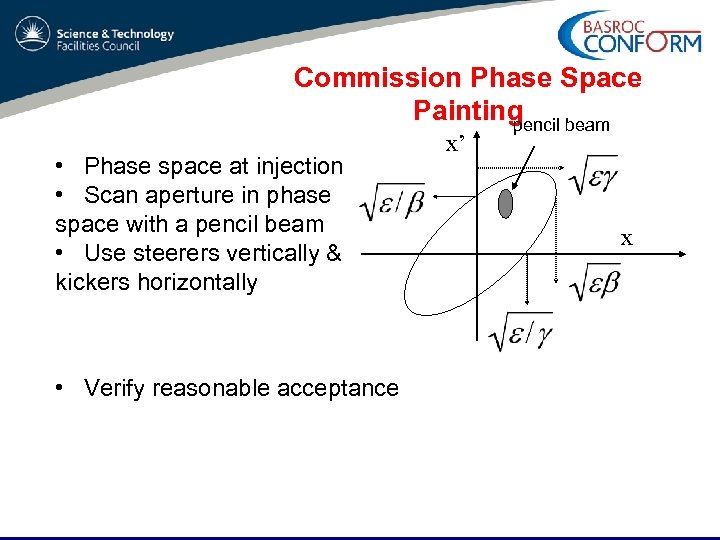
Commission Phase Space Painting beam pencil • Phase space at injection • Scan aperture in phase space with a pencil beam • Use steerers vertically & kickers horizontally • Verify reasonable acceptance x’ x
Towards Acceleration • Establish details of RF phase setting and control and synchronisation • Characterise lattice as at a few chosen energies including injection and extraction energy • Use orbit/corrector data to predict global correctors required for energy ramp • Commission extraction and diagnostics line at chosen extraction energy • Accelerate!
EXTRACTION AND DIAGNOSTICS LINE
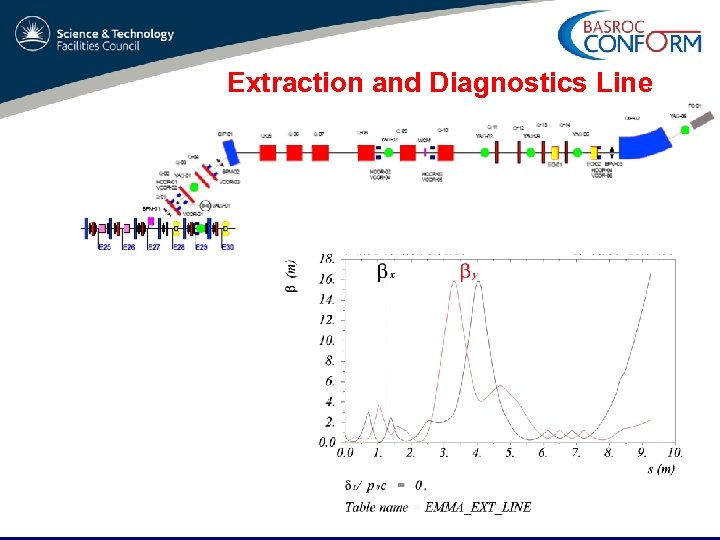
Extraction and Diagnostics Line
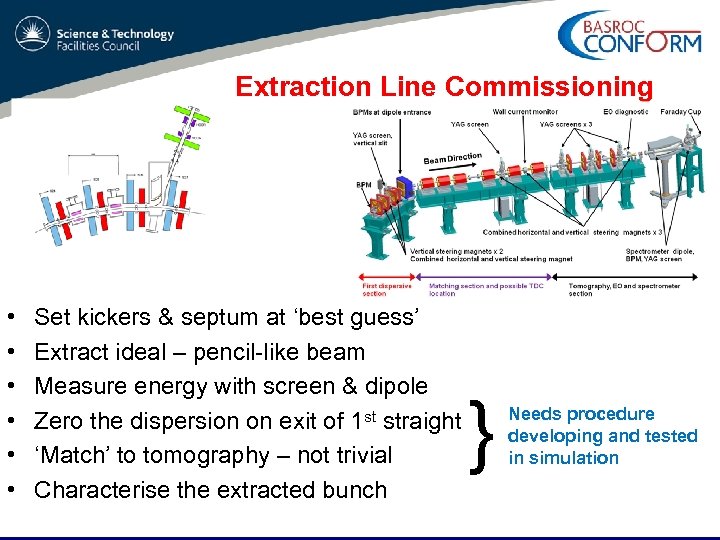
Extraction Line Commissioning • • • Set kickers & septum at ‘best guess’ Extract ideal – pencil-like beam Measure energy with screen & dipole Zero the dispersion on exit of 1 st straight ‘Match’ to tomography – not trivial Characterise the extracted bunch } Needs procedure developing and tested in simulation
Detailed Procedures e. g. • How to achieve zero dispersion at the exit of straight ? – Usually done by centring the beam and then slightly changing the energy & ensuring spot is motionless – Where do we introduce this change ? • main linac → changes dynamics of EMMA & spot could appear still with dispersion non-zero • switch off one of the EMMA cavities ? → also changes the dynamics • slightly reduce all of them ? • look at centeroid trajectories ? very long process – Use trajectory response matrix analysis ? – Use tomography section ? Needs simulation of procedure !!!
Measurements in Extraction Line • Emittance – Tomography section • Slice emittance – Transverse deflecting cavity (TDC) & screen in tomography section • Bunch length – Electro-optic monitor and / or TDC • Charge – Faraday cup after spectrometer dipole • Energy spread – Slit & YAG in first dispersive section / spec. dipole • Slice energy spread – TDC & spectrometer dipole

SIMULATIONS AND MODELLING
Pre Commissioning Modelling • Model ALICE injector to deliver EMMA beam (10 ps etc. ) • Create model of ALICE to EMMA injector line in GPT – Run this model both on & off line for comparisons / predictions • Create S 2 E model for all of EMMA in GPT / other – Run with field maps & misalignments for comparisons / predictions – Run all the way to spectrometer & dump in the EMMA extraction line • Compare this with ZGOUBI models & FFEMMAG / other models wherever possible
Online Model • Collaboration has agreed that ZGOUBI would be core to on-line model • Python wrap around will interface to EPICS controls and ZGOUBI programme • Other codes will be used and tested through the database. E. g One code simulating the accelerator the other testing algorithms. . . • Will develop a series of interfaces between the physicist/operators and the accelerator using the model to predict lattice parameters. • Test functionality on ALICE to EMMA commissioning line • Commissioning will assist in “correcting the model”
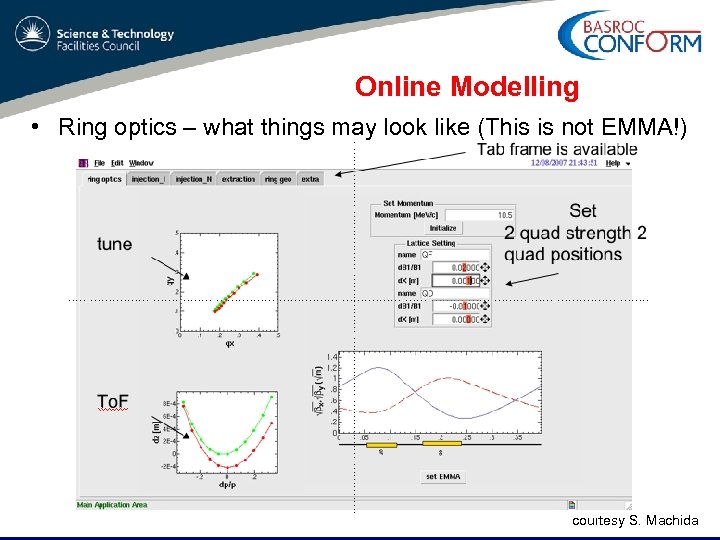
Online Modelling • Ring optics – what things may look like (This is not EMMA!) courtesy S. Machida
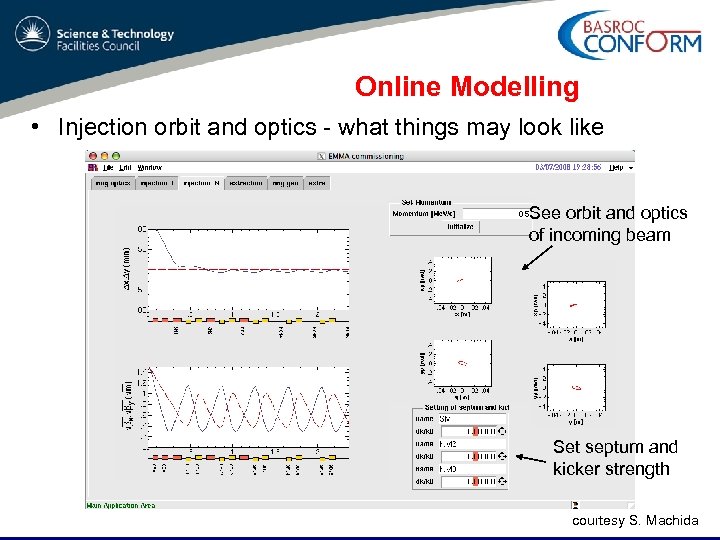
Online Modelling • Injection orbit and optics - what things may look like See orbit and optics of incoming beam Set septum and kicker strength courtesy S. Machida
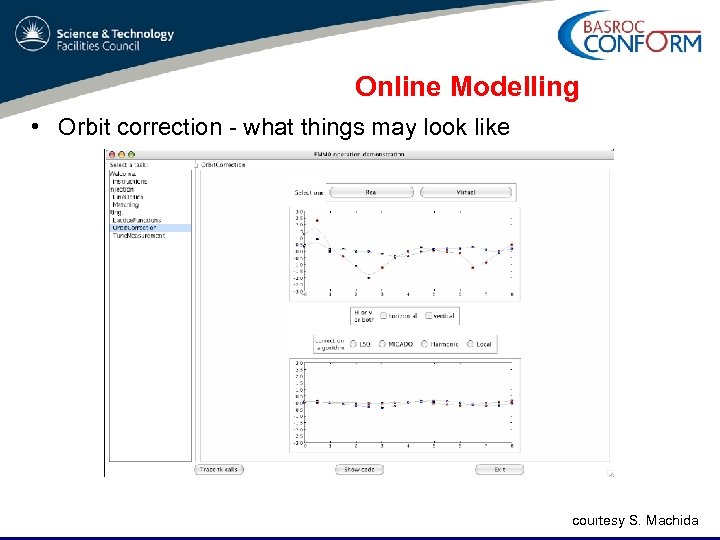
Online Modelling • Orbit correction - what things may look like courtesy S. Machida
EMMA Online Model Build of online model with interface (ZGOUBI / PIZGOUBI). Already under way Team includes. . . Yoel Giboudot, David Kelliher, Shinji Machida, Ben Shepherd, Sam Tygier, James Jones, Stefan Tzenov, Kiril Marinov DL EPICs controls experts Graham Cox. . .
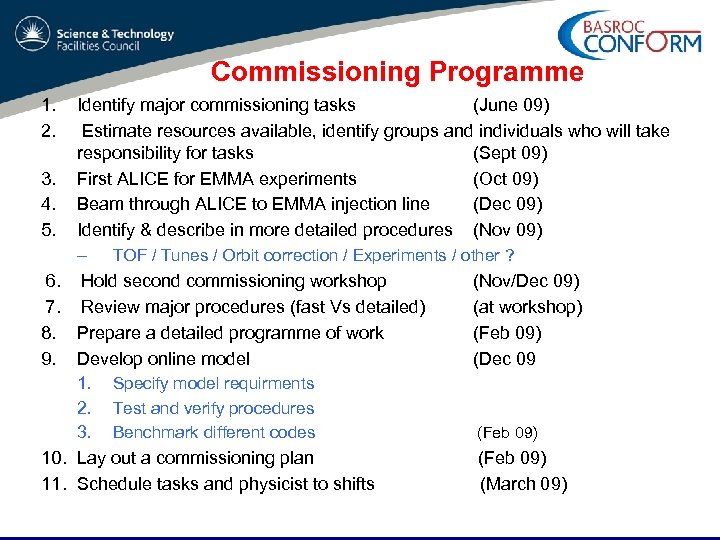
Commissioning Programme 1. 2. 3. 4. 5. 6. 7. 8. 9. 10. 11. Identify major commissioning tasks (June 09) Estimate resources available, identify groups and individuals who will take responsibility for tasks (Sept 09) First ALICE for EMMA experiments (Oct 09) Beam through ALICE to EMMA injection line (Dec 09) Identify & describe in more detailed procedures (Nov 09) – TOF / Tunes / Orbit correction / Experiments / other ? Hold second commissioning workshop (Nov/Dec 09) Review major procedures (fast Vs detailed) (at workshop) Prepare a detailed programme of work (Feb 09) Develop online model (Dec 09 1. Specify model requirments 2. Test and verify procedures 3. Benchmark different codes (Feb 09) Lay out a commissioning plan (Feb 09) Schedule tasks and physicist to shifts (March 09)
Conclusion • Commissioning was kicked off by a workshop in June • We think we know what we have to do? • We think we know who wants to do it? BUT we are looking for further collaboration as its complex and challenging! • We are starting to define how we will do it • This needs significant preparation including simulation studies • The online programme should assist in the preparation for commissioning • By March we will be ready to commission EMMA • After commissioning comes THE EMMA EXPERIMENT
Thanks you for your attention Thanks to. . . Bruno Muratori Yuri Saveliev and the rest of the DL and Conform teams Scott Berg, Eberhard Keil, Shane Koscielniak, Carol Johnstone, François Méot, Dejan Trbojevic and others. . . I have detailed information from Bruno on the current task and procedure list. Can we discuss this with interested parties during this week?
Скачать презентацию Commissioning EMMA Susan Smith STFC Daresbury Laboratory FFAG
877d24ca257f8ea388e9ba5c78369593.ppt