 Скачать презентацию Commissioner Basic Training Dave Prior S US A
371514fe3a82d4fe7b26e51080263894.ppt
- Количество слайдов: 91



Commissioner Basic Training Dave Prior S US A AI R SC HO OL GRADUATE FO S ON RC AP E WE Jenny Prior Sean Baker
Commissioner Quiz
Overview l Purpose of Scouting l BSA Organization l Providing Unit Service l Ways to Help a Unit l Membership Management l Commissioners Role l Counseling
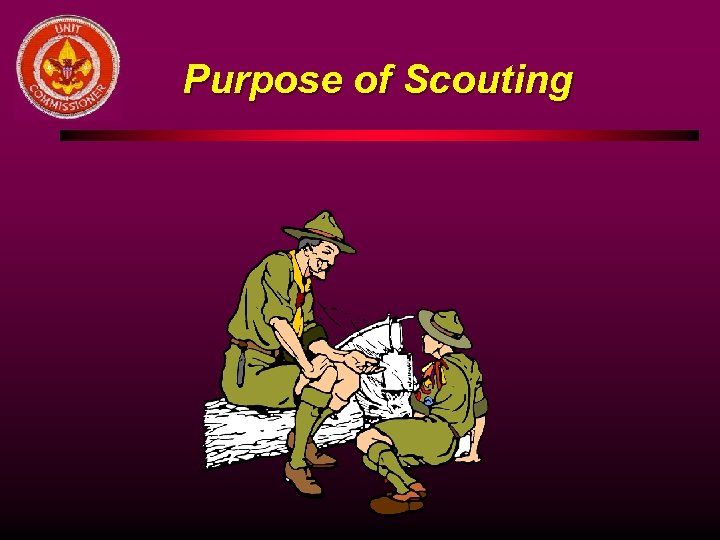
Purpose of Scouting
Aims of Scouting l What are the aims of Scouting? l Character development l Citizenship training l Personal fitness
Methods of Scouting l What are some methods of Scouting? l Cub Scouts l Boy Scouts / Varsity l Venturing
District Key 3 l District Executive – Scouting Professional l Staff advisor to Key 3 l Manages council resources in support of district l District Chair - Volunteer l Chairs the District Committee l District Commissioner – Volunteer l Directs the Commissioner Corps
District Committee l Four function organization Membership Finance Program Unit service
Membership Functions 1. l 2. l 3. l 4. l Fall Roundup Spring Roundup Special membership rallies Advice and help to units with membership problems
Finance Functions l 1. Sustaining Membership Enrollment / Friends of Scouting l 2. Trust Funds (James E. West Award) l 3. Advice to units
Program Functions 1. l 2. l 3. l 4. l Activities Advancement Camping Training
Activities Scout Expo l Scouting for Food l Scouting Anniversary Week l District Recognition Dinner l Cub Day Camp l Derbys: Pinewood, Soapbox, etc. l Camp-O-Rees, Klondike Derbies l
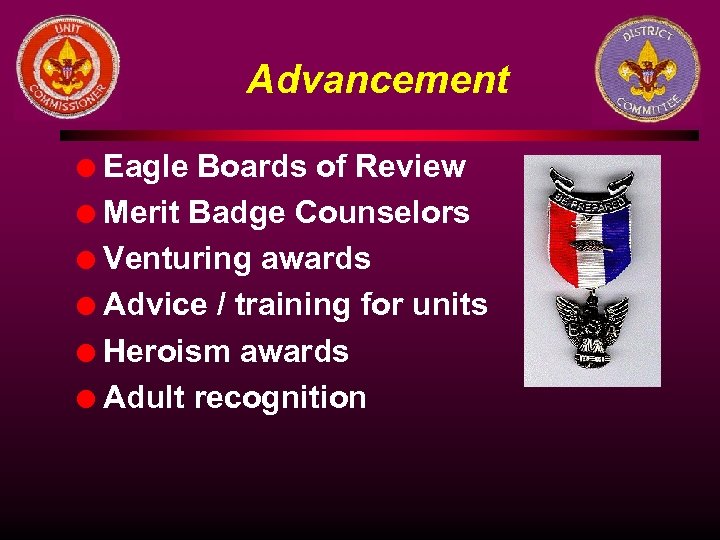
Advancement Eagle Boards of Review l Merit Badge Counselors l Venturing awards l Advice / training for units l Heroism awards l Adult recognition l
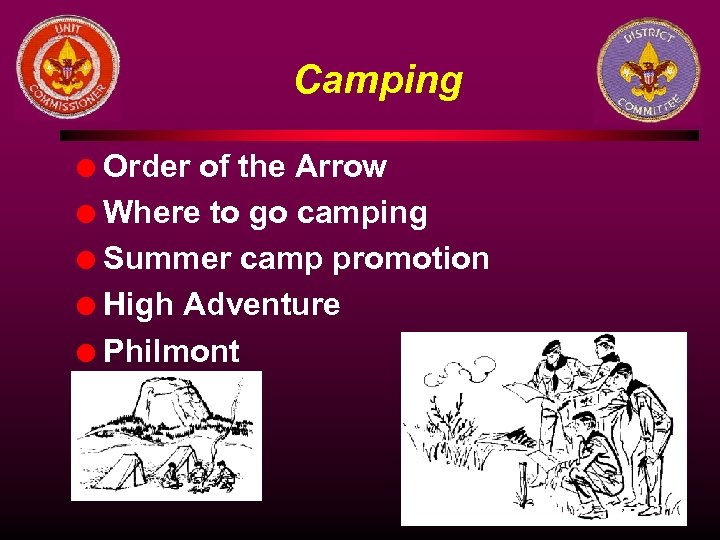
Camping Order of the Arrow l Where to go camping l Summer camp promotion l High Adventure l Philmont l
Training l l l Fast Start New Leader Essentials Leader Specific Training: l Den Leader, Cubmaster, Scoutmaster, Venturing Advisers l Intro to Outdoor Leadership Skills l Unit Committee Youth Protection P&TC, Roundtable, High Adventure Wood Badge, Powder Horn
Training l Youth: l Den Chief l Troop Leadership Training (Unit) l National Youth Leader Training (Council) l National Advanced Youth Leader Experience (National)
Commissioner Service Role
The Commissioner Concept l l l The commissioner is the liaison between the local council and Scouting units. The commissioner's mission is to l Keep units operating at maximum efficiency, l Maintain regular contact with unit leaders, l Counsel leaders on where to find assistance, l Note weaknesses in programs, l And suggest remedies. The commissioner is successful when units effectively deliver the ideals of Scouting to their members.
Job Description Card
Job Description Card l Friend
Job Description Card Friend l + Representative l
Job Description Card Friend l Representative l + Unit "GP doctor" l
Job Description Card Friend l Representative l Unit "GP doctor" l + Teacher l
Job Description Card Friend l Representative l Unit "GP doctor" l Teacher l + Counselor l
Providing Unit Service
Annual Commissioner Service Plan
Annual Commissioner Service Plan Gives specific purpose to regular and supportive contact with units.
Annual Commissioner Service Plan l l l l Membership inventory (twice a year) Uniform inspection Quality Unit measurement Unit leadership inventory Charter presentation ceremony Unit program planning Youth Protection visit Other ongoing commissioner functions
Annual Plan l l l l April - Unit leadership inventory May - Membership inventory - Troop uniform inspection June - Check on Quality Unit progress August - Unit program planning October - Troop/pack uniform inspection November - Youth Protection Training - Recharter December - Membership inventory - Quality Unit Measurement February - Charter presentation
Annual Plan coupled with regular visitation provides good commissioner service.
Making Unit Contacts l What do you need to know before you contact the unit as a commissioner? l l l Chartered organization status Membership (rosters) Leadership status Any current concerns Any special philosophy (e. g. home-school youth only)
Indicators of Unit Health: Pack l l l l l Leadership Webelos den Advancement Attendance Adult attendance Den activity Program operations Den chiefs or den aides Membership Planned program
Indicators of Unit Health: Troop l l l l l Meeting operation Youth leadership Advancement Adult assistance Attendance Outdoor program Patrol activity Budget plan Membership Planned program
Indicators of Unit Health: Crew l l l Adult Leadership Elected Officers Adult assistance Membership Meeting operation Planned program
Evaluation Tools l Commissioner Worksheets - pack, troop, crew l Unit self assessment l Centennial Quality Unit Award l Do unit leaders like evaluation? l What are your resources?
Visiting the Unit Meeting
Visiting A Unit Meeting l Call ahead and ask unit leader if it’s okay to visit. l Be in full field uniform to set the example. l Introduce yourself as a “friend” or “resource”. l Let everyone know how to contact you.
Visiting A Unit Meeting (cont’d) l Stay on the sidelines; do not interrupt the meeting. l Visit committee too, not just pack/troop meetings. l Do not sit and complete the form during the visit! l Aim for one contact a month (phone or email okay). l Go with your ADC/coach if you are a first time commissioner
Making a report after the visit l Report by form or phone or email or web form to your ADC or DC. l Use the information to see how you can help the unit.
Unit Visitation Reports Using the Commissioner Work Sheet
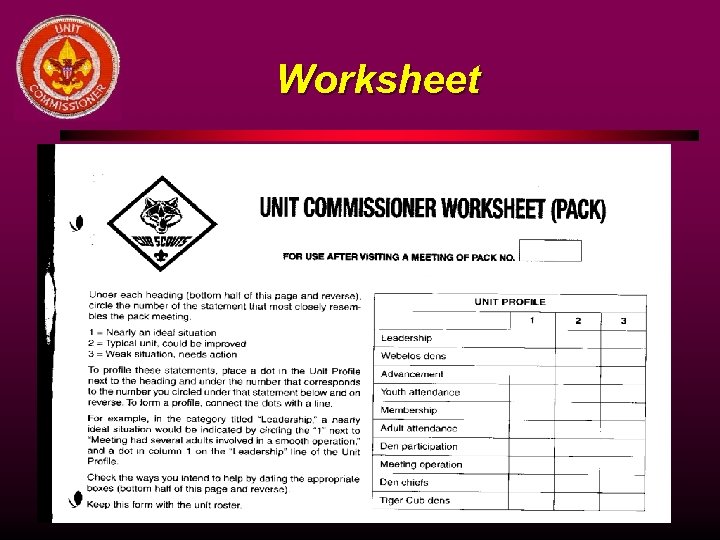
Worksheet
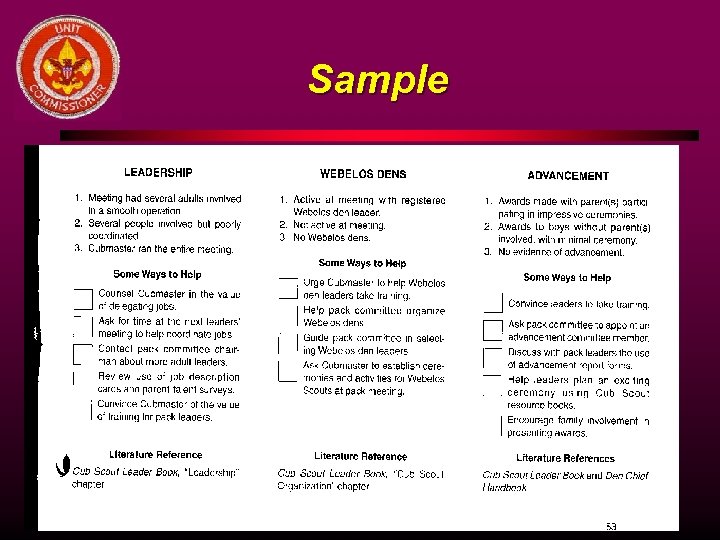
Sample
Follow-up (immediate) l Try to make a positive comment after meeting is over. l Address any breach of BSA policy as soon as possible.
Follow-up (soon after meeting) l l l Compliment the unit for its strengths (do try to find at least one!) Pick an area that could use improvement – but be tactful. Ask how leaders feel they are doing in that area. Or ask leader to pick one thing they would like to improve. Help them brainstorm ways to improve (see counseling). Suggest Unit Self-Assessment form as tool for leaders.
Second / Third Unit Visits l Second visit — unit meeting l Go by yourself l Stay only 15 minutes (drop-in) l Take your resource kit l Make worksheet (or changes) l Third visit — committee meeting l Visit with chartered organization representative l Be prepared with ways to help l Give everyone your phone and address l Wear your complete uniform as an example
Ways To Help a Unit l Encourage Quality Unit Operation l Training, Training l Introduction to Youth Protection l Unit Program Planning
Centennial Quality Unit Award l Help with a goal-setting meeting l Training is still #1 l Recruitment and retention, new adults l Advancement l Outdoor activities l Planning and financing the program l Visibility of Unit Commissioner l Ongoing Assessment
Training, and Training l Know training requirements for each leadership position l Encourage and enable leader training l Supply district training calendar and information l Offer special recognition of trained leaders
Youth Protection Training
Introduction to Youth Protection l The commissioner can help the unit with Youth Protection. l All adults need to be trained and know reporting process. l Commissioners should know adult and youth resources.
Commissioner and Youth Protection l Annual Youth Protection visit in the fall l Encourage proper leader selection procedures l Coach unit people if child abuse occurs l Promote the youth videos l It Happened to Me l A Time to Tell l Personal Safety Awareness l Explain how to use Youth Protection inserts l Complete Youth Protection Training yourself
Unit Program Planning l Understand the process for each level. l Understand how it works in a boy-run troop. l Know resources that you could suggest to the unit.
Break!
Commissioner Basic Training S US A AI R SC HO OL GRADUATE FO S ON RC AP E WE
Membership Management
Membership l New membership is essential to healthy unit!
Potential Membership Problems l Too many graduating at same time l Ineffective recruitment efforts l Poor retention of new youth
Recruitment and Retention Tools l Unit membership inventories, with follow-up l Year-round recruitment plan l Lists of available youth l Lists of Webelos ready to graduate l Phone call, personal invitation
More Recruitment and Retention Tools l Recruitment night or open house l Day Camp/Resident Camp/Cub Scout Fairs l Events such as Camporees or Webelos Woods l Boys having fun and telling their friends!
Webelos to Scout Transition l Unit Commissioner has a role in the process: l Access to information about troops l Introduce leaders to each other l Help troops come up with visibility campaign
Membership Resources l Know how to use district and council resources l School-night training for Cub Packs (often several districts) l Recruitment materials available from council
Membership Management l Unit with mostly older boys l Recruit l Inventories of active boys l Committee Involvement for inactive boys l Program or Administrative issue
Membership Management l Year-round recruiting l Birthday greetings l Phone Invitations l Personal Invitations l Webelos-Scout transition l Preventing dropped units l Assigned to unit l Assigned while organizing new units
Charter Renewal "If commissioners are providing regular visitation and doing their job as in the Annual Service Plan, then rechartering becomes a minor paperwork exercise. " George Crowl, 1982
Objective: Reregister unit l On time l Maximum membership l Member retention l Good leadership l
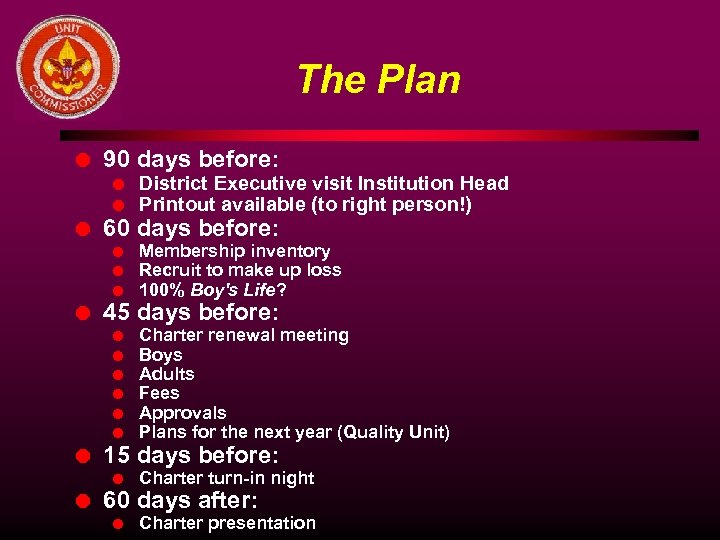
The Plan l 90 days before: l l l 60 days before: l l Charter renewal meeting Boys Adults Fees Approvals Plans for the next year (Quality Unit) 15 days before: l l Membership inventory Recruit to make up loss 100% Boy's Life? 45 days before: l l l l District Executive visit Institution Head Printout available (to right person!) Charter turn-in night 60 days after: l Charter presentation
Charter Renewal l l l Become familiar with the online recharter process, understand paper as a backup Encourage your unit to start early – online recharter opens 11/1 Understand the charter paperwork from the council Train the person doing the recharter, find best method. DE (could be UC with COR) visits the chartered org. Keep in touch with DE regarding potential problems.
Charter Renewal (cont’d) l l l l Help unit to do membership inventory. Determine Quality Unit status. Get the Commissioner’s Status Report from council. Collect charter signature forms and others, and return them with fees to council. If recharter is not in on time, find out who has it! Get the new charter certificate from DE or DC. Present the charter and QU award in an impressive ceremony.
Some Techniques l l l Talk about 100% Boy's Life early and often Engage committee members to do membership follow-up Discuss Quality Unit with the whole committee (several times a year) Commissioner (the expert) can assist with online recharter, and knows how to use paper as a backup Use a charter renewal checklist (available)
Commissioner Priorities Remember your job description l Stick to your primary responsibility l Unit focus l
Priorities l Don’t take on a lot of other Scouting stuff! l Give more time to units with greatest needs. l Concentrate on specific unit needs. l Prioritize the units’ needs, can’t fix all at once. l Tackle “life-threatening” problems first.
Prevent Commissioner Burnout l Don’t take responsibility for fixing everything. l Don’t allow leaders to give you “guilt-trips”.
Lifesaving Commissioner!!!
Vital Signs l What are they?
Vital Signs l l l Youth dropping out No youth recruiting or poor recruiting methods No adult leader No planned program No youth leaders No discipline Unit stops meeting Charter lapses / drops Chartered org. leader unhappy with the unit Only one active adult No parents involved Adult conflicts / poor communications
Hurry Cases l l l l Unit not meeting (stopped breathing) No leader (no heartbeat) No committee (choking) No new members (severe bleeding) Conflict with chartered organization (poisoning by mouth) New untrained leader (blue baby) Weak leadership (comatose)
TAKE ACTION l l l Consult ADC / DC Ask some basic questions l What are the problems? l What are possible solutions? l What do we do first? l Who do we involve? l How do we know when unit is saved? l What is “plan B”? Be enthusiastic Apply "first aid“ Apply “second aid” Promote teamwork
Lifesaving Team l Ad hoc, or organized l Bring appropriate skills to bear on the problem l Adapt to the individual problems
Where to get help if you are stumped! l District Executive and professional staff l Other commissioners and district committee l UC is “unit doctor”; district provides the “specialists”.
Why do we counsel? l To encourage or reassure l To develop a more effective Scouter l To help solve problems
Counseling "Listen to someone in such a way that they will solve their own problems. "
When do we counsel? l When a leader needs l help to solve a problem l encouragement in a difficult task or situation l help interpreting facts l assistance to resolve indecision or confusion l a pat on the back
Fundamentals Of Good Counseling l l l l l 1. 2. 3. 4. Time and place with no interruptions Understand what the leader is saying Let the leader know you hear and understand Do not give advice! Guide the discussion through questions Leader solves his/her own problem If they don't solve their own problem: Give information Propose possible alternatives Let leader pick best solution l 5. Summarize from time to keep on track 6. Support thinking with information l Know the difference between information and advice l
How Can We Become Effective Counselors l Select a good time and place l Listen – be an active listener l Check understanding (repeat back) l Give (or ask for) additional information l Do not give quick advice l Encourage multiple possibilities or solutions l Let leader select solution
Commissioner Quiz l l l l l The unit commissioner: (true / false) 1. Reports to the District Executive. 2. Must be an expert in training adults and youth. 3. Is only concerned with reregistering a unit on time. 4. Should be familiar with the official literature used by units for program. 5. Visits the unit committee only, on a regular basis. 6. Must know the unit program planning process. 7. "Sells" the unit leader on district and council functions, as a primary responsibility. 8. Periodically communicates with the chartered organization representative to offer help.
Commissioner Quiz l l l l The unit commissioner: (true / false) Continued 9. Regularly attends Roundtables to check up on unit leaders. 10. Guides the unit through the annual service plan. 11. May earn the Commissioner’s Key and/or the Cub Scouter Award. 12. Attends monthly meetings of the district committee. 13. Is not involved in the presentation of the unit charter. 14. Must be familiar with the monthly program themes. 15. Encourages assigned packs, troops, teams, and crews to earn the Quality Unit Award.
Summary l l l l Purpose of Scouting BSA Organization Providing Unit Service Ways to Help a Unit Membership Management Commissioners Role Counseling
Be an Effective Commissioner l l l l Evaluate yourself Maintain a positive attitude Work well with other adults Guide unit leaders Set a good example Continue learning Practice good communication
Be an Effective Commissioner l l l l Evaluate yourself Maintain a positive attitude Work well with other adults Guide unit leaders Set a good example Continue learning Practice good communication
Questions? S US A AI R SC HO OL GRADUATE FO S ON RC AP E WE
Thank You Dave Prior S US A AI R SC HO OL GRADUATE FO S ON RC AP E WE Jenny Prior Sean Baker
Скачать презентацию Commissioner Basic Training Dave Prior S US A
371514fe3a82d4fe7b26e51080263894.ppt