


 Скачать презентацию Commercialisition of innovation Maxim Korovkin 6 03 38
2.3. Коровкин.pptx
- Количество слайдов: 9
 Commercialisition of innovation Maxim Korovkin 6. 03. 38. 13. 01
 What commercialisation is?
 Commercialisation is ‘the process of transforming ideas, knowledge and inventions into greater wealth for individuals, businesses and/or society at large’.
 Ways of commercialisation of Innovations
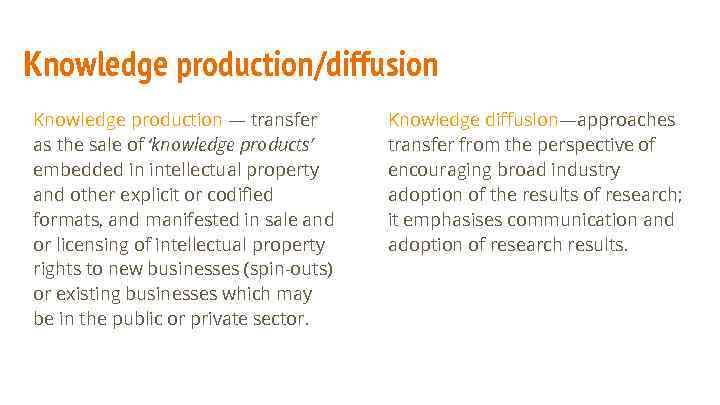 Knowledge production/diffusion Knowledge production — transfer as the sale of ‘knowledge products’ embedded in intellectual property and other explicit or codified formats, and manifested in sale and or licensing of intellectual property rights to new businesses (spin-outs) or existing businesses which may be in the public or private sector. Knowledge diffusion—approaches transfer from the perspective of encouraging broad industry adoption of the results of research; it emphasises communication and adoption of research results.
 Knowledge relationship/engagement Knowledge relationship — transfer as the provision of services to businesses based on a broadly defined intellectual property platform, including trade secrets, know-how and other forms of tacit knowledge; it emphasises collaboration, partnership and joint ventures. Knowledge engagement — transfer as a by-product of a convergence of interests between science and society and in particular, the interests of higher education, industry, and government.
 Measurement of innovation outcomes
 Triple bottom line assessment, looking at economic, social and environment benefits. Direct cost-benefit analysis at both an industry and enterprise level. Identification of the adoption rate of technologies by industry stakeholders. Satisfaction of stakeholders, providing a qualitative measure of the outcomes of technology adoption where appropriate. Where possible, measurement of direct realised benefit at an enterprise level
 thank you for attention