Скачать презентацию Commercialisation of Academic Research Graham Richards University of
e53061fa6404d5ead2836ac67e051a8c.ppt
- Количество слайдов: 44
 Commercialisation of Academic Research Graham Richards University of Oxford & IP Group Plc
 Importance Finance for Universities and the country Jobs in new industries Rewarding and retaining academics
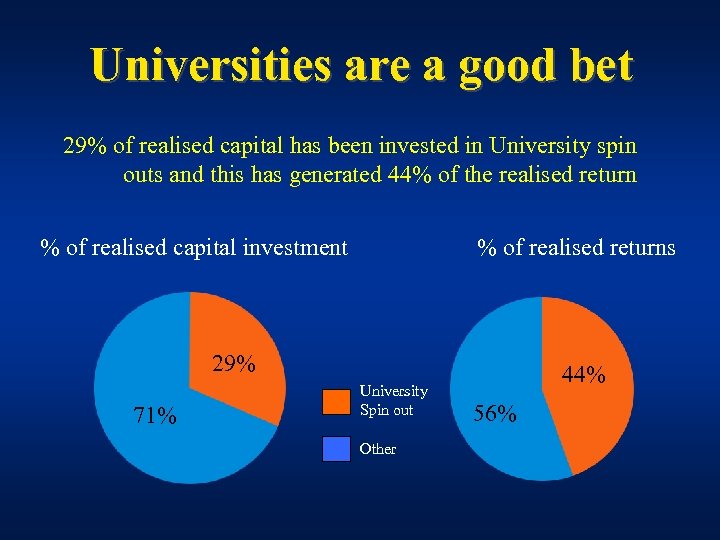 Universities are a good bet 29% of realised capital has been invested in University spin outs and this has generated 44% of the realised return % of realised capital investment % of realised returns 29% 71% University Spin out Other 44% 56%
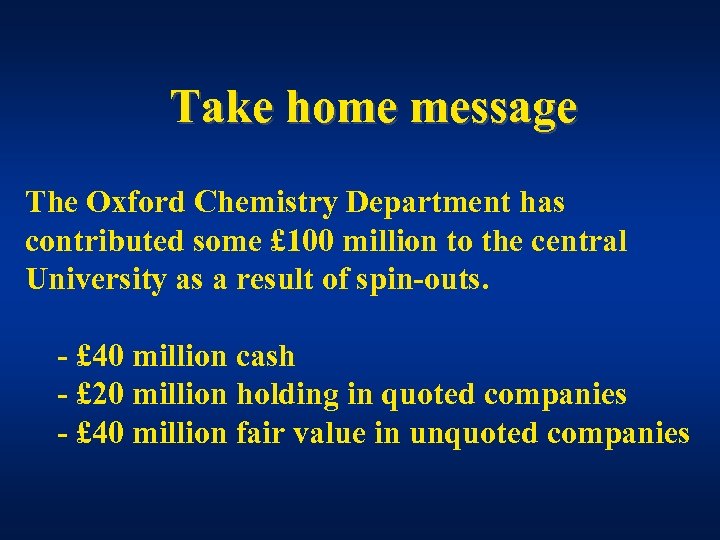 Take home message The Oxford Chemistry Department has contributed some £ 100 million to the central University as a result of spin-outs. - £ 40 million cash - £ 20 million holding in quoted companies - £ 40 million fair value in unquoted companies
 The Oxford Chemistry Department Size • The biggest Chemistry Department in the Western World • Each year 180 graduates with a four year degree including one full year of research • 90 Ph. Ds per year (cf Berkeley 64) • 150 Post-doctoral researchers • 80 Faculty
 The Oxford Chemistry Department Quality • Rated 5* and now 5** • 12 active FRS • Produced 4 Nobel Laureates • Annual research income ~ £ 15 million
 Historic Spin-out Companies • Medisense (now part of Abbott) • Oxford Molecular (now part of Pharmacopeia-Milennium) • Oxford Asymmetry (now Evotec OAI)
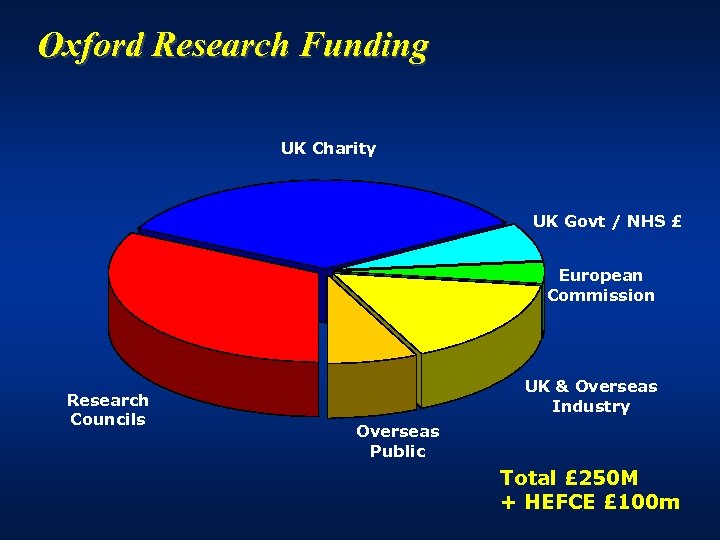 Oxford Research Funding UK Charity UK Govt / NHS £ European Commission Research Councils UK & Overseas Industry Overseas Public Total £ 250 M + HEFCE £ 100 m
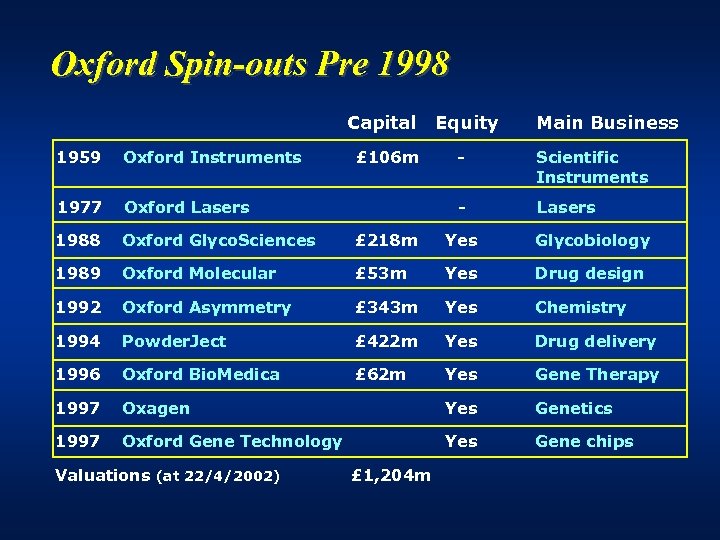 Oxford Spin-outs Pre 1998 Capital Main Business 1959 Oxford Instruments 1977 Oxford Lasers 1988 Oxford Glyco. Sciences £ 218 m Yes Glycobiology 1989 Oxford Molecular £ 53 m Yes Drug design 1992 Oxford Asymmetry £ 343 m Yes Chemistry 1994 Powder. Ject £ 422 m Yes Drug delivery 1996 Oxford Bio. Medica £ 62 m Yes Gene Therapy 1997 Oxagen Yes Genetics 1997 Oxford Gene Technology Yes Gene chips Valuations (at 22/4/2002) £ 106 m Equity Scientific Instruments - £ 1, 204 m - Lasers
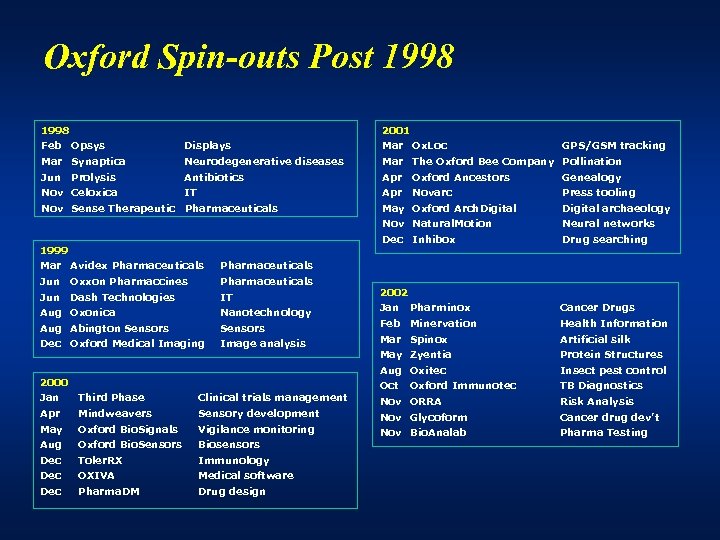 Oxford Spin-outs Post 1998 2001 Feb Opsys Displays Mar Ox. Loc Mar Synaptica Neurodegenerative diseases Mar The Oxford Bee Company Pollination Jun Antibiotics Apr Oxford Ancestors Genealogy Nov Celoxica IT Apr Novarc Press tooling Nov Sense Therapeutic Pharmaceuticals May Oxford Arch. Digital archaeology Nov Natural. Motion Neural networks Dec Inhibox Drug searching Prolysis 1999 Mar Avidex Pharmaceuticals Jun Oxxon Pharmaccines Pharmaceuticals Jun Dash Technologies IT GPS/GSM tracking Aug Oxonica Nanotechnology Aug Abington Sensors Dec Oxford Medical Imaging Image analysis 2002 Jan Pharminox Cancer Drugs Jan Third Phase Clinical trials management Apr Mindweavers Sensory development May Oxford Bio. Signals Vigilance monitoring Aug Oxford Bio. Sensors Biosensors Dec Toler. RX Immunology Dec OXIVA Medical software Dec Pharma. DM Drug design Health Information Mar Spinox Artificial silk May Zyentia Protein Structures Aug Oxitec 2000 Feb Minervation Insect pest control Oct TB Diagnostics Oxford Immunotec Nov ORRA Risk Analysis Nov Glycoform Cancer drug dev’t Nov Bio. Analab Pharma Testing
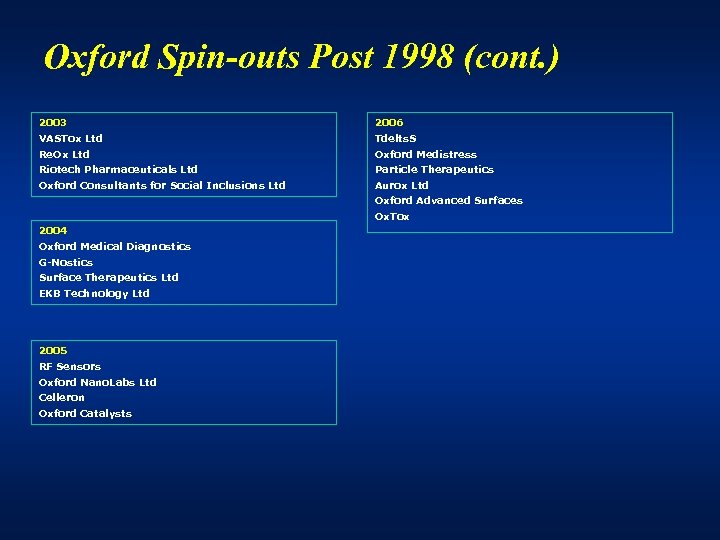 Oxford Spin-outs Post 1998 (cont. ) 2003 2006 VASTox Ltd Tdelts. S Re. Ox Ltd Oxford Medistress Riotech Pharmaceuticals Ltd Particle Therapeutics Oxford Consultants for Social Inclusions Ltd Aurox Ltd Oxford Advanced Surfaces Ox. Tox 2004 Oxford Medical Diagnostics G-Nostics Surface Therapeutics Ltd EKB Technology Ltd 2005 RF Sensors Oxford Nano. Labs Ltd Celleron Oxford Catalysts
 Intellectual Property Absolutely fundamental to the Oxford situation in the University’s ownership of IP. The University spends £ 2. 5 million per year on patents
 History I Until 1945 Universities neither owned or sought to own IP due to the Owen Scandal In 1924 Oxford’s Professor of Agricultural Engineering proved to be a swindler and the University was sued for £ 750, 000
 History II 1940 After the fall of France and Britain was alone the US provided 50 ships: the “lend lease” agreement. US got bases in the West Indies plus Britain agreed not to patent Radar Jet engine Penicillin 1945 Realising the UK had given away billions, the Atlee Government set up NRDC (National Research for Development Corporation) which owned all Government funded IP
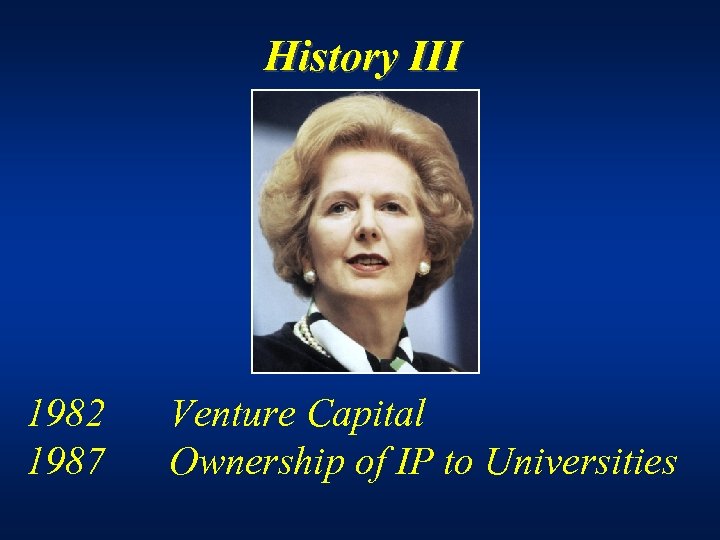 History III 1982 1987 Venture Capital Ownership of IP to Universities
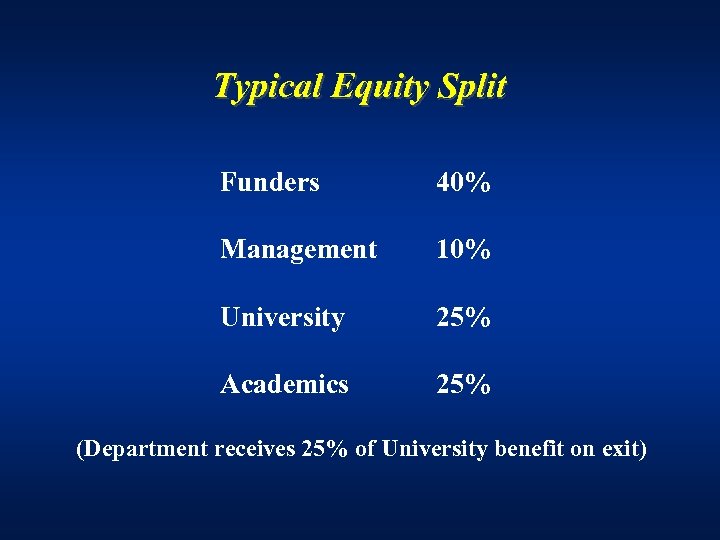 Typical Equity Split Funders 40% Management 10% University 25% Academics 25% (Department receives 25% of University benefit on exit)
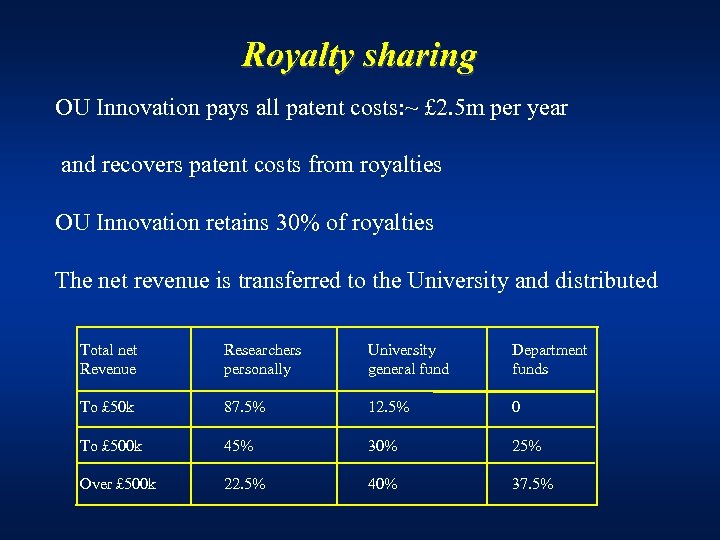 Royalty sharing OU Innovation pays all patent costs: ~ £ 2. 5 m per year and recovers patent costs from royalties OU Innovation retains 30% of royalties The net revenue is transferred to the University and distributed Total net Revenue Researchers personally University general fund Department funds To £ 50 k 87. 5% 12. 5% 0 To £ 500 k 45% 30% 25% Over £ 500 k 22. 5% 40% 37. 5%
 Oxford Molecular Admission to the Official List of The London Stock Exchange Placing Sponsored by Henry Cooke Corporate Finance Ltd
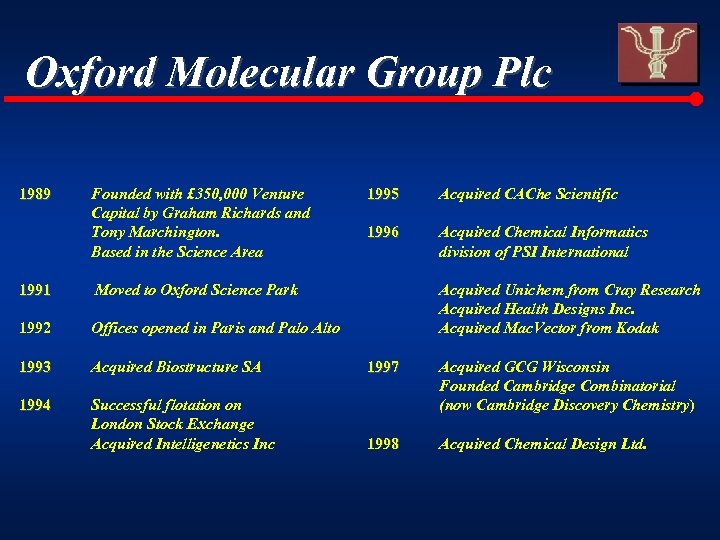 Oxford Molecular Group Plc 1989 Founded with £ 350, 000 Venture Capital by Graham Richards and Tony Marchington. Based in the Science Area 1995 Acquired CAChe Scientific 1996 Acquired Chemical Informatics division of PSI International 1991 Moved to Oxford Science Park Acquired Unichem from Cray Research Acquired Health Designs Inc. Acquired Mac. Vector from Kodak 1992 Offices opened in Paris and Palo Alto 1993 Acquired Biostructure SA 1997 1994 Successful flotation on London Stock Exchange Acquired Intelligenetics Inc Acquired GCG Wisconsin Founded Cambridge Combinatorial (now Cambridge Discovery Chemistry) 1998 Acquired Chemical Design Ltd.
 Oxford Molecular Group Plc Highlights Capitalization Highest £ 450 million Lowest Largest share of world bioinformatics market - 25% £ 30 million Biggest share of Japanese molecular modelling market 60% of sales in USA 400 employees, half in USA
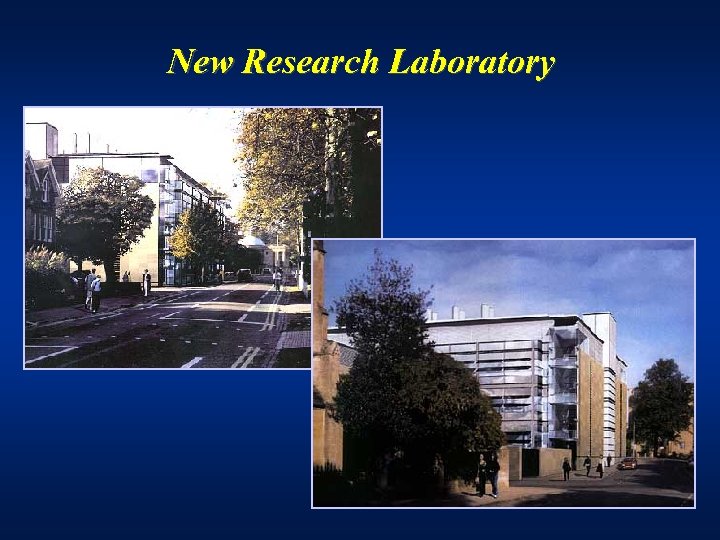 New Research Laboratory
 The IP Group Partnership For 15 years IP Group will receive half of the University equity in any Chemistry spin-out in return for an up front sum.
 Modus Operandi • ‘Chemist’ is defined by RAE • If another department involved, academics define the split • IP Group adds analysts’ knowledge • IP Group sources funds • Similar arrangements apply to licensing
 2001 Inhibox Based on the screen saver project of Graham Richards for drug lead discovery Still private but profitable www. inhibox. com
 2002 Glycoform Glycochemistry from the research of Ben Davies and Anthony Fairbanks www. glycoform. com
 2002 Zyentia Structural modification of proteins derived from Chris Dobson’s research www. zyentia. com
 2002 Pharminox Small molecule oncology originating with Gordon Lowe www. phaminox. com
 2002 Re. Ox Drug discovery based on controlling activity of hypoxia inducible factor, incorporating work of Chris Schofield www. reox. co. uk Major contract with Amgen
 2003 VASTox, now Summit Drug discovery from Steve Davies using chemical genomics. IPO 2004 Market cap was £ 60 million www. summitplc. com
 2004 Oxford Medical Diagnostics Laser based analytical techniques from Gus Hancock Acquired by Avacta Group Plc
 2005 Oxford Catalysts Now Velocys Catalysts for clean energy from the research of Malcolm Green and Tiancun Xiao. IPO 2006 Market cap £ 280 million www. oxfordcatalysts. com
 2005 Oxford Nanopore Technologies Single molecule detection based on research of Hagan Bayley Received over £ 145 million funding Major investment from Illumina www. nanoporetech. com
 2006 Oxford Advanced Surfaces Coatings using chemistry of Mark Moloney Reverse takeover of Kanyon Plc Market cap £ 160 million www. oxfordsurfaces. com
 2006 Ox. Tox Electrochemical detection based on the research of Richard Compton
 2013 Oxford Biotrans Enzyme-based technique which can transform commonly available natural extracts into related flavour and fragrance compounds. Based on work of Luet Wong. www. oxfordbiotrans. com
 2014 Oxford Advanced Conductors Advanced materials for high performance thin film coatings for touch panel displays. Based on work of Peter Edwards www. oxacs. com
 2014 Ox. Sy. Bio 3 D printing techniques to produce synthetic materials for wound healing and drug delivery and even synthetic tissues. Based on the work of Hagan Bayley www. oxsysbio. com
 2014 Ox. Stem Use of stem cells and medicinal chemistry to identify new classes of drugs that can re-program or stimulate cells. Based on the research of Steve Davies and Angela Russell www. oxstem. com
 2016 OMass Native mass spectrometry to characterise complex protein assemblies. Based on the research of Carol Robinson www. omasstech. com
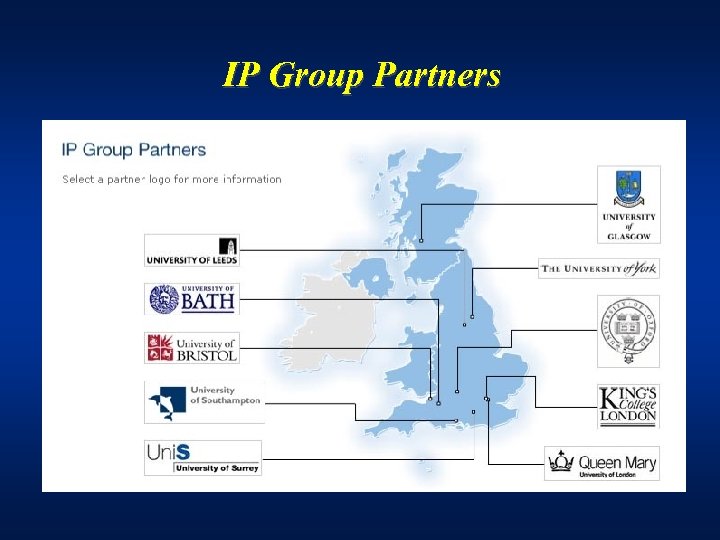 IP Group Partners
 Current problems Clarity of IP Ownership and pipelines Pricing investments, valuation Appetite for IPOs Weakness of the Alternative Investment Market Sources of funds Weakness of some Tech Transfer Offices Management
 Conclusions It is imperative that we go down this route Having some role model helps Clusters make things easier It can be profitable and fun Current market cap of IP Group Plc is £ 1 billion