


 Скачать презентацию Commercial Aviation Safety Team CAST Plan Metrics
b717aa3df2cee3061b2049660b576364.ppt
- Количество слайдов: 36
 Commercial Aviation Safety Team (CAST) Plan & Metrics
 Agenda l Executive Overview of CAST Progress l Historical Background l Progress to Date l Annual Safety Plan l Inclusion of R & D l Business model l Action Plan l Garner support for continued CAST activities
 CAST Origin
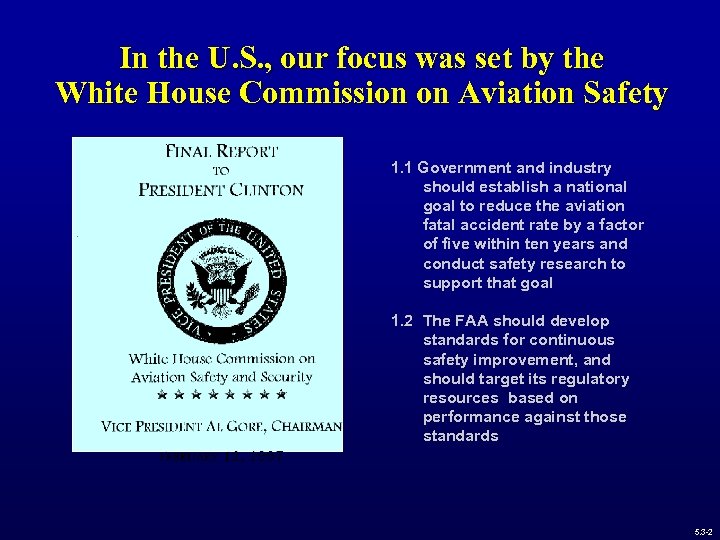 In the U. S. , our focus was set by the White House Commission on Aviation Safety 1. 1 Government and industry should establish a national goal to reduce the aviation fatal accident rate by a factor of five within ten years and conduct safety research to support that goal 1. 2 The FAA should develop standards for continuous safety improvement, and should target its regulatory resources based on performance against those standards 5. 3 -2
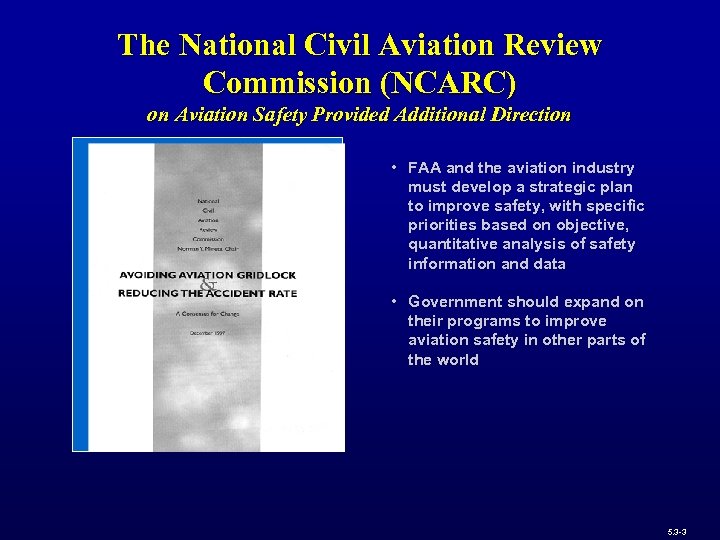 The National Civil Aviation Review Commission (NCARC) on Aviation Safety Provided Additional Direction • FAA and the aviation industry must develop a strategic plan to improve safety, with specific priorities based on objective, quantitative analysis of safety information and data • Government should expand on their programs to improve aviation safety in other parts of the world 5. 3 -3
 In Response l l l Ongoing Industry and FAA Safer Skies Initiatives were Combined into CAST Data-Driven, Consensus-Based, Integrated Strategic Safety Plan Developed In place and fully supported by Government and Industry with Worldwide Recognition - “CAST”
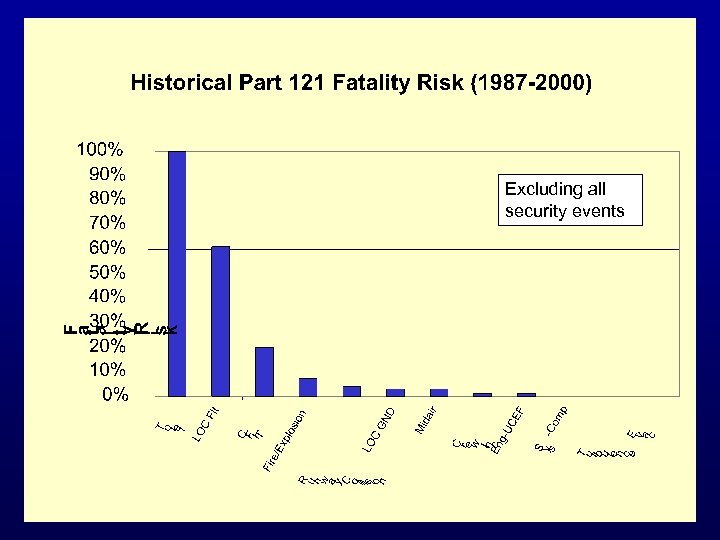 Excluding all security events
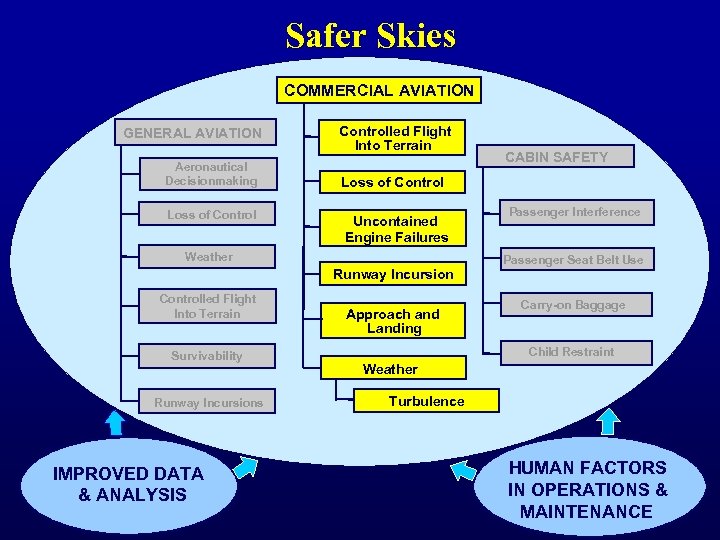 Safer Skies COMMERCIAL AVIATION GENERAL AVIATION Aeronautical Decisionmaking Loss of Controlled Flight Into Terrain Loss of Control Uncontained Engine Failures Weather Runway Incursion Controlled Flight Into Terrain Survivability Runway Incursions IMPROVED DATA & ANALYSIS CABIN SAFETY Approach and Landing Passenger Interference Passenger Seat Belt Use Carry-on Baggage Child Restraint Weather Turbulence HUMAN FACTORS IN OPERATIONS & MAINTENANCE
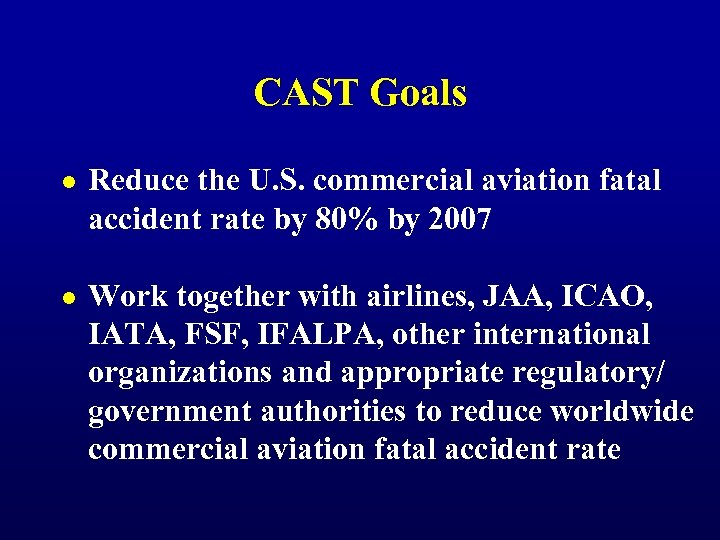 CAST Goals l Reduce the U. S. commercial aviation fatal accident rate by 80% by 2007 l Work together with airlines, JAA, ICAO, IATA, FSF, IFALPA, other international organizations and appropriate regulatory/ government authorities to reduce worldwide commercial aviation fatal accident rate
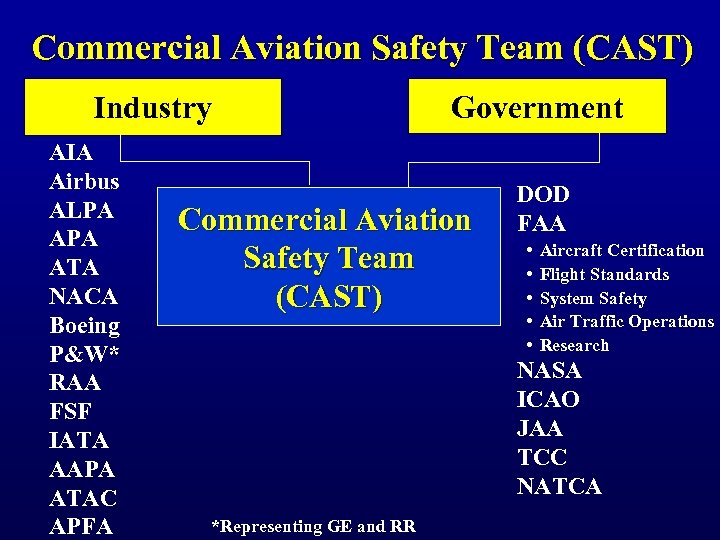 Commercial Aviation Safety Team (CAST) Industry AIA Airbus ALPA ATA NACA Boeing P&W* RAA FSF IATA AAPA ATAC APFA Government Commercial Aviation Safety Team (CAST) DOD FAA • • • Aircraft Certification Flight Standards System Safety Air Traffic Operations Research NASA ICAO JAA TCC NATCA *Representing GE and RR
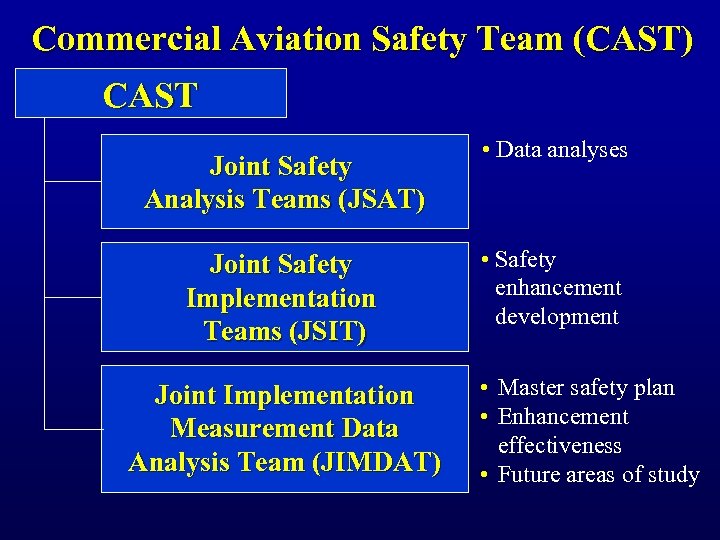 Commercial Aviation Safety Team (CAST) CAST Joint Safety Analysis Teams (JSAT) Joint Safety Implementation Teams (JSIT) Joint Implementation Measurement Data Analysis Team (JIMDAT) • Data analyses • Safety enhancement development • Master safety plan • Enhancement effectiveness • Future areas of study
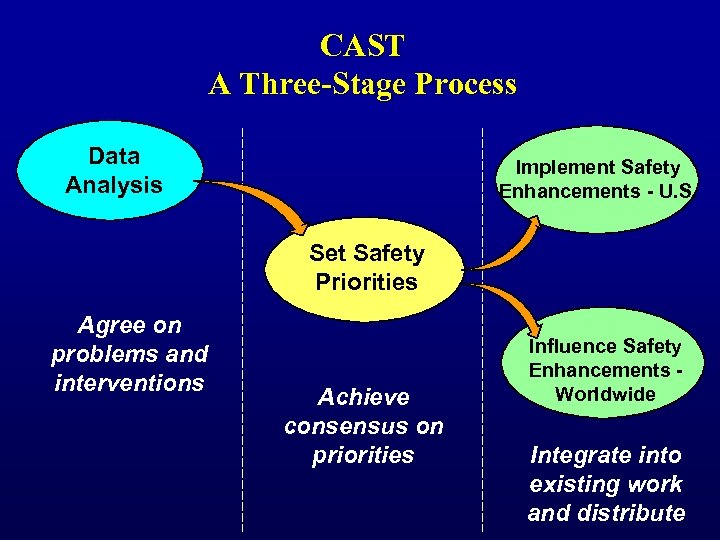 CAST A Three-Stage Process Data Analysis Implement Safety Enhancements - U. S. Set Safety Priorities Agree on problems and interventions Achieve consensus on priorities Influence Safety Enhancements Worldwide Integrate into existing work and distribute
 Additional Safer Skies Activities l Although the primary purpose of our briefing focuses on CAST, there are other Safer Skies focus areas: – General Aviation Joint Steering Committee (JSC) – Cabin Safety
 Integrated Strategic Safety Plan l l l Data-Driven, Consensus-Based, Integrated Strategic Safety Plan Developed – 46 Prioritized Safety Enhancements – 8 R&D Projects and 2 Studies 46 safety enhancements optimized to include those actions with the best effectiveness vs. resource relationships - 22 complete/24 committed and underway Initially combines short-term “liveware”-based enhancements with transition to design change enhancements long term Projected 73% Risk Reduction by 2007 (75% by 2020) Foundation for U. S-supported continuous improvements in worldwide aviation safety
 CAST Safety Plan
 Completed Safety Enhancements l l l Terrain avoidance warning system (TAWS) CFIT Standard Operating Procedures Precision approach implementation (PAI) Vertical Angles – Increase constant angle approaches Minimum Safe Altitude Warning (MSAW) Systems Proactive Safety Programs (FOQA + ASAP) CFIT Crew Resource Management (CRM) training CFIT Prevention training Air Traffic Controller CFIT training PAI-VGSI at runway ends PAI-DME at airports RI SOPs – Ground Operations (General Aviation) – Tow tug operators – ATC
 Completed Safety Enhancements (cont’d) l Safety Culture – Industry will include essential safety information in the appropriate airline manuals (i. e. , training programs) – FAA inspectors will utilize the Aircraft Flight Manual (AFM) database – CEO and Director of Safety (DOS) more visible l Maintenance Procedures – FAA published guidance on: § § § Servicing landing struts Surveillance of maintenance subcontractors Minimum Equipment List (MEL) (covers recurring maintenance events) – Air Carriers’ Directors of Safety completed internal surveys to verify guidance was being followed l l ALAR Flight crew training Uncontained Engine Failures – FAA issued Airworthiness Directives requiring the Inspection of High-Energy Rotating Parts
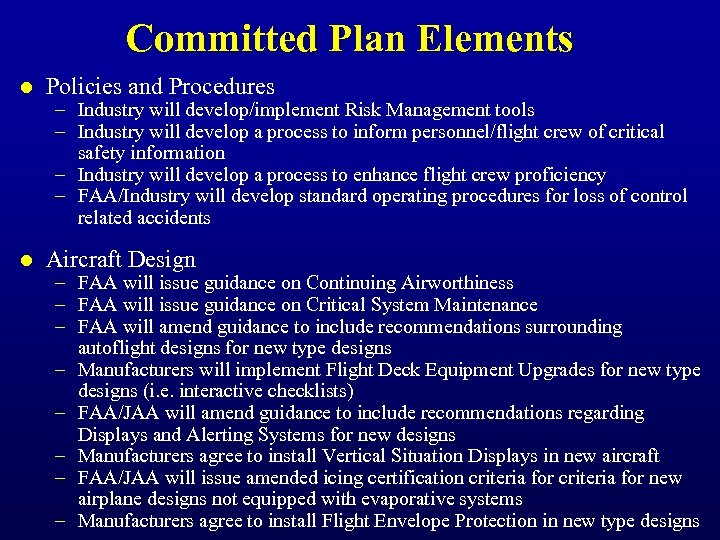 Committed Plan Elements l Policies and Procedures l Aircraft Design – Industry will develop/implement Risk Management tools – Industry will develop a process to inform personnel/flight crew of critical safety information – Industry will develop a process to enhance flight crew proficiency – FAA/Industry will develop standard operating procedures for loss of control related accidents – FAA will issue guidance on Continuing Airworthiness – FAA will issue guidance on Critical System Maintenance – FAA will amend guidance to include recommendations surrounding autoflight designs for new type designs – Manufacturers will implement Flight Deck Equipment Upgrades for new type designs (i. e. interactive checklists) – FAA/JAA will amend guidance to include recommendations regarding Displays and Alerting Systems for new designs – Manufacturers agree to install Vertical Situation Displays in new aircraft – FAA/JAA will issue amended icing certification criteria for new airplane designs not equipped with evaporative systems – Manufacturers agree to install Flight Envelope Protection in new type designs
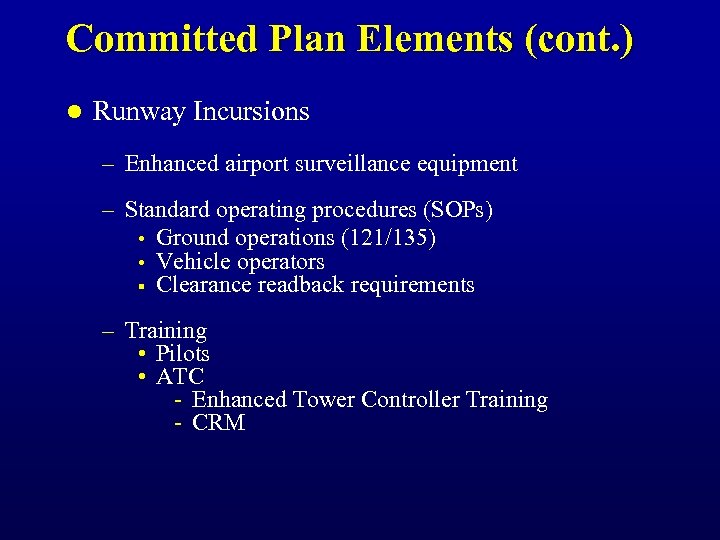 Committed Plan Elements (cont. ) l Runway Incursions – Enhanced airport surveillance equipment – Standard operating procedures (SOPs) • Ground operations (121/135) • Vehicle operators § Clearance readback requirements – Training • Pilots • ATC - Enhanced Tower Controller Training - CRM
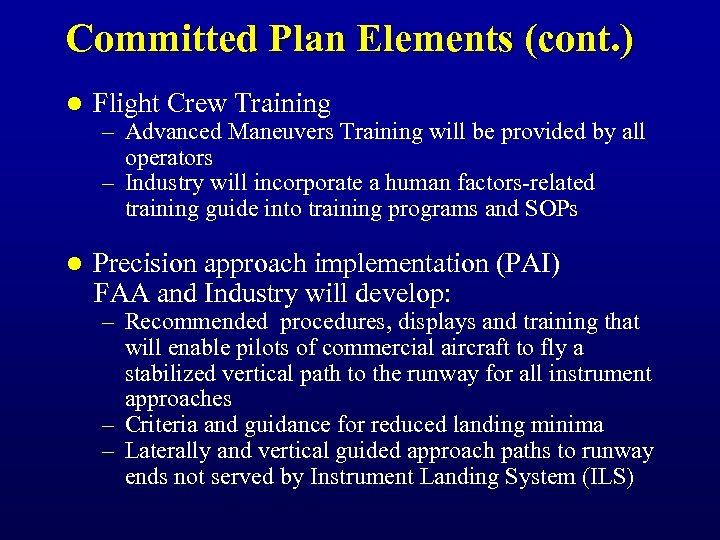 Committed Plan Elements (cont. ) l Flight Crew Training – Advanced Maneuvers Training will be provided by all operators – Industry will incorporate a human factors-related training guide into training programs and SOPs l Precision approach implementation (PAI) FAA and Industry will develop: – Recommended procedures, displays and training that will enable pilots of commercial aircraft to fly a stabilized vertical path to the runway for all instrument approaches – Criteria and guidance for reduced landing minima – Laterally and vertical guided approach paths to runway ends not served by Instrument Landing System (ILS)
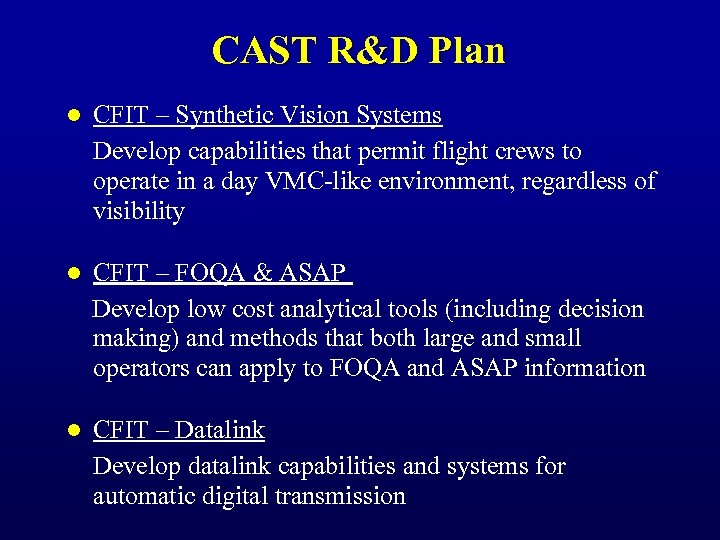 CAST R&D Plan l CFIT – Synthetic Vision Systems Develop capabilities that permit flight crews to operate in a day VMC-like environment, regardless of visibility l CFIT – FOQA & ASAP Develop low cost analytical tools (including decision making) and methods that both large and small operators can apply to FOQA and ASAP information l CFIT – Datalink Develop datalink capabilities and systems for automatic digital transmission
 CAST R&D Plan (cont’d) l CFIT Precision-Like Approach Conduct research necessary to determine human factors guidelines for design of instrument procedures l ALAR - Health & Usage Monitoring Systems (HUMS) Conduct research and develop technology for detection, prediction and/or annunciation of impending equipment failures l ALAR – Human Factors Conduct research into correcting and eliminating the underlying reasons/causes for procedural noncompliance.
 CAST R&D Plan (cont’d) l LOC – Icing For aircraft that incorporate non-evaporative ice protection systems, develop systems that sense the presence of ice accretion on the aircraft, automatically activate and manage the ice protection systems, and provide the pilot with feedback including the effect on measured aircraft performance, stability, and control l LOC - Envelope Protection -Existing Airplanes Complete study and determine feasibility of modifying existing aircraft to include angle-of-attack / low speed protection (e. g. , stick pushers/nudgers, column force ramps/gradients, automatic elevator/stabilizer inputs); thrust asymmetry compensation; and bank angle protection using hard or soft limits
 CAST R&D Plan (cont’d) l RI - ATC Procedures -Review Capacity Enhancement Program - LAHSO) Complete review of capacity enhancement programs to determine if they are contributory to runway incursions l RI - RI Visual Aids Enhancement and Automation Technology - Airports - Runway occupancy signal Develop, evaluate and install a visual signal to indicate runway occupancy to flight crews on final approach to that runway
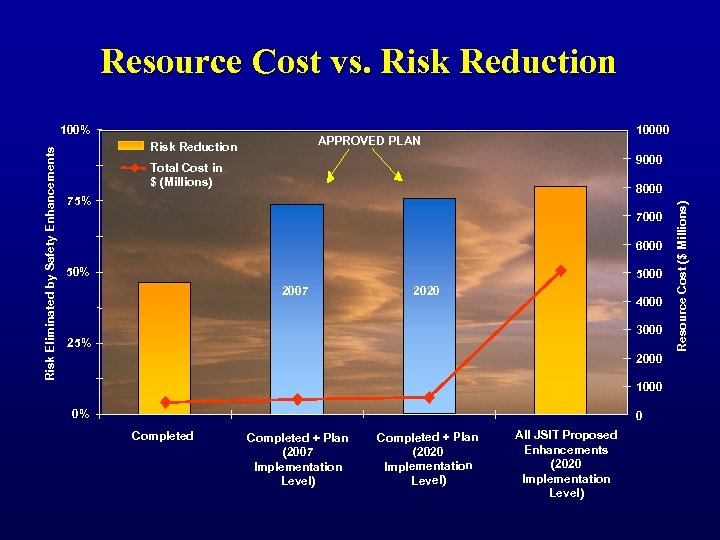 Resource Cost vs. Risk Reduction 10000 APPROVED PLAN Risk Reduction 9000 Total Cost in $ (Millions) 8000 75% 7000 6000 50% 5000 2007 2020 4000 3000 25% 2000 1000 0% 0 Completed + Plan (2007 Implementation Level) Completed + Plan (2020 Implementation Level) All JSIT Proposed Enhancements (2020 Implementation Level) Resource Cost ($ Millions) Risk Eliminated by Safety Enhancements 100%
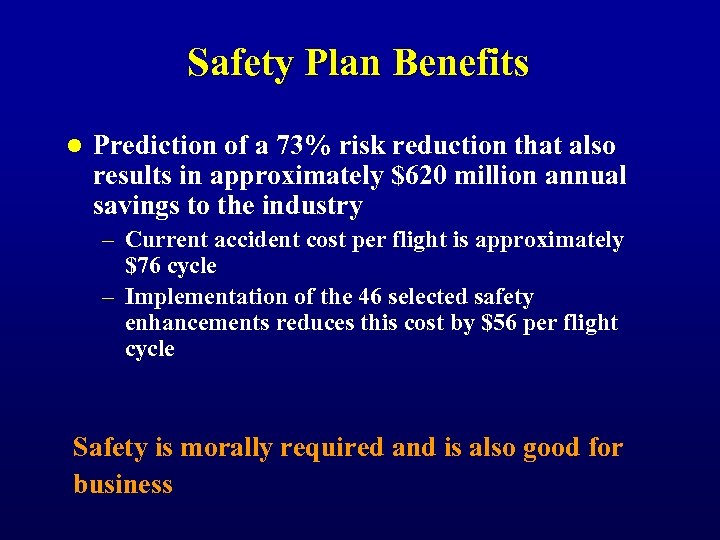 Safety Plan Benefits l Prediction of a 73% risk reduction that also results in approximately $620 million annual savings to the industry – Current accident cost per flight is approximately $76 cycle – Implementation of the 46 selected safety enhancements reduces this cost by $56 per flight cycle Safety is morally required and is also good for business
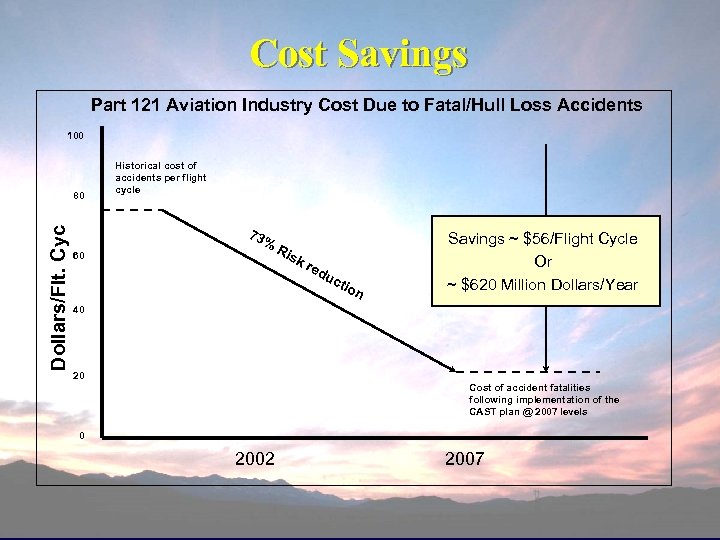 Cost Savings Part 121 Aviation Industry Cost Due to Fatal/Hull Loss Accidents 100 Dollars/Flt. Cyc 80 Historical cost of accidents per flight cycle 73 % 60 Ris kr ed uc ti on Savings ~ $56/Flight Cycle Or ~ $620 Million Dollars/Year 40 20 Cost of accident fatalities following implementation of the CAST plan @ 2007 levels 0 2002 2007
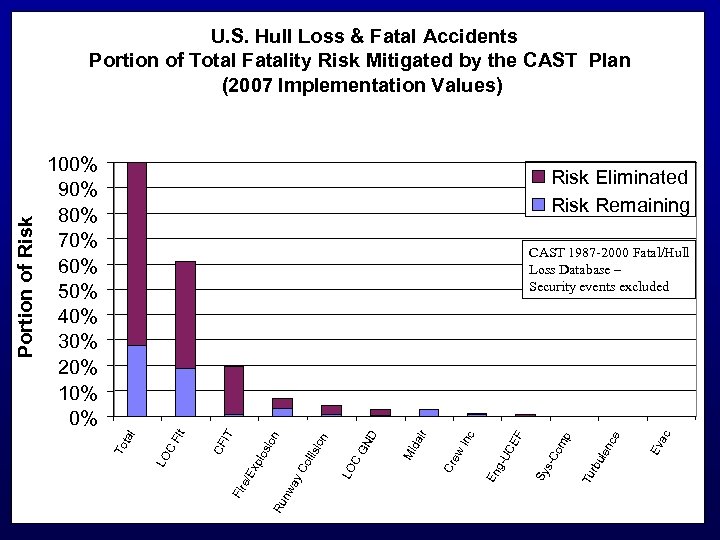 100% 90% 80% 70% 60% 50% 40% 30% 20% 10% 0% Risk Eliminated Risk Remaining ac Ev ce Tu rbu len p om s-C Sy En g-U CE F Inc ew Cr ir da Mi D GN C LO oll y. C wa Ru n Fir e/E xp los isi on ion IT CF Flt C LO tal CAST 1987 -2000 Fatal/Hull Loss Database – Security events excluded To Portion of Risk U. S. Hull Loss & Fatal Accidents Portion of Total Fatality Risk Mitigated by the CAST Plan (2007 Implementation Values)
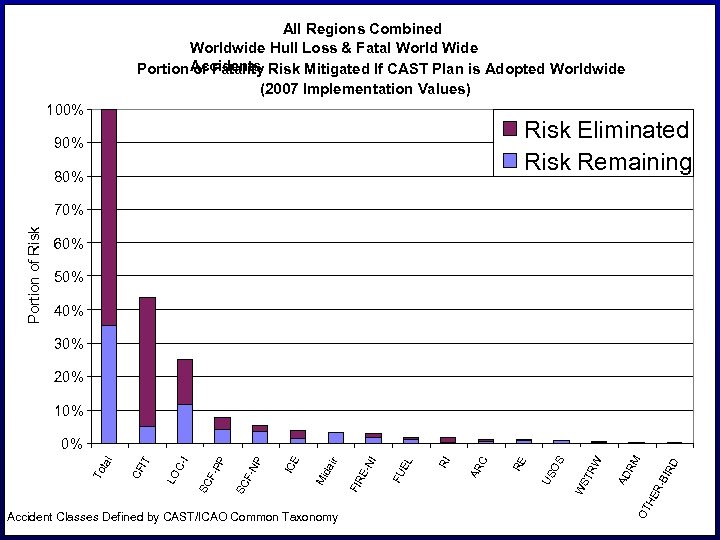 All Regions Combined Worldwide Hull Loss & Fatal World Wide Portion Accidents Risk Mitigated If CAST Plan is Adopted Worldwide of Fatality (2007 Implementation Values) 100% Risk Eliminated Risk Remaining 90% 80% Portion of Risk 70% 60% 50% 40% 30% 20% 10% D BIR HE R- AD W TR WS OS US RE C AR RI EL FU ENI RM OT Accident Classes Defined by CAST/ICAO Common Taxonomy FIR ir Mi da E IC P F-N SC SC F-P P I CLO IT CF To tal 0%
 The CAST Process is Flexible It may be used to analyze: • Suggestions from outside industry • Regulatory initiatives • Accident lessons learned • Incident data • Other
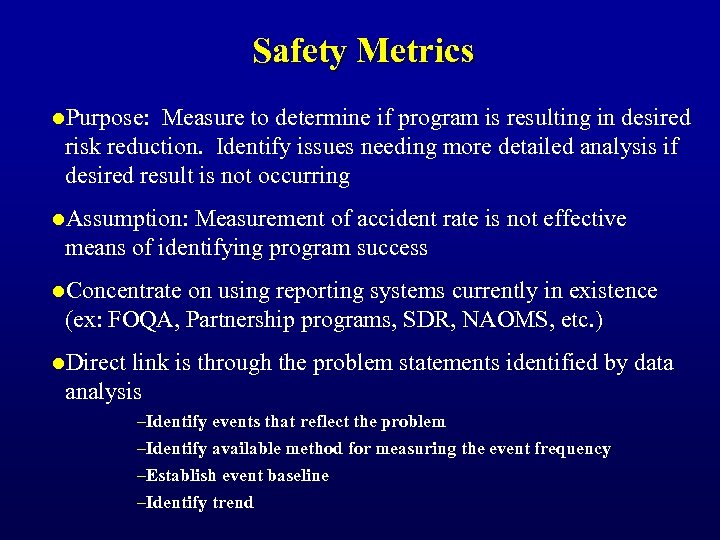 Safety Metrics l. Purpose: Measure to determine if program is resulting in desired risk reduction. Identify issues needing more detailed analysis if desired result is not occurring l. Assumption: Measurement of accident rate is not effective means of identifying program success l. Concentrate on using reporting systems currently in existence (ex: FOQA, Partnership programs, SDR, NAOMS, etc. ) l. Direct link is through the problem statements identified by data analysis –Identify events that reflect the problem –Identify available method for measuring the event frequency –Establish event baseline –Identify trend
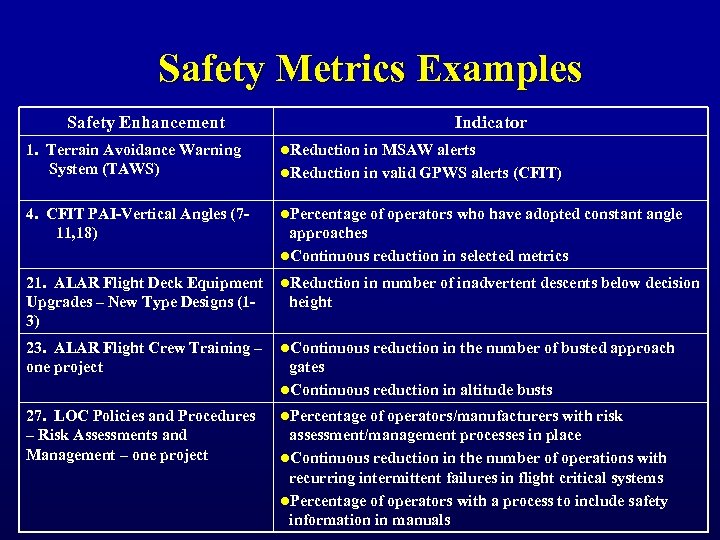 Safety Metrics Examples Safety Enhancement Indicator 1. Terrain Avoidance Warning System (TAWS) l. Reduction in MSAW alerts l. Reduction in valid GPWS alerts (CFIT) 4. CFIT PAI-Vertical Angles (711, 18) l. Percentage 21. ALAR Flight Deck Equipment Upgrades – New Type Designs (13) l. Reduction 23. ALAR Flight Crew Training – one project l. Continuous 27. LOC Policies and Procedures – Risk Assessments and Management – one project l. Percentage of operators who have adopted constant angle approaches l. Continuous reduction in selected metrics in number of inadvertent descents below decision height reduction in the number of busted approach gates l. Continuous reduction in altitude busts of operators/manufacturers with risk assessment/management processes in place l. Continuous reduction in the number of operations with recurring intermittent failures in flight critical systems l. Percentage of operators with a process to include safety information in manuals
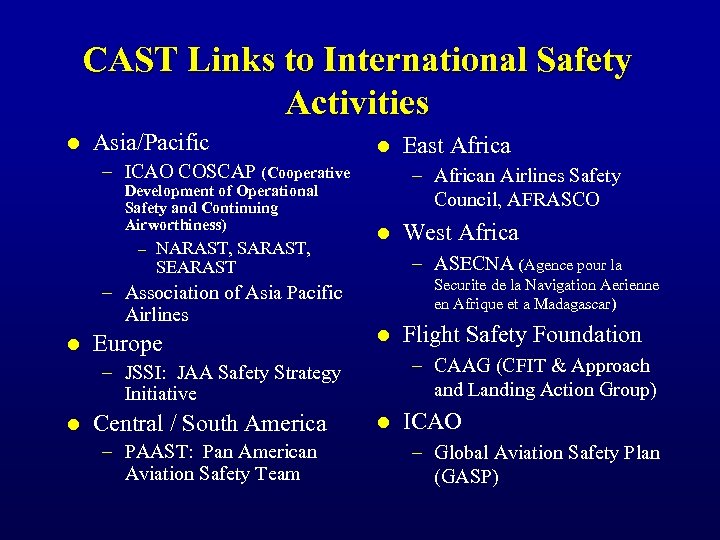 CAST Links to International Safety Activities l Asia/Pacific l – ICAO COSCAP (Cooperative Development of Operational Safety and Continuing Airworthiness) – NARAST, SEARAST – Association of Asia Pacific Airlines l Europe – African Airlines Safety Council, AFRASCO l Central / South America – PAAST: Pan American Aviation Safety Team West Africa – ASECNA (Agence pour la Securite de la Navigation Aerienne en Afrique et a Madagascar) l Flight Safety Foundation – CAAG (CFIT & Approach and Landing Action Group) – JSSI: JAA Safety Strategy Initiative l East Africa l ICAO – Global Aviation Safety Plan (GASP)
 Future Vision l Execute the CAST-approved Safety Plan l Measure Plan effectiveness and modify Plan based on metrics and results l Continue the development of a proactive incident-based risk mitigation methodology l Improve the CAST process l Expand CAST influence on worldwide safety programs l Integrate safety program with R & D initiatives l Catalog the many on-going safety initiatives that dilute limited resources and identify opportunities for program integration and efficiency improvements
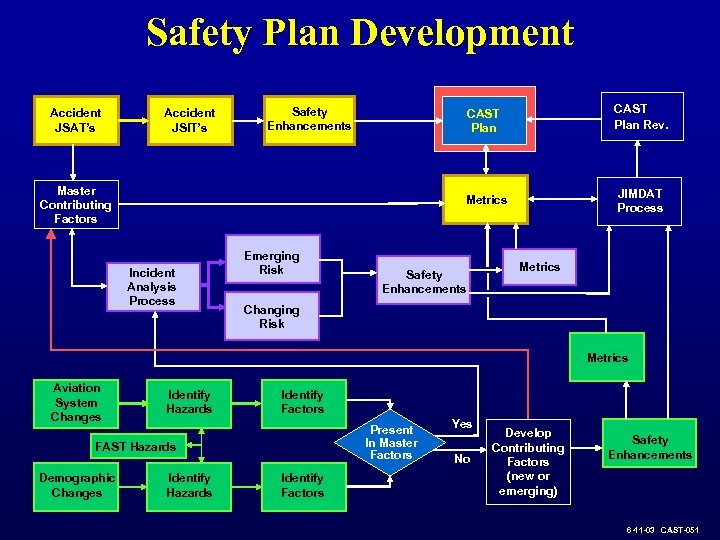 Safety Plan Development Accident JSAT’s CAST Plan JIMDAT Process Safety Enhancements Master Contributing Factors Incident Analysis Process CAST Plan Rev. Metrics Accident JSIT’s Emerging Risk Safety Enhancements Metrics Changing Risk Metrics Aviation System Changes Identify Hazards Identify Factors Present In Master Factors FAST Hazards Demographic Changes Identify Hazards Identify Factors Yes No Develop Contributing Factors (new or emerging) Safety Enhancements 6 -11 -03 CAST-051
 Conclusions CAST has an effective data-driven process l CAST has become the model for US Industry/Government consensus building on safety l CAST brings together all the key players l – Air Carriers – Employee Groups – Manufacturers – Government Predicted 73% risk reduction by 2007 l Industry is voluntarily implementing CAST recommendations l CAST is committed to worldwide participation l CAST is moving to develop proactive processes to identify changing and emerging risks l