 Скачать презентацию Commentary from a Certification Body Mike Violette Director
88826d2bc84e714c8f2afe012b5242e2.ppt
- Количество слайдов: 52



Commentary from a Certification Body Mike Violette Director American Certification Body mikev@acbcert. com
Background • i. NARTE-Certified EMC Engineer • Professional Engineer (Virginia) – Founder, Washington Laboratories (1989) – Founder, American Certification Body (1999)
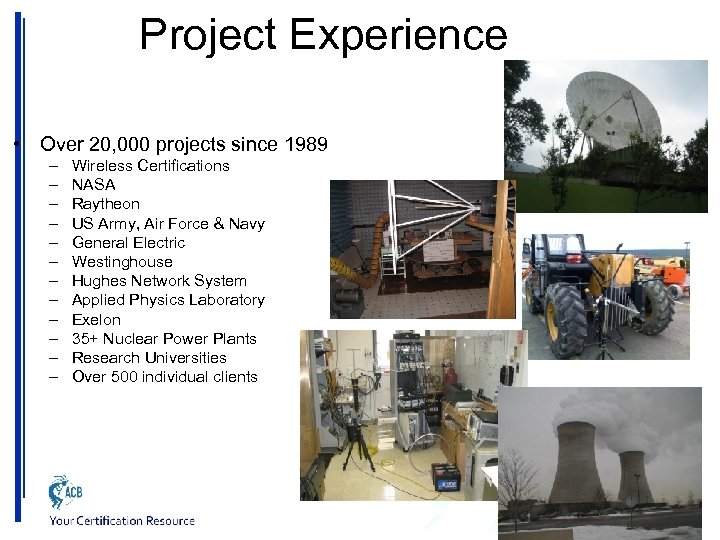
Project Experience • Over 20, 000 projects since 1989 – – – Wireless Certifications NASA Raytheon US Army, Air Force & Navy General Electric Westinghouse Hughes Network System Applied Physics Laboratory Exelon 35+ Nuclear Power Plants Research Universities Over 500 individual clients
Presentation for Today 3 Themes • Services for a booming wireless industry • Some statistics • Delivering what the customer needs * For Devices
Standards and Regulations • Compatibility and Spectrum Protection • Health and Safety • Functional • Performance * For Devices
Compatibility & Spectrum Protection • Regulatory – FCC in US – ISED in Canada – CE Marking in EU – MIC Japan • Country specific
Health & Safety Standards • IEC: International Electro-technical Commission • EN: European Norm • UL: Underwriters Laboratories • CSA: Canadian Standards
Hazards • • • Fire Shock Acoustic Chemical Radiation Mechanical
Functional • Communications Protocols – IEEE 802. 11, etc – CTIA • Size, weight, form and fit – Role for Inspection Body • ISO 17020
Performance • • Physical Electrical Environmental End-use – Often Contractual
U. S. REGULATORY AUTHORITIES – Federal Communications Commission (FCC) • Control use and protection of Radio Frequency Services for Public
RF Safety Issues Human Exposure - SAR • • ANSI C 95. 1 OET 65 -C FCC Part 1. 1037 FCC Part 2. 1091 Mobile Devices FCC Part 2. 1093 Portable Devices FCC Part 15. 247 (b) (4)
Accreditation in Our Industry • ISO 17065 for Certification Bodies • ISO 17025 for Laboratory Operations • Accreditation by third-party accreditors
Accreditation Bodies • International Laboratory Accreditation Program (ILAC) – Since 1996 – 66 Accreditation Bodies
Accreditation Process • Audit – Management System – Records – Calibration – Incoming sample control – Reports – Methods – Complaints and Corrective Actions
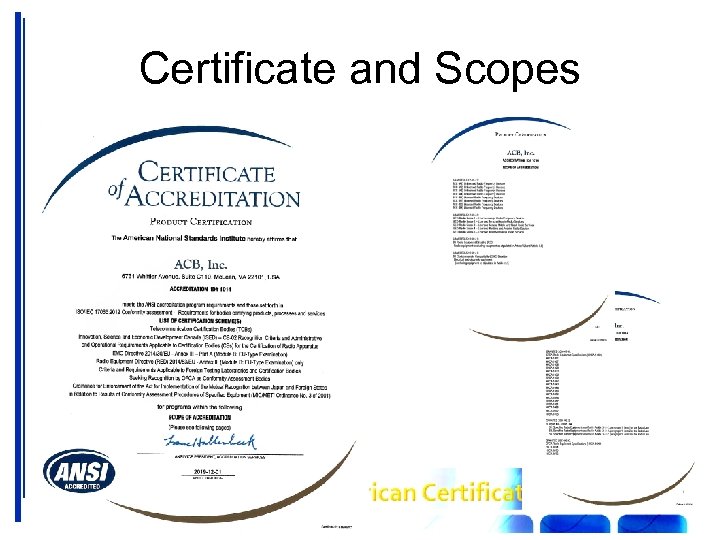
Certificate and Scopes
Testing and Evaluation
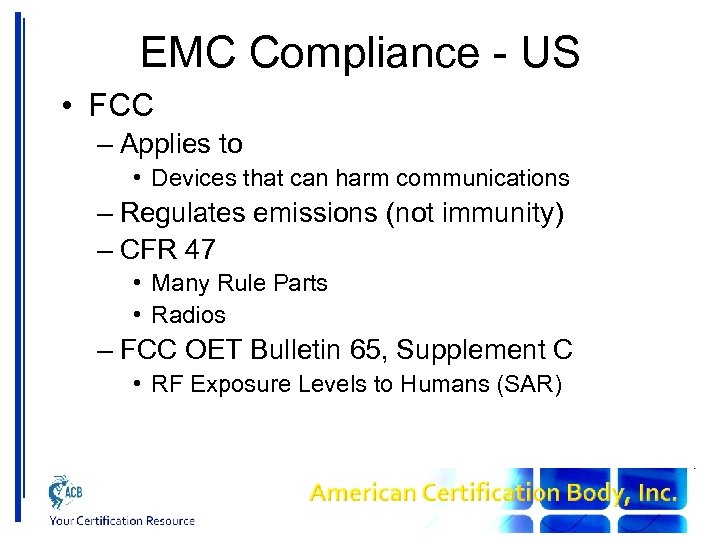
EMC Compliance - US • FCC – Applies to • Devices that can harm communications – Regulates emissions (not immunity) – CFR 47 • Many Rule Parts • Radios – FCC OET Bulletin 65, Supplement C • RF Exposure Levels to Humans (SAR)
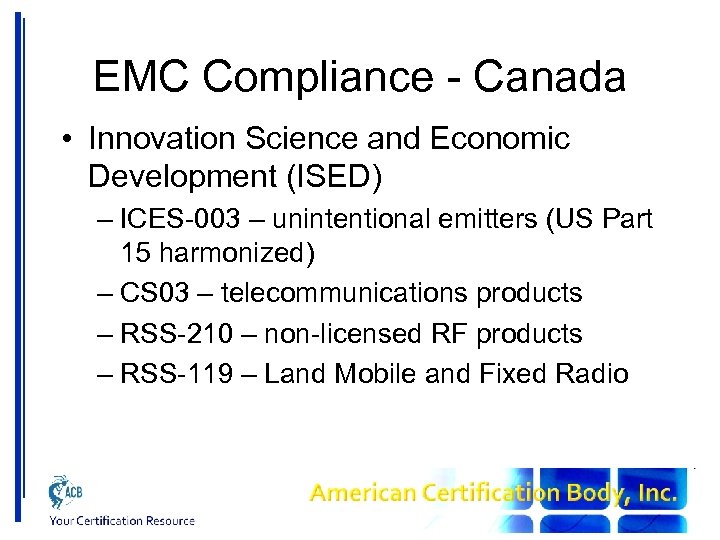
EMC Compliance - Canada • Innovation Science and Economic Development (ISED) – ICES-003 – unintentional emitters (US Part 15 harmonized) – CS 03 – telecommunications products – RSS-210 – non-licensed RF products – RSS-119 – Land Mobile and Fixed Radio
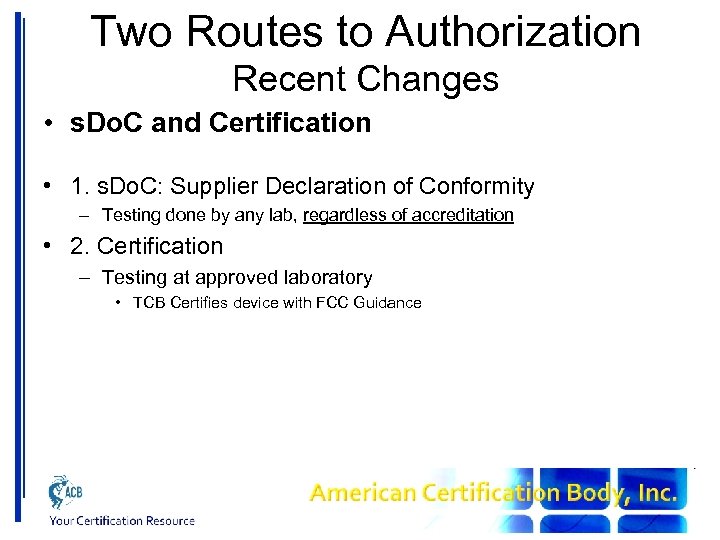
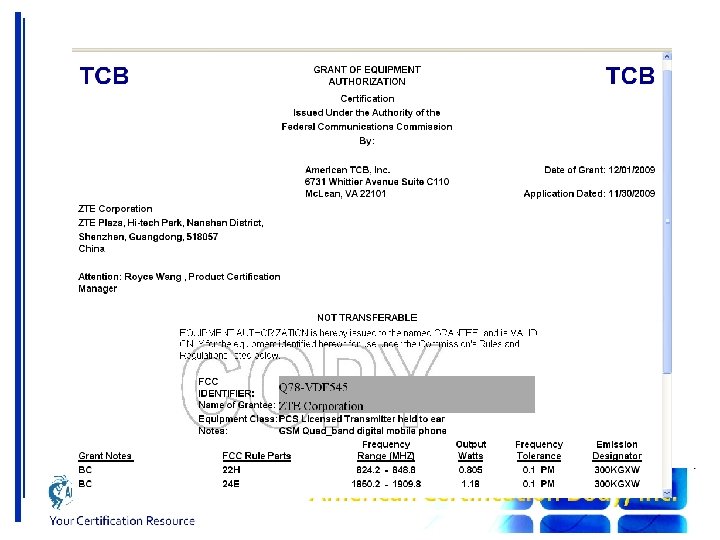
Two Routes to Authorization Recent Changes • s. Do. C and Certification • 1. s. Do. C: Supplier Declaration of Conformity – Testing done by any lab, regardless of accreditation • 2. Certification – Testing at approved laboratory • TCB Certifies device with FCC Guidance
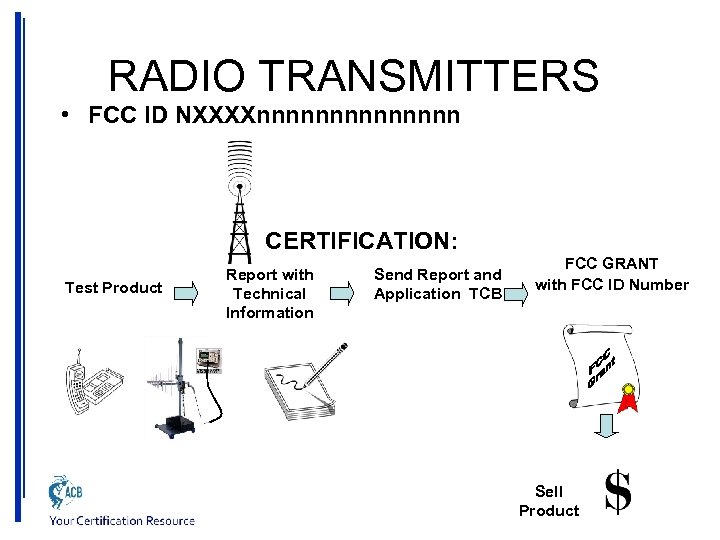
RADIO TRANSMITTERS • FCC ID NXXXXnnnnnnn CERTIFICATION: Test Product Report with Technical Information Send Report and Application TCB FCC GRANT with FCC ID Number Sell Product
Major Regional Requirements Electronic Devices • US: FCC, Product Safety, Environmental – Toys: Consumer Product Safety Commission • Europe: CE Marking “easy” • Brazil, China: – Compulsory testing in-country for telecom • MRA Countries (Mutual Recognition) Many Changes in ~20 Years
World View: 1990 • Small and Medium Size Enterprise (SME’s) World View
NOW: 2017 • SME’s World View
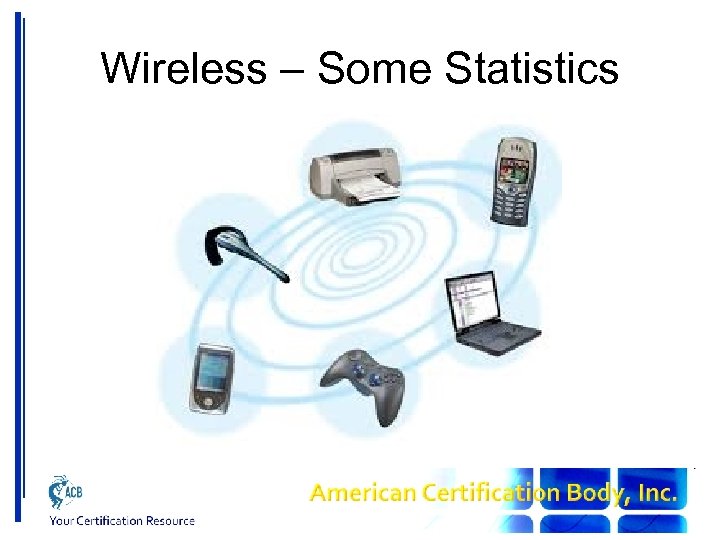
Wireless – Some Statistics
FCC Certification • All Wireless Devices are certified by Telecommunications Certification Bodies • TCBs – Private companies – About 30 in the world – ACB Issued 2700 Original Grants in past year • ~18%
TCB Program • Post-market surveillance – 5% of all devices must be tested by TCB • FCC performs market Surveillance • Example: – Big tablet manufacturer – Complaint by competitor • FCC tested the device – Power over the limit – Compliance program required
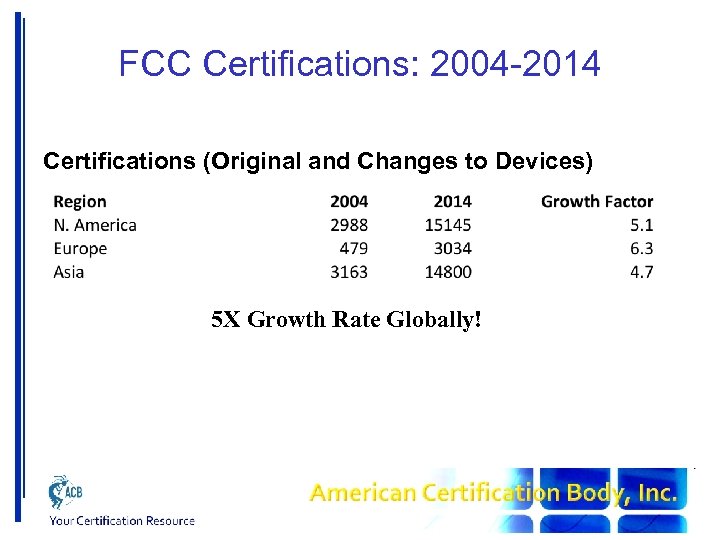
FCC Certifications: 2004 -2014 Certifications (Original and Changes to Devices) 5 X Growth Rate Globally!
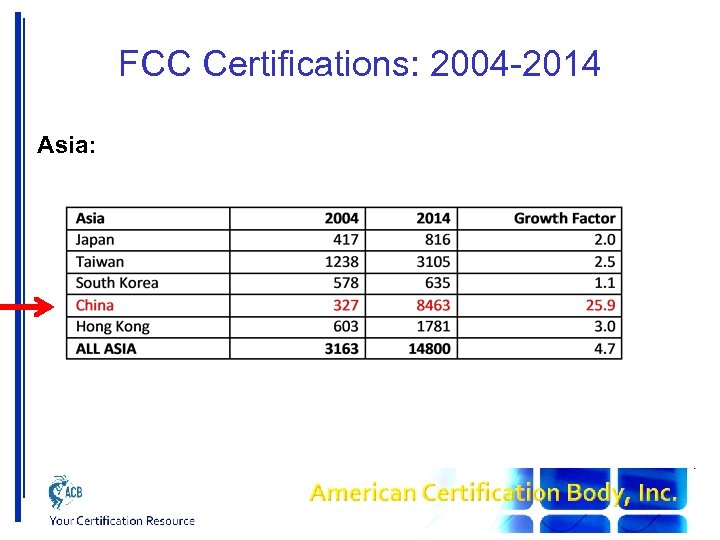
FCC Certifications: 2004 -2014 Asia:
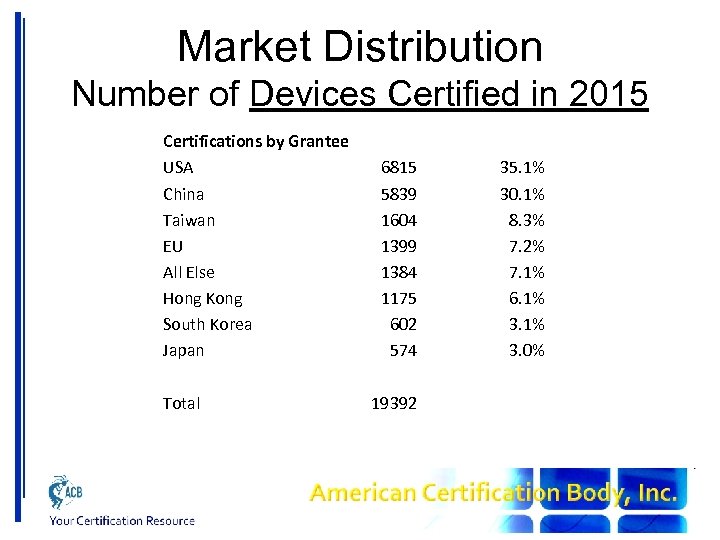
Market Distribution Number of Devices Certified in 2015 Certifications by Grantee USA China Taiwan EU All Else Hong Kong South Korea Japan Total 6815 5839 1604 1399 1384 1175 602 574 19392 35. 1% 30. 1% 8. 3% 7. 2% 7. 1% 6. 1% 3. 0%
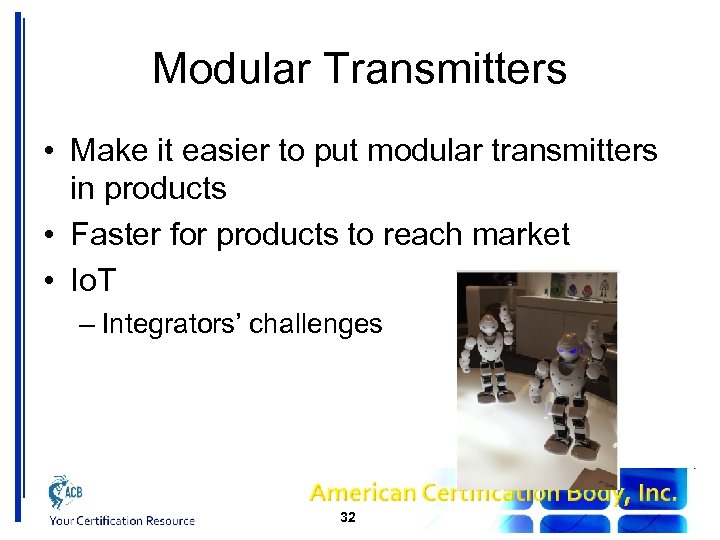
Modular Transmitters • Make it easier to put modular transmitters in products • Faster for products to reach market • Io. T – Integrators’ challenges 32
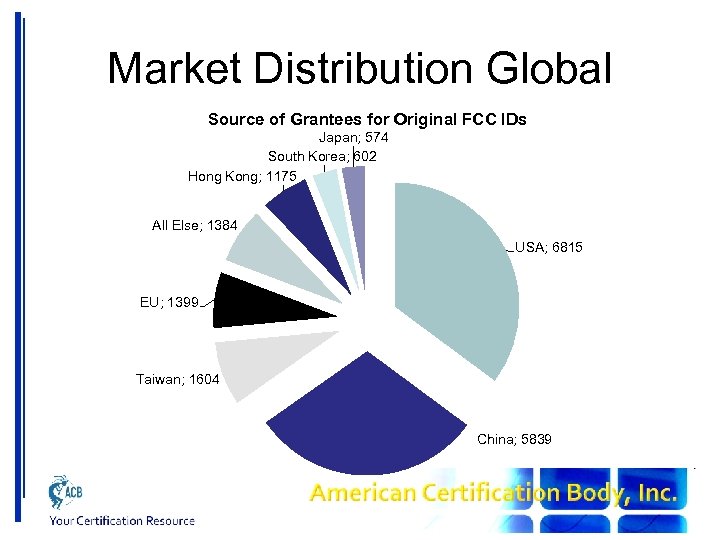
Market Distribution Global Source of Grantees for Original FCC IDs Japan; 574 South Korea; 602 Hong Kong; 1175 All Else; 1384 USA; 6815 EU; 1399 Taiwan; 1604 China; 5839
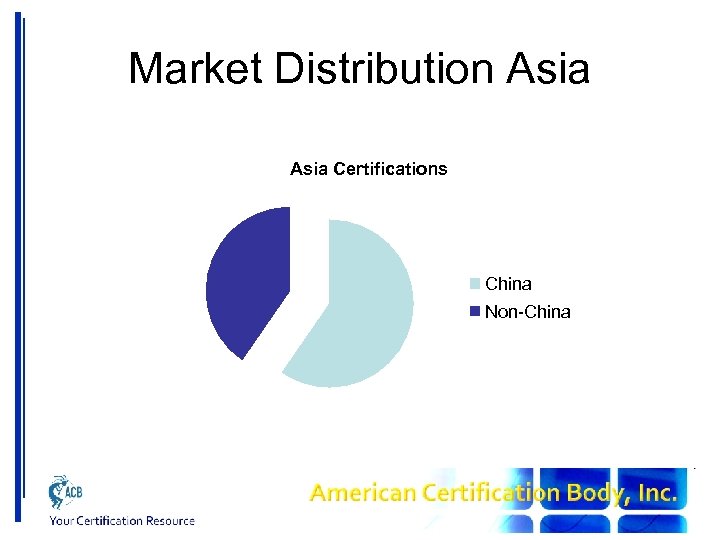
Market Distribution Asia Certifications China Non-China
MRAs have been good to us • A mutual recognition agreement (MRA) is an international agreement by which two or more countries/economies agree to recognize each other’s conformity assessments – Can also be used for other purposes (accreditation, law enforcement, security, finance, standards) • To facilitate TRADE 35
US MRAs • US-EU • US-EAA EFTA (non EU Europe) • APEC TEL MRA – Multi-Lateral (multiple countries) • Signed in 1998 • US-Japan MRA • US-Israel MRA • CITEL (South America, not operational) 36
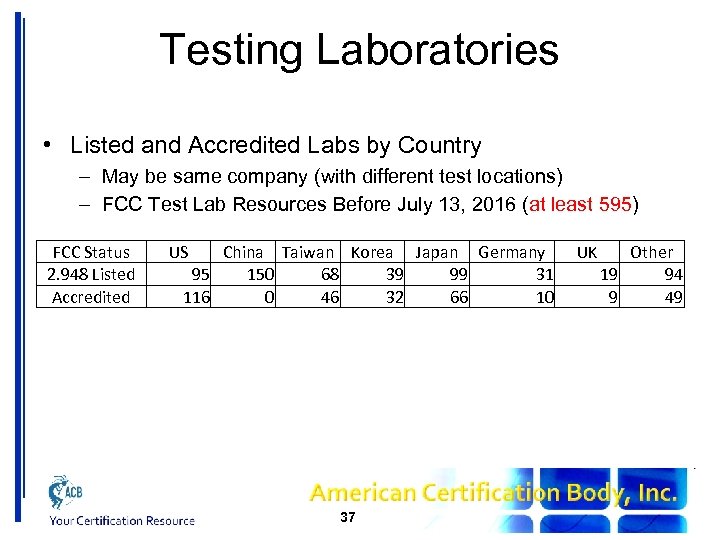
Testing Laboratories • Listed and Accredited Labs by Country – May be same company (with different test locations) – FCC Test Lab Resources Before July 13, 2016 (at least 595) FCC Status 2. 948 Listed Accredited US China Taiwan Korea Japan Germany 95 150 68 39 99 31 116 0 46 32 66 10 37 UK Other 19 94 9 49
Testing Laboratories in non-MRA Countries • Test Firms in non MRA countries – New initiative recognizes labs in non-MRA countries – FCC recognized US Test Firm Accreditation bodies (TFAB’s) are permitted to designate domestic accredited test firms to the FCC 38
Supplier’s Declaration of Conformity • Combine two separate product approval programs – Declaration of Conformity and Verification – into one product selfapproval program: – Verification and Do. C are used for equipment that has a strong record of compliance and for which there is minimal risk of harmful interference – FCC Logo • Labeling of products 39
MRA Definitions • Phase 1: Confidence Building – Accept Test Reports • Phase 2: Full Implementation – Can Certify • Conformity Assessment Body (CAB) – Recognized to perform “Certification” activity • TCB in US • Notified Body in EU 40
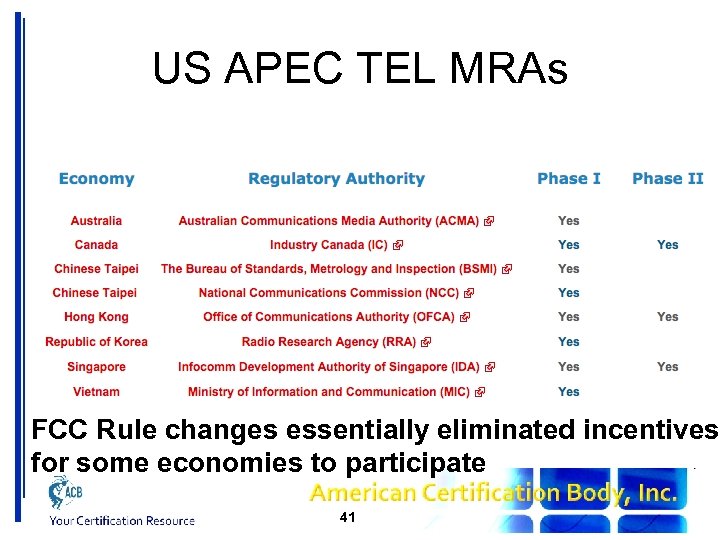
US APEC TEL MRAs FCC Rule changes essentially eliminated incentives for some economies to participate 41
Changes • • • Benefits to consumers Accessibility to communications “Always on” Security and infrastructure isses More to come
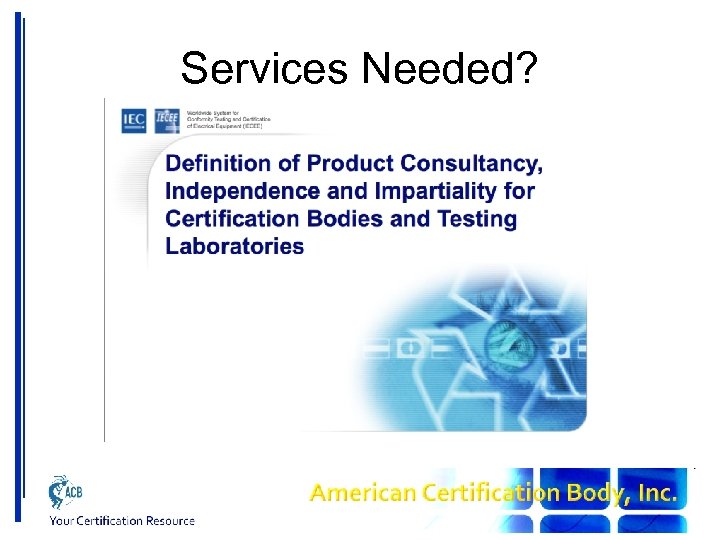
Services Needed?
Product Consultancy • We are asked for solutions to CA issues constantly • ISO 17025 and ISO 17065 preclude “consultancy” as a risk to impartiality • This situation creates inherent conflict – Serve customer? – Effectively compete – Feed my people
This happens frequently 1. It is not a unique method of solving a problem but rather one of a number of well-known solutions. 2. It is not based on someone else’s proprietary information, such as a unique construction seen in a product of another customer. 3. The same type of advice is given to all customers, as may be applicable. There may be a printed list of alternative methods of overcoming common problems; and, such a list is provided to all customers. 4. The customer must understand that it is the customer who is responsible for choosing any specific design and ensuring that it complies with the requirements.
Tricky Issue § It is particularly important for an NCB or CBTL not to suggest actual design changes that might bring the product in compliance with the IEC Standard's requirements. § If an NCB or CBTL/ACTL makes an error in suggesting a change when, in fact, by test it could prove to be unacceptable, a gross mistake has been made and the NCB or CBTL/ACTL can be put in an uncomfortable position. § It is not the NCB’s or CBTL's/ACTLs job to redesign products to comply with the IEC Standard's requirements (i. e. "commercial design consultancy").
“Not Consultancy” 1. It is not a unique method of solving a problem but rather one of a number of well-known solutions. 2. It is not based on someone else’s proprietary information, such as a unique construction seen in a product of another customer. 3. The same type of advice is given to all customers, as may be applicable. There may be a printed list of alternative methods of overcoming common problems; and, such a list is provided to all customers. 4. The customer must understand that it is the customer who is responsible for choosing any specific design and ensuring that it complies with the requirements.
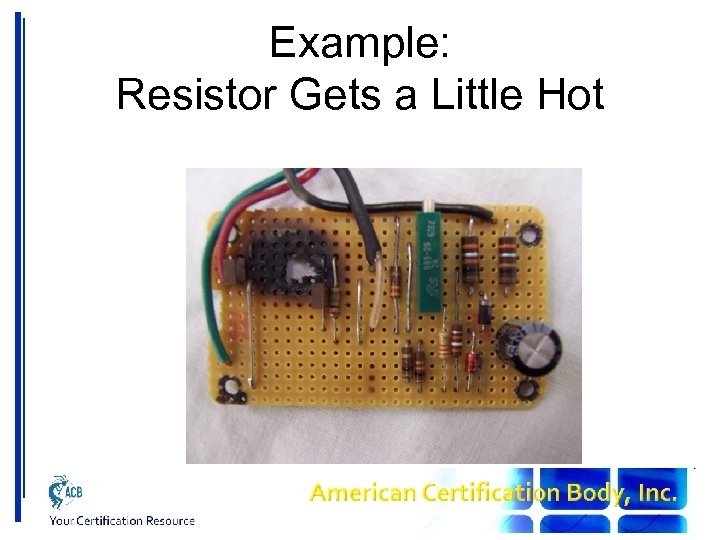
Example: Resistor Gets a Little Hot
Alternative Approaches • Either a printed wiring board with a temperature rating according to the test results needs to be provided, or • the resistor should be sufficiently elevated from the printed wiring board to ensure that the adhesive bond between the conductor foils and base material is not subjected to this temperature.
An Example for Suggesting Appropriate Alternatives • Either a printed wiring board with a temperature rating according to the test results needs to be provided, or • the resistor should be sufficiently elevated from the printed wiring board to ensure that the adhesive bond between the conductor foils and base material is not subjected to this temperature. IECEE Lead Assessor Training, Geneva, CH 50/26
Pragmatic Approach • Balance between supporting client product development and impartiality • Must have internal controls • Transparency in providing solutions
Questions? • Contact: • mikev@acbcert. com • www. acbcert. com
Скачать презентацию Commentary from a Certification Body Mike Violette Director
88826d2bc84e714c8f2afe012b5242e2.ppt