


 Скачать презентацию COMMAS I What is the correct use of
a46c5e351a14dbbbf9267e577ecc5beb.ppt
- Количество слайдов: 30
 COMMAS I: What is the correct use of commas in a sentence? 0701. 1. 4 Demonstrate the correct use of commas (e. g. , after introductory words, phrases or clauses; setting off appositives and interrupters; before coordinating
 Use commas to separate items in dates and addresses. Examples She was born on January 26 1988 in Cheshire Connecticut. A letter dated November 26 1888 was found in the old house at 980 West Street Davenport Iowa yesterday.
 Use commas to separate items in dates and addresses. Examples She was born on January 26, 1988, in Cheshire, Connecticut. A letter dated November 26, 1888, was found in the old house at 980 West Street, Davenport, Iowa, yesterday.
 Use commas to separate items in dates and addresses. Please note: A comma separates the last item in a date or in an address from the words that follow it. However, a comma does not separate a month from a day (January 26) or a house number from a street name (980 West Street).
 Use a comma after the salutation of a personal letter and after the closing of any letter. • Dear Dad, • Dear Sharon, • With love, • Yours truly,
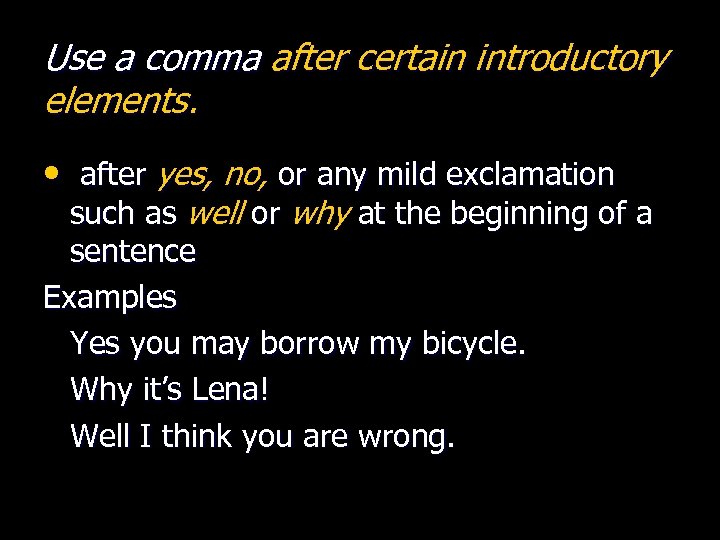 Use a comma after certain introductory elements. • after yes, no, or any mild exclamation such as well or why at the beginning of a sentence Examples Yes you may borrow my bicycle. Why it’s Lena! Well I think you are wrong.
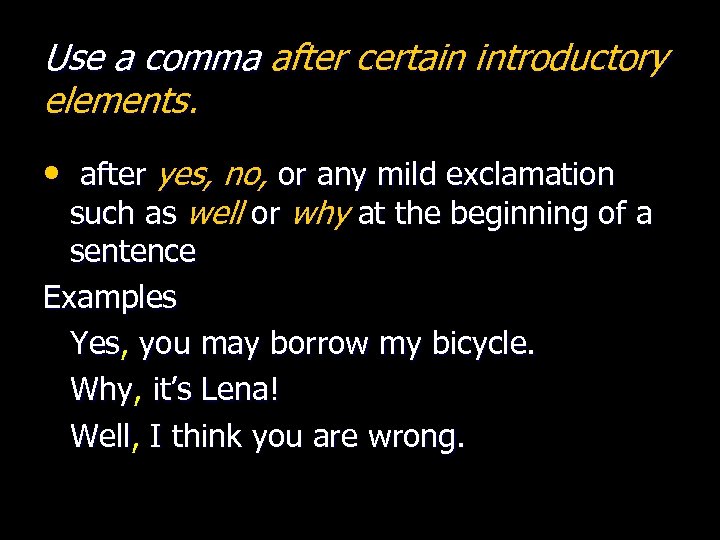 Use a comma after certain introductory elements. • after yes, no, or any mild exclamation such as well or why at the beginning of a sentence Examples Yes, you may borrow my bicycle. Why, it’s Lena! Well, I think you are wrong.
 Use commas to set off words that are used in direct address. Ben please answer the doorbell. Mom needs you Francine. Would you show me ma’am where the craft store is?
 Use commas to set off words that are used in direct address. Ben, please answer the doorbell. Mom needs you, Francine. Would you show me, ma’am, where the craft store is?
 Assessment Prompt: • Create a sentence which includes a direct address or an interrupter. • Swap with a classmate to properly punctuate their sentence with commas.
 Use commas to separate items in a series.
 Use commas to separate items in a series. 1) Words in a series Example: The baby was happy alert playful and active.
 Use commas to separate items in a series. 1) Words in a series Example: The baby was happy, alert, playful, and active.
 Use commas to separate items in a series. 1) Words in a series 2) Example: The baby was happy, alert, playful, and active. 2) Phrases in a series 3) Example: There were fingerprints at the top on the sides and on the bottom.
 Use commas to separate items in a series. 1) Words in a series 2) Example: The baby was happy, alert, playful, and active. 2) Phrases in a series 3) Example: There were fingerprints at the top, on the sides, and on the bottom.
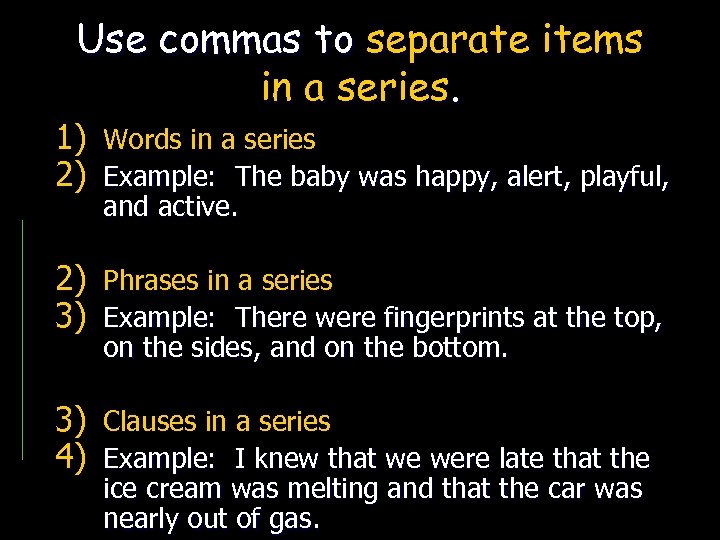 Use commas to separate items in a series. 1) Words in a series 2) Example: The baby was happy, alert, playful, and active. 2) Phrases in a series 3) Example: There were fingerprints at the top, on the sides, and on the bottom. 3) 4) Clauses in a series Example: I knew that we were late that the ice cream was melting and that the car was nearly out of gas.
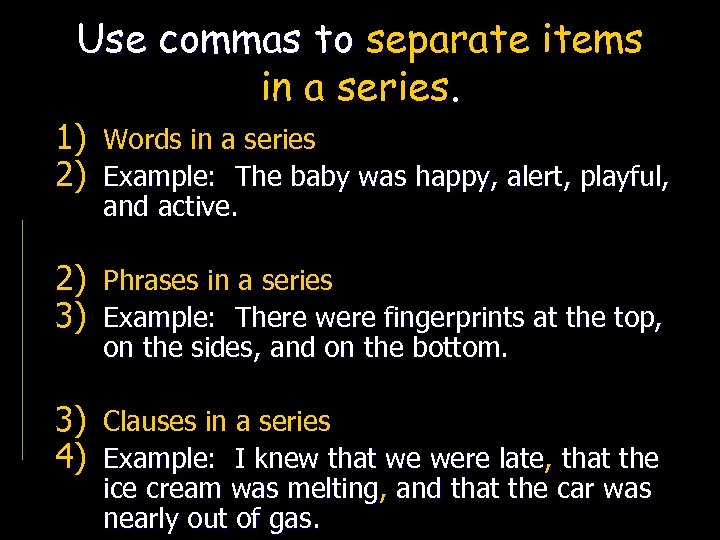 Use commas to separate items in a series. 1) Words in a series 2) Example: The baby was happy, alert, playful, and active. 2) Phrases in a series 3) Example: There were fingerprints at the top, on the sides, and on the bottom. 3) 4) Clauses in a series Example: I knew that we were late, that the ice cream was melting, and that the car was nearly out of gas.
 Use a comma to separate two or more adjectives that come before a noun.
 Use a comma to separate two or more adjectives that come before a noun. Examples: A white dwarf is a tiny dense star.
 Use a comma to separate two or more adjectives that come before a noun. Examples: A white dwarf is a tiny, dense star.
 Use a comma to separate two or more adjectives that come before a noun. Examples: A white dwarf is a tiny, dense star. Venus Williams played a powerful brilliant game.
 Use a comma to separate two or more adjectives that come before a noun. Examples: A white dwarf is a tiny, dense star. Venus Williams played a powerful, brilliant game.
 DO NOT put a comma between an adjective and the noun immediately following it or if the word is part of that noun.
 DO NOT put a comma between an adjective and the noun immediately following it or if the word is part of that noun. Examples: My spaniel is a fat sassy puppy.
 DO NOT put a comma between an adjective and the noun immediately following it or if the word is part of that noun. Examples: My spaniel is a fat, sassy puppy.
 DO NOT put a comma between an adjective and the noun immediately following it or if the word is part of that noun. Examples: My spaniel is a fat, sassy puppy. An unshaded electric light hung from the ceiling.
 DO NOT put a comma between an adjective and the noun immediately following it or if the word is part of that noun. Examples: My spaniel is a fat, sassy puppy. An unshaded electric light hung from the ceiling. A huge horned owl lives in those woods.
 Assessment Prompt: • Create a sentence which includes a list or sequence (without the correct commas included. ) • Swap with a classmate to properly punctuate their sentence with commas.
 Summarizer: • In pairs, write a short friendly letter that includes a properly punctuated salutation, closing, and date which explains how to use commas appropriately.
 ASSIGNMENT So let’s practice… Turn in your GUM Workbook to pages 280 & 287