 Скачать презентацию Coming to Terms Establishing a Business Relationship with
8c19f504c6146e5a48b4bea351e98853.ppt
- Количество слайдов: 30



Coming to Terms: Establishing a Business Relationship with Parents Presented by Tom Copeland, JD Family Child Care Trainer and Author AFSCME Department of Education
Welcome This class will help you – – – Establish a business relationship with parents Identify the four key elements of a contract Ensure that parents won’t leave owing you money Enforce your contract and policies
Instructor • Tom Copeland, JD • Partnership with National Association for Family Child Care • Call Tom: 800 -359 -3817 ex 321 • Email Tom: tcopeland@nafcc. org
After this class… • You will be able to download the materials from this class on www. afscme. org/providerprograms. • You will get a certificate after you submit the quiz at the end. • CEU credits vary by state. Contact your local CCPT or AFSCME affiliate office. We are working with crediting agencies to have the workshops approved. • Questions on AFSCME programs: Kate Headley kheadley@afscme. org or (202) 429 -5092
AFSCME is uniting child care workers! AFSCME CCWU (in NJ) VOICE CCPT CCPUNITED
Business Resources • www. resourcesforchildcare. org – Hundreds of free articles, newsletter, and other resources • Resources from Redleaf Press (www. redleafpress. org; 800 -423 -8309) – Family Child Care Contracts and Policies – by Tom Copeland – The Redleaf Complete Forms Kit – Sharing in the Caring – Agreement Packet
Poll - 1 How long have you been in business? 1) Not yet in business 2) Less than 1 year 3) 1 -5 years 4) 6 -10 years 5) More than 10 years
Class Outline 1) Establish a business relationship with parents 2) The difference between a contract and policies 3) Key contract and policies terms 4) How to enforce your agreement
It’s illegal to discriminate based on race, sex, color, religion, disability, or national origin
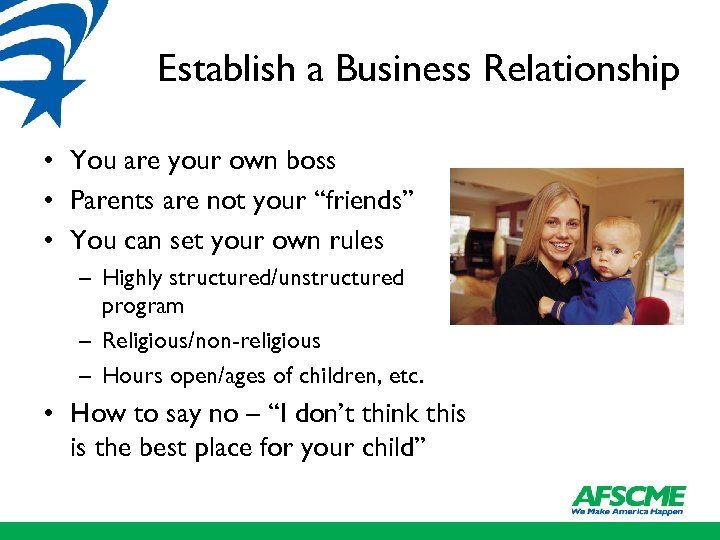
Establish a Business Relationship • You are your own boss • Parents are not your “friends” • You can set your own rules – Highly structured/unstructured program – Religious/non-religious – Hours open/ages of children, etc. • How to say no – “I don’t think this is the best place for your child”
Take Responsibility • It’s up to you to establish a business relationship with parents • Hardest thing to say to parents – “You owe me money” No classes for parents on “How to pay your child care provider on time!”
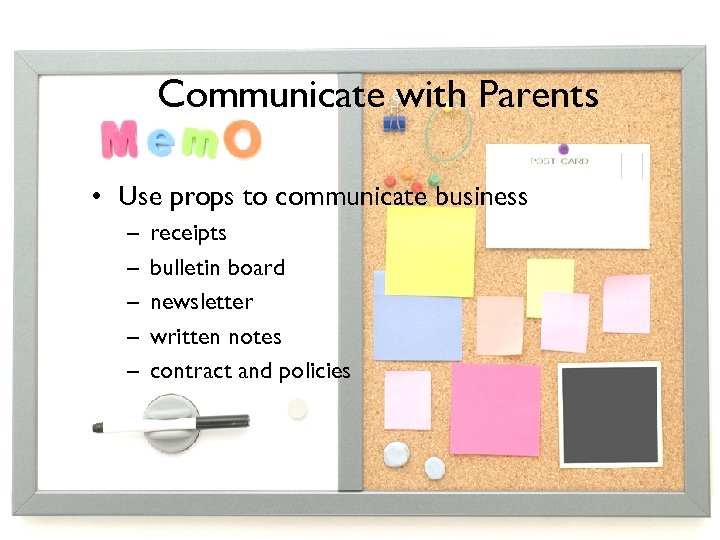
Communicate with Parents • Use props to communicate business – – – receipts bulletin board newsletter written notes contract and policies

Four Key Elements of a Contract • Names of the parties • Terms of the contract – Time – Money • Termination clause • Signatures of both parties
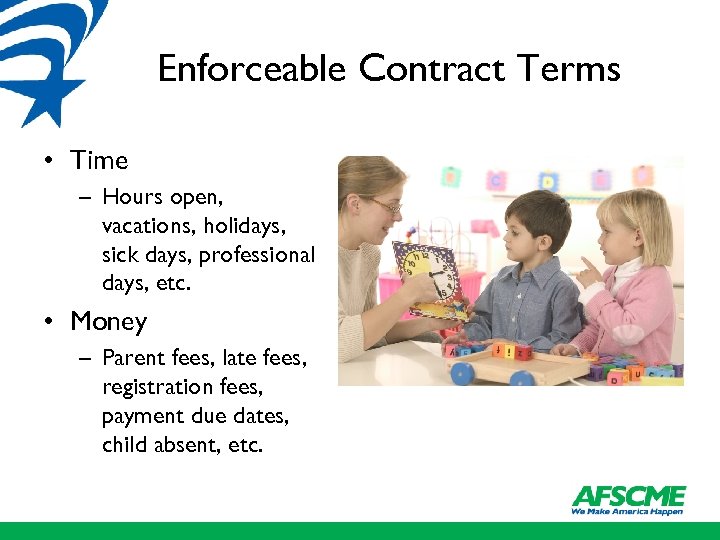
Enforceable Contract Terms • Time – Hours open, vacations, holidays, sick days, professional days, etc. • Money – Parent fees, late fees, registration fees, payment due dates, child absent, etc.
Two Key Contract Money Terms • Require parents to pay you at least one week in advance. • Require parents to pay you for last two weeks of care at enrollment – If a parent can’t afford it, allow them to pay something extra each week over time.
Termination Notice “Parent must give at least a two week notice” “Provider may terminate at will”
Holding Fee • Parent wants to enroll child at a future date • Two options – Provider promises to hold space for a nonrefundable fee • Fee should not apply to child care later – Provider does not promise to hold space
Five Key Elements of Policies • • • Provider information Client responsibilities Child care program Illness, health/safety Transportation of children
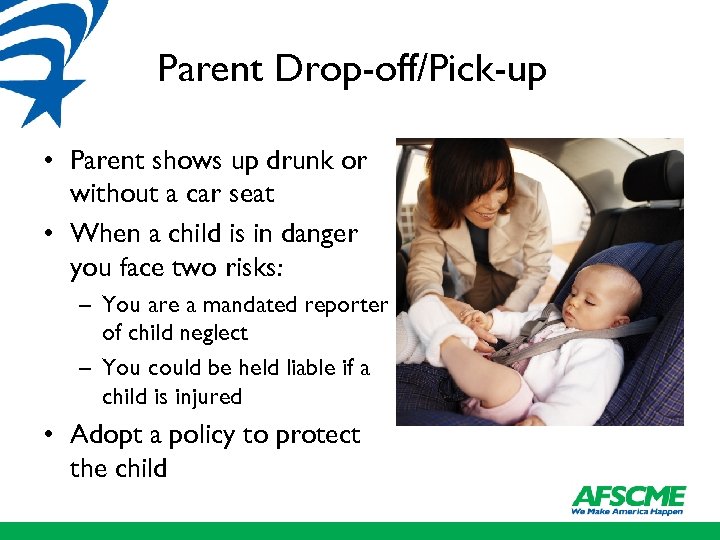
Parent Drop-off/Pick-up • Parent shows up drunk or without a car seat • When a child is in danger you face two risks: – You are a mandated reporter of child neglect – You could be held liable if a child is injured • Adopt a policy to protect the child
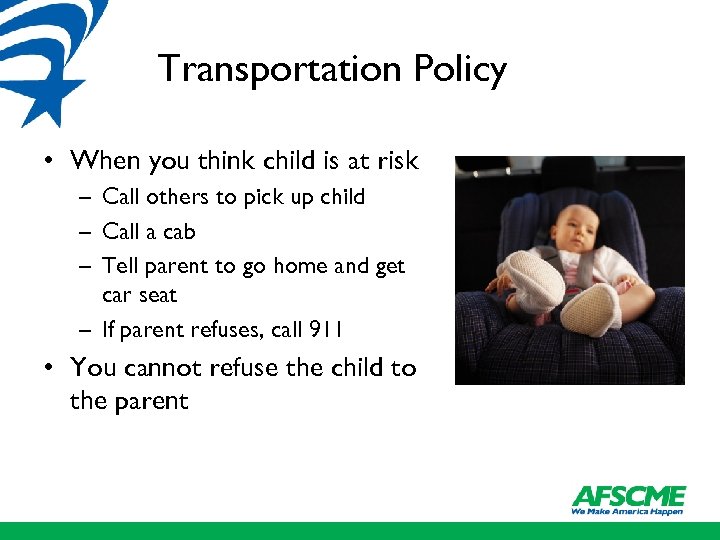
Transportation Policy • When you think child is at risk – Call others to pick up child – Call a cab – Tell parent to go home and get car seat – If parent refuses, call 911 • You cannot refuse the child to the parent
Enforcing Your Agreement • You must set your own limits • To enforce your agreement there must be a consequence for a parent who fails to follow your contract or policies
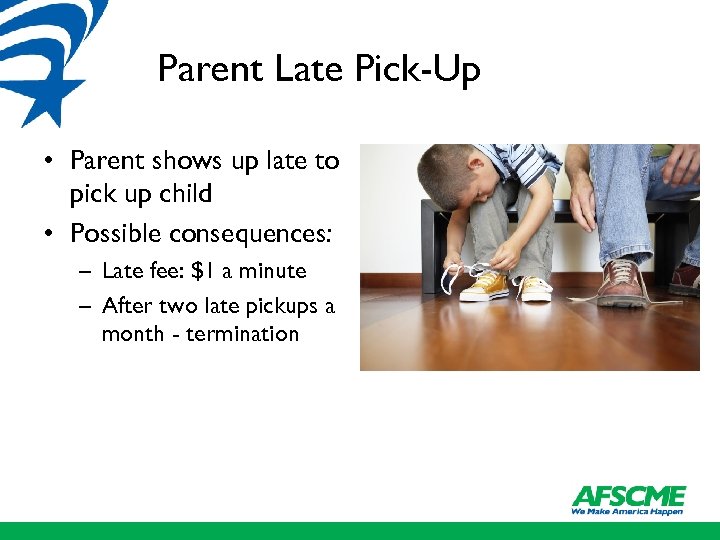
Parent Late Pick-Up • Parent shows up late to pick up child • Possible consequences: – Late fee: $1 a minute – After two late pickups a month - termination
Time Vs. Money • When parent is late, which is more important to you – time or money? – If it’s time – you don’t want to work • Enforce high consequence ($1/minute or more) – If it’s money – you would work longer if paid enough • Adjust late fees so parents will pay ($. 50/minute) or set an “evening rate”
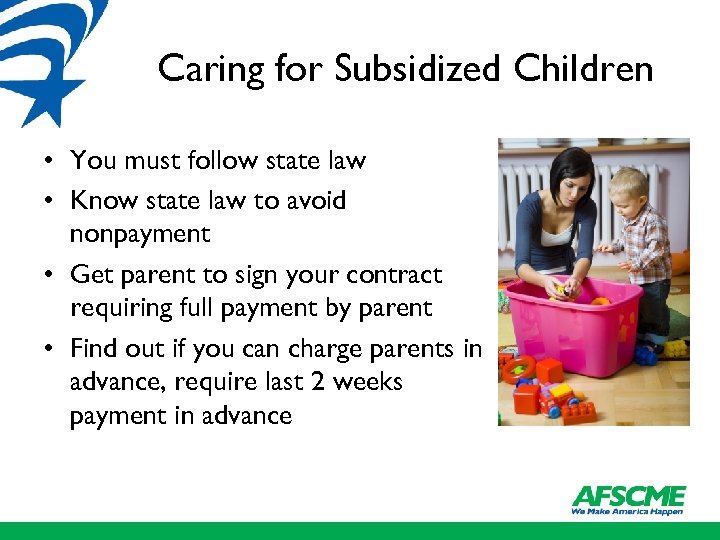
Caring for Subsidized Children • You must follow state law • Know state law to avoid nonpayment • Get parent to sign your contract requiring full payment by parent • Find out if you can charge parents in advance, require last 2 weeks payment in advance
Ending The Parent Relationship -1 • Avoid the problem – When not to accept parents – Ask for references – Question parents at the interview • Deal with the problem – Trial period – Take notes – Get outside help
Ending the Parent Relationship 2 • You can terminate your contract – Disruptive behavior – Violation of your contract – Any other reason (except illegal discrimination) • Give parents a warning before terminating • Contact your licensor • Don’t put reasons for terminating in writing

Three Choices of Life • To resolve conflicts with parents, get a coach to help you choose one: – “I am happy” – “I am not happy” – Decide what will make you happy and enforce this on the parent – “I quit”
Closing • By using your contract and policies you can establish a business relationship with parents • You will have an easier time if you set clear rules and enforce them consistently

Contact Tom For Help • Call: 800 -359 -3817 ex 321 • Email: tcopeland@nafcc. org Good Luck!
After this class… • You will be able to download the materials from this class on www. afscme. org/providerprograms. • You will get a certificate after you submit the quiz at the end. • CEU credits vary by state. Contact your local CCPT or AFSCME affiliate office. We are working with crediting agencies to have the workshops approved. • Questions on AFSCME programs: Kate Headley kheadley@afscme. org or (202) 429 -5092
Скачать презентацию Coming to Terms Establishing a Business Relationship with
8c19f504c6146e5a48b4bea351e98853.ppt