 Скачать презентацию Comfortable homes that save the world Sustainable Environmental
19c6c84074ffc17268e697d04908e0bd.ppt
- Количество слайдов: 23




Comfortable homes that save the world Sustainable Environmental Economic Development October 27, 2007 Don Otto dpoconstruction. com
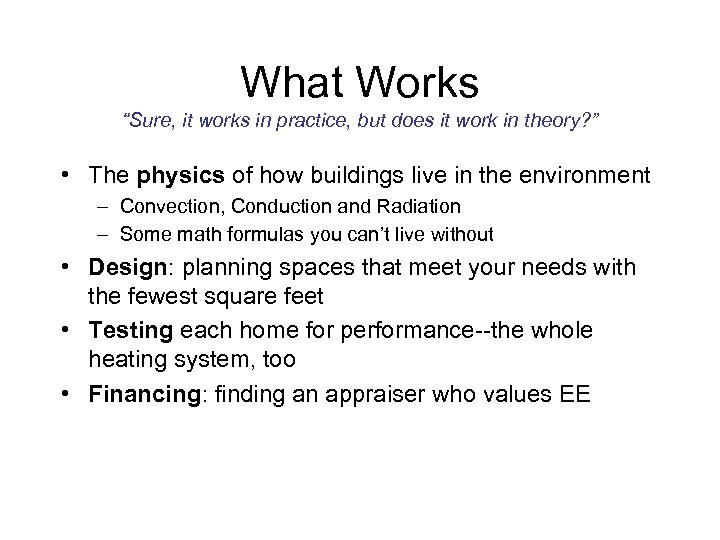
What Works “Sure, it works in practice, but does it work in theory? ” • The physics of how buildings live in the environment – Convection, Conduction and Radiation – Some math formulas you can’t live without • Design: planning spaces that meet your needs with the fewest square feet • Testing each home for performance--the whole heating system, too • Financing: finding an appraiser who values EE

Some details of how I do it
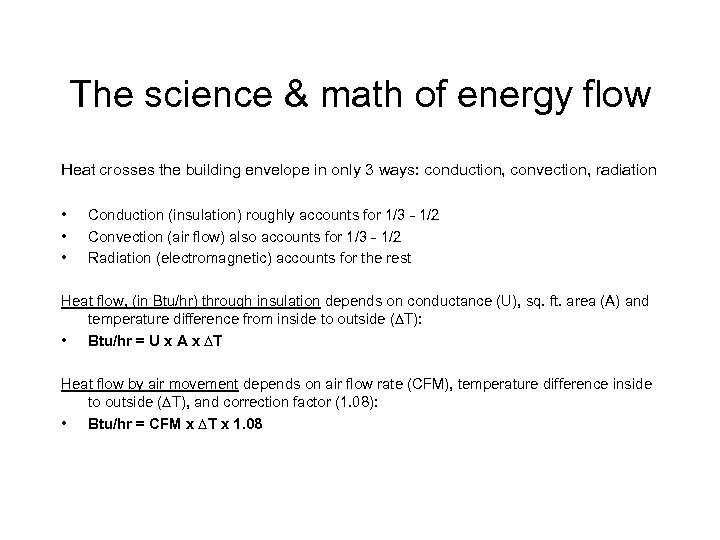
The science & math of energy flow Heat crosses the building envelope in only 3 ways: conduction, convection, radiation • • • Conduction (insulation) roughly accounts for 1/3 - 1/2 Convection (air flow) also accounts for 1/3 - 1/2 Radiation (electromagnetic) accounts for the rest Heat flow, (in Btu/hr) through insulation depends on conductance (U), sq. ft. area (A) and temperature difference from inside to outside (∆T): • Btu/hr = U x A x ∆T Heat flow by air movement depends on air flow rate (CFM), temperature difference inside to outside (∆T), and correction factor (1. 08): • Btu/hr = CFM x ∆T x 1. 08
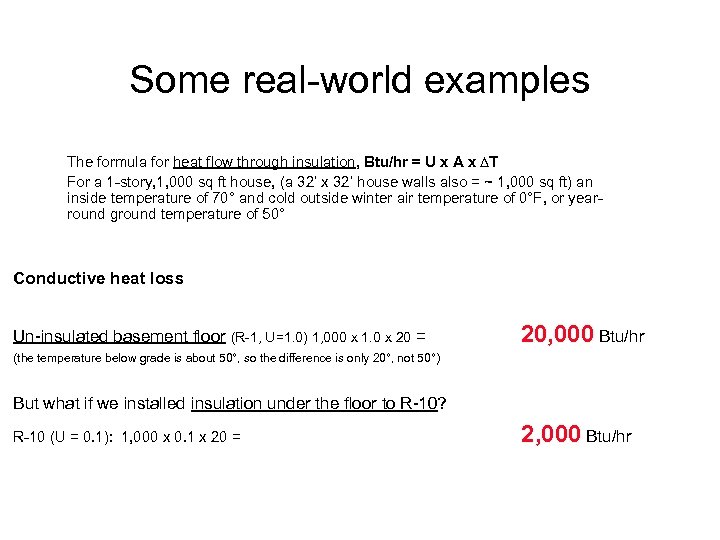
Some real-world examples The formula for heat flow through insulation, Btu/hr = U x A x ∆T For a 1 -story, 1, 000 sq ft house, (a 32’ x 32’ house walls also = ~ 1, 000 sq ft) an inside temperature of 70° and cold outside winter air temperature of 0°F, or yearround ground temperature of 50° Conductive heat loss Un-insulated basement floor (R-1, U=1. 0) 1, 000 x 1. 0 x 20 = 20, 000 Btu/hr (the temperature below grade is about 50°, so the difference is only 20°, not 50°) But what if we installed insulation under the floor to R-10? R-10 (U = 0. 1): 1, 000 x 0. 1 x 20 = 2, 000 Btu/hr
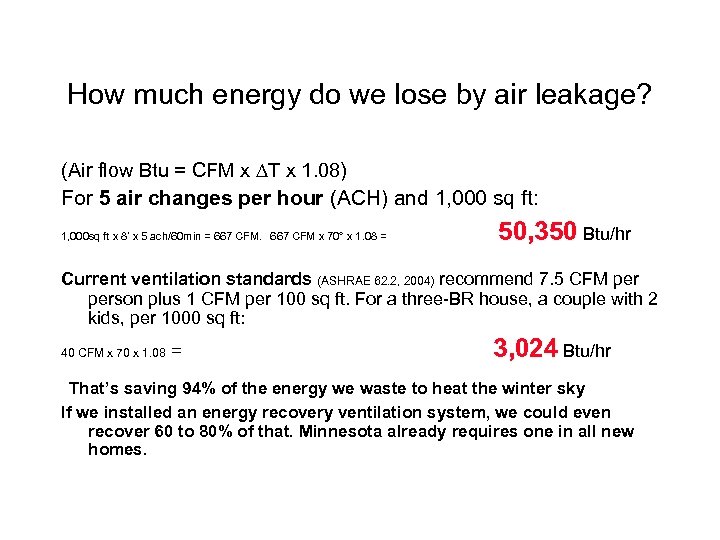
How much energy do we lose by air leakage? (Air flow Btu = CFM x ∆T x 1. 08) For 5 air changes per hour (ACH) and 1, 000 sq ft: 1, 000 sq ft x 8’ x 5 ach/60 min = 667 CFM x 70° x 1. 08 = 50, 350 Btu/hr Current ventilation standards (ASHRAE 62. 2, 2004) recommend 7. 5 CFM person plus 1 CFM per 100 sq ft. For a three-BR house, a couple with 2 kids, per 1000 sq ft: 40 CFM x 70 x 1. 08 = 3, 024 Btu/hr That’s saving 94% of the energy we waste to heat the winter sky If we installed an energy recovery ventilation system, we could even recover 60 to 80% of that. Minnesota already requires one in all new homes.
Photos of the science applied








Designmeeting your needs with the fewest square feet
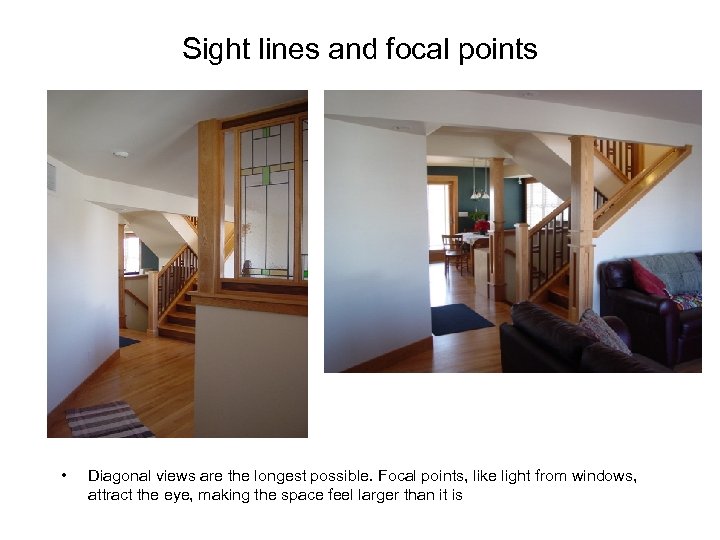
Sight lines and focal points • Diagonal views are the longest possible. Focal points, like light from windows, attract the eye, making the space feel larger than it is
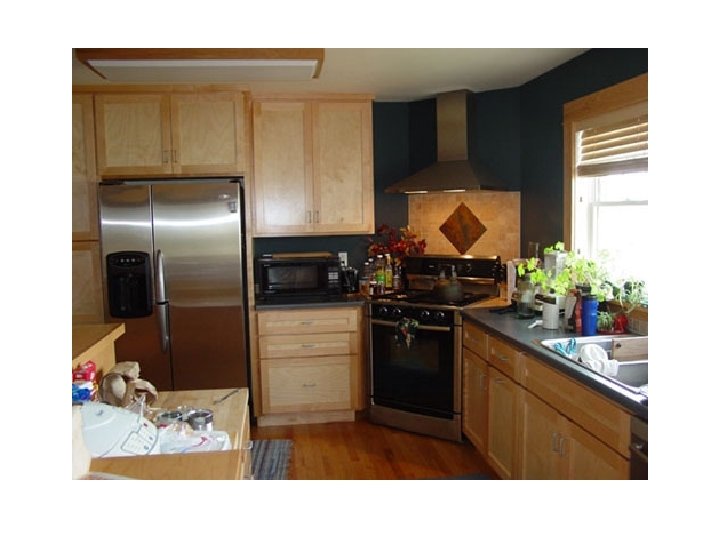
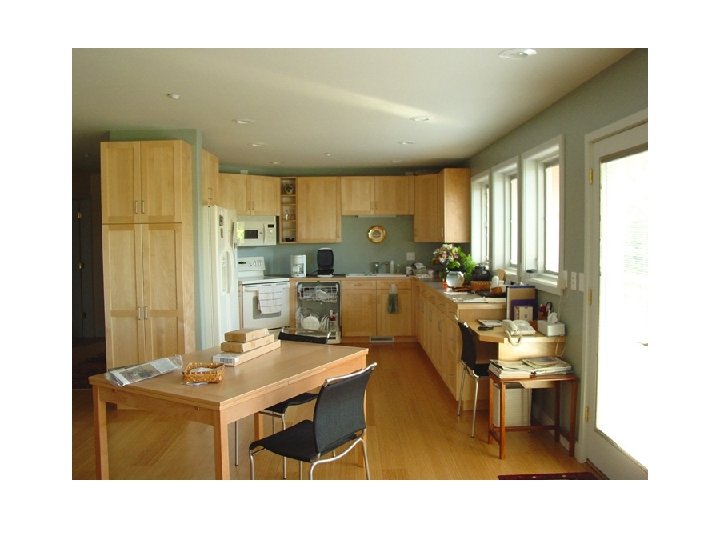
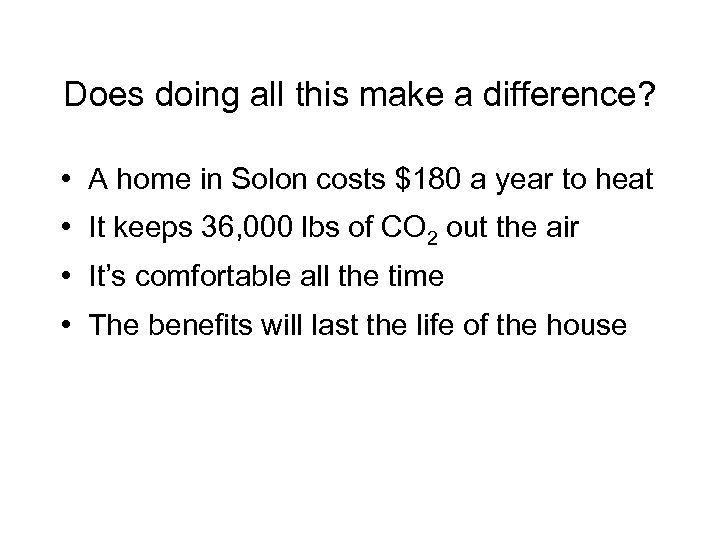
Does doing all this make a difference? • A home in Solon costs $180 a year to heat • It keeps 36, 000 lbs of CO 2 out the air • It’s comfortable all the time • The benefits will last the life of the house
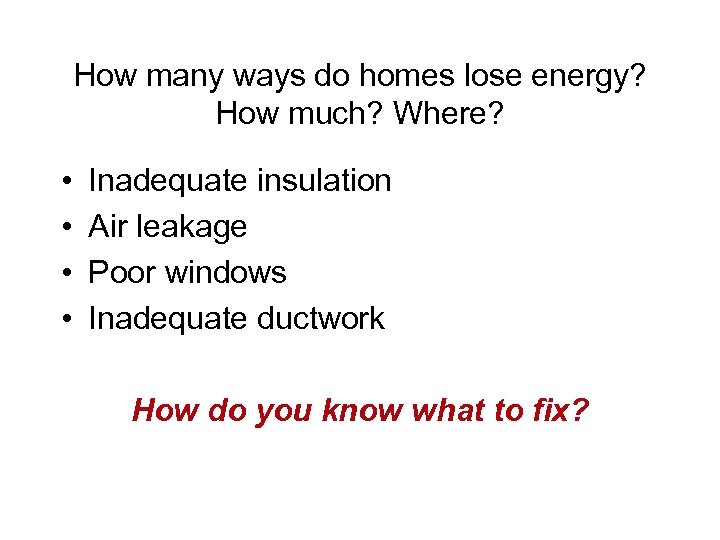
How many ways do homes lose energy? How much? Where? • • Inadequate insulation Air leakage Poor windows Inadequate ductwork How do you know what to fix?
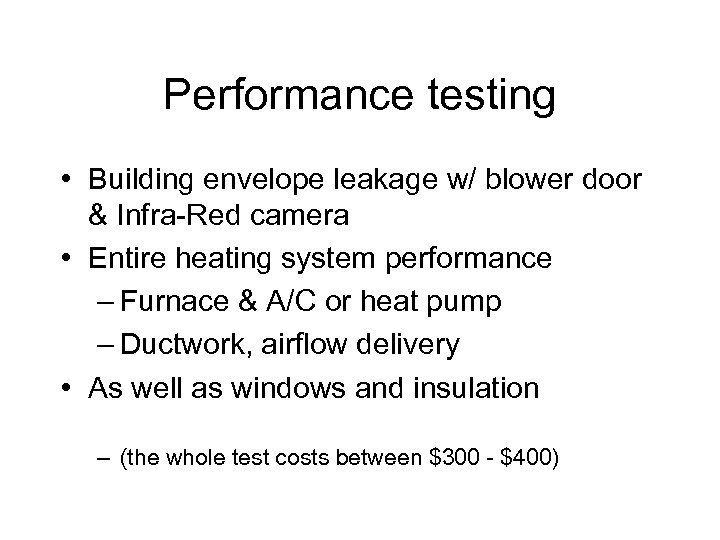
Performance testing • Building envelope leakage w/ blower door & Infra-Red camera • Entire heating system performance – Furnace & A/C or heat pump – Ductwork, airflow delivery • As well as windows and insulation – (the whole test costs between $300 - $400)

Financing energy upgrades Banks need appraisers who place a value on energy efficient features in order to include them on a loan. I know of one such appraiser: JIM POTTER, Preferred Appraisal, 319 -373 -6746

THANKS This presentation will be on my Website, dpoconstruction. com
Скачать презентацию Comfortable homes that save the world Sustainable Environmental
19c6c84074ffc17268e697d04908e0bd.ppt