


 Скачать презентацию Comenius The Earth s geosphere The atmosphere
a888283817020cb96d95daca495113f3.ppt
- Количество слайдов: 14
 Comenius
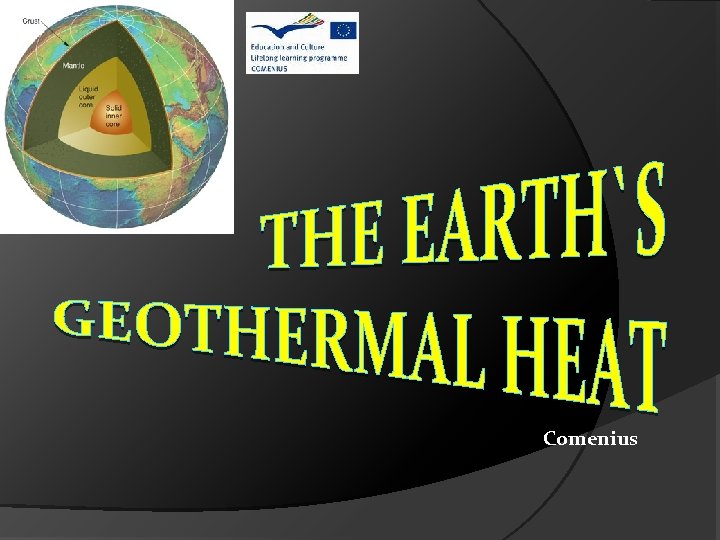
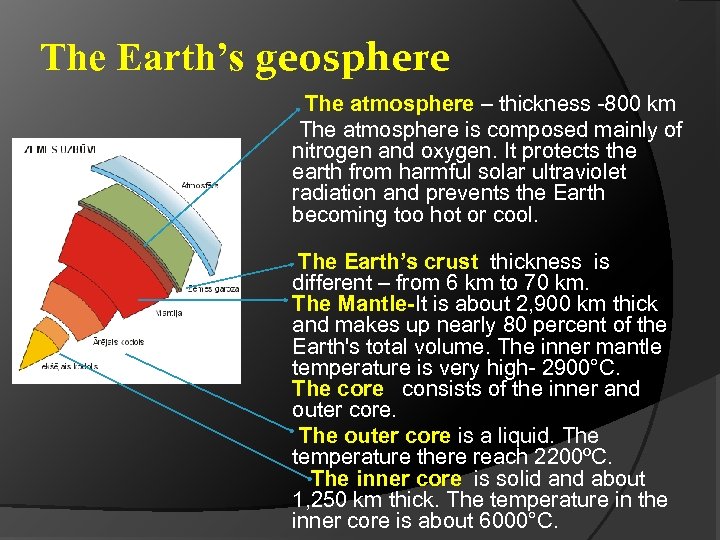 The Earth’s geosphere The atmosphere – thickness -800 km The atmosphere is composed mainly of nitrogen and oxygen. It protects the earth from harmful solar ultraviolet radiation and prevents the Earth becoming too hot or cool. The Earth’s crust thickness is different – from 6 km to 70 km. The Mantle-It is about 2, 900 km thick and makes up nearly 80 percent of the Earth's total volume. The inner mantle temperature is very high- 2900°C. The core consists of the inner and outer core. The outer core is a liquid. The temperature there reach 2200ºC. The inner core is solid and about 1, 250 km thick. The temperature in the inner core is about 6000°C.
 Pollution continue to increase. Therefore people are looking for new ways how to get an ecological clean energy. One of such alternative is the geothermal energy. The geothermal energy is the heat from within the earth. We can use the steam and hot water produced inside the earth to heat buildings or generate electricity. Geothermal energy is a renewable energy source.
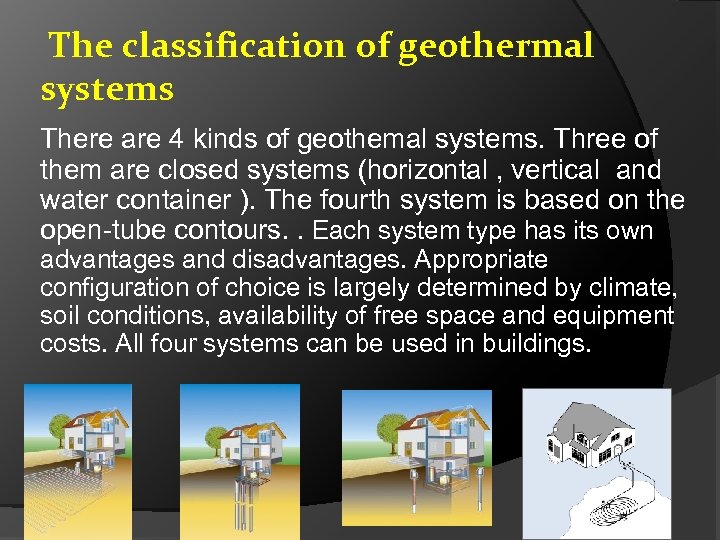 The classification of geothermal systems There are 4 kinds of geothemal systems. Three of them are closed systems (horizontal , vertical and water container ). The fourth system is based on the open-tube contours. . Each system type has its own advantages and disadvantages. Appropriate configuration of choice is largely determined by climate, soil conditions, availability of free space and equipment costs. All four systems can be used in buildings.
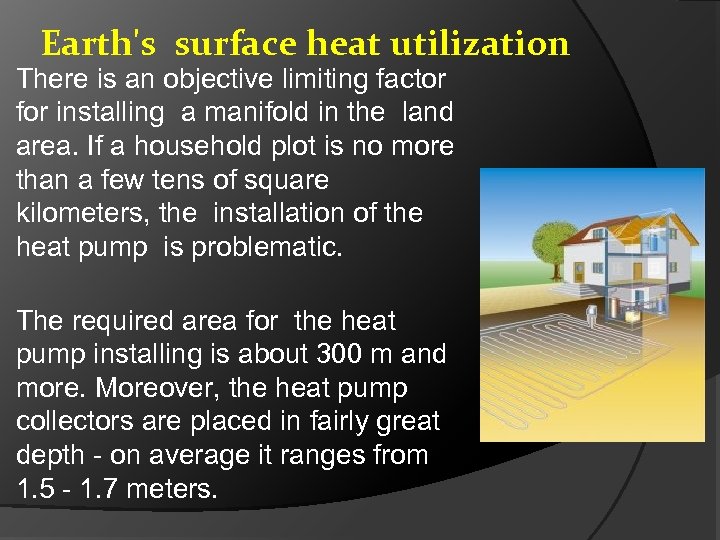 Earth's surface heat utilization There is an objective limiting factor for installing a manifold in the land area. If a household plot is no more than a few tens of square kilometers, the installation of the heat pump is problematic. The required area for the heat pump installing is about 300 m and more. Moreover, the heat pump collectors are placed in fairly great depth - on average it ranges from 1. 5 - 1. 7 meters.
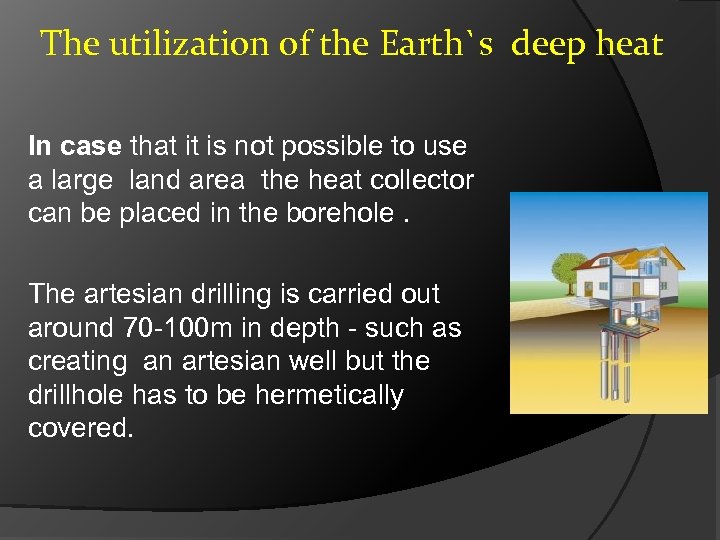 The utilization of the Earth`s deep heat In case that it is not possible to use a large land area the heat collector can be placed in the borehole. The artesian drilling is carried out around 70 -100 m in depth - such as creating an artesian well but the drillhole has to be hermetically covered.
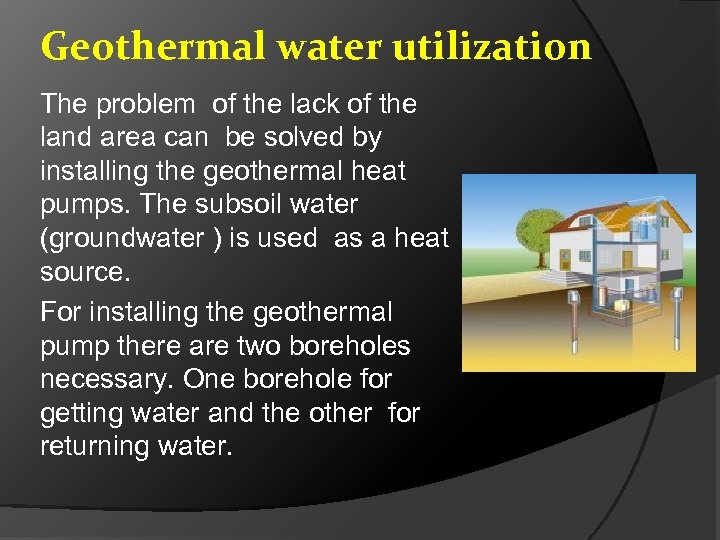 Geothermal water utilization The problem of the lack of the land area can be solved by installing the geothermal heat pumps. The subsoil water (groundwater ) is used as a heat source. For installing the geothermal pump there are two boreholes necessary. One borehole for getting water and the other for returning water.
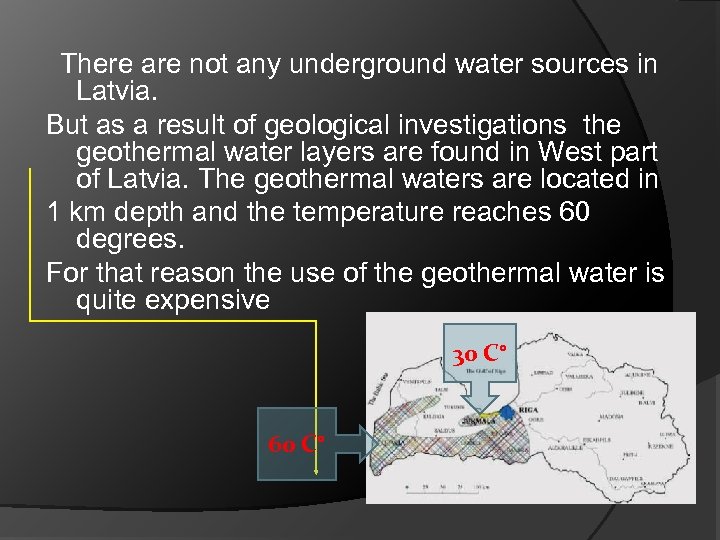 There are not any underground water sources in Latvia. But as a result of geological investigations the geothermal water layers are found in West part of Latvia. The geothermal waters are located in 1 km depth and the temperature reaches 60 degrees. For that reason the use of the geothermal water is quite expensive 30 C° 60 C°
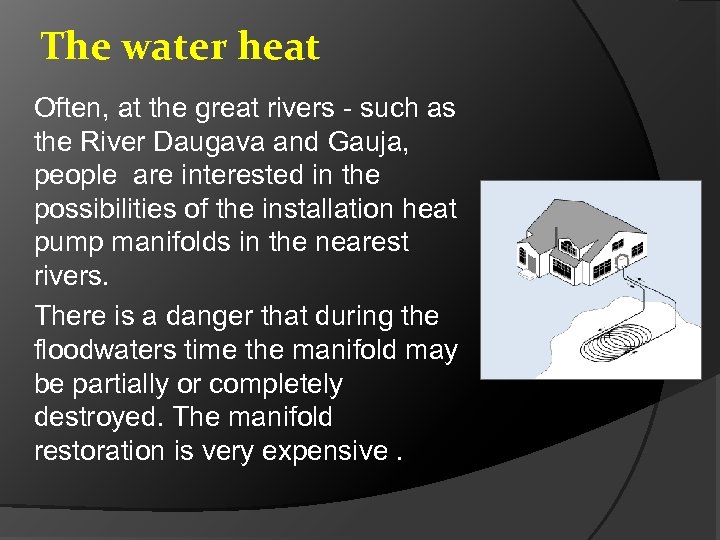 The water heat Often, at the great rivers - such as the River Daugava and Gauja, people are interested in the possibilities of the installation heat pump manifolds in the nearest rivers. There is a danger that during the floodwaters time the manifold may be partially or completely destroyed. The manifold restoration is very expensive.
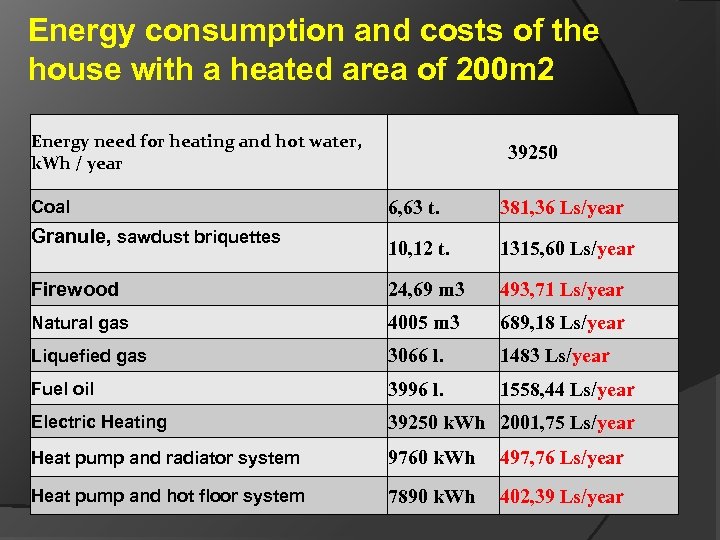 Energy consumption and costs of the house with a heated area of 200 m 2 Energy need for heating and hot water, k. Wh / year 39250 6, 63 t. 381, 36 Ls/year 10, 12 t. 1315, 60 Ls/year Firewood 24, 69 m 3 493, 71 Ls/year Natural gas 4005 m 3 689, 18 Ls/year Liquefied gas 3066 l. 1483 Ls/year Fuel oil 3996 l. 1558, 44 Ls/year Electric Heating 39250 k. Wh 2001, 75 Ls/year Heat pump and radiator system 9760 k. Wh 497, 76 Ls/year Heat pump and hot floor system 7890 k. Wh 402, 39 Ls/year Coal Granule, sawdust briquettes
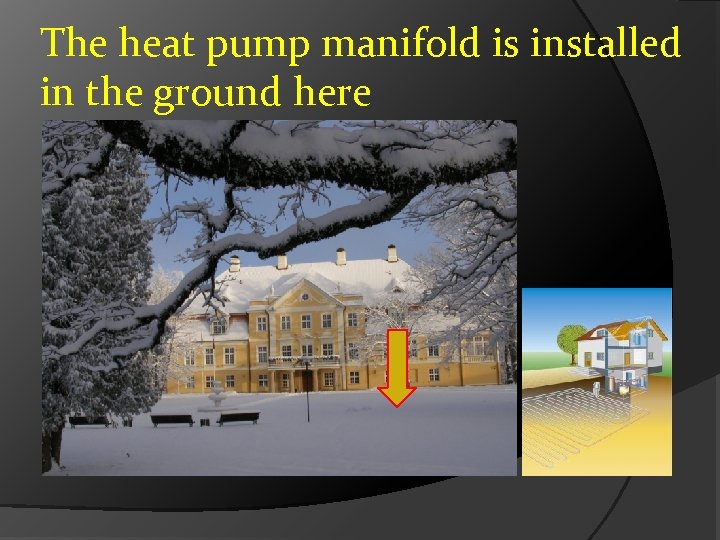 The heat pump manifold is installed in the ground here
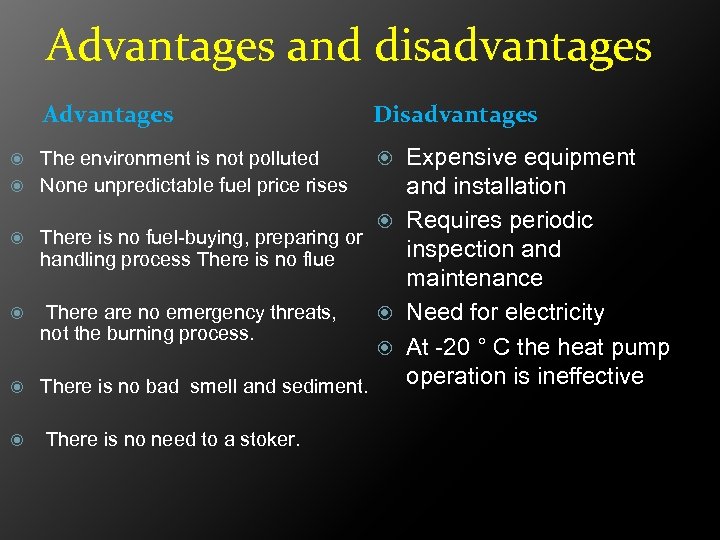 Advantages and disadvantages Advantages Expensive equipment and installation Requires periodic There is no fuel-buying, preparing or inspection and handling process There is no flue maintenance There are no emergency threats, Need for electricity not the burning process. At -20 ° C the heat pump operation is ineffective There is no bad smell and sediment. The environment is not polluted None unpredictable fuel price rises Disadvantages There is no need to a stoker.
 Companies, which offers the heat pumps equipments and the installation of Latvia
 Applied Materials www. ivtsiltumsukni. lv www. siltumsuknis. lv www. argil. lv discovermagazine. com