


 Скачать презентацию Comedy after Shakespeare Does not take up
ef0b74a68f8f8d089d4a562d9c2fcd35.ppt
- Количество слайдов: 190
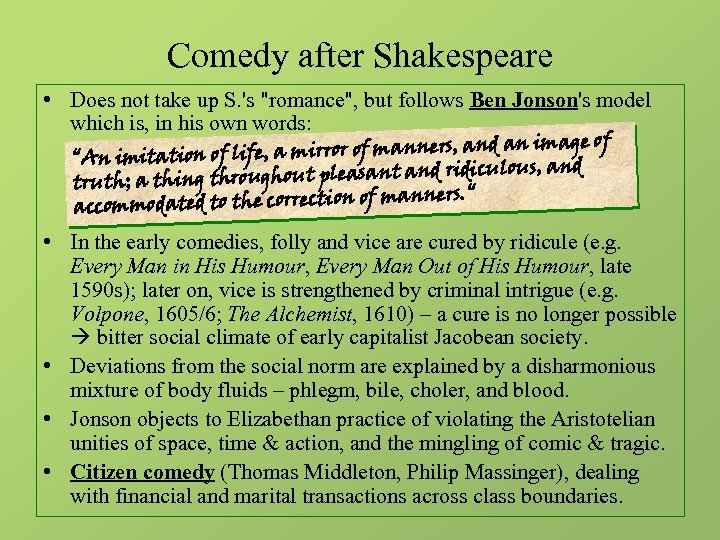 Comedy after Shakespeare • Does not take up S. 's "romance", but follows Ben Jonson's model which is, in his own words: image of life, a mirror of manners, and an “An imitation of , and roughout pleasant and ridiculous truth; a thing th ners. “ mmodated to the correction of man acco • In the early comedies, folly and vice are cured by ridicule (e. g. Every Man in His Humour, Every Man Out of His Humour, late 1590 s); later on, vice is strengthened by criminal intrigue (e. g. Volpone, 1605/6; The Alchemist, 1610) – a cure is no longer possible bitter social climate of early capitalist Jacobean society. • Deviations from the social norm are explained by a disharmonious mixture of body fluids – phlegm, bile, choler, and blood. • Jonson objects to Elizabethan practice of violating the Aristotelian unities of space, time & action, and the mingling of comic & tragic. • Citizen comedy (Thomas Middleton, Philip Massinger), dealing with financial and marital transactions across class boundaries.
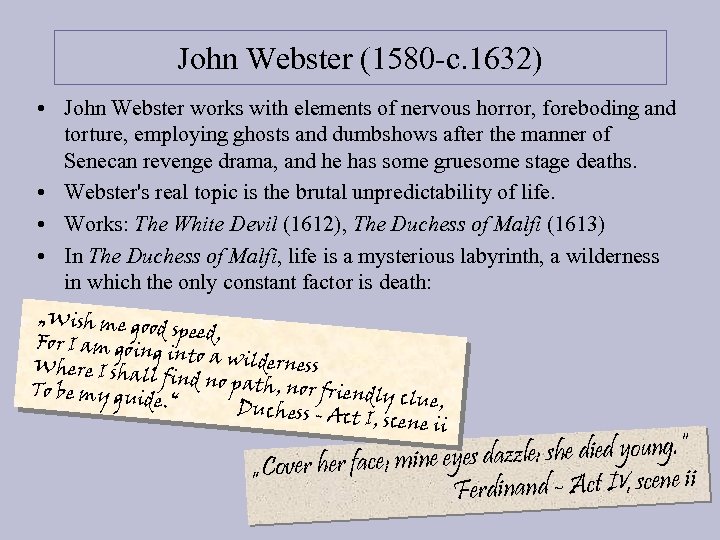 John Webster (1580 -c. 1632) • John Webster works with elements of nervous horror, foreboding and torture, employing ghosts and dumbshows after the manner of Senecan revenge drama, and he has some gruesome stage deaths. • Webster's real topic is the brutal unpredictability of life. • Works: The White Devil (1612), The Duchess of Malfi (1613) • In The Duchess of Malfi, life is a mysterious labyrinth, a wilderness in which the only constant factor is death: „Wish me goo d speed, For I am goin g into a wild erness Where I shal l find no path , nor friendly To be my guid clue, e. “ Duchess - Act I, scene ii ine eyes dazzle: she died young. “ „Cover her face; m ene ii Ferdinand - Act IV, sc
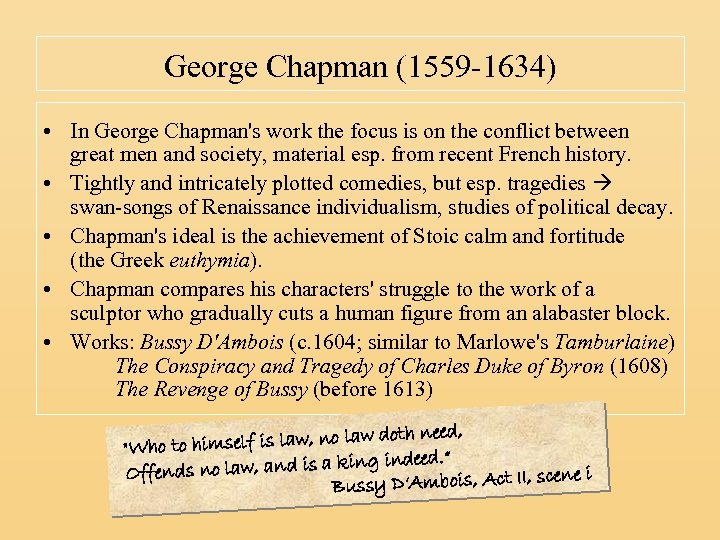 George Chapman (1559 -1634) • In George Chapman's work the focus is on the conflict between great men and society, material esp. from recent French history. • Tightly and intricately plotted comedies, but esp. tragedies swan-songs of Renaissance individualism, studies of political decay. • Chapman's ideal is the achievement of Stoic calm and fortitude (the Greek euthymia). • Chapman compares his characters' struggle to the work of a sculptor who gradually cuts a human figure from an alabaster block. • Works: Bussy D'Ambois (c. 1604; similar to Marlowe's Tamburlaine) The Conspiracy and Tragedy of Charles Duke of Byron (1608) The Revenge of Bussy (before 1613) doth need, to himself is law, no law "Who deed. “ no law, and is a king in Offends ene i ssy D‘Ambois, Act II, sc Bu
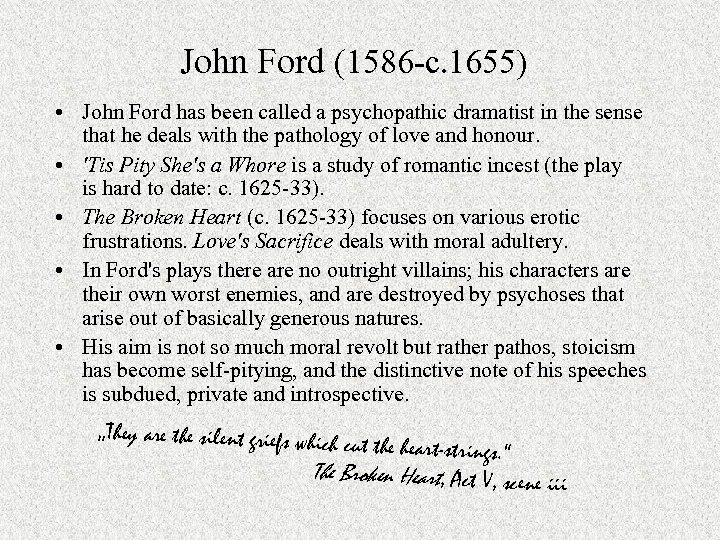 John Ford (1586 -c. 1655) • John Ford has been called a psychopathic dramatist in the sense that he deals with the pathology of love and honour. • 'Tis Pity She's a Whore is a study of romantic incest (the play is hard to date: c. 1625 -33). • The Broken Heart (c. 1625 -33) focuses on various erotic frustrations. Love's Sacrifice deals with moral adultery. • In Ford's plays there are no outright villains; his characters are their own worst enemies, and are destroyed by psychoses that arise out of basically generous natures. • His aim is not so much moral revolt but rather pathos, stoicism has become self-pitying, and the distinctive note of his speeches is subdued, private and introspective. „They are the silent griefs which cut the heart-strings. “ The Broken Heart, Act V, scene ii i
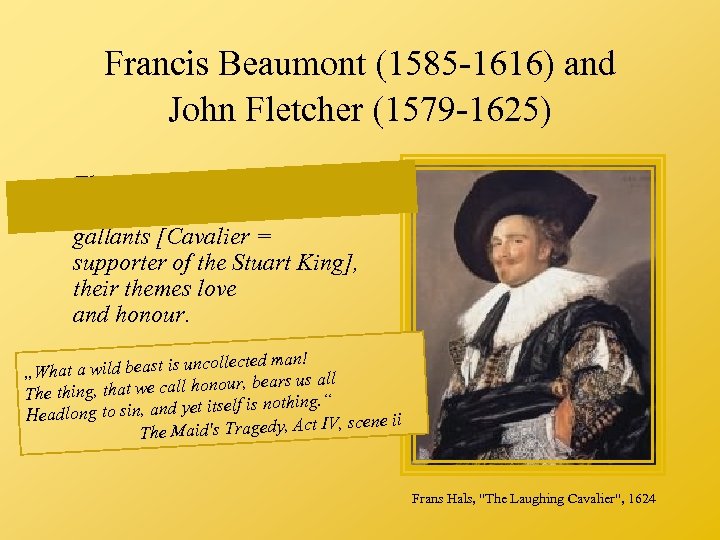 Francis Beaumont (1585 -1616) and John Fletcher (1579 -1625) The heroes of Beaumont and Fletcher are Cavalier gallants [Cavalier = supporter of the Stuart King], their themes love and honour. ted man! t a wild beast is uncollec „Wha rs us all that we call honour, bea The thing, lf is nothing. “ dlong to sin, and yet itse Hea ct IV, scene ii The Maid's Tragedy, A Frans Hals, "The Laughing Cavalier", 1624
 F. Beaumont and J. Fletcher • Follow Shakespeare as principal writers for King's Men: romantic tragedies and tragicomedies, which develop into heroic drama in Restoration. • Esp. Philaster (c. 1609) and A King and No King (1611): – high-flown language of courtly compliments; tone of flattery towards audience – Cavalier gallants as protagonists – chivalric adventures and love dilemmas of Sidney's Arcadia transposed into Stuart gallantry – uncertain treatment of sexual love between idealisation and boisterous laughter • Decisive change in the social outlook of theatre from the 2 nd decade of 17 th century on: drama becomes entertainment for Stuart court aristocracy – little remains of the national/ historical consciousness Shakespeare brought to tragedy.
 English Sonnet Tradition – 1 • Sonnet cycle: major achievement of later Elizabethan period after Wyatt and Surrey, remains important also during/after 17 th century. • Sidney's Astrophel and Stella (c. 1582) adheres to the convention of self-dramatising/ecstatic lover, while overturning the Petrarcan pattern of submissive lover and cruel fair woman. • Among Sidney's successors: Samuel Daniel, Michael Drayton, Edmund Spenser (celebrating married love), George Chapman (more philosophical subject matters).
 English Sonnet Tradition – 2 • Shakespeare's sonnets celebrate the affection of an older man for a noble and wayward youth, 25 sonnets address a mysterious dark lady endless biographical speculation. • Sonnet 18: poetological self-reflection – art as the realm of timelessness/eternal beauty prevailing concept of art up to 20 th century. • Three quatrains of four lines, plus a concluding heroic couplet – rhymed abab cdcd efef gg:
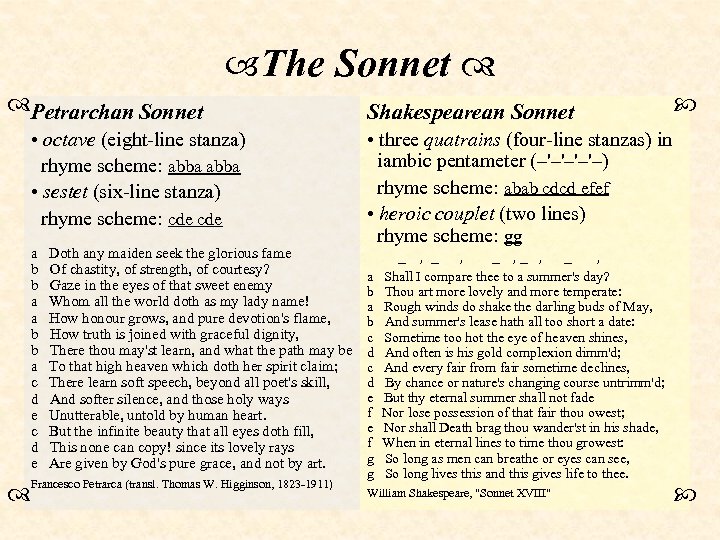 The Sonnet Petrarchan Sonnet • octave (eight-line stanza) rhyme scheme: abba • sestet (six-line stanza) rhyme scheme: cde a Doth any maiden seek the glorious fame b Of chastity, of strength, of courtesy? b Gaze in the eyes of that sweet enemy a Whom all the world doth as my lady name! a How honour grows, and pure devotion's flame, b How truth is joined with graceful dignity, b There thou may'st learn, and what the path may be a To that high heaven which doth her spirit claim; c There learn soft speech, beyond all poet's skill, d And softer silence, and those holy ways e Unutterable, untold by human heart. c But the infinite beauty that all eyes doth fill, d This none can copy! since its lovely rays e Are given by God's pure grace, and not by art. Francesco Petrarca (transl. Thomas W. Higginson, 1823 -1911) Shakespearean Sonnet • three quatrains (four-line stanzas) in iambic pentameter (–'–'–) rhyme scheme: abab cdcd efef • heroic couplet (two lines) rhyme scheme: gg _ ‚ _ ‚_ ‚ a Shall I compare thee to a summer's day? b Thou art more lovely and more temperate: a Rough winds do shake the darling buds of May, b And summer's lease hath all too short a date: c Sometime too hot the eye of heaven shines, d And often is his gold complexion dimm'd; c And every fair from fair sometime declines, d By chance or nature's changing course untrimm'd; e But thy eternal summer shall not fade f Nor lose possession of that fair thou owest; e Nor shall Death brag thou wander'st in his shade, f When in eternal lines to time thou growest: g So long as men can breathe or eyes can see, g So long lives this and this gives life to thee. William Shakespeare, "Sonnet XVIII"
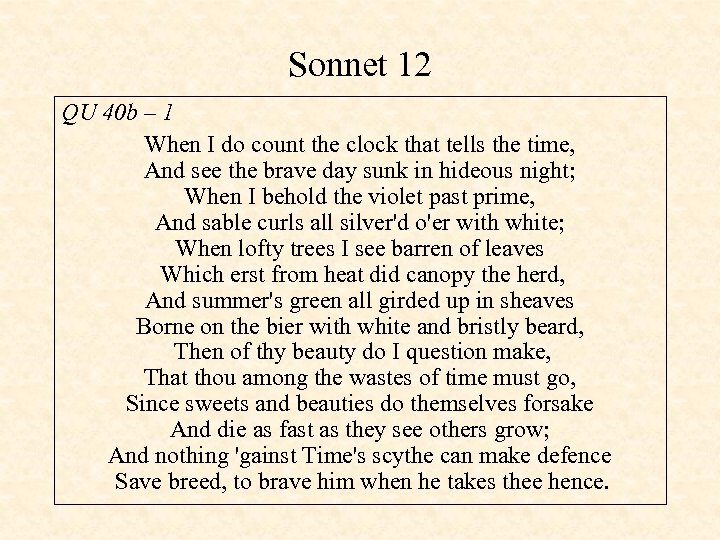 Sonnet 12 QU 40 b – 1 When I do count the clock that tells the time, And see the brave day sunk in hideous night; When I behold the violet past prime, And sable curls all silver'd o'er with white; When lofty trees I see barren of leaves Which erst from heat did canopy the herd, And summer's green all girded up in sheaves Borne on the bier with white and bristly beard, Then of thy beauty do I question make, That thou among the wastes of time must go, Since sweets and beauties do themselves forsake And die as fast as they see others grow; And nothing 'gainst Time's scythe can make defence Save breed, to brave him when he takes thee hence.
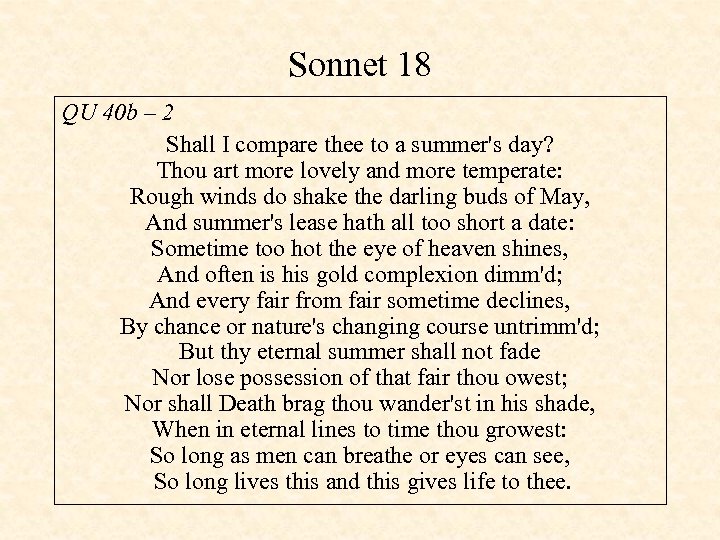 Sonnet 18 QU 40 b – 2 Shall I compare thee to a summer's day? Thou art more lovely and more temperate: Rough winds do shake the darling buds of May, And summer's lease hath all too short a date: Sometime too hot the eye of heaven shines, And often is his gold complexion dimm'd; And every fair from fair sometime declines, By chance or nature's changing course untrimm'd; But thy eternal summer shall not fade Nor lose possession of that fair thou owest; Nor shall Death brag thou wander'st in his shade, When in eternal lines to time thou growest: So long as men can breathe or eyes can see, So long lives this and this gives life to thee.
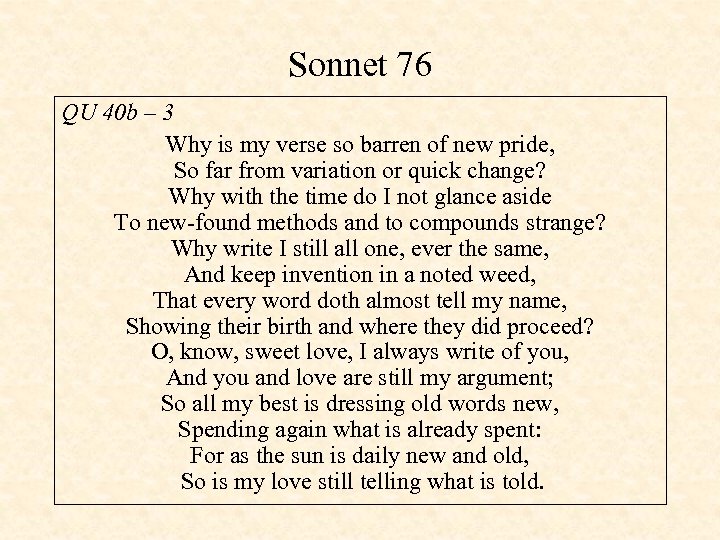 Sonnet 76 QU 40 b – 3 Why is my verse so barren of new pride, So far from variation or quick change? Why with the time do I not glance aside To new-found methods and to compounds strange? Why write I still all one, ever the same, And keep invention in a noted weed, That every word doth almost tell my name, Showing their birth and where they did proceed? O, know, sweet love, I always write of you, And you and love are still my argument; So all my best is dressing old words new, Spending again what is already spent: For as the sun is daily new and old, So is my love still telling what is told.
 Metaphysical Poets • c. 1600: New literary movements set in, esp. through Ben Jonson (satirical comedy) and John Donne. • Poetry: from flowing Elizabethan (copious, amplified etc. ) rhetoric to a more concise style, esp. epigram/epigrammatic genres
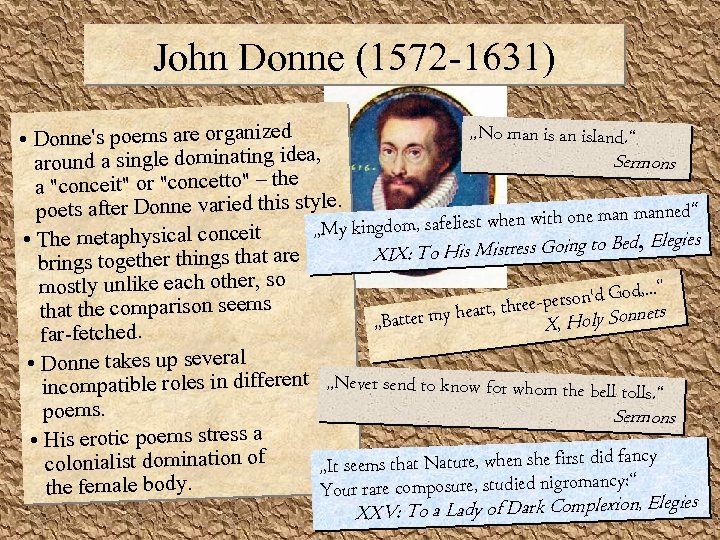 John Donne (1572 -1631) „No man island. “ • Donne's poems are organized Sermons around a single dominating idea, a "conceit" or "concetto" – the ned“ poets after Donne varied this style. est when with one man „My kingdom, safeli hysical conceit • The metap Bed, Elegies : To His Mistress Going to XIX brings together things that are mostly unlike each other, so d, . . . “ person'd Go s threethat the comparison seems net er my heart, „Batt X, Holy Son far-fetched. • Donne takes up several incompatible roles in different „Never send to know for whom the bell tolls. “ poems. Sermons • His erotic poems stress a fancy colonialist domination of „It seems that Nature, when she first did y: “ the female body. Your rare composure, studied nigromanc egies XXV: To a Lady of Dark Complexion, El
 John Donne – 2 • Satires, love elegies (short, philosophically charged love poems), divine poems. • Donne adopts Sidney's passionate speaker and Horace's satirical narrator; subject matters vary, erotic poems stress colonialist domination of the female body, cf. : "My kingdom, safeliest when with one manned" (Elegy 19, To his Mistress Going to Bed). • Metaphysical school of poetry (also George Herbert, Henry King, Henry Vaughan): dramatic voice intellectually acute and quick to involve the listener in intimate thoughts – entails a rhetorically plain diction, though with a highly compressed meaning, cf. :
 John Donne, "The Flea" – 1 QU 41 MARK but this flea, and mark in this, How little that which thou deniest me is; It suck'd me first, and now sucks thee, And in this flea our two bloods mingled be. Thou know'st that this cannot be said A sin, nor shame, nor loss of maidenhead; Yet this enjoys before it woo, And pamper'd swells with one blood made of two; And this, alas! is more than we would do.
 John Donne, "The Flea" – 2 O stay, three lives in one flea spare, Where we almost, yea, more than married are. This flea is you and I, and this Our marriage bed, and marriage temple is. Though parents grudge, and you, we're met, And cloister'd in these living walls of jet. Though use make you apt to kill me, Let not to that self-murder added be, And sacrilege, three sins in killing three.
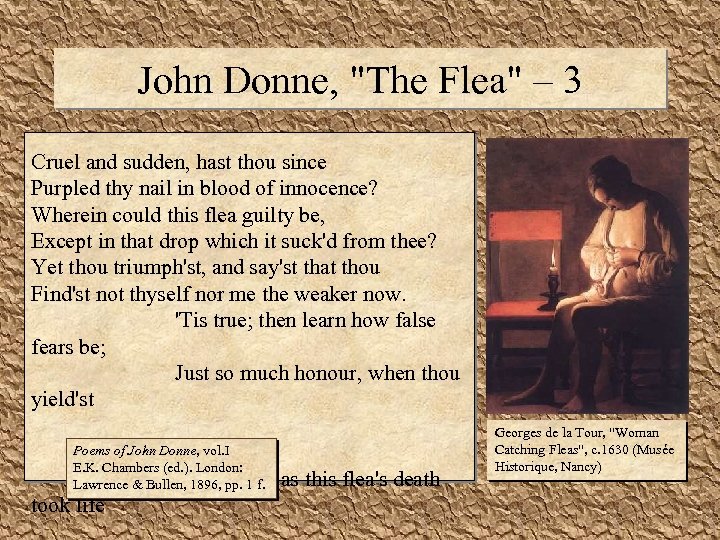 John Donne, "The Flea" – 3 Cruel and sudden, hast thou since Purpled thy nail in blood of innocence? Wherein could this flea guilty be, Except in that drop which it suck'd from thee? Yet thou triumph'st, and say'st that thou Find'st not thyself nor me the weaker now. 'Tis true; then learn how false fears be; Just so much honour, when thou yield'st Poems of John Donne, vol. I to me, E. K. Chambers (ed. ). London: Lawrence & Bullen, 1896, pp. 1 f. Will waste, as this flea's death took life Georges de la Tour, "Woman Catching Fleas", c. 1630 (Musée Historique, Nancy)
 John Donne – 3 • Conceit (i. e. far-fetched comparison) starts with single image of the flea, which the speaker elaborates: The lovers are already united, their blood mingled in the flea's stomach – so why hesitate with premarital intercourse? • Belittles grave offence against the woman's social status. • However: comic quality, exercise in metaphysical wit. • Dramatic monologue: monologue rather than soliloquy, lyrical speaker in the role of cavalier; stage props (flea) and dramatic action (flea squashed).
 John Donne, "The Bait" – 1 QU 42 COME live with me, and be my love, And we will some new pleasures prove Of golden sands, and crystal brooks, With silken lines and silver hooks. There will the river whisp'ring run Warm'd by thy eyes, more than the sun; And there th' enamour'd fish will stay, Begging themselves they may betray.
 John Donne, "The Bait" – 2 When thou wilt swim in that live bath, Each fish, which every channel hath, Will amorously to thee swim, Gladder to catch thee, than thou him. If thou, to be so seen, be'st loth, By sun or moon, thou dark'nest both, And if myself have leave to see, I need not their light, having thee. Let others freeze with angling reeds, And cut their legs with shells and weeds, Or treacherously poor fish beset, With strangling snare, or windowy net.
 John Donne, "The Bait" – 3 Let coarse bold hands from slimy nest The bedded fish in banks out-wrest; Or curious traitors, sleeve-silk flies, Bewitch poor fishes' wand'ring eyes. For thee, thou need'st no such deceit, For thou thyself art thine own bait: That fish, that is not catch'd thereby, Alas ! is wiser far than I. Poems of John Donne, vol. I, ed. E. K. Chambers. London: Lawrence & Bullen, 1896, pp. 47 -49
 John Donne – 4 • Again: Image of the bait/imagery of fishing is elaborated/ applied to human realm; request and paradise-like picture of the first stanzas themselves: some sort of second bait • First three stanzas are astonishingly sensual, the following ones realistic; flattering comparison of mistress' eyes with the sun: old literary topos and rhetorical device. • Other poets vary this style: Richard Crashaw devises sensuous, emblematic, 'baroque' conceits; George Herbert bases comparisons on liturgy/Bible and on homely/ familiar objects, e. g. "You must sit down, says Love, and taste my meat" – sensual, spiritual, eucharistic word play.
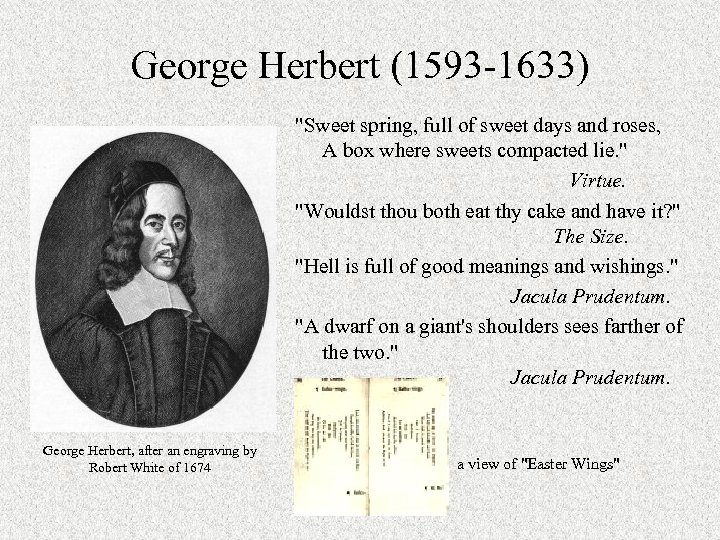 George Herbert (1593 -1633) "Sweet spring, full of sweet days and roses, A box where sweets compacted lie. " Virtue. "Wouldst thou both eat thy cake and have it? " The Size. "Hell is full of good meanings and wishings. " Jacula Prudentum. "A dwarf on a giant's shoulders sees farther of the two. " Jacula Prudentum. George Herbert, after an engraving by Robert White of 1674 a view of "Easter Wings"
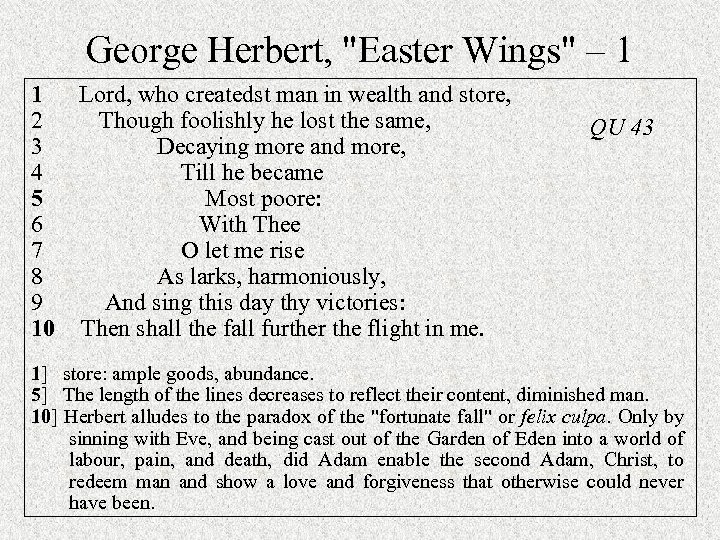 George Herbert, "Easter Wings" – 1 1 Lord, who createdst man in wealth and store, 2 Though foolishly he lost the same, 3 Decaying more and more, 4 Till he became 5 Most poore: 6 With Thee 7 O let me rise 8 As larks, harmoniously, 9 And sing this day thy victories: 10 Then shall the fall further the flight in me. QU 43 1] store: ample goods, abundance. 5] The length of the lines decreases to reflect their content, diminished man. 10] Herbert alludes to the paradox of the "fortunate fall" or felix culpa. Only by sinning with Eve, and being cast out of the Garden of Eden into a world of labour, pain, and death, did Adam enable the second Adam, Christ, to redeem man and show a love and forgiveness that otherwise could never have been.
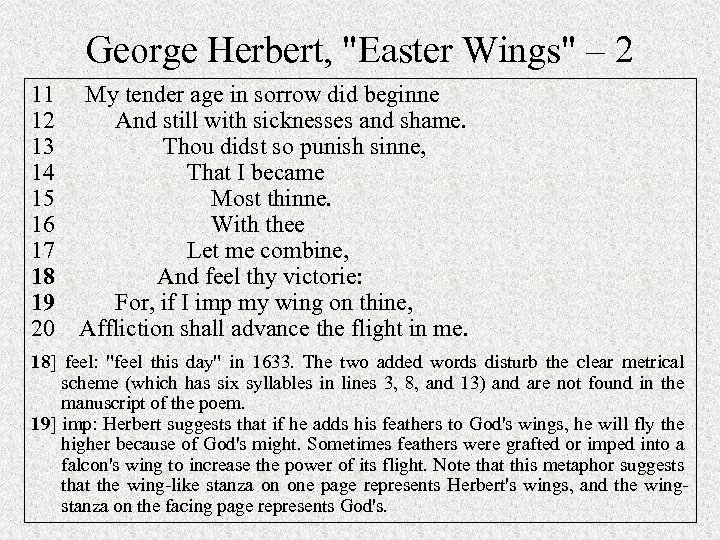 George Herbert, "Easter Wings" – 2 11 My tender age in sorrow did beginne 12 And still with sicknesses and shame. 13 Thou didst so punish sinne, 14 That I became 15 Most thinne. 16 With thee 17 Let me combine, 18 And feel thy victorie: 19 For, if I imp my wing on thine, 20 Affliction shall advance the flight in me. 18] feel: "feel this day" in 1633. The two added words disturb the clear metrical scheme (which has six syllables in lines 3, 8, and 13) and are not found in the manuscript of the poem. 19] imp: Herbert suggests that if he adds his feathers to God's wings, he will fly the higher because of God's might. Sometimes feathers were grafted or imped into a falcon's wing to increase the power of its flight. Note that this metaphor suggests that the wing-like stanza on one page represents Herbert's wings, and the wingstanza on the facing page represents God's.
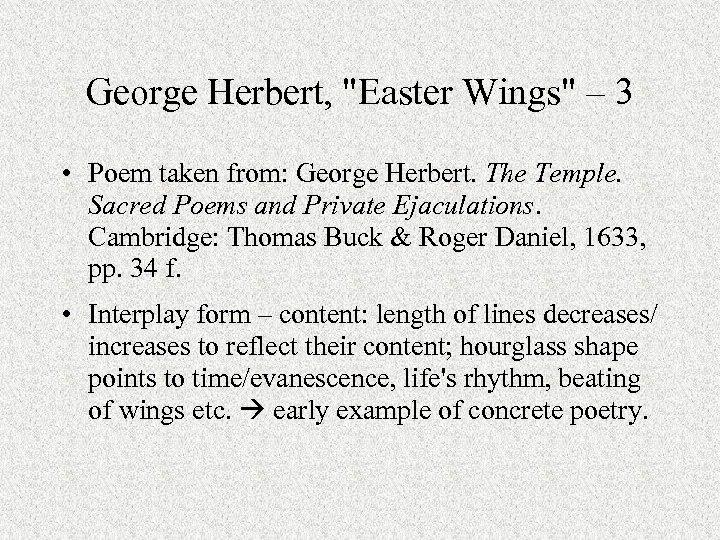 George Herbert, "Easter Wings" – 3 • Poem taken from: George Herbert. The Temple. Sacred Poems and Private Ejaculations. Cambridge: Thomas Buck & Roger Daniel, 1633, pp. 34 f. • Interplay form – content: length of lines decreases/ increases to reflect their content; hourglass shape points to time/evanescence, life's rhythm, beating of wings etc. early example of concrete poetry.
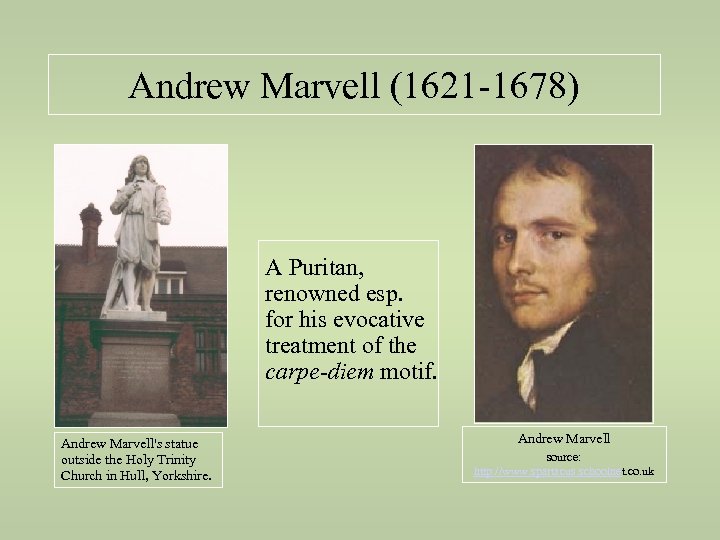 Andrew Marvell (1621 -1678) A Puritan, renowned esp. for his evocative treatment of the carpe-diem motif. Andrew Marvell's statue outside the Holy Trinity Church in Hull, Yorkshire. Andrew Marvell source: http: //www. spartacus. schoolnet. co. uk
 Andrew Marvell, "To his Coy Mistress" – 1 1 Had we but world enough, and time, 2 This coyness, lady, were no crime. 3 We would sit down and think which way 4 To walk, and pass our long love's day; 5 Thou by the Indian Ganges' side 6 Shouldst rubies find; I by the tide 7 Of Humber would complain. I would 8 Love you ten years before the Flood; 9 And you should, if you please, refuse 10 Till the conversion of the Jews. 11 My vegetable love should grow QU 44 7] Humber: Hull, where Marvell lived as a boy, and which he represented as an M. P. for nearly twenty years from 1659, is on the river Humber. 10] The conversion of the Jews was to take place just before the end of the world. 11] vegetable love: that of his "vegetable" soul.
 Andrew Marvell, "To his Coy Mistress" – 2 12 Vaster than empires, and more slow. 13 An hundred years should go to praise 14 Thine eyes, and on thy forehead gaze; 15 Two hundred to adore each breast, 16 But thirty thousand to the rest; 17 An age at least to every part, 18 And the last age should show your heart. 19 For, lady, you deserve this state, 20 Nor would I love at lower rate. 21 But at my back I always hear 22 Time's winged chariot hurrying near; 23 And yonder all before us lie 24 Deserts of vast eternity. 25 Thy beauty shall no more be found, 26 Nor, in thy marble vault, shall sound
 Andrew Marvell, "To his Coy Mistress" – 3 27 My echoing song; then worms shall try 28 That long preserv'd virginity, 29 And your quaint honour turn to dust, 30 And into ashes all my lust. 31 The grave's a fine and private place, 32 But none I think do there embrace. 33 Now therefore, while the youthful hue 34 Sits on thy skin like morning dew, 35 And while thy willing soul transpires 36 At every pore with instant fires, 37 Now let us sport us while we may; 29] quaint: elegant, artificial. 34] dew. The original reading is "glew, " which has been justified as meaning "glow. " 36] instant: immediate and urgent.
 Andrew Marvell, "To his Coy Mistress" – 4 38 And now, like am'rous birds of prey, 39 Rather at once our time devour, 40 Than languish in his slow-chapp'd power. 41 Let us roll all our strength, and all 42 Our sweetness, up into one ball; 43 And tear our pleasures with rough strife 44 Thorough the iron gates of life. 45 Thus, though we cannot make our sun 46 Stand still, yet we will make him run. 40] slow-chapp'd: i. e. , with slow-devouring jaws. Andrew Marvell. Miscellaneous Poems. Mary Marvell [ed. ]. [1681]. Scolar Press, 1969.
 Andrew Marvell – 2 • Lines 13 ff. : descriptio tradition satirically exaggerated "For, lady, you deserve this state": ambivalent compliment – because of her coyness, she deserves to remain without lover. • 21 ff. : "Time's winged chariot" flies – everything is evanescent, transitory; at the same time: sexual allusions "quaint" (Chaucer's English), "skin", "transpires", "fires", "sport", "am'rous", "devour", "Let us roll […]/[…] up into one ball", "pleasures". • 45 f. : The intended "sport" will accelerate time (towards death) rather than make it stand still.
 17 th century Prose Thomas Hobbes' Leviathan (1651) • Contradictory sources of human action: elementary condition of war (bellum omnium contra omnes); on the other hand, fear of violent death people surrender their freedom to sovereign power – societal contract (vs. divine kingship). and Francis Bacon
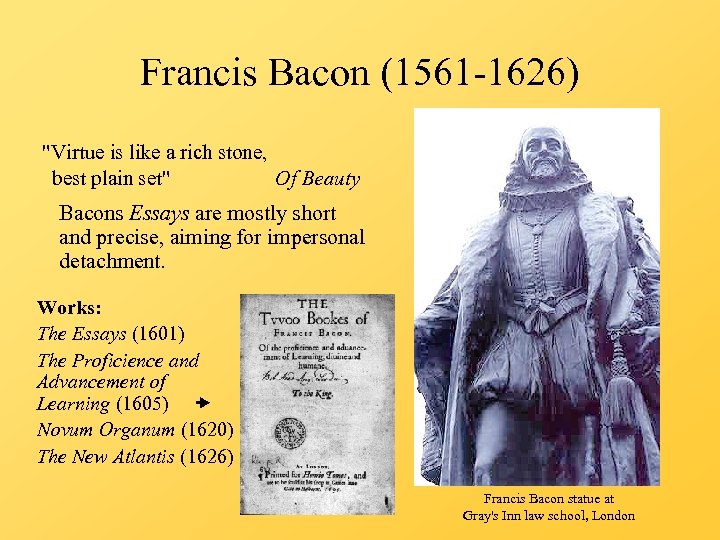 Francis Bacon (1561 -1626) "Virtue is like a rich stone, best plain set" Of Beauty Bacons Essays are mostly short and precise, aiming for impersonal detachment. Works: The Essays (1601) The Proficience and Advancement of Learning (1605) Novum Organum (1620) The New Atlantis (1626) Francis Bacon statue at Gray's Inn law school, London
 Francis Bacon – 2 • Essays: in Montaigne's sense more economical/ less dogmatic than the Platonic dialogue or formal discourse – aphoristic style; at the same time avoiding Montaigne's personal tone. • The Advancement of Learning (1605): critique of humanism, programme of empirical and experimental methodology – clad in vigorous style; New Atlantis (unfinished): utopian description of a research academy with a narrowly technological bent – strangely agrees with neo-feudal social structure. • Esp. Novum Organum (1620): advocates sense perception, experiment, experience indicates paradigm shift from authority-centred to experiencerelated models of reality.
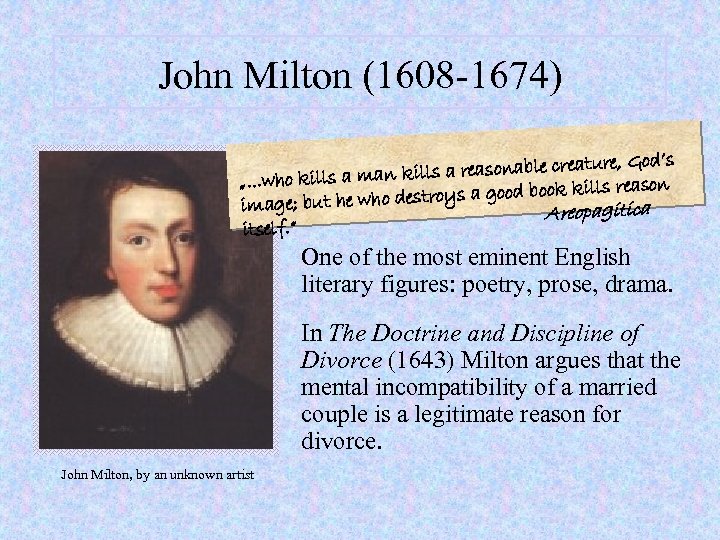 John Milton (1608 -1674) re, God’s kills a reasonable creatu „. . . who kills a man ls reason destroys a good book kil image; but he who Areopagitica itself. “ One of the most eminent English literary figures: poetry, prose, drama. In The Doctrine and Discipline of Divorce (1643) Milton argues that the mental incompatibility of a married couple is a legitimate reason for divorce. John Milton, by an unknown artist
 John Milton – 2 • Areopagitica (1644): classical oration/speech addressed to Commons and Lords – glowing plea for liberty of speech, thought, expression: QU 45 "Methinks I see in my mind a noble and puissant (mighty) nation rousing herself like a strong man after sleep, and shaking her invincible locks. Methinks I see her as an eagle mewing her mighty youth, and kindling her undazzled eyes at the full midday beam; purging and unscaling her long-abused sight at the fountain itself of heavenly radiance; while the whole noise of timorous and flocking birds, with those also that love the twilight, flutter about…"
 John Milton – 3 • Lofty hopes of the English revolution's idealistic phase; The Tenure of Kings and Magistrates (1650) develops a reasoned defence of the killing of tyrants: "…the power of kings and magistrates is nothing else but what is only derivative, transferred and committed to them in trust from the people, to the common good of them all…" • Famous elegy Lycidas (1637) laments the death of Milton's friend Edward King – dwelling on theme of vita brevis ars longa; assured diction, free syntax/metre: powerfully elevated tone – Milton's "organ voice" (Tennyson):
 QU 46 John Milton, Lycidas – 1 In this Monody the author bewails a learned friend, unfortunately drowned in his passage from Chester on the Irish Seas, 1637; and by occasion foretells the ruin of our corrupted clergy, then in their height 1 Yet once more, O ye laurels, and once more 1] First printed in 1638, in Obsequies to the memorie of Mr. Edward King. Present text, that of Poems, 1645. Edward King, Fellow of Christ's College, Cambridge, was drowned on a voyage to Ireland, and his Cambridge friends issued a volume of verse in his memory, consisting, first, of poems in Latin and Greek, under the title Justa Eduardo King, and, secondly, with separate title-page (as above), English poems. Lycidas, signed I. M. , is the last poem in the volume. The name "Lycidas" is fairly common in pastoral poetry (e. g. , in Theocritus, Idyl I, Virgil, Eclogues VII and IX). The note under the title was added in Poems, 1645. By plucking laurel, myrtle, and ivy, constituents of the poet's crowning, is symbolized Milton's return to the writing of verse (after the interval of four years since Comus); the reference to this enforced and premature action indicates Milton's unwillingness to write poetry at this time while still preparing himself for his magnum opus.
 John Milton, Lycidas – 2 2 3 4 5 6 7 8 9 10 Ye myrtles brown, with ivy never sere, I come to pluck your berries harsh and crude, And with forc'd fingers rude Shatter your leaves before the mellowing year. Bitter constraint and sad occasion dear Compels me to disturb your season due; For Lycidas is dead, dead ere his prime, Young Lycidas, and hath not left his peer. Who would not sing for Lycidas? he knew 3] crude: unripe. 5] shatter: scatter. 6] dear: grievous, but with overtones from other meanings of the word. 10] Milton treats Edward King as at once priest and poet. Like others with a humanistic education, King could, and on occasion did, write Latin verses.
 John Milton, Lycidas – 3 11 12 13 14 Himself to sing, and build the lofty rhyme. He must not float upon his wat'ry bier Unwept, and welter to the parching wind, Without the meed of some melodious tear. 15 16 17 18 19 Begin then, Sisters of the sacred well That from beneath the seat of Jove doth spring; Begin, and somewhat loudly sweep the string. Hence with denial vain and coy excuse! So may some gentle muse 13] welter: roll about. 14] meed: token of honour; tear: commonly used as a poetic synonym for elegy (as in Spenser's Teares of the Muses). 15] One of the haunts sacred to the Muses was the spring Aganippe on Mount Helicon, near which was a temple to Zeus. See P. L. I, 10 -12.
 John Milton, Lycidas – 4 20 21 22 With lucky words favour my destin'd urn, And as he passes turn And bid fair peace be to my sable shroud! 23 24 25 26 27 28 For we were nurs'd upon the self-same hill, Fed the same flock, by fountain, shade, and rill; Together both, ere the high lawns appear'd Under the opening eyelids of the morn, We drove afield, and both together heard What time the gray-fly winds her sultry horn, 20] my destin'd urn. The urn, used by the ancients for burial (cf. Sir Thomas Brown, Urn Burial), here stands for the poet's death. 22] Say, Requiescat in pace; shroud (burial cloth) here stands for the dead. 25] lawns: grass lands. 28] gray-fly: so called from its colour, and also the trumpet-cry from the noise it makes.
 John Milton, Lycidas – 5 29 Batt'ning our flocks with the fresh dews of night, 30 Oft till the star that rose at ev'ning bright 31 Toward heav'n's descent had slop'd his westering wheel. 32 Meanwhile the rural ditties were not mute, 33 Temper'd to th'oaten flute; 34 Rough Satyrs danc'd, and Fauns with clov'n heel, 35 From the glad sound would not be absent long; 36 And old Damœtas lov'd to hear our song. 29] battening: making fat. 30] Though some inexactness in the description has been noticed, Milton probably intends the Evening Star (Hesperus). 34] Satyrs in Greek myth were human figures, but with pointed ears and clad in skins' beasts. By the Romans they were identified with their fauns and represented with goat's horn, tail, and cloven hoof (hence cloven heel). Here they stand for Milton and King's fellow students. 36] Damœtas: presumably standing for some fellow of the college.
 John Milton, Lycidas – 6 37 38 39 40 41 42 43 44 45 46 But O the heavy change now thou art gone, Now thou art gone, and never must return! Thee, Shepherd, thee the woods and desert caves, With wild thyme and the gadding vine o'ergrown, And all their echoes mourn. The willows and the hazel copses green Shall now no more be seen Fanning their joyous leaves to thy soft lays. As killing as the canker to the rose, Or taint-worm to the weanling herds that graze, 40] gadding: wandering, that is, growing naturally, not subjected to control. 45] canker: canker-worm, which by feeding on it produces canker in the blossom. 46] taint-worm: a worm thought to taint or infect cattle.
 John Milton, Lycidas – 7 47 48 49 50 Or frost to flowers that their gay wardrobe wear When first the white thorn blows: Such, Lycidas, thy loss to shepherd's ear. Where were ye, Nymphs, when the remorseless deep 48] white thorn: the common hawthorn. 50] An appeal to the nymphs was one of the conventions of pastoral elegy. The places named in Greek and Latin pastoral belonged to the ancient world and were selected with some reference to the subject. As is appropriate in Eclogue X, the lament for Gallus, a poet, Virgil appeals to the Naiads in association with places sacred to the Muses, and may suggest that by Naiads he really means the Muses. Milton appropriately substitutes British places in the vicinity of King's fatal journey; and by Nymphs he probably means the Muses, since he associates them with bards, and the Bards formed a division of the Druids, the priests of the Britons, while traditions accessible to Milton traced a connection between ancient Greek and ancient British religion and culture. His first [ctd. ]
 John Milton, Lycidas – 8 51 52 53 54 55 56 57 Clos'd o'er the head of your lov'd Lycidas? For neither were ye playing on the steep Where your old bards, the famous Druids, lie, Nor on the shaggy top of Mona high, Nor yet where Deva spreads her wizard stream. Ay me! I fondly dream 'Had ye bin there'--for what could that have done? 50] [ctd. ] allusion refers vaguely to some burial place of the Druids in the Welsh mountains (the steep); the second, and more specific, is to the island of Anglesey, which the Romans called Mona; the third is to the river Dee, marking the border of England Wales and supposed to possess magic powers by which it predicted the fortunes of the hostile nations; over the Dee stood Chester, whence travellers took ship for Ireland.
 John Milton, Lycidas – 9 58 59 60 61 62 63 What could the Muse herself that Orpheus bore, The Muse herself, for her enchanting son, Whom universal nature did lament, When by the rout that made the hideous roar His gory visage down the stream was sent, Down the swift Hebrus to the Lesbian shore? 58] Orpheus, the mythical originator of poetry and song, was reputed to be the son of the Muse Calliope, and gifted with the power of charming by his music all animate and inanimate things, which subsequently united in lamenting his death. After his final loss of his wife, Eurydice, he wandered through Thrace mourning for her, where he was encountered by the wild female worshippers of Bacchus. Enraged by his repelling of their advances, they hurled their spears at him, but these, charmed by his music, fell harmless to the ground, whereupon the women set up a loud cry, drowning the music, and the spears took effect. They cast the head of Orpheus and his lyre into the river Hebrus which bore them out to sea and cast them up on the island of Lesbos.
 John Milton, Lycidas – 10 64 65 66 67 68 69 Alas! what boots it with incessant care To tend the homely, slighted shepherd's trade, And strictly meditate thankless Muse? Were it not better done, as others use, To sport with Amaryllis in the shade, Or with the tangles of Neæra's hair? 70 71 72 Fame is the spur that the clear spirit doth raise (That last infirmity of noble mind) To scorn delights and live laborious days; 68] Amaryllis and Neaera are names which occur in erotic pastoral poetry. Milton is perhaps thinking of the amatory court poets of his own day. 70] clear: noble (Lat. clarus). 71] Alluding to the saying of Tacitus, Histories, IV, VI, that "for even the wise man the desire of glory is the last to be put aside. "
 John Milton, Lycidas – 11 73 74 75 76 77 78 But the fair guerdon when we hope to find, And think to burst out into sudden blaze, Comes the blind Fury with th'abhorred shears, And slits the thin-spun life. "But not the praise, " Phoebus replied, and touch'd my trembling ears; "Fame is no plant that grows on mortal soil, 75] Milton alludes to Atropos, the one of the three Fates who cut the thread of life. Thinking of her inexorable character and the fear she inspires, Milton deliberately calls her not a Fate, but a Fury. 76] Phoebus, god of poetry, intervenes with the counterstatement that praise is not ended by death. It can be shown from the Latin poets that touching the ear was a way of reminding one of something forgotten (Virgil, Eclogue, VI, 3); trembling here is a transferred epithet, signifying: "touch'd my ears, I trembling the while. " 77] foil: a thin leaf of metal placed behind a gem to enhance its brightness.
 John Milton, Lycidas – 12 79 80 81 82 83 84 Nor in the glistering foil Set off to th'world, nor in broad rumour lies, But lives and spreads aloft by those pure eyes And perfect witness of all-judging Jove; As he pronounces lastly on each deed, Of so much fame in Heav'n expect thy meed. " 85 O fountain Arethuse, and thou honour'd flood, 81] True fame depends on merit in the sight of God and will be enjoyed in heaven. (Jove here stands for God, as often in Christian humanist poetry. ) 85] Arethusa, the spring Arethusa, in the island of Ortygia, off the coast of Sicily, here symbolizes Greek pastoral poetry, and especially the Idyls of Theocritus, born in nearby Syracuse. Mincius, the river flowing roumd Mantua, claimed by Virgil as his birth, symbolizes Latin pastoral poetry, and especially the Eclogues of Virgil. The vocal reeds are the stems used for making the shepherd's pipes. The words of the preceding [ctd. ]
 John Milton, Lycidas – 13 86 87 88 89 90 91 92 93 94 Smooth-sliding Mincius, crown'd with vocal reeds, That strain I heard was of a higher mood. But now my oat proceeds, And listens to the Herald of the Sea, That came in Neptune's plea. He ask'd the waves, and ask'd the felon winds, "What hard mishap hath doom'd this gentle swain? " And question'd every gust of rugged wings That blows from off each beaked promontory. 85] [ctd. ] paragraph were of a higher order and transcended the pastoral mood, to which the poet returns, as suggested in Now my oat [another synonym for the shepherd's pipes] proceeds. 89] herald of the sea: Triton. 90] in Neptune's plea: that is, to exonerate Neptune (the sea) from blame for the death of Lycidas, by calling witnesses to the calm weather.
 John Milton, Lycidas – 14 95 96 97 98 99 100 101 102 They knew not of his story; And sage Hippotades their answer brings, That not a blast was from his dungeon stray'd; The air was calm, and on the level brine Sleek Panope with all her sisters play'd. It was that fatal and perfidious bark, Built in th'eclipse, and rigg'd with curses dark, That sunk so low that sacred head of thine. 103 Next Camus, reverend sire, went footing slow, 96] Hippotades: Aeolus, son of Hippotes and guardian of the winds. 99] Panope: one of the Nereids or sea-nymphs, who was associated with calm weather and invoked by Roman sailors. 101] An eclipse was proverbially of evil omen. 103] Camus, thought of as the genius of the Cam, and the representative here of Cambridge University, built on its banks. His appearance [ctd. ]
 John Milton, Lycidas – 15 104 105 106 107 108 109 His mantle hairy, and his bonnet sedge, Inwrought with figures dim, and on the edge Like to that sanguine flower inscrib'd with woe. "Ah! who hath reft, " quoth he, "my dearest pledge? " Last came, and last did go, The Pilot of the Galilean lake; 103] [ctd. ] suggests the slow-flowing, weed-grown river. The sanguine flower inscribed with woe is the hyacinth as it is accounted for in the myth of Hyacinthus (Ovid, Metamorphoses, X, 174 -217) accidentally slain while at play with Apollo: his blood fell on a lily, staining it purple, and on the petals the god wrote ai, ai (ahs, ahs). The implication is that the sedge of the Cam bears a like sign of woe. 107] pledge: child (Lat. pignus). 109] As a fisherman on the Sea of Galilee, and leader of the Disciples, St. Peter is here called the Pilot of the Galilean lake.
 John Milton, Lycidas – 16 110 111 112 113 Two massy keys he bore of metals twain (The golden opes, the iron shuts amain). He shook his mitred locks, and stern bespake: "How well could I have spar'd for thee, young swain, 110] The starting point of these lines is Christ's words to St. Peter, "And I will give the keys of the kingdom of heaven" (Matthew 16: 19), read perhaps in the light of, "he shall open, and none shall shut; and he shall shut, and none shall open" (Isaiah 22: 22). 112] mitred, referring to the crown of the bishop, St. Peter being presented in the role of ideal bishop. 113] Commencing with an indictment of the clergy as entering the ministry from worldly motives and excluding those with a true vocation, Milton describes their neglect of their duties and the consequences to the flock. Lines 123 -25 are usually explained as an allusion to their infrequent and valueless sermons which do nothing to nourish the flock; but quite possibly it is a reference (couched in the language of shepherd life) [ctd. ]
 John Milton, Lycidas – 17 114 115 116 117 118 119 120 121 122 123 Enow of such as for their bellies' sake Creep and intrude, and climb into the fold? Of other care they little reck'ning make Than how to scramble at the shearers' feast And shove away the worthy bidden guest. Blind mouths! that scarce themselves know how to hold A sheep-hook, or have learn'd aught else the least That to the faithful herdman's art belongs! What recks it them? What need they? They are sped; And when they list their lean and flashy songs 113] [ctd. ] to their neglect of their duty while they give themselves to song and other secular recreations. 122] sped: provided for. 123] flashy: destitute of meaning, trifling.
 John Milton, Lycidas – 18 124 125 126 127 128 129 Grate on their scrannel pipes of wretched straw, The hungry sheep look up, and are not fed, But, swoll'n with wind and the rank mist they draw, Rot inwardly, and foul contagion spread; Besides what the grim wolf with privy paw Daily devours apace, and nothing said, 124] scrannel pipes. Virgil has the phrase stridenti stipula (Eclogues, III, 27). Milton's scrannel appears to be his invention, though possibly based on some dialect word meaning thin; its sound suits well with his verb Grate. 126] allude to the corrupting effect of the false doctrines taught them. 128] allude to conversions to the Roman Catholic Church (here symbolized by the wolf), at which, as the Puritans erroneously believed, Archbishop Laud connived.
 John Milton, Lycidas – 19 130 131 But that two-handed engine at the door Stands ready to smite once, and smite no more". 132 133 Return, Alpheus: the dread voice is past That shrunk thy streams; return, Sicilian Muse, 130] This is the most disputed passage in Milton's poetry. It seems evident from the context that the two-handed engine is some heavy weapon, ready at the door of the sheepfold, to be used against the wolf. This must be the starting point for any interpretation of meaning. 132] Alpheus, a river god in Arcadia, pursued the nymph Arethusa (see above, lines 85 -87 n. ) and when she, to escape his pursuit, was transformed to a spring by Diana and passed beneath the sea to Ortygia, the river Alpheus followed her and reached the same island. Here the association with Arethusa makes Alpheus likewise a symbol for Sicily and pastoral poetry. To ensure that the meaning is not missed, Milton adds an invocation to the muse of pastoral verse, "Return Sicilian Muse. "
 John Milton, Lycidas – 20 134 135 136 137 138 139 140 141 142 143 And call the vales and bid them hither cast Their bells and flow'rets of a thousand hues. Ye valleys low, where the mild whispers use Of shades and wanton winds, and gushing brooks, On whose fresh lap the swart star sparely looks, Throw hither all your quaint enamel'd eyes, That on the green turf suck the honied showers And purple all the ground with vernal flowers. Bring the rathe primrose that forsaken dies, The tufted crow-toe, and pale jessamine, 136] use: are accustomed (to dwell). 138] swart star: Sirius, the star whose rising in August was said to burn the fields swart or dark. 142] rathe: early.
 John Milton, Lycidas – 21 144 145 146 147 148 149 150 151 152 153 The white pink, and the pansy freak'd with jet, The glowing violet, The musk-rose, and the well attir'd woodbine, With cowslips wan that hang the pensive head, And every flower that sad embroidery wears; Bid amaranthus all his beauty shed, And daffadillies fill their cups with te To strew the laureate hearse where Lycid lies. For so to interpose a little ease, Let our frail thoughts dally with false surmise. 144] freakt: spotted or streaked. 149] amaranthus: an imaginary everlasting flower. 151] laureate hearse. The hearse, or frame supporting the bier, here stands for the bier itself; laureate (by its association with the laurel of the poet's crown) signifies that the bier is a poet's.
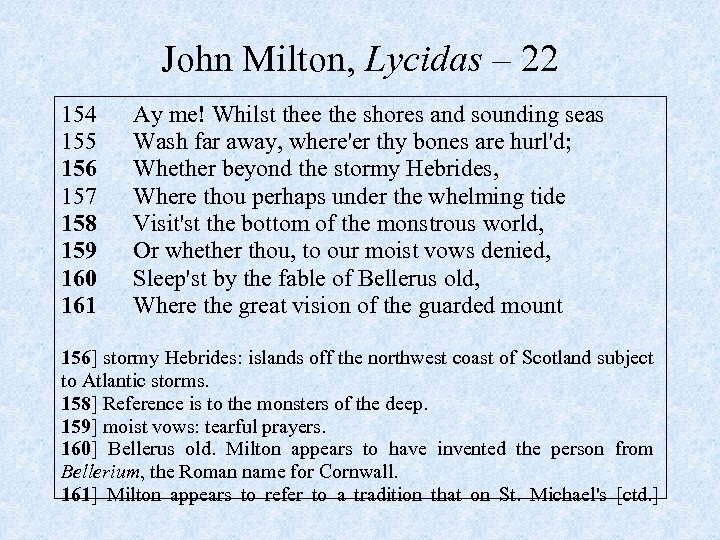 John Milton, Lycidas – 22 154 155 156 157 158 159 160 161 Ay me! Whilst thee the shores and sounding seas Wash far away, where'er thy bones are hurl'd; Whether beyond the stormy Hebrides, Where thou perhaps under the whelming tide Visit'st the bottom of the monstrous world, Or whether thou, to our moist vows denied, Sleep'st by the fable of Bellerus old, Where the great vision of the guarded mount 156] stormy Hebrides: islands off the northwest coast of Scotland subject to Atlantic storms. 158] Reference is to the monsters of the deep. 159] moist vows: tearful prayers. 160] Bellerus old. Milton appears to have invented the person from Bellerium, the Roman name for Cornwall. 161] Milton appears to refer to a tradition that on St. Michael's [ctd. ]
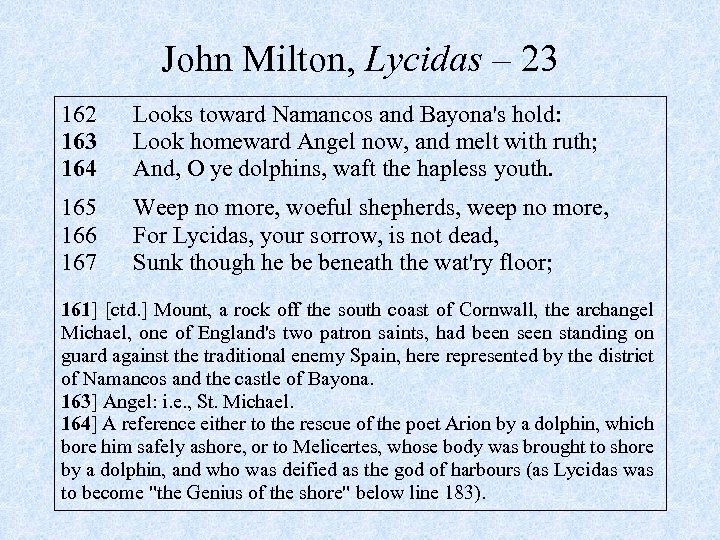 John Milton, Lycidas – 23 162 163 164 Looks toward Namancos and Bayona's hold: Look homeward Angel now, and melt with ruth; And, O ye dolphins, waft the hapless youth. 165 166 167 Weep no more, woeful shepherds, weep no more, For Lycidas, your sorrow, is not dead, Sunk though he be beneath the wat'ry floor; 161] [ctd. ] Mount, a rock off the south coast of Cornwall, the archangel Michael, one of England's two patron saints, had been standing on guard against the traditional enemy Spain, here represented by the district of Namancos and the castle of Bayona. 163] Angel: i. e. , St. Michael. 164] A reference either to the rescue of the poet Arion by a dolphin, which bore him safely ashore, or to Melicertes, whose body was brought to shore by a dolphin, and who was deified as the god of harbours (as Lycidas was to become "the Genius of the shore" below line 183).
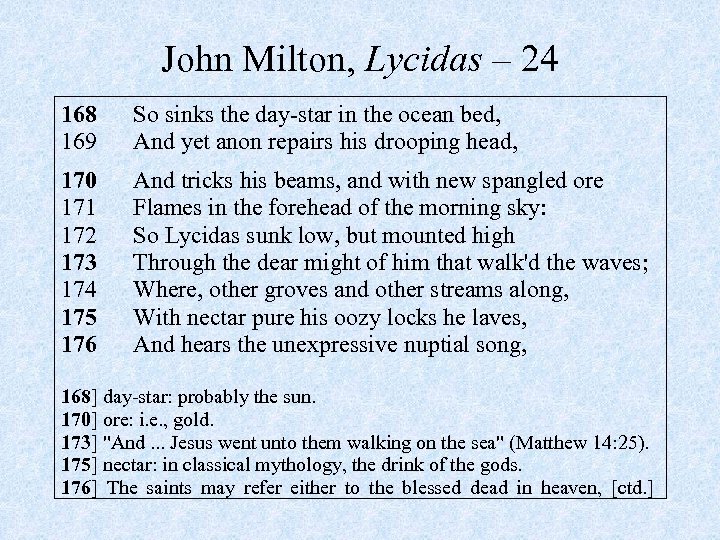 John Milton, Lycidas – 24 168 169 So sinks the day-star in the ocean bed, And yet anon repairs his drooping head, 170 171 172 173 174 175 176 And tricks his beams, and with new spangled ore Flames in the forehead of the morning sky: So Lycidas sunk low, but mounted high Through the dear might of him that walk'd the waves; Where, other groves and other streams along, With nectar pure his oozy locks he laves, And hears the unexpressive nuptial song, 168] day-star: probably the sun. 170] ore: i. e. , gold. 173] "And. . . Jesus went unto them walking on the sea" (Matthew 14: 25). 175] nectar: in classical mythology, the drink of the gods. 176] The saints may refer either to the blessed dead in heaven, [ctd. ]
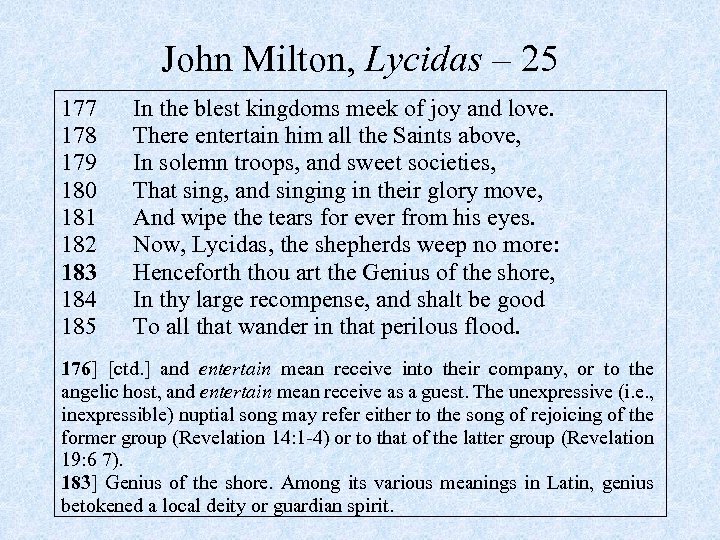 John Milton, Lycidas – 25 177 178 179 180 181 182 183 184 185 In the blest kingdoms meek of joy and love. There entertain him all the Saints above, In solemn troops, and sweet societies, That sing, and singing in their glory move, And wipe the tears for ever from his eyes. Now, Lycidas, the shepherds weep no more: Henceforth thou art the Genius of the shore, In thy large recompense, and shalt be good To all that wander in that perilous flood. 176] [ctd. ] and entertain mean receive into their company, or to the angelic host, and entertain mean receive as a guest. The unexpressive (i. e. , inexpressible) nuptial song may refer either to the song of rejoicing of the former group (Revelation 14: 1 -4) or to that of the latter group (Revelation 19: 6 7). 183] Genius of the shore. Among its various meanings in Latin, genius betokened a local deity or guardian spirit.
 John Milton, Lycidas – 26 187 188 189 190 191 192 193 Thus sang the uncouth swain to th'oaks and rills, While the still morn went out with sandals gray; He touch'd the tender stops of various quills, With eager thought warbling his Doric lay; And now the sun had stretch'd out all the hills, And now was dropp'd into the western bay; At last he rose, and twitch'd his mantle blue: To-morrow to fresh woods, and pastures new. 186] The song proper ends at 185, and is followed by this brief narrative passage. The uncouth swain is Milton in his guise of shepherd poet. The quills are the shepherd's pipe. Doric, the dialect used by Theocritus, hence denotes the simple language of pastoral poetry. Online text copyright © 2003, Ian Lancashire for the Department of English, U o Toronto. (John Milton. Poems 1645. Facs. ed. Menston: Scolar Press, 1970)
 John Milton, Paradise Lost (1667) – 1 • Vastly influential: First epic of modern times to rival ancient classics in style. • Follows conventions of classical epic scrupulously; instead of the mythical history of a people, the biblical history of salvation – Creation, the fall of corrupted angels, the Fall of Man.
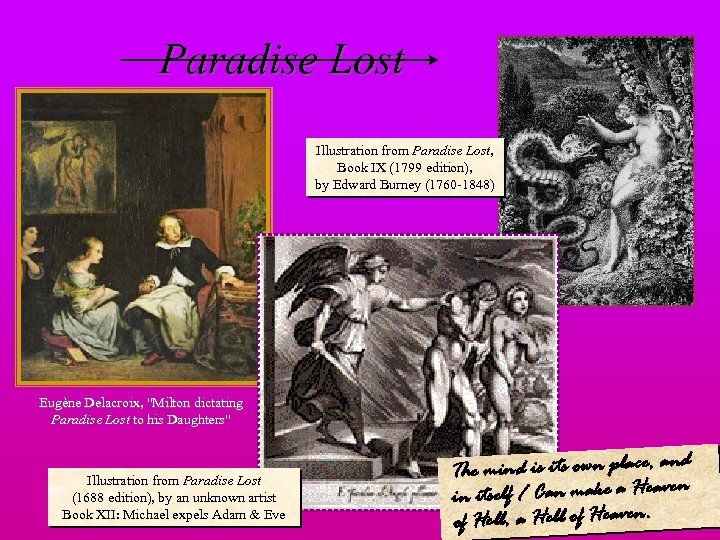 Paradise Lost Illustration from Paradise Lost, Book IX (1799 edition), by Edward Burney (1760 -1848) Eugène Delacroix, "Milton dictating Paradise Lost to his Daughters" Illustration from Paradise Lost (1688 edition), by an unknown artist Book XII: Michael expels Adam & Eve d The mind is its own place, an ven in itself / Can make a Hea of Hell, a Hell of Heaven.
 QU 47 1 John Milton, Paradise Lost – 1 Paradise Lost: Book I Of Man's first disobedience, and the fruit 1] A drama on the Fall, entitled "Paradise Lost, " was planned by Milton in 1640 -42. Lines 32 -41 of Book IV were composed about 1642, and were intended for the opening speech of this drama. After a long interruption he re-commenced the poem in epic form, perhaps about 1657, and completed it by 1663 or 1665. It was published in ten books in 1667; it was subsequently revised and redivided into twelve books for the "Second Edition" published in 1674. A note on "The Verse" explains: "The measure is English heroic verse without rime, as that of Homer in Greek, and of Virgil in Latin, --rime being no necessary adjunct or true ornament of poem or good verse, in longer works especially, but the invention of a barbarous age, to set off wretched matter and lame metre; graced indeed since by the use of some famous modern poets, carried away by custom, but much to their own vexation, hindrance, and constraint to express many things otherwise, and for the most part worse, than else they would have expressed them. Not without cause therefore some both Italian [ctd. ]
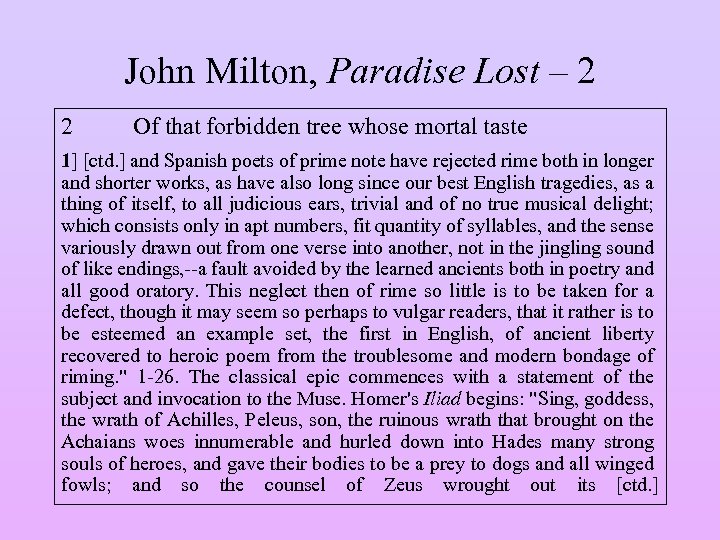 John Milton, Paradise Lost – 2 2 Of that forbidden tree whose mortal taste 1] [ctd. ] and Spanish poets of prime note have rejected rime both in longer and shorter works, as have also long since our best English tragedies, as a thing of itself, to all judicious ears, trivial and of no true musical delight; which consists only in apt numbers, fit quantity of syllables, and the sense variously drawn out from one verse into another, not in the jingling sound of like endings, --a fault avoided by the learned ancients both in poetry and all good oratory. This neglect then of rime so little is to be taken for a defect, though it may seem so perhaps to vulgar readers, that it rather is to be esteemed an example set, the first in English, of ancient liberty recovered to heroic poem from the troublesome and modern bondage of riming. " 1 -26. The classical epic commences with a statement of the subject and invocation to the Muse. Homer's Iliad begins: "Sing, goddess, the wrath of Achilles, Peleus, son, the ruinous wrath that brought on the Achaians woes innumerable and hurled down into Hades many strong souls of heroes, and gave their bodies to be a prey to dogs and all winged fowls; and so the counsel of Zeus wrought out its [ctd. ]
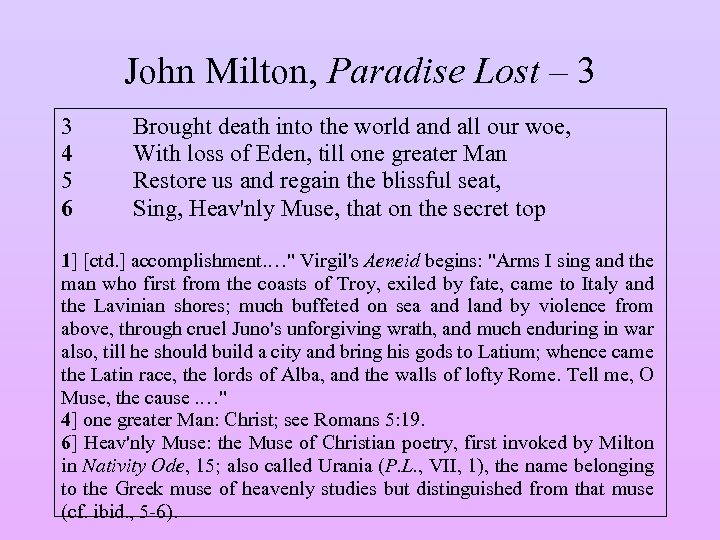 John Milton, Paradise Lost – 3 3 4 5 6 Brought death into the world and all our woe, With loss of Eden, till one greater Man Restore us and regain the blissful seat, Sing, Heav'nly Muse, that on the secret top 1] [ctd. ] accomplishment. …" Virgil's Aeneid begins: "Arms I sing and the man who first from the coasts of Troy, exiled by fate, came to Italy and the Lavinian shores; much buffeted on sea and land by violence from above, through cruel Juno's unforgiving wrath, and much enduring in war also, till he should build a city and bring his gods to Latium; whence came the Latin race, the lords of Alba, and the walls of lofty Rome. Tell me, O Muse, the cause. …" 4] one greater Man: Christ; see Romans 5: 19. 6] Heav'nly Muse: the Muse of Christian poetry, first invoked by Milton in Nativity Ode, 15; also called Urania (P. L. , VII, 1), the name belonging to the Greek muse of heavenly studies but distinguished from that muse (cf. ibid. , 5 -6).
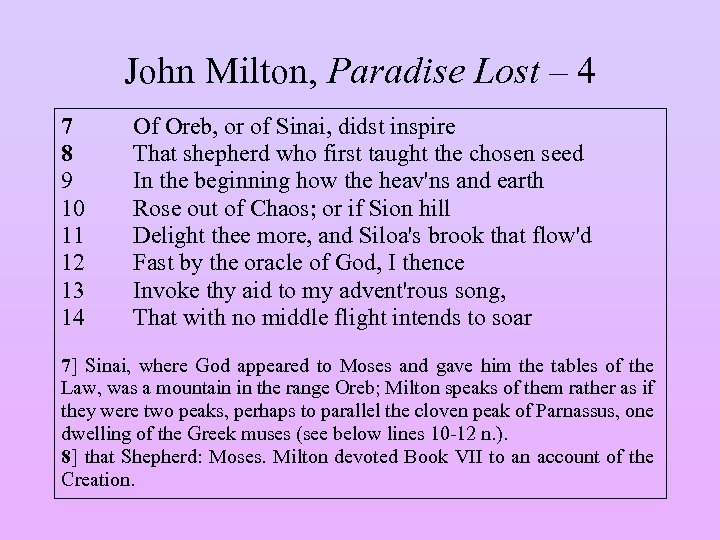 John Milton, Paradise Lost – 4 7 8 9 10 11 12 13 14 Of Oreb, or of Sinai, didst inspire That shepherd who first taught the chosen seed In the beginning how the heav'ns and earth Rose out of Chaos; or if Sion hill Delight thee more, and Siloa's brook that flow'd Fast by the oracle of God, I thence Invoke thy aid to my advent'rous song, That with no middle flight intends to soar 7] Sinai, where God appeared to Moses and gave him the tables of the Law, was a mountain in the range Oreb; Milton speaks of them rather as if they were two peaks, perhaps to parallel the cloven peak of Parnassus, one dwelling of the Greek muses (see below lines 10 -12 n. ). 8] that Shepherd: Moses. Milton devoted Book VII to an account of the Creation.
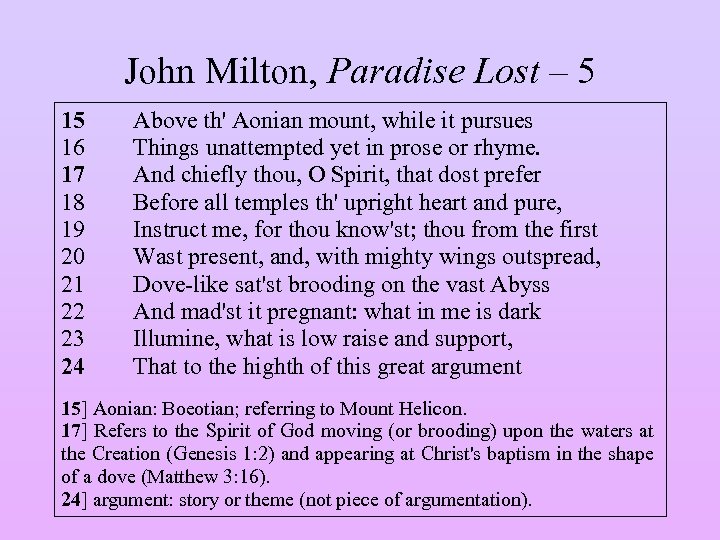 John Milton, Paradise Lost – 5 15 16 17 18 19 20 21 22 23 24 Above th' Aonian mount, while it pursues Things unattempted yet in prose or rhyme. And chiefly thou, O Spirit, that dost prefer Before all temples th' upright heart and pure, Instruct me, for thou know'st; thou from the first Wast present, and, with mighty wings outspread, Dove-like sat'st brooding on the vast Abyss And mad'st it pregnant: what in me is dark Illumine, what is low raise and support, That to the highth of this great argument 15] Aonian: Boeotian; referring to Mount Helicon. 17] Refers to the Spirit of God moving (or brooding) upon the waters at the Creation (Genesis 1: 2) and appearing at Christ's baptism in the shape of a dove (Matthew 3: 16). 24] argument: story or theme (not piece of argumentation).
 John Milton, Paradise Lost – 6 25 26 I may assert Eternal Providence And justify the ways of God to men. 27 28 29 30 31 32 33 34 35 Say first--for Heav'n hides nothing from thy view, Nor the deep tract of Hell--say first what cause Mov'd our grand parents in that happy state, Favour'd of Heav'n so highly, to fall off From their Creator and transgress his will For one restraint, lords of the world besides? Who first seduc'd them to that foul revolt? Th' infernal Serpent; he it was, whose guile, Stirr'd up with envy and revenge, deceiv'd 26] justify: declare (not plead) the justice of. 31] For one restraint: on account of one prohibition (to eat of the tree of Knowledge--Genesis 2: 17).
 John Milton, Paradise Lost – 7 36 37 38 39 40 41 42 43 44 45 46 47 The Mother of Mankind, what time his pride Had cast him out from Heav'n, with all his host Of rebel Angels, by whose aid, aspiring To set himself in glory above his peers, He trusted to have equall'd the Most High, If he oppos'd; and with ambitious aim Against the throne and monarchy of God Rais'd impious war in Heav'n and battle proud, With vain attempt. Him the Almighty Power Hurl'd headlong flaming from th' ethereal sky, With hideous ruin and combustion, down To bottomless perdition, there to dwell 46] ruin: falling (Lat. ruina); combustion: burning (cf. line 45).
 John Milton, Paradise Lost – 8 48 49 50 51 52 53 54 55 56 57 58 In adamantine chains and penal fire, Who durst defy th' Omnipotent to arms. Nine times the space that measures day and night To mortal men, he with his horrid crew Lay vanquish'd, rolling in the fiery gulf, Confounded though immortal. But his doom Reserv'd him to more wrath; for now the thought Both of lost happiness and lasting pain Torments him; round he throws his baleful eyes, That witness'd huge affliction and dismay Mix'd with obdurate pride and steadfast hate. 52] fiery gulf: the burning lake. 56] baleful: full of woe (not malignancy, which is reserved for line 58). 57] witness'd: bore witness to.
 John Milton, Paradise Lost – 9 59 60 61 62 63 64 65 66 67 68 69 At once, as far as Angels ken, he views The dismal situation waste and wild: A dungeon horrible on all sides round As one great furnace flam'd; yet from those flames No light, but rather darkness visible Serv'd only to discover sights of woe, Regions of sorrow, doleful shades, where peace And rest can never dwell, hope never comes That comes to all, but torture without end Still urges, and a fiery deluge, fed With ever-burning sulphur unconsum'd. 59] angels ken: angels can (see and) know. 68] urges: afflicts (Lat. urgere).
 John Milton, Paradise Lost – 10 70 71 72 73 74 75 76 77 78 Such place Eternal Justice had prepar'd For those rebellious; here their prison ordain'd In utter darkness, and their portion set, As far remov'd from God and light of Heav'n As from the centre thrice to th' utmost pole. Oh how unlike the place from whence they fell! There the companions of his fall, o'erwhelm'd With floods and whirlwinds of tempestuous fire, He soon discerns; and welt'ring by his side 72] utter: outer. 74] centre: the centre of the earth the utmost pole: the pole of the outermost sphere according to the Ptolemaic System (see Nativity Ode, 125 n. ). 78] weltering: rolling about.
 John Milton, Paradise Lost – 11 79 80 81 82 83 One next himself in power and next in crime, Long after known in Palestine and nam'd Beëlzebub. To whom th' Arch-Enemy, And thence in Heav'n call'd Satan, with bold words Breaking the horrid silence, thus began: 84 85 86 87 88 "If thou beest he--but oh how fall'n! how chang'd From him who, in the happy realms of light, Cloth'd with transcendent brightness didst outshine Myriads though bright!--if he whom mutual league, United thoughts and counsels, equal hope 81] Beëlzebub: Baal-zebub, the "Lord of Flies", a manifestation of Baal, worshipped by the Philistines at Ekron. 82] Satan signifies "The Adversary".
 John Milton, Paradise Lost – 12 89 90 91 92 93 94 95 96 97 98 And hazard in the glorious enterprise, Join'd with me once, now misery hath join'd In equal ruin, into what pit thou seest From what highth fall'n. So much the stronger prov'd He with his thunder--and till then who knew The force of those dire arms? Yet not for those, Nor what the potent victor in his rage Can else inflict, do I repent or change, Though chang'd in outward lustre, that fix'd mind, And high disdain from sense of injur'd merit, 93] He: i. e. , God. 98] sense of injur'd merit: sense of injury from God's undervaluing of his merit. The cause and course of Satan's revolt are narrated in Books V and VI (see synopsis linking IV and IX).
 John Milton, Paradise Lost – 13 99 100 101 102 103 104 105 106 107 108 109 110 That with the mightiest rais'd me to contend, And to the fierce contention brought along Innumerable force of Spirits arm'd, That durst dislike his reign and, me preferring, His utmost power with adverse power oppos'd In dubious battle on the plains of Heav'n, And shook his throne. What though the field be lost? All is not lost--the unconquerable will, And study of revenge, immortal hate, And courage never to submit or yield: And what is else not to be overcome? That glory never shall his wrath or might 107] study: zealous pursuit (Lat. studium).
 John Milton, Paradise Lost – 14 111 112 113 114 115 116 117 118 119 120 Extort from me. To bow and sue for grace With suppliant knee, and deify his power Who from the terror of this arm so late Doubted his empire, that were low indeed; That were an ignominy and shame beneath This downfall: since by fate the strength of Gods And this empyreal substance cannot fail, Since through experience of this great event In arms not worse, in foresight much advanc'd, We may with more successful hope resolve 117] Satan refuses to admit that he owes his being to God (though he knows better--see below, IV, 42 -44), but asserts that the angels have their being from their empyreal, celestial (literally fiery) substance, which is indestructible.
 John Milton, Paradise Lost – 15 121 122 123 124 To wage by force or guile eternal war, Irreconcilable to our grand foe, Who now triumphs and, in th' excess of joy Sole reigning, holds the tyranny of Heav'n. " 125 126 127 So spake th' apostate Angel, though in pain, Vaunting aloud, but rack'd with deep despair. And him thus answer'd soon his bold compeer: 128 129 130 131 "O Prince, O Chief of many throned Powers, That led th' embattl'd Seraphim to war Under thy conduct and, in dreadful deeds Fearless, endanger'd Heav'n's perpetual King, 124] tyranny. It is Satan's contention that God rules as a tyrant.
 John Milton, Paradise Lost – 16 132 133 134 135 136 137 138 139 140 141 142 143 And put to proof his high supremacy, Whether upheld by strength, or chance, or fate, Too well I see and rue the dire event That with sad overthrow and foul defeat Hath lost us Heav'n, and all this mighty host In horrible destruction laid thus low, As far as Gods and heav'nly essences Can perish: for the mind and spirit remains Invincible, and vigour soon returns, Though all our glory extinct, and happy state Here swallow'd up in endless misery. But what if he our conqueror (whom I now 138] essences: beings.
 John Milton, Paradise Lost – 17 144 145 146 147 148 149 150 151 152 153 154 155 Of force believe almighty, since no less Than such could have o'erpow'r'd such force as ours) Have left us this our spirit and strength entire, Strongly to suffer and support our pains, That we may so suffice his vengeful ire, Or do him mightier service as his thralls By right of war, whate'er his business be, Here in the heart of Hell to work in fire, Or do his errands in the gloomy deep: What can it then avail though yet we feel Strength undiminish'd, or eternal being To undergo eternal punishment? " 144] Of force: perforce.
 John Milton, Paradise Lost – 18 156 157 158 159 160 161 162 163 164 165 Whereto with speedy words th' Arch-Fiend replied: "Fall'n Cherub, to be weak is miserable, Doing or suffering: but of this be sure, To do aught good never will be our task, But ever to do ill our sole delight, As being the contrary to his high will Whom we resist. If then his providence Out of our evil seek to bring forth good, Our labour must be to pervert that end, And out of good still to find means of evil; 157] Cherub: one of the second order of angels. Milton makes some use of the symbolic values attached to the hierarchy of the angels (see Nativity Ode, 28 n. ), but not in the case of fallen angels, since place in the hierarchy is given by the special virtue possessed.
 John Milton, Paradise Lost – 19 166 167 168 169 170 171 172 173 174 175 176 177 Which ofttimes may succeed so as perhaps Shall grieve him, if I fail not, and disturb His inmost counsels from their destin'd aim. But see! the angry victor hath recall'd His ministers of vengeance and pursuit Back to the gates of Heav'n: the sulphurous hail, Shot after us in storm, o'erblown hath laid The fiery surge that from the precipice Of Heav'n receiv'd us falling, and the thunder, Wing'd with red lightning and impetuous rage, Perhaps hath spent his shafts, and ceases now To bellow through the vast and boundless deep. 167] if I fail not: if I mistake not (Lat. ni fallor).
 John Milton, Paradise Lost – 20 178 179 180 181 182 183 184 185 186 187 188 Let us not slip th' occasion, whether scorn Or satiate fury yield it from our foe. Seest thou yon dreary plain, forlorn and wild, The seat of desolation, void of light, Save what the glimmering of these livid flames Casts pale and dreadful? Thither let us tend From off the tossing of these fiery waves; There rest, if any rest can harbour there, And, re-assembling our afflicted powers, Consult how we may henceforth most offend Our enemy, our own loss how repair, 186] afflicted: struck down (Lat. afflictus). 187] offend: strike at (Lat. offendere).
 John Milton, Paradise Lost – 21 189 190 191 How overcome this dire calamity, What reinforcement we may gain from hope, If not, what resolution from despair. " 192 193 194 195 196 197 198 Thus Satan, talking to his nearest mate, With head uplift above the wave, and eyes That sparkling blaz'd; his other parts besides, Prone on the flood, extended long and large, Lay floating many a rood, in bulk as huge As whom the fables name of monstrous size, Titanian, or Earth-born, that warr'd on Jove, 195] large: wide. 198] The Titans fought against their father Uranus (Heaven). Later they themselves were overthrown by Zeus (Jove). Finally the Giants, sons of Earth (Earth-born), fought unsuccessfully against Zeus and his fellow Olympians. Titans and Giants are sometimes confused.
 John Milton, Paradise Lost – 22 199 200 201 Briareos or Typhon, whom the den By ancient Tarsus held, or that sea-beast Leviathan, which God of all his works 199] Briareos: a hundred-handed monster, son of Uranus, and thus Titanian; in one legend, the defender of Zeus, which cannot be intended here, in another, the enemy of the gods. Typhon: a hundred-headed serpent monster, in one legend, imprisoned in a den in Cilicia, whose capital was Tarsus; he stands for the Giants. It is noteworthy that in addition to their size all the monsters resemble Satan in being enemies to the divine power and subject to its punishment. 201] Leviathan: name applied to various water beasts in Old Testament: described by Isaiah as the dragon that is in the sea and said to be reserved for God's special vengeance; in Milton's day, and by him, identified with the whale. A similar episode to Milton's of the skiff, night-founder'd (benighted, literally sunk in the darkness of night) and anchored to [ctd. ]
 John Milton, Paradise Lost – 23 202 203 204 205 206 207 208 209 Created hugest that swim th' ocean-stream: Him haply slumb'ring on the Norway foam The pilot of some small night-founder'd skiff, Deeming some island, oft, as seamen tell, With fixed anchor in his scaly rind Moors by his side under the lee, while night Invests the sea, and wished morn delays. So stretch'd out huge in length the Arch-Fiend lay 201] [ctd. ] a whale mistaken by its crew for an island, is recounted by the Swedish writer Olaus Magnus in his History of the Northern Nations, translated into English in 1658. Here the secondary suggestion is Satan's deceptiveness and his betrayal of those that trust him to their destruction.
 John Milton, Paradise Lost – 24 210 211 212 213 214 215 216 217 218 219 220 Chain'd on the burning lake; nor ever thence Had ris'n or heav'd his head, but that the will And high permission of all-ruling Heaven Left him at large to his own dark designs, That with reiterated crimes he might Heap on himself damnation, while he sought Evil to others, and enrag'd might see How all his malice serv'd but to bring forth Infinite goodness, grace, and mercy shewn On Man by him seduc'd, but on himself Treble confusion, wrath and vengeance pour'd. 210] References to the lake of fire occur in Revelation 19 and 20. Milton makes the four rivers of Hell flow into the burning lake (P. L. , II, 576 -77). 210 -13. It was theologically necessary to indicate that whatever Satan did was not in spite of God, but by his permissive will (see line 239 and note).
 John Milton, Paradise Lost – 25 221 222 223 224 225 226 227 228 229 230 231 Forthwith upright he rears from off the pool His mighty stature; on each hand the flames Driv'n backward slope their pointing spires and, roll'd In billows, leave i' th' midst a horrid vale. Then with expanded wings he steers his flight Aloft, incumbent on the dusky air, That felt unusual weight, till on dry land He lights--if it were land that ever burn'd With solid, as the lake with liquid fire, And such appear'd in hue as when the force Of subterranean wind transports a hill 226] incumbent: leaning (Lat. incumbens). 230] According to a theory still current in Milton's day, earthquakes were explained as due to winds imprisoned below the earth's surface
 John Milton, Paradise Lost – 26 232 233 234 235 236 237 238 239 Torn from Pelorus, or the shatter'd side Of thund'ring Ætna, whose combustible And fuell'd entrails, thence conceiving fire, Sublim'd with mineral fury, aid the winds, And leave a singed bottom all involv'd With stench and smoke: such resting found the sole Of unblest feet. Him follow'd his next mate, Both glorying to have scap'd the Stygian flood 232] Pelorus: the northeast point of Sicily. 233] Ætna: the great volcano near Pelorus. The alchemists thought that all minerals contained sulphur and mercury, making them combustible. "Sublimed" is an alchemical term, meaning 'raised to pure flame. ' 236] bottom: valley; involv'd: wrapped in (Lat. involvere). 239] Ironically, Satan and Beelzebub are ignorant that they are by God's permissive will (see lines 210 -13 and n. ).
 John Milton, Paradise Lost – 27 240 241 As Gods, and by their own recover'd strength, Not by the sufferance of Supernal Power. 242 243 244 245 246 247 248 249 250 "Is this the region, this the soil, the clime, " Said then the lost Archangel, "this the seat That we must change for Heav'n? --this mournful gloom For that celestial light? Be it so, since he Who now is sovran can dispose and bid What shall be right: farthest from him is best Whom reason hath equall'd, force hath made supreme Above his equals. Farewell, happy fields Where joy for ever dwells! hail horrors, hail 242] clime: climate. 244] change for: take in exchange for.
 John Milton, Paradise Lost – 28 251 252 253 254 255 256 257 258 259 260 261 Infernal world! and thou, profoundest Hell, Receive thy new possessor: one who brings A mind not to be chang'd by place or time. The mind is its own place, and in itself Can make a Heav'n of Hell, a Hell of Heav'n. What matter where, if I be still the same And what I should be, all but less than he Whom thunder hath made greater? Here at least We shall be free; th' Almighty hath not built Here for his envy, will not drive us hence: Here we may reign secure, and in my choice 257] all but less than he: all but equal to him. 259] hath not built for himself, begrudging possession to anyone else.
 John Milton, Paradise Lost – 29 262 263 264 265 266 267 268 269 To reign is worth ambition, though in Hell: Better to reign in Hell than serve in Heav'n. But wherefore let we then our faithful friends, Th' associates and co-partners of our loss, Lie thus astonish'd on th' oblivious pool, And call them not to share with us their part In this unhappy mansion, or once more With rallied arms to try what may be yet 270 271 272 Regain'd in Heav'n, or what more lost in Hell? " So Satan spake; and him Beëlzebub Thus answer'd: "Leader of those armies bright, 266] astonish'd: stunned literally, thunder-struck; oblivious: causing forgetfulness.
 John Milton, Paradise Lost – 30 273 274 275 276 277 278 279 280 281 282 Which but th' Omnipotent none could have foil'd, If once they hear that voice, their liveliest pledge Of hope in fears and dangers, heard so oft In worst extremes, and on the perilous edge Of battle when it rag'd, in all assaults Their surest signal, they will soon resume New courage and revive, though now they lie Grovelling and prostrate on yon lake of fire, As we erewhile, astounded and amaz'd-- No wonder, fall'n such a pernicious highth!" 283 He scarce had ceas'd when the superior Fiend 281] amaz'd: in a maze, stupefied. . 282] pernicious: utterly destructive (Lat. perniciosus).
 John Milton, Paradise Lost – 31 284 285 286 287 288 289 290 291 292 Was moving toward the shore; his ponderous shield, Ethereal temper, massy, large and round, Behind him cast; the broad circumference Hung on his shoulders like the moon, whose orb Through optic glass the Tuscan artist views At ev'ning from the top of Fesole, Or in Valdarno, to descry new lands, Rivers or mountains in her spotty globe. His spear--to equal which the tallest pine 288] During his visit to Florence in 1638 Milton met Galileo, the perfecter of the telescope, and defender of the Copernican theory. artist: here used in the sense of an expert in science. 289] Fesole: Fiesole, a hill-town three miles north of Florence. 290] Valdarno: Val d'Arno, the valley of the river Arno, which runs through Florence.
 John Milton, Paradise Lost – 32 293 294 295 296 297 298 299 300 301 302 Hewn on Norwegian hills, to be the mast Of some great ammiral, were but a wand-- He walk'd with, to support uneasy steps Over the burning marle, not like those steps On Heaven's azure, and the torrid clime Smote on him sore besides, vaulted with fire. Nathless he so endur'd, till on the beach Of that inflamed sea, he stood and call'd His legions--angel forms, who lay entranc'd Thick as autumnal leaves that strow the brooks 294] ammiral: flagship, from the Arabic "amir al bahr, " prince (emir) of the sea. 296] marle: soil. 301] entranc'd: as if thrown into a trance.
 John Milton, Paradise Lost – 33 304 305 306 In Vallombrosa, where th' Etrurian shades High over-arch'd embow'r; or scatter'd sedge Afloat, when with fierce winds Orion arm'd Hath vex'd the Red-Sea coast, whose waves o'erthrew 303] Vallombrosa: "Shady Valley", a beautiful valley eighteen miles from Florence. Etrurian: the ancient state of Etruria included Tuscany. 304] The Red Sea was called in Hebrew the Sea of Sedge on account of the weed growing at its margin. This affords Milton his second comparison: thick as the sedge floating (like the fallen angels) as it is scattered by the storms. 305] Orion, a giant transformed to the constellation of that name, whose rising and setting coincided with storms (so that Virgil spoke of "stormy Orion"); Milton thinks of the giant as armed with fierce winds, by which the (waters along the) coast are vex'd, violently disturbed (Lat. vexare).
 John Milton, Paradise Lost – 34 307 308 309 310 Busiris and his Memphian chivalry, While with perfidious hatred they pursu'd The sojourners of Goshen, who beheld From the safe shore their floating carcases 307] Milton applies Busiris, the name of a legendary king of Egypt (met in Ralegh's History of the World) to Pharaoh. his chivalry: his mounted soldiers (chivalry and cavalry having a common derivation). Memphian: used for Egyptian, since Memphis was the ancient capital of Egypt. 308] perfidious because Pharaoh had given the Israelites, whom he now pursued, permission to go. See Exodus 14, where we read that after opening to allow the passage of the Children of Israel, the waters of the Red Sea engulfed the Egyptians and God "took off the wheels of their chariots". Thence Milton draws a third (implied) comparison, thick as the carcasses and broken chariot wheels of Pharaoh's engulfed army, which brings in the secondary suggestion of enemies of God overtaken by his vengeance.
 John Milton, Paradise Lost – 35 311 312 313 314 315 316 317 318 319 320 321 322 And broken chariot-wheels: so thick bestrown, Abject and lost, lay these, covering the flood, Under amazement of their hideous change. He call'd so loud that all the hollow deep Of Hell resounded: "Princes, Potentates, Warriors, the flow'r of Heav'n, once yours, now lost If such astonishment as this can seize Eternal spirits--or have ye chos'n this place After the toil of battle to repose Your wearied virtue, for the ease you find To slumber here, as in the vales of Heav'n? Or in this abject posture have ye sworn 320] virtue: valour (Lat. virtus).
 John Milton, Paradise Lost – 36 323 324 325 326 327 328 329 330 To adore the conqueror, who now beholds Cherub and Seraph rolling in the flood With scatter'd arms and ensigns, till anon His swift pursuers from Heav'n-gates discern Th' advantage, and descending tread us down Thus drooping, or with linked thunderbolts Transfix us to the bottom of this gulf? -- Awake, arise, or be for ever fall'n!" 331 332 333 334 They heard, and were abash'd, and up they sprung Upon the wing, as when men wont to watch, On duty sleeping found by whom they dread, Rouse and bestir themselves ere well awake.
 John Milton, Paradise Lost – 37 335 336 337 338 339 340 341 342 343 Nor did they not perceive the evil plight In which they were, or the fierce pains not feel; Yet to their General's voice they soon obey'd Innumerable. As when the potent rod Of Amram's son, in Egypt's evil day, Wav'd round the coast, up-call'd a pitchy cloud Of locusts, warping on the eastern wind, That o'er the realm of impious Pharaoh hung Like night, and darken'd all the land of Nile: 335] Nor did they not: i. e. , and they did (cf. Lat. neque non). 339] See Exodus 10: 12 -1 5; Amram's son: Moses (see Exodus 6: 20). 340] pitchy: dark as pitch (cf. lines 342 -43). 341] warping: working themselves around (like a ship).
 John Milton, Paradise Lost – 38 344 345 346 347 348 349 350 351 352 So numberless were those bad Angels seen Hovering on wing under the cope of Hell, 'Twixt upper, nether, and surrounding fires; Till, as a signal giv'n, th' uplifted spear Of their great Sultan waving to direct Their course, in even balance down they light On the firm brimstone, and fill all the plain: A multitude like which the populous North Pour'd never from her frozen loins, to pass 345] cope: roof. 351] Milton draws his comparison from the series of barbarian invasions (lines 240 -440), spreading from the north to and across Rhene (the Rhine) and Danaw (the Danube), and from Spain, by the Straits of Gibraltar, to the Lybian sands (North Africa).
 John Milton, Paradise Lost – 39 353 354 355 356 357 358 359 360 361 Rhene or the Danaw, when her barbarous sons Came like a deluge on the South, and spread Beneath Gibraltar to the Lybian sands. Forthwith, from every squadron and each band, The heads and leaders thither haste where stood Their great Commander: godlike shapes and forms Excelling human, princely dignities, And Powers that erst in Heaven sat on thrones, Though of their names in heav'nly records now 361] Preparatory to the catalogue of the leaders, since the names of the rebel angels are unknown, blotted out of the Book of Life, Milton adopts the tradition, found recorded, for example, in Hooker's Laws of Ecclesiastical Polity and Burton's Anatomy of Melancholy, that they became the gods of the heathen world, and calls them by these, their second names.
 John Milton, Paradise Lost – 40 362 363 364 365 366 367 368 369 370 371 372 Be no memorial, blotted out and ras'd By their rebellion from the Books of Life. Nor had they yet among the sons of Eve Got them new names, till wand'ring o'er the earth, Through God's high sufferance for the trial of man, By falsities and lies the greatest part Of mankind they corrupted to forsake God their Creator, and th' invisible Glory of him that made them to transform Oft to the image of a brute, adorn'd With gay religions full of pomp and gold, 370] Cf. Romans 1: 23. 372] gay religions: showy religious rites.
 John Milton, Paradise Lost – 41 373 374 375 And devils to adore for deities: Then were they known to men by various names, And various idols through the heathen world. 376 377 378 379 380 Say, Muse, their names then known, who first, who last, Rous'd from the slumber on that fiery couch, At their great Emperor's call, as next in worth Came singly where he stood on the bare strand, While the promiscuous crowd stood yet aloof. 381 The chief were those who, from the pit of Hell 373] Cf. I Corinthians 10: 20. 376] Homer and Virgil, on occasion, thus appeal to the Muse (e. g. , Iliad, II, 484, Aeneid, VII, 641). 380] promiscuous: mixed, undiscriminated.
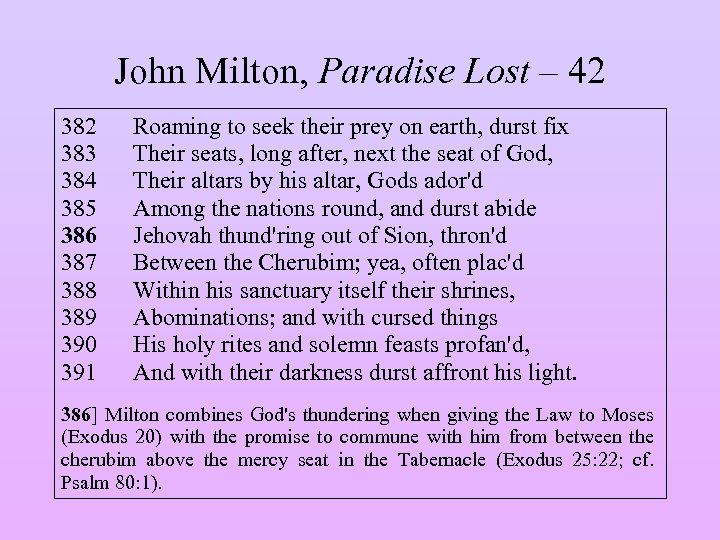 John Milton, Paradise Lost – 42 383 384 385 386 387 388 389 390 391 Roaming to seek their prey on earth, durst fix Their seats, long after, next the seat of God, Their altars by his altar, Gods ador'd Among the nations round, and durst abide Jehovah thund'ring out of Sion, thron'd Between the Cherubim; yea, often plac'd Within his sanctuary itself their shrines, Abominations; and with cursed things His holy rites and solemn feasts profan'd, And with their darkness durst affront his light. 386] Milton combines God's thundering when giving the Law to Moses (Exodus 20) with the promise to commune with him from between the cherubim above the mercy seat in the Tabernacle (Exodus 25: 22; cf. Psalm 80: 1).
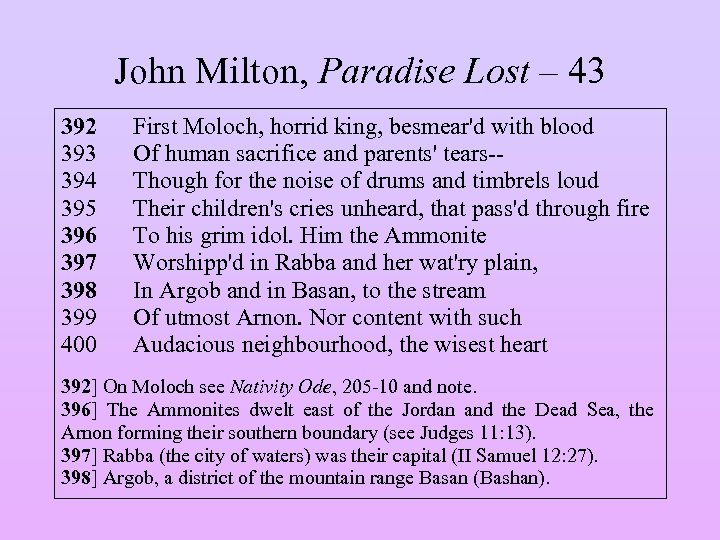 John Milton, Paradise Lost – 43 392 393 394 395 396 397 398 399 400 First Moloch, horrid king, besmear'd with blood Of human sacrifice and parents' tears-- Though for the noise of drums and timbrels loud Their children's cries unheard, that pass'd through fire To his grim idol. Him the Ammonite Worshipp'd in Rabba and her wat'ry plain, In Argob and in Basan, to the stream Of utmost Arnon. Nor content with such Audacious neighbourhood, the wisest heart 392] On Moloch see Nativity Ode, 205 -10 and note. 396] The Ammonites dwelt east of the Jordan and the Dead Sea, the Arnon forming their southern boundary (see Judges 11: 13). 397] Rabba (the city of waters) was their capital (II Samuel 12: 27). 398] Argob, a district of the mountain range Basan (Bashan).
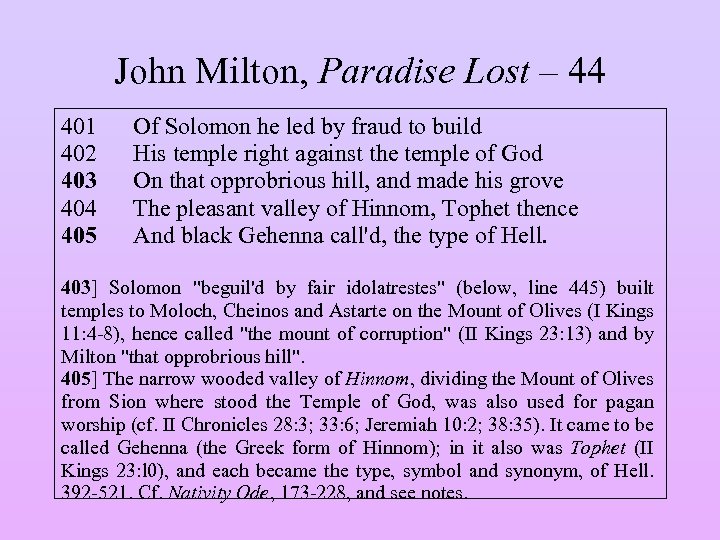 John Milton, Paradise Lost – 44 401 402 403 404 405 Of Solomon he led by fraud to build His temple right against the temple of God On that opprobrious hill, and made his grove The pleasant valley of Hinnom, Tophet thence And black Gehenna call'd, the type of Hell. 403] Solomon "beguil'd by fair idolatrestes" (below, line 445) built temples to Moloch, Cheinos and Astarte on the Mount of Olives (I Kings 11: 4 -8), hence called "the mount of corruption" (II Kings 23: 13) and by Milton "that opprobrious hill". 405] The narrow wooded valley of Hinnom, dividing the Mount of Olives from Sion where stood the Temple of God, was also used for pagan worship (cf. II Chronicles 28: 3; 33: 6; Jeremiah 10: 2; 38: 35). It came to be called Gehenna (the Greek form of Hinnom); in it also was Tophet (II Kings 23: l 0), and each became the type, symbol and synonym, of Hell. 392 -521. Cf. Nativity Ode, 173 -228, and see notes.
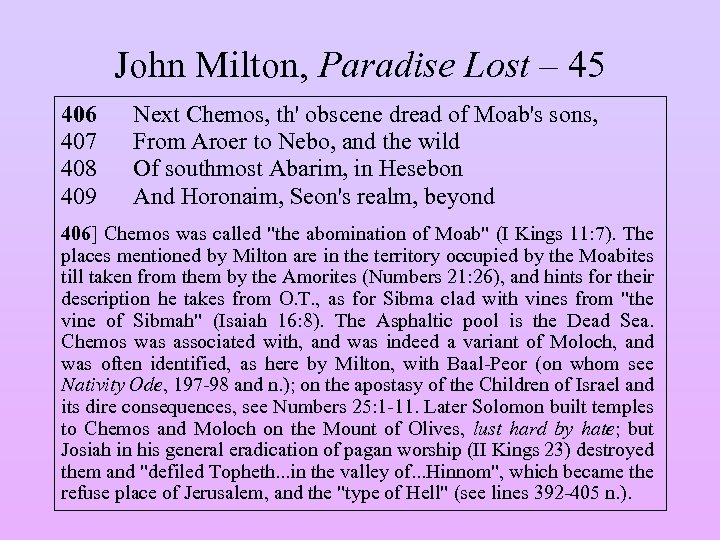 John Milton, Paradise Lost – 45 406 407 408 409 Next Chemos, th' obscene dread of Moab's sons, From Aroer to Nebo, and the wild Of southmost Abarim, in Hesebon And Horonaim, Seon's realm, beyond 406] Chemos was called "the abomination of Moab" (I Kings 11: 7). The places mentioned by Milton are in the territory occupied by the Moabites till taken from them by the Amorites (Numbers 21: 26), and hints for their description he takes from O. T. , as for Sibma clad with vines from "the vine of Sibmah" (Isaiah 16: 8). The Asphaltic pool is the Dead Sea. Chemos was associated with, and was indeed a variant of Moloch, and was often identified, as here by Milton, with Baal-Peor (on whom see Nativity Ode, 197 -98 and n. ); on the apostasy of the Children of Israel and its dire consequences, see Numbers 25: 1 -11. Later Solomon built temples to Chemos and Moloch on the Mount of Olives, lust hard by hate; but Josiah in his general eradication of pagan worship (II Kings 23) destroyed them and "defiled Topheth. . . in the valley of. . . Hinnom", which became the refuse place of Jerusalem, and the "type of Hell" (see lines 392 -405 n. ).
 John Milton, Paradise Lost – 46 410 411 412 413 414 415 416 417 418 419 420 421 The flow'ry dale of Sibma clad with vines, And Elealè to th' Asphaltic pool: Peor his other name, when he entic'd Israel in Sittim, on their march from Nile, To do him wanton rites, which cost them woe; Yet thence his lustful orgies he enlarg'd Even to that hill of scandal, by the grove Of Moloch homicide, lust hard by hate; Till good Josiah drove them thence to Hell. With these came they who, from the bord'ring flood Of old Euphrates to the brook that parts Egypt from Syrian ground, had general names 420] the brook that parts: Shihor, "the River of Egypt".
 John Milton, Paradise Lost – 47 422 423 424 425 426 427 428 429 430 431 432 433 Of Baälim and Ashtaroth--those male, These feminine. (For spirits when they please Can either sex assume, or both; so soft And uncompounded is their essence pure, Not tied or manacl'd with joint or limb, Nor founded on the brittle strength of bones, Like cumbrous flesh; but, in what shape they choose, Dilated or condens'd, bright or obscure, Can execute their aery purposes, And works of love or enmity fulfil. ) For those the race of Israel oft forsook Their living strength, and unfrequented left 422] Baälim and Ashtaroth: plural forms of Baal and Ashtoreth, hence including all their manifestations.
 John Milton, Paradise Lost – 48 434 435 436 437 438 439 440 His righteous altar, bowing lowly down To bestial Gods; for which their heads, as low Bow'd down in battle, sunk before the spear Of despicable foes. With these in troop Came Astoreth, whom the Phœnicians call'd Astarte, Queen of Heav'n, with crescent horns; To whose bright image nightly by the moon 438] see Nativity Ode, 200 -4 and notes. Astoreth or Astarte was called by the Greeks Aphrodite and the Romans Venus. When associated with the moon rather than the planet Venus, she was represented with crescent horns and worshipped as queen of Heav'n (cf. Jeremiah 7: 18) at Sidon, as at other cities of Phoenicia, and also in Israel (Jeremiah, as above), where Solomon built a temple to her as to other pagan deities (see above, lines 392 -405 n. ). Though "God gave Solomon wisdom . . . and largeness of heart" (I Kings 4: 29), he proved uxorious and was led into idolatry by his women.
 John Milton, Paradise Lost – 49 441 442 443 444 445 446 447 448 449 Sidonian virgins paid their vows and songs; In Sion also not unsung, where stood Her temple on th' offensive mountain, built By that uxorious king whose heart, though large, Beguil'd by fair idolatresses, fell To idols foul. Thammuz came next behind, Whose annual wound in Lebanon allur'd The Syrian damsels to lament his fate In amorous ditties all a summer's day, 446] According to the season, in Phoenician myth and ritual, Thammuz (the original of the Greek Adonis) was annually slain in Lebanon by the wild boar, when the river Adonis ran red, supposedly with his blood, and annually revived. (The word "purple" was quite commonly used to designate the colour of blood. ) Ezekiel (8: 14) found "women weeping for Thammuz" even at the door of the Temple of God.
 John Milton, Paradise Lost – 50 451 452 453 454 455 456 457 458 459 460 461 While smooth Adonis from his native rock Ran purple to the sea, suppos'd with blood Of Thammuz yearly wounded: the love-tale Infected Sion's daughters with like heat, Whose wanton passions in the sacred porch Ezekiel saw, when by the vision led His eye survey'd the dark idolatries Of alienated Judah. Next came one Who mourn'd in earnest, when the captive ark Maim'd his brute image, head and hands lopp'd off In his own temple, on the grunsel-edge, Where he fell flat and sham'd his worshippers:
 John Milton, Paradise Lost – 51 462 463 464 465 466 467 Dagon his name, sea monster, upward man And downward fish, yet had his temple high Rear'd in Azotus, dreaded through the coast Of Palestine, in Gath and Ascalon, And Accaron and Gaza's frontier bounds. Him follow'd Rimmon, whose delightful seat 462] Dagon, the national god of the Philistines, had cause to mourn, for when the ark of the covenant was brought into his temple, the idol fell from its place and, set up again, fell once more on the threshold (grundsel), so that the head and hands were knocked off (I Samuel 1 -4); hence the "twice-batter'd god" of Nativity Ode, 199. The suggested derivation of the name Dagon from the Hebrew dag, a fish, which would make him a sea-deity, Milton evidently accepts, and proceeds to name five principal seats of his worship. 467] In connection with Rimmon, the Syrian god worshipped at [ctd. ]
 John Milton, Paradise Lost – 52 468 469 470 471 472 473 474 Was fair Damascus on the fertile banks Of Abbana and Pharphar, lucid streams; He also against the house of God was bold: A leper once he lost and gain'd a king, Ahaz, his sottish conqueror, whom he drew God's altar to disparage and displace For one of Syrian mode, whereon to burn 467] [ctd. ] Damascus, Milton alludes to two otherwise unconnected episodes: (i) how Naaman, the Syrian captain of the host, was cured of his leprosy, by Elisha, the prophet of God, and abandoned Rimmon's worship for God's (II Kings 5), and (ii) how Ahaz, king of Judah, having entered Damascus as a conqueror, imitated the altar and worship of his vanquished enemy (II Kings 16): hence Rimmon a leper . . . lost and gain'd a king (which Milton evidently considered a bad bargain!)
 John Milton, Paradise Lost – 53 475 476 477 478 His odious off'rings, and adore the Gods Whom he had vanquish'd. After these appear'd A crew who, under names of old renown, Osiris, Isis, Orus, and their train, 478] On Osiris, Isis, Orus, "the brutish gods of Nile", see Nativity Ode, 211 -20 (where for once the treatment is fuller) and notes. Milton attributes the Israelites, setting up of a golden calf for worship (Exodus 32) to imitation of the worship of Apis, learned from the Egyptians whom they had spoiled by taking their possessions (Exodus 12: 35 -36). The rebel king is Jeroboam, rebel against Rehoboam. He doubled the earlier sin of the Israelites by setting up two golden calves in Bethel and Dan respectively (I Kings 12: 20, 28 -29). To do so was to change "their glory [God] into the similitude of an ox that eateth grass" and to forget "God their saviour which had done great things in Egypt" (Psalm 106: 20 -21), how in a single night he slew the first-born of the Egyptians and of their cattle and flocks, but pass'd over the Israelites (Exodus 12: 29, 42 -43).
 John Milton, Paradise Lost – 54 479 480 481 482 483 484 485 486 487 488 489 490 With monstrous shapes and sorceries abus'd Fanatic Egypt and her priests to seek Their wand'ring Gods disguis'd in brutish forms Rather than human. Nor did Israel scape Th' infection when their borrow'd gold compos'd The calf in Oreb, and the rebel king Doubl'd that sin in Bethel and in Dan, Lik'ning his Maker to the grazed ox-- Jehovah, who, in one night, when he pass'd From Egypt marching, equall'd with one stroke Both her first born and all her bleating Gods. Belial came last, than whom a spirit more lewd 490] Belial: not a god but an abstraction, meaning "worthlessness", [ctd. ]
 John Milton, Paradise Lost – 55 491 492 493 494 495 496 Fell not from Heaven, or more gross to love Vice for itself; to him no temple stood Or altar smok'd, yet who more oft than he In temples and at altars, when the priest Turns atheist as did Eli's sons, who fill'd With lust and violence the house of God? 490] [ctd. ] as in the phrase "man of Belial" (II Samuel 20: 1); Milton, however, personifies the quality as a god here, adding him to the roll as given in the Nativity Ode. For Elia's sons and their misconduct see II Samuel 2: 12 -17, 22 -25. In referring to luxurious (i. e. , voluptuous, lascivious) cities and the Sons of Belial, flown (i. e. , flushed) with insolence and wine, Milton is perhaps glancing at Restoration London and the courtiers of Charles II, before specifying the yet worse outrages of Sodom and of members of the tribe of Benjamin in Gibeah (Genesis 19: 129; Judges 19: 14 -20: 13).
 John Milton, Paradise Lost – 56 497 498 499 500 501 502 503 504 505 In courts and palaces he also reigns, And in luxurious cities, where the noise Of riot ascends above their loftiest tow'rs, And injury and outrage; and, when night Darkens the streets, then wander forth the sons Of Belial, flown with insolence and wine: Witness the streets of Sodom, and that night In Gibeah, when the hospitable door Expos'd a matron to avoid worse rape. 506 507 These were the prime in order and in might. The rest were long to tell. Though far renown'd,
 John Milton, Paradise Lost – 57 508 509 Th' Ionian Gods, of Javan's issue held Gods, yet confess'd later than Heav'n and Earth, 508] The Ionian gods are the Olympian deities worshipped by the Ionians, who stand for the ancient Greeks, descendants of Javan, the son of Japheth (Genesis 10: 2), one of the sons of Noah. Though held to be gods, these deities are confess'd to be later than Heaven (Uranus) and Earth (Ge), whose descendants they were. The first offspring were the Titans (see above, lines 198 -200 n. ); the youngest of them, Saturn, seized power from Titan (his eldest brother), only to lose it finally to Jove, his own son and Rhea's. These gods were first known on the mount Ida in Crete, and later dwelt on Olympus, high in the middle (of the three strata of the) air, but also spread through the Doric land (i. e. , Greece), frequenting such places as Delphi (an oracle of Apollo) and Dodona (an oracle of Zeus), while the deposed Saturn fled over the Adriatic to the Hesperian (i. e. , western) fields (and principally Italy); Milton imagines his having companions who roamed through the Celtic (fields--i. e. , Gaul) and to the utmost (i. e. , the British) isles.
 John Milton, Paradise Lost – 58 510 511 512 513 514 515 516 517 518 519 520 521 Their boasted parents: Titan, Heav'n's first born, With his enormous brood, and birthright seiz'd By younger Saturn: he from mightier Jove, His own and Rhea's son, like measure found: So Jove usurping reign'd. These, first in Crete And Ida known, thence on the snowy top Of cold Olympus rul'd the middle air, Their highest heav'n; or on the Delphian cliff, Or in Dodona, and through all the bounds Of Doric land; or who with Saturn old Fled over Adria to th' Hesperian fields, And o'er the Celtic roam'd the utmost isles. 522 523 All these and more came flocking; but with looks Downcast and damp, yet such wherein appear'd
 John Milton, Paradise Lost – 59 524 525 526 527 528 529 530 531 532 533 534 Obscure some glimpse of joy to have found their Chief Not in despair, to have found themselves not lost In loss itself; which on his count'nance cast Like doubtful hue. But he his wonted pride Soon recollecting, with high words, that bore Semblance of worth, not substance, gently rais'd Their fainting courage, and dispell'd their fears; Then straight commands that, at the warlike sound Of trumpets loud and clarions, be uprear'd His mighty standard. That proud honour claim'd Azazel as his right, a Cherub tall, 534] Azazel occurs in Leviticus 16: 8 (A. V. ) as the marginal reading for "scapegoat" in the text. Possibly some evil spirit is meant, for whom Milton accounts by making him a fallen Cherub (see above, line 157 n. ).
 John Milton, Paradise Lost – 60 535 536 537 538 539 540 541 542 543 544 Who forthwith from the glittering staff unfurl'd Th' imperial ensign, which full high advanc'd Shone like a meteor, streaming to the wind With gems and golden lustre rich emblaz'd, Seraphic arms and trophies; all the while Sonorous metal blowing martial sounds: At which the universal host up-sent A shout that tore Hell's concave, and beyond Frighted the reign of Chaos and old Night. All in a moment through the gloom were seen 536] advanc'd: to "advance" is the technical term for to "raise" a standard. 539] arms and trophies: armorial bearings and memorials of victories. 542] Above Hell's concave (arched roof) extended the reign of (region ruled over by) Chaos and Night, described in detail in Book II, 890 -1009.
 John Milton, Paradise Lost – 61 545 546 547 548 549 550 551 Ten thousand banners rise into the air, With orient colours waving; with them rose A forest huge of spears, and thronging helms Appear'd, and serried shields in thick array Of depth immeasurable. Anon they move In perfect phalanx to the Dorian mood Of flutes and soft recorders--such as rais'd 546] orient: bright. 548] serried: locked together (the shields being so borne by infantry formed in a phalanx for battle). 550] phalanx: see 548 n. Dorian mood. Of the three modes of Greek music, Dorian, Phrygian and Lydian, the first inspired "a moderate and settled temper" (Aristotle Politics 8. 5); elaborated below, lines 551 -59. 551] recorders: the recorder is a kind of flute.
 John Milton, Paradise Lost – 62 553 554 555 556 557 558 559 560 561 562 563 To highth of noblest temper heroes old Arming to battle, and instead of rage Deliberate valour breath'd, firm and unmov'd With dread of death to flight or foul retreat; Nor wanting power to mitigate and swage With solemn touches troubl'd thoughts, and chase Anguish and doubt and fear and sorrow and pain From mortal or immortal minds. Thus they, Breathing united force with fixed thought, Mov'd on in silence to soft pipes that charm Their painful steps o'er the burnt soil; and now Advanc'd in view they stand, a horrid front 560] Breathing: expressing. 563] horrid: bristling (Lat. horridus) with spears.
 John Milton, Paradise Lost – 63 564 565 566 567 568 569 570 571 572 573 574 Of dreadful length and dazzling arms, in guise Of warriors old with order'd spear and shield, Awaiting what command their mighty Chief Had to impose. He through the armed files Darts his experienc'd eye and soon traverse The whole battalion views, their order due, Their visages and stature as of Gods; Their number last he sums. And now his heart Distends with pride and, hard'ning in his strength, Glories: for never, since created man, Met such embodied force as, nam'd with these, 568] traverse: across. 573] since created man: a Latinism: since man was created.
 John Milton, Paradise Lost – 64 575 576 577 578 579 580 Could merit more than that small infantry Warr'd on by cranes--though all the giant brood Of Phlegra with th' heroic race were join'd That fought at Thebes and Ilium, on each side Mix'd with auxiliar Gods, and what resounds In fable or romance of Uther's son 575] that small infantry: the Pygmies; said by Homer to be attacked yearly by cranes. See Iliad, III. 5. 577] Phlegra: a peninsula in Macedonia, scene of the fight between the Giants and the Gods. To these were joined: (i) the heroic race who fought (in Greek legend) in the siege of Troy (Ilium) in which gods lent aid on both sides, and in the war of the Seven against Thebes; (ii) what is told of King Arthur and the heroes of British and Breton romance; (iii) all who fought on both sides in the wars of Christian and Saracen. 580] Uther's son: King Arthur.
 John Milton, Paradise Lost – 65 581 582 583 584 585 Begirt with British and Armoric knights, And all who since, baptiz'd or infidel, Jousted in Aspramont or Montalban, Damasco or Marocco or Trebisond, Or whom Biserta sent from Afric shore 581] Armoric: Breton. 583] Aspramont: town and castle near Nice, mentioned in Ariosto's Orlando Furioso; Montalban: Castle of Renaud, or Reynaldo, a hero of Old French romance. 584] Trebisond. This city on the Black Sea was the seat of a splendid court from 1204 to 1461, when it was captured by the Turks. 585] Biserta: the ancient Utica on the North African coast; in Boiardo's Orlando Innamorato, the port from which the Saracens invade Spain.
 John Milton, Paradise Lost – 66 587 588 589 590 591 592 593 594 595 When Charlemain with all his peerage fell By Fontarabbia. Thus far these beyond Compare of mortal prowess, yet observ'd Their dread Commander. He, above the rest In shape and gesture proudly eminent, Stood like a tow'r; his form had yet not lost All her original brightness, nor appear'd Less than Archangel ruin'd, and th' excess Of glory obscur'd: as when the sun new-ris'n Looks through the horizontal misty air 586] The scene of this famous battle (778) was not Fontarabbia, but Roncesvalles, forty miles away. Charlemagne was not killed, but his nephew Roland.
 John Milton, Paradise Lost – 67 596 597 598 599 600 601 602 603 604 Shorn of his beams, or from behind the moon In dim eclipse disastrous twilight sheds On half the nations, and with fear of change Perplexes monarchs. Dark'n'd so, yet shone Above them all th' Archangel; but his face Deep scars of thunder had intrench'd, and care Sat on his faded cheek, but under brows Of dauntless courage, and considerate pride Waiting revenge; cruel his eye, but cast 597] An eclipse (of sun or moon) was held to be disastrous (i. e. , to bode disaster). 603] considerate: thoughtful (i. e. , his expression betokened not only pride, but reflection).
 John Milton, Paradise Lost – 68 605 606 607 608 609 610 611 612 613 614 615 Signs of remorse and passion to behold The fellows of his crime, the followers rather (Far other once beheld in bliss), condemn'd For ever now to have their lot in pain-- Millions of spirits for his fault amerc'd Of Heav'n, and from eternal splendours flung For his revolt--yet faithful how they stood, Their glory wither'd: as, when Heaven's fire Hath scath'd the forest oaks, or mountain pines, With singed top their stately growth, though bare, Stands on the blasted heath. He now prepar'd 605] remorse and passion: pity and suffering. 609] amerc'd of: deprived of.
 John Milton, Paradise Lost – 69 616 617 618 619 620 621 To speak; whereat their doubl'd ranks they bend From wing to wing, and half enclose him round With all his peers: attention held them mute. Thrice he assay'd, and thrice, in spite of scorn, Tears such as Angels weep burst forth; at last Words interwove with sighs found out their way: 622 623 "O myriads of immortal Spirits, O Powers, Matchless but with th' Almighty!--and that strife 618] With all his peers. Standing with Satan, and half enclosed by the army, are the leaders (described above, lines 392 -605) "the prime in order and in might", here called his peers, not as his equals (as in line 39 above) but as the nobles of his court.
 John Milton, Paradise Lost – 70 624 625 626 627 628 629 630 631 632 633 Was not inglorious, though th' event was dire, As this place testifies, and this dire change Hateful to utter. But what power of mind, Foreseeing or presaging from the depth Of knowledge past or present, could have fear'd How such united force of Gods, how such As stood like these, could ever know repulse? For who can yet believe, though after loss, That all these puissant legions, whose exile Hath emptied Heav'n, shall fail to re-ascend 624] event: outcome (Latin eventus). 633] emptied Heav'n: a typical Satanic boast; that the rebels numbered one third of the angels is the inference from Revelation 12: 4.
 John Milton, Paradise Lost – 71 634 635 636 637 638 639 640 641 642 Self-rais'd, and repossess their native seat? For me, be witness all the host of Heav'n, If counsels different, or danger shunn'd By me, have lost our hopes. But he who reigns Monarch in Heav'n till then as one secure Sat on his throne, upheld by old repute, Consent, or custom, and his regal state Put forth at full, but still his strength conceal'd; Which tempted our attempt and wrought 636] Satan seeks to explain their defeat as due neither to divided counsels nor failure of his courage, but only to their ignorance of God's power, who exercised his rule to the full, upheld by custom, by his reputation, and by the acquiescence of the ruled, but concealed his strength.
 John Milton, Paradise Lost – 72 643 644 645 646 647 648 649 650 651 652 653 654 Henceforth his might we know, and know our own, So as not either to provoke or dread New war provok'd; our better part remains To work, in close design, by fraud or guile What force effected not: that he no less At length from us may find, who overcomes By force hath overcome but half his foe. Space may produce new worlds; whereof so rife There went a fame in Heav'n that he ere long Intended to create, and therein plant A generation whom his choice regard Should favour equal to the Sons of Heaven. 651] fame: rumour.
 John Milton, Paradise Lost – 73 655 656 657 658 659 660 661 662 Thither, if but to pry, shall be perhaps Our first eruption, thither or elsewhere; For this infernal pit shall never hold Celestial Spirits in bondage, nor th' Abyss Long under darkness cover. But these thoughts Full counsel must mature. Peace is despair'd, For who can think submission? War then, war Open or understood, must be resolv'd. " 663 664 He spake; and, to confirm his words, out-flew Millions of flaming swords, drawn from the thighs 660] Peace is despair'd: a Latinism: there is no hope of peace (since it could be had only by submission). 662] understood, among themselves only, and so secret.
 John Milton, Paradise Lost – 74 665 666 667 668 669 Of mighty Cherubim; the sudden blaze Far round illumin'd Hell. Highly they rag'd Against the Highest, and fierce with grasped arms Clash'd on their sounding shields the din of war, Hurling defiance toward the vault of heav'n. 670 671 672 673 674 675 There stood a hill not far, whose grisly top Belch'd fire and rolling smoke; the rest entire Shone with a glossy scurf, undoubted sign That in his womb was hid metallic ore, The work of sulphur. Thither, wing'd with speed, A num'rous brigad hasten'd; as when ban 672] scurf: scales. 673] All metals were believed to contain sulphur.
 John Milton, Paradise Lost – 75 676 677 678 679 680 681 682 Of pioneers with spade and pickaxe arm'd, Forerun the royal camp, to trench a field, Or cast a rampart. Mammon led them on, Mammon, the least erected Spirit that fell From Heav'n; for ev'n in Heav'n his looks and thoughts Were always downward bent, admiring more The riches of Heav'n's pavement, trodd'n gold, 676] pioneers: troops (now called engineers): so named formerly because they went before to prepare the road. 678] Mammon: like Belial (above, lines 490 -505 n. ) not a god, but an abstract noun signifying riches, added, however, by Milton to his list of fallen angels. 679] erected: elevated, noble (Lat. erectus). 682] Heav'n's pavement, trodd'n gold: cf. Revelation 21: 21.
 John Milton, Paradise Lost – 76 683 684 685 686 687 688 689 690 691 692 693 Than aught divine or holy else enjoy'd In vision beatific; by him first Men also, and by his suggestion taught, Ransack'd the centre, and with impious hands Rifl'd the bowels of their mother Earth For treasures better hid. Soon had his crew Op'n'd into the hill a spacious wound And digg'd out ribs of gold. Let none admire That riches grow in Hell: that soil may best Deserve the precious bane. And here let those Who boast in mortal things, and wond'ring tell 686] the centre: i. e. , the earth, the centre of the Ptolemaic universe. 690] admire: wonder (Lat. admirari).
 John Milton, Paradise Lost – 77 694 695 696 697 698 699 700 701 702 Of Babel, and the works of Memphian kings, Learn how their greatest monuments of fame, And strength, and art, are easily outdone By Spirits reprobate, and in an hour What in an age they, with incessant toil And hands innumerable, scarce perform. Nigh on the plain, in many cells prepar'd, That underneath had veins of liquid fire Sluic'd from the lake, a second multitude 694] Memphian: Egyptian; see above, line 307 n. 700] cells: cavities. 702] Sluic'd: carried in sluices (from the burning lake; see above, line 52 n. ).
 John Milton, Paradise Lost – 78 703 704 705 706 707 708 709 710 711 With wondrous art founded the massy ore, Severing each kind, and scumm'd the bullion-dross. A third as soon had form'd within the ground A various mould, and from the boiling cells By strange conveyance fill'd each hollow nook, As in an organ from one blast of wind To many a row of pipes the sound-board breathes. Anon out of the earth a fabric huge Rose like an exhalation, with the sound 703] founded (reading of 1667): meld; reading of 1674, found out, is evidently a printer's error. 704] scumm'd the bullion-dross: skimmed off the scum rising from the liquified metal. 711] As Troy rose to the music of Apollo's lyre.
 John Milton, Paradise Lost – 79 712 713 714 715 716 717 Of dulcet symphonies and voices sweet, Built like a temple, where pilasters round Were set, and Doric pillars overlaid With golden architrave; nor did there want Cornice or frieze, with bossy sculptures grav'n; The roof was fretted gold. Not Babylon, 713] pilasters: rectangular columns set within a wall. 714] Doric pillars: the simplest of the three types of Greek column. 715] architrave: main beam resting on the row of pillars, with the frieze coming just above and the cornice projecting above this again. 716] bossy: done in relief. 717] fretted: covered with designs. The capital cities of the two great empires, the Assyrian (Babylon) and the Egyptian (Alcairo), could not compare with "Pandemonium, the high capital/Of Satan and his peers" (lines 756 -57). By Alcairo Milton intends Memphis, the ancient [ctd. ]
 John Milton, Paradise Lost – 80 718 719 720 721 722 723 724 725 726 Nor great Alcairo, such magnificence Equall'd in all their glories, to enshrine Belus or Serapis their Gods, or seat Their kings, when Egypt with Assyria strove In wealth and luxury. Th' ascending pile Stood fix'd her stately highth; and straight the doors, Op'ning their brazen folds, discover wide Within her ample spaces o'er the smooth And level pavement; from the arched roof, 717] [ctd. ] capital of Egypt, replaced by the new city in the tenth century A. D. Memphis was the seat of a shrine to Serapis, the Greek Hades. Belus, called by the Hebrews Baal, was the god of the Assyrians, with a famous temple in their capital, Babylon. . 724] discover: reveal.
 John Milton, Paradise Lost – 81 727 728 729 730 731 732 Pendant by subtle magic, many a row Of starry lamps and blazing cressets, fed With naphtha and asphaltus, yielded light As from a sky. The hasty multitude Admiring enter'd, and the work some praise And some the architect. His hand was known 728] cressets: iron vessels for holding burning oil or other inflammable matter and hung aloft to give light. 730] hasty: i. e. , in haste to enter. 732] The architect was the Greek Hephaestus, Roman Vulcan, also called Mulciber (the softener or welder of metals, from Lat. mulcae, 'to soften'). Milton places him among the fallen angels and adapts the classical story to his own purposes. Having built the palaces of the gods on Olympus (the Greek heaven), Hephaestus enraged Zeus by taking the part of Here against him, whereupon Zeus threw the rebel from Olympus. [ctd. ]
 John Milton, Paradise Lost – 82 733 734 735 736 737 738 In Heav'n by many a tower'd structure high, Where sceptred Angels held their residence, And sat as Princes, whom the supreme King Exalted to such power, and gave to rule, Each in his hierarchy, the Orders bright. Nor was his name unheard or unador'd 732] [ctd. ] Milton paraphrases the story from Homer (Iliad, I, 590 ff. ), but suggests that it is really a false account based on his earlier building in Heaven and his fall with the other rebel angels, when his former activities and his engines, invented contrivances, availed him nothing. 737] the Orders bright: the nine orders of angels, which were grouped into three hierarchies thus: Seraphim, Cherubim, Thrones; Dominations, Virtues, Powers; Principalities, Archangels, Angels. These were first formulated in a treatise attributed to Dionysius the Areopagite, really written about A. D. 500.
 John Milton, Paradise Lost – 83 739 740 741 742 743 744 745 746 747 748 749 750 751 In ancient Greece, and in Ausonian land Men called him Mulciber; and how he fell From Heav'n they fabl'd, thrown by angry Jove Sheer o'er the crystal battlements: from morn To noon he fell, from noon to dewy eve, A summer's day, and with the setting sun Dropt from the zenith, like a falling star, On Lemnos, th' Ægæan isle. Thus they relate, Erring; for he with this rebellious rout Fell long before; nor aught avail'd him now To have built in Heav'n high tow'rs; nor did he scape By all his engines, but was headlong sent With his industrious crew to build in Hell. 752 Meanwhile the winged haralds, by command
 John Milton, Paradise Lost – 84 753 754 755 756 757 758 759 760 761 Of sovran power, with awful ceremony And trumpets' sound, throughout the host proclaim A solemn council forthwith to be held At Pandemonium, the high capital Of Satan and his peers. Their summons call'd From every band squared regiment By place or choice the worthiest; they anon With hundreds and with thousands trooping came Attended: all access was throng'd; the gates 753] awful: awe-inspiring. 756] Pandemonium: place of all the daemons. 758] The worthiest representatives were to be sent (whether duly elected or by virtue of their office) from each squared regiment (i. e. , "perfect phalanx"--cf. above, line 550). These came attended by so vast a company that all the approaches were thronged.
 John Milton, Paradise Lost – 85 762 763 764 765 766 767 768 And porches wide, but chief the spacious hall (Though like a cover'd field, where champions bold Wont ride in arm'd, and at the Soldan's chair Defied the best of Paynim chivalry To mortal combat or career with lance) Thick swarm'd, both on the ground and in the air, Brush'd with the hiss of rustling wings. As bees 762] the spacious hall: so huge that it resembled the covered field into which Christian knights were wont to ride and, at the Sultan's throne, challenge the paynim chivalry (pagan knights), one mode of battle being mortal combat (a fight to the death), the other, the joust, where the opponents rode at full career (short fast gallop) with poised lances, and to unseat your man was sufficient. 768] The epic simile of swarming bees had precedent in Homer (Iliad, II, 87 ff. ) and Virgil (Aeneid I, 430 ff; VI, 707 ff. ). The sun is in Taurus [ctd. ]
 John Milton, Paradise Lost – 86 769 770 771 772 773 774 775 776 777 In spring-time, when the sun with Taurus rides, Pour forth their populous youth about the hive In clusters; they among fresh dews and flowers Fly to and fro, or on the smoothed plank, The suburb of their straw-built citadel, New rubb'd with balm, expatiate and confer Their state-affairs: so thick the aery crowd Swarm'd and were strait'n'd; till, the signal giv'n, -- Behold a wonder!--they but now who seem'd 768] [ctd. ] (the bull), the second division of the Zodiac, from April 19 to May 20. The bees expatiate, wander about, on the plank on which the straw hive is placed and which has been rubbed with balm (an aromatic herb) to attract them. 776] strait'n'd: crowded together.
 John Milton, Paradise Lost – 87 778 779 780 781 782 783 784 In bigness to surpass Earth's Giant sons Now less than smallest dwarfs, in narrow room Throng numberless, like that Pygmean race Beyond the Indian mount, or faery elves, Whose midnight revels, by a forest-side Or fountain, some belated peasant sees, Or dreams he sees, while overhead the Moon 778] Earth's Giant sons: cf. above, lines 198 -200 and note. 780] that Pigmean race, as described by Pliny (Natural History, VII, 26). 781] Here Milton combines with a look at the fairy world of A Midsummer Night's Dream, a hint from Virgil (Aeneid, VI, 454), where Aeneas encountering Dido among the shades is filled with uncertainty as "one who sees or dreams he sees the moon just visible through clouds".
 John Milton, Paradise Lost – 89 785 786 787 788 789 790 791 792 793 794 795 Sits arbitress, and nearer to the earth Wheels her pale course; they, on their mirth and dance Intent, with jocund music charm his ear; At once with joy and fear his heart rebounds. Thus incorporeal Spirits to smallest forms Reduc'd their shapes immense, and were at large, Though without number still, amidst the hall Of that infernal court. But far within, And in their own dimensions like themselves, The great Seraphic lords and Cherubim In close recess and secret conclave sat, 793] The peers (above, line 618 and note), in their own dimension, not reduced in size, form as it were a second chamber or privy council.
 John Milton, Paradise Lost – 90 796 797 798 A thousand demi-gods on golden seats, Frequent and full. After short silence then, And summons read, the great consult began. THE END OF THE FIRST BOOK 797] frequent: crowded (Lat. frequens). ____________ Online text copyright © 2003, Ian Lancashire for the Department of English, U o Toronto. (John Milton. Paradise Lost. 2 nd edn. 1674 [1667])
 John Milton, Paradise Lost (1667) – 2 • "Of Man's first disobedience […] / Sing, Heav'nly Muse": names topic and invokes Muse – like Virgil; secular history replaced by spiritual history, Virgil's Aeneas superseded by Adam and Christ. • Meta-epic: Highlights/turns against conventions of the pagan paradigm; brings in the narrator's situation as the blind poet of a lost cause.
 John Milton, Paradise Lost (1667) – 3 • Twelve books: the fallen angels' awakening in their new abode; Satan's journey to the world; Paradise; the prehistory of the angels' revolt and their defeat; Creation; Fall of Man and a preview of the history of fallen humankind: "thou shalt possess / A paradise within thee" (Book 12) – Adam and Eve set out to reshape themselves and the world, preparing for a divine realm on earth. • Genre variants: classical epic (Books 1/2), Christian epic (3 ff. ), Raphael's martial epic, Books 9/10 modulate to tragedy, Michael's prophetic account of history (11/12) approaches biblical epic form; likewise, varying scales of moral strength.
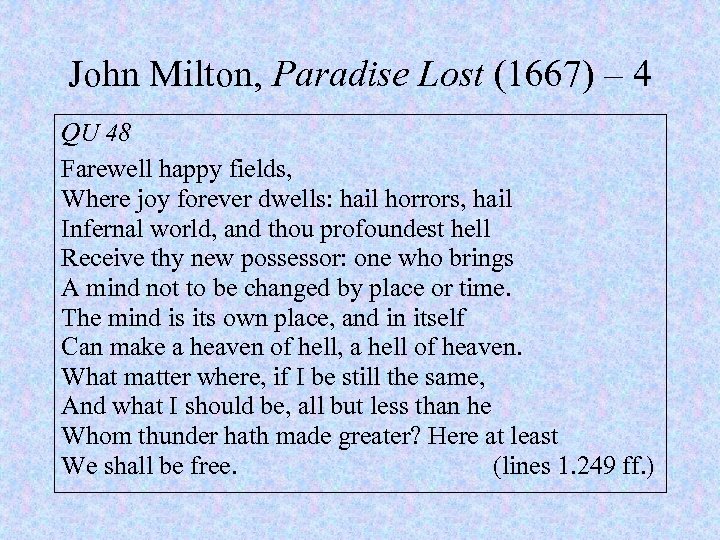 John Milton, Paradise Lost (1667) – 4 QU 48 Farewell happy fields, Where joy forever dwells: hail horrors, hail Infernal world, and thou profoundest hell Receive thy new possessor: one who brings A mind not to be changed by place or time. The mind is its own place, and in itself Can make a heaven of hell, a hell of heaven. What matter where, if I be still the same, And what I should be, all but less than he Whom thunder hath made greater? Here at least We shall be free. (lines 1. 249 ff. )
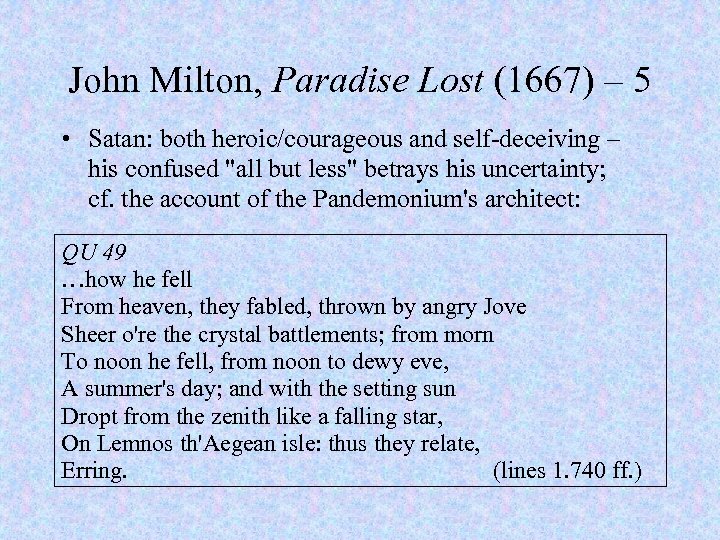 John Milton, Paradise Lost (1667) – 5 • Satan: both heroic/courageous and self-deceiving – his confused "all but less" betrays his uncertainty; cf. the account of the Pandemonium's architect: QU 49 …how he fell From heaven, they fabled, thrown by angry Jove Sheer o're the crystal battlements; from morn To noon he fell, from noon to dewy eve, A summer's day; and with the setting sun Dropt from the zenith like a falling star, On Lemnos th'Aegean isle: thus they relate, Erring. (lines 1. 740 ff. )
 John Milton, Paradise Lost (1667) – 6 • Diction: generally lofty, combines Latinate phrasing with colloquial vigour. • Description of paradise: new epic mixture, georgic rather than pastoral – draws on Virgil and Hesiod (georgic: non-escapist, written in middle style, contrasts authentic country life with city life) multi-generic form: opens modes within which writers from Pope to Joyce will be writing. • Political relevance: allusions to civil war, monarchic Satan alluding to hapless king? – subject of rebellion against established authority is inscribed in Milton's epic.
 John Milton, Paradise Lost (1667) – 7 • At any rate: new Puritan myth – morality of individual responsibility to Creator, which exceeds the aristocratic/hierarchic code of honour of the Cavaliers (and Satan). • Sequel Paradise Regained (1671): Christ tempted/not succumbing to reconcile humanity with God. • Samson Agonistes (1671): recreates Athenian tragedy in the Aristotelian sense with great precision.
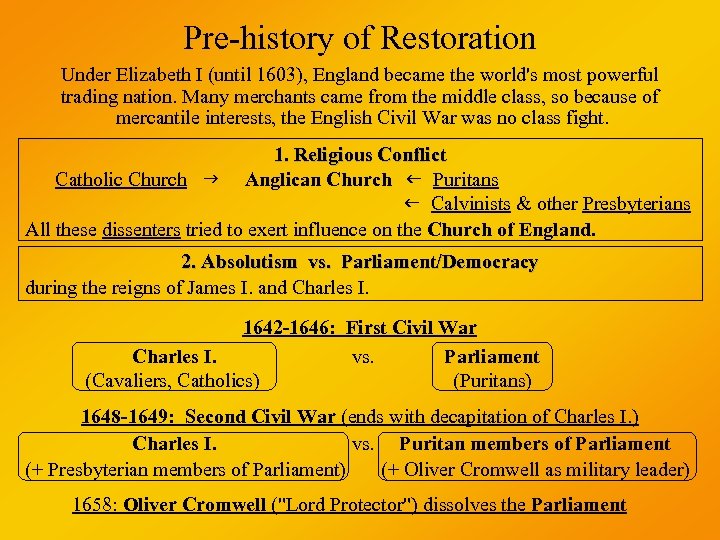 Pre-history of Restoration Under Elizabeth I (until 1603), England became the world's most powerful trading nation. Many merchants came from the middle class, so because of mercantile interests, the English Civil War was no class fight. 1. Religious Conflict Catholic Church Anglican Church Puritans Calvinists & other Presbyterians All these dissenters tried to exert influence on the Church of England. 2. Absolutism vs. Parliament/Democracy during the reigns of James I. and Charles I. 1642 -1646: First Civil War Charles I. vs. Parliament (Cavaliers, Catholics) (Puritans) 1648 -1649: Second Civil War (ends with decapitation of Charles I. ) Charles I. vs. Puritan members of Parliament (+ Presbyterian members of Parliament) (+ Oliver Cromwell as military leader) 1658: Oliver Cromwell ("Lord Protector") dissolves the Parliament
 Restoration period – 1 • James I/Charles I (Scottish house of Stuart): strong absolutist tendencies – continuous struggle for power between King and self-confident, Puritan-dominated parliament (Puritan: esp. radical Protestant idea of Independentism). 1642 -46 1 st Civil War – Puritan parliamentary party/ Roundheads defeat royalist Cavaliers. 1648 2 nd Civil War – Charles I decapitated 1649 by order of Cromwell, leader of Puritan party. 1649 -60 Puritan Interregnum (1649 -60): monarchy abolished – royalists/Presbyterians excluded from power.
 Restoration period – 2 1654 Mew constitution, Cromwell 'Lord Protector' (in 14 th/15 th century: a young king's reigning uncle); theatres closed as places of vice, entertainment as such rejected; England split up into petty political factions, increasing parliamentary opposition. 1658 Cromwell dissolves parliament and reigns as dictator; he dies in the same year succeeded by his weak son – ignored by military leaders, abdicates 1659. 1660 -1688 Restoration period proper
 Restoration period – 3 1660 Charles II ascends to the throne (Stuart monarchy restored); has to cede power to Parliament; Catholic tendencies – heated political discussions. harles II, as pporters of James II, the brother of C Tories su : "Irish bandits, outlaws"; successor to the throne; literally ty th century: royalists; today: Conservative Par 19 tish horse drivers"; holic, Presbyterians; literally: "Scot Whigs anti-Cat later: Liberal Party 1685 James II succeeds his brother a Catholic is head of the Protestant Anglican Church: opposition grows. 1688 William of Orange, Protestant Stadtholder of the Netherlands, invades England on Whig instigation without much resistance ("Glorious Revolution"). James II flees to France. William III of England, Ireland, Scotland. Restoration period ends. 1689 William signs the Bill of Rights Protestantism and Parliament strengthened, absolutist tendencies abolished.
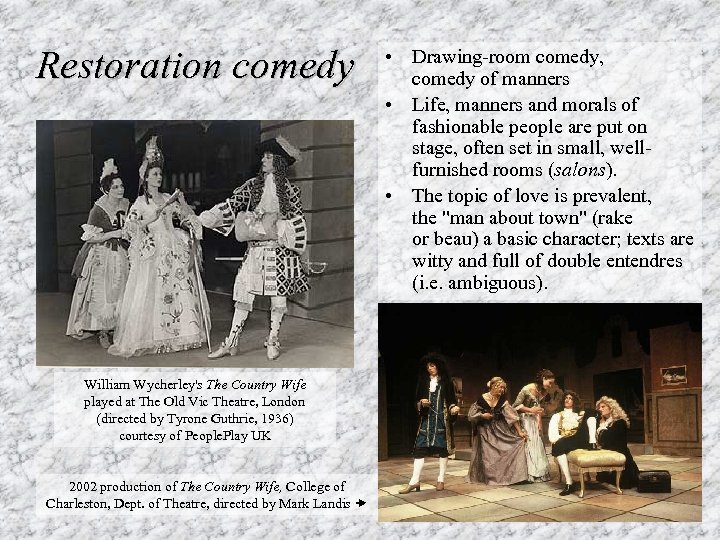 Restoration comedy William Wycherley's The Country Wife played at The Old Vic Theatre, London (directed by Tyrone Guthrie, 1936) courtesy of People. Play UK 2002 production of The Country Wife, College of Charleston, Dept. of Theatre, directed by Mark Landis • Drawing-room comedy, comedy of manners • Life, manners and morals of fashionable people are put on stage, often set in small, wellfurnished rooms (salons). • The topic of love is prevalent, the "man about town" (rake or beau) a basic character; texts are witty and full of double entendres (i. e. ambiguous).
 Restoration comedy – 1 • One of the dominant genres in the second half of the 17 th century. • After Puritan Interregnum, mental climate changes completely: theatres reopened, liberal tone in drama (sexual innuendo, double entendre, pun etc. ), love most important theme Restoration theatre follows great tradition of English drama. • Restoration playwrights: e. g. , George Etherege, William Wycherley (older generation) as well as William Congreve, John Vanbrugh, George Farquhar (younger generation): • Etherege: most famous comedy The Man of Mode, or Sir Fopling Flutter, first performed 1676.
 Restoration comedy – 2 • Wycherley: like Etherege, very close to the king – famous plays Love in a Wood (1671), The Country Wife (1674), The Plain-Dealer (1676) • Congreve (1670 -1729): The Old Batchelour (1693), Love for Love (1695) instantly successful – latter provokes Collier's "A short view of the immorality and profaneness of the English stage"; most famous play The Way of the World (1700) literary period exceeds political Restoration: 'Long 18 th Century'. • Vanbrugh: important English architect (esp. Blenheim Palace), famous play The Provok'd Wife (1697); Farquhar: less successful, more widely known by his comedy The Beaux' Stratagem (1707).
 George Etherege, The Man of Mode, or Sir Fopling Flutter – 1 • Restoration comedy: closer to Jonson's and Middleton's/ Massinger's plays than to Shakespeare's – focuses on the manners of affluent social class: 'comedy of manners', 'drawing room comedy' French model of aristocratic culture – theatre on/for the social elites. • 'Domestic': set in the drawing/dressing/bedrooms of aristocratic households intimacy of gentle(wo)men spending their days calling on each other – also without announcing: characters appear when dramatic action requires it – suspense, comedy. (Oscar Wilde adopts this tradition of Restoration/drawing room comedy towards the end of the 19 th century. ) • Displays society and its manners (dress, conversation, mentality etc. ): Sir Fopling Flutter is a fop/would-be rake author develops 'playing (i. e. exposing) the fool':
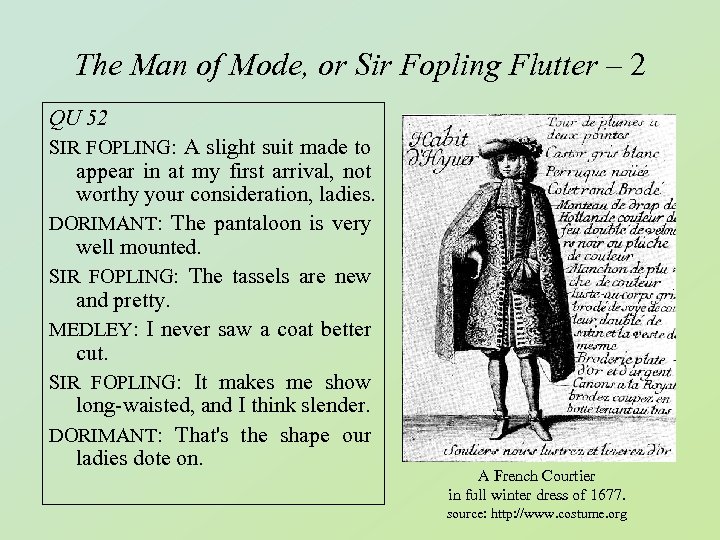 The Man of Mode, or Sir Fopling Flutter – 2 QU 52 SIR FOPLING: A slight suit made to appear in at my first arrival, not worthy your consideration, ladies. DORIMANT: The pantaloon is very well mounted. SIR FOPLING: The tassels are new and pretty. MEDLEY: I never saw a coat better cut. SIR FOPLING: It makes me show long-waisted, and I think slender. DORIMANT: That's the shape our ladies dote on. A French Courtier in full winter dress of 1677. source: http: //www. costume. org
 The Man of Mode, or Sir Fopling Flutter – 3 MEDLEY: Your breech though is a handful too high in my eye, Sir Fopling. SIR FOPLING: Peace, Medley, I have wished it lower a thousand times, but a pox on't, 'twill not be. LADY TOWNLEY: His gloves are well fringed, large and graceful. SIR FOPLING: I was always eminent for being bien ganté. EMILIA: He wears nothing but what are originals of the most famous hands in Paris. SIR FOPLING: You are in the right, madam. LADY TOWNLEY: The suit. SIR FOPLING: Barroy. EMILIA: The garniture. SIR FOPLING: Le Gras – MEDLEY: The shoes.
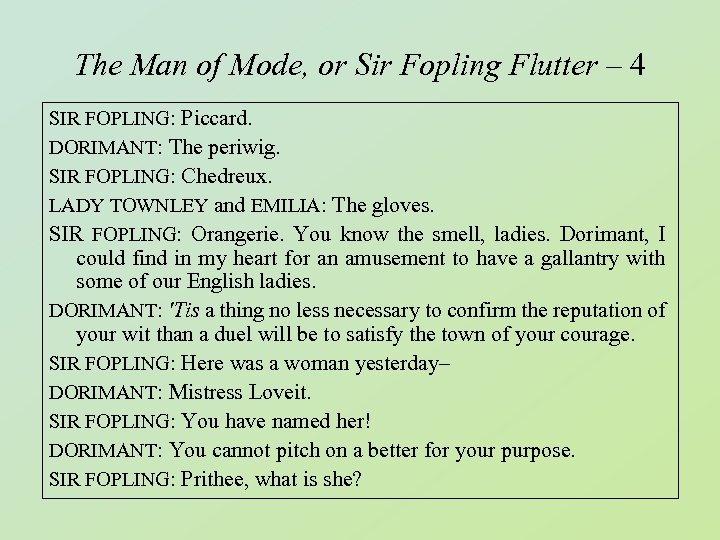 The Man of Mode, or Sir Fopling Flutter – 4 SIR FOPLING: Piccard. DORIMANT: The periwig. SIR FOPLING: Chedreux. LADY TOWNLEY and EMILIA: The gloves. SIR FOPLING: Orangerie. You know the smell, ladies. Dorimant, I could find in my heart for an amusement to have a gallantry with some of our English ladies. DORIMANT: 'Tis a thing no less necessary to confirm the reputation of your wit than a duel will be to satisfy the town of your courage. SIR FOPLING: Here was a woman yesterday– DORIMANT: Mistress Loveit. SIR FOPLING: You have named her! DORIMANT: You cannot pitch on a better for your purpose. SIR FOPLING: Prithee, what is she?
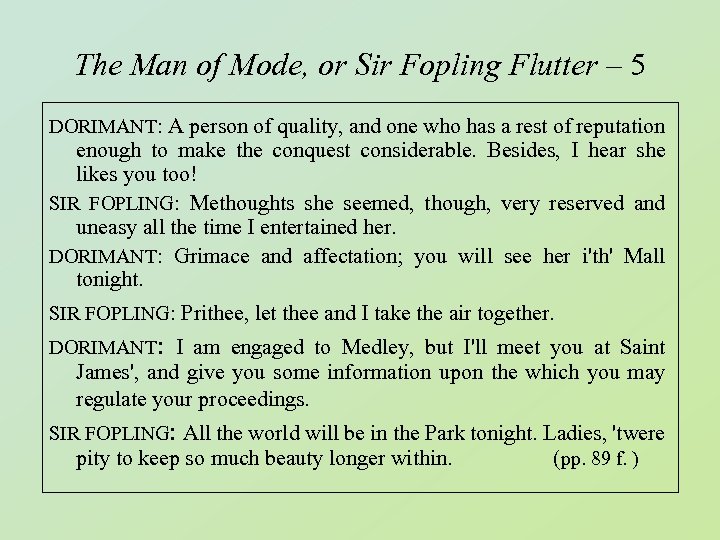 The Man of Mode, or Sir Fopling Flutter – 5 DORIMANT: A person of quality, and one who has a rest of reputation enough to make the conquest considerable. Besides, I hear she likes you too! SIR FOPLING: Methoughts she seemed, though, very reserved and uneasy all the time I entertained her. DORIMANT: Grimace and affectation; you will see her i'th' Mall tonight. SIR FOPLING: Prithee, let thee and I take the air together. DORIMANT: I am engaged to Medley, but I'll meet you at Saint James', and give you some information upon the which you may regulate your proceedings. SIR FOPLING: All the world will be in the Park tonight. Ladies, 'twere pity to keep so much beauty longer within. (pp. 89 f. )
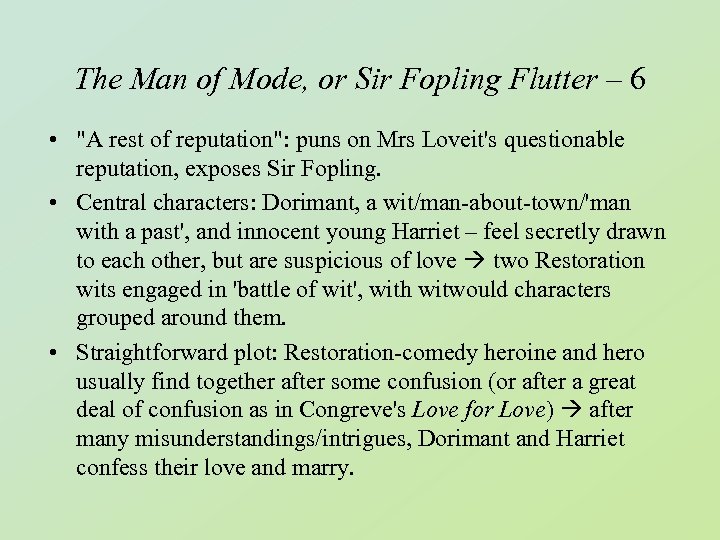 The Man of Mode, or Sir Fopling Flutter – 6 • "A rest of reputation": puns on Mrs Loveit's questionable reputation, exposes Sir Fopling. • Central characters: Dorimant, a wit/man-about-town/'man with a past', and innocent young Harriet – feel secretly drawn to each other, but are suspicious of love two Restoration wits engaged in 'battle of wit', with witwould characters grouped around them. • Straightforward plot: Restoration-comedy heroine and hero usually find together after some confusion (or after a great deal of confusion as in Congreve's Love for Love) after many misunderstandings/intrigues, Dorimant and Harriet confess their love and marry.
 The Man of Mode, or Sir Fopling Flutter – 7 • Other typical characters in Restoration comedy: country bumpkin, cuckold etc. ; telling names, e. g. , Dorimant ("d'or amant" – 'golden lover' or 'lover of gold'? ), Mrs Loveit, Lady Townley vs. Lady Woodville (opposition town – country), servants Pert and Waitwell. • High register, witty dialogue: repartee, puns, aphorisms, sexual innuendo.
 William Wycherley, The Country Wife – 1 QU 53 LADY FIDGET: Hah, hah! Faith, I can't but laugh however. Why d'ye think the unmannerly toad would not come down to me to the coach? I was fain to come up to fetch him, or go without him, which I was resolved not to do; for he knows china very well, and has himself very good, but will not let me see it lest I should beg some. But I will find it out, and have what I came for yet. Exit LADY FIDGET, and locks the door, followed by HORNER to the door. HORNER [apart to LADY FIDGET]: Lock the door, madam. (Aloud) So, she has got into my chamber, and locked me out. Oh, the impertinency of woman-kind! Well, Sir Jasper, plain dealing is a jewel; if ever you suffer your wife to trouble [ctd. ]
![William Wycherley, The Country Wife – 2 HORNER [ctd. ] me again here, she](https://present5.com/presentation/ef0b74a68f8f8d089d4a562d9c2fcd35/image-178.jpg "William Wycherley, The Country Wife – 2 HORNER [ctd. ] me again here, she") William Wycherley, The Country Wife – 2 HORNER [ctd. ] me again here, she shall carry you home a pair of horns, by my Lord Mayor she shall; though I cannot furnish you myself, you are sure, yet I'll find a way. SIR JASPER [aside]: Hah, ha, he! At my first coming in, and finding her arms about him, tickling him it seems, I was half jealous, but now I see my folly. – Heh, he! Poor Horner. HORNER: Nay, though you laugh now, 'twill be my turn ere long. Oh women, more impertinent, more cunning, and more mischievous than their monkeys, and to me almost as ugly! Now is she throwing my things about, and rifling all I have, but I'll get into her the back way, and so rifle her for it – SIR JASPER: Hah, ha! Poor angry Horner. HORNER: Stay here a little, I'll ferret her out to you presently, I warrant.
William Wycherley, The Country Wife – 2 HORNER [ctd. ] me again here, she shall carry you home a pair of horns, by my Lord Mayor she shall; though I cannot furnish you myself, you are sure, yet I'll find a way. SIR JASPER [aside]: Hah, ha, he! At my first coming in, and finding her arms about him, tickling him it seems, I was half jealous, but now I see my folly. – Heh, he! Poor Horner. HORNER: Nay, though you laugh now, 'twill be my turn ere long. Oh women, more impertinent, more cunning, and more mischievous than their monkeys, and to me almost as ugly! Now is she throwing my things about, and rifling all I have, but I'll get into her the back way, and so rifle her for it – SIR JASPER: Hah, ha! Poor angry Horner. HORNER: Stay here a little, I'll ferret her out to you presently, I warrant.
 William Wycherley, The Country Wife – 3 Exit HORNER at t'other door. SIR JASPER [SIR JASPER calls through to door to his wife, she answers from within]: Wife! My Lady Fidget! Wife! He is coming into you the back way. LADY FIDGET: Let him come, and welcome, which way he will. SIR JASPER: He'll catch you, and use you roughly, and be too strong for you. LADY FIDGET: Don't you trouble yourself, let him if he can. QUACK [behind]: This indeed, I could not have believed from him, nor any but my own eyes. Enter Mrs SQUEAMISH: Where's this woman-hater, this toad, this ugly, greasy, dirty sloven?
![William Wycherley, The Country Wife – 4 SIR JASPER [aside]: So, the women all](https://present5.com/presentation/ef0b74a68f8f8d089d4a562d9c2fcd35/image-180.jpg "William Wycherley, The Country Wife – 4 SIR JASPER [aside]: So, the women all") William Wycherley, The Country Wife – 4 SIR JASPER [aside]: So, the women all will have him ugly. Methinks he is a comely person, but his wants make his form contemptible to 'em. And 'tis e'en as my wife said yesterday, talking of him, that a proper handsome eunuch was as ridiculous a thing as a gigantic coward. Mrs SQUEAMISH: Sir Jasper, your servant. Where is the odious beast? SIR JASPER: He's within in his chamber, with my wife. She's playing the wag with him. Mrs SQUEAMISH: Is she so? And he's a clownish beast, he'll give her no quarter, he'll play the wag with her again, let me tell you. Come, let's go help her. – What, the door's locked? SIR JASPER: Ay, my wife locked it – Mrs SQUEAMISH: Did she so? Let us break it open then.
William Wycherley, The Country Wife – 4 SIR JASPER [aside]: So, the women all will have him ugly. Methinks he is a comely person, but his wants make his form contemptible to 'em. And 'tis e'en as my wife said yesterday, talking of him, that a proper handsome eunuch was as ridiculous a thing as a gigantic coward. Mrs SQUEAMISH: Sir Jasper, your servant. Where is the odious beast? SIR JASPER: He's within in his chamber, with my wife. She's playing the wag with him. Mrs SQUEAMISH: Is she so? And he's a clownish beast, he'll give her no quarter, he'll play the wag with her again, let me tell you. Come, let's go help her. – What, the door's locked? SIR JASPER: Ay, my wife locked it – Mrs SQUEAMISH: Did she so? Let us break it open then.
 William Wycherley, The Country Wife – 5 SIR JASPER: No, no, he'll do her no hurt. Mrs SQUEAMISH: No. – [Aside] But is there no other way to get into 'em? Whither goes this? I will disturb 'em. Exit Mrs SQUEAMISH at another door. Enter OLD LADY SQUEAMISH: Where is this harlotry, this impudent baggage, this rambling tomrigg? O Sir Jasper, I'm glad to see you here. Did you not see my vild grandchild come in hither just now? SIR JASPER: Yes. OLD LADY SQUEAMISH: Ay, but where is she then? Where is she? Lord, Sir Jasper, I have e'en rattled myself to pieces in pursuit of her. But can you tell what she makes here? They say below, no woman lodges here.
 William Wycherley, The Country Wife – 6 SIR JASPER: No. OLD LADY SQUEAMISH: No! What does she here then? Say if it be not a woman's lodging, what makes she here? But are you sure no woman lodges here? SIR JASPER: No, nor no man neither. This is Mr Horner's lodging. OLD LADY SQUEAMISH: Is it so? Are you sure? SIR JASPER: Yes, yes. OLD LADY SQUEAMISH: So; then there's no hurt in't, I hope. But where is he? SIR JASPER: He's in the next room with my wife. OLD LADY SQUEAMISH: Nay, if you trust him with your wife, I may with my Biddy. They say he's a merry harmless man [ctd. ]
![William Wycherley, The Country Wife – 7 OLD LADY SQUEAMISH: [ctd. ] now, e'en](https://present5.com/presentation/ef0b74a68f8f8d089d4a562d9c2fcd35/image-183.jpg "William Wycherley, The Country Wife – 7 OLD LADY SQUEAMISH: [ctd. ] now, e'en") William Wycherley, The Country Wife – 7 OLD LADY SQUEAMISH: [ctd. ] now, e'en as harmless a man as ever came out of Italy with a good voice, and as pretty harmless company for a lady, as a snake without his teeth. SIR JASPER: Ay, ay, poor man. Enter Mrs SQUEAMISH: I can't find 'em. – Oh, are you here, grandmother? I follow'd, you must know, My Lady Fidget hither; 'tis the prettiest lodging, and I have been staring on the prettiest pictures. Enter LADY FIDGET with a piece of china in her hand, and HORNER following. LADY FIDGET: And I have been toiling and moiling, for the prettiest piece of china, my dear.
William Wycherley, The Country Wife – 7 OLD LADY SQUEAMISH: [ctd. ] now, e'en as harmless a man as ever came out of Italy with a good voice, and as pretty harmless company for a lady, as a snake without his teeth. SIR JASPER: Ay, ay, poor man. Enter Mrs SQUEAMISH: I can't find 'em. – Oh, are you here, grandmother? I follow'd, you must know, My Lady Fidget hither; 'tis the prettiest lodging, and I have been staring on the prettiest pictures. Enter LADY FIDGET with a piece of china in her hand, and HORNER following. LADY FIDGET: And I have been toiling and moiling, for the prettiest piece of china, my dear.
 William Wycherley, The Country Wife – 8 HORNER: Nay, she has been too hard for me, do what I could. Mrs SQUEAMISH: Oh Lord, I'll have some china too, good Mr Horner. Don't think to give other people china, and me none. Come in with me too. HORNER: Upon my honour, I have none left now. Mrs SQUEAMISH: Nay, nay, I have known you deny your china before now, but you shan't put me off so. Come – HORNER: This lady had the last there. LADY FIDGET: Yes indeed, madam, to my certain knowledge he has no more left. Mrs SQUEAMISH: Oh, but it may be he may have some you could not find.
 William Wycherley, The Country Wife – 9 LADY FIDGET: What? D'ye think if he had any left, I would not have had it too? For we women of quality never think we have china enough. HORNER: Do not take it ill, I cannot make china for you all, but I will have a roll-wagon for you too another time. Mrs SQUEAMISH: Thank you, dear toad. LADY FIDGET [to HORNER, aside]: What do you mean by that promise? HORNER [apart to LADY FIDGET]: Alas, she has an innocent, literal understanding. OLD LADY SQUEAMISH: Poor Mr Horner, he has enough to do to please you all, I see. HORNER: Ay, madam, you see how they use me. (pp. 221 ff. )
 William Wycherley, The Country Wife – 10 • Information unequally distributed between Horner/Lady Fidget and Sir Jasper/Mrs Squeamish double entendre: sexual level of meaning understood only by insiders (including audience) • Farcical: circumstances grossly exaggerated – similar situation in Chaucer's Franklin's Tale. • Raillery: high-spirited, witty teasing – part of the 'battle of wit',
 William Congreve, Love for Love – 1 QU 54 Angelica: Will you lend me your coach, or I'll go on. Nay, I'll declare how you prophesied popery was coming, only because the butler had mislaid some of the Apostle spoons, and thought they were lost. Away went religion and spoonmeat together. – Indeed, uncle, I'll indite you for a wizard. Foresight: How, hussy? Was there ever such a provoking minx? Nurse: O merciful father how she talks! Angelica: Yes, I can make oath of your unlawful midnight practices; you and the old nurse there. Nurse: Marry, Heaven defend – I at midnight practices! [ctd. ]
![William Congreve, Love for Love – 2 Nurse: [ctd. ] O Lord what's here](https://present5.com/presentation/ef0b74a68f8f8d089d4a562d9c2fcd35/image-188.jpg "William Congreve, Love for Love – 2 Nurse: [ctd. ] O Lord what's here") William Congreve, Love for Love – 2 Nurse: [ctd. ] O Lord what's here to do? I in unlawful doings with my master's worship! Why, did you ever hear the like now? Sir, did I ever do any thing of your midnight concerns but warm your bed and tuck you up, and set the candle and your tobacco box and your urinal by you, and now and then rub the soles of your feet? – O Lord, I! Angelica: Yes, I saw you together, through the key hole of the closet one night, like Saul and the Witch of Endor, turning the sieve and shears, and pricking your thumbs to write poor innocent servants' names in blood about a little nutmeg grater which she had forgot in the caudle cup. Nay, I know something worse, if I would speak of it.
William Congreve, Love for Love – 2 Nurse: [ctd. ] O Lord what's here to do? I in unlawful doings with my master's worship! Why, did you ever hear the like now? Sir, did I ever do any thing of your midnight concerns but warm your bed and tuck you up, and set the candle and your tobacco box and your urinal by you, and now and then rub the soles of your feet? – O Lord, I! Angelica: Yes, I saw you together, through the key hole of the closet one night, like Saul and the Witch of Endor, turning the sieve and shears, and pricking your thumbs to write poor innocent servants' names in blood about a little nutmeg grater which she had forgot in the caudle cup. Nay, I know something worse, if I would speak of it.
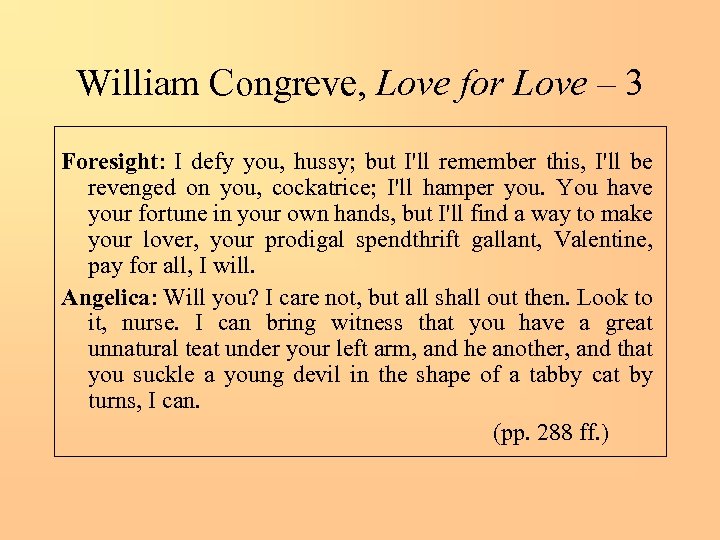 William Congreve, Love for Love – 3 Foresight: I defy you, hussy; but I'll remember this, I'll be revenged on you, cockatrice; I'll hamper you. You have your fortune in your own hands, but I'll find a way to make your lover, your prodigal spendthrift gallant, Valentine, pay for all, I will. Angelica: Will you? I care not, but all shall out then. Look to it, nurse. I can bring witness that you have a great unnatural teat under your left arm, and he another, and that you suckle a young devil in the shape of a tabby cat by turns, I can. (pp. 288 ff. )
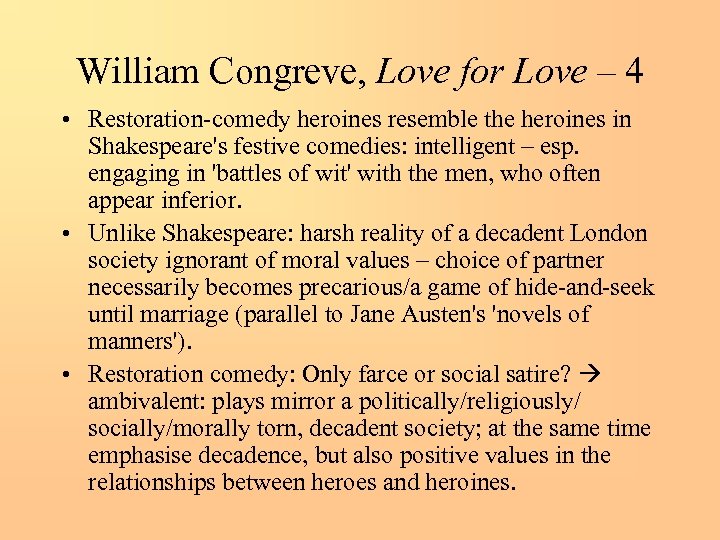 William Congreve, Love for Love – 4 • Restoration-comedy heroines resemble the heroines in Shakespeare's festive comedies: intelligent – esp. engaging in 'battles of wit' with the men, who often appear inferior. • Unlike Shakespeare: harsh reality of a decadent London society ignorant of moral values – choice of partner necessarily becomes precarious/a game of hide-and-seek until marriage (parallel to Jane Austen's 'novels of manners'). • Restoration comedy: Only farce or social satire? ambivalent: plays mirror a politically/religiously/ socially/morally torn, decadent society; at the same time emphasise decadence, but also positive values in the relationships between heroes and heroines.