 Скачать презентацию Combustion science in aid of conversion of lignaceous
7ffcff49b183bb65cc39d2d88fff2c0f.ppt
- Количество слайдов: 57



Combustion science in aid of conversion of lignaceous solid biofuels to gaseous fuels Prof. H S Mukunda , CGPL - Dept of Aerospace Engg - IISc
Ø Background Importance for developed countries and developing countries What fuels, why? Ø Single particle combustion and inferences for gasification Ø Flame propagation in particle beds Ø Producer gas – Combustion features for engine applications Ø Power Gasifiers and Gasifier Stoves CGPL, Dept. of Aerospace Engg. , IISc (… 2)
Part of the inspiration for this talk – Proceedings of the Combustion Institute, volume 28, 2000/pp 1 -10. HOTTEL LECTURE SUPERSONIC FLIGHT AND COOKING OVER WOODBURNING STOVES: CHALLENGES TO THE COMBUSTION COMMUNITY IRVIN GLASSMAN Department of Mechanical and Aerospace Engineering Princeton University Princeton, NJ 08554, USA CGPL, Dept. of Aerospace Engg. , IISc (… 3)
Background Importance for developing and developed countries Renewable fuels need to be used sooner or later – sooner for the developing countries (including parts of South America) and later for Europe and even later for the North Americas. Why? - Oil importing countries have large impetus to gain from the economy of biofuels Rich countries can afford to work with expensive renewable & “fashionable” technologies (like SPV) and ignore cheaper options for a long time. CGPL, Dept. of Aerospace Engg. , IISc (… 4)
International compulsions of GHG reduction will be imposed on populated developing countries Thus it is better for us in India to do research to help ourselves rather than wait till other countries do research and transfer technologies at high cost. At IISc, a 300 man-year effort has gone into solid biofuelto-gas field in a unique laboratory, on fundamental research, technology development, field testing and improvements in design over the last 20 years. CGPL, Dept. of Aerospace Engg. , IISc (… 5)
What fuels and why? Agro-fuels Rice husk and Rice straw – for India, China, S-E Asia Other straws, Sugarcane trash (& Bagasse), Peanut shells, -------- These are light (~100 kg/m 3), fine sized (a few mm), high ash (5 to 20 %), highly alkaline ash – Potassium from the fertilizer application, Moisture problem not serious (because of thin walls) -------- Coconut shells, Cotton stalk, mustard stalk, weeds like Ipomia, Parthenium (properties like woody fuels) CGPL, Dept. of Aerospace Engg. , IISc (… 6)
Aim Convert these into gaseous fuels through thermo-chemical conversion process – gasification process – and enable them to be used for electricity generation through reciprocating engines/gas turbines or heat applications – cooking, industrial drying or melting all with highest possible efficiency and little emissions, keeping cost as low as is possible. Just what is this technology? Get all biomass into solid form - CGPL, Dept. of Aerospace Engg. , IISc (… 7)
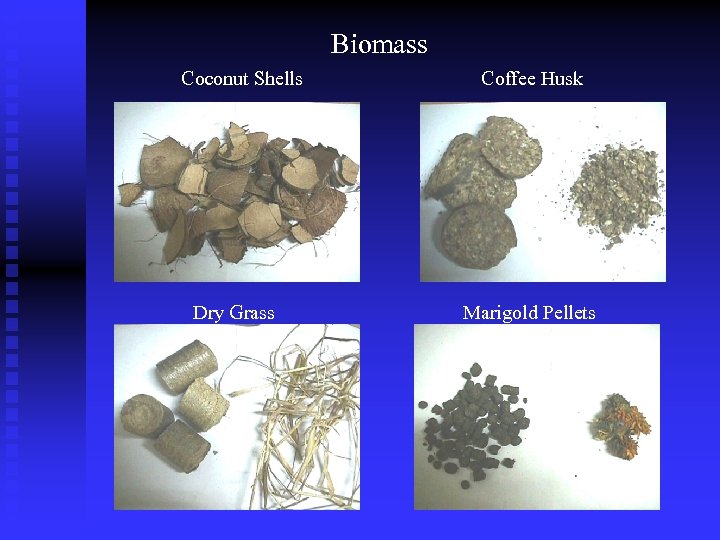
Biomass Coconut Shells Dry Grass Coffee Husk Marigold Pellets
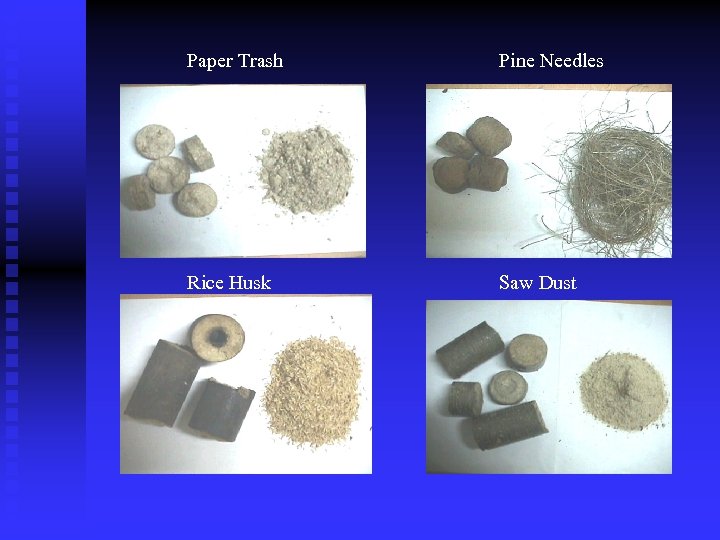
Paper Trash Pine Needles Rice Husk Saw Dust
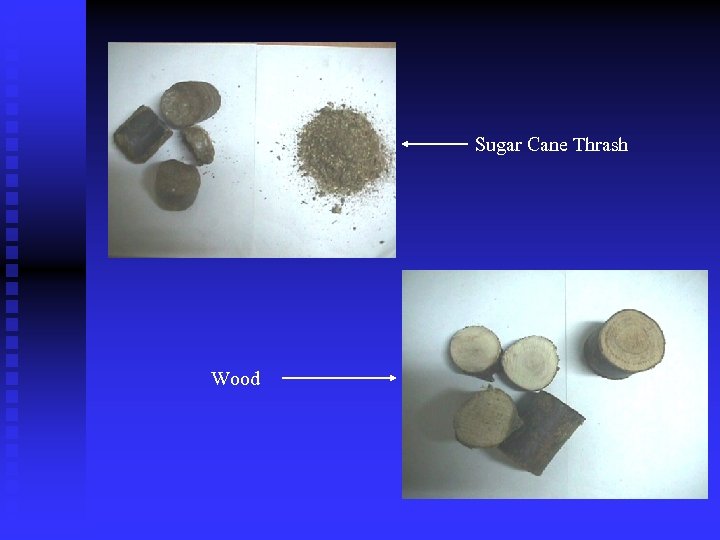
Sugar Cane Thrash Wood
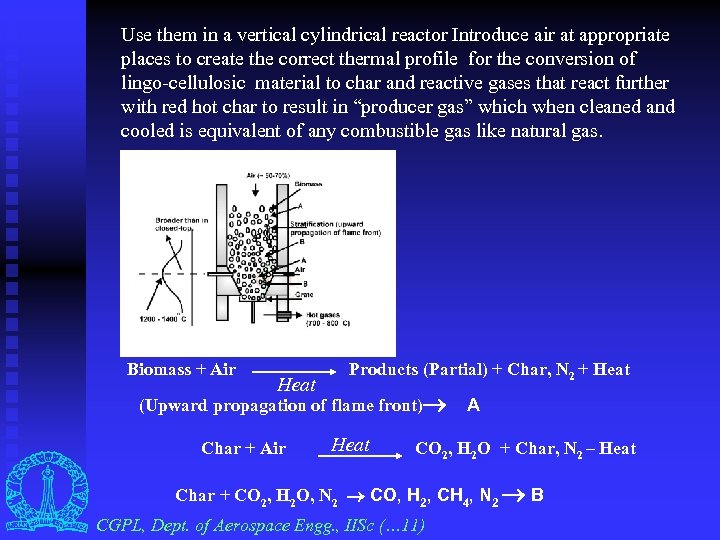
Use them in a vertical cylindrical reactor Introduce air at appropriate places to create the correct thermal profile for the conversion of lingo-cellulosic material to char and reactive gases that react further with red hot char to result in “producer gas” which when cleaned and cooled is equivalent of any combustible gas like natural gas. Biomass + Air Heat Products (Partial) + Char, N 2 + Heat (Upward propagation of flame front) A Char + Air Heat CO 2, H 2 O + Char, N 2 – Heat Char + CO 2, H 2 O, N 2 CO, H 2, CH 4, N 2 B CGPL, Dept. of Aerospace Engg. , IISc (… 11)
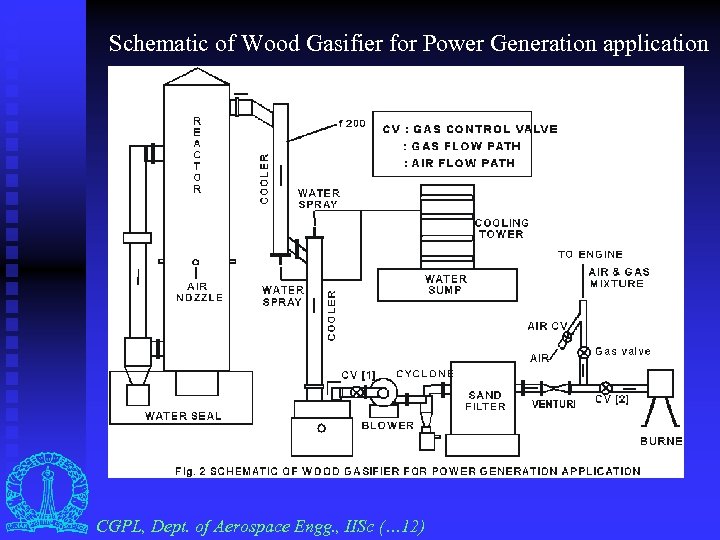
Schematic of Wood Gasifier for Power Generation application CGPL, Dept. of Aerospace Engg. , IISc (… 12)
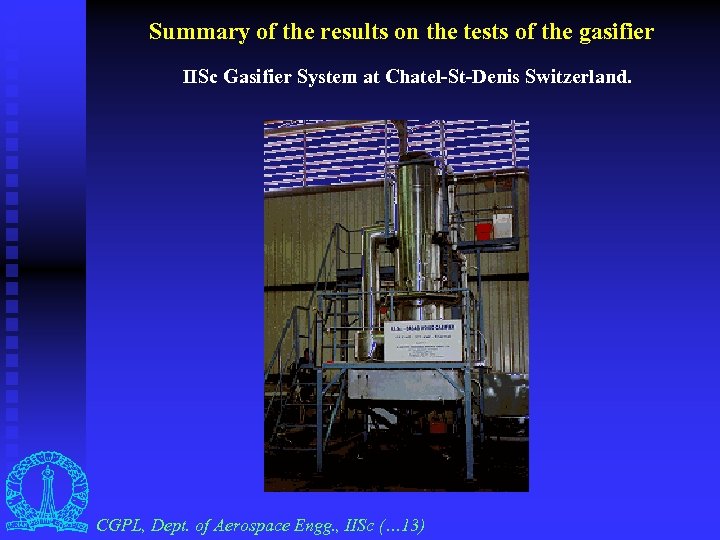
Summary of the results on the tests of the gasifier IISc Gasifier System at Chatel-St-Denis Switzerland. CGPL, Dept. of Aerospace Engg. , IISc (… 13)
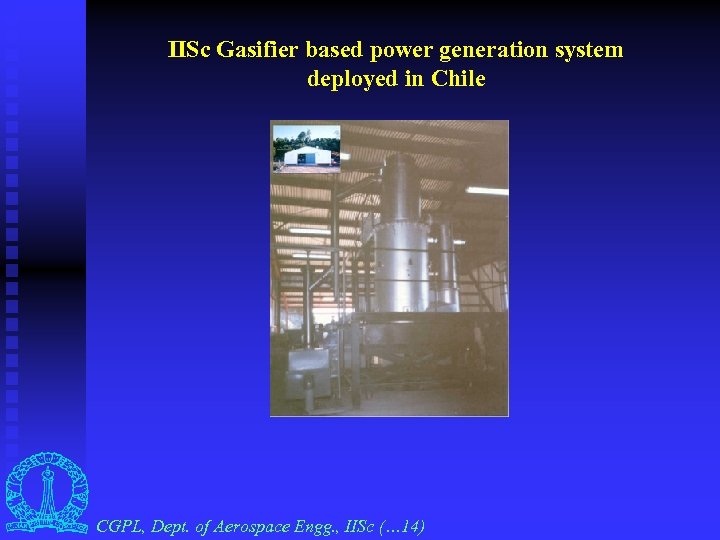
IISc Gasifier based power generation system deployed in Chile CGPL, Dept. of Aerospace Engg. , IISc (… 14)
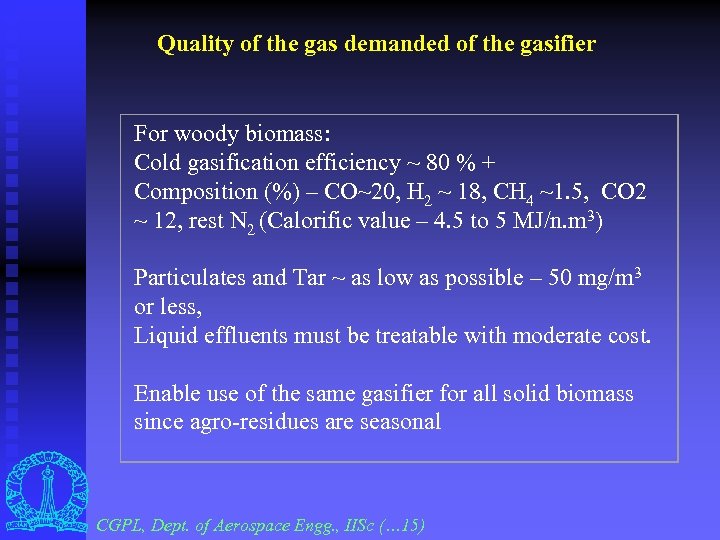
Quality of the gas demanded of the gasifier For woody biomass: Cold gasification efficiency ~ 80 % + Composition (%) – CO~20, H 2 ~ 18, CH 4 ~1. 5, CO 2 ~ 12, rest N 2 (Calorific value – 4. 5 to 5 MJ/n. m 3) Particulates and Tar ~ as low as possible – 50 mg/m 3 or less, Liquid effluents must be treatable with moderate cost. Enable use of the same gasifier for all solid biomass since agro-residues are seasonal CGPL, Dept. of Aerospace Engg. , IISc (… 15)
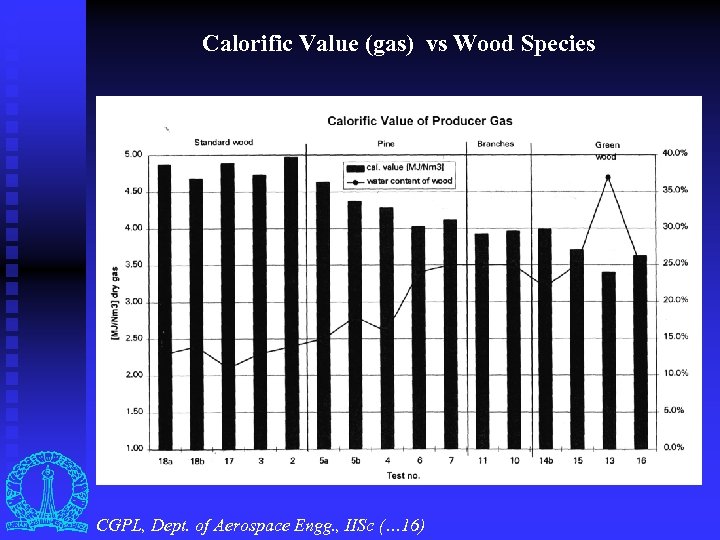
Calorific Value (gas) vs Wood Species CGPL, Dept. of Aerospace Engg. , IISc (… 16)
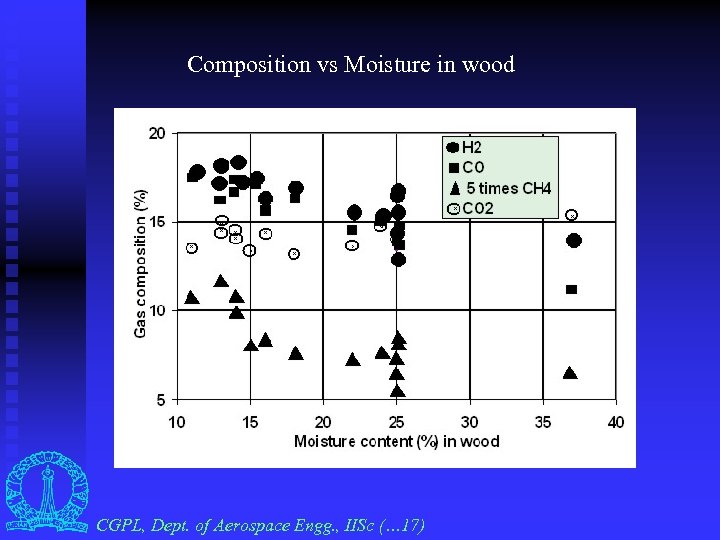
Composition vs Moisture in wood CGPL, Dept. of Aerospace Engg. , IISc (… 17)
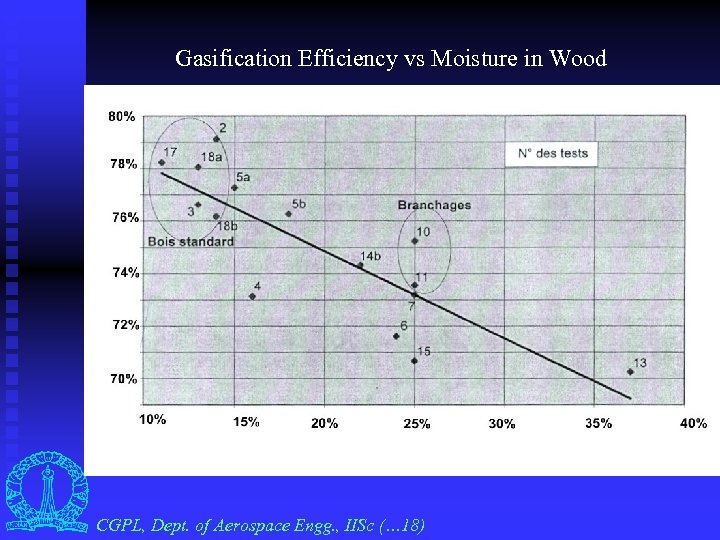
Gasification Efficiency vs Moisture in Wood CGPL, Dept. of Aerospace Engg. , IISc (… 18)
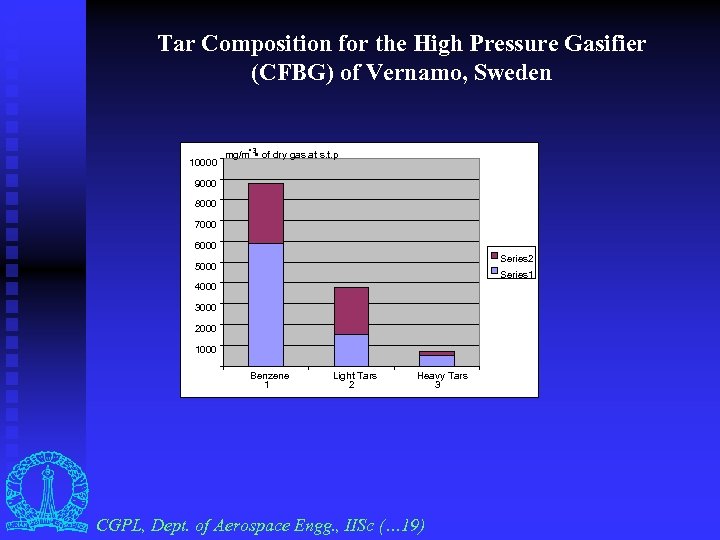
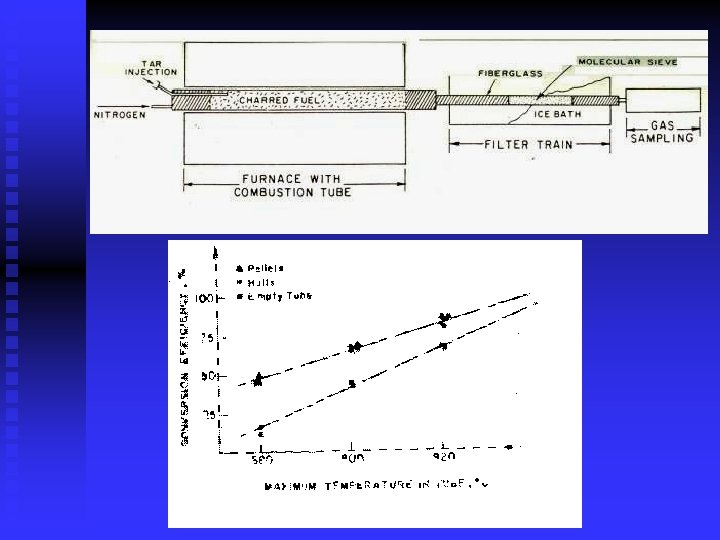
Tar Composition for the High Pressure Gasifier (CFBG) of Vernamo, Sweden • 3 10000 mg/m • of dry gas at s. t. p 9000 8000 7000 6000 Series 2 5000 Series 1 4000 3000 2000 1000 Benzene 1 Light Tars 2 Heavy Tars 3 CGPL, Dept. of Aerospace Engg. , IISc (… 19)
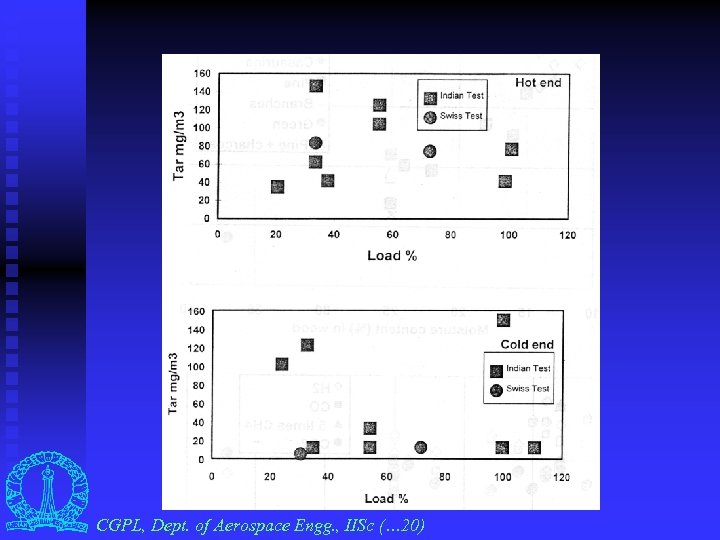
CGPL, Dept. of Aerospace Engg. , IISc (… 20)
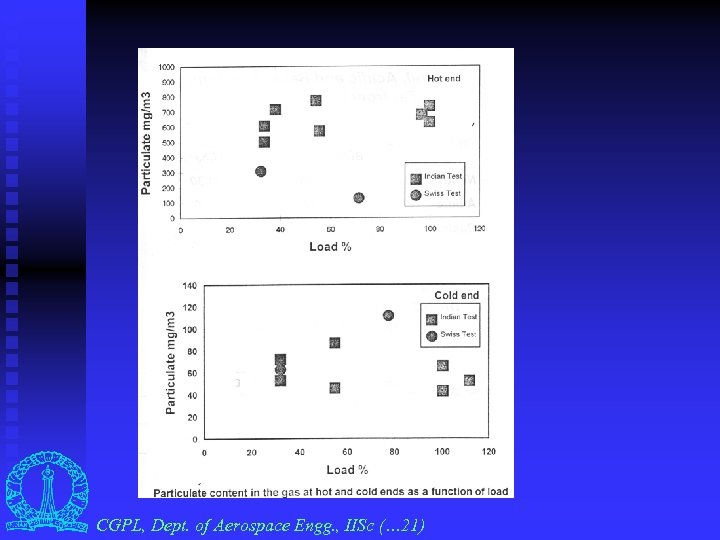
CGPL, Dept. of Aerospace Engg. , IISc (… 21)
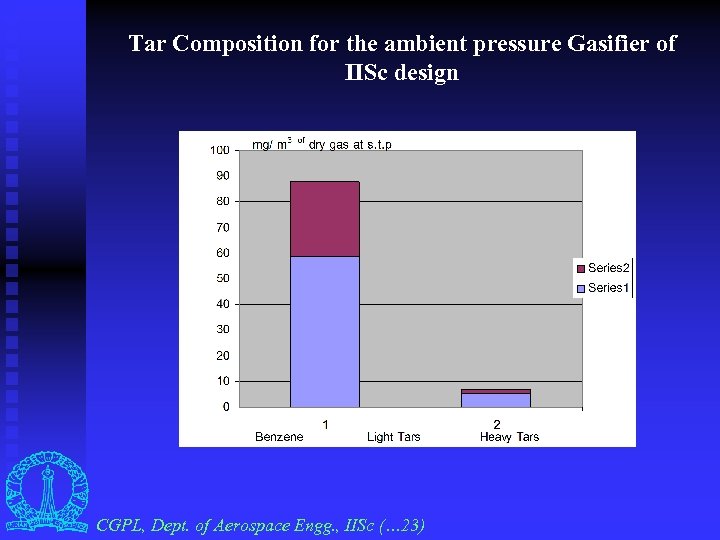
Tar Composition for the ambient pressure Gasifier of IISc design CGPL, Dept. of Aerospace Engg. , IISc (… 23)
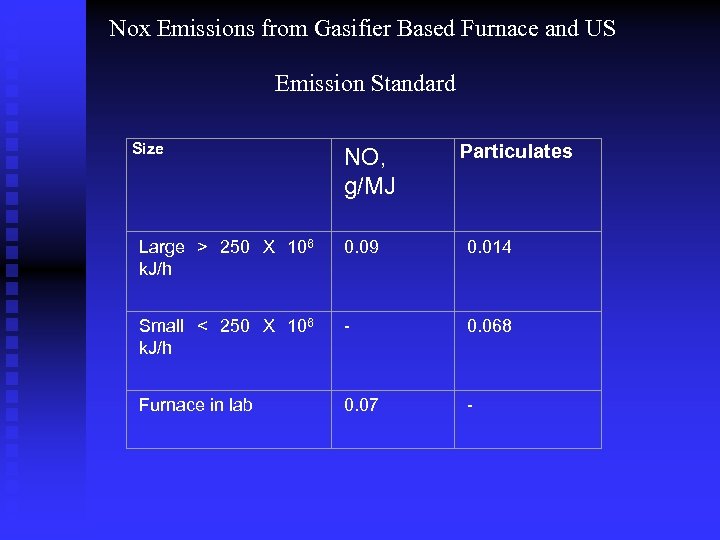
Nox Emissions from Gasifier Based Furnace and US Emission Standard Size NO, g/MJ Particulates Large > 250 X 106 k. J/h 0. 09 0. 014 Small < 250 X 106 k. J/h - 0. 068 Furnace in lab 0. 07 -
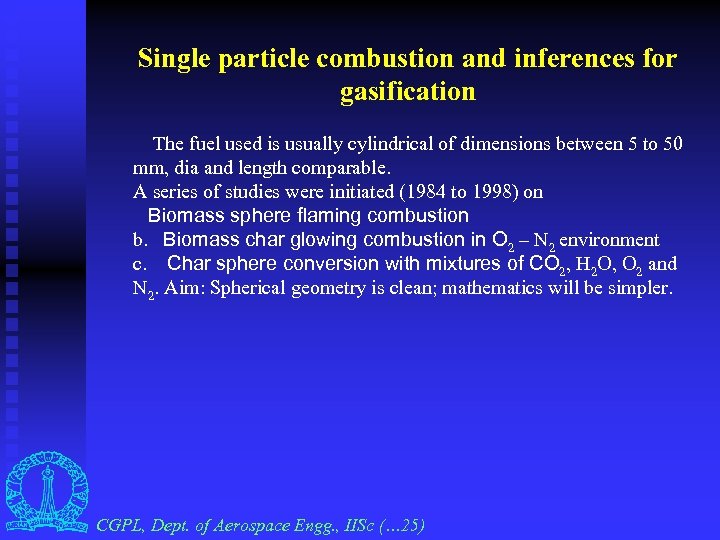
Single particle combustion and inferences for gasification The fuel used is usually cylindrical of dimensions between 5 to 50 mm, dia and length comparable. A series of studies were initiated (1984 to 1998) on Biomass sphere flaming combustion b. Biomass char glowing combustion in O 2 – N 2 environment c. Char sphere conversion with mixtures of CO 2, H 2 O, O 2 and N 2. Aim: Spherical geometry is clean; mathematics will be simpler. CGPL, Dept. of Aerospace Engg. , IISc (… 25)
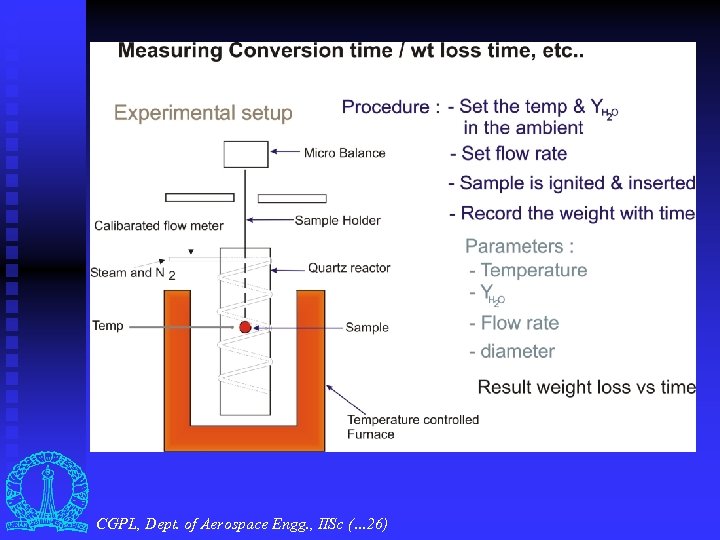
CGPL, Dept. of Aerospace Engg. , IISc (… 26)
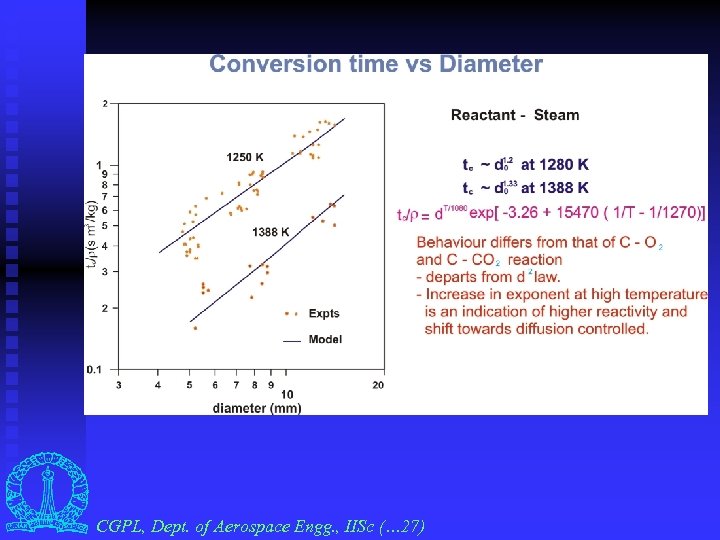
CGPL, Dept. of Aerospace Engg. , IISc (… 27)
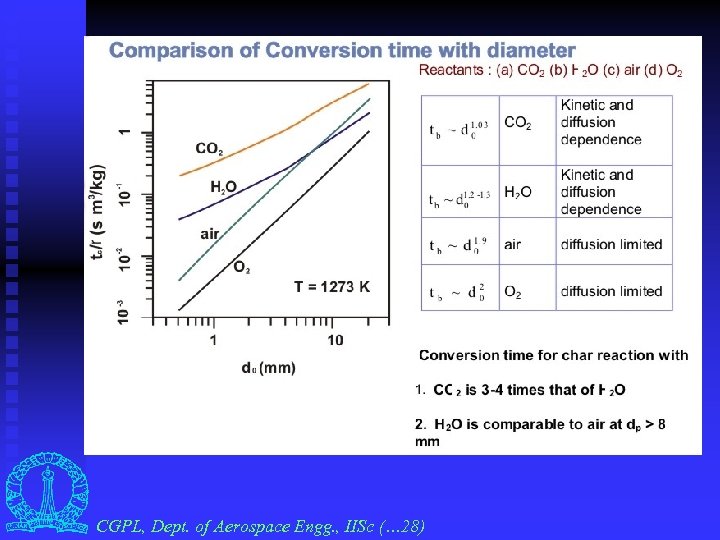
CGPL, Dept. of Aerospace Engg. , IISc (… 28)
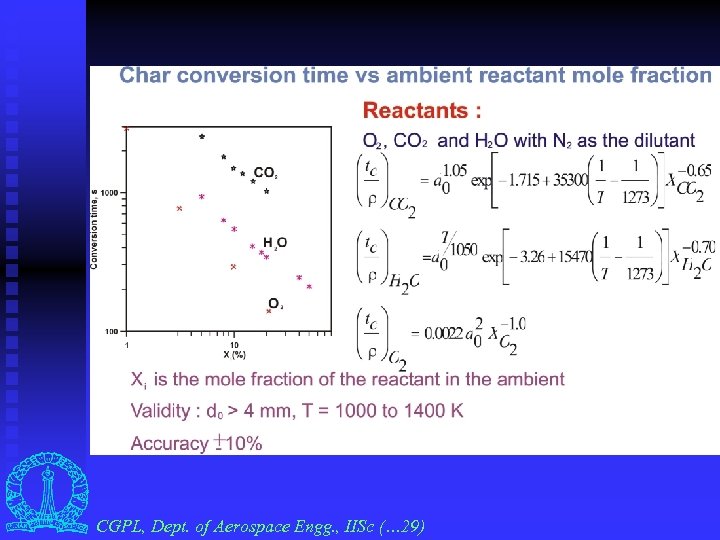
CGPL, Dept. of Aerospace Engg. , IISc (… 29)
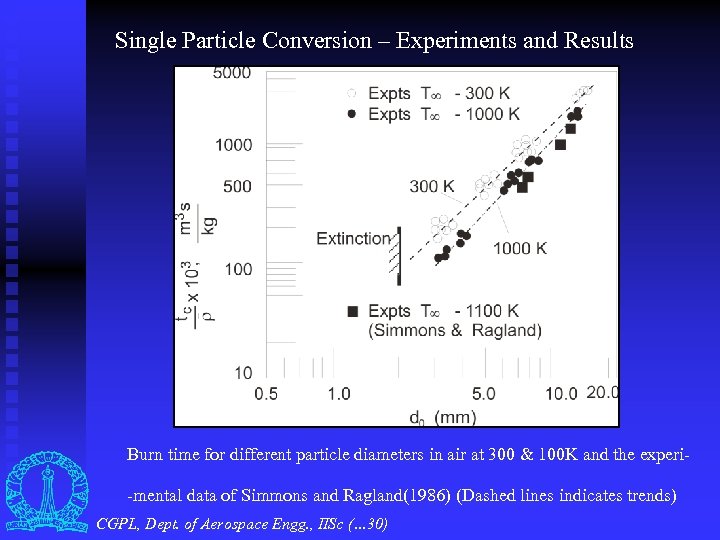
Single Particle Conversion – Experiments and Results Burn time for different particle diameters in air at 300 & 100 K and the experi-mental data of Simmons and Ragland(1986) (Dashed lines indicates trends) CGPL, Dept. of Aerospace Engg. , IISc (… 30)
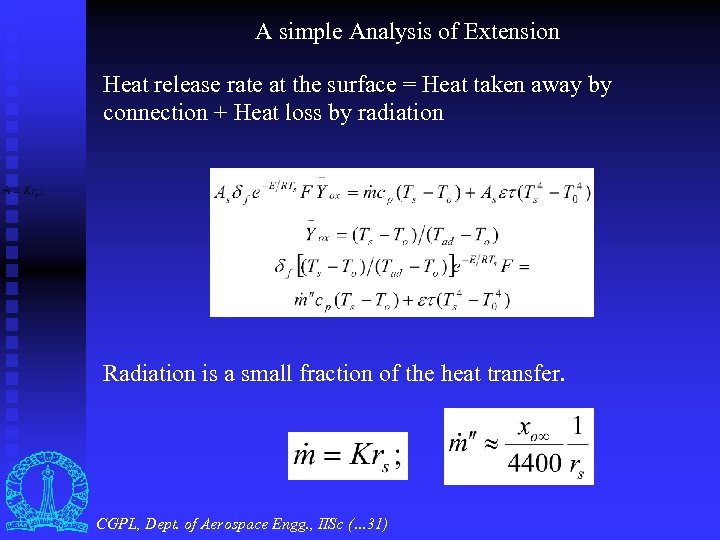
A simple Analysis of Extension Heat release rate at the surface = Heat taken away by connection + Heat loss by radiation Radiation is a small fraction of the heat transfer. CGPL, Dept. of Aerospace Engg. , IISc (… 31)
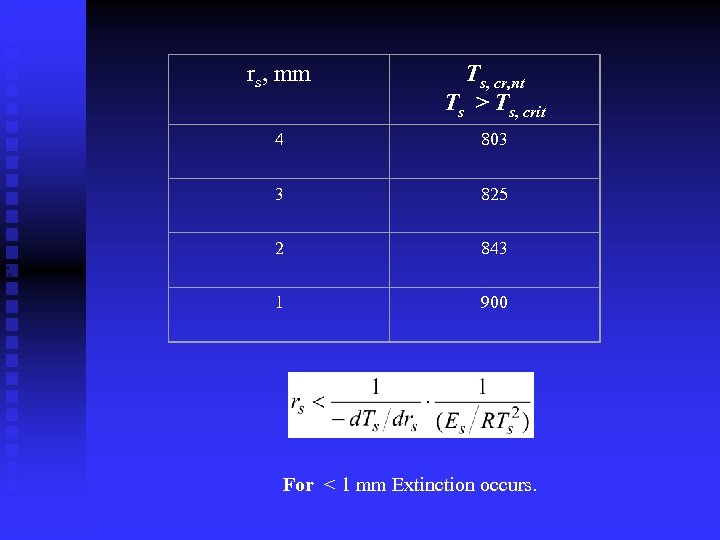
rs, mm Ts, cr, nt Ts > Ts, crit 4 803 3 825 2 843 1 900 For < 1 mm Extinction occurs.
Combustion Experiments with a) Rice Husk b) Sawdust with 20% Silica c) Pulverised Rice Husk d) Sawdust e) Spheres- Wood and Rice Husk Briquette CGPL, Dept. of Aerospace Engg. , IISc (… 33)
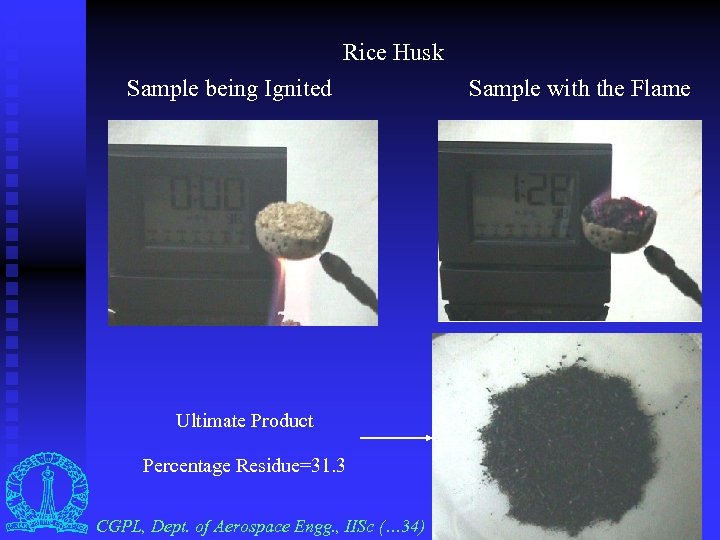
Rice Husk Sample being Ignited Ultimate Product Percentage Residue=31. 3 CGPL, Dept. of Aerospace Engg. , IISc (… 34) Sample with the Flame
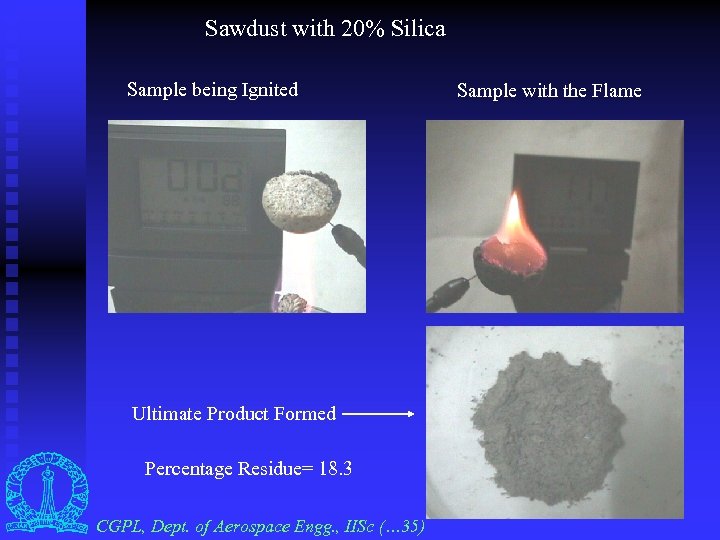
Sawdust with 20% Silica Sample being Ignited Ultimate Product Formed Percentage Residue= 18. 3 CGPL, Dept. of Aerospace Engg. , IISc (… 35) Sample with the Flame
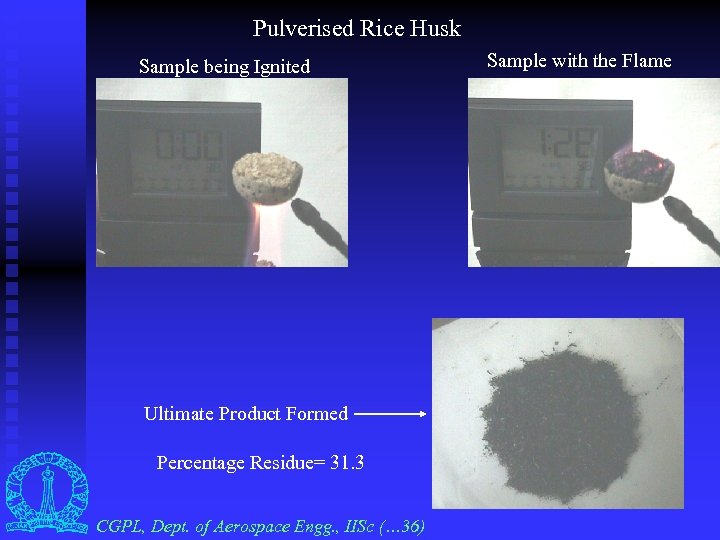
Pulverised Rice Husk Sample being Ignited Ultimate Product Formed Percentage Residue= 31. 3 CGPL, Dept. of Aerospace Engg. , IISc (… 36) Sample with the Flame
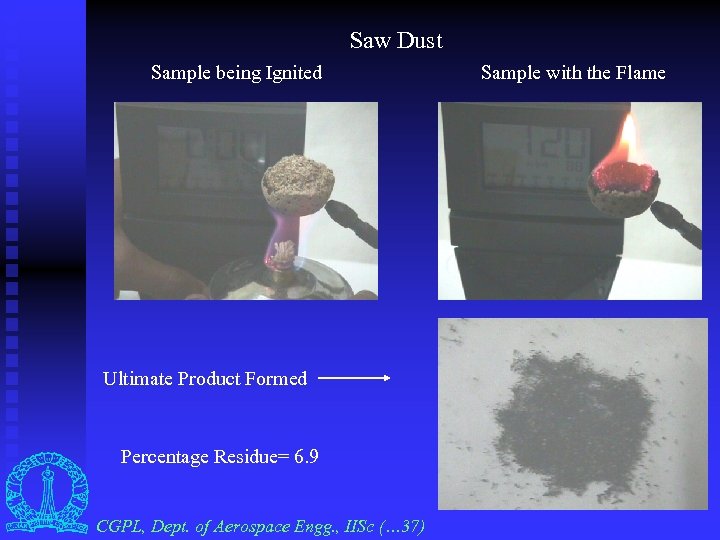
Saw Dust Sample being Ignited Ultimate Product Formed Percentage Residue= 6. 9 CGPL, Dept. of Aerospace Engg. , IISc (… 37) Sample with the Flame
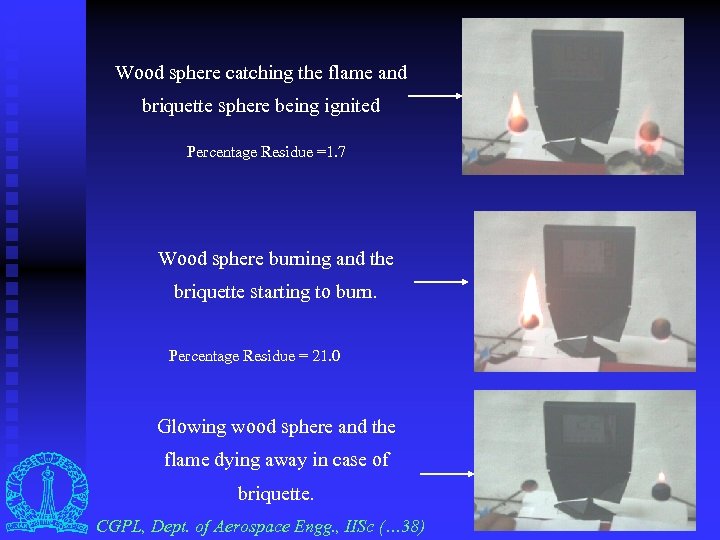
Wood sphere catching the flame and briquette sphere being ignited Percentage Residue =1. 7 Wood sphere burning and the briquette starting to burn. Percentage Residue = 21. 0 Glowing wood sphere and the flame dying away in case of briquette. CGPL, Dept. of Aerospace Engg. , IISc (… 38)
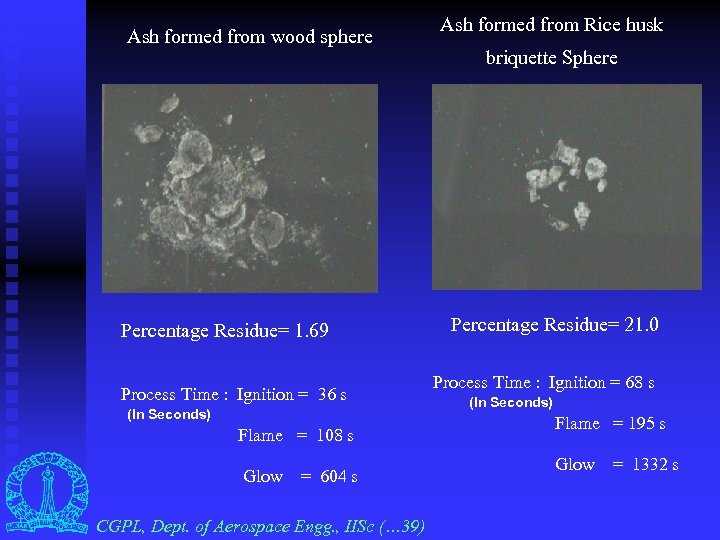
Ash formed from wood sphere Percentage Residue= 1. 69 Process Time : Ignition = 36 s (In Seconds) Flame = 108 s Glow = 604 s CGPL, Dept. of Aerospace Engg. , IISc (… 39) Ash formed from Rice husk briquette Sphere Percentage Residue= 21. 0 Process Time : Ignition = 68 s (In Seconds) Flame = 195 s Glow = 1332 s
Relevance to Rice Husk gasifiers • The conversion of rice husk char is slower than of wood char. • It occurs only at very slow heating rates and at temperatures below 8000 C. • Rice husk char is structurally more complex than wood char. It has 40 to 50 % inert. The Silica (~95 % inert – ash) is molecularly interspersed with carbon making carbon more inaccessible to conversion by O 2 and for sure, CO 2 and H 2 O as these are less reactive with endothermicity. • One can therefore expect that rice husk gasifiers using as-received rice husk to work virtually as pyrolisers with limited cracking at high temperatures. • One can therefore expect more tarry gas. CGPL, Dept. of Aerospace Engg. , IISc (… 40)
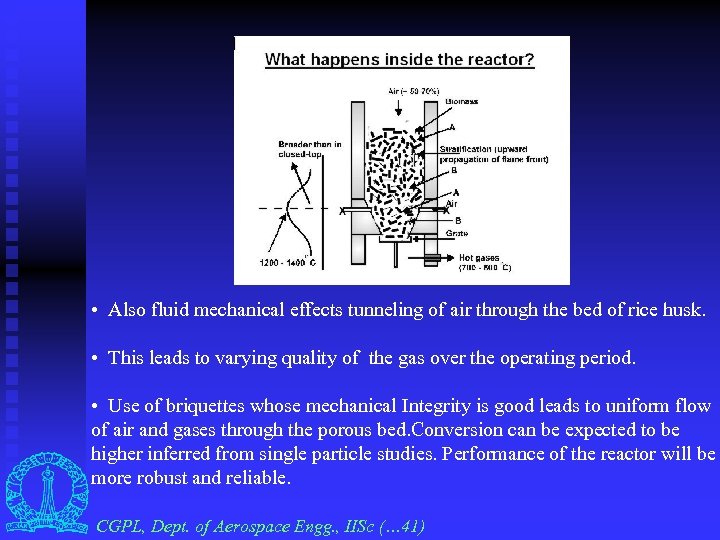
• Also fluid mechanical effects tunneling of air through the bed of rice husk. • This leads to varying quality of the gas over the operating period. • Use of briquettes whose mechanical Integrity is good leads to uniform flow of air and gases through the porous bed. Conversion can be expected to be higher inferred from single particle studies. Performance of the reactor will be more robust and reliable. CGPL, Dept. of Aerospace Engg. , IISc (… 41)
CGPL, Dept. of Aerospace Engg. , IISc (… 42)
CGPL, Dept. of Aerospace Engg. , IISc (… 43)
CGPL, Dept. of Aerospace Engg. , IISc (… 44)
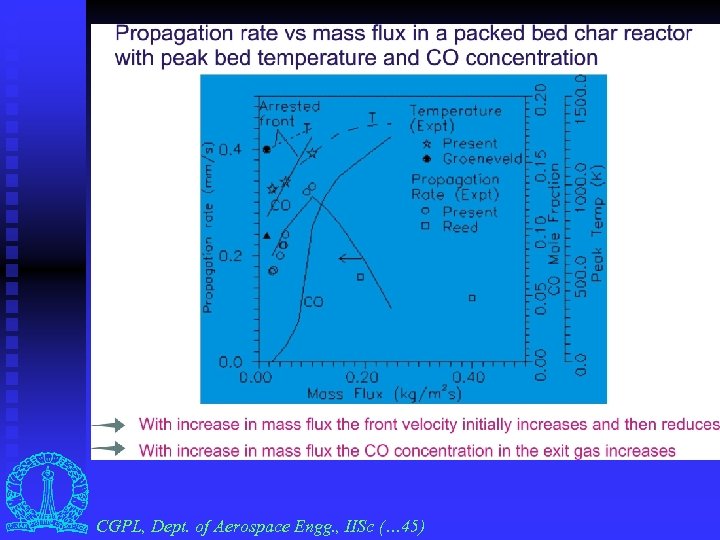
CGPL, Dept. of Aerospace Engg. , IISc (… 45)
Producer gas Combustion features for engine applications
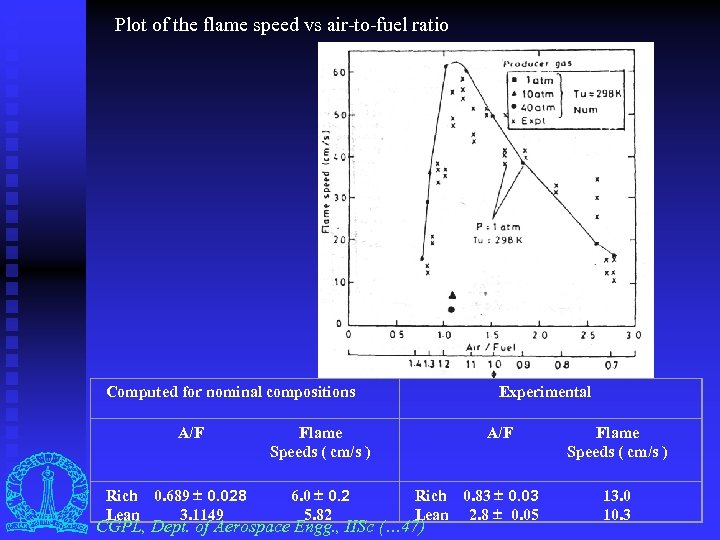
Plot of the flame speed vs air-to-fuel ratio Computed for nominal compositions Experimental A/F Flame Speeds ( cm/s ) A/F Flame Speeds ( cm/s ) Rich 0. 689 0. 028 6. 0 0. 2 Lean 3. 1149 5. 82 Rich 0. 83 0. 03 13. 0 Lean 2. 8 0. 05 10. 3 CGPL, Dept. of Aerospace Engg. , IISc (… 47)
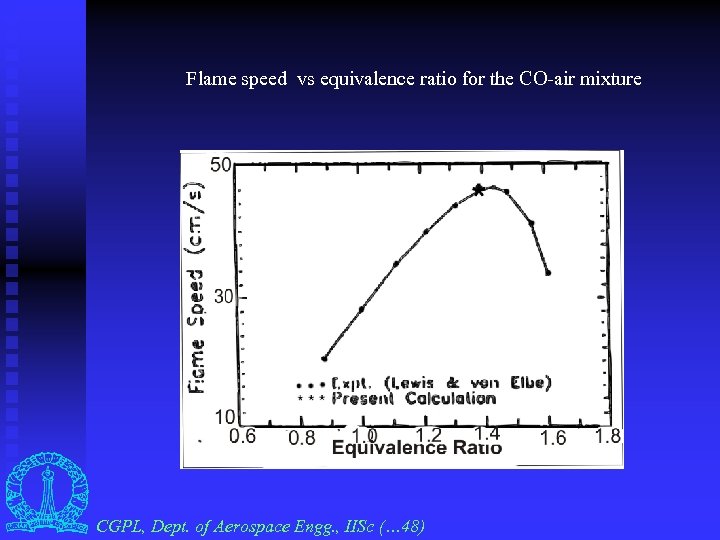
Flame speed vs equivalence ratio for the CO-air mixture CGPL, Dept. of Aerospace Engg. , IISc (… 48)
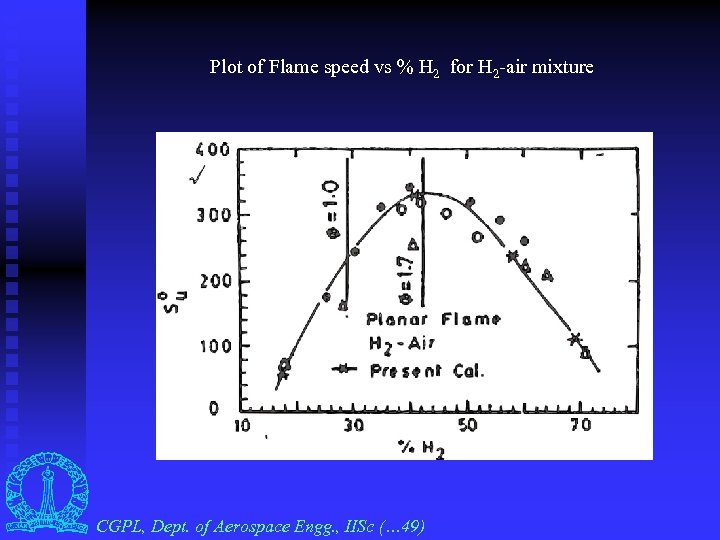
Plot of Flame speed vs % H 2 for H 2 -air mixture CGPL, Dept. of Aerospace Engg. , IISc (… 49)
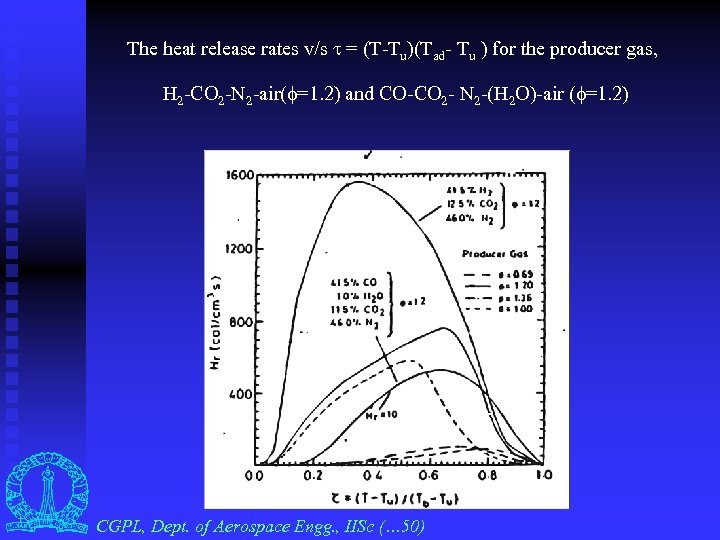
The heat release rates v/s = (T-Tu)(Tad- Tu ) for the producer gas, H 2 -CO 2 -N 2 -air( =1. 2) and CO-CO 2 - N 2 -(H 2 O)-air ( =1. 2) CGPL, Dept. of Aerospace Engg. , IISc (… 50)
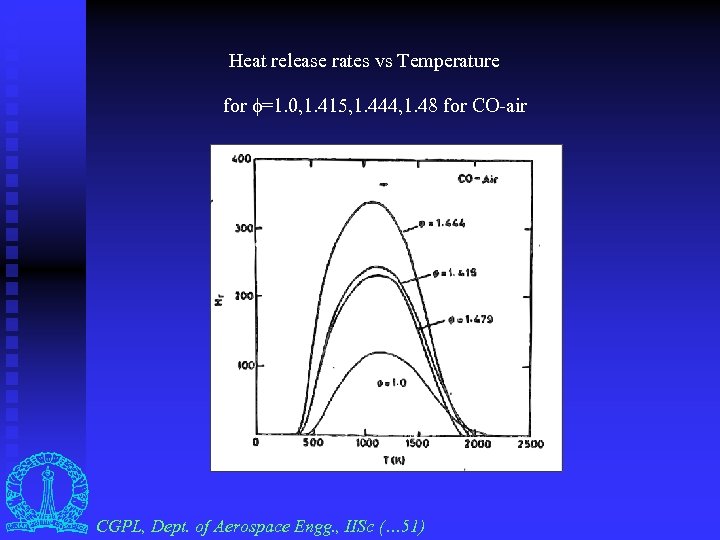
Heat release rates vs Temperature for =1. 0, 1. 415, 1. 444, 1. 48 for CO-air CGPL, Dept. of Aerospace Engg. , IISc (… 51)
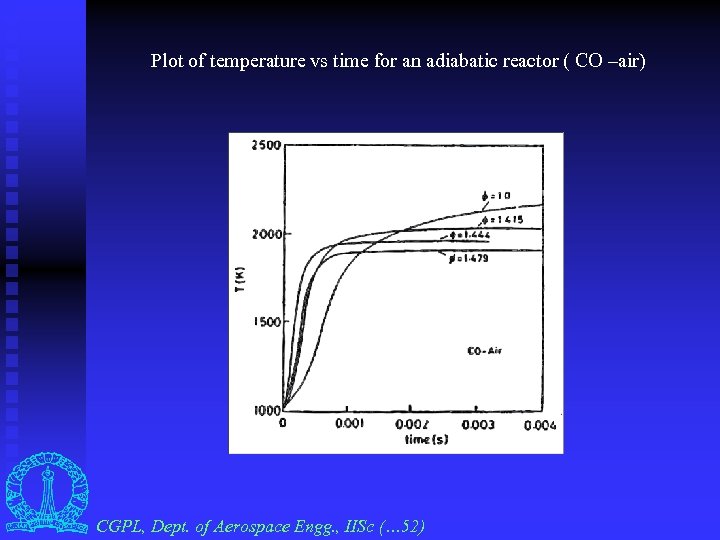
Plot of temperature vs time for an adiabatic reactor ( CO –air) CGPL, Dept. of Aerospace Engg. , IISc (… 52)
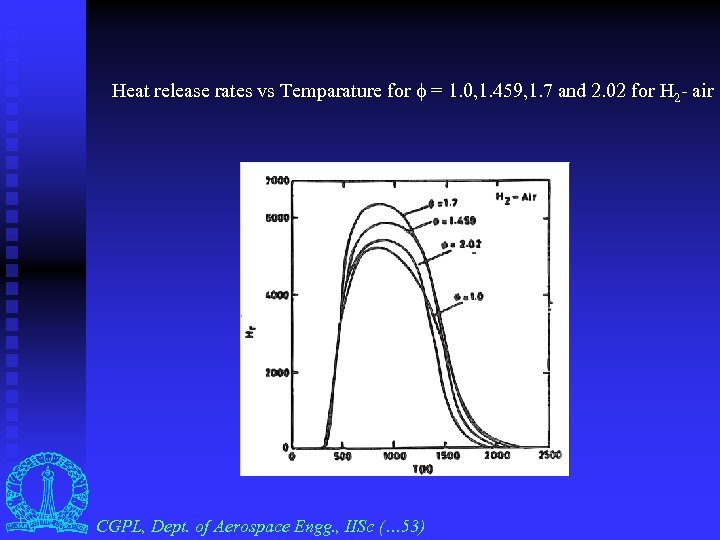
Heat release rates vs Temparature for = 1. 0, 1. 459, 1. 7 and 2. 02 for H 2 - air CGPL, Dept. of Aerospace Engg. , IISc (… 53)
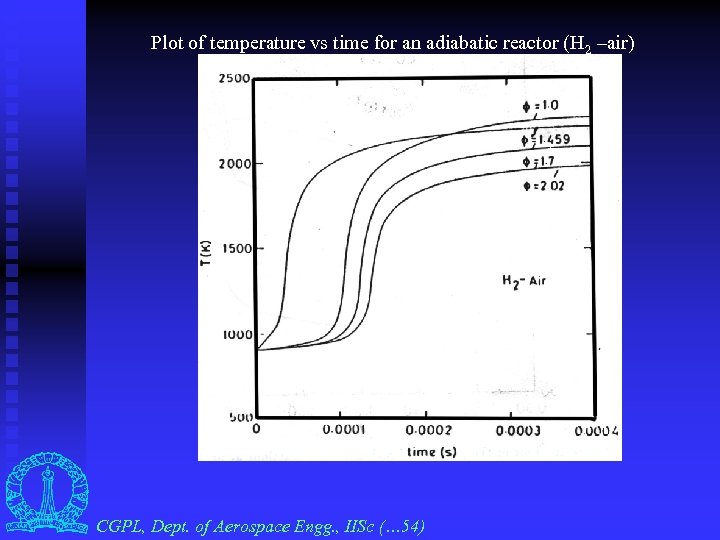
Plot of temperature vs time for an adiabatic reactor (H 2 –air) CGPL, Dept. of Aerospace Engg. , IISc (… 54)
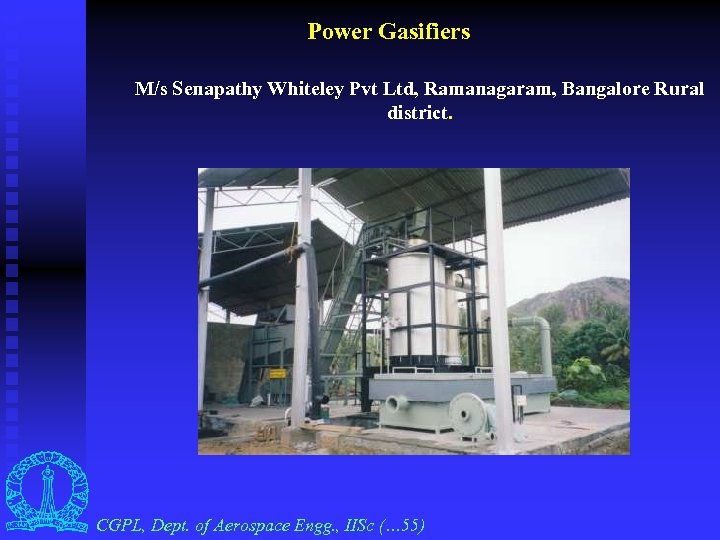
Power Gasifiers M/s Senapathy Whiteley Pvt Ltd, Ramanagaram, Bangalore Rural district. CGPL, Dept. of Aerospace Engg. , IISc (… 55)
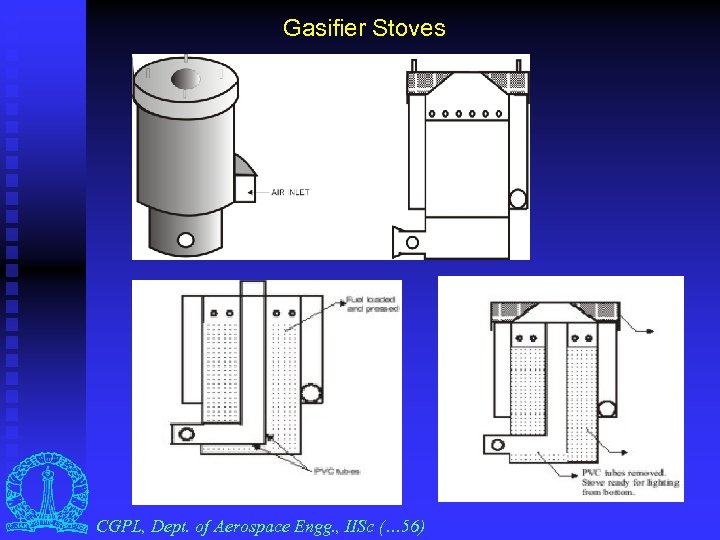
Gasifier Stoves CGPL, Dept. of Aerospace Engg. , IISc (… 56)
In this presentation, we have seen: Ø Background on biofuels and their importance Ø Single particle combustion and inferences for gasification Ø Flame propagation in particle beds Ø Producer gas – Combustion features for engine applications Ø Power Gasifiers and Gasifier Stoves Thank You
Скачать презентацию Combustion science in aid of conversion of lignaceous
7ffcff49b183bb65cc39d2d88fff2c0f.ppt