 Скачать презентацию Combining the AHRQ Indicator Sets to Assess the
28dcca1eb2ec69462c8b17cc41f71742.ppt
- Количество слайдов: 30



Combining the AHRQ Indicator Sets to Assess the Health of Communities: Powerful information for planning purp Susan Mc. Bride, Ph. D, RN Dallas-Fort Worth Hospital Council Data Initiative DFWHC 2005©
DFWHC Data Initiative DFWHC is a Trade Association for Member Hospitals The Data Initiative is under the Education & Research Foundation in a 501 C 3 not for profit subsidiary to the Council Zero based budget organization Strategic Plan designed by member hospitals Strategic Plan & Budget recommended by the DI Executive Committee and approved by the Board of Directors DFWHC 2005© 2
The Current Value Clean data for internal and external reporting Collaborative data sharing throughout the region to improve the health of the populations served Shared data with over 6 years of data in the data warehouse – 1999 -2004 – Approximately 3, 650, 000 million encounters in the DI warehouse to date – Matched Birth Certificate & Hospital Discharge Data Power in collaboration & partnership! DFWHC 2005© 3
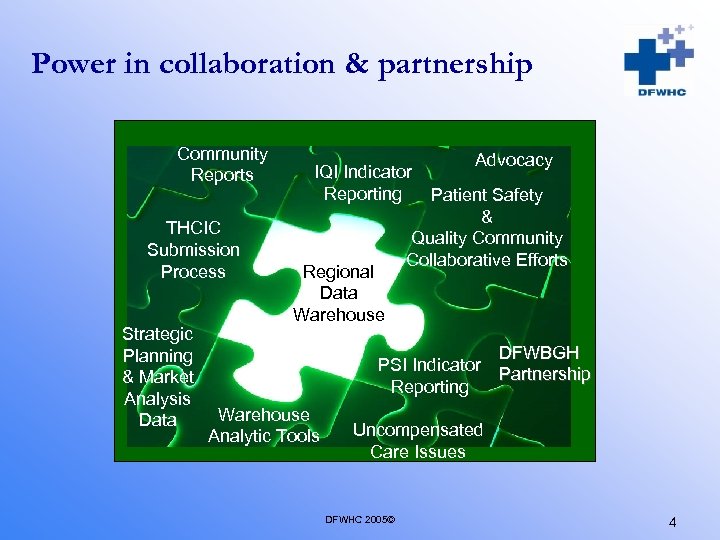
Power in collaboration & partnership Community Reports THCIC Submission Process Strategic Planning & Market Analysis Data IQI Indicator Reporting Regional Data Warehouse Advocacy Patient Safety & Quality Community Collaborative Efforts DFWBGH PSI Indicator Partnership Reporting Warehouse Analytic Tools Uncompensated Care Issues DFWHC 2005© 4
AHRQ Quality Indicators Inpatient Quality Indicators – Utilized statewide for public domain reporting – Utilized regionally in DFW for collaborative efforts on improving patient care and examining inpatient mortality – Interest with local public health officials in using the AHRQ output files for planning purposes Patient Safety Indicators – Utilized regionally in DFW for collaborative efforts on improving patient care & examining patient safety events – Interest with local public health officials in using the AHRQ output files for planning purposes • Comorbidity groupings are of particular interest to the epidemiologists Prevention Quality Indicators – Utilized for the DFW regions Community Health Assessments – Interest from public health departments in utilizing the indicators for assessment, intervention effectiveness and annual reports DFWHC 2005© 5
Improving Patient Care & the Health of the Communities Through Use of the AHRQ Indicators & Collaborative Data Sharing A Few Examples of Practical Applications DFWHC 2005©
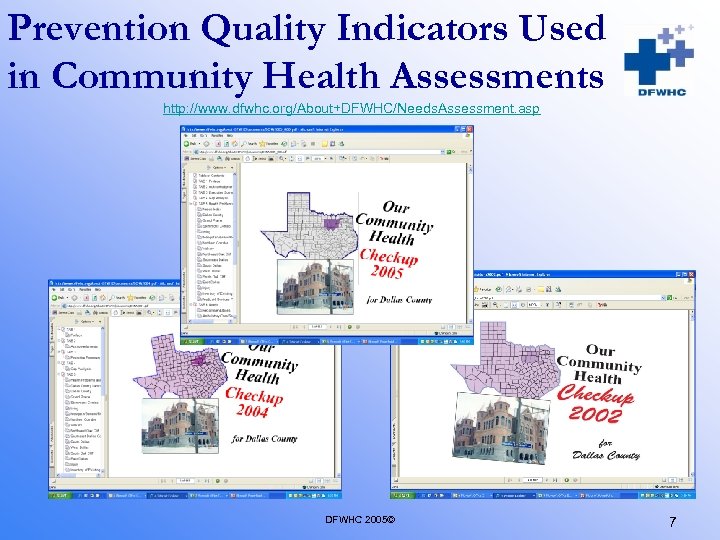
Prevention Quality Indicators Used in Community Health Assessments http: //www. dfwhc. org/About+DFWHC/Needs. Assessment. asp DFWHC 2005© 7
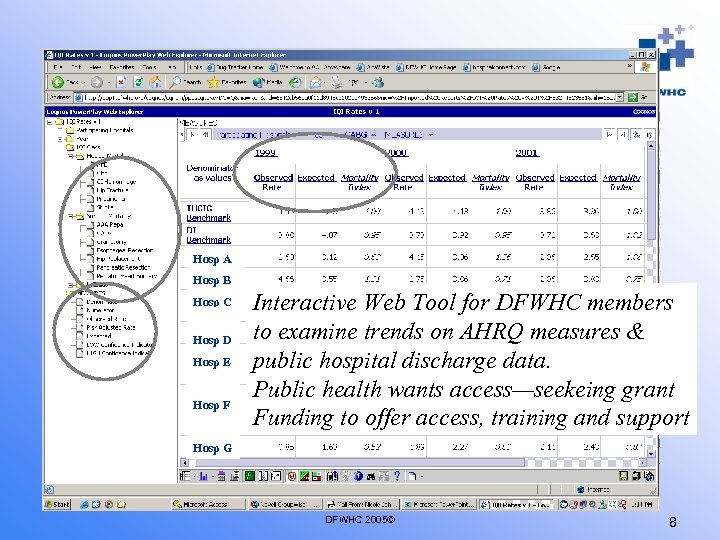
Hosp A Hosp B Hosp C Hosp D Hosp E Hosp F Interactive Web Tool for DFWHC members to examine trends on AHRQ measures & public hospital discharge data. Public health wants access—seekeing grant Funding to offer access, training and support Hosp G DFWHC 2005© 8
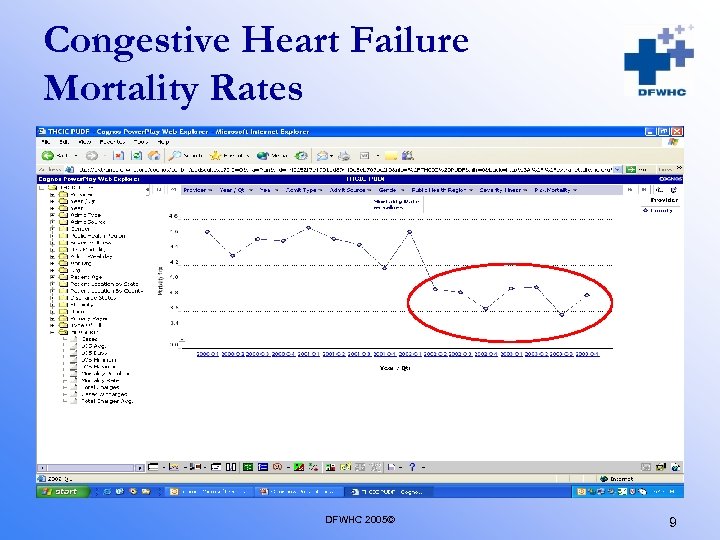
Congestive Heart Failure Mortality Rates DFWHC 2005© 9
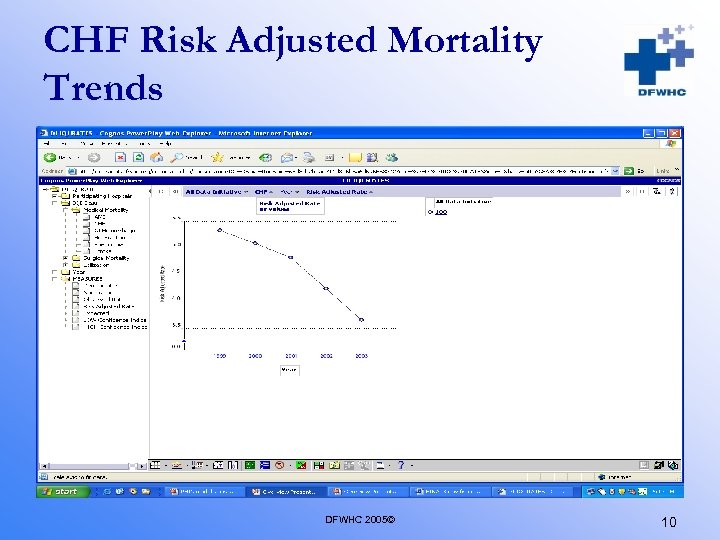
CHF Risk Adjusted Mortality Trends DFWHC 2005© 10
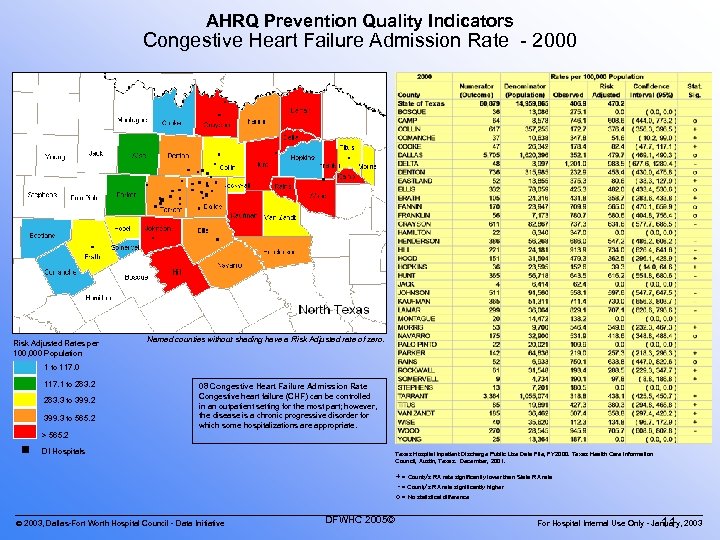
AHRQ Prevention Quality Indicators Congestive Heart Failure Admission Rate - 2000 Risk Adjusted Rates per 100, 000 Population Named counties without shading have a Risk Adjusted rate of zero. 1 to 117. 0 117. 1 to 283. 2 283. 3 to 399. 2 399. 3 to 565. 2 08 Congestive Heart Failure Admission Rate Congestive heart failure (CHF) can be controlled in an outpatient setting for the most part; however, the disease is a chronic progressive disorder for which some hospitalizations are appropriate. > 565. 2 DI Hospitals Texas Hospital Inpatient Discharge Public Use Date File, FY 2000. Texas Health Care Information Council, Austin, Texas. December, 2001. + = County’s RA rate significantly lower than State RA rate - = County’s RA rate significantly higher o = No statistical difference © 2003, Dallas-Fort Worth Hospital Council - Data Initiative DFWHC 2005© 11 For Hospital Internal Use Only - January, 2003
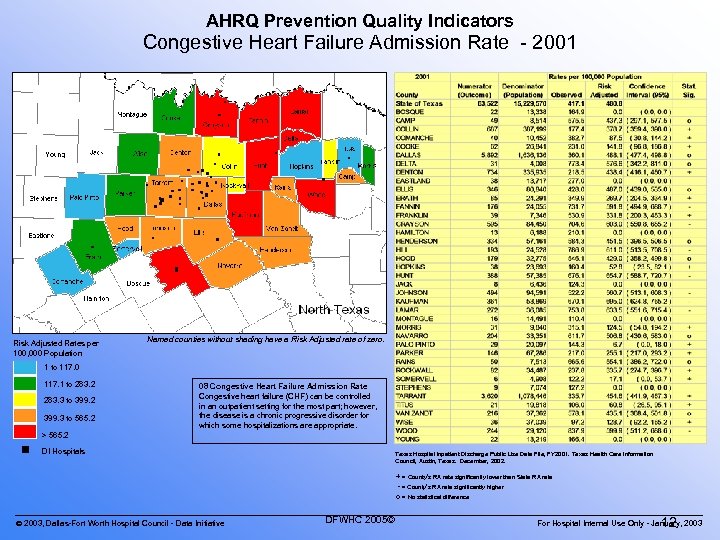
AHRQ Prevention Quality Indicators Congestive Heart Failure Admission Rate - 2001 Risk Adjusted Rates per 100, 000 Population Named counties without shading have a Risk Adjusted rate of zero. 1 to 117. 0 117. 1 to 283. 2 283. 3 to 399. 2 399. 3 to 565. 2 08 Congestive Heart Failure Admission Rate Congestive heart failure (CHF) can be controlled in an outpatient setting for the most part; however, the disease is a chronic progressive disorder for which some hospitalizations are appropriate. > 565. 2 DI Hospitals Texas Hospital Inpatient Discharge Public Use Date File, FY 2001. Texas Health Care Information Council, Austin, Texas. December, 2002. + = County’s RA rate significantly lower than State RA rate - = County’s RA rate significantly higher o = No statistical difference © 2003, Dallas-Fort Worth Hospital Council - Data Initiative DFWHC 2005© 12 For Hospital Internal Use Only - January, 2003
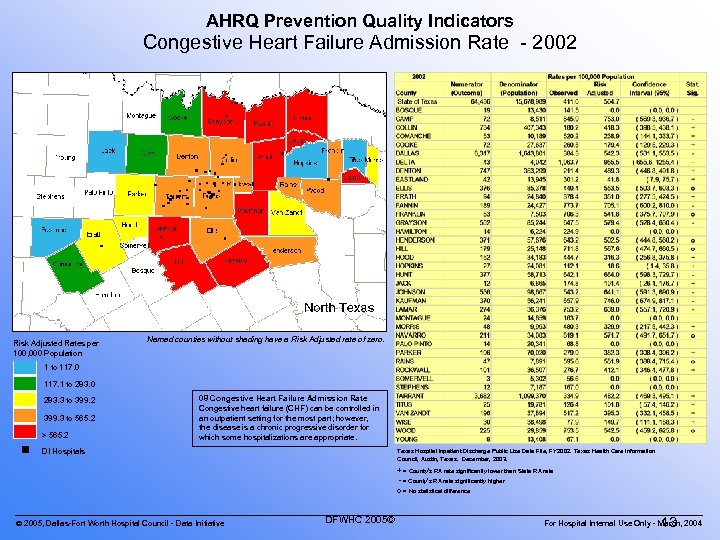
AHRQ Prevention Quality Indicators Congestive Heart Failure Admission Rate - 2002 Risk Adjusted Rates per 100, 000 Population Named counties without shading have a Risk Adjusted rate of zero. 1 to 117. 0 117. 1 to 283. 0 283. 3 to 399. 2 399. 3 to 565. 2 > 565. 2 08 Congestive Heart Failure Admission Rate Congestive heart failure (CHF) can be controlled in an outpatient setting for the most part; however, the disease is a chronic progressive disorder for which some hospitalizations are appropriate. DI Hospitals Texas Hospital Inpatient Discharge Public Use Date File, FY 2002. Texas Health Care Information Council, Austin, Texas. December, 2003. + = County’s RA rate significantly lower than State RA rate - = County’s RA rate significantly higher o = No statistical difference © 2005, Dallas-Fort Worth Hospital Council - Data Initiative DFWHC 2005© 13 For Hospital Internal Use Only - March, 2004
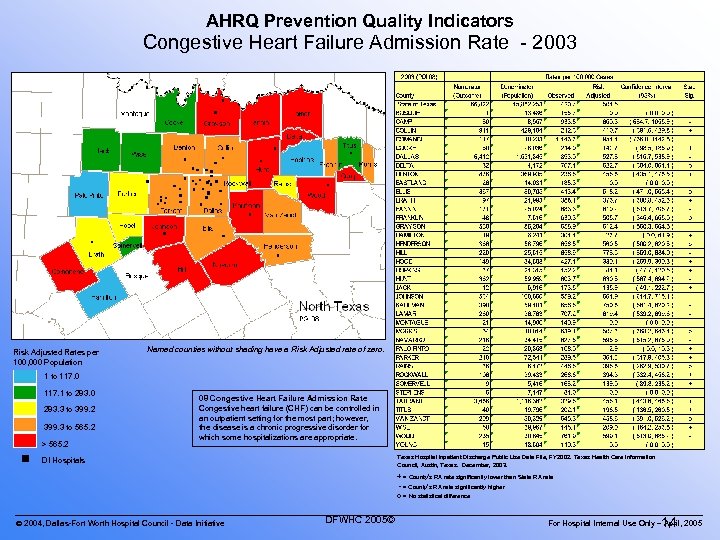
AHRQ Prevention Quality Indicators Congestive Heart Failure Admission Rate - 2003 Risk Adjusted Rates per 100, 000 Population Named counties without shading have a Risk Adjusted rate of zero. 1 to 117. 0 117. 1 to 283. 0 283. 3 to 399. 2 399. 3 to 565. 2 > 565. 2 08 Congestive Heart Failure Admission Rate Congestive heart failure (CHF) can be controlled in an outpatient setting for the most part; however, the disease is a chronic progressive disorder for which some hospitalizations are appropriate. Texas Hospital Inpatient Discharge Public Use Date File, FY 2002. Texas Health Care Information Council, Austin, Texas. December, 2003. DI Hospitals + = County’s RA rate significantly lower than State RA rate - = County’s RA rate significantly higher o = No statistical difference © 2004, Dallas-Fort Worth Hospital Council - Data Initiative DFWHC 2005© 14 For Hospital Internal Use Only – April, 2005
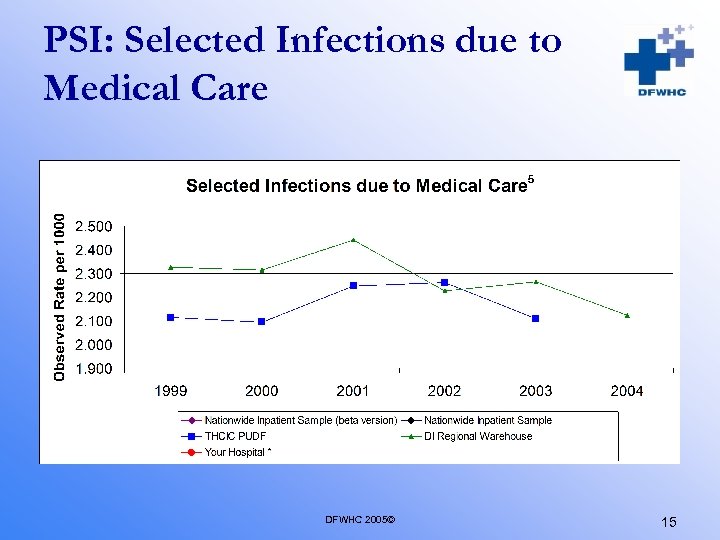
PSI: Selected Infections due to Medical Care DFWHC 2005© 15
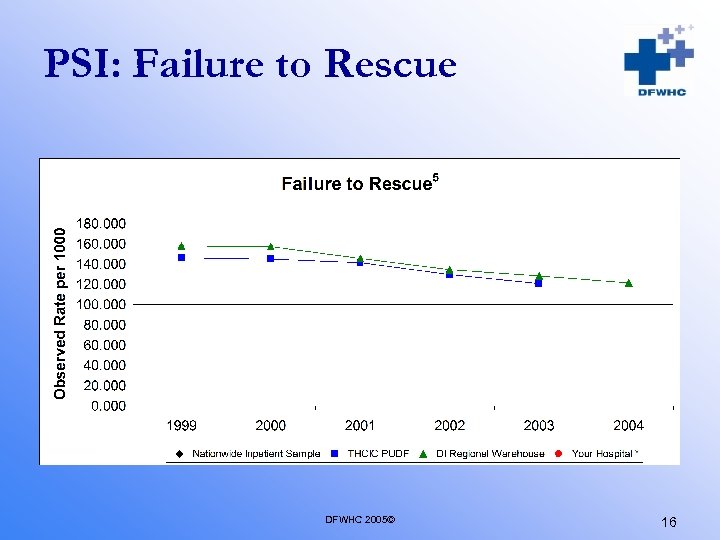
PSI: Failure to Rescue No E Code Dependency DFWHC 2005© 16

New Project Focus: MRSA in North Texas Potential CDC Funding for the Project DFWHC 2005©
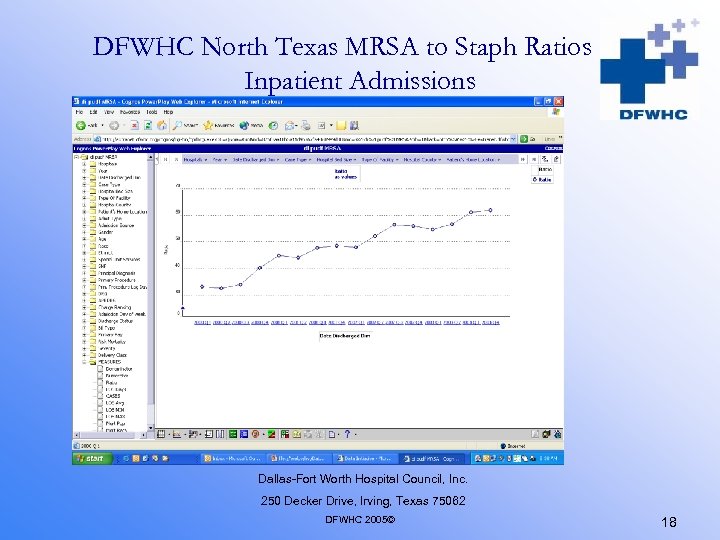
DFWHC North Texas MRSA to Staph Ratios on Inpatient Admissions Dallas-Fort Worth Hospital Council, Inc. 250 Decker Drive, Irving, Texas 75062 DFWHC 2005© 18
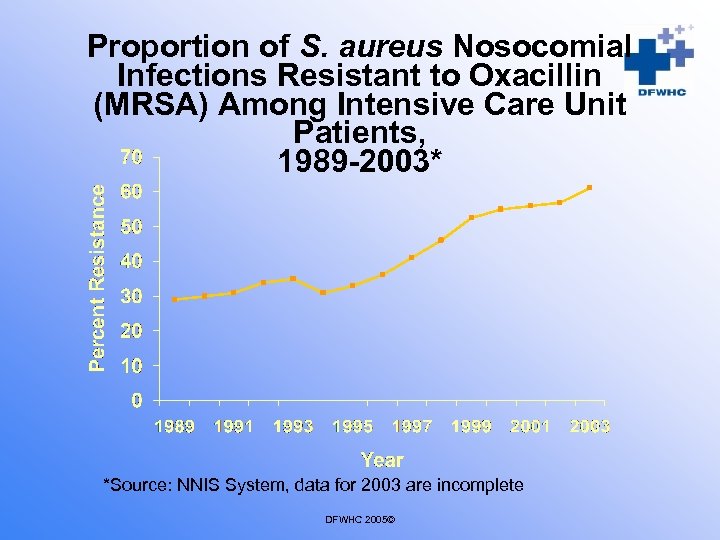
Proportion of S. aureus Nosocomial Infections Resistant to Oxacillin (MRSA) Among Intensive Care Unit Patients, 1989 -2003* *Source: NNIS System, data for 2003 are incomplete DFWHC 2005©

Geo-map Trending of the MRSA Infections in Hospital Discharge Data Dallas-Fort Worth Hospital Council, Inc. 250 Decker Drive, Irving, Texas 75062 DFWHC 2005©
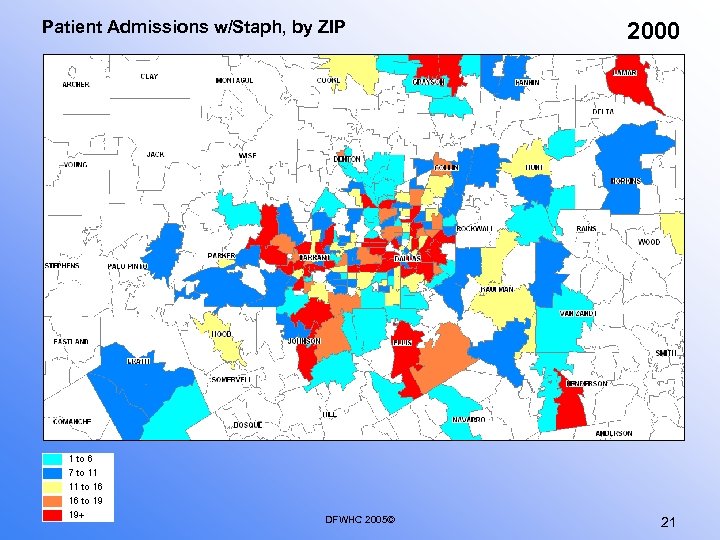
Patient Admissions w/Staph, by ZIP DFWHC 2005© 2000 21
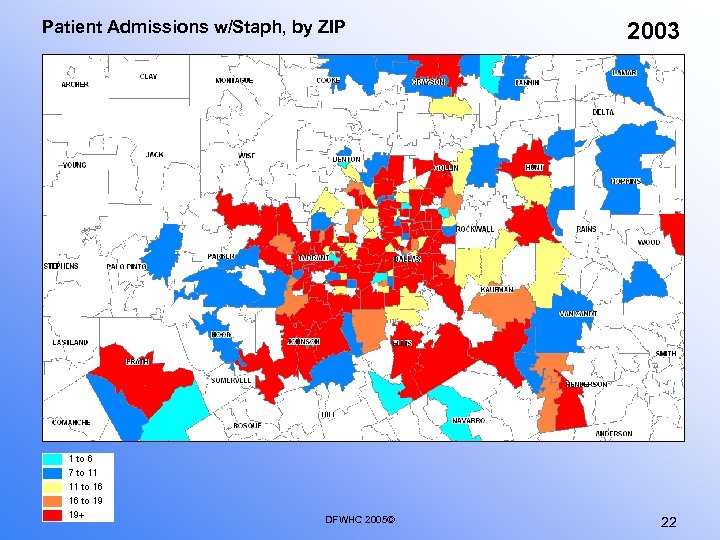
Patient Admissions w/Staph, by ZIP DFWHC 2005© 2003 22
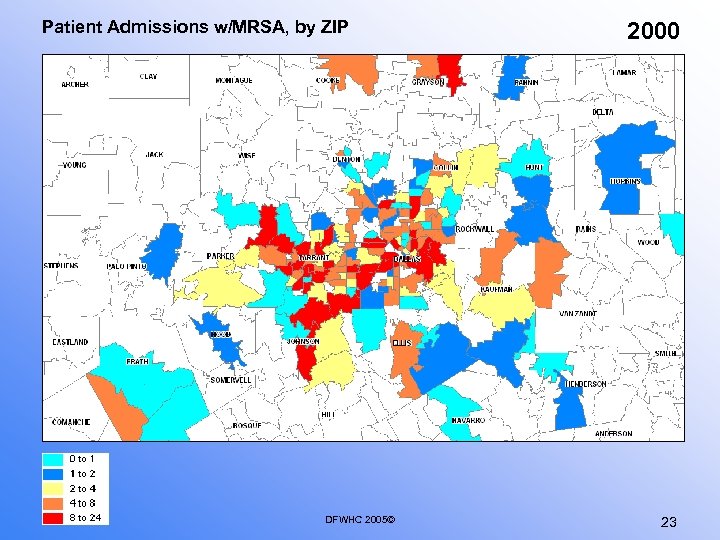
Patient Admissions w/MRSA, by ZIP DFWHC 2005© 2000 23
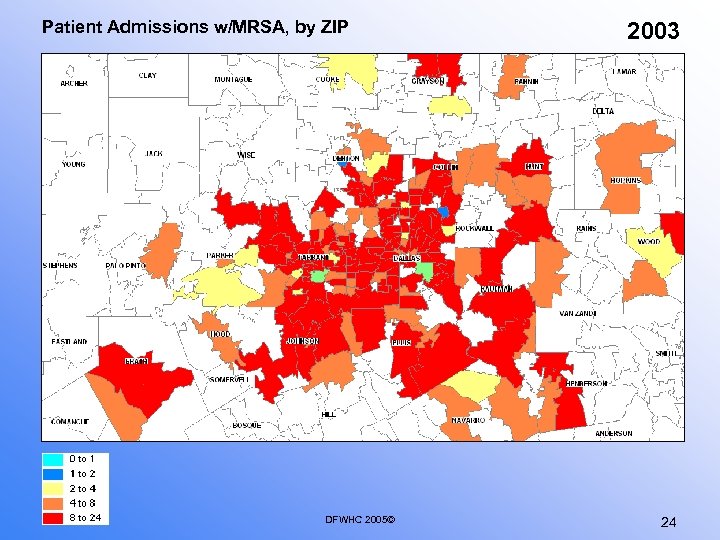
Patient Admissions w/MRSA, by ZIP DFWHC 2005© 2003 24
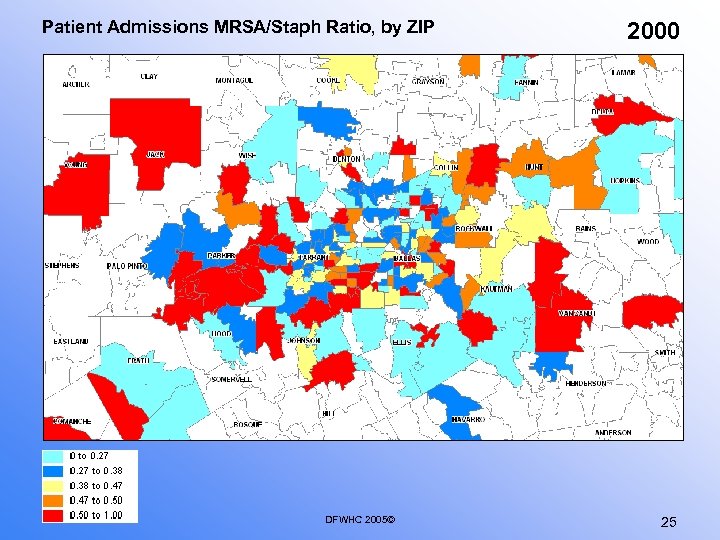
Patient Admissions MRSA/Staph Ratio, by ZIP DFWHC 2005© 2000 25
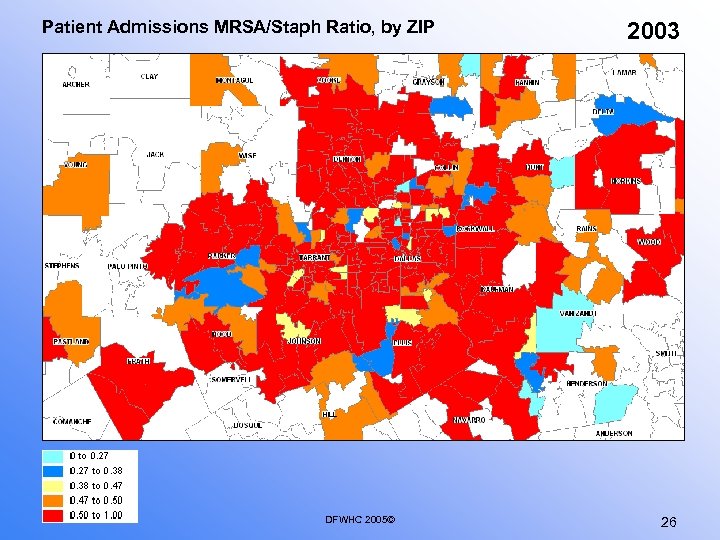
Patient Admissions MRSA/Staph Ratio, by ZIP DFWHC 2005© 2003 26
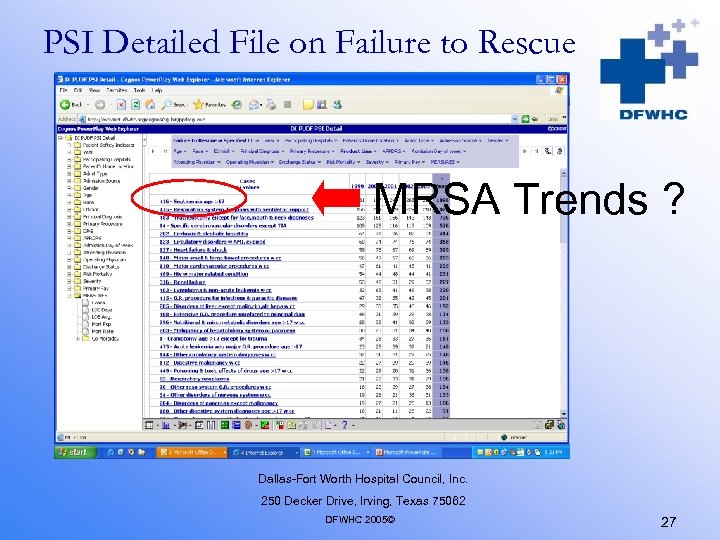
PSI Detailed File on Failure to Rescue MRSA Trends ? Dallas-Fort Worth Hospital Council, Inc. 250 Decker Drive, Irving, Texas 75062 DFWHC 2005© 27
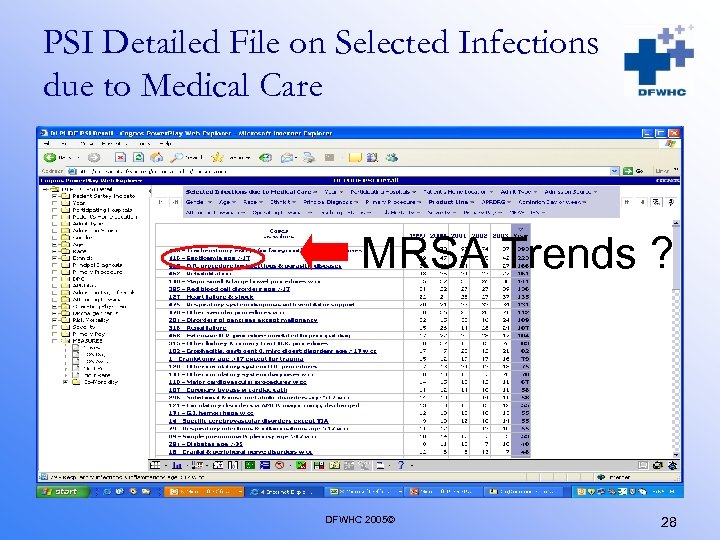
PSI Detailed File on Selected Infections due to Medical Care MRSA Trends ? DFWHC 2005© 28
Next Steps for the region Use the indicators at the regional level to examine overall performance and health trends Partner with Dept of State Health Services, Local Public Health and Schools of Public Health to better utilize the measures to improve the health of the populations served Find funding to distribute data sharing capability to public health and the state Pursue ambulatory data project Support Texas efforts for public reporting of hospital infection rates such that the state generates value for consumers and providers Develop community interventions to address health concerns – MRSA trends – Indigent care access to care & funding issues DFWHC 2005© 29
Discussion and Questions Susan Mc. Bride, Ph. D, RN Vice President of Data Initiative 972 -719 -4900 smcbride@dfwhc. org www. dfwhc. org DFWHC 2005© 30
Скачать презентацию Combining the AHRQ Indicator Sets to Assess the
28dcca1eb2ec69462c8b17cc41f71742.ppt