 Скачать презентацию Combining Behavior and Academic Instructional Support to Improve
2671a986dacbf5ae28d198f999954de8.ppt
- Количество слайдов: 70



Combining Behavior and Academic Instructional Support to Improve English Learners Reading Outcomes Jorge Preciado University of Oregon 1
Overview l Applied Behavior Analysis/Behavior Management Principles l Function-based Behavior Support l Instructional Design Variables l Reading Acquisition 2
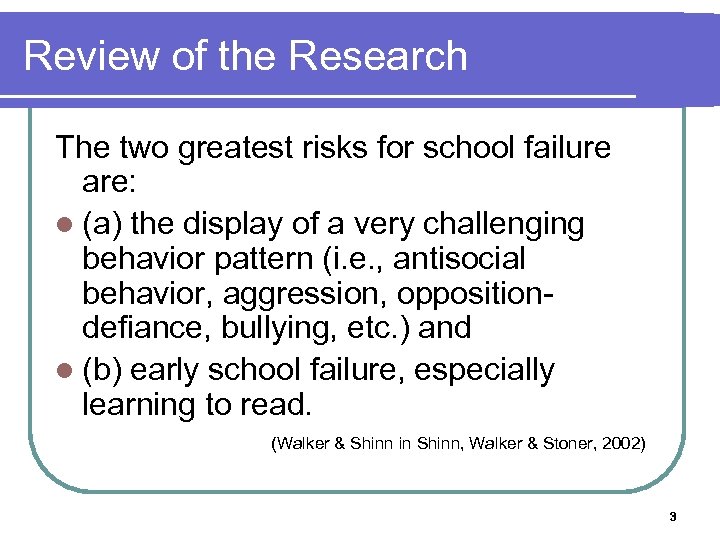
Review of the Research The two greatest risks for school failure are: l (a) the display of a very challenging behavior pattern (i. e. , antisocial behavior, aggression, oppositiondefiance, bullying, etc. ) and l (b) early school failure, especially learning to read. (Walker & Shinn in Shinn, Walker & Stoner, 2002) 3
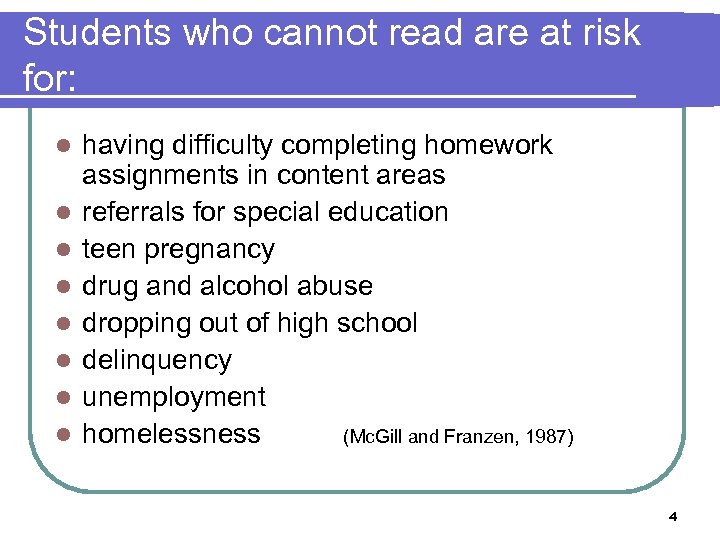
Students who cannot read are at risk for: l l l l having difficulty completing homework assignments in content areas referrals for special education teen pregnancy drug and alcohol abuse dropping out of high school delinquency unemployment homelessness (Mc. Gill and Franzen, 1987) 4
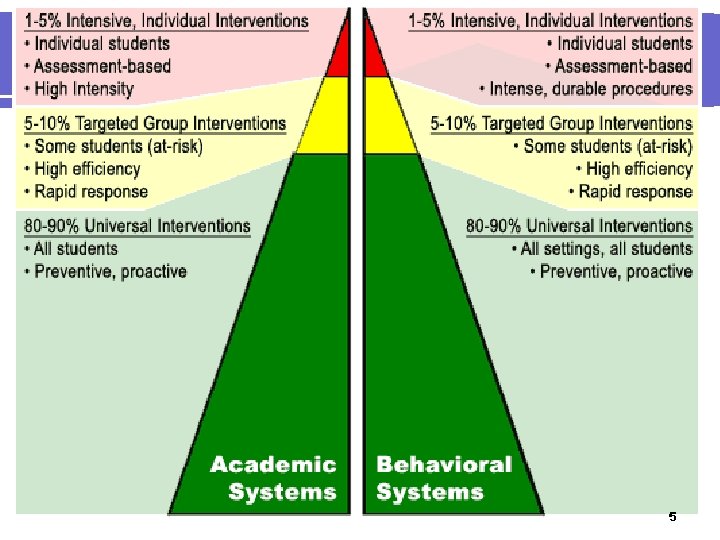
5
Three key elements l Classroom Behavior Principles/Function-based Behavior Support l l l Instructional Design Variables l l Positive behavior support – establishing conditions where behaviors are explicitly taught and reinforced to improve prosocial behavior Behavior support is most effective when designed based on the function of a student’s behavior Correct academic placement Teaching explicitly Providing multiple opportunities to respond Reading Acquisition l Blending, Fluency, Vocabulary, and Comprehension Strategies 6
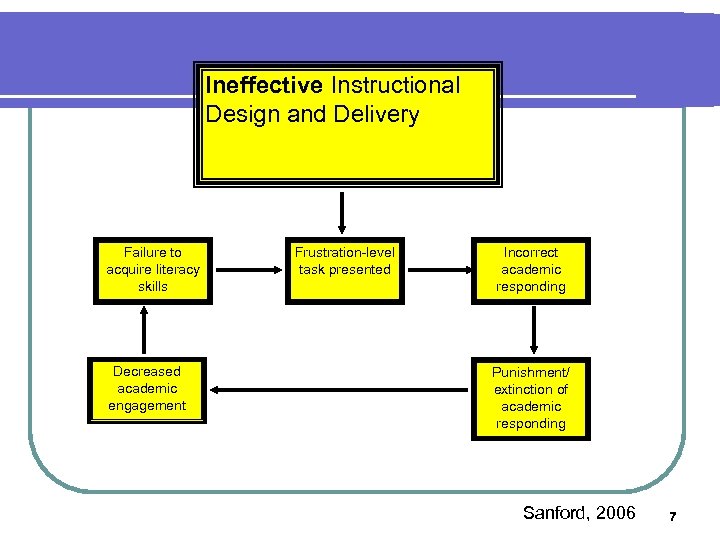
Ineffective Instructional Design and Delivery Failure to acquire literacy skills Decreased academic engagement Frustration-level task presented Incorrect academic responding Punishment/ extinction of academic responding Sanford, 2006 7
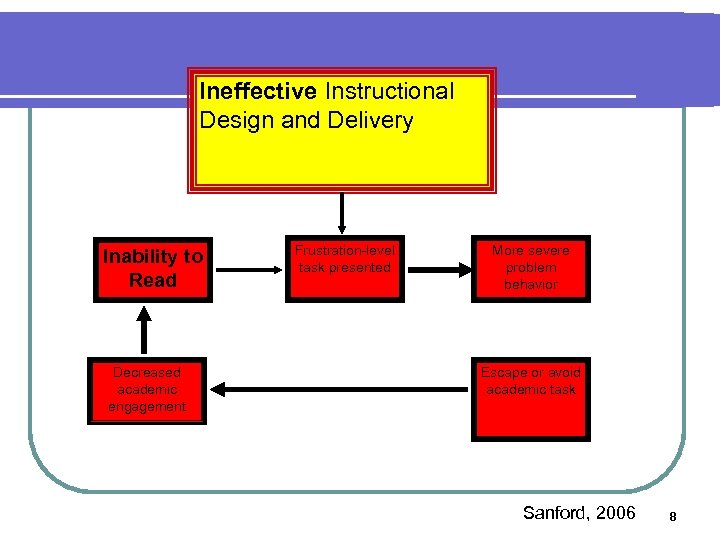
Ineffective Instructional Design and Delivery Inability to Read Decreased academic engagement Frustration-level task presented More severe problem behavior Escape or avoid academic task Sanford, 2006 8
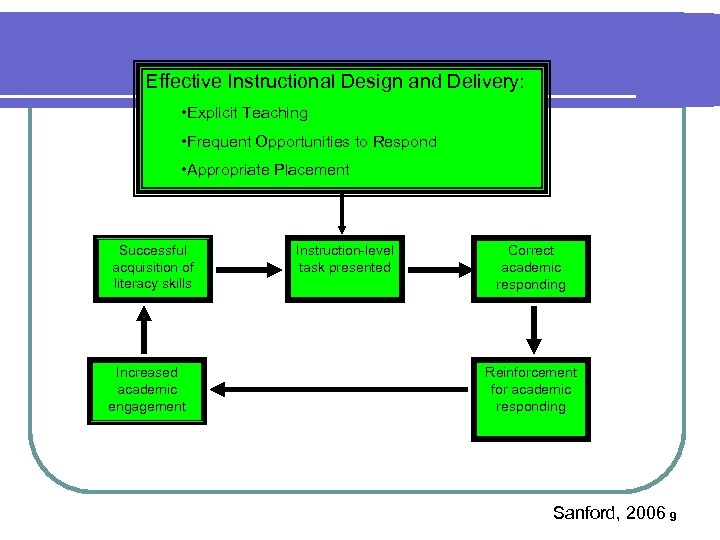
Effective Instructional Design and Delivery: • Explicit Teaching • Frequent Opportunities to Respond • Appropriate Placement Successful acquisition of literacy skills Increased academic engagement Instruction-level task presented Correct academic responding Reinforcement for academic responding Sanford, 2006 9
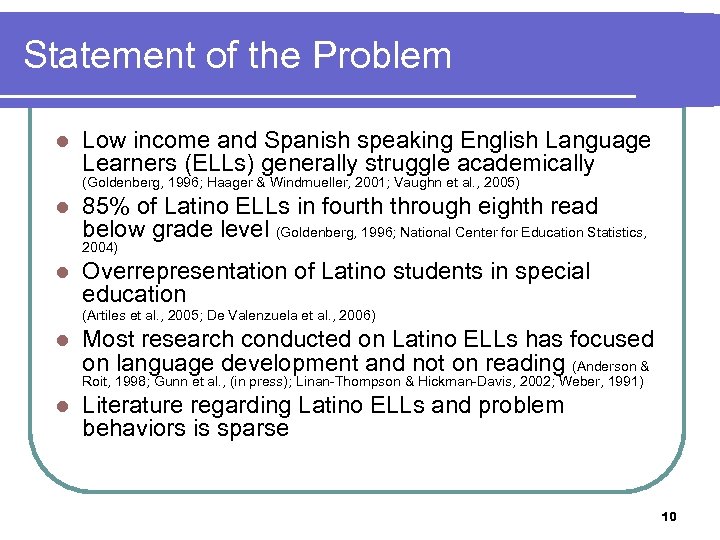
Statement of the Problem l Low income and Spanish speaking English Language Learners (ELLs) generally struggle academically (Goldenberg, 1996; Haager & Windmueller, 2001; Vaughn et al. , 2005) l 85% of Latino ELLs in fourth through eighth read below grade level (Goldenberg, 1996; National Center for Education Statistics, 2004) l Overrepresentation of Latino students in special education (Artiles et al. , 2005; De Valenzuela et al. , 2006) l Most research conducted on Latino ELLs has focused on language development and not on reading (Anderson & Roit, 1998; Gunn et al. , (in press); Linan-Thompson & Hickman-Davis, 2002; Weber, 1991) l Literature regarding Latino ELLs and problem behaviors is sparse 10
Continued l If problem behaviors are related to escape or avoidance of grade level academic tasks, a negative reinforcement condition could be established. l How? 11
How these word are used in this context: l “Negative” means that something is taken away. l “Reinforcement” means the behavior is more likely to happen again. 12
What is “negative reinforcement? ” l. A consequence that makes a particular behavior more likely to happen again because the person avoids something aversive or unpleasant. 13
Scenario l Ms. Kerns thought an easy way to get students to quit arguing about assignments would be to let the students who argued skip some of the questions or have more time to do assignments. l However, over the next few weeks, that actually lead to more students coming up with arguments about assignments more often. 14
Scenario l Juan is in the first grade. Juan dislikes reading because he is a poor reader. During reading class, Juan hits his peers whenever his teacher Mr. Suarez asks him to read a passage. Immediately, Mr. Suarez sends Juan to the principal office for fighting. 15
Scenario l Esteban is in the second grade and he is reading below grade level. Esteban likes to sing songs in class and talk to his peers during reading class. Ms. Rivera scolds Esteban and then sends him to the back of the room to work. Esteban puts his head down and does not bother his peers for the rest of the period. 16
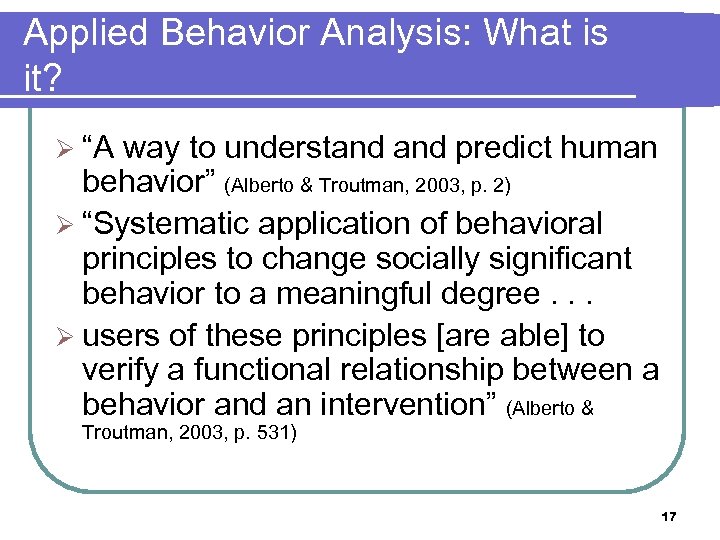
Applied Behavior Analysis: What is it? Ø “A way to understand predict human behavior” (Alberto & Troutman, 2003, p. 2) Ø “Systematic application of behavioral principles to change socially significant behavior to a meaningful degree. . . Ø users of these principles [are able] to verify a functional relationship between a behavior and an intervention” (Alberto & Troutman, 2003, p. 531) 17
Can Applied Behavior Analysis Help? Ø “Applied behavior analysis. . . is probably the most widely used process for addressing a variety of learning and behavior problems. Ø There is no doubt that more data are available to support behaviorally based interventions for ameliorating behavior problems than for all other models combined” (Jackson & Panyan, 2002, p. 30). 18
How Can We Help Mr. Suarez? Conventional wisdom is to get tough on the student as this will make Juan comply. l If problem behavior is caused by escape of task, conventional wisdom will backfire, escalate the problem, and create animosity between Juan and Mr. Suarez (Mc. Intosh, Chard, Boland, & Horner, 2006: Patterson, 1982: Preciado et al. , 2009; Sanford, 2006). l 19
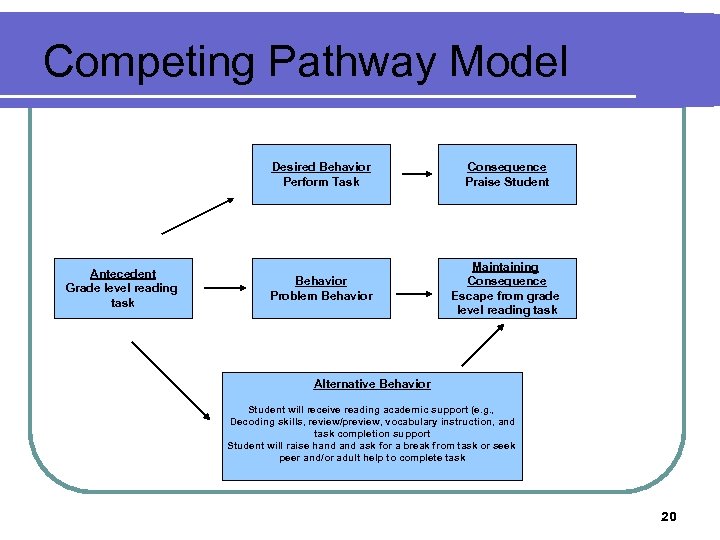
Competing Pathway Model Desired Behavior Perform Task Antecedent Grade level reading task Consequence Praise Student Behavior Problem Behavior Maintaining Consequence Escape from grade level reading task Alternative Behavior Student will receive reading academic support (e. g. , Decoding skills, review/preview, vocabulary instruction, and task completion support Student will raise hand ask for a break from task or seek peer and/or adult help to complete task 20
Function-Based Behavior Support l Four ways to quantify behaviors: l A) Escape l B) Attention l C) Access to a tangible l D) Self-reinforcement 21
ABC’s of Problem Behavior l Antecedent l Behavior l Consequences 22
Antecedent l “The circumstances that exist in the environment before a behavior is exhibited” (Maag, 2004, p. 402) l Here are some examples of antecedents for common behaviors that you can probably guess: Phone ringing l Teacher asks a question in class l Billy calls Tara a name that is an ethnic slur l 23
Behavior l “What individuals do – their observable actions. . . can be verbal or nonverbal. . l [In classrooms] includes actions students undertake to indicate they have [gained] knowledge” (Maag, 2004, p. 403). 24
Consequences l “Circumstances that change the environment shortly after a behavior is displayed and that affect the future performance of the behavior by serving to increase, decrease, or maintain it” (Maag, 2004, p. 405) 25
Alternative Behavior l In order for students to attain a more socially appropriate behavior, students need an alternative behavior that serves the same function as the problem behavior. l What do you mean by same function? 26
Hypothesis Statement l Determine (hypothesis statement) which of the four behavioral functions does the student exhibit. l Conduct Competing Pathway Model. l Remember to make the problem behavior irrelevant, inefficient, and ineffective. 27
Start with Antecedent How can we manipulate the antecedent to make the problem behavior irrelevant? l Problem Behavior: Julio makes noises during independent reading time. l Hypothesis Statement: Attention l Antecedent Manipulation: Speak to Julio ahead of time and discuss possibility of Julio orally sharing an event with the class. This will allow Julio access to peer attention. l 28
Behavior l Make the problem behavior inefficient! l Access to attention is easier to obtain than engaging in problem behavior. l Julio gets up in front of class and shares that he will go to his cousins house over the weekend to celebrate his birthday. 29
Consequence l Make the problem behavior ineffective! l Provide Alternative Behavior to support student with behavior problems during independent reading time. l Alternative behavior must be the same function as the problem behavior. 30
Scenario l Juan is in the first grade. Juan dislikes reading because he is a poor reader. During reading class, Juan hits his peers whenever his teacher Mr. Suarez asks him to read a passage. Immediately, Mr. Suarez sends Juan to the principals office for fighting. l Antecedents, behavior, consequences? 31
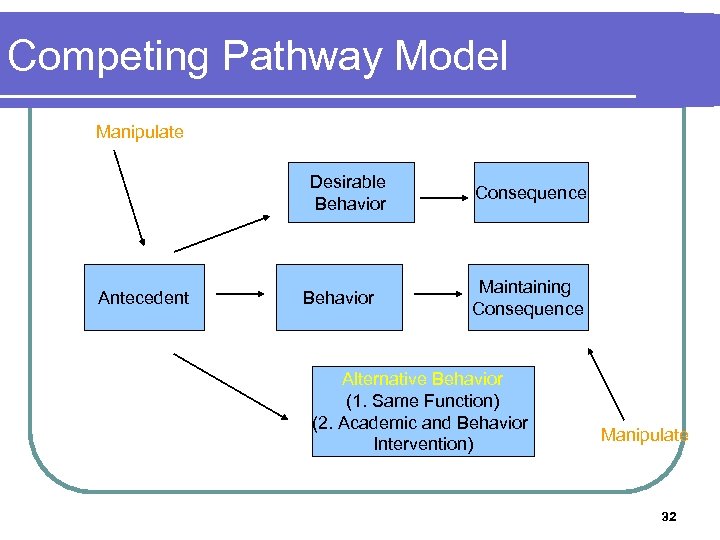
Competing Pathway Model Manipulate Desirable Behavior Antecedent Behavior Consequence Maintaining Consequence Alternative Behavior (1. Same Function) (2. Academic and Behavior Intervention) Manipulate 32
Let’s Practice l Look at the scenario and provide a competing pathway model. l Let’s review l Think of one of your students and conduct a competing pathway model. 33
Teach Social Skills Everyday l Teach expectations and routines explicitly, systematically, and directly l Teach maintenance and generalization l Reinforce appropriate behavior l Be consistent l Provide opportunities to practice appropriate behaviors/Role Play l Provide constructive feedback 34
Expectations and Routines Expectations are rules (e. g. , Be safe, Be Responsible, Be Respectful) l Routines are procedures that occur in classrooms (e. g. , passing out paper, lining up, sitting at the carpet, listening to peers) l We must teach expectations and routines daily (Alberto & Troutman, 2009). l Teaching social skills is the equivalent of teaching the five big ideas in reading! l 35
Continued l Expectations are rules: l Positively state 3 -5 classroom rules l Positively Stated: Be Safe l Negatively Stated: Do not hit your peers. l Avoid terms such as: Do not and/or Never l Routines are behaviors: l Passing out paper, waiting in line 36
Let’s practice l State 3 -5 classroom expectations (rules) that can be positively stated. l Examples: Be Safe, Be Responsible, Be Respectful l Use expectations to teach 3 -5 classroom routines 37
Maintenance and Generalization l Students need to be firm on skills (maintenance). l Students need to incorporate learned skills into new settings (generalization). l Provide scaffolding support in new settings to assure student success! l (Alberto & Troutman, 2009) 38
Instructional Design Variables l Correct academic placement l Teaching explicitly l Providing multiple opportunities to respond 39
Correct Academic Placement l l l Place students at his or her instructional level. Placement testing and progress monitoring. Instructional level-responding with 85% success rate on material. Homogeneous grouping Always think-Acceleration (Why)? How can my students catch up? 40
Continued l l l Flexible grouping Small or large group Good rule of thumb: Less attentive students who need more time in mastering skills, require small group instruction. Selecting Instructional Materials Using templates to make instruction explicit and systematic. 41
Continued l Always teach more of the following: l Phonemic awareness (blending and segmenting) l Letter sounds correspondences l Word reading l Irregular words (introduce several lessons before they appear in stories) l Story reading-accuracy 42
Teaching Explicitly l l l Use Model, Lead, Test. Teach skills so that students can rely on strategies/framework (not memorization). Decrease teacher wording. Avoid vocabulary and sentence structures that are confusing for students. Pre-teach critical vocabulary: Academic language and Tier 2 words. 43
Continued l Introduce one skill at a time. l Provide guided practice. l As students gain skills, teacher formats will decrease in structure. l Present appropriate introductory examples. l Provide discrimination practice. l Sequencing skills. 44
Continued l Teach pre-skills of a strategy. l Introduce high-utility skills before less useful ones. l Introduce easy skills before more difficult ones. l Separate confusing strategies and information. 45
Continued l Introduce new information at a realistic rate. l Provide adequate practice and review. l Think and teach to Mastery! l Develop accuracy and fluency. l Increase practice and feedback when introducing a new skill. l (Carnine et al. , 2006) 46
Let’s Practice l Take one skill (one that you would like feedback) from your core book. l Plan how you would make the skill more explicit. l Incorporate templates into the lesson. l Practice teaching the skill to yourself. l Practice teaching the skill to a peer. 47
Providing Multiple Opportunities to Respond l Monitoring group responses. l Incorporate unison responses. l Watch students eyes and mouths. l Sit low achieving students in the center. l Individual Responses (After students have mastered a skill). 48
Continued l If students make errors during individual turns, teacher needs to provide more practice during unison responses. l Correcting errors (Five Steps). l Model, Lead, Test, Firm up, and Delayed Test. 49
Continued l Teaching to Mastery. l Level of practice determined by skill level of students. l Motivate students (Teacher point game). l Practice skills daily. l Do not introduce new information too quickly. 50
Continued l Diagnosing l As students progress within a reading program, recurring errors may be the result of students not being firm on previously taught skills. l Structure lessons to provide more instruction on particular areas of need. l In other words, re-teach! 51
Continued l l l l Motivate Students Demonstrate to students that they can succeed. High level of reinforcement for good behavior (4 to 1 ratio). Effective management techniques. Praising of desired behavior/Ignoring? (Model and Discussion) (Carnine et al. , 2006) 52
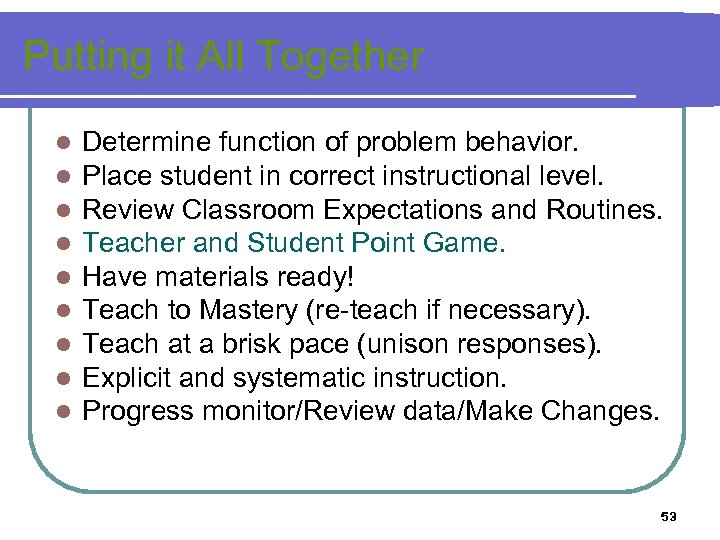
Putting it All Together l l l l l Determine function of problem behavior. Place student in correct instructional level. Review Classroom Expectations and Routines. Teacher and Student Point Game. Have materials ready! Teach to Mastery (re-teach if necessary). Teach at a brisk pace (unison responses). Explicit and systematic instruction. Progress monitor/Review data/Make Changes. 53
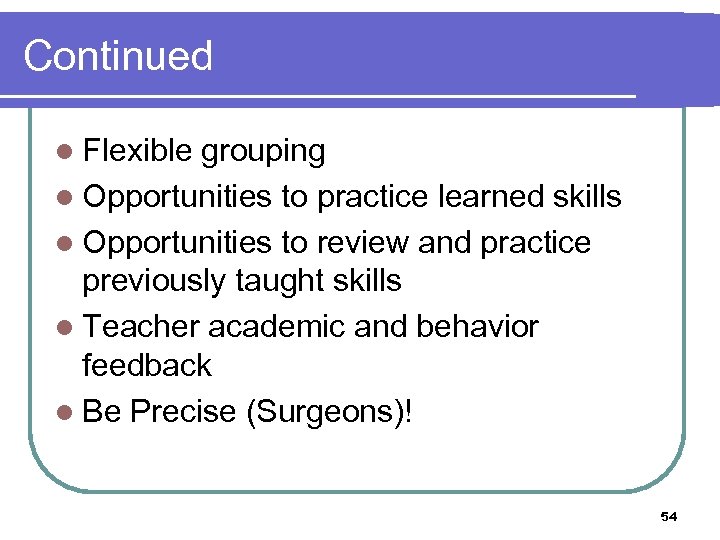
Continued l Flexible grouping l Opportunities to practice learned skills l Opportunities to review and practice previously taught skills l Teacher academic and behavior feedback l Be Precise (Surgeons)! 54
Pair Share l Speak to your partner and provide ideas regarding how to teach instructionally naïve students. l Speak to your partner and provide ideas regarding how to teach students who are ready to move on. l Write ideas on a piece of paper! 55
Reading Acquisition l Blending Strategies (phonemic awareness and alphabetic principle) l Fluency Strategies l Vocabulary l Comprehension 56
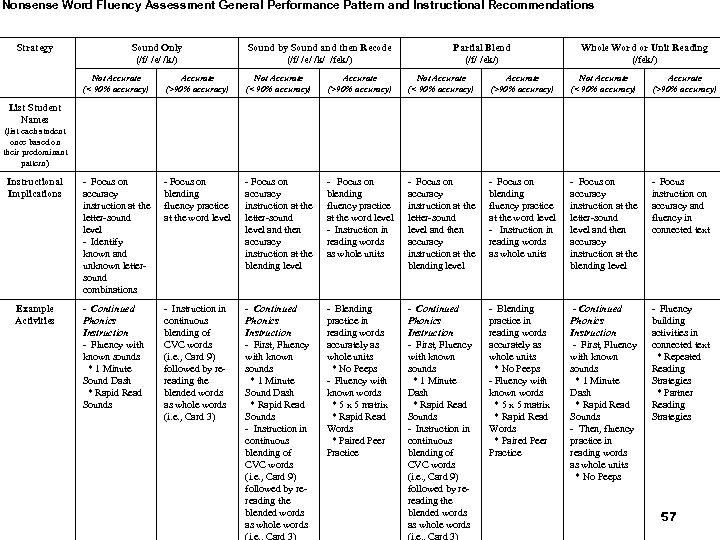
Nonsense Word Fluency Assessment General Performance Pattern and Instructional Recommendations Strategy Sound Only (/f/ /e/ /k/) Sound by Sound and then Recode (/f/ /e/ /k/ /fek/) Partial Blend (/f/ /ek/) Whole Word or Unit Reading (/fek/) Not Accurate (< 90% accuracy) Accurate (>90% accuracy) - Focus on accuracy instruction at the letter-sound level - Identify known and unknown lettersound combinations - Focus on blending fluency practice at the word level - Focus on accuracy instruction at the letter-sound level and then accuracy instruction at the blending level - Focus on blending fluency practice at the word level - Instruction in reading words as whole units - Focus on accuracy instruction at the letter-sound level and then accuracy instruction at the blending level - Focus instruction on accuracy and fluency in connected text - Continued Phonics Instruction - Fluency with known sounds * 1 Minute Sound Dash * Rapid Read Sounds - Instruction in continuous blending of CVC words (i. e. , Card 9) followed by rereading the blended words as whole words (i. e. , Card 3) - Continued Phonics Instruction - First, Fluency with known sounds * 1 Minute Sound Dash * Rapid Read Sounds - Instruction in continuous blending of CVC words (i. e. , Card 9) followed by rereading the blended words as whole words - Blending practice in reading words accurately as whole units * No Peeps - Fluency with known words * 5 x 5 matrix * Rapid Read Words * Paired Peer Practice - Continued Phonics Instruction - First, Fluency with known sounds * 1 Minute Dash * Rapid Read Sounds - Then, fluency practice in reading words as whole units * No Peeps - Fluency building activities in connected text * Repeated Reading Strategies * Partner Reading Strategies List Student Names (list each student once based on their predominant pattern) Instructional Implications Example Activities 57
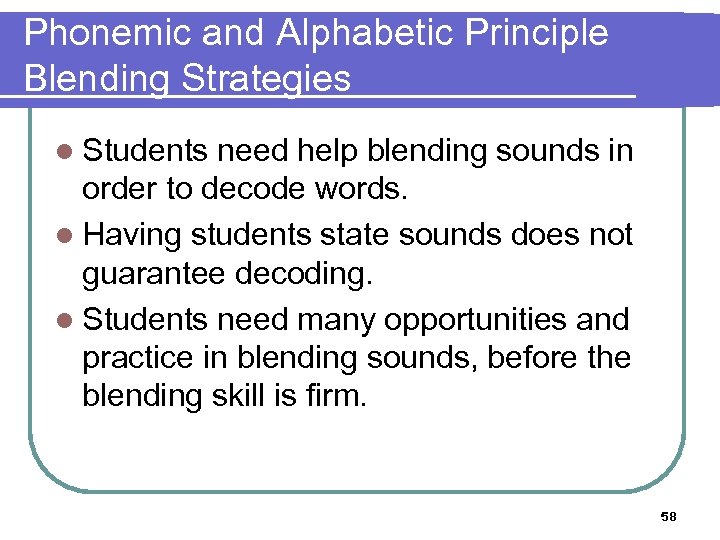
Phonemic and Alphabetic Principle Blending Strategies l Students need help blending sounds in order to decode words. l Having students state sounds does not guarantee decoding. l Students need many opportunities and practice in blending sounds, before the blending skill is firm. 58
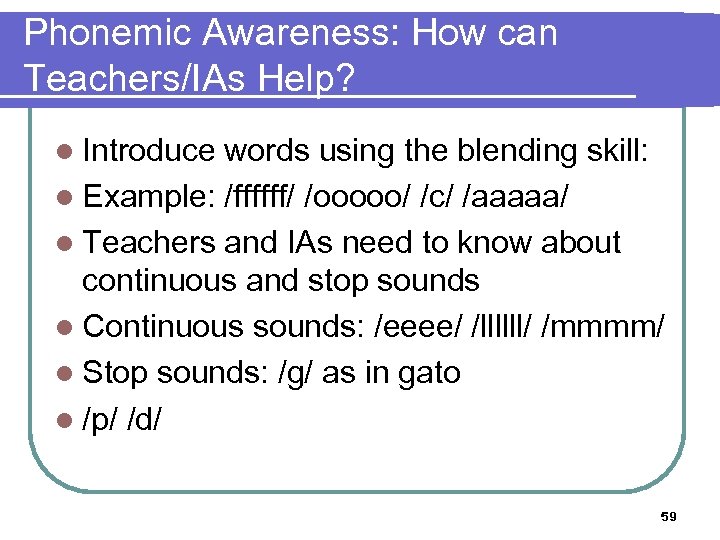
Phonemic Awareness: How can Teachers/IAs Help? l Introduce words using the blending skill: l Example: /ffffff/ /ooooo/ /c/ /aaaaa/ l Teachers and IAs need to know about continuous and stop sounds l Continuous sounds: /eeee/ /llllll/ /mmmm/ l Stop sounds: /g/ as in gato l /p/ /d/ 59
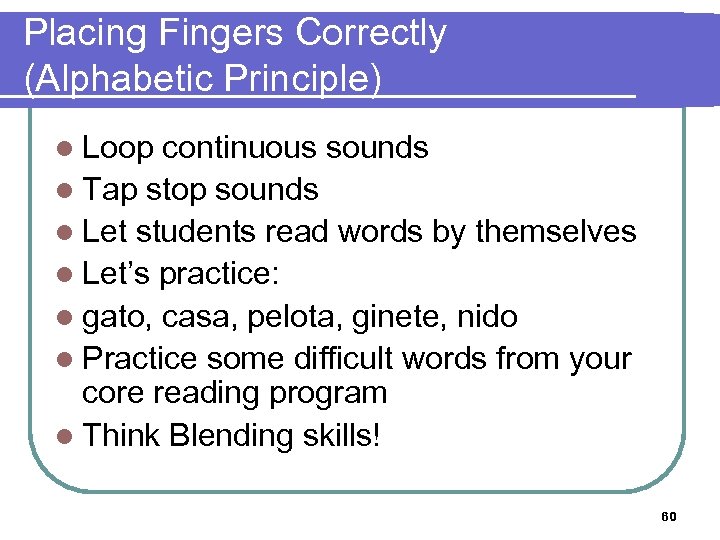
Placing Fingers Correctly (Alphabetic Principle) l Loop continuous sounds l Tap stop sounds l Let students read words by themselves l Let’s practice: l gato, casa, pelota, ginete, nido l Practice some difficult words from your core reading program l Think Blending skills! 60
Why Fluency? Fluency Strategies l Why should students read quickly? l Reading quickly is not comprehending! l Compelling evidence that supports the correlation of fluency and comprehension. l All good readers are fluent readers. 61
Continued l Teachers should provide practice and support: l Fluency l Accuracy l Prosody l How do we do this? 62
Continued l Support fluency and prosody activities. l Provide opportunities for students to be fluent and accurate, while demonstrating prosody. l Small group pair share reading l Pair share reading at desk/carpet l Ask: Who, what , where, why, and next questions. 63
Continued l Graph results l Students need folders to keep graphing sheets l Hot and cold reads? l Both serve a purpose. l Encourage fiction and non-fiction texts. l Two sets of graphs (fiction and nonfiction). 64
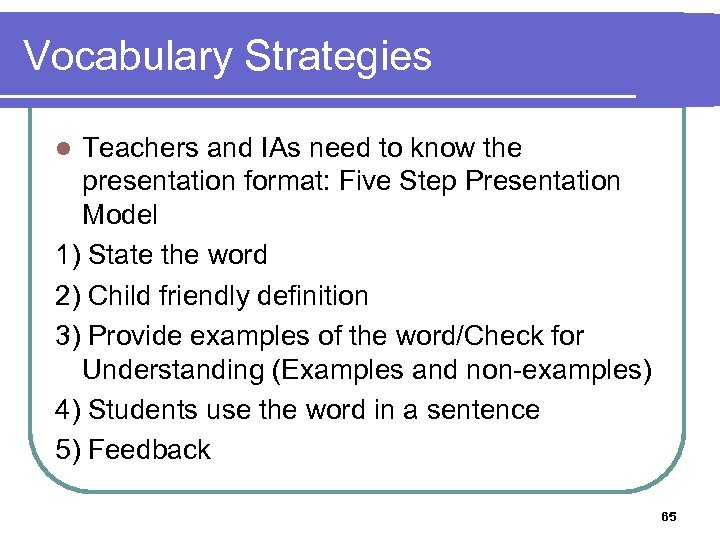
Vocabulary Strategies Teachers and IAs need to know the presentation format: Five Step Presentation Model 1) State the word 2) Child friendly definition 3) Provide examples of the word/Check for Understanding (Examples and non-examples) 4) Students use the word in a sentence 5) Feedback l 65
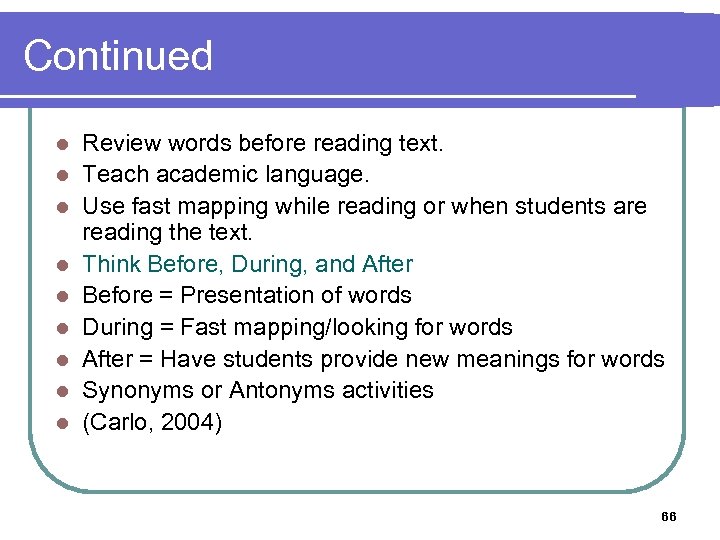
Continued l l l l l Review words before reading text. Teach academic language. Use fast mapping while reading or when students are reading the text. Think Before, During, and After Before = Presentation of words During = Fast mapping/looking for words After = Have students provide new meanings for words Synonyms or Antonyms activities (Carlo, 2004) 66
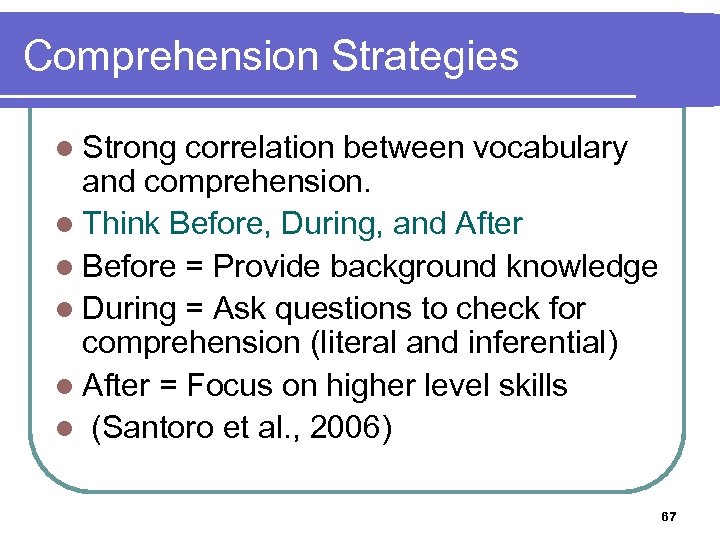
Comprehension Strategies l Strong correlation between vocabulary and comprehension. l Think Before, During, and After l Before = Provide background knowledge l During = Ask questions to check for comprehension (literal and inferential) l After = Focus on higher level skills l (Santoro et al. , 2006) 67
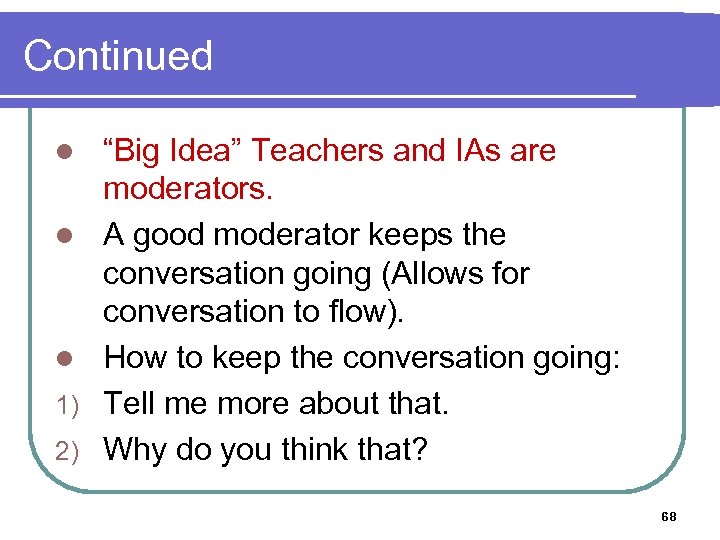
Continued l l l 1) 2) “Big Idea” Teachers and IAs are moderators. A good moderator keeps the conversation going (Allows for conversation to flow). How to keep the conversation going: Tell me more about that. Why do you think that? 68
Continued l Do you think that the character was correct in their decision? l I liked what you said, please tell me more. l How do we know that the character was correct? l Did the character act appropriately? l Teach students this format. 69
Re-Cap l Combine behavior and academic support for hard to deal students. l Model, Lead, Test l Teach Explicitly l Provide Feedback l Teach social skills 70
Скачать презентацию Combining Behavior and Academic Instructional Support to Improve
2671a986dacbf5ae28d198f999954de8.ppt