 Скачать презентацию COMBINED ROBOTIC PLATFORM VALUE CHAIN GENERAL CONTEXT Modification
680fd410cc84f65a15a0da978bf3692e.ppt
- Количество слайдов: 3



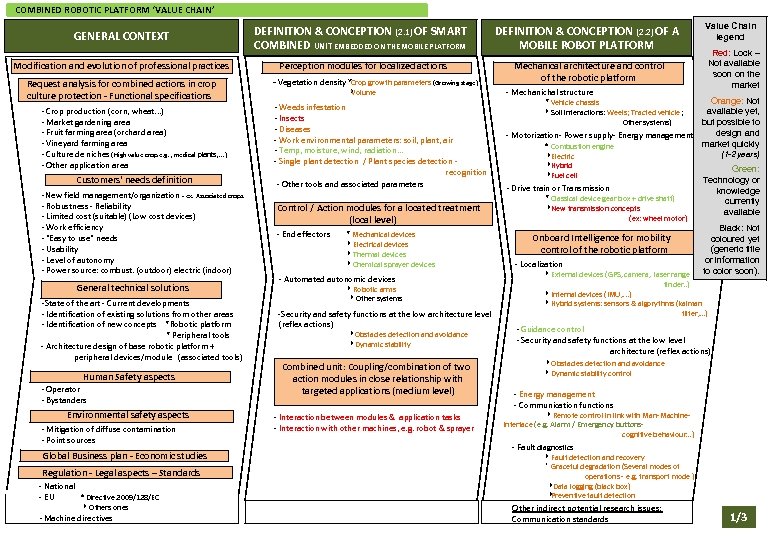
COMBINED ROBOTIC PLATFORM ‘VALUE CHAIN’ GENERAL CONTEXT Modification and evolution of professional practices Request analysis for combined actions in crop culture protection - Functional specifications - Crop production (corn, wheat. . . ) - Market gardening area - Fruit farming area (orchard area) - Vineyard farming area - Culture de niches (High value crop e. g. , medical plants, …) - Other application area Customers' needs definition DEFINITION & CONCEPTION (2. 1) OF SMART COMBINED UNIT EMBEDDED ON THE MOBILE PLATFORM Perception modules for localized actions - Vegetation density*Crop growth parameters (Growing stage) * Volume - Weeds infestation - Insects - Diseases - Work environmental parameters: soil, plant, air - Temp, moisture, wind, radiation. . . - Single plant detection / Plant species detection recognition - Other tools and associated parameters - New field management/organization - ex. Associated crops - Robustness - Reliability - Limited cost (suitable) (Low cost devices) - Work efficiency - "Easy to use" needs - Usability - Level of autonomy - Power source: combust. (outdoor) electric (indoor) General technical solutions - State of the art - Current developments - Identification of existing solutions from other areas - Identification of new concepts *Robotic platform * Peripheral tools - Architecture design of base robotic platform + peripheral devices/module (associated tools) Human Safety aspects - Operator - Bystanders Environmental safety aspects - Mitigation of diffuse contamination - Point sources Global Business plan - Economic studies Regulation - Legal aspects – Standards - National - EU * Directive 2009/128/EC * Others ones - Machine directives Control / Action modules for a located treatment (local level) - End effectors * Mechanical devices * Electrical devices * Thermal devices * Chemical sprayer devices - Automated autonomic devices * Robotic arms * Other systems - Security and safety functions at the low architecture level (reflex actions) * Obstacles detection and avoidance * Dynamic stability Combined unit: Coupling/combination of two action modules in close relationship with targeted applications (medium level) - Interaction between modules & application tasks - Interaction with other machines, e. g. robot & sprayer DEFINITION & CONCEPTION (2. 2) OF A MOBILE ROBOT PLATFORM Mechanical architecture and control of the robotic platform - Mechanichal structure * Vehicle chassis Value Chain legend Red: Lock – Not available soon on the market Orange: Not available yet, but possible to design and - Motorization- Power supply- Energy management market quickly * Combustion engine * Soil interactions: Weels; Tracted vehicle; Other systems) *Electric *Hybrid *Fuel cell - Drive train or Transmission * Classical device gear box + drive shaft) *New transmission concepts (ex: wheel motor) Onboard Intelligence for mobility control of the robotic platform - Localization (1 -2 years) Green: Technology or knowledge currently available Black: Not coloured yet (generic title or information to color soon). * External devices (GPS, camera, laser range finder. . ) * Internal devices (IMU, . . . ) * Hybrid systems: sensors & algorythms (kalman filter, …) - Guidance control - Security and safety functions at the low level architecture (reflex actions) * Obstacles detection and avoidance * Dynamic stability control - Energy management - Communication functions * Remote control in link with Man-Machine. Interface (e. g. Alarm / Emergency buttonscognitive behaviour…) - Fault diagnostics * Fault detection and recovery * Graceful degradation (Several modes of operations - e. g. transport mode ) *Data logging (black box) * Preventive fault detection Other indirect potential research issues: Communication standards 1/3
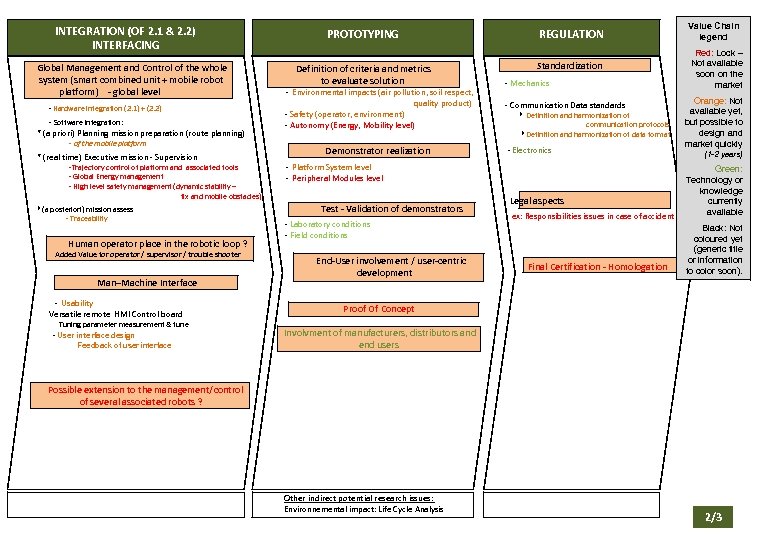
INTEGRATION (OF 2. 1 & 2. 2) INTERFACING Global Management and Control of the whole system (smart combined unit + mobile robot platform) - global level - Hardware integration (2. 1) + (2. 2) - Software integration: * (a priori) Planning mission preparation (route planning) - of the mobile platform * (real time) Executive mission - Supervision -Trajectory control of platform and associated tools - Global Energy management - High level safety management (dynamic stability – fix and mobile obstacles) * (a posteriori) mission assess - Traceability Human operator place in the robotic loop ? Added Value for operator / supervisor / trouble shooter Man–Machine Interface - Usability Versatile remote HMI Control board Tuning parameter measurement & tune - User interface design Feedback of user interface PROTOTYPING Definition of criteria and metrics to evaluate solution - Environmental impacts (air pollution, soil respect, quality product) - Safety (operator, environment) - Autonomy (Energy, Mobility level) Demonstrator realization REGULATION Standardization - Mechanics - Communication Data standards * Definition and harmonization of communication protocols * Definition and harmonization of data format - Electronics - Platform System level - Peripheral Modules level Test - Validation of demonstrators - Laboratory conditions - Field conditions End-User involvement / user-centric development Legal aspects ex: Responsibilities issues in case of accident Final Certification - Homologation Value Chain legend Red: Lock – Not available soon on the market Orange: Not available yet, but possible to design and market quickly (1 -2 years) Green: Technology or knowledge currently available Black: Not coloured yet (generic title or information to color soon). Proof Of Concept Involvment of manufacturers, distributors and end users Possible extension to the management/control of several associated robots ? Other indirect potential research issues: Environnemental impact: Life Cycle Analysis 2/3
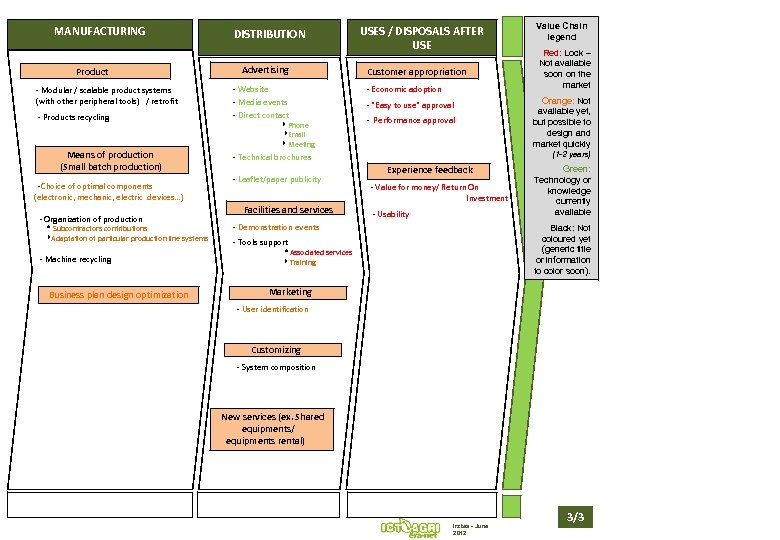
MANUFACTURING Product - Modular / scalable product systems (with other peripheral tools) / retrofit - Products recycling Means of production (Small batch production) - Choice of optimal components (electronic, mechanic, electric devices…) - Organization of production * Subcontractors contributions * Adaptation of particular production line systems - Machine recycling Business plan design optimization DISTRIBUTION Advertising - Website - Media events - Direct contact * Phone *Email * Meeting USES / DISPOSALS AFTER USE Customer appropriation - Economic adoption - “Easy to use" approval - Performance approval Facilities and services Red: Lock – Not available soon on the market Orange: Not available yet, but possible to design and market quickly (1 -2 years) - Technical brochures - Leaflet/paper publicity Value Chain legend Experience feedback - Value for money/ Return On Investment - Usability - Demonstration events Green: Technology or knowledge currently available Black: Not coloured yet (generic title or information to color soon). - Tools support * Associated services * Training Marketing - User identification Customizing - System composition New services (ex. Shared equipments/ equipments rental) Irstea - June 2012 3/3
Скачать презентацию COMBINED ROBOTIC PLATFORM VALUE CHAIN GENERAL CONTEXT Modification
680fd410cc84f65a15a0da978bf3692e.ppt