 Скачать презентацию Combined Action Program CAP All Alone in Indian
d7b820887d8807fd3067f509f64c086a.ppt
- Количество слайдов: 15



Combined Action Program (CAP) “All Alone in Indian Country” Richard M. Cavagnol USMC Phu Bai, Vietnam 1965 -1966
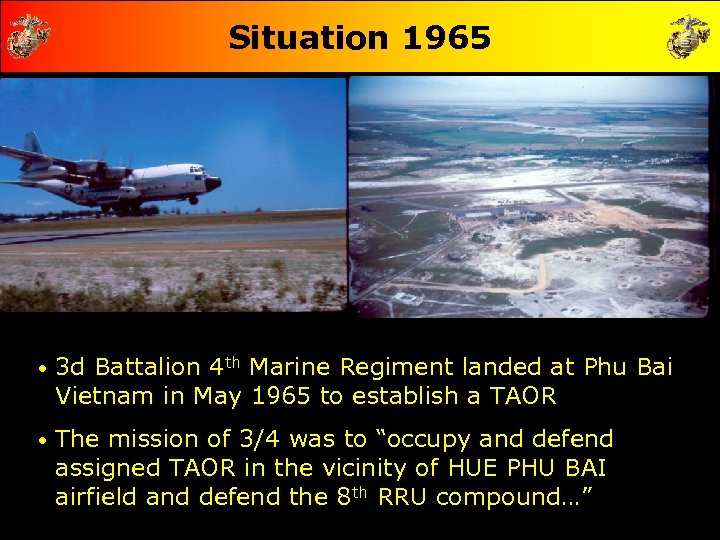
Situation 1965 • 3 d Battalion 4 th Marine Regiment landed at Phu Bai Vietnam in May 1965 to establish a TAOR • The mission of 3/4 was to “occupy and defend assigned TAOR in the vicinity of HUE PHU BAI airfield and defend the 8 th RRU compound…”
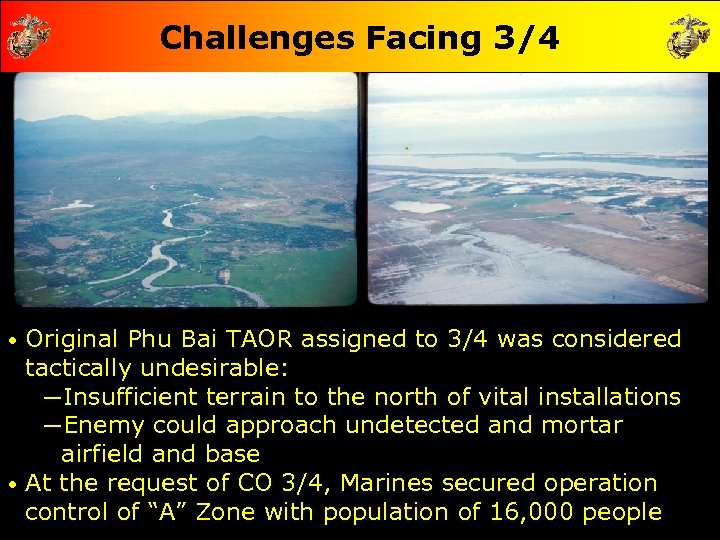
Challenges Facing 3/4 Original Phu Bai TAOR assigned to 3/4 was considered tactically undesirable: —Insufficient terrain to the north of vital installations —Enemy could approach undetected and mortar airfield and base • At the request of CO 3/4, Marines secured operation control of “A” Zone with population of 16, 000 people •
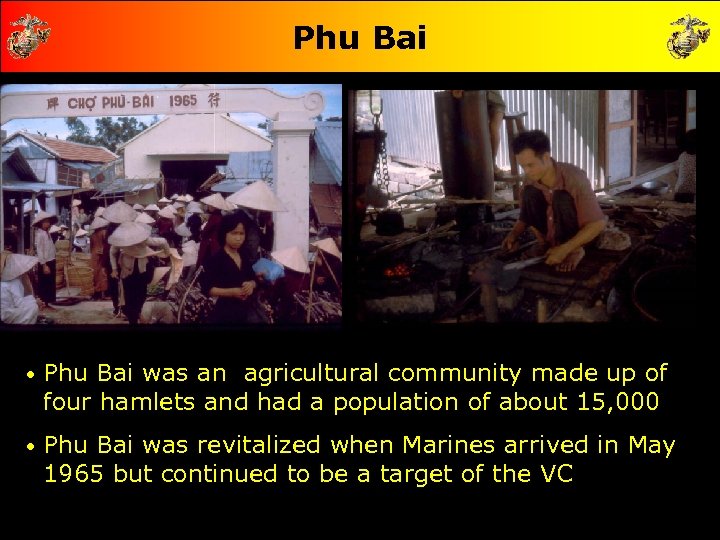
Phu Bai • Phu Bai was an agricultural community made up of four hamlets and had a population of about 15, 000 • Phu Bai was revitalized when Marines arrived in May 1965 but continued to be a target of the VC
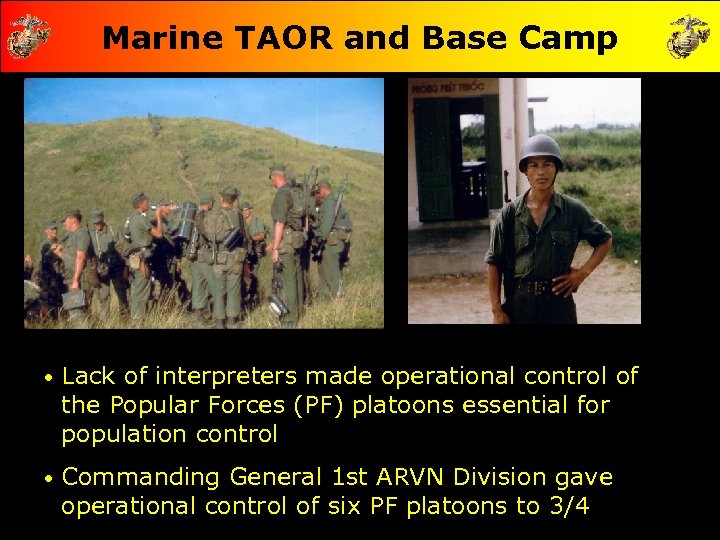
Marine TAOR and Base Camp • Lack of interpreters made operational control of the Popular Forces (PF) platoons essential for population control • Commanding General 1 st ARVN Division gave operational control of six PF platoons to 3/4
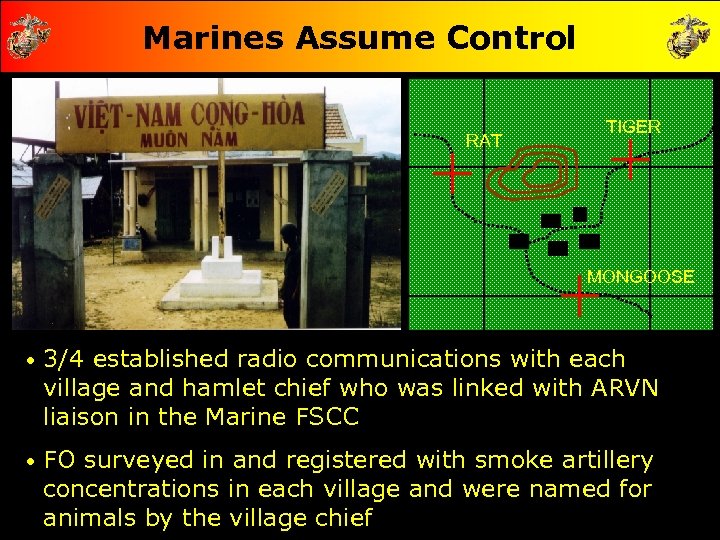
Marines Assume Control RAT TIGER MONGOOSE • 3/4 established radio communications with each village and hamlet chief who was linked with ARVN liaison in the Marine FSCC • FO surveyed in and registered with smoke artillery concentrations in each village and were named for animals by the village chief
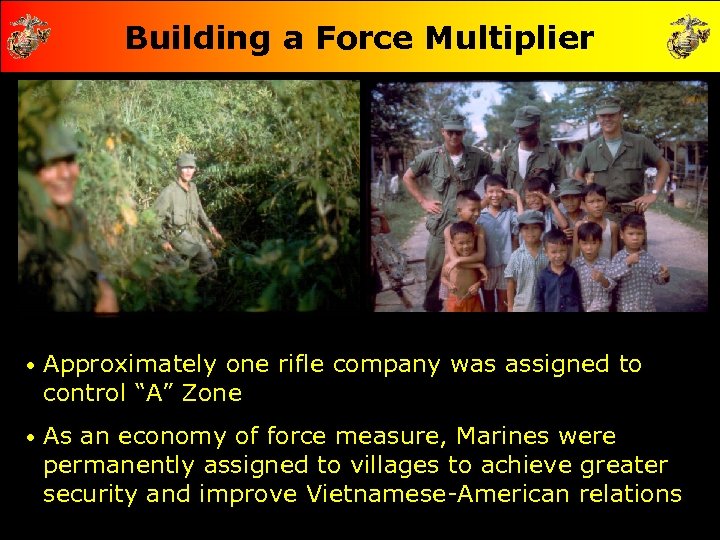
Building a Force Multiplier • Approximately one rifle company was assigned to control “A” Zone • As an economy of force measure, Marines were permanently assigned to villages to achieve greater security and improve Vietnamese-American relations
Joint Action Company • Lt. Col Taylor and the staff of 3/4 developed a plan to create a “Joint Action Company (JAC)” composed of Marines and Popular Forces • A battalion officer and recent graduate of Vietnamese Language School was named Company Commander • One T/O squad of Marines was hand picked from each of the four rifle companies to become a permanently organized unit – 1 st Provisional Marine Platoon • Six PF platoons were formed into a company and an ARVN officer named Company Commander • The Marine platoon and PF company became the Joint Action Company with a Marine officer as the CO and the ARVN officer as the XO
Training CAP Units • • • CAP personnel were hand-picked and interviewed for the job They were given very little cultural or language training. Much of what they learned was on-the-job training (OJT) For the first CAP units in Phu Bai, we started a weeklong combined action school that included a crash course in Vietnamese political structure and culture Notably absent from the syllabus was any sort of language training, a weakness of the program that would continue throughout its existence Later, a formal school was set up in Danang, and the candidate CAP members went through two-week curriculum that included basic language instruction and cultural awareness
JAC to CAP • The name of the Joint Action Company evolved to Combined Action Company with each of the village units called Combined Action Platoons (CAP) • In each village, the Marine squad leader was responsible for operations of the integrated unit • Operationally his commands are passed through the PF platoon commander to the Vietnamese • The Marine squad leader always consulted his PF counterpart • All matters pertaining to the village are accomplished through, and in conjunction with, the village chief • The village chief was kept apprised of all tactical operations
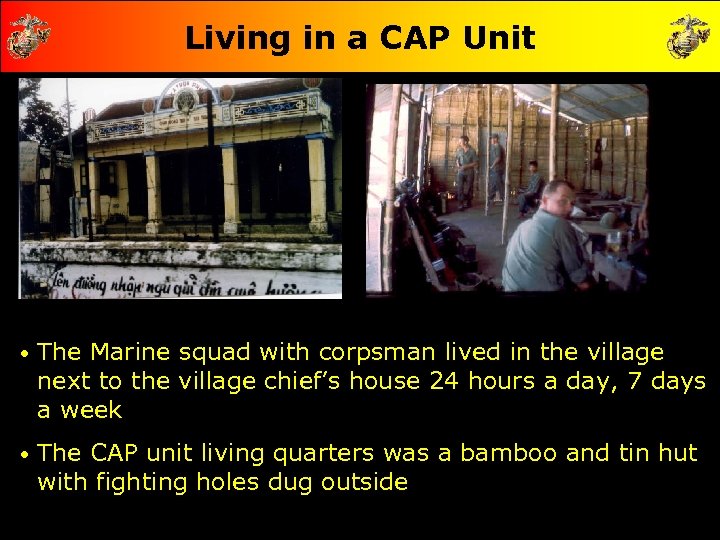
Living in a CAP Unit • The Marine squad with corpsman lived in the village next to the village chief’s house 24 hours a day, 7 days a week • The CAP unit living quarters was a bamboo and tin hut with fighting holes dug outside
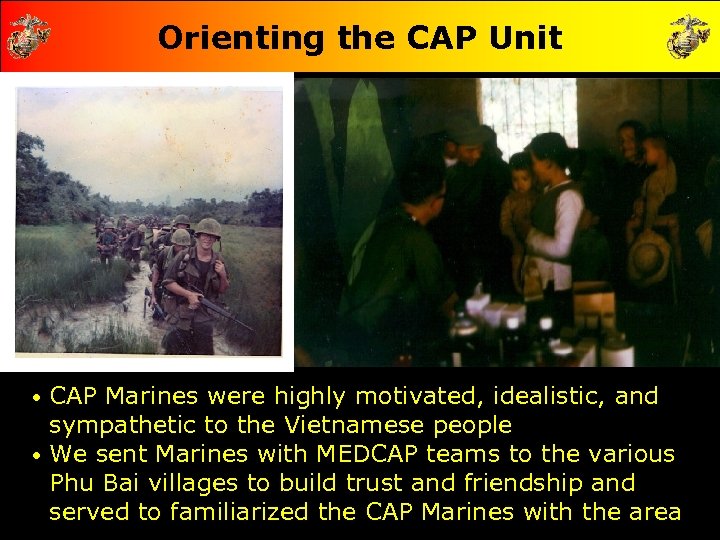
Orienting the CAP Unit CAP Marines were highly motivated, idealistic, and sympathetic to the Vietnamese people • We sent Marines with MEDCAP teams to the various Phu Bai villages to build trust and friendship and served to familiarized the CAP Marines with the area •
Mission of the CAP Unit • Destroy the communist infrastructure within the platoon's area of responsibility. • Protect public security; help maintain law and order • Organize local intelligence nets • Participate in civic action and conduct propaganda against the communists • Motivate and instill pride, patriotism, and aggressiveness in the militia • Conduct training for all members of the combinedaction platoon in general military subjects, leadership, and language • Increase the proficiency of the PF so they could function effectively without the Marines
CAP Unit Operations • • • Tactical Operations – Recon patrols, security patrols and ambushes (~20 per week) Intelligence – Reduced VC domination of the villages from 35% to near 0% and opened information flow Counterintelligence – CAP unit denied the use of the villages by the VC and propaganda dropped to near 0% Economic Influence – Became part of the community and assisted in civil action projects Psychological Operations – By word of mouth, CAP unit offers people friendship, civic action and protection as representatives of the South Vietnamese government Coordination and Liaison – Close contact was maintained with civil, military and police heads for mutual assistance in intelligence and operations
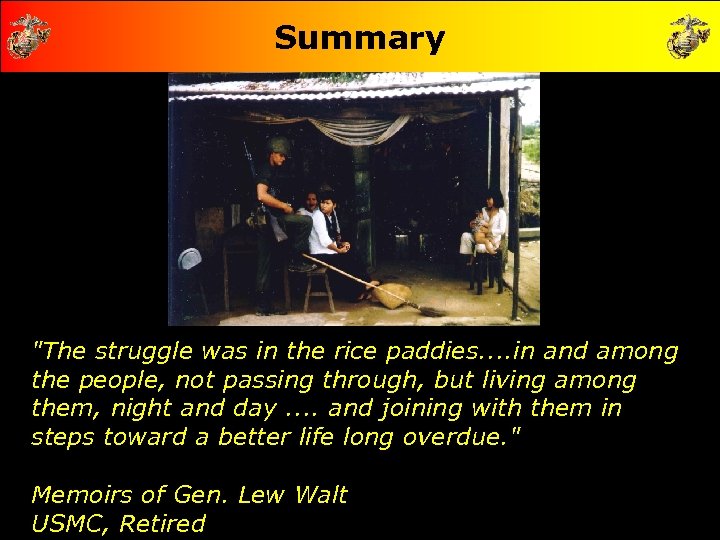
Summary "The struggle was in the rice paddies. . in and among the people, not passing through, but living among them, night and day. . and joining with them in steps toward a better life long overdue. " Memoirs of Gen. Lew Walt USMC, Retired
Скачать презентацию Combined Action Program CAP All Alone in Indian
d7b820887d8807fd3067f509f64c086a.ppt