 Скачать презентацию Combating malnutrition through sustainable interventions EU-ASEAN relations as
e8d3b74f15eefa83d96e46cf4ad21239.ppt
- Количество слайдов: 16



Combating malnutrition through sustainable interventions EU-ASEAN relations as key driver Panel 1. On Science and Impact 1/9 Brussels, Belgium 08/Nov. /2011 13: 35 -13: 45 (Keynote address) Possible malnutrition in the elderly in developed countries Findings from epidemiologic studies ■ Nutritional needs are different by age. Department of Social and Preventive Epidemiology, School of Public Health, The University of Tokyo, Japan Satoshi Sasaki, M. D. , Ph. D.
I would like to address the importance of epidemiologic studies for combating malnutrition, especially in the elderly populations. Epidemiology is … one of research methods used in medicine. It is a method that we collect data from a group of persons. Then we examine association between two or more than two factors collected from this group of persons. Epidemiologic researches are done, not in laboratories, but, in most cases, in societies. Epidemiology focused on nutrition and health is called “nutritional epidemiology”. Most of information for healthy eating, for example reducing saturated fat to prevent coronary heart disease, has been obtained mainly from nutritional epidemiologic studies. As keynote address, I would like to show possible malnutrition occurring in elderly people in developed countries found by epidemiologic studies, taking association between obesity and 2/9
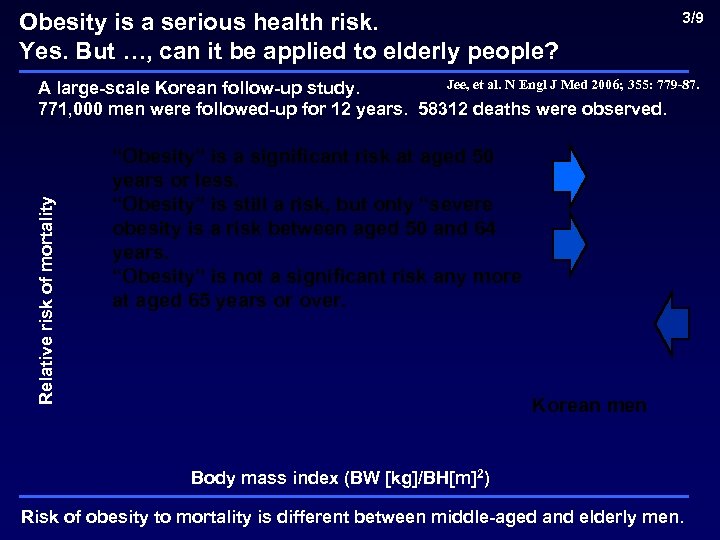
Obesity is a serious health risk. Yes. But …, can it be applied to elderly people? 3/9 Relative risk of mortality Jee, et al. N Engl J Med 2006; 355: 779 -87. A large-scale Korean follow-up study. 771, 000 men were followed-up for 12 years. 58312 deaths were observed. “Obesity” is a significant risk at aged 50 years or less. “Obesity” is still a risk, but only “severe obesity is a risk between aged 50 and 64 years. “Obesity” is not a significant risk any more at aged 65 years or over. Korean men Body mass index (BW [kg]/BH[m]2) Risk of obesity to mortality is different between middle-aged and elderly men.
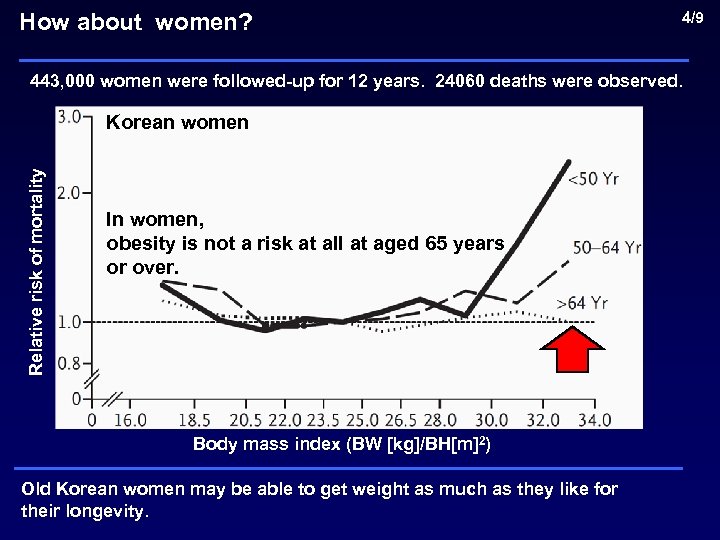
How about women? 4/9 443, 000 women were followed-up for 12 years. 24060 deaths were observed. Relative risk of mortality Korean women In women, obesity is not a risk at all at aged 65 years or over. Body mass index (BW [kg]/BH[m]2) Old Korean women may be able to get weight as much as they like for their longevity.
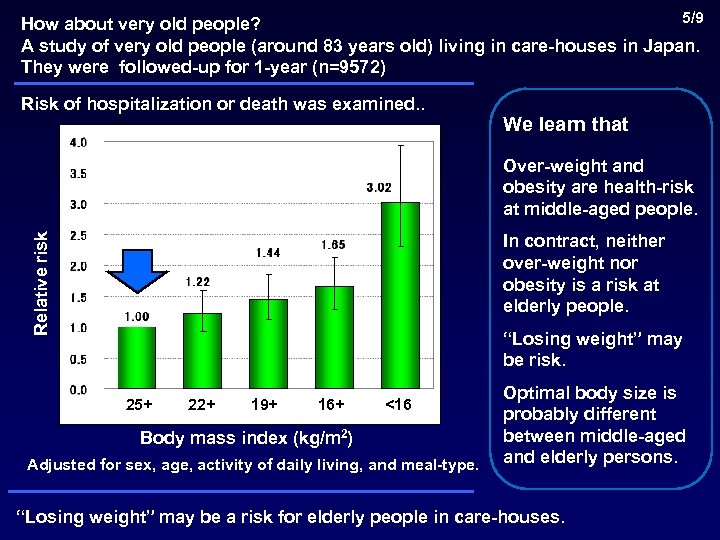
5/9 How about very old people? A study of very old people (around 83 years old) living in care-houses in Japan. They were followed-up for 1 -year (n=9572) Risk of hospitalization or death was examined. . We learn that Relative risk Over-weight and obesity are health-risk at middle-aged people. In contract, neither over-weight nor obesity is a risk at elderly people. “Losing weight” may be risk. 25+ 22+ 19+ 16+ <16 Body mass index (kg/m 2) Adjusted for sex, age, activity of daily living, and meal-type. Optimal body size is probably different between middle-aged and elderly persons. “Losing weight” may be a risk for elderly people in care-houses.
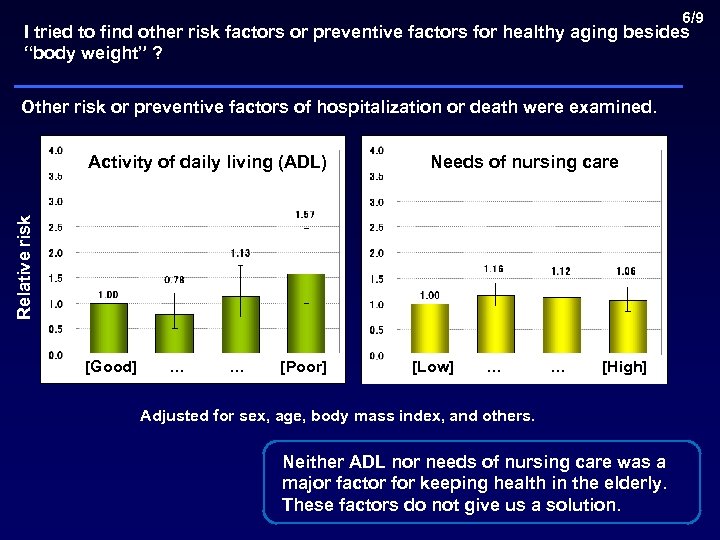
6/9 I tried to find other risk factors or preventive factors for healthy aging besides “body weight” ? Other risk or preventive factors of hospitalization or death were examined. Needs of nursing care Relative risk Activity of daily living (ADL) [Good] … … [Poor] [Low] … … [High] Adjusted for sex, age, body mass index, and others. Neither ADL nor needs of nursing care was a major factor for keeping health in the elderly. These factors do not give us a solution.
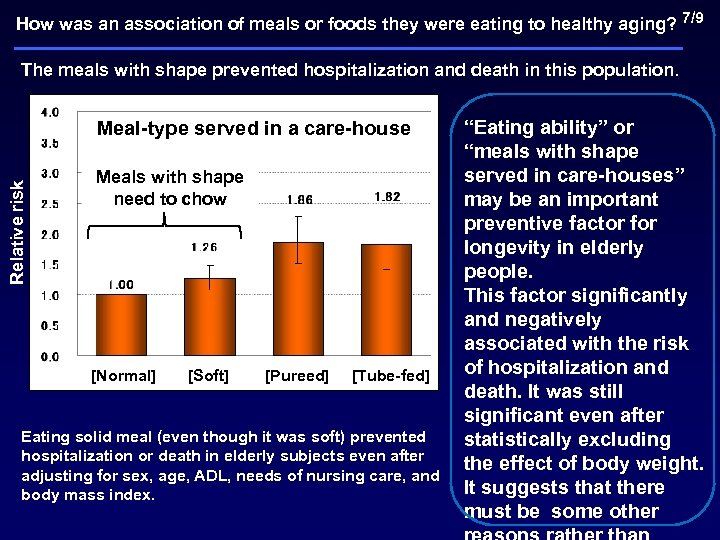
How was an association of meals or foods they were eating to healthy aging? 7/9 The meals with shape prevented hospitalization and death in this population. Relative risk Meal-type served in a care-house Meals with shape need to chow [Normal] [Soft] [Pureed] [Tube-fed] Eating solid meal (even though it was soft) prevented hospitalization or death in elderly subjects even after adjusting for sex, age, ADL, needs of nursing care, and body mass index. “Eating ability” or “meals with shape served in care-houses” may be an important preventive factor for longevity in elderly people. This factor significantly and negatively associated with the risk of hospitalization and death. It was still significant even after statistically excluding the effect of body weight. It suggests that there must be some other
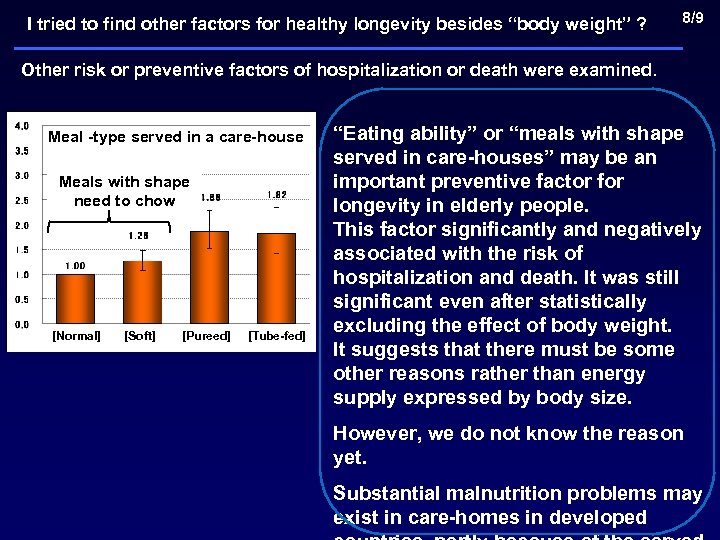
I tried to find other factors for healthy longevity besides “body weight” ? 8/9 Other risk or preventive factors of hospitalization or death were examined. Meal -type served in a care-house Meals with shape need to chow [Normal] [Soft] [Pureed] [Tube-fed] “Eating ability” or “meals with shape served in care-houses” may be an important preventive factor for longevity in elderly people. This factor significantly and negatively associated with the risk of hospitalization and death. It was still significant even after statistically excluding the effect of body weight. It suggests that there must be some other reasons rather than energy supply expressed by body size. However, we do not know the reason yet. Substantial malnutrition problems may exist in care-homes in developed
![[Conclusions and Suggestions] 9/9 Relationships between nutrient and food intakes and health status have](https://present5.com/presentation/e8d3b74f15eefa83d96e46cf4ad21239/image-9.jpg "[Conclusions and Suggestions] 9/9 Relationships between nutrient and food intakes and health status have")
[Conclusions and Suggestions] 9/9 Relationships between nutrient and food intakes and health status have broadly been investigated during this half a century in middle-aged populations. However, the results obtained from middle-aged people cannot be extrapolated to elderly people. The studies for elderly people are relatively scarce, and especially for oldest-old people because of its difficulty. In addition, association between nutrition and health status may be different in different cultures. The studies should be done covering various populations with different cultures, different dietary habits, and different food availability and environments. “Epidemiologic studies on nutrition (nutritional epidemiology)” may find reasons and solutions of possible malnutrition occurring in the elderly people, especially those living in care-houses and probably in hospitals too. We strongly need more nutritional epidemiologic studies in elderly populations in the world, both in developed. Thank you for your attention! and developing countries.

In women, bone mineral density (g/cm 2) starts to decrease around 50 -55 years of age by menopause. What should know Nutritional prevention strategy of osteoporosis and osteoporotic bone fracture in elderly people. Is this a normal physiologic change or not? Are we able to make this decline slower? #13485. Warming L, et al. Osteoporos Int 2002; 13: 105 -12.
![Calcium intake and bone fracture (backbone [Japanese], hip[western]) Review of follow-up studies Relative risk](https://present5.com/presentation/e8d3b74f15eefa83d96e46cf4ad21239/image-12.jpg "Calcium intake and bone fracture (backbone [Japanese], hip[western]) Review of follow-up studies Relative risk")
Calcium intake and bone fracture (backbone [Japanese], hip[western]) Review of follow-up studies Relative risk Japanese (40, 000 subjects) Western (170, 000 subjects) Reference Nakamura, et al. Br J Nutr 2009; 101: 285 -94. Bischoff-Ferrari, et al. Am J Clin Nutr 2007; 86: 1780 -90. Neither high level of calcium intake nor calcium supplement is a solution. If so, …, vitamin D? vitamin K? , isoflavon (in soya)? Many candidates. No conclusion.
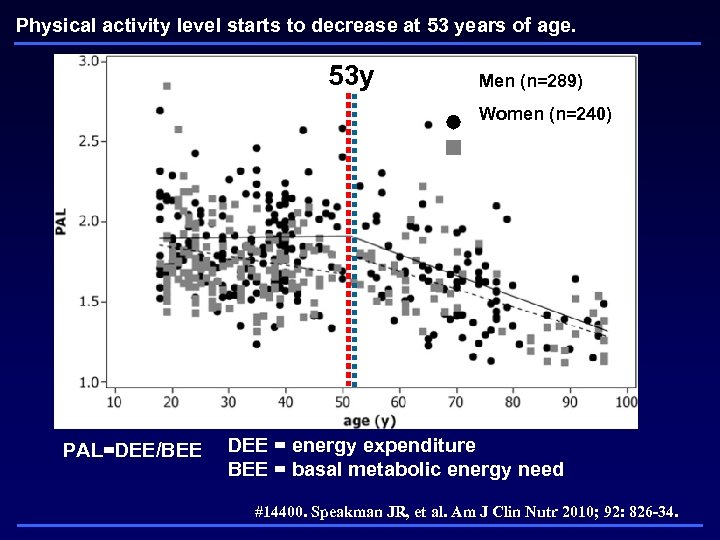
Physical activity level starts to decrease at 53 years of age. 53 y Men (n=289) Women (n=240) PAL=DEE/BEE DEE = energy expenditure BEE = basal metabolic energy need #14400. Speakman JR, et al. Am J Clin Nutr 2010; 92: 826 -34.
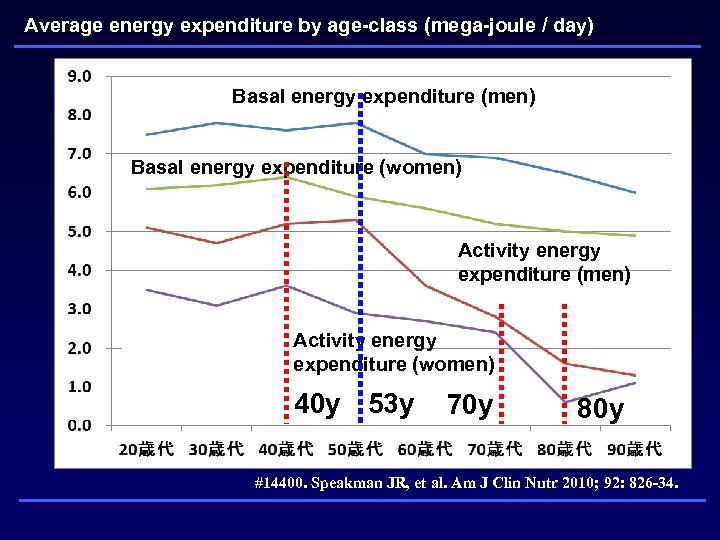
Average energy expenditure by age-class (mega-joule / day) Basal energy expenditure (men) Basal energy expenditure (women) Activity energy expenditure (women) 40 y 53 y 70 y 80 y #14400. Speakman JR, et al. Am J Clin Nutr 2010; 92: 826 -34.
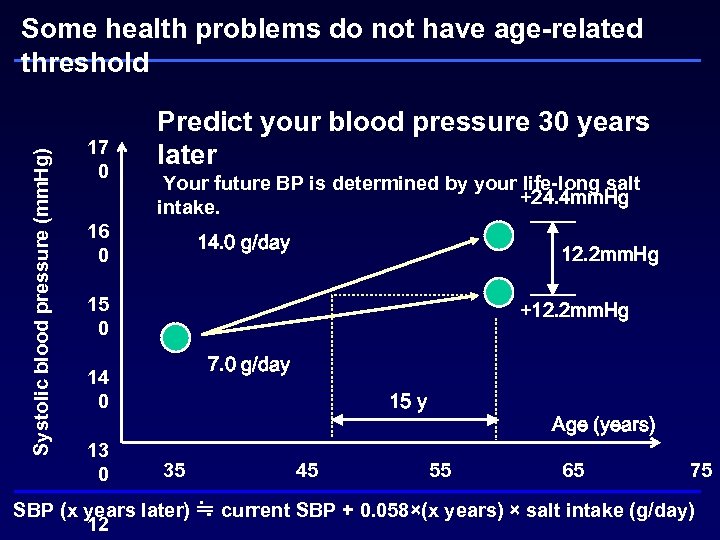
Systolic blood pressure (mm. Hg) Some health problems do not have age-related threshold 17 0 Predict your blood pressure 30 years later Your future BP is determined by your life-long salt +24. 4 mm. Hg intake. 16 0 14. 0 g/day 12. 2 mm. Hg 15 0 +12. 2 mm. Hg 7. 0 g/day 14 0 13 0 15 y 35 45 Age (years) 55 65 75 SBP (x years later) ≒ current SBP + 0. 058×(x years) × salt intake (g/day) 12
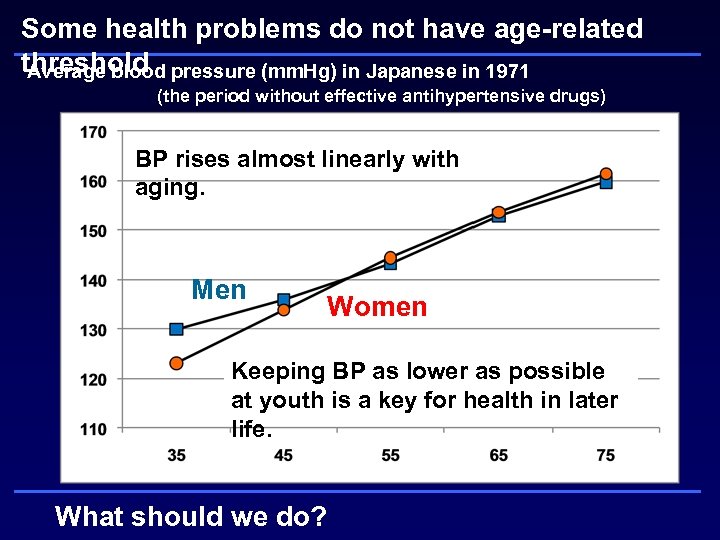
Some health problems do not have age-related threshold pressure (mm. Hg) in Japanese in 1971 Average blood (the period without effective antihypertensive drugs) BP rises almost linearly with aging. Men Women Keeping BP as lower as possible at youth is a key for health in later life. What should we do?
Скачать презентацию Combating malnutrition through sustainable interventions EU-ASEAN relations as
e8d3b74f15eefa83d96e46cf4ad21239.ppt