 Скачать презентацию COM-405 Mobile Networks Prof Jean-Pierre Hubaux EPFL http
6071bc25118fa8944588a7a54515c9fe.ppt
- Количество слайдов: 33



COM-405 Mobile Networks Prof. Jean-Pierre Hubaux EPFL http: //mobnet. epfl. ch (redirected to Moodle) 1
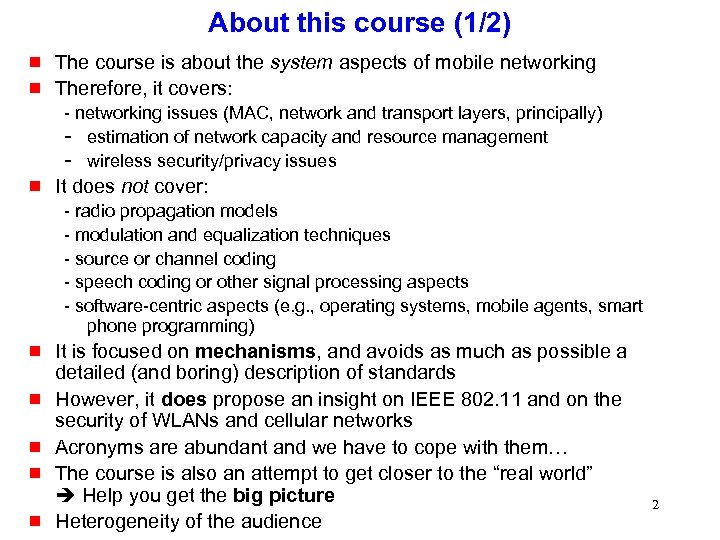
About this course (1/2) g g The course is about the system aspects of mobile networking Therefore, it covers: - networking issues (MAC, network and transport layers, principally) - estimation of network capacity and resource management - wireless security/privacy issues g It does not cover: - radio propagation models - modulation and equalization techniques - source or channel coding - speech coding or other signal processing aspects - software-centric aspects (e. g. , operating systems, mobile agents, smart phone programming) g g g It is focused on mechanisms, and avoids as much as possible a detailed (and boring) description of standards However, it does propose an insight on IEEE 802. 11 and on the security of WLANs and cellular networks Acronyms are abundant and we have to cope with them… The course is also an attempt to get closer to the “real world” Help you get the big picture Heterogeneity of the audience 2
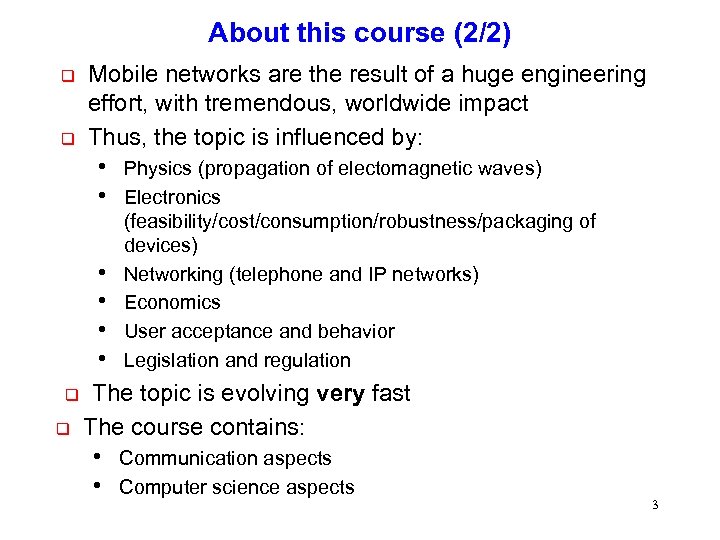
About this course (2/2) q q Mobile networks are the result of a huge engineering effort, with tremendous, worldwide impact Thus, the topic is influenced by: • • • q q Physics (propagation of electomagnetic waves) Electronics (feasibility/cost/consumption/robustness/packaging of devices) Networking (telephone and IP networks) Economics User acceptance and behavior Legislation and regulation The topic is evolving very fast The course contains: • • Communication aspects Computer science aspects 3
Web site http: //mobnet. epfl. ch/ (or check for “Mobile Networks” in the EPFL Moodle) Of particular relevance: - Calendar - Material (all slides used at the lectures, homeworks, …) - Information about clickers - Previous exams 4
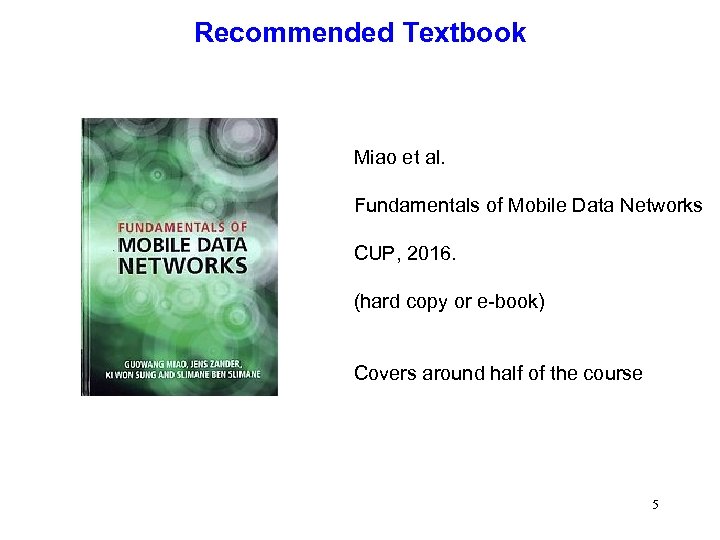
Recommended Textbook Miao et al. Fundamentals of Mobile Data Networks CUP, 2016. (hard copy or e-book) Covers around half of the course 5
Other Textbook Useful for the « security » part, Chapter 1 and Appendix A of the book (but getting a bit obsolete): L. Buttyan and JP Hubaux: Security and Cooperation in Wireless Networks Cambridge University Press, 2008 http: //secowinet. epfl. c If asked a password: « salaam » 6
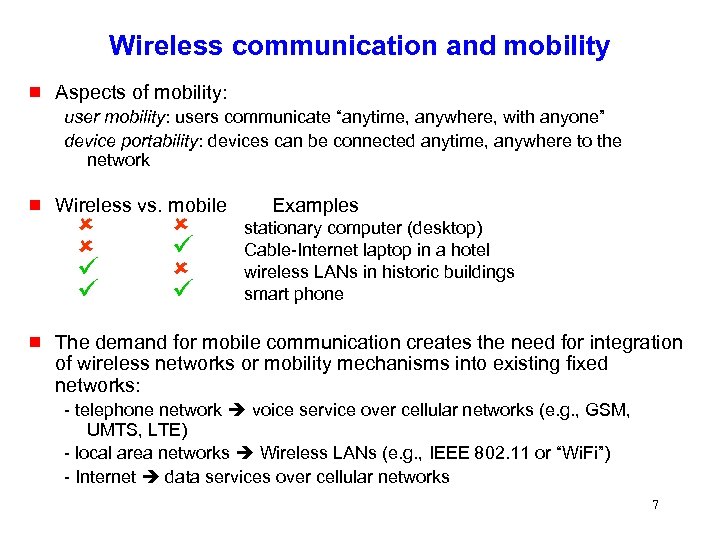
Wireless communication and mobility g Aspects of mobility: users communicate “anytime, anywhere, with anyone” device portability: devices can be connected anytime, anywhere to the network g Wireless vs. mobile Examples stationary computer (desktop) Cable-Internet laptop in a hotel wireless LANs in historic buildings smart phone g The demand for mobile communication creates the need for integration of wireless networks or mobility mechanisms into existing fixed networks: - telephone network voice service over cellular networks (e. g. , GSM, UMTS, LTE) - local area networks Wireless LANs (e. g. , IEEE 802. 11 or “Wi. Fi”) - Internet data services over cellular networks 7
Examples of mobile applications (1/2) g g g Person to person communication (e. g. , voice, SMS) Person to server (e. g. , location-based services, timetable consultation, e-banking) Vehicles position via GPS local ad-hoc network with vehicles close-by to prevent accidents, guidance system, adaptive cruise control transmission of news, road condition, weather, music via Digital Audio Broadcasting vehicle data (e. g. , from buses, trains, aircrafts) transmitted for maintenance g Disaster situations replacement of a fixed infrastructure in case of earthquakes, hurricanes, fire, etc. g Military networks 8
Examples of applications (2/2) g Traveling salespeople direct access to customer files stored in a central location consistent databases for all agents mobile office g Replacement of fixed networks Sensors trade shows networks LANs in historic buildings g Entertainment, education, . . . q lt Bui C B 150 outdoor Internet access travel guide with up-to-date location dependent information ad-hoc networks for multi user games Location-dependent advertising The mobile phone apps 9
Location dependent services g Location aware services what services, e. g. , printer, fax, phone, server etc. exist in the local environment g Follow-on services transmission of the actual workspace to the current location g Information services „push“: e. g. , current special offers in the shop nearby „pull“: e. g. , where is the closest Migros? g Support services caches, intermediate results, state information etc. „follow“ the mobile device through the fixed network g Location-Based Services (LBSs) Foursquare, Facebook Mobile, … 10
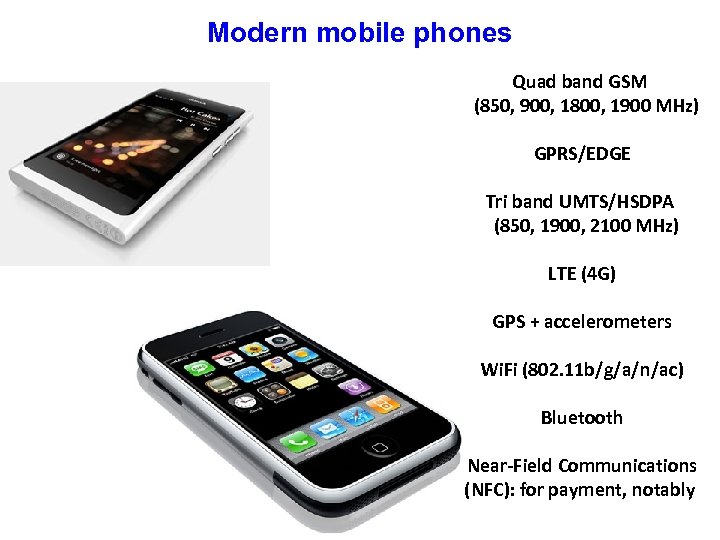
Modern mobile phones Quad band GSM (850, 900, 1800, 1900 MHz) GPRS/EDGE Tri band UMTS/HSDPA (850, 1900, 2100 MHz) LTE (4 G) GPS + accelerometers Wi. Fi (802. 11 b/g/a/n/ac) Bluetooth 11 Near-Field Communications (NFC): for payment, notably
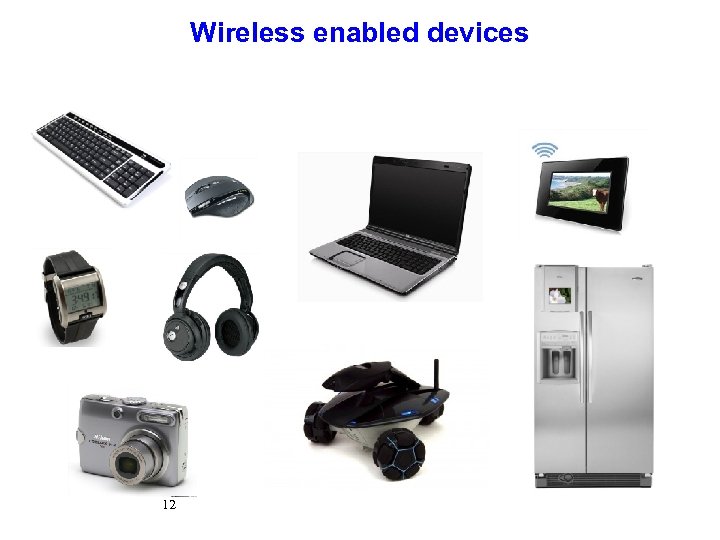
Wireless enabled devices 12
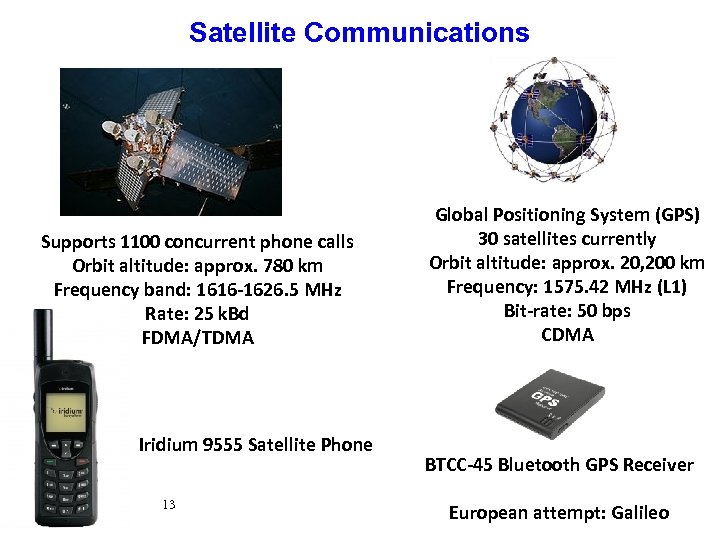
Satellite Communications Supports 1100 concurrent phone calls Orbit altitude: approx. 780 km Frequency band: 1616 -1626. 5 MHz Rate: 25 k. Bd FDMA/TDMA Iridium 9555 Satellite Phone 13 Global Positioning System (GPS) 30 satellites currently Orbit altitude: approx. 20, 200 km Frequency: 1575. 42 MHz (L 1) Bit-rate: 50 bps CDMA BTCC-45 Bluetooth GPS Receiver European attempt: Galileo
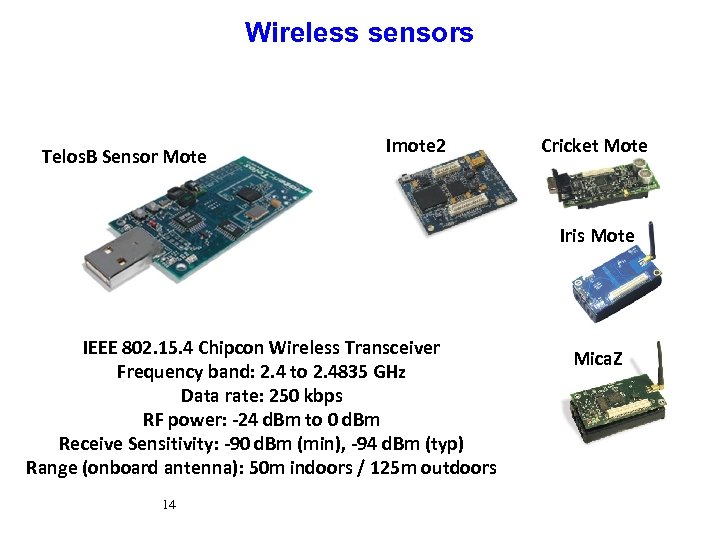
Wireless sensors Telos. B Sensor Mote Imote 2 Cricket Mote Iris Mote IEEE 802. 15. 4 Chipcon Wireless Transceiver Frequency band: 2. 4 to 2. 4835 GHz Data rate: 250 kbps RF power: -24 d. Bm to 0 d. Bm Receive Sensitivity: -90 d. Bm (min), -94 d. Bm (typ) Range (onboard antenna): 50 m indoors / 125 m outdoors 14 Mica. Z
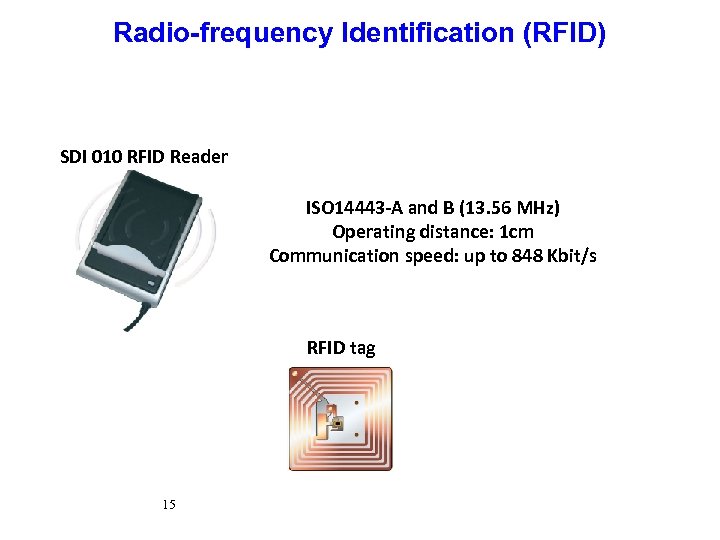
Radio-frequency Identification (RFID) SDI 010 RFID Reader ISO 14443 -A and B (13. 56 MHz) Operating distance: 1 cm Communication speed: up to 848 Kbit/s RFID tag 15
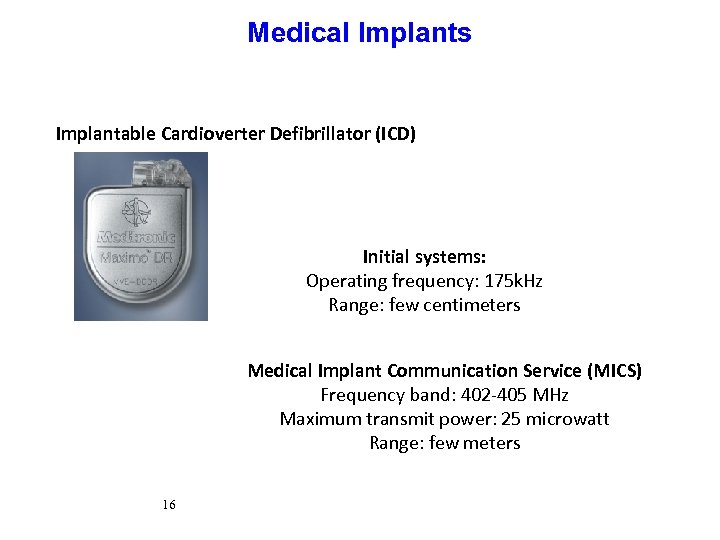
Medical Implants Implantable Cardioverter Defibrillator (ICD) Initial systems: Operating frequency: 175 k. Hz Range: few centimeters Medical Implant Communication Service (MICS) Frequency band: 402 -405 MHz Maximum transmit power: 25 microwatt Range: few meters 16
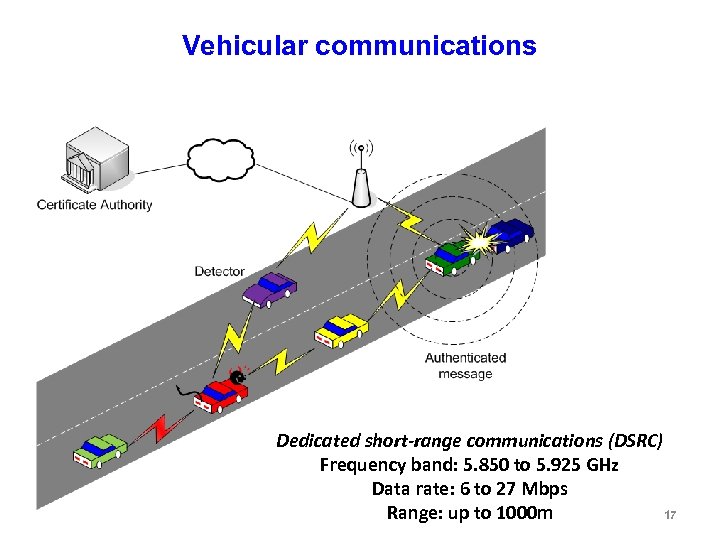
Vehicular communications 17 Dedicated short-range communications (DSRC) Frequency band: 5. 850 to 5. 925 GHz Data rate: 6 to 27 Mbps Range: up to 1000 m 17
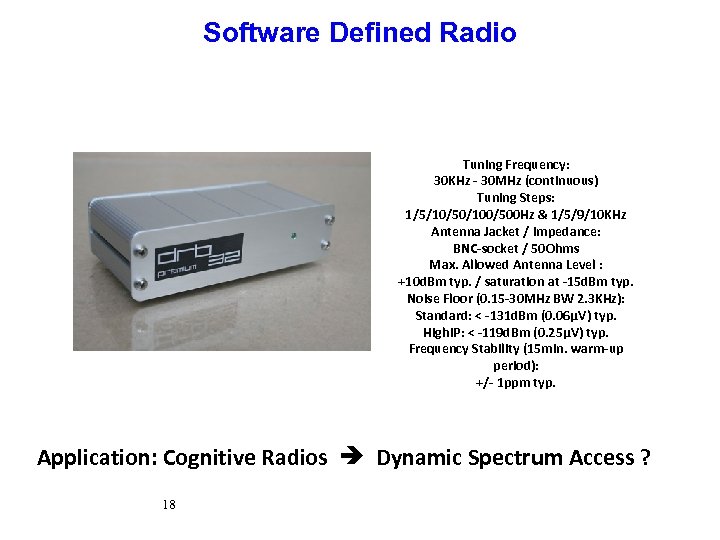
Software Defined Radio Tuning Frequency: 30 KHz - 30 MHz (continuous) Tuning Steps: 1/5/10/50/100/500 Hz & 1/5/9/10 KHz Antenna Jacket / Impedance: BNC-socket / 50 Ohms Max. Allowed Antenna Level : +10 d. Bm typ. / saturation at -15 d. Bm typ. Noise Floor (0. 15 -30 MHz BW 2. 3 KHz): Standard: < -131 d. Bm (0. 06μV) typ. High. IP: < -119 d. Bm (0. 25μV) typ. Frequency Stability (15 min. warm-up period): +/- 1 ppm typ. Application: Cognitive Radios Dynamic Spectrum Access ? 18
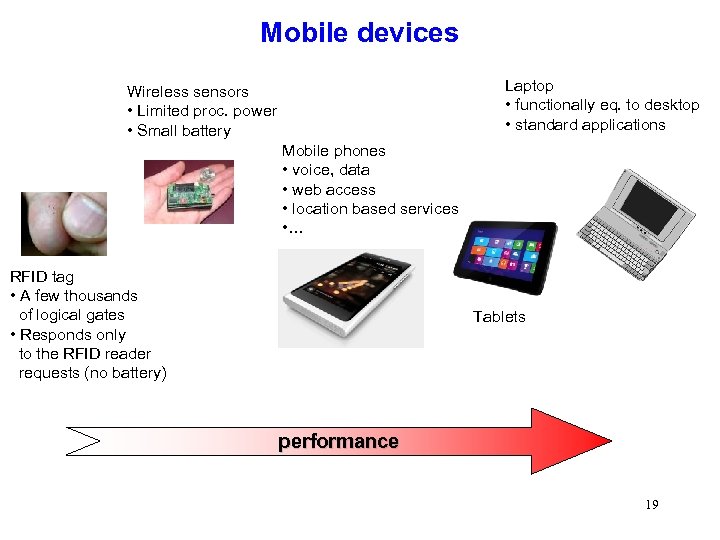
Mobile devices Laptop • functionally eq. to desktop • standard applications Wireless sensors • Limited proc. power • Small battery Mobile phones • voice, data • web access • location based services • … RFID tag • A few thousands of logical gates • Responds only to the RFID reader requests (no battery) Tablets performance 19
Wireless networks in comparison to fixed networks g Higher data loss-rates due notably to interferences emissions of e. g. , engines, lightning, other wireless networks, microwave ovens g Restrictive regulations of frequencies Usage of frequencies has to be coordinated, useful frequencies are almost all occupied (or at least reserved) g Lower transmission rates From a few kbit/s (e. g. , GSM) to a 100 s of Mbit/s (e. g. WLAN) g g g Higher jitter Lower security (higher vulnerability) Radio link permanently shared need of sophisticated MAC Fluctuating quality of the radio links Unknown and variable access points authentication procedures Unknown location of the mobile station mobility management 20
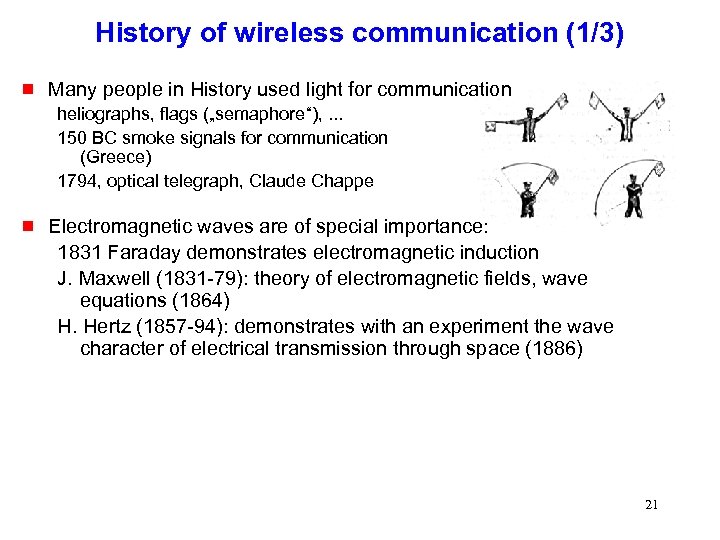
History of wireless communication (1/3) g Many people in History used light for communication heliographs, flags („semaphore“), . . . 150 BC smoke signals for communication (Greece) 1794, optical telegraph, Claude Chappe g Electromagnetic waves are of special importance: 1831 Faraday demonstrates electromagnetic induction J. Maxwell (1831 -79): theory of electromagnetic fields, wave equations (1864) H. Hertz (1857 -94): demonstrates with an experiment the wave character of electrical transmission through space (1886) 21
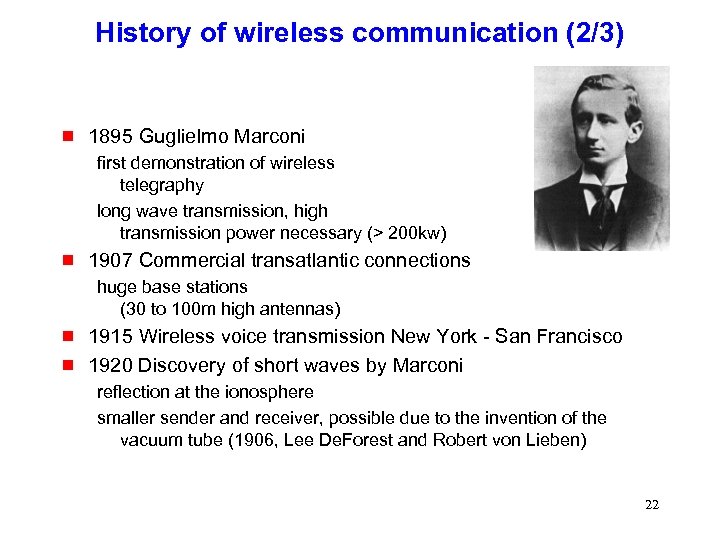
History of wireless communication (2/3) g 1895 Guglielmo Marconi first demonstration of wireless telegraphy long wave transmission, high transmission power necessary (> 200 kw) g 1907 Commercial transatlantic connections huge base stations (30 to 100 m high antennas) g g 1915 Wireless voice transmission New York - San Francisco 1920 Discovery of short waves by Marconi reflection at the ionosphere smaller sender and receiver, possible due to the invention of the vacuum tube (1906, Lee De. Forest and Robert von Lieben) 22
History of wireless communication (3/3) g g g 1928 Many TV broadcast trials (across Atlantic, color TV, TV news) 1933 Frequency modulation (E. H. Armstrong) 1946 First public mobile telephone service in 25 US cities (1 antenna per city…) 1976 Bell Mobile Phone service for NY city 1979 Nordic Mobile Telephone (NMT) at 450 MHz (Scandinavian countries) 1982 Start of GSM-specification Goal: pan-European digital mobile phone system with roaming g g g 1983 Start of the American AMPS (Advanced Mobile Phone System, analog) 1984 CT-1 standard (Europe) for cordless telephones 1992 First deployment of GSM 2002 First deployment of UMTS 2013 - LTE (4 G) standards mature, first trials Today: 4 G deployed, 5 G under development (to be deployed in the early 2020 s) 23
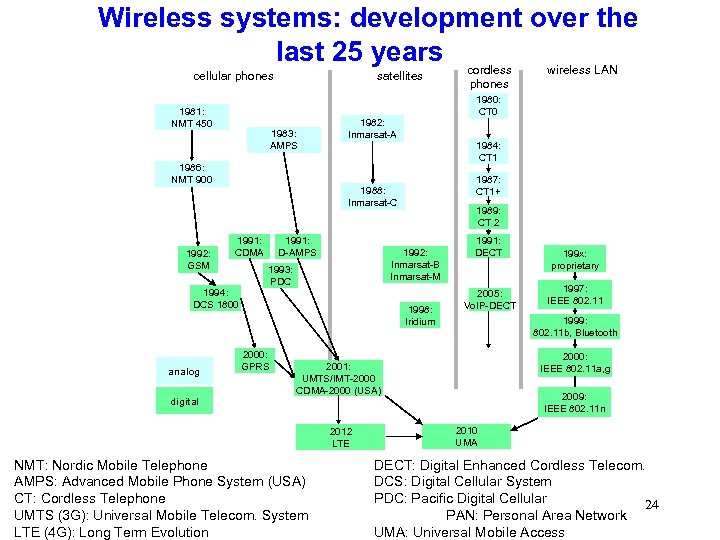
Wireless systems: development over the last 25 years cordless wireless LAN cellular phones 1981: NMT 450 satellites 1983: AMPS 1986: NMT 900 1992: GSM 1994: DCS 1800 analog digital 1980: CT 0 1982: Inmarsat-A 1984: CT 1 1987: CT 1+ 1988: Inmarsat-C 1991: CDMA 1991: D-AMPS 1989: CT 2 1992: Inmarsat-B Inmarsat-M 1993: PDC 1998: Iridium 2000: GPRS phones 1991: DECT 2005: Vo. IP-DECT NMT: Nordic Mobile Telephone AMPS: Advanced Mobile Phone System (USA) CT: Cordless Telephone UMTS (3 G): Universal Mobile Telecom. System LTE (4 G): Long Term Evolution 1997: IEEE 802. 11 1999: 802. 11 b, Bluetooth 2000: IEEE 802. 11 a, g 2001: UMTS/IMT-2000 CDMA-2000 (USA) 2012 LTE 199 x: proprietary 2009: IEEE 802. 11 n 2010 UMA DECT: Digital Enhanced Cordless Telecom. DCS: Digital Cellular System PDC: Pacific Digital Cellular 24 PAN: Personal Area Network UMA: Universal Mobile Access
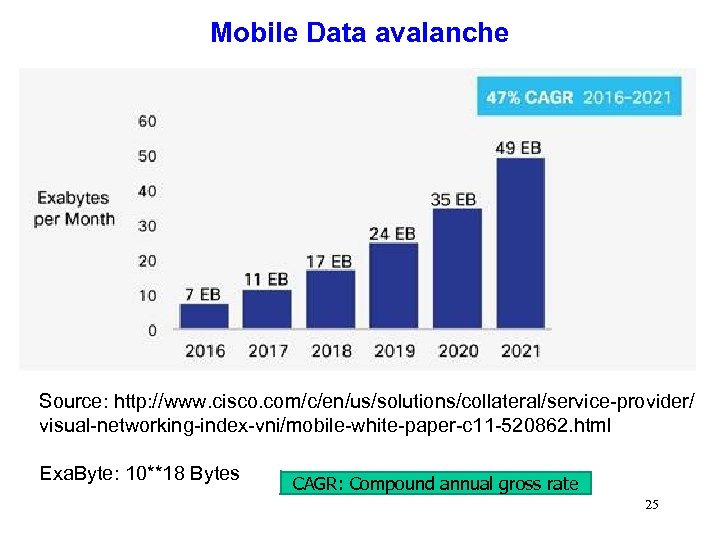
Mobile Data avalanche Source: http: //www. cisco. com/c/en/us/solutions/collateral/service-provider/ visual-networking-index-vni/mobile-white-paper-c 11 -520862. html Exa. Byte: 10**18 Bytes CAGR: Compound annual gross rate 25
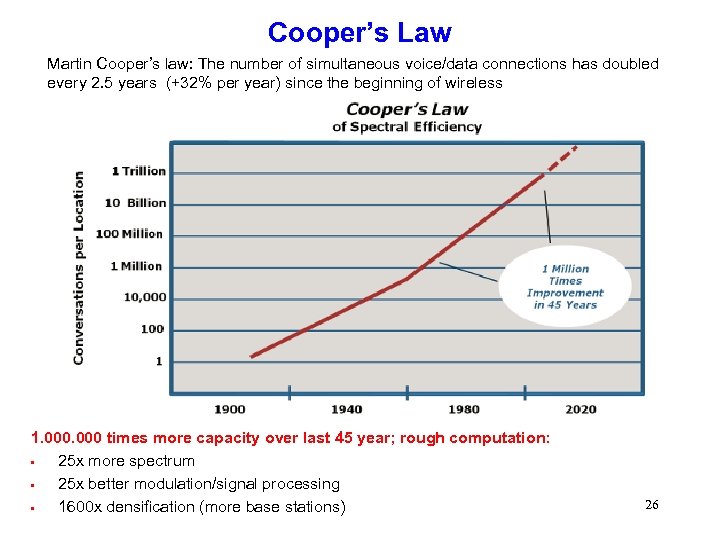
Cooper’s Law Martin Cooper’s law: The number of simultaneous voice/data connections has doubled every 2. 5 years (+32% per year) since the beginning of wireless 1. 000 times more capacity over last 45 year; rough computation: • 25 x more spectrum • 25 x better modulation/signal processing • 1600 x densification (more base stations) 26
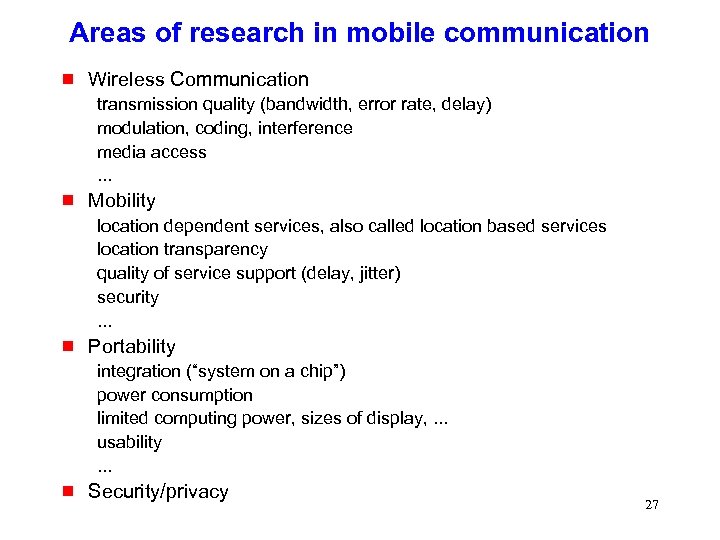
Areas of research in mobile communication g Wireless Communication transmission quality (bandwidth, error rate, delay) modulation, coding, interference media access. . . g Mobility location dependent services, also called location based services location transparency quality of service support (delay, jitter) security. . . g Portability integration (“system on a chip”) power consumption limited computing power, sizes of display, . . . usability. . . g Security/privacy 27
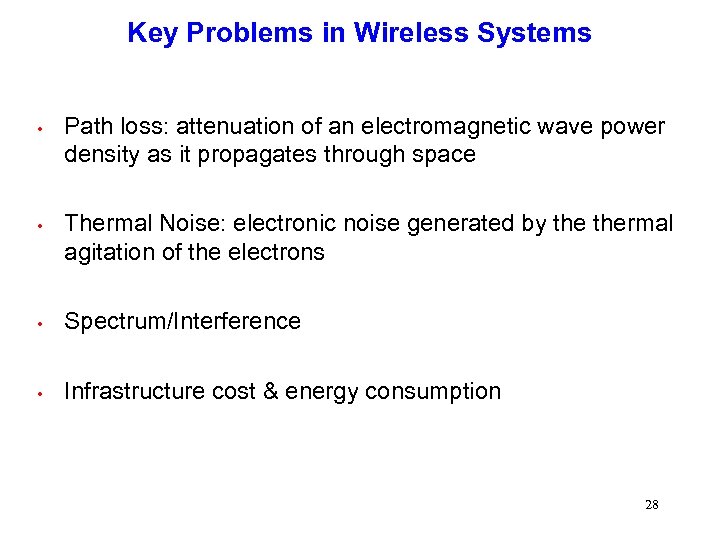
Key Problems in Wireless Systems • Path loss: attenuation of an electromagnetic wave power density as it propagates through space • Thermal Noise: electronic noise generated by thermal agitation of the electrons • Spectrum/Interference • Infrastructure cost & energy consumption 28
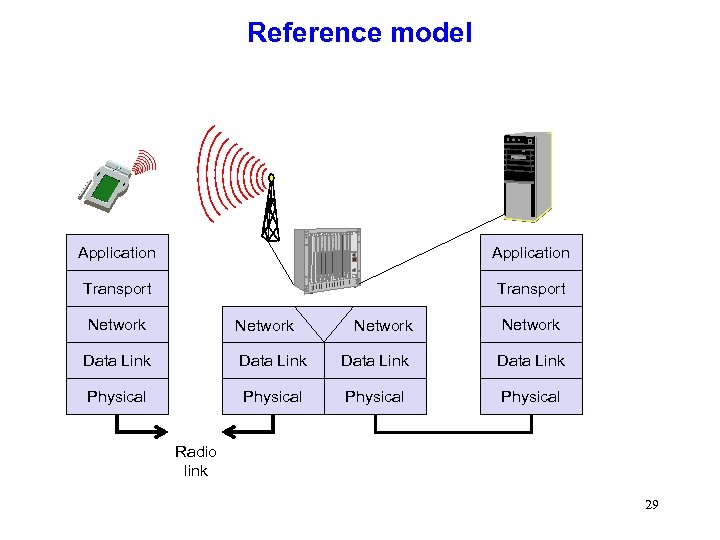
Reference model Application Transport Network Data Link Physical Radio link 29
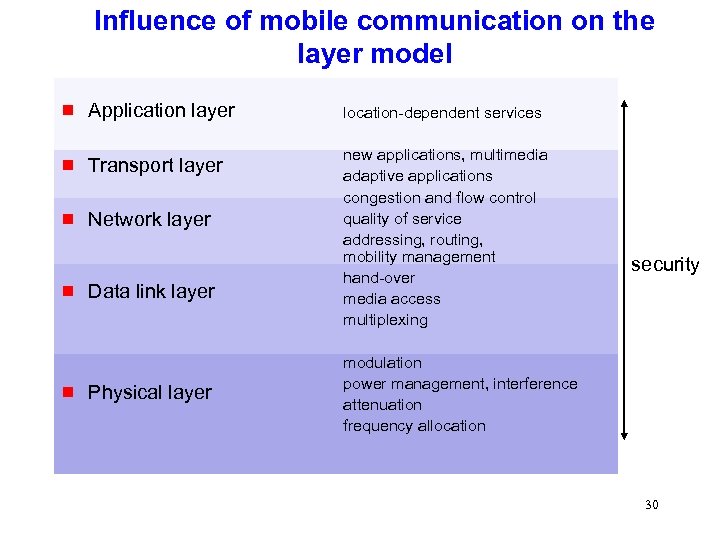
Influence of mobile communication on the layer model g Application layer location-dependent services g Transport layer g Network layer new applications, multimedia adaptive applications congestion and flow control quality of service addressing, routing, mobility management hand-over media access multiplexing g g Data link layer Physical layer security modulation power management, interference attenuation frequency allocation 30
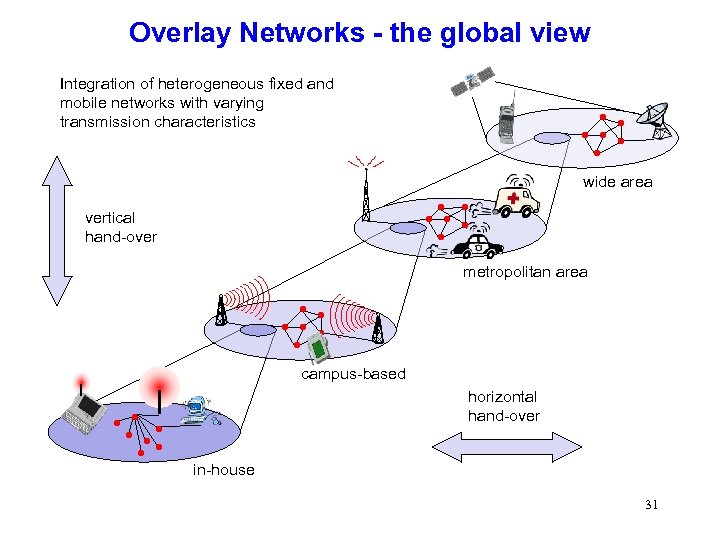
Overlay Networks - the global view Integration of heterogeneous fixed and mobile networks with varying transmission characteristics wide area vertical hand-over metropolitan area campus-based horizontal hand-over in-house 31
For Next Week - Read the Web site Mobnet. epfl. ch , including last year exams - Get the Miao et al. book (hardcopy or e-book) - Review the lecture; get prepared for the quiz !! Starts at 13: 15 - Get your clicker - - From the Library at the Rolex Learning Center, room RLC D 1 210, Monday to Friday 8: 00 – 18: 00 As mentioned, please register your clicker before next lecture! The app on smartphone or tablet is not allowed For all clicker-related issues, please contact Alexandra: alexandramihaela. olteanu@epfl. ch Try to solve the homework posted on the Moodle We will help you as of 15: 00 next time 32
References (in addition to the recommended textbooks) g g B. Walke: Mobile Radio Networks, Wiley, Second Edition, 2002 T. Rappaport: Wireless Communications, Prentice Hall, Second Edition, 2001 A. Goldsmith: Wireless Communications, Cambridge University Press, 2005 D. Tse and P. Viswanath: Fundamentals of Wireless Communication, Cambridge University Press, 2005 33
Скачать презентацию COM-405 Mobile Networks Prof Jean-Pierre Hubaux EPFL http
6071bc25118fa8944588a7a54515c9fe.ppt