


 Скачать презентацию Coloured Petri Nets Modelling and Validation of Concurrent
241b1714804f6fcd77e9565875e95f5b.ppt
- Количество слайдов: 90
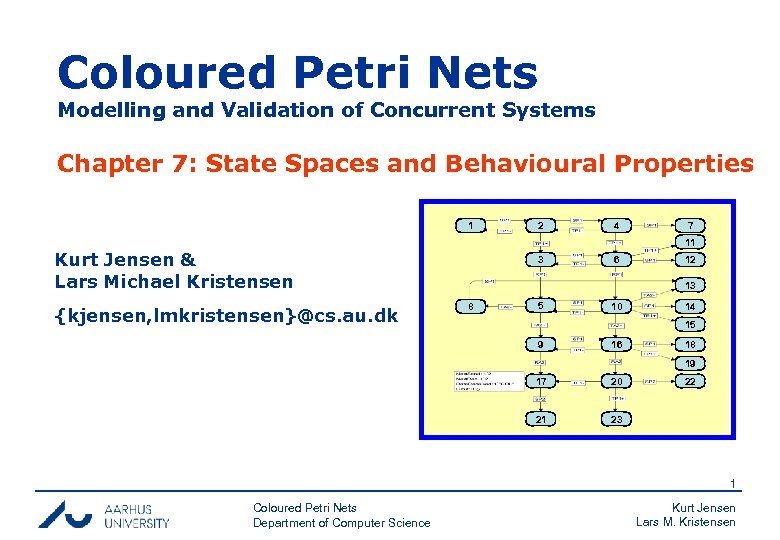 Coloured Petri Nets Modelling and Validation of Concurrent Systems Chapter 7: State Spaces and Behavioural Properties 1 2 4 7 11 Kurt Jensen & Lars Michael Kristensen {kjensen, lmkristensen}@cs. au. dk 3 6 12 13 8 5 10 14 15 9 16 18 19 17 20 21 22 23 1 Coloured Petri Nets Department of Computer Science Kurt Jensen Lars M. Kristensen
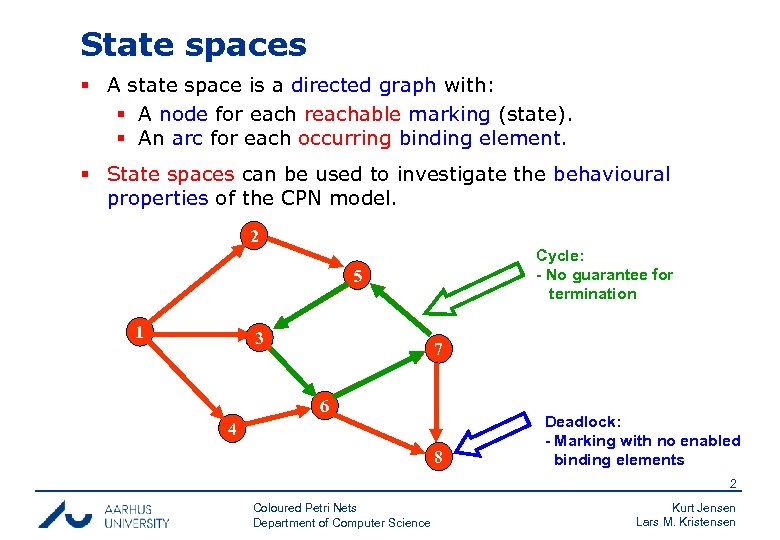 State spaces § A state space is a directed graph with: § A node for each reachable marking (state). § An arc for each occurring binding element. § State spaces can be used to investigate the behavioural properties of the CPN model. 2 Cycle: - No guarantee for termination 5 1 3 7 6 4 8 Deadlock: - Marking with no enabled binding elements 2 Coloured Petri Nets Department of Computer Science Kurt Jensen Lars M. Kristensen
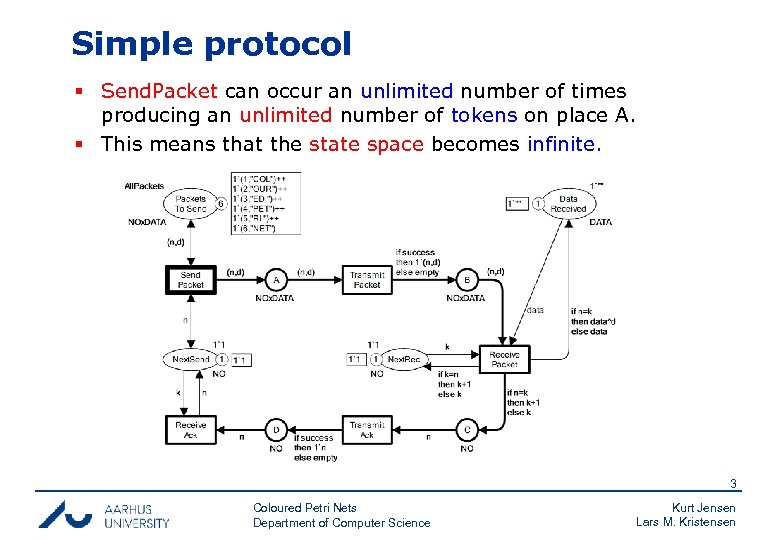 Simple protocol § Send. Packet can occur an unlimited number of times producing an unlimited number of tokens on place A. § This means that the state space becomes infinite. 3 Coloured Petri Nets Department of Computer Science Kurt Jensen Lars M. Kristensen
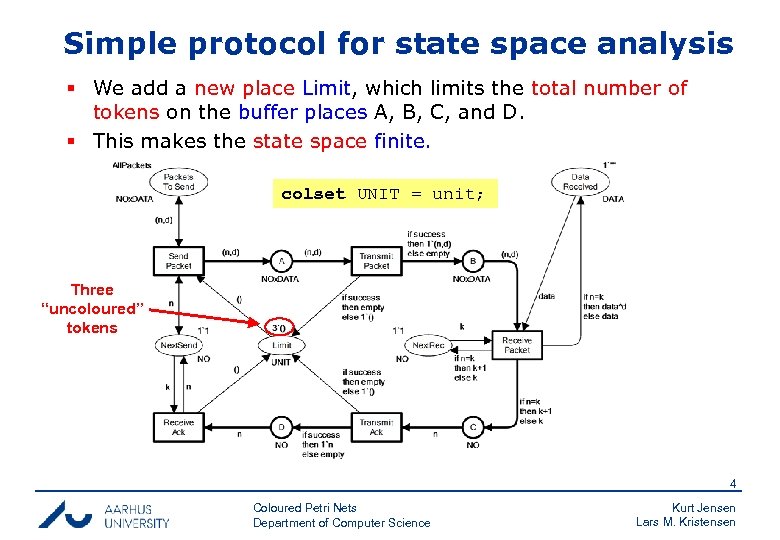 Simple protocol for state space analysis § We add a new place Limit, which limits the total number of tokens on the buffer places A, B, C, and D. § This makes the state space finite. colset UNIT = unit; Three “uncoloured” tokens 4 Coloured Petri Nets Department of Computer Science Kurt Jensen Lars M. Kristensen
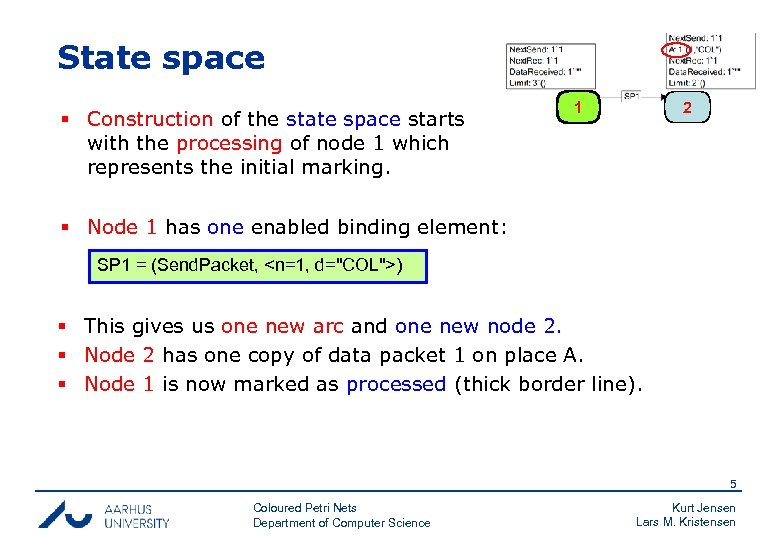 State space § Construction of the state space starts with the processing of node 1 which represents the initial marking. 1 2 § Node 1 has one enabled binding element: SP 1 = (Send. Packet,
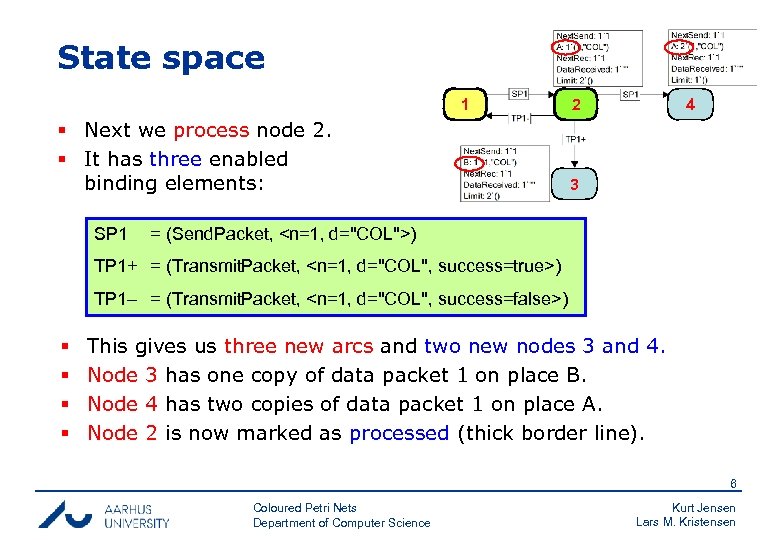 State space 1 § Next we process node 2. § It has three enabled binding elements: SP 1 2 4 3 = (Send. Packet,
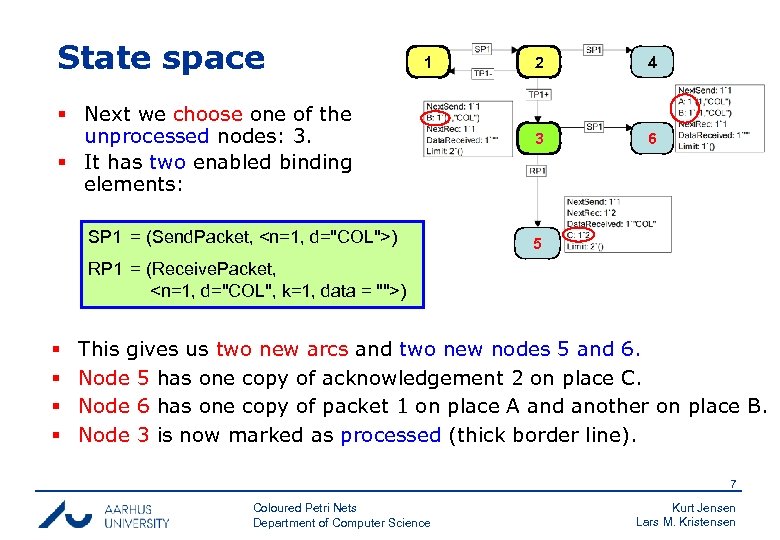 State space 1 § Next we choose one of the unprocessed nodes: 3. § It has two enabled binding elements: SP 1 = (Send. Packet,
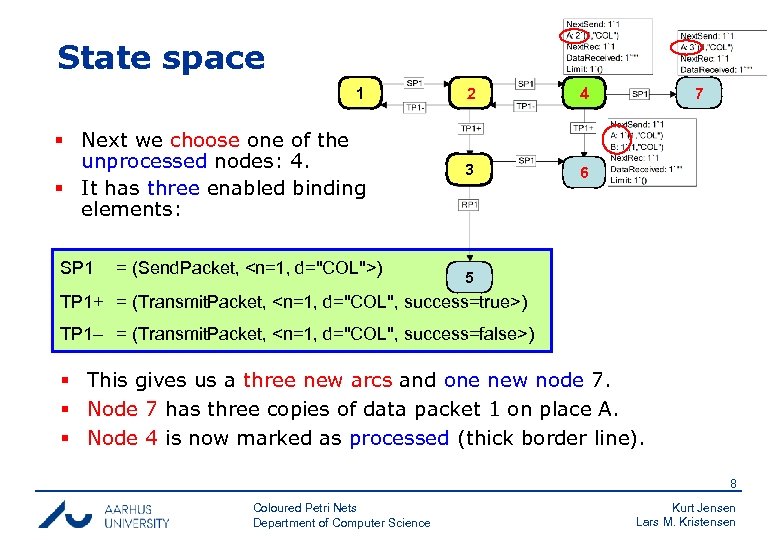 State space 1 2 4 § Next we choose one of the unprocessed nodes: 4. § It has three enabled binding elements: 3 6 SP 1 = (Send. Packet,
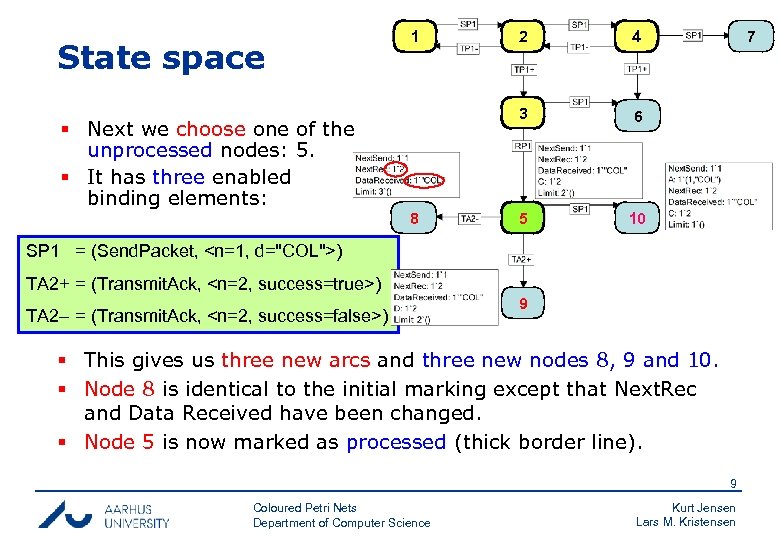 State space § Next we choose one of the unprocessed nodes: 5. § It has three enabled binding elements: 1 4 3 8 2 6 5 7 10 SP 1 = (Send. Packet,
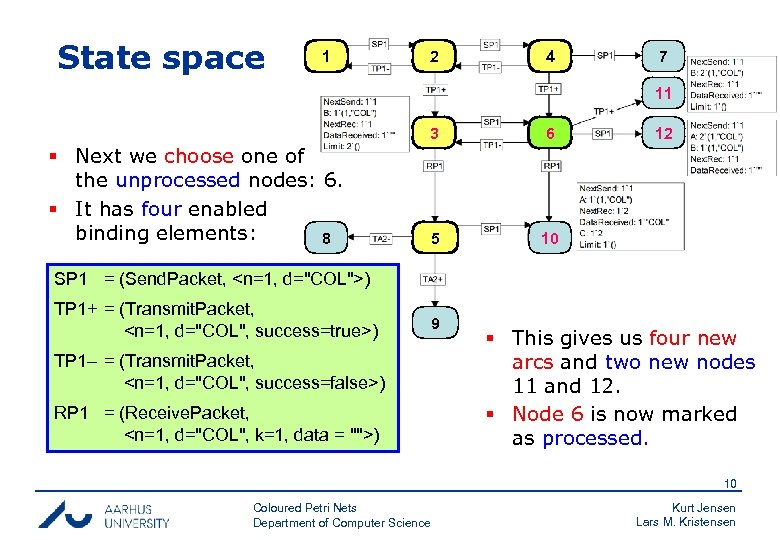 State space 1 2 4 7 11 3 6 5 10 § Next we choose one of the unprocessed nodes: 6. § It has four enabled binding elements: 8 12 SP 1 = (Send. Packet,
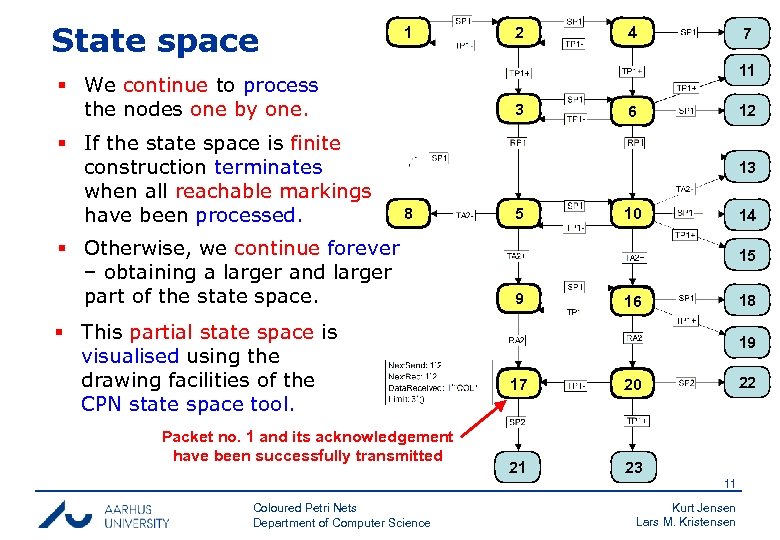 State space 1 4 7 11 § We continue to process the nodes one by one. § If the state space is finite construction terminates when all reachable markings have been processed. 2 3 12 6 13 8 § Otherwise, we continue forever – obtaining a larger and larger part of the state space. § This partial state space is visualised using the drawing facilities of the CPN state space tool. Packet no. 1 and its acknowledgement have been successfully transmitted 5 10 14 15 9 18 16 19 17 21 22 20 23 11 Coloured Petri Nets Department of Computer Science Kurt Jensen Lars M. Kristensen
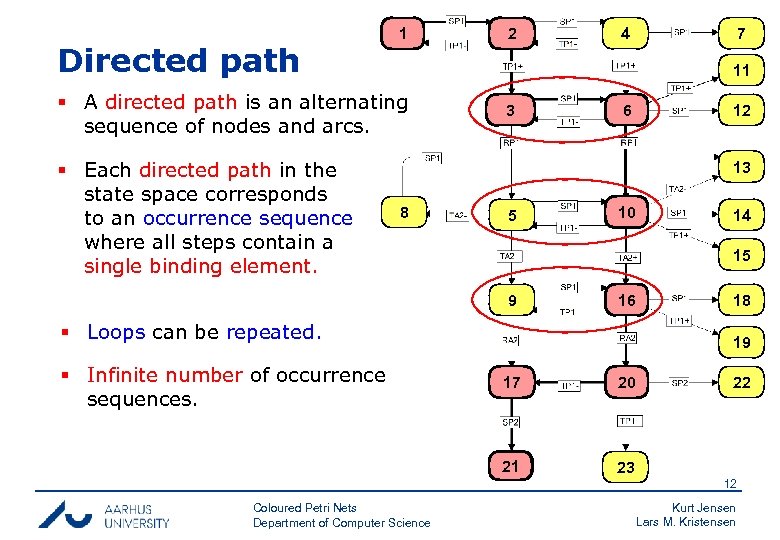 Directed path 1 4 7 11 § A directed path is an alternating sequence of nodes and arcs. § Each directed path in the state space corresponds to an occurrence sequence where all steps contain a single binding element. 2 3 6 12 13 8 5 10 15 9 16 § Loops can be repeated. § Infinite number of occurrence sequences. 14 18 19 17 20 21 22 23 12 Coloured Petri Nets Department of Computer Science Kurt Jensen Lars M. Kristensen
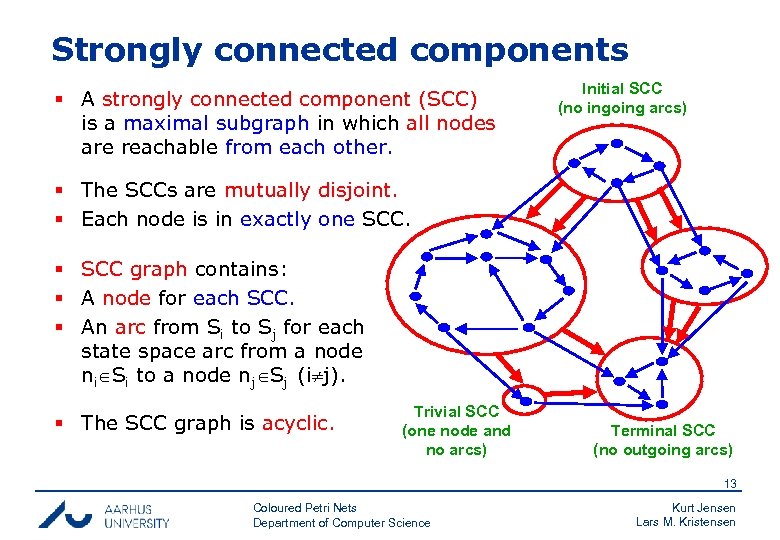 Strongly connected components § A strongly connected component (SCC) is a maximal subgraph in which all nodes are reachable from each other. Initial SCC (no ingoing arcs) § The SCCs are mutually disjoint. § Each node is in exactly one SCC. § SCC graph contains: § A node for each SCC. § An arc from Si to Sj for each state space arc from a node ni Si to a node nj Sj (i j). § The SCC graph is acyclic. Trivial SCC (one node and no arcs) Terminal SCC (no outgoing arcs) 13 Coloured Petri Nets Department of Computer Science Kurt Jensen Lars M. Kristensen
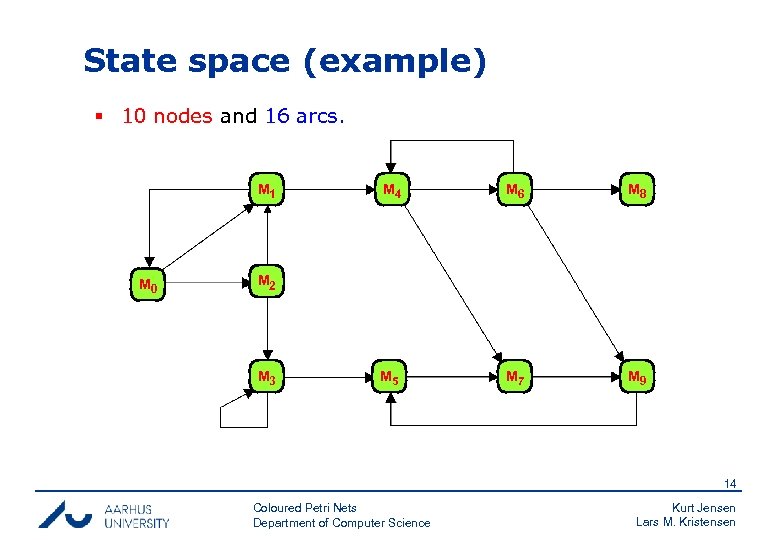 State space (example) § 10 nodes and 16 arcs. M 1 M 0 M 4 M 6 M 8 M 5 M 7 M 9 M 2 M 3 14 Coloured Petri Nets Department of Computer Science Kurt Jensen Lars M. Kristensen
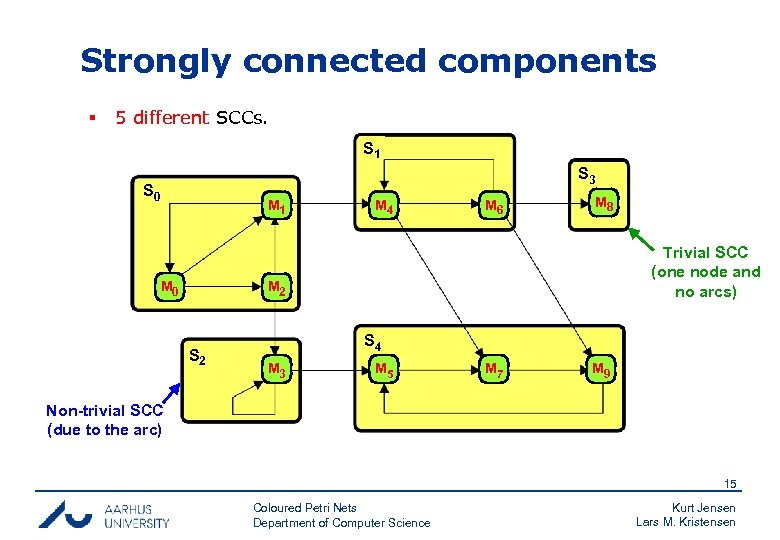 Strongly connected components § 5 different SCCs. S 1 S 3 S 0 M 1 M 0 M 4 M 6 M 8 Trivial SCC (one node and no arcs) M 2 S 4 M 3 M 5 M 7 M 9 Non-trivial SCC (due to the arc) 15 Coloured Petri Nets Department of Computer Science Kurt Jensen Lars M. Kristensen
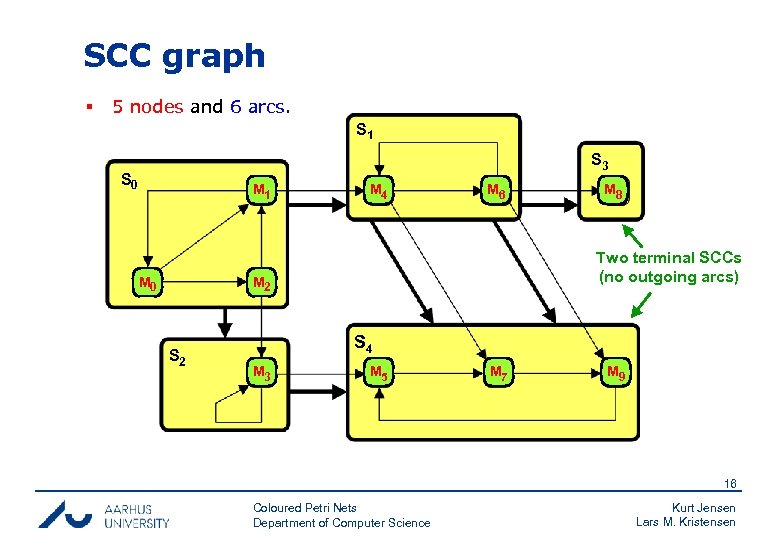 SCC graph § 5 nodes and 6 arcs. S 1 S 3 S 0 M 1 M 0 M 4 M 6 Two terminal SCCs (no outgoing arcs) M 2 S 2 M 8 S 4 M 3 M 5 M 7 M 9 16 Coloured Petri Nets Department of Computer Science Kurt Jensen Lars M. Kristensen
 State space construction and analysis § State spaces may be very large and hence we need computer tools to construct and analyse them. § Analysis of the state space starts with the generation of the state space report. § This is done totally automatic. § The report contains a lot of useful information about the behavioural properties of the CPN model. § The report is excellent for locating errors or increase our confidence in the correctness of the system. 17 Coloured Petri Nets Department of Computer Science Kurt Jensen Lars M. Kristensen
 State space report § The state space report contains information about standard behavioural properties which make sense for all CPN models: § Size of the state space and the time used to generate it. § Bounds for the number of tokens on each place and information about the possible token colours. § Home markings. § Dead and live transitions. § Fairness properties for transitions. 18 Coloured Petri Nets Department of Computer Science Kurt Jensen Lars M. Kristensen
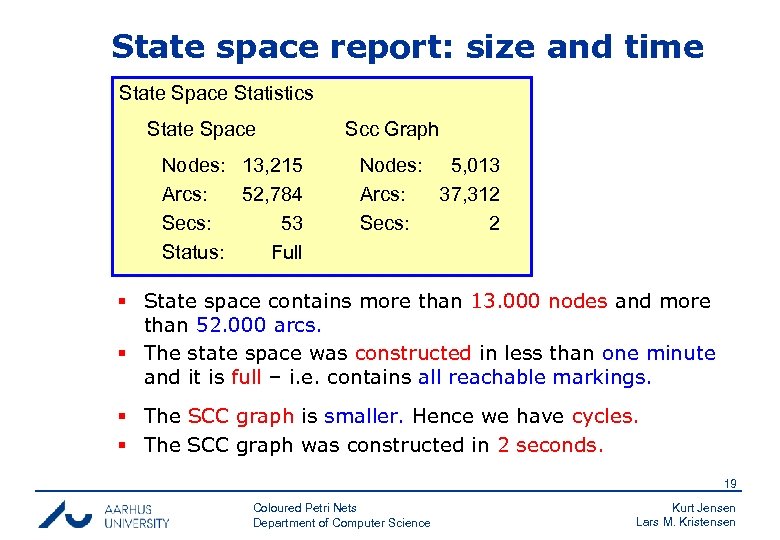 State space report: size and time State Space Statistics State Space Nodes: 13, 215 Arcs: 52, 784 Secs: 53 Status: Full Scc Graph Nodes: 5, 013 Arcs: 37, 312 Secs: 2 § State space contains more than 13. 000 nodes and more than 52. 000 arcs. § The state space was constructed in less than one minute and it is full – i. e. contains all reachable markings. § The SCC graph is smaller. Hence we have cycles. § The SCC graph was constructed in 2 seconds. 19 Coloured Petri Nets Department of Computer Science Kurt Jensen Lars M. Kristensen
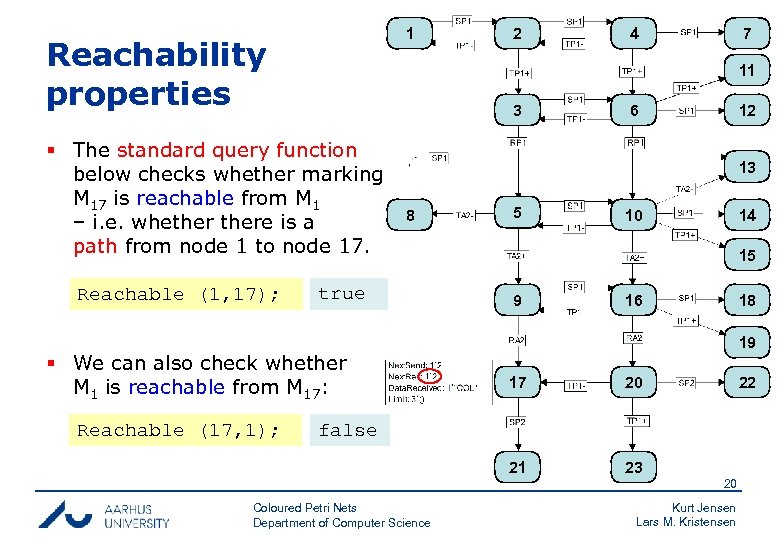 1 Reachability properties 4 3 6 12 13 8 true § We can also check whether M 1 is reachable from M 17: 5 10 14 15 9 16 18 19 17 20 21 Reachable (17, 1); 7 11 § The standard query function below checks whether marking M 17 is reachable from M 1 – i. e. whethere is a path from node 1 to node 17. Reachable (1, 17); 2 22 23 false 20 Coloured Petri Nets Department of Computer Science Kurt Jensen Lars M. Kristensen
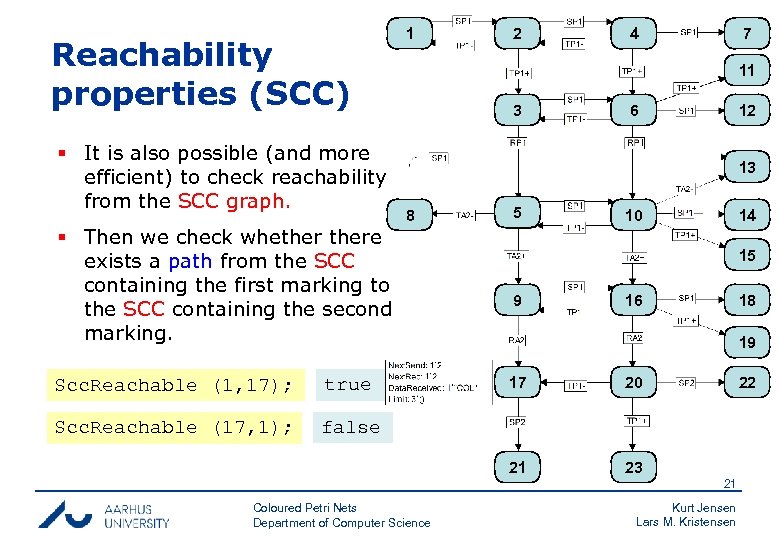 Reachability properties (SCC) § It is also possible (and more efficient) to check reachability from the SCC graph. § Then we check whethere exists a path from the SCC containing the first marking to the SCC containing the second marking. 1 2 4 11 3 6 8 true Scc. Reachable (17, 1); 12 13 5 10 14 15 9 16 18 19 17 20 21 Scc. Reachable (1, 17); 7 22 23 false 21 Coloured Petri Nets Department of Computer Science Kurt Jensen Lars M. Kristensen
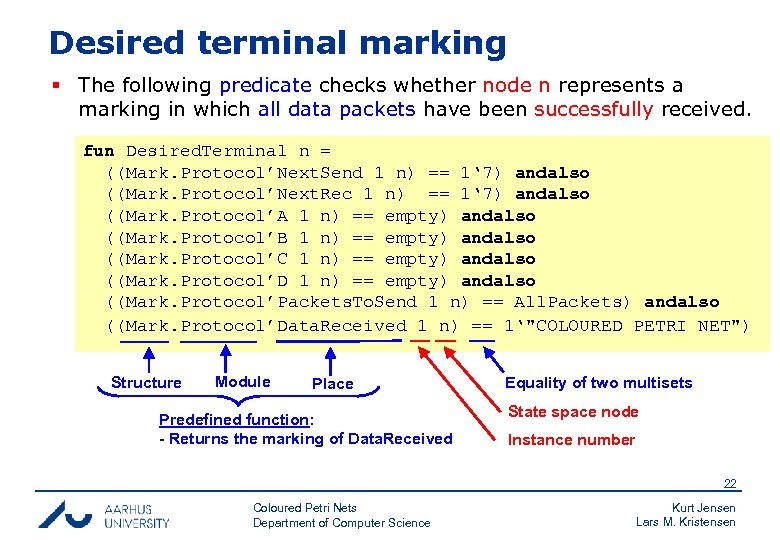 Desired terminal marking § The following predicate checks whether node n represents a marking in which all data packets have been successfully received. fun Desired. Terminal n = ((Mark. Protocol’Next. Send 1 n) == 1‘ 7) andalso ((Mark. Protocol’Next. Rec 1 n) == 1‘ 7) andalso ((Mark. Protocol’A 1 n) == empty) andalso ((Mark. Protocol’B 1 n) == empty) andalso ((Mark. Protocol’C 1 n) == empty) andalso ((Mark. Protocol’D 1 n) == empty) andalso ((Mark. Protocol’Packets. To. Send 1 n) == All. Packets) andalso ((Mark. Protocol’Data. Received 1 n) == 1‘"COLOURED PETRI NET") Structure Module Place Predefined function: - Returns the marking of Data. Received Equality of two multisets State space node Instance number 22 Coloured Petri Nets Department of Computer Science Kurt Jensen Lars M. Kristensen
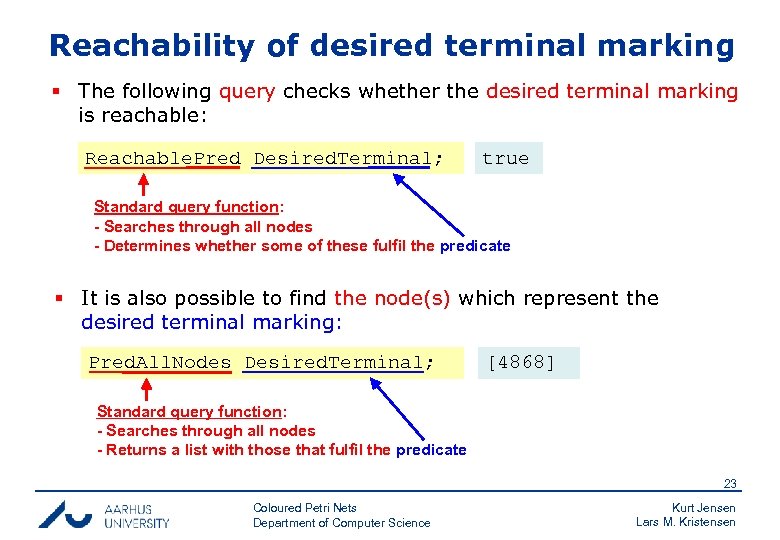 Reachability of desired terminal marking § The following query checks whether the desired terminal marking is reachable: Reachable. Pred Desired. Terminal; true Standard query function: - Searches through all nodes - Determines whether some of these fulfil the predicate § It is also possible to find the node(s) which represent the desired terminal marking: Pred. All. Nodes Desired. Terminal; [4868] Standard query function: - Searches through all nodes - Returns a list with those that fulfil the predicate 23 Coloured Petri Nets Department of Computer Science Kurt Jensen Lars M. Kristensen
 State space report: reachability properties § The state space report does not contain information about reachability properties. § The specific markings which it is of interest to investigate is highly model dependent – and there are too many to investigate all pairs. § The statistics in the state space report for the protocol shows that there are more than one SCC. § This implies that not all nodes in the state space are mutually reachable – as demonstrated above using standard query functions. 24 Coloured Petri Nets Department of Computer Science Kurt Jensen Lars M. Kristensen
 Integer bounds § Integer bounds counts the number of tokens on a place. § The best upper integer bound for a place is the maximal number of tokens on the place in a reachable marking. § The best lower integer bound for a place is the minimal number of tokens on the place in a reachable marking. § Places with an upper integer bound are bounded. § Places with no upper integer bound are unbounded. § 0 is always a lower integer bound, but it may not be the best. 25 Coloured Petri Nets Department of Computer Science Kurt Jensen Lars M. Kristensen
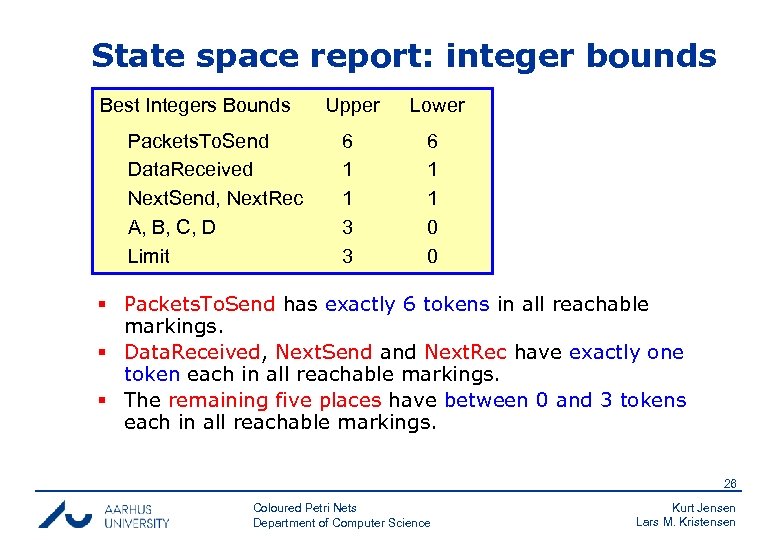 State space report: integer bounds Best Integers Bounds Packets. To. Send Data. Received Next. Send, Next. Rec A, B, C, D Limit Upper Lower 6 1 1 3 3 6 1 1 0 0 § Packets. To. Send has exactly 6 tokens in all reachable markings. § Data. Received, Next. Send and Next. Rec have exactly one token each in all reachable markings. § The remaining five places have between 0 and 3 tokens each in all reachable markings. 26 Coloured Petri Nets Department of Computer Science Kurt Jensen Lars M. Kristensen
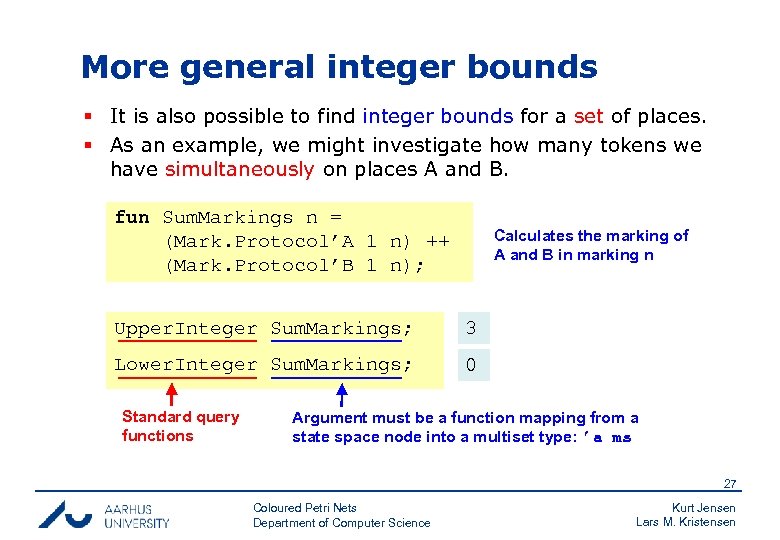 More general integer bounds § It is also possible to find integer bounds for a set of places. § As an example, we might investigate how many tokens we have simultaneously on places A and B. fun Sum. Markings n = (Mark. Protocol’A 1 n) ++ (Mark. Protocol’B 1 n); Calculates the marking of A and B in marking n Upper. Integer Sum. Markings; 3 Lower. Integer Sum. Markings; 0 Standard query functions Argument must be a function mapping from a state space node into a multiset type: ’a ms 27 Coloured Petri Nets Department of Computer Science Kurt Jensen Lars M. Kristensen
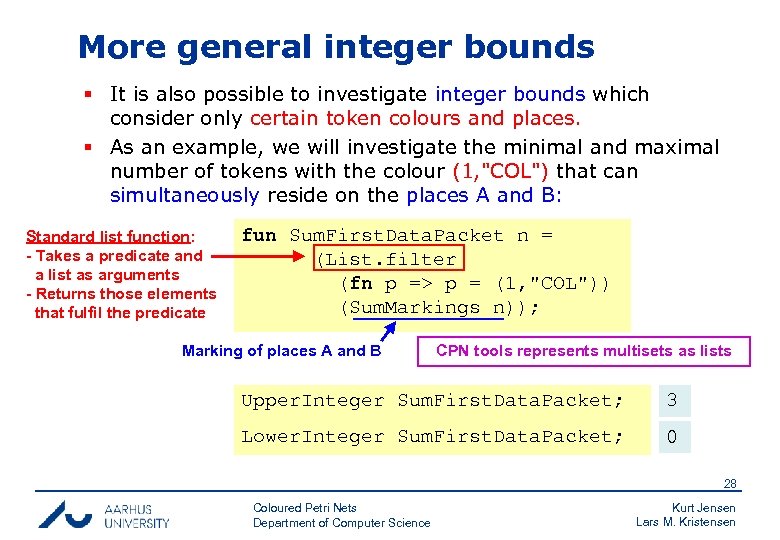 More general integer bounds § It is also possible to investigate integer bounds which consider only certain token colours and places. § As an example, we will investigate the minimal and maximal number of tokens with the colour (1, "COL") that can simultaneously reside on the places A and B: Standard list function: - Takes a predicate and a list as arguments - Returns those elements that fulfil the predicate fun Sum. First. Data. Packet n = (List. filter (fn p => p = (1, "COL")) (Sum. Markings n)); Marking of places A and B CPN tools represents multisets as lists Upper. Integer Sum. First. Data. Packet; 3 Lower. Integer Sum. First. Data. Packet; 0 28 Coloured Petri Nets Department of Computer Science Kurt Jensen Lars M. Kristensen
 Multiset bounds § Integer bounds count the number of tokens ignoring the token colours. § Multiset bounds provide information about the possible token colours. § The best upper multiset bound for a place is a multiset over the colour set of the place. § The coefficient for a colour c is the maximal number of occurrences of tokens with colour c in a reachable marking. § The best lower multiset bound for a place is a multiset over the colour set of the place. § The coefficient for a colour c is the minimal number of occurrences of tokens with colour c in a reachable marking. 29 Coloured Petri Nets Department of Computer Science Kurt Jensen Lars M. Kristensen
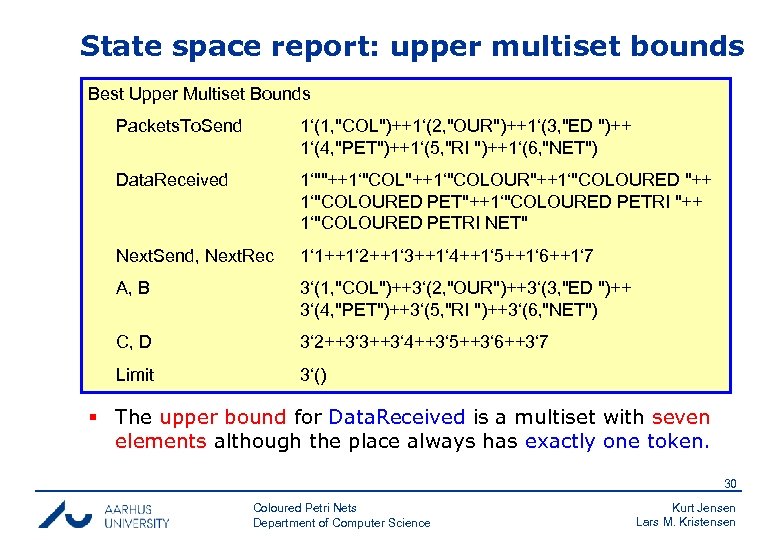 State space report: upper multiset bounds Best Upper Multiset Bounds Packets. To. Send 1‘(1, "COL")++1‘(2, "OUR")++1‘(3, "ED ")++ 1‘(4, "PET")++1‘(5, "RI ")++1‘(6, "NET") Data. Received 1‘""++1‘"COLOUR"++1‘"COLOURED "++ 1‘"COLOURED PET"++1‘"COLOURED PETRI "++ 1‘"COLOURED PETRI NET" Next. Send, Next. Rec 1‘ 1++1‘ 2++1‘ 3++1‘ 4++1‘ 5++1‘ 6++1‘ 7 A, B 3‘(1, "COL")++3‘(2, "OUR")++3‘(3, "ED ")++ 3‘(4, "PET")++3‘(5, "RI ")++3‘(6, "NET") C, D 3‘ 2++3‘ 3++3‘ 4++3‘ 5++3‘ 6++3‘ 7 Limit 3‘() § The upper bound for Data. Received is a multiset with seven elements although the place always has exactly one token. 30 Coloured Petri Nets Department of Computer Science Kurt Jensen Lars M. Kristensen
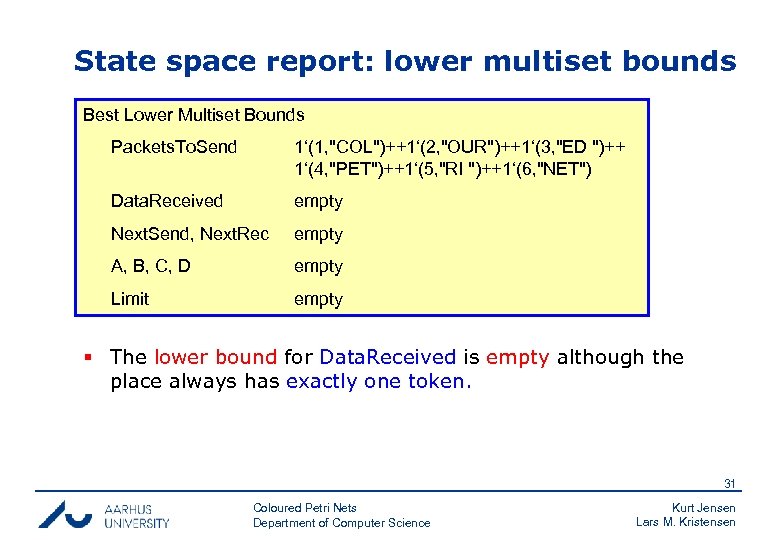 State space report: lower multiset bounds Best Lower Multiset Bounds Packets. To. Send 1‘(1, "COL")++1‘(2, "OUR")++1‘(3, "ED ")++ 1‘(4, "PET")++1‘(5, "RI ")++1‘(6, "NET") Data. Received empty Next. Send, Next. Rec empty A, B, C, D empty Limit empty § The lower bound for Data. Received is empty although the place always has exactly one token. 31 Coloured Petri Nets Department of Computer Science Kurt Jensen Lars M. Kristensen
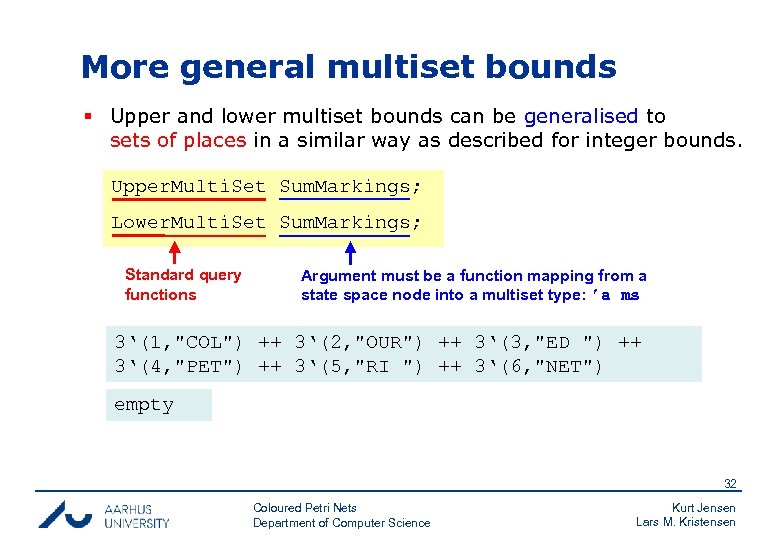 More general multiset bounds § Upper and lower multiset bounds can be generalised to sets of places in a similar way as described for integer bounds. Upper. Multi. Set Sum. Markings; Lower. Multi. Set Sum. Markings; Standard query functions Argument must be a function mapping from a state space node into a multiset type: ’a ms 3‘(1, "COL") ++ 3‘(2, "OUR") ++ 3‘(3, "ED ") ++ 3‘(4, "PET") ++ 3‘(5, "RI ") ++ 3‘(6, "NET") empty 32 Coloured Petri Nets Department of Computer Science Kurt Jensen Lars M. Kristensen
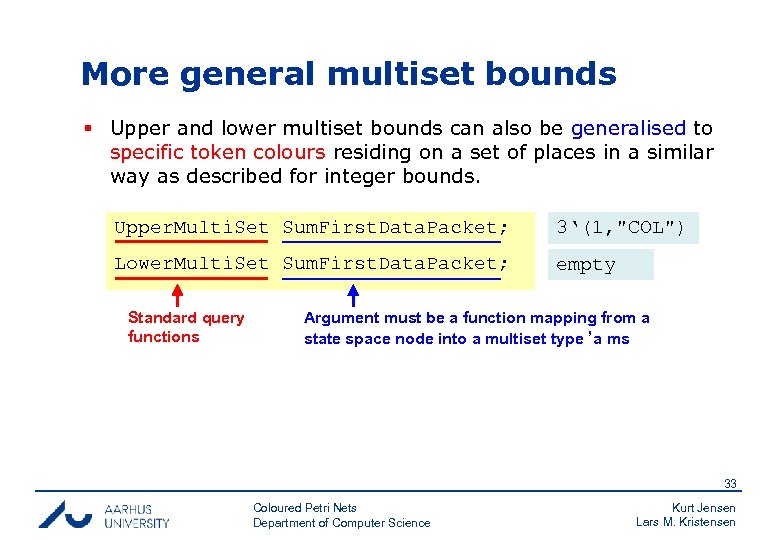 More general multiset bounds § Upper and lower multiset bounds can also be generalised to specific token colours residing on a set of places in a similar way as described for integer bounds. Upper. Multi. Set Sum. First. Data. Packet; 3‘(1, "COL") Lower. Multi. Set Sum. First. Data. Packet; empty Standard query functions Argument must be a function mapping from a state space node into a multiset type ’a ms 33 Coloured Petri Nets Department of Computer Science Kurt Jensen Lars M. Kristensen
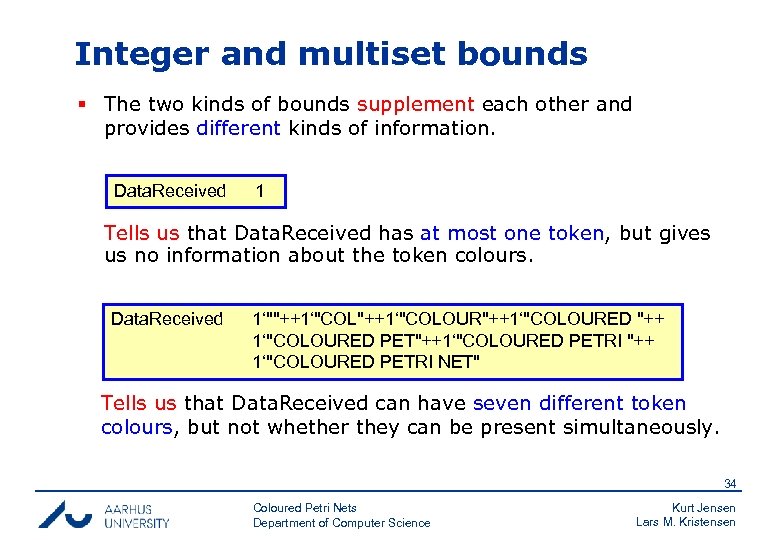 Integer and multiset bounds § The two kinds of bounds supplement each other and provides different kinds of information. Data. Received 1 Tells us that Data. Received has at most one token, but gives us no information about the token colours. Data. Received 1‘""++1‘"COLOUR"++1‘"COLOURED "++ 1‘"COLOURED PET"++1‘"COLOURED PETRI "++ 1‘"COLOURED PETRI NET" Tells us that Data. Received can have seven different token colours, but not whether they can be present simultaneously. 34 Coloured Petri Nets Department of Computer Science Kurt Jensen Lars M. Kristensen
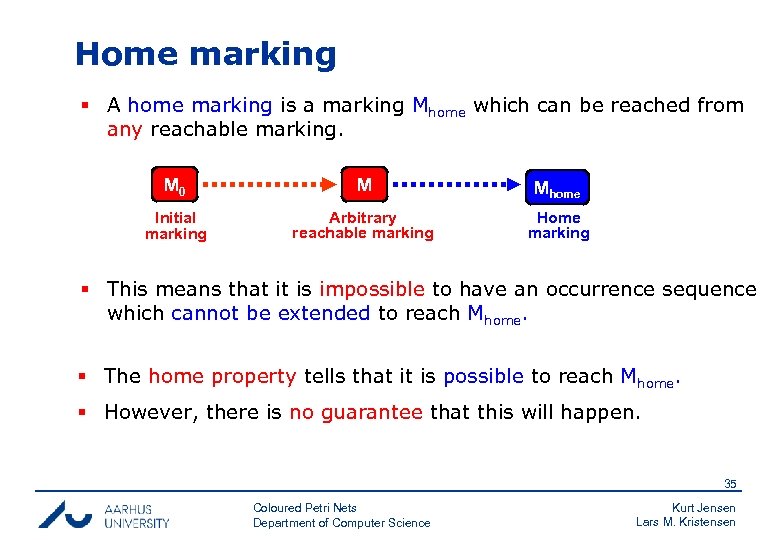 Home marking § A home marking is a marking Mhome which can be reached from any reachable marking. M 0 M Mhome Initial marking Arbitrary reachable marking Home marking § This means that it is impossible to have an occurrence sequence which cannot be extended to reach Mhome. § The home property tells that it is possible to reach Mhome. § However, there is no guarantee that this will happen. 35 Coloured Petri Nets Department of Computer Science Kurt Jensen Lars M. Kristensen
![State space report: home markings Home Properties Home Markings: [4868] § There is a](https://present5.com/presentation/241b1714804f6fcd77e9565875e95f5b/image-36.jpg "State space report: home markings Home Properties Home Markings: [4868] § There is a") State space report: home markings Home Properties Home Markings: [4868] § There is a single home marking represented by node number 4868. § The marking of this node can be shown in the CPN simulator. 36 Coloured Petri Nets Department of Computer Science Kurt Jensen Lars M. Kristensen
State space report: home markings Home Properties Home Markings: [4868] § There is a single home marking represented by node number 4868. § The marking of this node can be shown in the CPN simulator. 36 Coloured Petri Nets Department of Computer Science Kurt Jensen Lars M. Kristensen
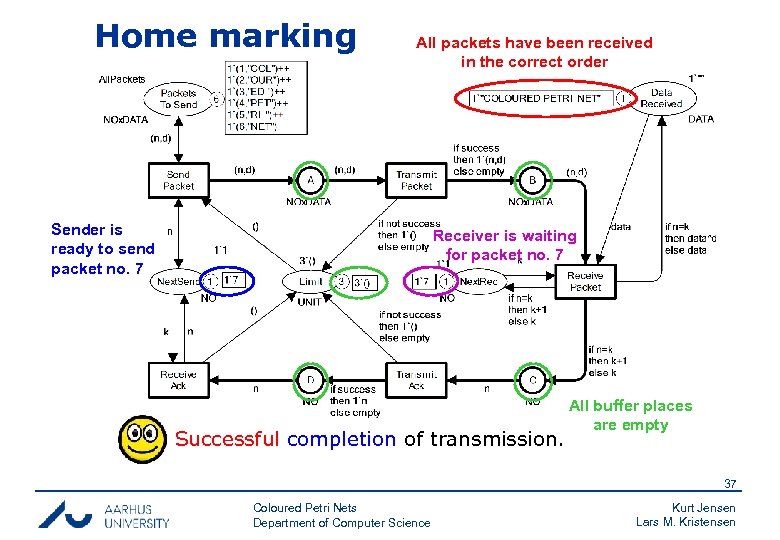 Home marking All packets have been received in the correct order Sender is ready to send packet no. 7 Receiver is waiting for packet no. 7 § Successful completion of transmission. All buffer places are empty 37 Coloured Petri Nets Department of Computer Science Kurt Jensen Lars M. Kristensen
 Home space § A home space is a set of markings M*home such that at least one marking in M*home can be reached from any reachable marking. M 13 M 0 M Initial marking Arbitrary reachable marking M 57 M 24 M*home M 456 M 5278 Home space § This means that it is impossible to have an occurrence sequence which cannot be extended to reach a marking in M*home. § The home property tells that it is possible to reach a marking in M*home. § However, there is no guarantee that this will happen. 38 Coloured Petri Nets Department of Computer Science Kurt Jensen Lars M. Kristensen
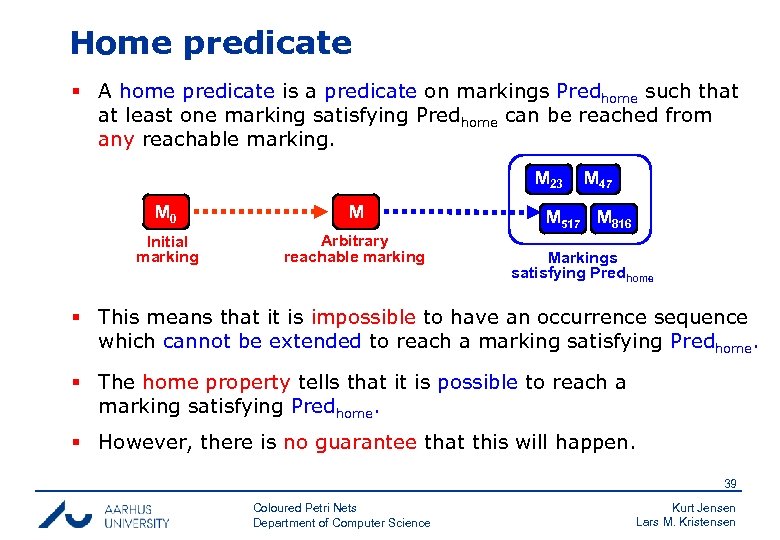 Home predicate § A home predicate is a predicate on markings Predhome such that at least one marking satisfying Predhome can be reached from any reachable marking. M 23 M 0 M Initial marking Arbitrary reachable marking M 47 M 517 M 816 Markings satisfying Predhome § This means that it is impossible to have an occurrence sequence which cannot be extended to reach a marking satisfying Predhome. § The home property tells that it is possible to reach a marking satisfying Predhome. § However, there is no guarantee that this will happen. 39 Coloured Petri Nets Department of Computer Science Kurt Jensen Lars M. Kristensen
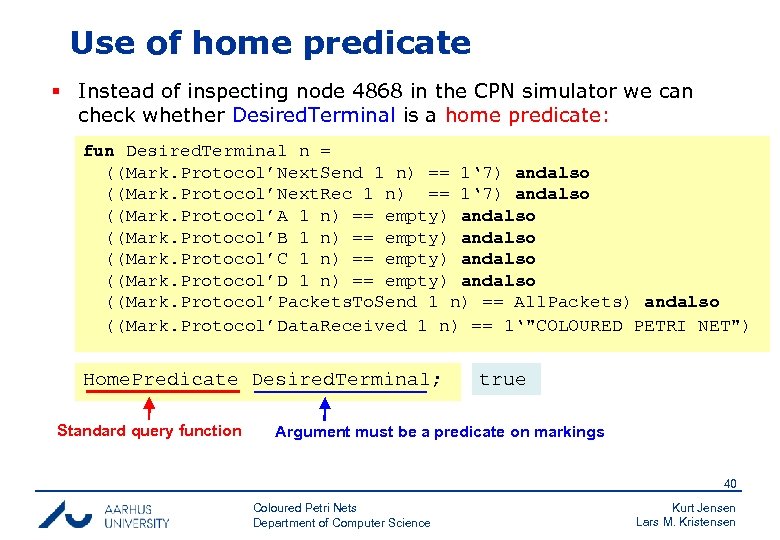 Use of home predicate § Instead of inspecting node 4868 in the CPN simulator we can check whether Desired. Terminal is a home predicate: fun Desired. Terminal n = ((Mark. Protocol’Next. Send 1 n) == 1‘ 7) andalso ((Mark. Protocol’Next. Rec 1 n) == 1‘ 7) andalso ((Mark. Protocol’A 1 n) == empty) andalso ((Mark. Protocol’B 1 n) == empty) andalso ((Mark. Protocol’C 1 n) == empty) andalso ((Mark. Protocol’D 1 n) == empty) andalso ((Mark. Protocol’Packets. To. Send 1 n) == All. Packets) andalso ((Mark. Protocol’Data. Received 1 n) == 1‘"COLOURED PETRI NET") Home. Predicate Desired. Terminal; Standard query function true Argument must be a predicate on markings 40 Coloured Petri Nets Department of Computer Science Kurt Jensen Lars M. Kristensen
 Use of home properties to locate errors § Home properties are excellent to locate certain kinds of errors. § As an example, consider a CPN model of a telephone system. § If all users stop calling and terminate all ongoing calls, the system is expected to reach an idle system state in which all lines and all equipment are unused and no calls are in progress. § The idle system state will be represented: § by a home marking (if the system is without memory), § by a home space (if information is stored about prior activities). § If one or more reachable markings exist from which we cannot reach the idle system state, we may have made a modelling error or a design error – e. g. , forgotten to return some resources. 41 Coloured Petri Nets Department of Computer Science Kurt Jensen Lars M. Kristensen
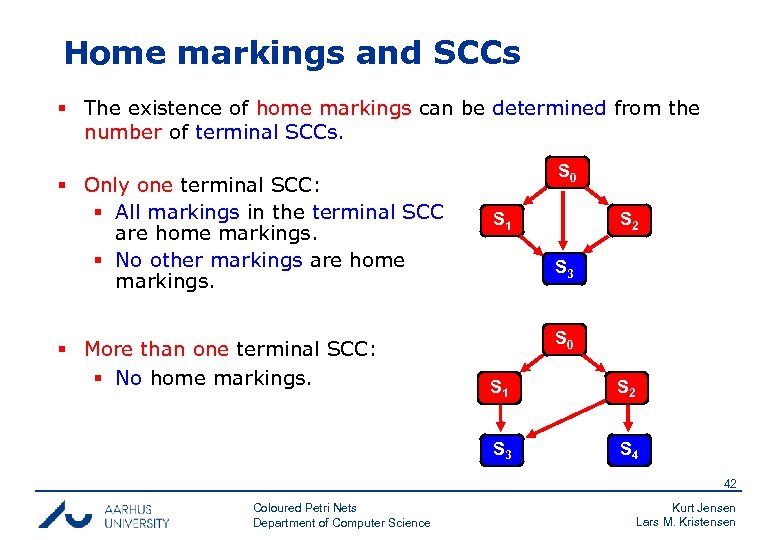 Home markings and SCCs § The existence of home markings can be determined from the number of terminal SCCs. § Only one terminal SCC: § All markings in the terminal SCC are home markings. § No other markings are home markings. § More than one terminal SCC: § No home markings. S 0 S 2 S 1 S 3 S 0 S 1 S 2 S 3 S 4 42 Coloured Petri Nets Department of Computer Science Kurt Jensen Lars M. Kristensen
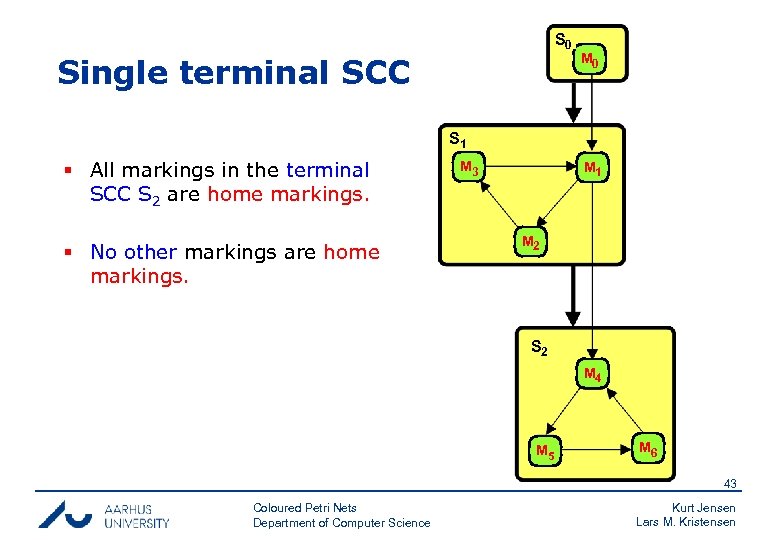 S 0 Single terminal SCC M 0 S 1 § All markings in the terminal SCC S 2 are home markings. § No other markings are home markings. M 3 M 1 M 2 S 2 M 4 M 5 M 6 43 Coloured Petri Nets Department of Computer Science Kurt Jensen Lars M. Kristensen
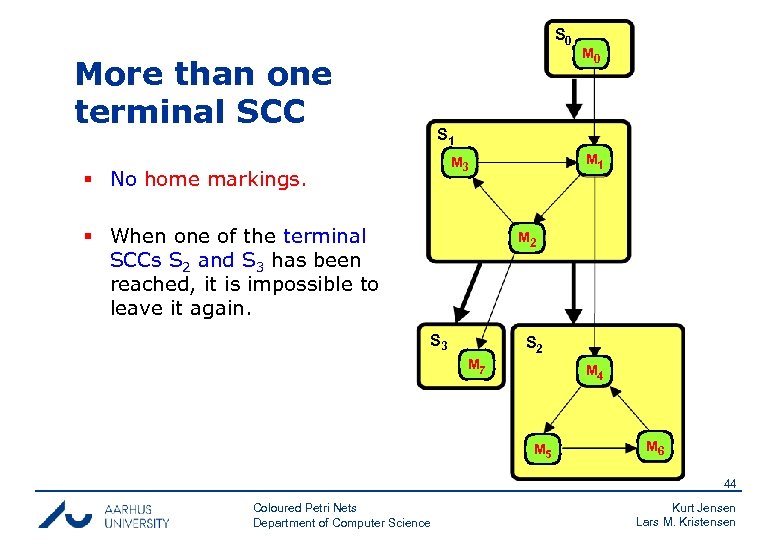 S 0 More than one terminal SCC M 0 S 1 M 3 § No home markings. § When one of the terminal SCCs S 2 and S 3 has been reached, it is impossible to leave it again. M 2 S 3 S 2 M 7 M 4 M 5 M 6 44 Coloured Petri Nets Department of Computer Science Kurt Jensen Lars M. Kristensen
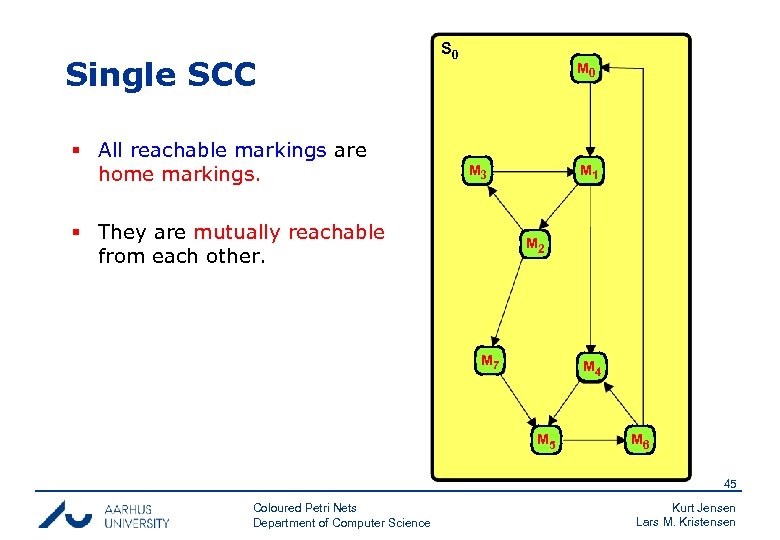 Single SCC § All reachable markings are home markings. S 0 M 3 § They are mutually reachable from each other. M 1 M 2 M 7 M 4 M 5 M 6 45 Coloured Petri Nets Department of Computer Science Kurt Jensen Lars M. Kristensen
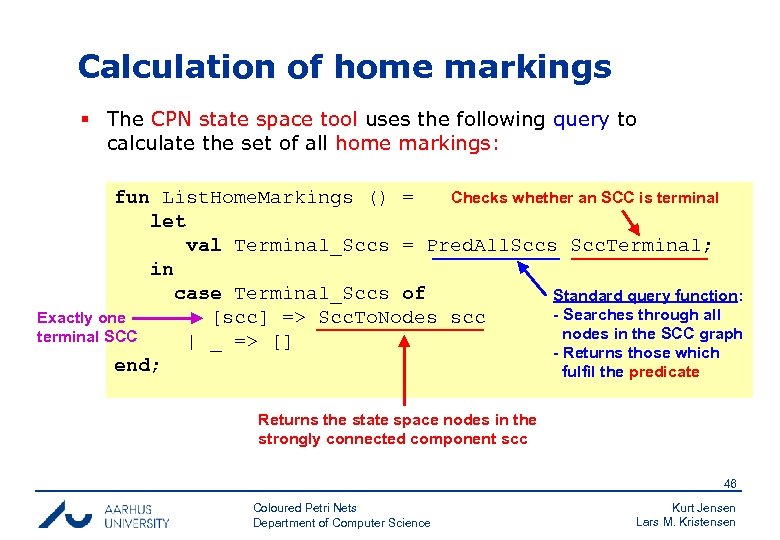 Calculation of home markings § The CPN state space tool uses the following query to calculate the set of all home markings: Checks whether an SCC is terminal fun List. Home. Markings () = let val Terminal_Sccs = Pred. All. Sccs Scc. Terminal; in case Terminal_Sccs of Standard query function: - Searches through all Exactly one [scc] => Scc. To. Nodes scc nodes in the SCC graph terminal SCC | _ => [] - Returns those which end; fulfil the predicate Returns the state space nodes in the strongly connected component scc 46 Coloured Petri Nets Department of Computer Science Kurt Jensen Lars M. Kristensen
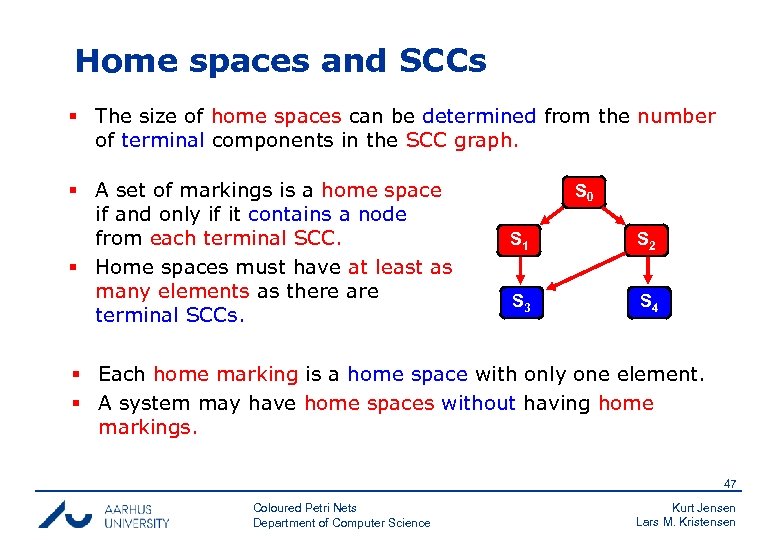 Home spaces and SCCs § The size of home spaces can be determined from the number of terminal components in the SCC graph. § A set of markings is a home space if and only if it contains a node from each terminal SCC. § Home spaces must have at least as many elements as there are terminal SCCs. S 0 S 1 S 2 S 3 S 4 § Each home marking is a home space with only one element. § A system may have home spaces without having home markings. 47 Coloured Petri Nets Department of Computer Science Kurt Jensen Lars M. Kristensen
 Liveness properties – being dead § A marking M is dead if M has no enabled transitions. § A transition t is dead if t never can occur – i. e. is disabled in all reachable markings. § Generalisations: § A binding element is dead if it can never become enabled. § A set of binding elements is dead if none of the binding elements can become enabled. § A set of transitions is dead if the union of their binding elements is dead. 48 Coloured Petri Nets Department of Computer Science Kurt Jensen Lars M. Kristensen
![State space report: being dead Liveness Properties Dead Markings: [4868] Dead Transitions: None Live](https://present5.com/presentation/241b1714804f6fcd77e9565875e95f5b/image-49.jpg "State space report: being dead Liveness Properties Dead Markings: [4868] Dead Transitions: None Live") State space report: being dead Liveness Properties Dead Markings: [4868] Dead Transitions: None Live Transitions: None § There is a single dead marking represented by node number 4868. § Same marking as home marking. § There are no dead transitions. 49 Coloured Petri Nets Department of Computer Science Kurt Jensen Lars M. Kristensen
State space report: being dead Liveness Properties Dead Markings: [4868] Dead Transitions: None Live Transitions: None § There is a single dead marking represented by node number 4868. § Same marking as home marking. § There are no dead transitions. 49 Coloured Petri Nets Department of Computer Science Kurt Jensen Lars M. Kristensen
 Marking no 4868 § We have seen that marking M 4868 represents the state in which we have achieved successful completion of the transmission. § M 4868 is the only dead marking. § Tells us that the system is partially correct. If execution terminates we will have the correct result. § M 4868 is a home marking. § Tells us that it always is possible to reach the correct result – independently of the number of losses and overtakings. 50 Coloured Petri Nets Department of Computer Science Kurt Jensen Lars M. Kristensen
 Being dead § It is straightforward to check whether markings, transitions and binding elements are dead. § A marking is dead if the corresponding state space node has no outgoing arcs. § A transition is dead if it does not appear on an arc in the state space. § A binding element is dead if it does not appear on an arc in the state space. § A set of binding elements is dead if no binding element in the set appears on an arc in the state space. § A set of transitions is dead if none of their binding elements appear on an arc in the state space. 51 Coloured Petri Nets Department of Computer Science Kurt Jensen Lars M. Kristensen
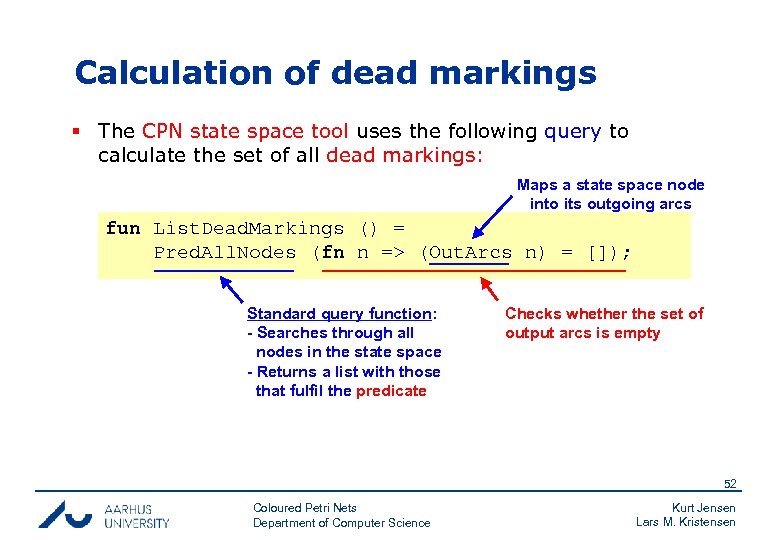 Calculation of dead markings § The CPN state space tool uses the following query to calculate the set of all dead markings: Maps a state space node into its outgoing arcs fun List. Dead. Markings () = Pred. All. Nodes (fn n => (Out. Arcs n) = []); Standard query function: - Searches through all nodes in the state space - Returns a list with those that fulfil the predicate Checks whether the set of output arcs is empty 52 Coloured Petri Nets Department of Computer Science Kurt Jensen Lars M. Kristensen
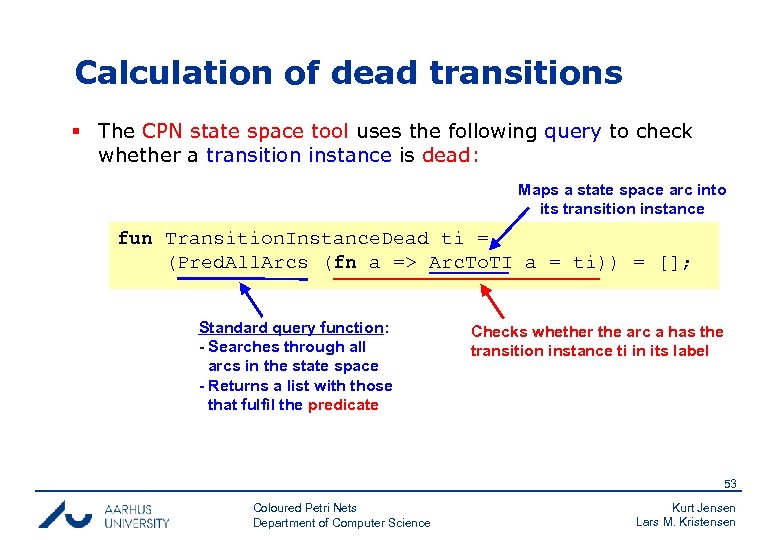 Calculation of dead transitions § The CPN state space tool uses the following query to check whether a transition instance is dead: Maps a state space arc into its transition instance fun Transition. Instance. Dead ti = (Pred. All. Arcs (fn a => Arc. To. TI a = ti)) = []; Standard query function: - Searches through all arcs in the state space - Returns a list with those that fulfil the predicate Checks whether the arc a has the transition instance ti in its label 53 Coloured Petri Nets Department of Computer Science Kurt Jensen Lars M. Kristensen
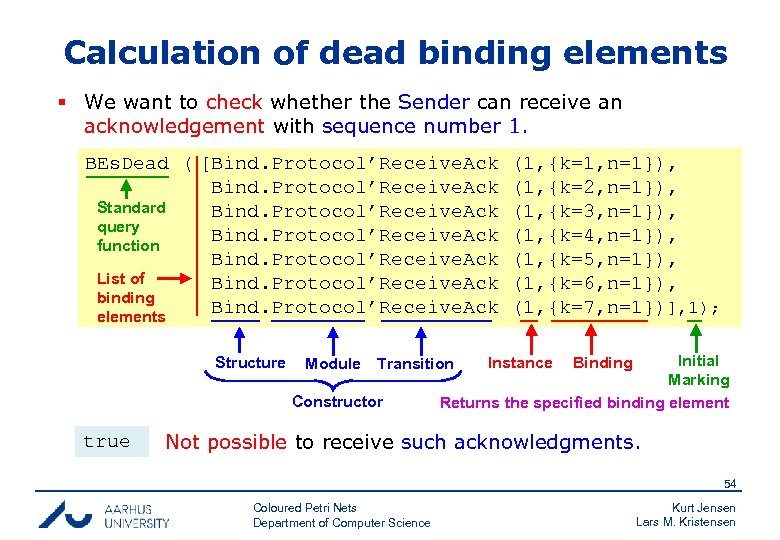 Calculation of dead binding elements § We want to check whether the Sender can receive an acknowledgement with sequence number 1. BEs. Dead ( [Bind. Protocol’Receive. Ack Standard Bind. Protocol’Receive. Ack query Bind. Protocol’Receive. Ack function Bind. Protocol’Receive. Ack List of Bind. Protocol’Receive. Ack binding Bind. Protocol’Receive. Ack elements Structure true Initial Marking Returns the specified binding element Module Transition Constructor (1, {k=1, n=1}), (1, {k=2, n=1}), (1, {k=3, n=1}), (1, {k=4, n=1}), (1, {k=5, n=1}), (1, {k=6, n=1}), (1, {k=7, n=1})], 1); Instance Binding Not possible to receive such acknowledgments. 54 Coloured Petri Nets Department of Computer Science Kurt Jensen Lars M. Kristensen
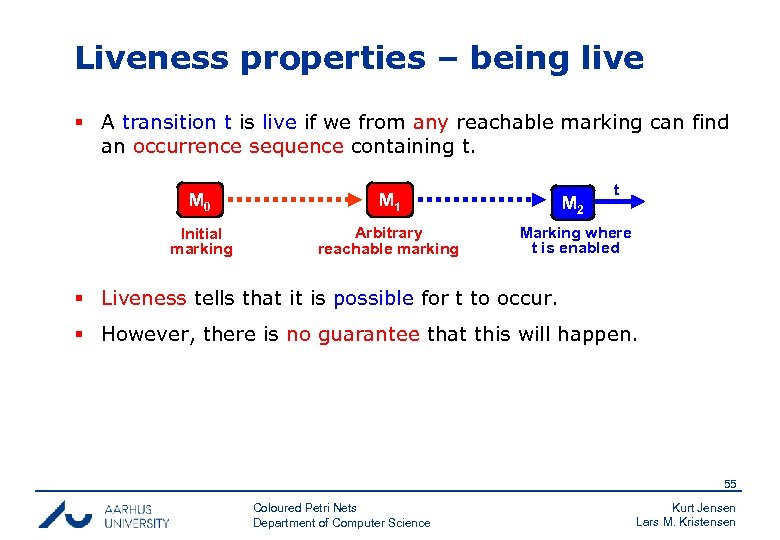 Liveness properties – being live § A transition t is live if we from any reachable marking can find an occurrence sequence containing t. t M 0 M 1 M 2 Initial marking Arbitrary reachable marking Marking where t is enabled § Liveness tells that it is possible for t to occur. § However, there is no guarantee that this will happen. 55 Coloured Petri Nets Department of Computer Science Kurt Jensen Lars M. Kristensen
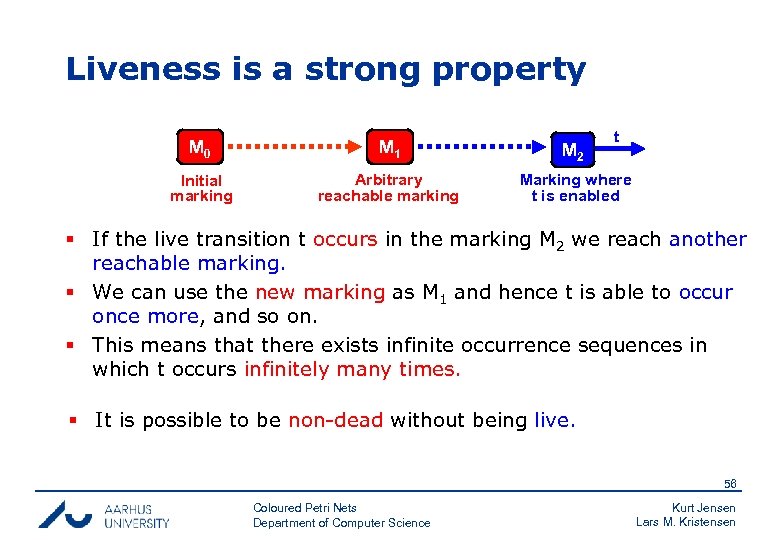 Liveness is a strong property t M 0 M 1 M 2 Initial marking Arbitrary reachable marking Marking where t is enabled § If the live transition t occurs in the marking M 2 we reach another reachable marking. § We can use the new marking as M 1 and hence t is able to occur once more, and so on. § This means that there exists infinite occurrence sequences in which t occurs infinitely many times. § It is possible to be non-dead without being live. 56 Coloured Petri Nets Department of Computer Science Kurt Jensen Lars M. Kristensen
![State space report: being live Liveness Properties Dead Markings: [4868] Dead Transitions: None Live](https://present5.com/presentation/241b1714804f6fcd77e9565875e95f5b/image-57.jpg "State space report: being live Liveness Properties Dead Markings: [4868] Dead Transitions: None Live") State space report: being live Liveness Properties Dead Markings: [4868] Dead Transitions: None Live Transitions: None § There are no live transitions § Trivial consequence of the existence of a dead marking. 57 Coloured Petri Nets Department of Computer Science Kurt Jensen Lars M. Kristensen
State space report: being live Liveness Properties Dead Markings: [4868] Dead Transitions: None Live Transitions: None § There are no live transitions § Trivial consequence of the existence of a dead marking. 57 Coloured Petri Nets Department of Computer Science Kurt Jensen Lars M. Kristensen
 Generalisations of liveness § A binding element is live if it can always become enabled. § A set of binding elements is live if it is always possible to enable at least one binding element in the set. § A set of transitions is live if the union of their binding elements is live. 58 Coloured Petri Nets Department of Computer Science Kurt Jensen Lars M. Kristensen
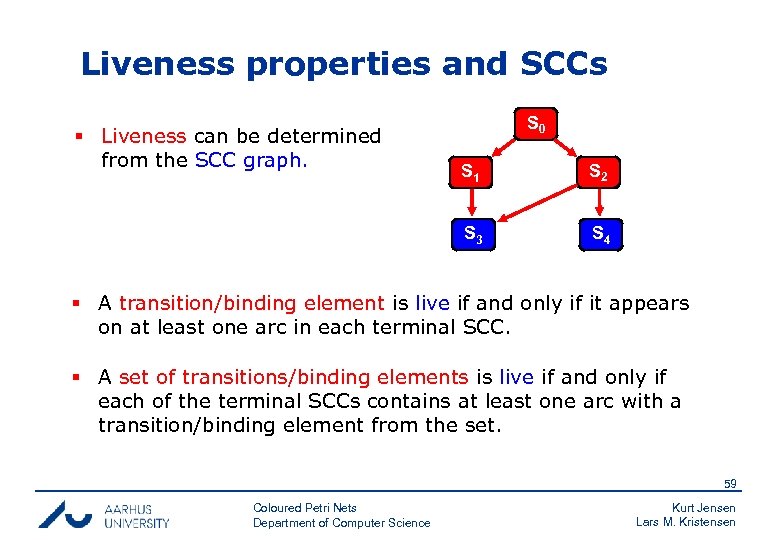 Liveness properties and SCCs § Liveness can be determined from the SCC graph. S 0 S 1 S 2 S 3 S 4 § A transition/binding element is live if and only if it appears on at least one arc in each terminal SCC. § A set of transitions/binding elements is live if and only if each of the terminal SCCs contains at least one arc with a transition/binding element from the set. 59 Coloured Petri Nets Department of Computer Science Kurt Jensen Lars M. Kristensen
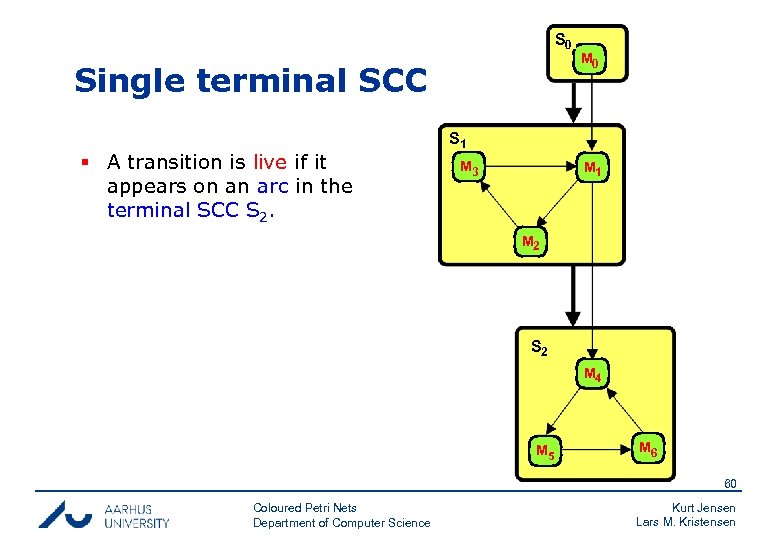 S 0 Single terminal SCC § A transition is live if it appears on an arc in the terminal SCC S 2. M 0 S 1 M 3 M 1 M 2 S 2 M 4 M 5 M 6 60 Coloured Petri Nets Department of Computer Science Kurt Jensen Lars M. Kristensen
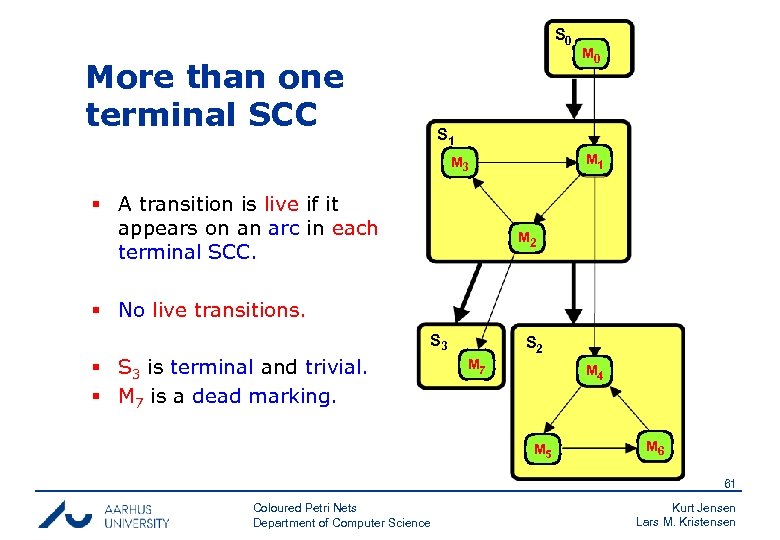 S 0 More than one terminal SCC M 0 S 1 M 3 § A transition is live if it appears on an arc in each terminal SCC. M 2 § No live transitions. S 3 § S 3 is terminal and trivial. § M 7 is a dead marking. S 2 M 7 M 4 M 5 M 6 61 Coloured Petri Nets Department of Computer Science Kurt Jensen Lars M. Kristensen
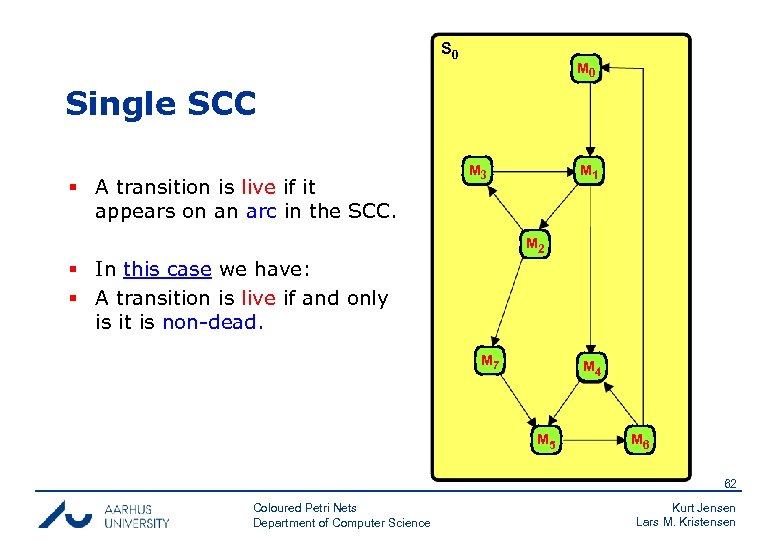 S 0 M 0 Single SCC § A transition is live if it appears on an arc in the SCC. M 3 M 1 M 2 § In this case we have: § A transition is live if and only is it is non-dead. M 7 M 4 M 5 M 6 62 Coloured Petri Nets Department of Computer Science Kurt Jensen Lars M. Kristensen
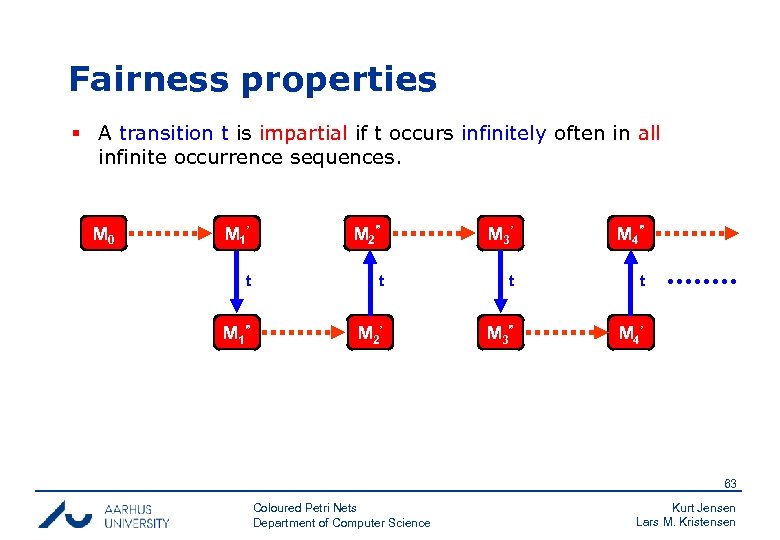 Fairness properties § A transition t is impartial if t occurs infinitely often in all infinite occurrence sequences. M 0 M 1 ’ M 2 ” M 3 ’ M 4 ” t t M 1 ” M 2 ’ M 3 ” M 4 ’ 63 Coloured Petri Nets Department of Computer Science Kurt Jensen Lars M. Kristensen
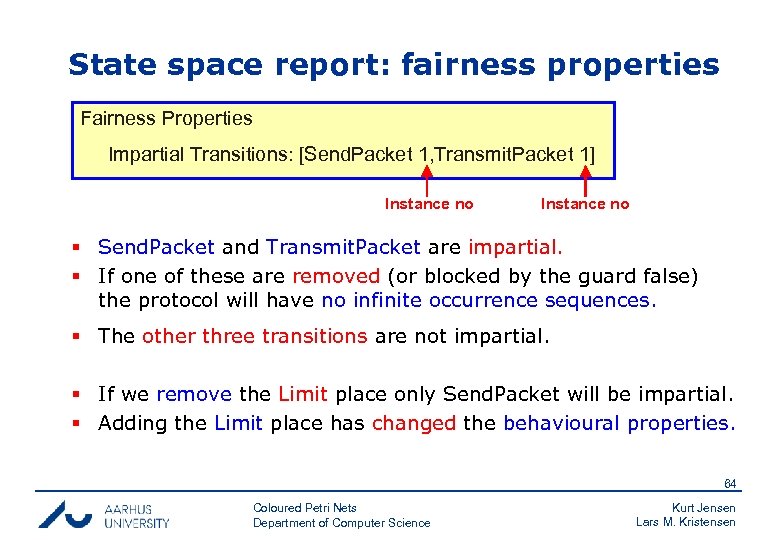 State space report: fairness properties Fairness Properties Impartial Transitions: [Send. Packet 1, Transmit. Packet 1] Instance no § Send. Packet and Transmit. Packet are impartial. § If one of these are removed (or blocked by the guard false) the protocol will have no infinite occurrence sequences. § The other three transitions are not impartial. § If we remove the Limit place only Send. Packet will be impartial. § Adding the Limit place has changed the behavioural properties. 64 Coloured Petri Nets Department of Computer Science Kurt Jensen Lars M. Kristensen
 Generalisations of impartial § A binding element is impartial if it occurs infinitely often in all infinite occurrence sequences. § A set of binding elements is impartial if binding elements from the set occurs infinitely often in all infinite occurrence sequences. § A set of transitions is impartial if the union of their binding elements is impartial. 65 Coloured Petri Nets Department of Computer Science Kurt Jensen Lars M. Kristensen
 Fairness properties and SCCs § Impartiality of a transition/binding element X can be checked by means of an SCC graph: § Construct the pruned state space in which all arcs with X are removed. § Construct the SCC graph of the pruned state space. § X is impartial if and only if the two graphs have the same size (are isomorphic). § Impartiality of a set of transitions/binding elements is checked in a similar way. 66 Coloured Petri Nets Department of Computer Science Kurt Jensen Lars M. Kristensen
 Use of fairness properties § As an example, we will investigate whether the set of binding elements corresponding to loss of data packets and acknowledgements is impartial. § If the protocol does not terminate we expect this to be because the network keeps losing packets, and we therefore expect this set of binding elements to be impartial. 67 Coloured Petri Nets Department of Computer Science Kurt Jensen Lars M. Kristensen
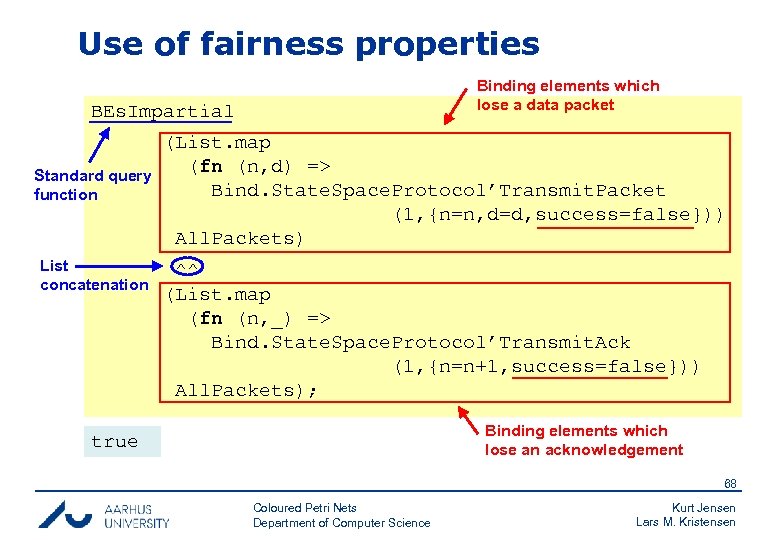 Use of fairness properties Binding elements which lose a data packet BEs. Impartial Standard query function List concatenation (List. map (fn (n, d) => Bind. State. Space. Protocol’Transmit. Packet (1, {n=n, d=d, success=false})) All. Packets) ^^ (List. map (fn (n, _) => Bind. State. Space. Protocol’Transmit. Ack (1, {n=n+1, success=false})) All. Packets); Binding elements which lose an acknowledgement true 68 Coloured Petri Nets Department of Computer Science Kurt Jensen Lars M. Kristensen
 State space report / query functions § The state space report contains information about standard behavioural properties which make sense for all CPN models. § Non-standard behavioural properties can be investigated by means of queries. § For some purposes it is sufficient to provide arguments to a predefined query function – e. g. to check whether a set of markings constitute a home space. § For other more special purposes it is necessary to write your own query functions using the CPN ML programming language. 69 Coloured Petri Nets Department of Computer Science Kurt Jensen Lars M. Kristensen
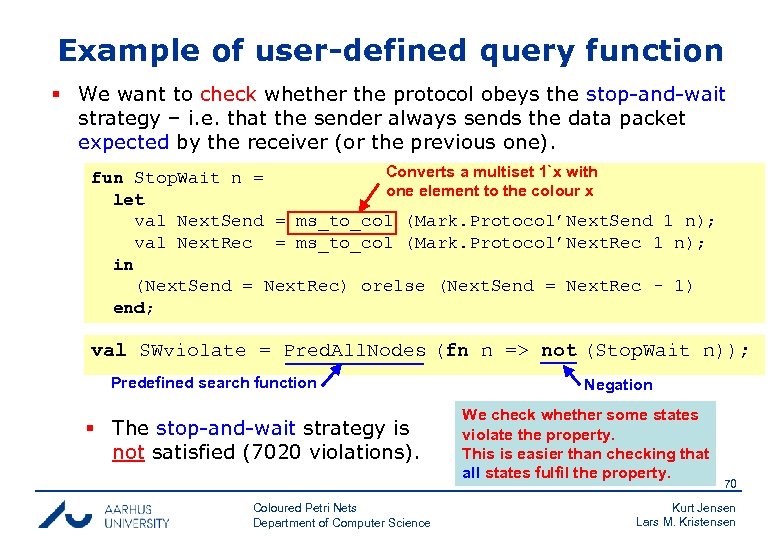 Example of user-defined query function § We want to check whether the protocol obeys the stop-and-wait strategy – i. e. that the sender always sends the data packet expected by the receiver (or the previous one). Converts a multiset 1`x with fun Stop. Wait n = one element to the colour x let val Next. Send = ms_to_col (Mark. Protocol’Next. Send 1 n); val Next. Rec = ms_to_col (Mark. Protocol’Next. Rec 1 n); in (Next. Send = Next. Rec) orelse (Next. Send = Next. Rec - 1) end; val SWviolate = Pred. All. Nodes (fn n => not (Stop. Wait n)); Predefined search function § The stop-and-wait strategy is not satisfied (7020 violations). Coloured Petri Nets Department of Computer Science Negation We check whether some states violate the property. This is easier than checking that all states fulfil the property. 70 Kurt Jensen Lars M. Kristensen
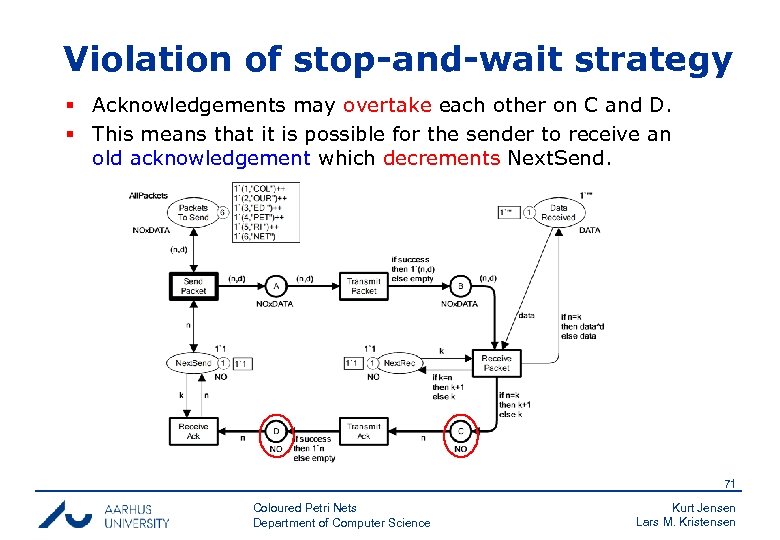 Violation of stop-and-wait strategy § Acknowledgements may overtake each other on C and D. § This means that it is possible for the sender to receive an old acknowledgement which decrements Next. Send. 71 Coloured Petri Nets Department of Computer Science Kurt Jensen Lars M. Kristensen
 Shortest counterexample § We want to construct a shortest counterexample – i. e. to find one of the shortest occurrence sequences leading from the initial marking to a marking where the predicate does not hold. § The state space is generated in breadth-first order. § Hence, we search for the lowest numbered node in the list SWviolate. 72 Coloured Petri Nets Department of Computer Science Kurt Jensen Lars M. Kristensen
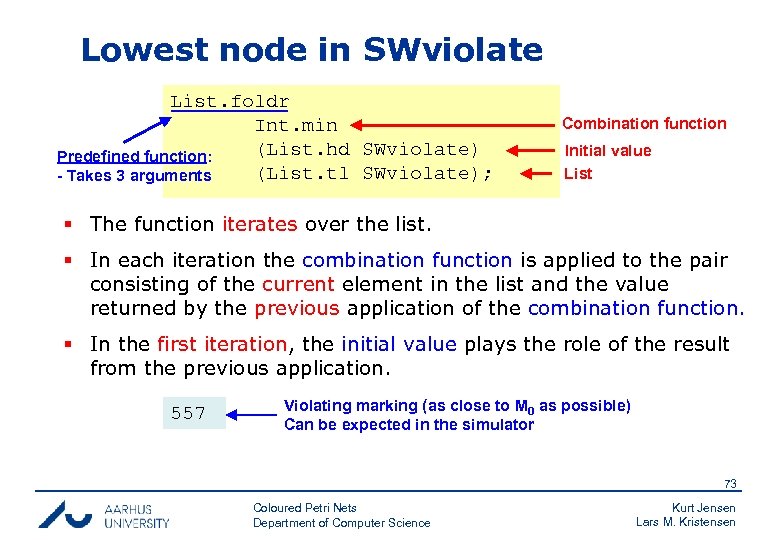 Lowest node in SWviolate List. foldr Int. min (List. hd SWviolate) Predefined function: (List. tl SWviolate); - Takes 3 arguments Combination function Initial value List § The function iterates over the list. § In each iteration the combination function is applied to the pair consisting of the current element in the list and the value returned by the previous application of the combination function. § In the first iteration, the initial value plays the role of the result from the previous application. 557 Violating marking (as close to M 0 as possible) Can be expected in the simulator 73 Coloured Petri Nets Department of Computer Science Kurt Jensen Lars M. Kristensen
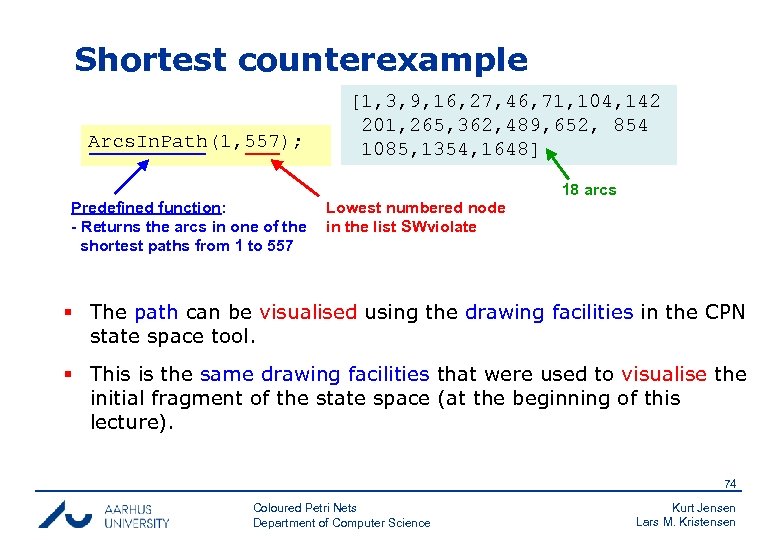 Shortest counterexample Arcs. In. Path(1, 557); [1, 3, 9, 16, 27, 46, 71, 104, 142 201, 265, 362, 489, 652, 854 1085, 1354, 1648] 18 arcs Predefined function: - Returns the arcs in one of the shortest paths from 1 to 557 Lowest numbered node in the list SWviolate § The path can be visualised using the drawing facilities in the CPN state space tool. § This is the same drawing facilities that were used to visualise the initial fragment of the state space (at the beginning of this lecture). 74 Coloured Petri Nets Department of Computer Science Kurt Jensen Lars M. Kristensen
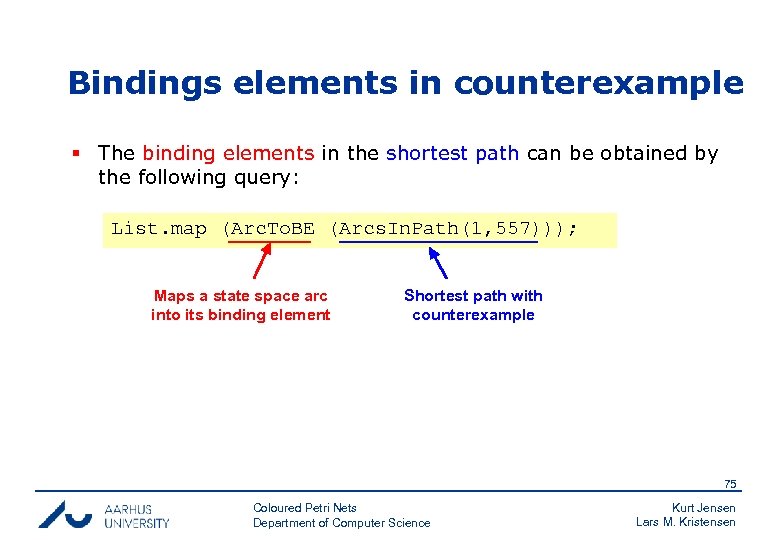 Bindings elements in counterexample § The binding elements in the shortest path can be obtained by the following query: List. map (Arc. To. BE (Arcs. In. Path(1, 557))); Maps a state space arc into its binding element Shortest path with counterexample 75 Coloured Petri Nets Department of Computer Science Kurt Jensen Lars M. Kristensen
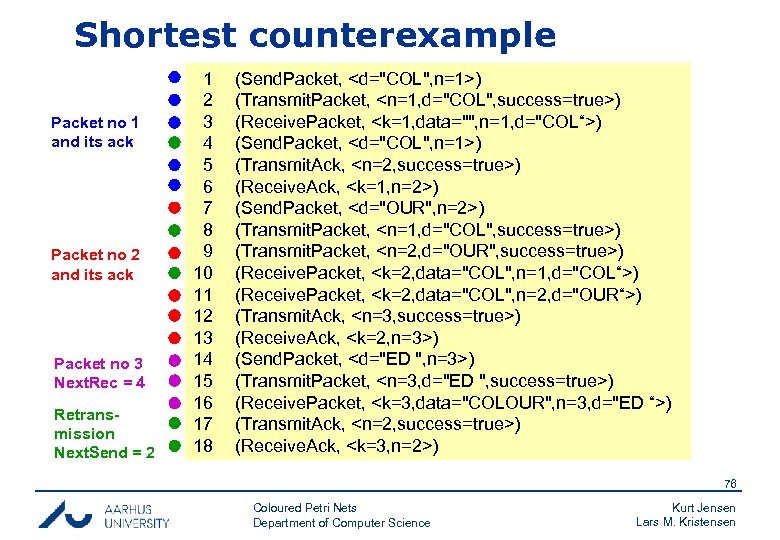 Shortest counterexample Packet no 1 and its ack Packet no 2 and its ack Packet no 3 Next. Rec = 4 Retransmission Next. Send = 2 1 2 3 4 5 6 7 8 9 10 11 12 13 14 15 16 17 18 (Send. Packet,
 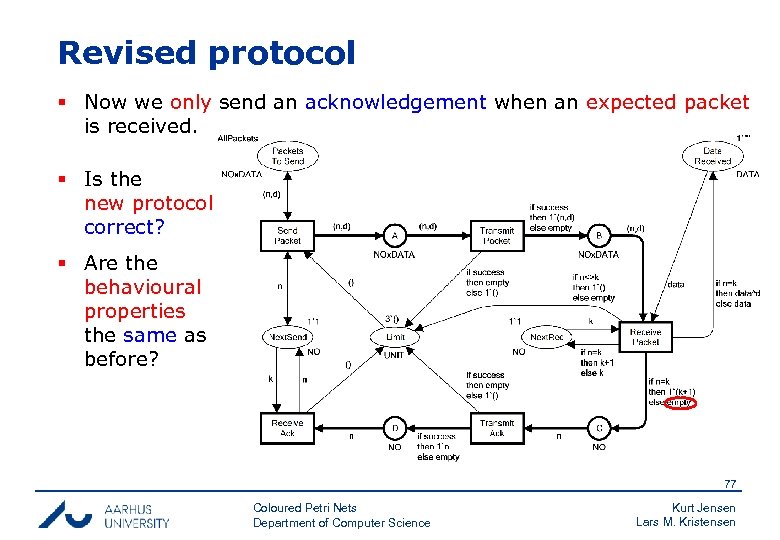 Revised protocol § Now we only send an acknowledgement when an expected packet is received. § Is the new protocol correct? § Are the behavioural properties the same as before? 77 Coloured Petri Nets Department of Computer Science Kurt Jensen Lars M. Kristensen
 State space for revised protocol § The state space contains 1, 823 nodes and 6, 829 arcs. § Before we had 13, 215 nodes and 52, 874 arcs. § As before there is a single dead marking which corresponds to the desired terminal marking, where all packets have been successfully transmitted. § The new protocol is partially correct. § Now there are no home markings. § We can reach situations from which it is impossible to reach the desired terminal marking. 78 Coloured Petri Nets Department of Computer Science Kurt Jensen Lars M. Kristensen
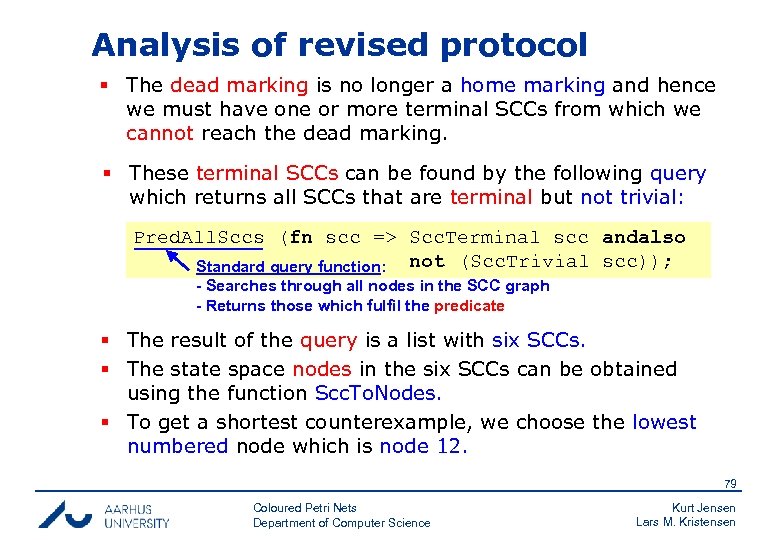 Analysis of revised protocol § The dead marking is no longer a home marking and hence we must have one or more terminal SCCs from which we cannot reach the dead marking. § These terminal SCCs can be found by the following query which returns all SCCs that are terminal but not trivial: Pred. All. Sccs (fn scc => Scc. Terminal scc andalso Standard query function: not (Scc. Trivial scc)); - Searches through all nodes in the SCC graph - Returns those which fulfil the predicate § The result of the query is a list with six SCCs. § The state space nodes in the six SCCs can be obtained using the function Scc. To. Nodes. § To get a shortest counterexample, we choose the lowest numbered node which is node 12. 79 Coloured Petri Nets Department of Computer Science Kurt Jensen Lars M. Kristensen
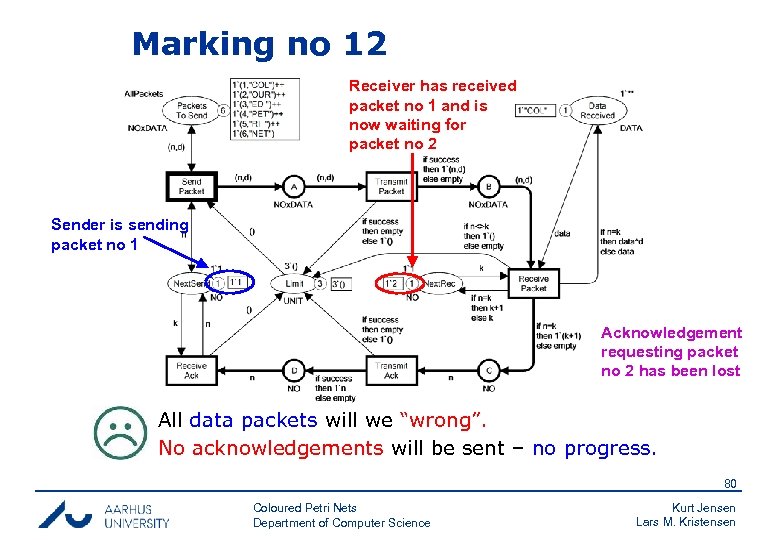 Marking no 12 Receiver has received packet no 1 and is now waiting for packet no 2 Sender is sending packet no 1 Acknowledgement requesting packet no 2 has been lost § All data packets will we “wrong”. § No acknowledgements will be sent – no progress. 80 Coloured Petri Nets Department of Computer Science Kurt Jensen Lars M. Kristensen
 What is wrong § The analysis of marking no 12 has told us what the problem is. § The sender continues to send wrong packets and the receiver never sends an acknowledgement which can correct the problem. § We might also want to know how we arrived at this unfortunate situation. § This is done by constructing an error trace / counterexample. 81 Coloured Petri Nets Department of Computer Science Kurt Jensen Lars M. Kristensen
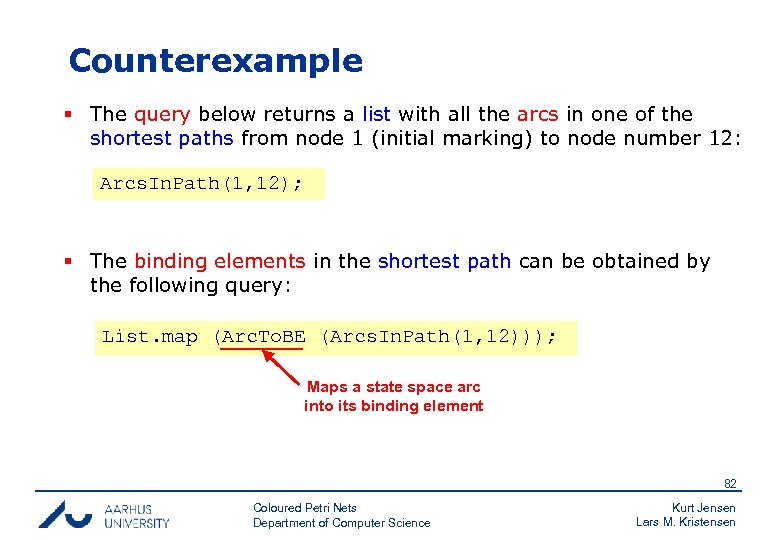 Counterexample § The query below returns a list with all the arcs in one of the shortest paths from node 1 (initial marking) to node number 12: Arcs. In. Path(1, 12); § The binding elements in the shortest path can be obtained by the following query: List. map (Arc. To. BE (Arcs. In. Path(1, 12))); Maps a state space arc into its binding element 82 Coloured Petri Nets Department of Computer Science Kurt Jensen Lars M. Kristensen
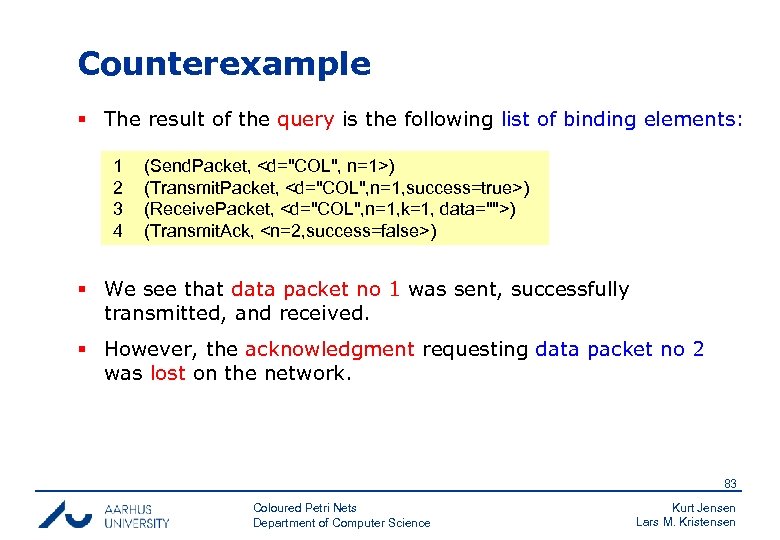 Counterexample § The result of the query is the following list of binding elements: 1 2 3 4 (Send. Packet,
 System configurations § With state space analysis we always investigate a system for a particular configuration of the system parameters. § In practice it is often sufficient to consider a few rather small configurations – although we cannot be totally sure that larger configurations will have the same properties. § As system parameters increase the size of the state space increases – often in an exponential way. § This is called state space explosion, and it is one of the most severe limitations of the state space method. 84 Coloured Petri Nets Department of Computer Science Kurt Jensen Lars M. Kristensen
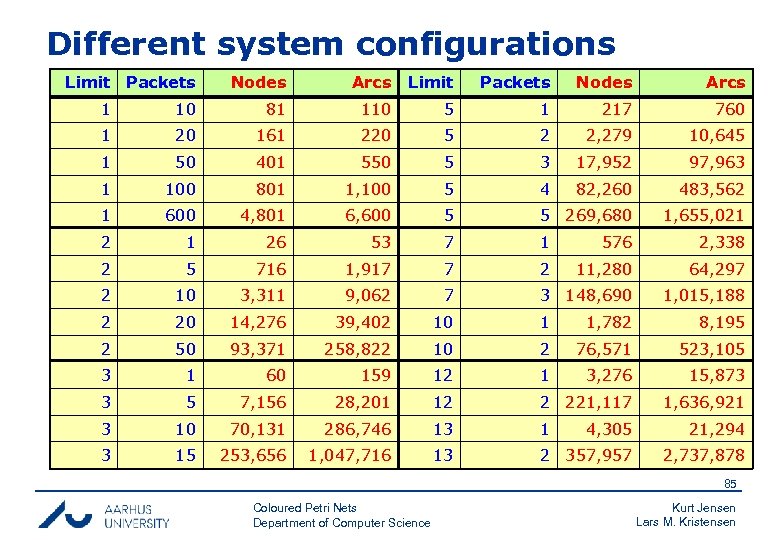 Different system configurations Limit Packets Nodes Arcs 1 10 81 110 5 1 217 760 1 20 161 220 5 2 2, 279 10, 645 1 50 401 550 5 3 17, 952 97, 963 1 100 801 1, 100 5 4 82, 260 483, 562 1 600 4, 801 6, 600 5 5 269, 680 1, 655, 021 2 1 26 53 7 1 576 2, 338 2 5 716 1, 917 7 2 11, 280 64, 297 2 10 3, 311 9, 062 7 3 148, 690 1, 015, 188 2 20 14, 276 39, 402 10 1 1, 782 8, 195 2 50 93, 371 258, 822 10 2 76, 571 523, 105 3 1 60 159 12 1 3, 276 15, 873 3 5 7, 156 28, 201 12 2 221, 117 1, 636, 921 3 10 70, 131 286, 746 13 1 4, 305 21, 294 3 15 253, 656 1, 047, 716 13 2 357, 957 2, 737, 878 85 Coloured Petri Nets Department of Computer Science Kurt Jensen Lars M. Kristensen
 Is it worthwhile? § State space analysis can be a time consuming process where it takes many hours to generate the state spaces and verify the desired properties. § However, it is fully automatic and hence requires much less human work than lengthy simulations and tests. § It may take days to verify the properties of a system by means of state spaces. § However, this is still a relatively small investment: § compared to the total number of resources used in a system development project. § compared to the cost of implementing, deploying and correcting a system with errors that could have been detected in the design phase. 86 Coloured Petri Nets Department of Computer Science Kurt Jensen Lars M. Kristensen
 Partial state spaces § It is sometimes impossible to generate the full state space for a given system configuration – either because it is too big or takes too long time. § This means that only a partial state space – i. e. a fragment of the state space is generated. § Partial state spaces cannot in general be used to verify properties, but they may identify errors. § As an example, an undesirable dead marking in a partial state space will also be present in the full state space. § Partial state spaces can in that sense be viewed as being positioned between simulation and state spaces. § The CPN state space tool has a number of parameters to control the generation of partial state spaces. 87 Coloured Petri Nets Department of Computer Science Kurt Jensen Lars M. Kristensen
 State spaces - summary § State spaces are powerful and easy to use. § Construction and analysis can be automated. § The user do not need to know the mathematics behind the analysis methods. § The main drawback is the state explosion – i. e. the size of the state space. § The present CPN state space tool handles state spaces with up to one million states. § For many systems this is not sufficient. § A much more efficient state space tool is under development. 88 Coloured Petri Nets Department of Computer Science Kurt Jensen Lars M. Kristensen
 Reduced state spaces § Fortunately, it is often possible to construct reduced state spaces – without losing analytic power. § This is done by exploiting: § Progress measure. § Symmetries in the modelled system. § Other kinds of equivalent behaviour. § Concurrency between events. § The reduction methods rely on complex mathematics. 89 Coloured Petri Nets Department of Computer Science Kurt Jensen Lars M. Kristensen
 Questions 90 Coloured Petri Nets Department of Computer Science Kurt Jensen Lars M. Kristensen