


 Скачать презентацию Colloid and surface phenomena aspects of Chocolate CE
8252e0bd3efb8cb201c7dc87aa32c0a2.ppt
- Количество слайдов: 33
 Colloid and surface phenomena aspects of Chocolate CE 457/527 Chin Kok Ooi Teck Yu Sia Anshu Verma Shushan Munshi
 Introduction n n Chocolates has a wide variety and found in common places Has to meet consumer need Types of chocolates Good for health
 Marketing n Designing chocolates n n n Energy Size Price Efficiency Legal requirements Advertisement
 Components and Compositions n. The ingredients of chocolate n. Cocoa, cocoa butter, milk and sugar n. Additional ingredients n. Lecithin(emulsifier) and flavoring agents
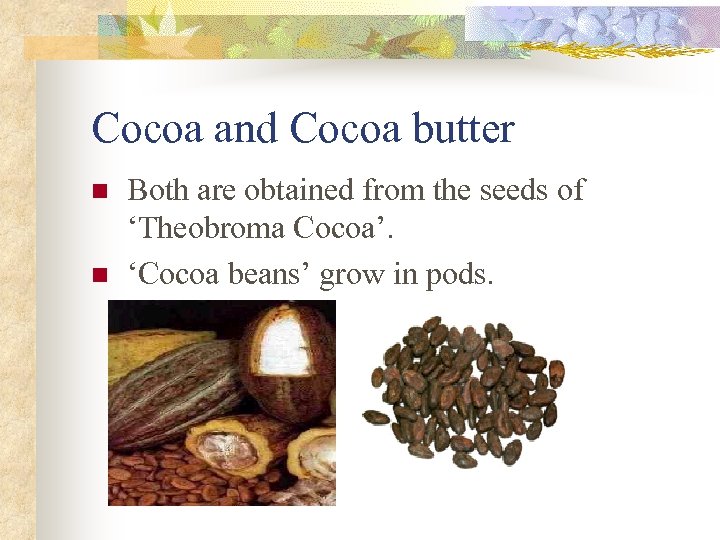 Cocoa and Cocoa butter n n Both are obtained from the seeds of ‘Theobroma Cocoa’. ‘Cocoa beans’ grow in pods.
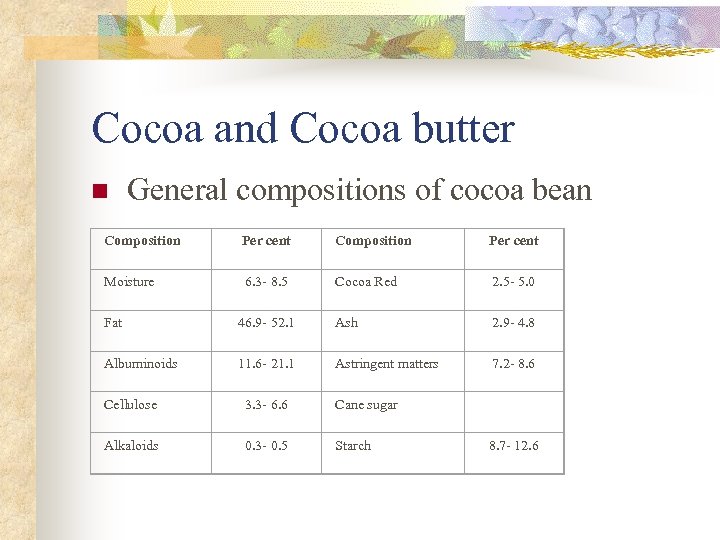 Cocoa and Cocoa butter n General compositions of cocoa bean Composition Per cent Moisture 6. 3 - 8. 5 Cocoa Red 2. 5 - 5. 0 Fat 46. 9 - 52. 1 Ash 2. 9 - 4. 8 Albuminoids 11. 6 - 21. 1 Astringent matters 7. 2 - 8. 6 Cellulose 3. 3 - 6. 6 Cane sugar Alkaloids 0. 3 - 0. 5 Starch 8. 7 - 12. 6
 Cocoa and Cocoa butter n Alkaloids n Theobromine and caffeine n Theobromine – 3, 7 -dimethyl-xanthine n Caffeine – 1, 3, 7 -trimethyl-xanthine n ‘Cocoa red’– is formed during the drying of the beans by the action of enzymes on the glucosides.
 Cocoa and Cocoa butter n Special characteristics of cocoa butter: n n n The melting point of cocoa butter is between 32°C and 36°C. In spite of low melting point, cocoa butter is hard and brittle at normal room temperature. Help to prevent ‘fat bloom’
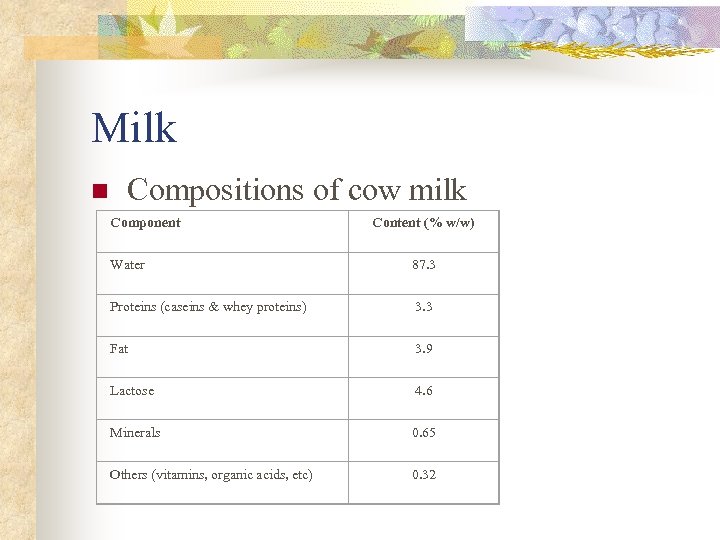 Milk n Compositions of cow milk Component Content (% w/w) Water 87. 3 Proteins (caseins & whey proteins) 3. 3 Fat 3. 9 Lactose 4. 6 Minerals 0. 65 Others (vitamins, organic acids, etc) 0. 32
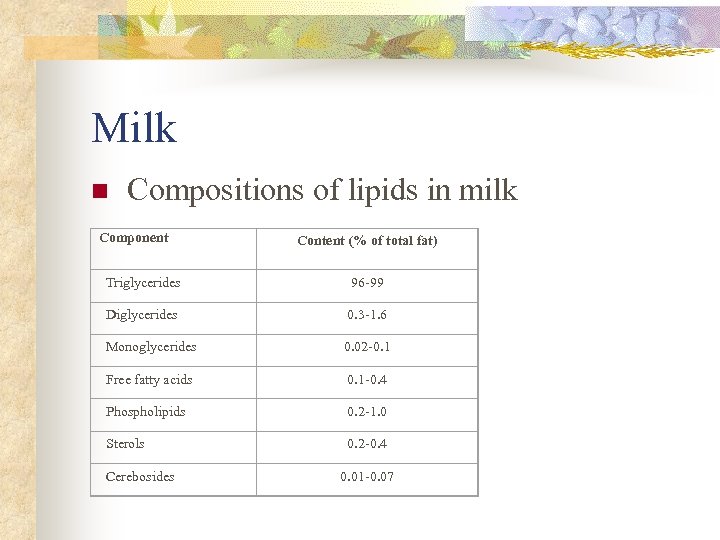 Milk n Compositions of lipids in milk Component Content (% of total fat) Triglycerides 96 -99 Diglycerides 0. 3 -1. 6 Monoglycerides 0. 02 -0. 1 Free fatty acids 0. 1 -0. 4 Phospholipids 0. 2 -1. 0 Sterols 0. 2 -0. 4 Cerebosides 0. 01 -0. 07
 Sugar n Sucrose n n Combination of ‘glucose’ and ‘fructose’ Sugar bloom
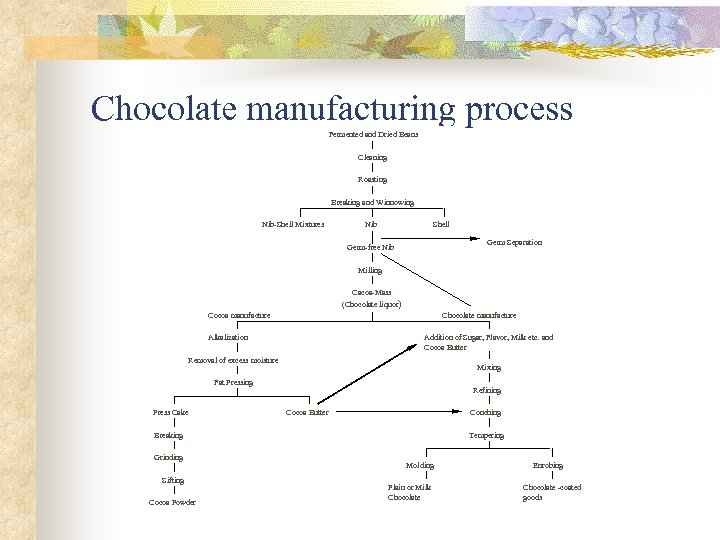 Chocolate manufacturing process Fermented and Dried Beans Cleaning Roasting Breaking and Winnowing Nib-Shell Mixtures Nib Shell Germ Separation Germ-free Nib Milling Cacoa-Mass (Chocolate liquor) Cocoa manufacture Chocolate manufacture Addition of Sugar, Flavor, Milk etc. and Cocoa Butter Alkalization Removal of excess moisture Mixing Fat Pressing Press Cake Refining Conching Cocoa Butter Breaking Grinding Sifting Cocoa Powder Tempering Molding Enrobing Plain or Milk Chocolate -coated goods
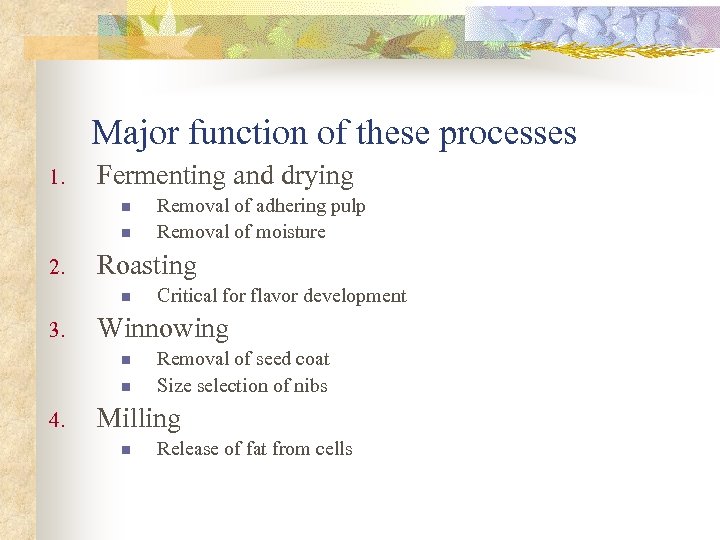 Major function of these processes 1. Fermenting and drying n n 2. Roasting n 3. Critical for flavor development Winnowing n n 4. Removal of adhering pulp Removal of moisture Removal of seed coat Size selection of nibs Milling n Release of fat from cells
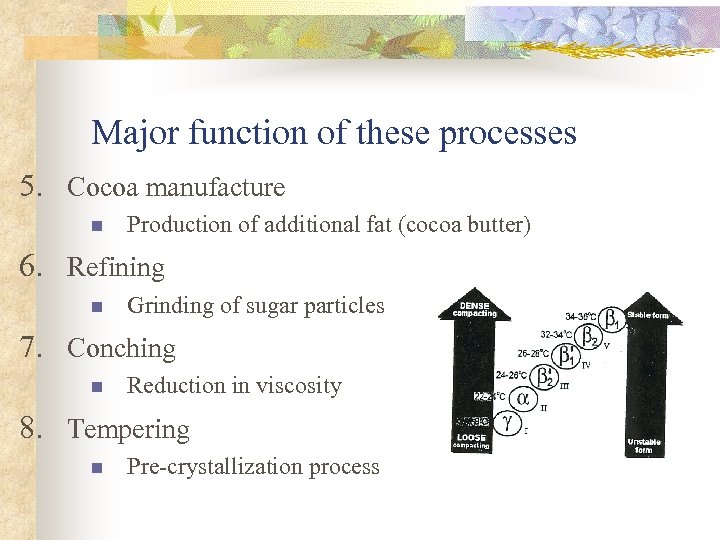 Major function of these processes 5. Cocoa manufacture n Production of additional fat (cocoa butter) 6. Refining n Grinding of sugar particles 7. Conching n Reduction in viscosity 8. Tempering n Pre-crystallization process
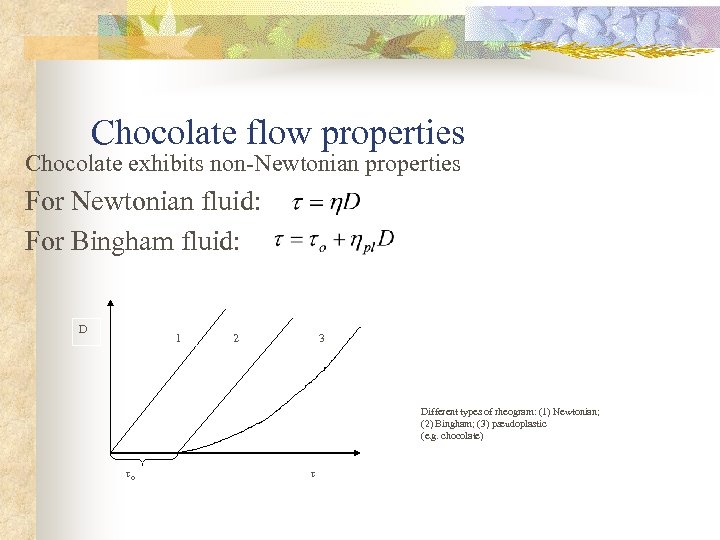 Chocolate flow properties Chocolate exhibits non-Newtonian properties For Newtonian fluid: For Bingham fluid: D 1 2 3 Different types of rheogram: (1) Newtonian; (2) Bingham; (3) pseudoplastic (e. g. chocolate) o
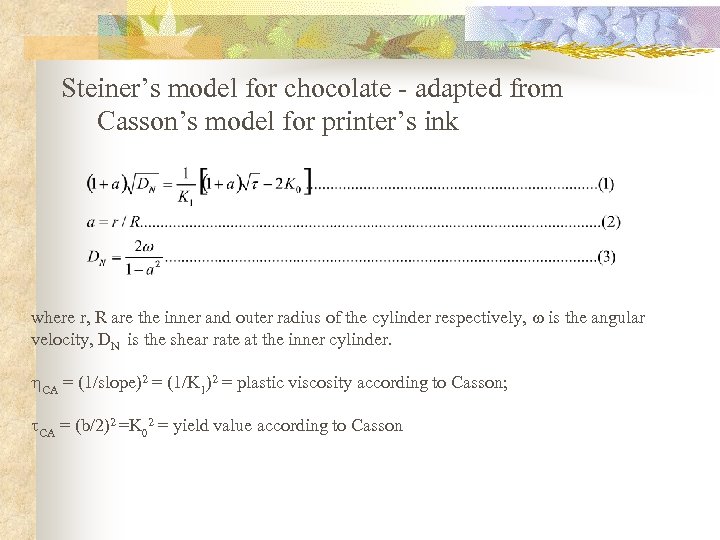 Steiner’s model for chocolate - adapted from Casson’s model for printer’s ink where r, R are the inner and outer radius of the cylinder respectively, is the angular velocity, DN is the shear rate at the inner cylinder. CA = (1/slope)2 = (1/K 1)2 = plastic viscosity according to Casson; CA = (b/2)2 =K 02 = yield value according to Casson
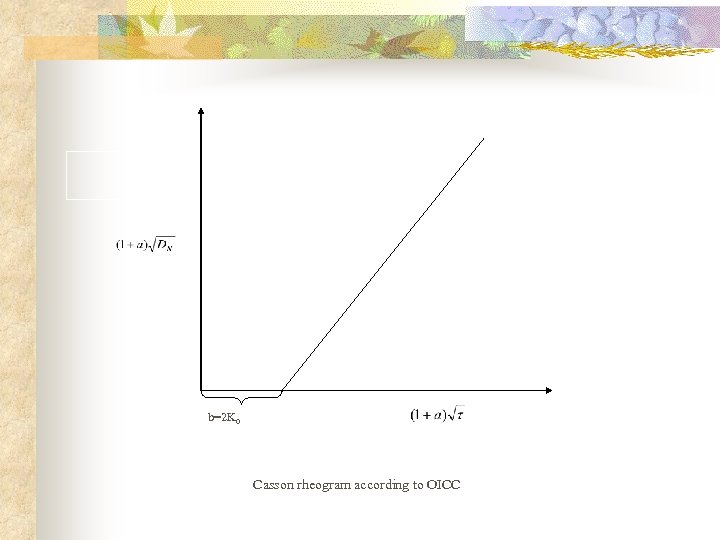 b=2 K 0 Casson rheogram according to OICC
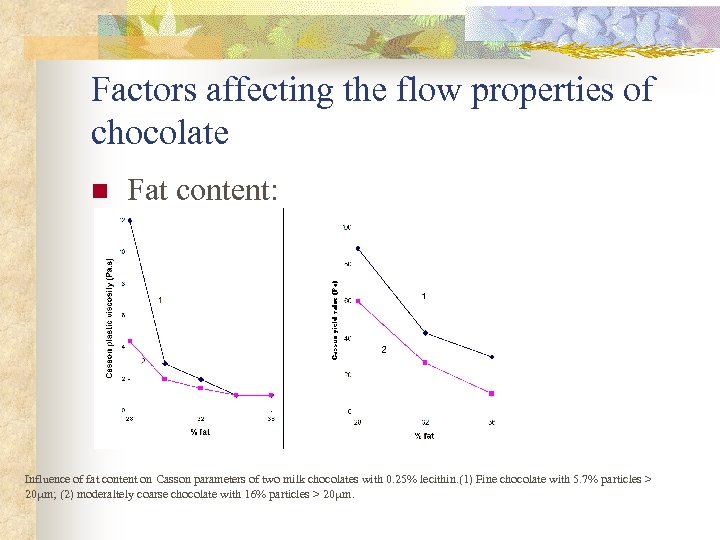 Factors affecting the flow properties of chocolate n Fat content: Influence of fat content on Casson parameters of two milk chocolates with 0. 25% lecithin. (1) Fine chocolate with 5. 7% particles > 20 m; (2) moderaltely coarse chocolate with 16% particles > 20 m.
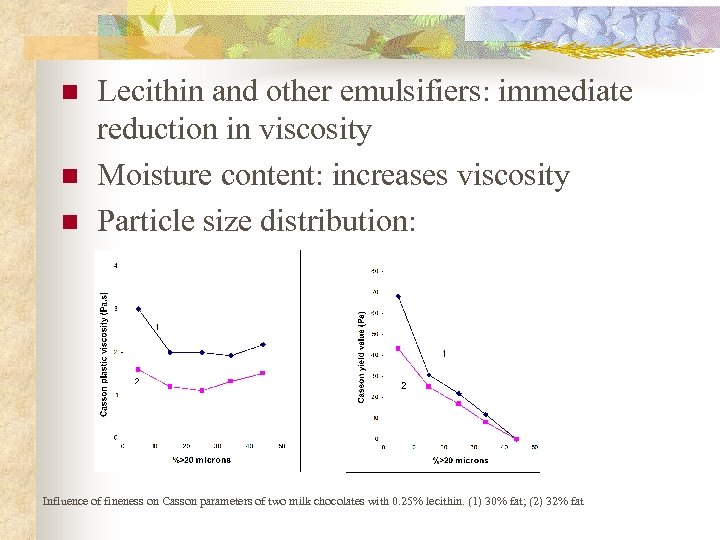 n n n Lecithin and other emulsifiers: immediate reduction in viscosity Moisture content: increases viscosity Particle size distribution: Influence of fineness on Casson parameters of two milk chocolates with 0. 25% lecithin. (1) 30% fat; (2) 32% fat
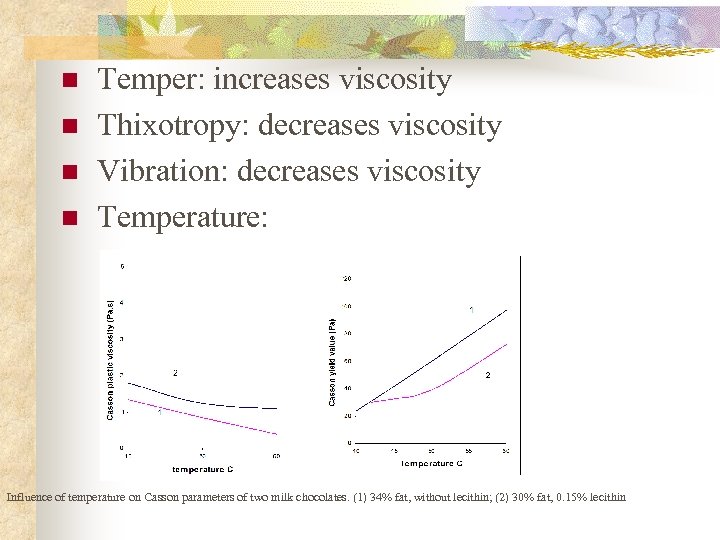 n n Temper: increases viscosity Thixotropy: decreases viscosity Vibration: decreases viscosity Temperature: Influence of temperature on Casson parameters of two milk chocolates. (1) 34% fat, without lecithin; (2) 30% fat, 0. 15% lecithin
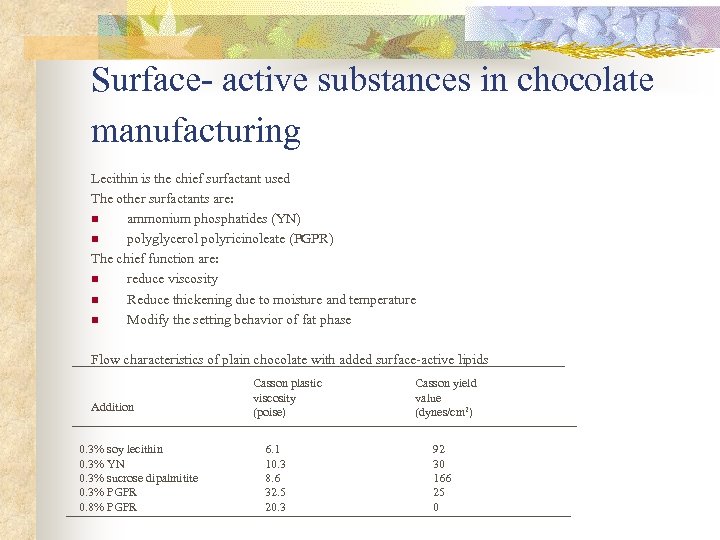 Surface- active substances in chocolate manufacturing Lecithin is the chief surfactant used The other surfactants are: n ammonium phosphatides (YN) n polyglycerol polyricinoleate (PGPR) The chief function are: n reduce viscosity n Reduce thickening due to moisture and temperature n Modify the setting behavior of fat phase Flow characteristics of plain chocolate with added surface-active lipids Addition 0. 3% soy lecithin 0. 3% YN 0. 3% sucrose dipalmitite 0. 3% PGPR 0. 8% PGPR Casson plastic viscosity (poise) 6. 1 10. 3 8. 6 32. 5 20. 3 Casson yield value (dynes/cm 2) 92 30 166 25 0
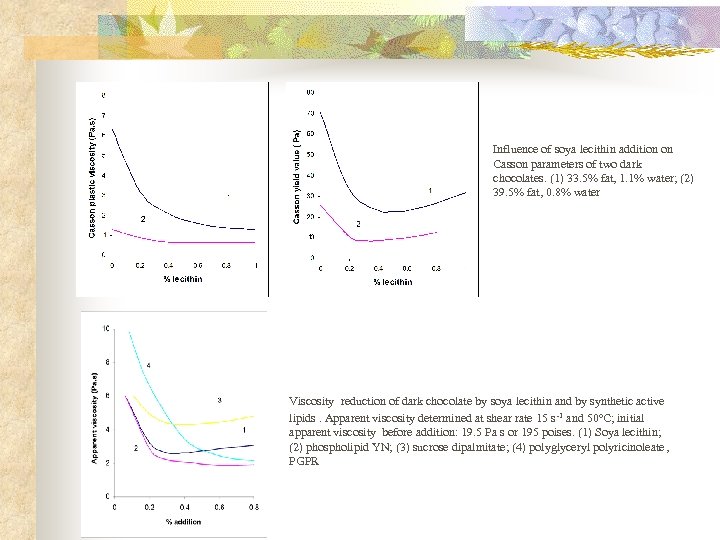 Influence of soya lecithin addition on Casson parameters of two dark chocolates. (1) 33. 5% fat, 1. 1% water; (2) 39. 5% fat, 0. 8% water Viscosity reduction of dark chocolate by soya lecithin and by synthetic active lipids. Apparent viscosity determined at shear rate 15 s -1 and 50 o. C; initial apparent viscosity before addition: 19. 5 Pa s or 195 poises. (1) Soya lecithin; (2) phospholipid YN; (3) sucrose dipalmitate; (4) polyglyceryl polyricinoleate, PGPR
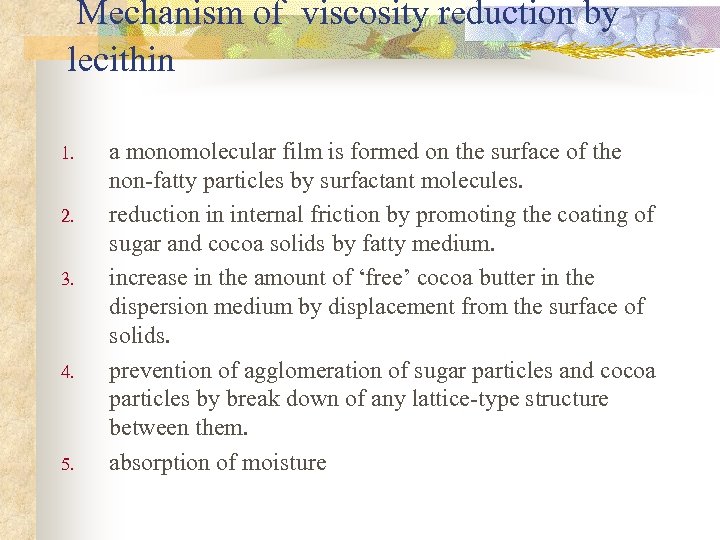 Mechanism of viscosity reduction by lecithin 1. 2. 3. 4. 5. a monomolecular film is formed on the surface of the non-fatty particles by surfactant molecules. reduction in internal friction by promoting the coating of sugar and cocoa solids by fatty medium. increase in the amount of ‘free’ cocoa butter in the dispersion medium by displacement from the surface of solids. prevention of agglomeration of sugar particles and cocoa particles by break down of any lattice-type structure between them. absorption of moisture
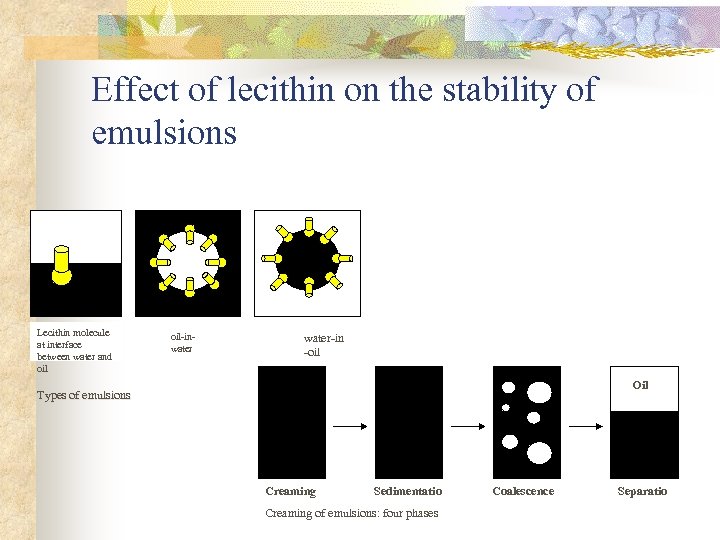 Effect of lecithin on the stability of emulsions Lecithin molecule at interface between water and oil-inwater-in -oil Oil Types of emulsions Creaming Sedimentatio n Creaming of emulsions: four phases Coalescence Separatio n
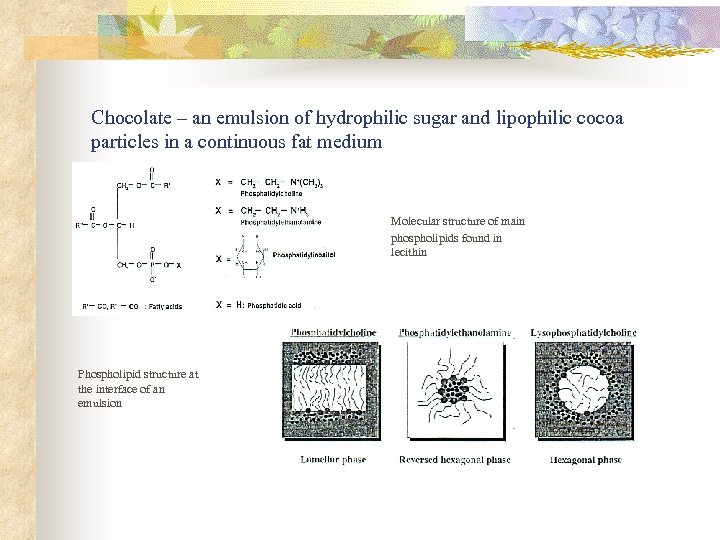 Chocolate – an emulsion of hydrophilic sugar and lipophilic cocoa particles in a continuous fat medium Molecular structure of main phospholipids found in lecithin Phospholipid structure at the interface of an emulsion
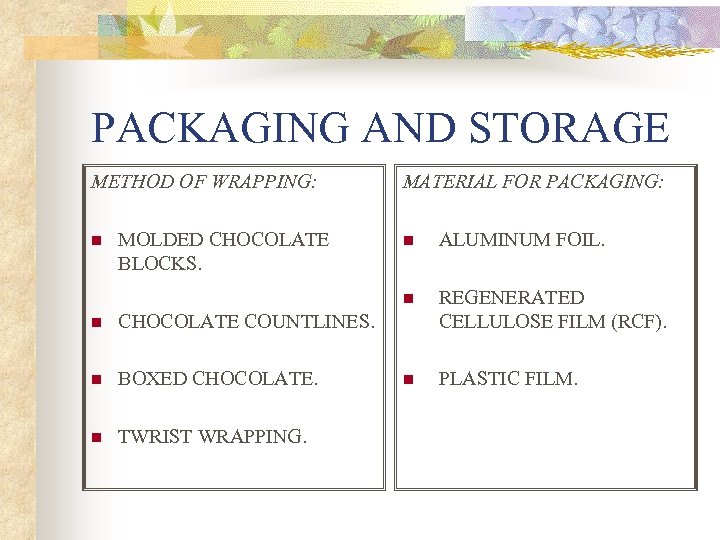 PACKAGING AND STORAGE METHOD OF WRAPPING: n BOXED CHOCOLATE. n TWRIST WRAPPING. ALUMINUM FOIL. REGENERATED CELLULOSE FILM (RCF). n PLASTIC FILM. CHOCOLATE COUNTLINES. n n MOLDED CHOCOLATE BLOCKS. MATERIAL FOR PACKAGING:
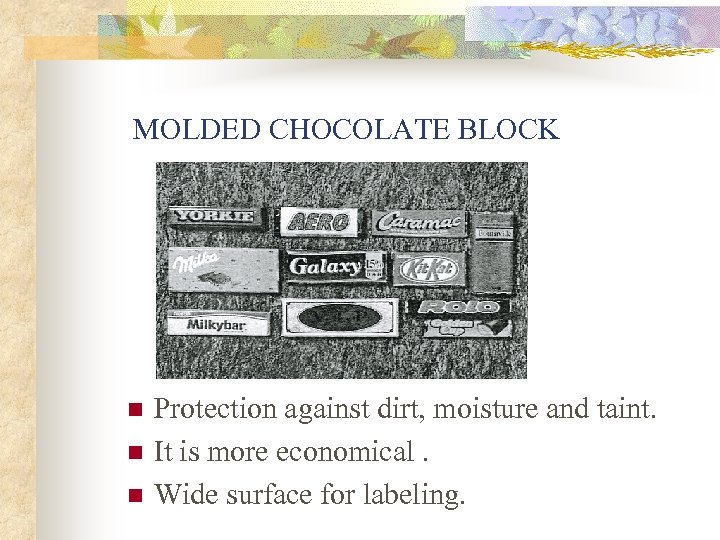 MOLDED CHOCOLATE BLOCK n n n Protection against dirt, moisture and taint. It is more economical. Wide surface for labeling.
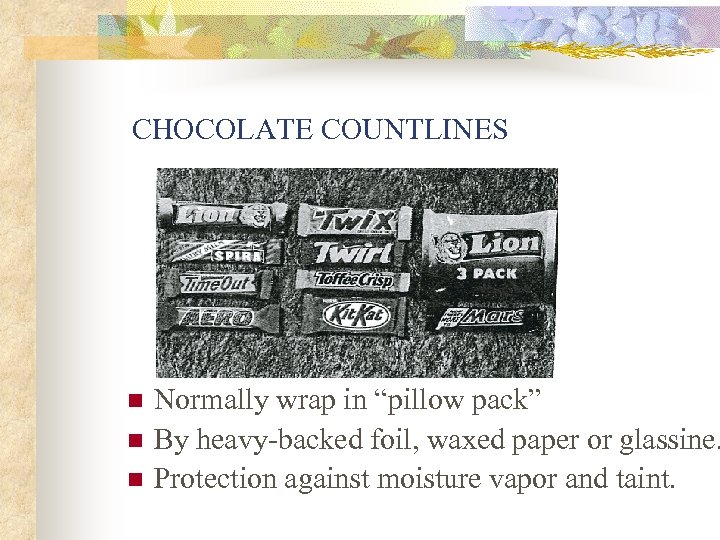 CHOCOLATE COUNTLINES n n n Normally wrap in “pillow pack” By heavy-backed foil, waxed paper or glassine. Protection against moisture vapor and taint.
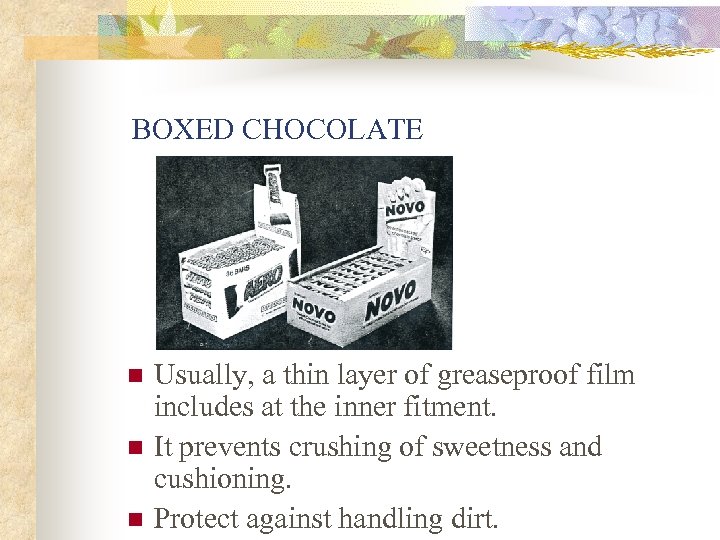 BOXED CHOCOLATE n n n Usually, a thin layer of greaseproof film includes at the inner fitment. It prevents crushing of sweetness and cushioning. Protect against handling dirt.
 TWRIST WRAPPING n n n In “double end fantail” form. By aluminum foil, backed and unbacked plain sliver, colored and printed film. Protection against dirt and taint.
 ALUMINUM FOIL n n Best barrier for water vapor and gas transmission. Thickness range from 7 -12 m for pure aluminum. Combination with special alloy for extra strength. Thickness range 7 -8 m.
 REGENERATED CELLULOSE FLIM (RCF) n n n Packaging in flexible form. Usually coated or giving other treatments. Protection against moisture vapor and taint. PVDC for extra protection such as electrostatics. An advantage for tear strip product.
 PLASTIC FILM n n n Three different forms: polyethylene, polyvinyl chloride and polyester. Available in film or coating purposes. Protection against moisture, gas and ultraviolet.