


 Скачать презентацию Colleges and the National Innovation Agenda Karen Corkery
4cc489a45e0f8491d65b4027d75bba10.ppt
- Количество слайдов: 38
 Colleges and the National Innovation Agenda Karen Corkery Senior Analyst Strategic Policy Branch Industry Canada August 1, 2002
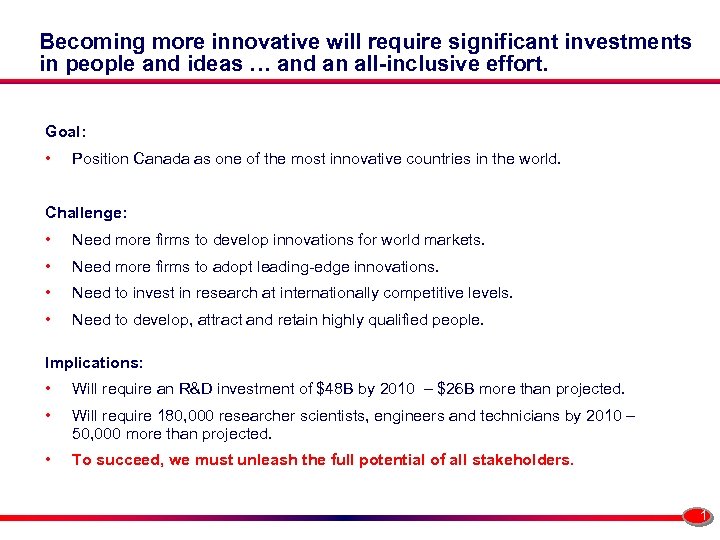 Becoming more innovative will require significant investments in people and ideas … and an all-inclusive effort. Goal: • Position Canada as one of the most innovative countries in the world. Challenge: • Need more firms to develop innovations for world markets. • Need more firms to adopt leading-edge innovations. • Need to invest in research at internationally competitive levels. • Need to develop, attract and retain highly qualified people. Implications: • Will require an R&D investment of $48 B by 2010 – $26 B more than projected. • Will require 180, 000 researcher scientists, engineers and technicians by 2010 – 50, 000 more than projected. • To succeed, we must unleash the full potential of all stakeholders. 1
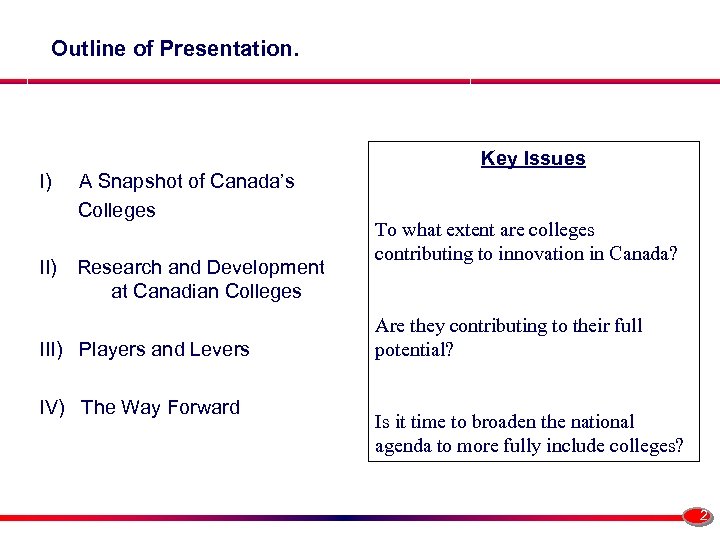 Outline of Presentation. Key Issues I) A Snapshot of Canada’s Colleges II) Research and Development at Canadian Colleges III) Players and Levers IV) The Way Forward To what extent are colleges contributing to innovation in Canada? Are they contributing to their full potential? Is it time to broaden the national agenda to more fully include colleges? 2
 I) A Snap Shot of Canada’s Colleges 3
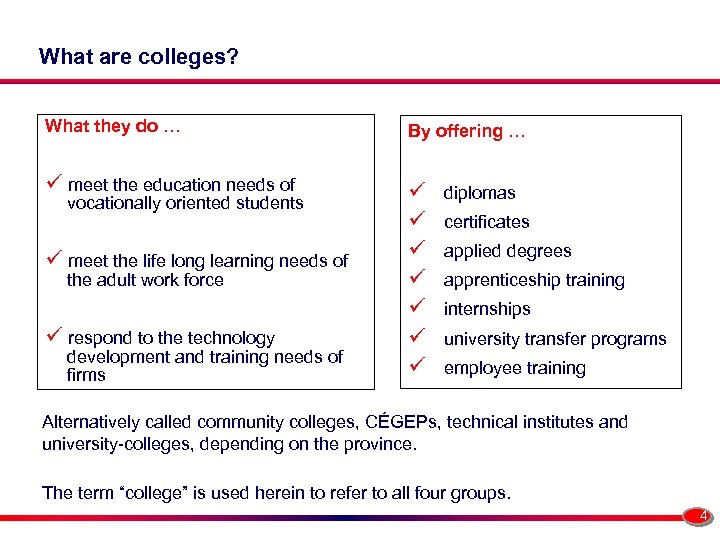 What are colleges? What they do … By offering … ü meet the education needs of ü ü ü ü vocationally oriented students ü meet the life long learning needs of the adult work force ü respond to the technology development and training needs of firms diplomas certificates applied degrees apprenticeship training internships university transfer programs employee training Alternatively called community colleges, CÉGEPs, technical institutes and university-colleges, depending on the province. The term “college” is used herein to refer to all four groups. 4
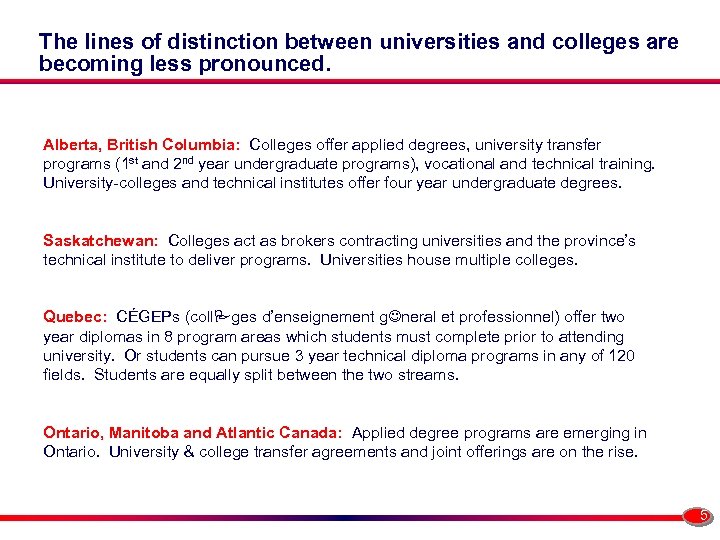 The lines of distinction between universities and colleges are becoming less pronounced. Alberta, British Columbia: Colleges offer applied degrees, university transfer programs (1 st and 2 nd year undergraduate programs), vocational and technical training. University-colleges and technical institutes offer four year undergraduate degrees. Saskatchewan: Colleges act as brokers contracting universities and the province’s technical institute to deliver programs. Universities house multiple colleges. Quebec: CÉGEPs (coll ges d’enseignement g neral et professionnel) offer two year diplomas in 8 program areas which students must complete prior to attending university. Or students can pursue 3 year technical diploma programs in any of 120 fields. Students are equally split between the two streams. Ontario, Manitoba and Atlantic Canada: Applied degree programs are emerging in Ontario. University & college transfer agreements and joint offerings are on the rise. 5
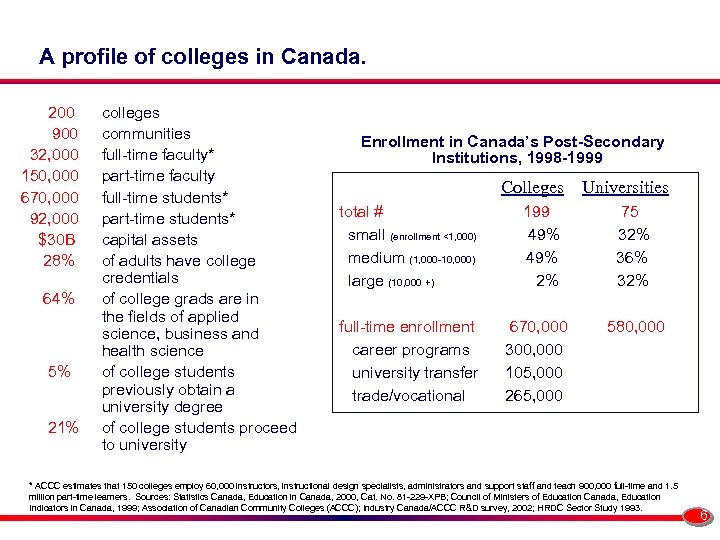 A profile of colleges in Canada. 200 900 32, 000 150, 000 670, 000 92, 000 $30 B 28% 64% 5% 21% colleges communities full-time faculty* part-time faculty full-time students* part-time students* capital assets of adults have college credentials of college grads are in the fields of applied science, business and health science of college students previously obtain a university degree of college students proceed to university Enrollment in Canada’s Post-Secondary Institutions, 1998 -1999 Colleges total # small (enrollment <1, 000) medium (1, 000 -10, 000) large (10, 000 +) full-time enrollment career programs university transfer trade/vocational 199 49% 2% 670, 000 300, 000 105, 000 265, 000 Universities 75 32% 36% 32% 580, 000 * ACCC estimates that 150 colleges employ 60, 000 instructors, instructional design specialists, administrators and support staff and teach 900, 000 full-time and 1. 5 million part-time learners. Sources: Statistics Canada, Education in Canada, 2000, Cat. No. 81 -229 -XPB; Council of Ministers of Education Canada, Education Indicators in Canada, 1999; Association of Canadian Community Colleges (ACCC); Industry Canada/ACCC R&D survey, 2002; HRDC Sector Study 1993. 6
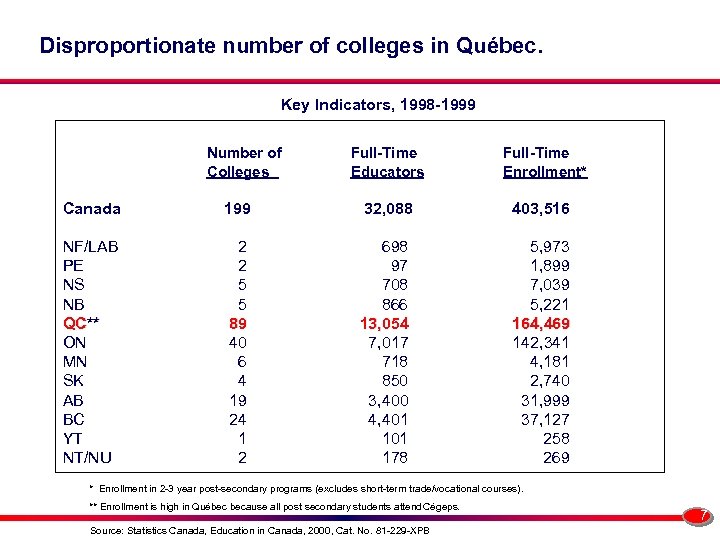 Disproportionate number of colleges in Québec. Key Indicators, 1998 -1999 Number of Colleges Full-Time Educators Full-Time Enrollment* Canada 199 32, 088 403, 516 NF/LAB PE NS NB QC** ON MN SK AB BC YT NT/NU 2 2 5 5 89 40 6 4 19 24 1 2 698 97 708 866 13, 054 7, 017 718 850 3, 400 4, 401 178 5, 973 1, 899 7, 039 5, 221 164, 469 142, 341 4, 181 2, 740 31, 999 37, 127 258 269 * Enrollment in 2 -3 year post-secondary programs (excludes short-term trade/vocational courses). ** Enrollment is high in Québec because all post secondary students attend Cégeps. Source: Statistics Canada, Education in Canada, 2000, Cat. No. 81 -229 -XPB 7
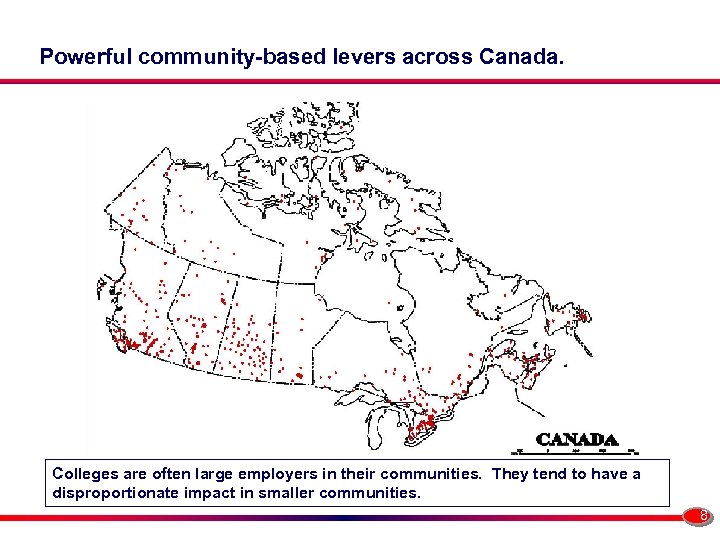 Powerful community-based levers across Canada. Colleges are often large employers in their communities. They tend to have a disproportionate impact in smaller communities. 8
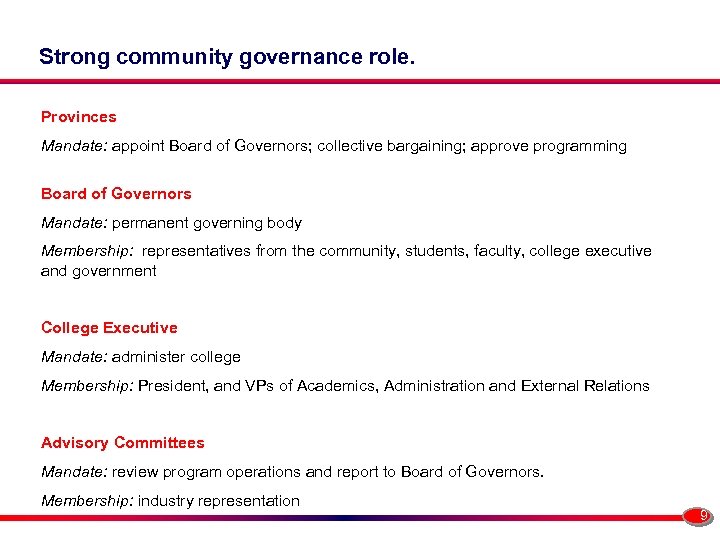 Strong community governance role. Provinces Mandate: appoint Board of Governors; collective bargaining; approve programming Board of Governors Mandate: permanent governing body Membership: representatives from the community, students, faculty, college executive and government College Executive Mandate: administer college Membership: President, and VPs of Academics, Administration and External Relations Advisory Committees Mandate: review program operations and report to Board of Governors. Membership: industry representation 9
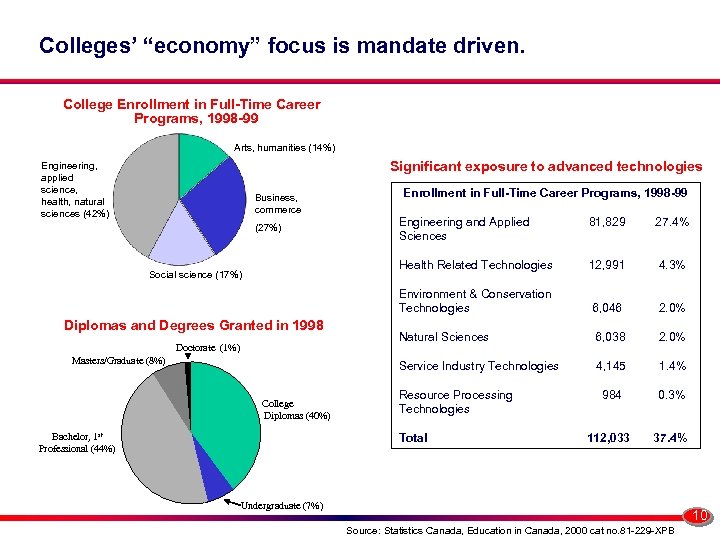 Colleges’ “economy” focus is mandate driven. College Enrollment in Full-Time Career Programs, , 1998 -99 Arts, humanities (14%) Significant exposure to advanced technologies Engineering, applied science, health, natural sciences (42%) Business, commerce Enrollment in Full-Time Career Programs, 1998 -99 Doctorate (1%) Masters/Graduate (8%) College Diplomas (40%) 27. 4% 12, 991 4. 3% 6, 046 2. 0% Natural Sciences 6, 038 2. 0% Service Industry Technologies Diplomas and Degrees Granted in 1998 81, 829 Environment & Conservation Technologies Social science (17%) Engineering and Applied Sciences Health Related Technologies (27%) 4, 145 1. 4% 984 0. 3% 112, 033 37. 4% Resource Processing Technologies Total Bachelor, 1 st Professional (44%) Undergraduate (7%) 10 Source: Statistics Canada, Education in Canada, 2000 cat no. 81 -229 -XPB
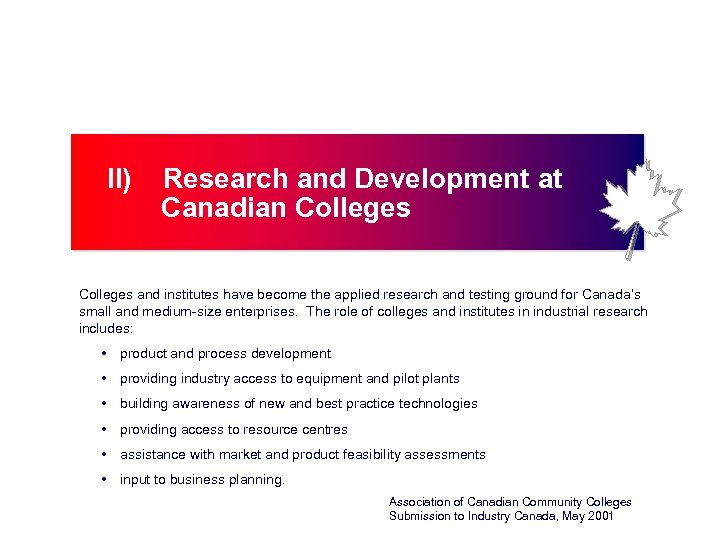 II) Research and Development at Canadian Colleges and institutes have become the applied research and testing ground for Canada’s small and medium-size enterprises. The role of colleges and institutes in industrial research includes: • product and process development • providing industry access to equipment and pilot plants • building awareness of new and best practice technologies • providing access to resource centres • assistance with market and product feasibility assessments 11 • input to business planning. Association of Canadian Community Colleges Submission to Industry Canada, May 2001
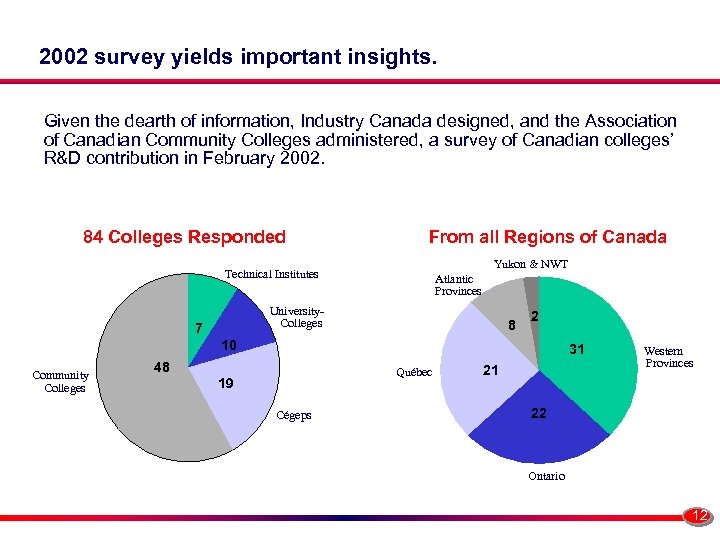 2002 survey yields important insights. Given the dearth of information, Industry Canada designed, and the Association of Canadian Community Colleges administered, a survey of Canadian colleges’ R&D contribution in February 2002. 84 Colleges Responded From all Regions of Canada Yukon & NWT Technical Institutes Atlantic Provinces University. Colleges 7 8 2 10 Community Colleges 31 48 Québec 19 Cégeps 21 Western Provinces 22 Ontario 12
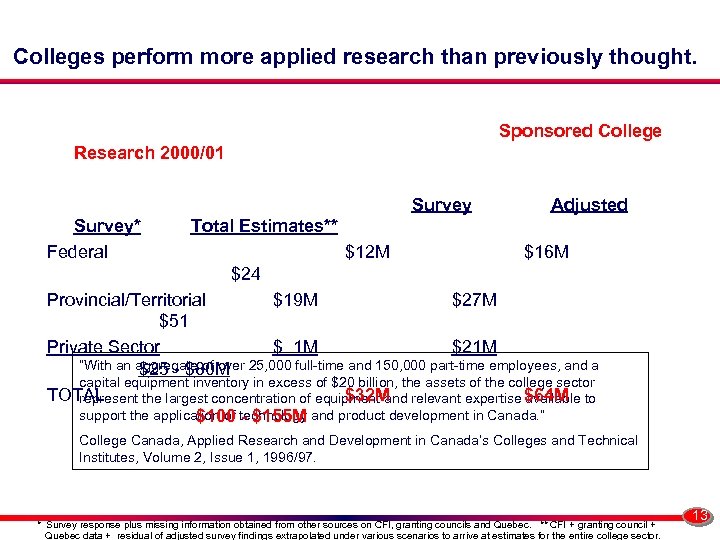 Colleges perform more applied research than previously thought. Sponsored College Research 2000/01 Survey* Federal Adjusted Total Estimates** $12 M $16 M $24 Provincial/Territorial $19 M $27 M $51 Private Sector $ 1 M $21 M “With an aggregate of over 25, 000 full-time and 150, 000 part-time employees, and a $25 - $80 M capital equipment inventory in excess of $20 billion, the assets of the college sector TOTAL $32 M represent the largest concentration of equipment and relevant expertise $64 M to available support the application of technology and product development in Canada. ” $100 - $155 M College Canada, Applied Research and Development in Canada’s Colleges and Technical Institutes, Volume 2, Issue 1, 1996/97. * Survey response plus missing information obtained from other sources on CFI, granting councils and Quebec. ** CFI + granting council + Quebec data + residual of adjusted survey findings extrapolated under various scenarios to arrive at estimates for the entire college sector. 13
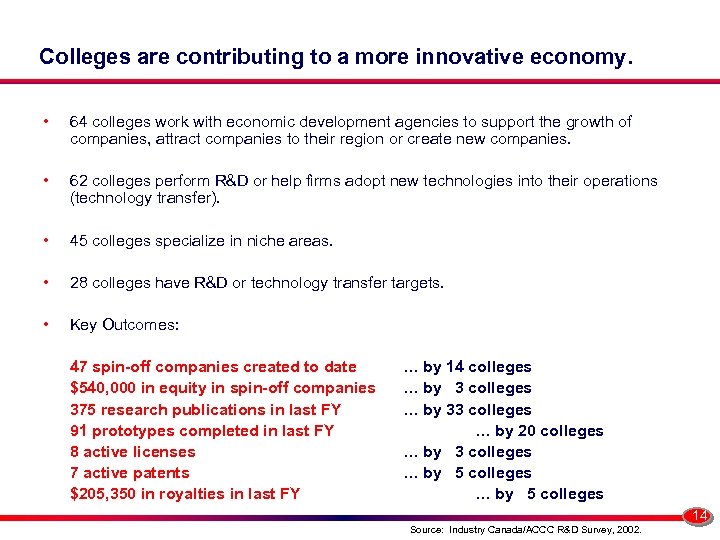 Colleges are contributing to a more innovative economy. • 64 colleges work with economic development agencies to support the growth of companies, attract companies to their region or create new companies. • 62 colleges perform R&D or help firms adopt new technologies into their operations (technology transfer). • 45 colleges specialize in niche areas. • 28 colleges have R&D or technology transfer targets. • Key Outcomes: 47 spin-off companies created to date $540, 000 in equity in spin-off companies 375 research publications in last FY 91 prototypes completed in last FY 8 active licenses 7 active patents $205, 350 in royalties in last FY … by 14 colleges … by 33 colleges … by 20 colleges … by 3 colleges … by 5 colleges 14 Source: Industry Canada/ACCC R&D Survey, 2002.
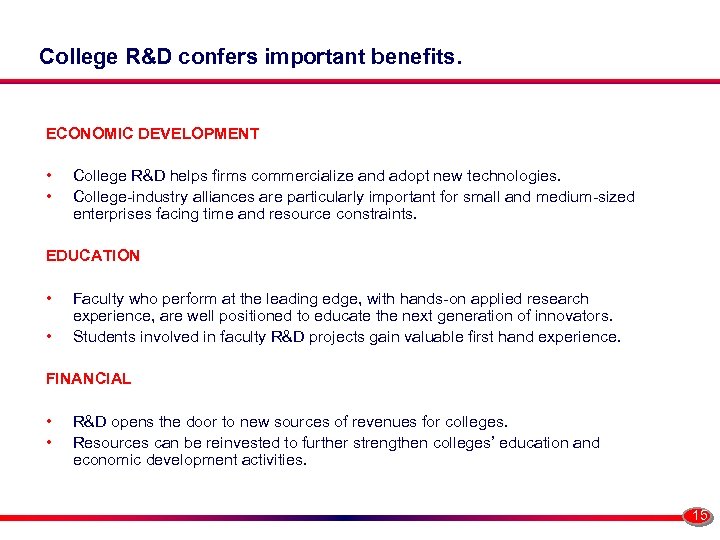 College R&D confers important benefits. ECONOMIC DEVELOPMENT • • College R&D helps firms commercialize and adopt new technologies. College-industry alliances are particularly important for small and medium-sized enterprises facing time and resource constraints. EDUCATION • • Faculty who perform at the leading edge, with hands-on applied research experience, are well positioned to educate the next generation of innovators. Students involved in faculty R&D projects gain valuable first hand experience. FINANCIAL • • R&D opens the door to new sources of revenues for colleges. Resources can be reinvested to further strengthen colleges’ education and economic development activities. 15
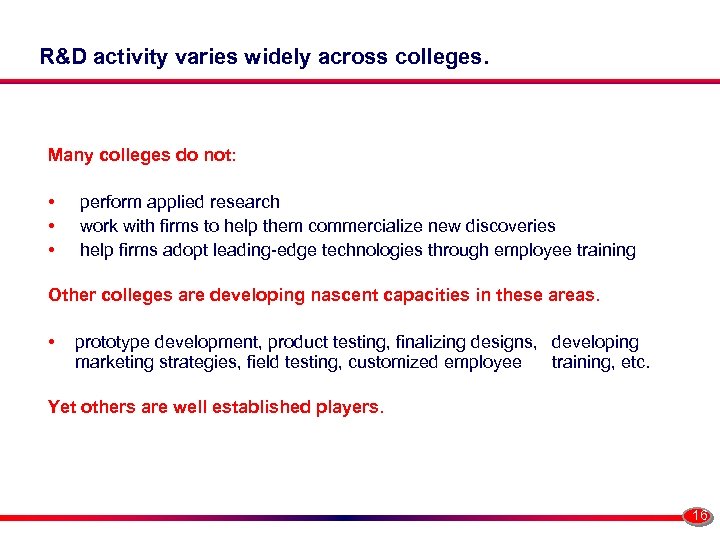 R&D activity varies widely across colleges. Many colleges do not: • • • perform applied research work with firms to help them commercialize new discoveries help firms adopt leading-edge technologies through employee training Other colleges are developing nascent capacities in these areas. • prototype development, product testing, finalizing designs, developing marketing strategies, field testing, customized employee training, etc. Yet others are well established players. 16
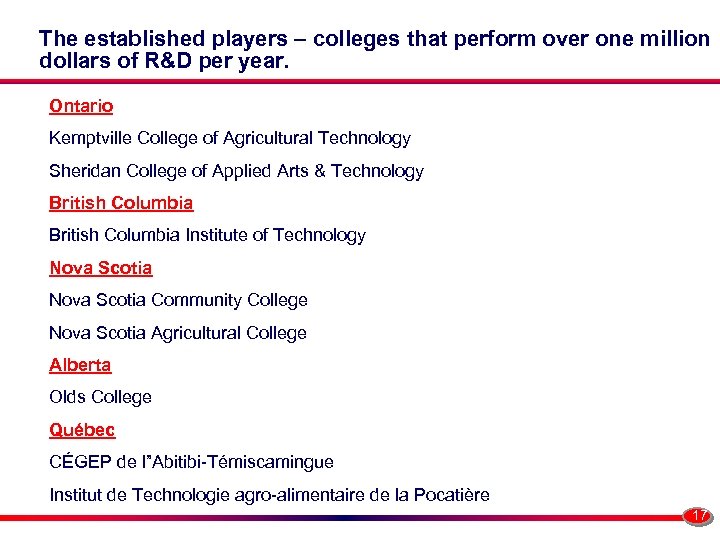 The established players – colleges that perform over one million dollars of R&D per year. Ontario Kemptville College of Agricultural Technology Sheridan College of Applied Arts & Technology British Columbia Institute of Technology Nova Scotia Community College Nova Scotia Agricultural College Alberta Olds College Québec CÉGEP de l”Abitibi-Témiscamingue Institut de Technologie agro-alimentaire de la Pocatière 17
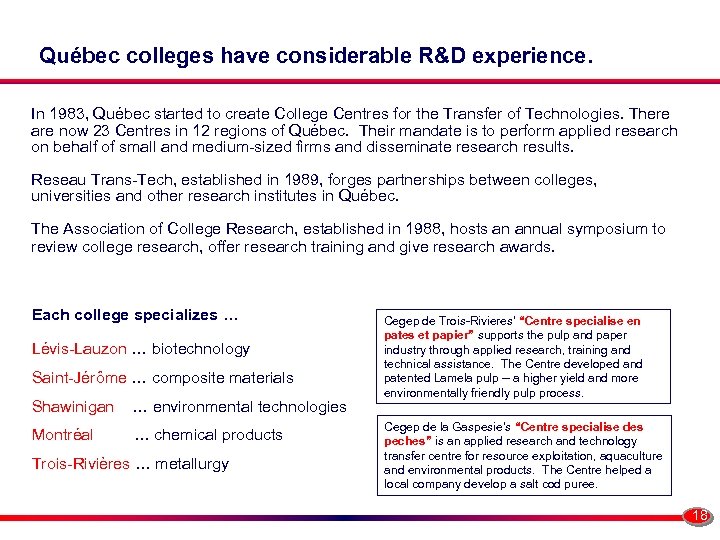 Québec colleges have considerable R&D experience. In 1983, Québec started to create College Centres for the Transfer of Technologies. There are now 23 Centres in 12 regions of Québec. Their mandate is to perform applied research on behalf of small and medium-sized firms and disseminate research results. Reseau Trans-Tech, established in 1989, forges partnerships between colleges, universities and other research institutes in Québec. The Association of College Research, established in 1988, hosts an annual symposium to review college research, offer research training and give research awards. Each college specializes … Lévis-Lauzon … biotechnology Saint-Jérôme … composite materials Shawinigan … environmental technologies Montréal … chemical products Trois-Rivières … metallurgy Cegep de Trois-Rivieres’ “Centre specialise en pates et papier” supports the pulp and paper industry through applied research, training and technical assistance. The Centre developed and patented Lamela pulp -- a higher yield and more environmentally friendly pulp process. Cegep de la Gaspesie’s “Centre specialise des peches” is an applied research and technology transfer centre for resource exploitation, aquaculture and environmental products. The Centre helped a local company develop a salt cod puree. 18
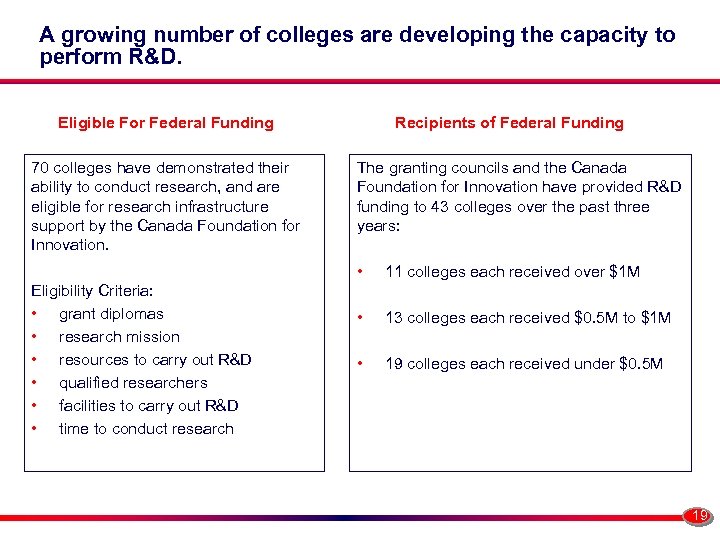 A growing number of colleges are developing the capacity to perform R&D. Eligible For Federal Funding 70 colleges have demonstrated their ability to conduct research, and are eligible for research infrastructure support by the Canada Foundation for Innovation. Recipients of Federal Funding The granting councils and the Canada Foundation for Innovation have provided R&D funding to 43 colleges over the past three years: • Eligibility Criteria: • grant diplomas • research mission • resources to carry out R&D • qualified researchers • facilities to carry out R&D • time to conduct research 11 colleges each received over $1 M • 13 colleges each received $0. 5 M to $1 M • 19 colleges each received under $0. 5 M 19
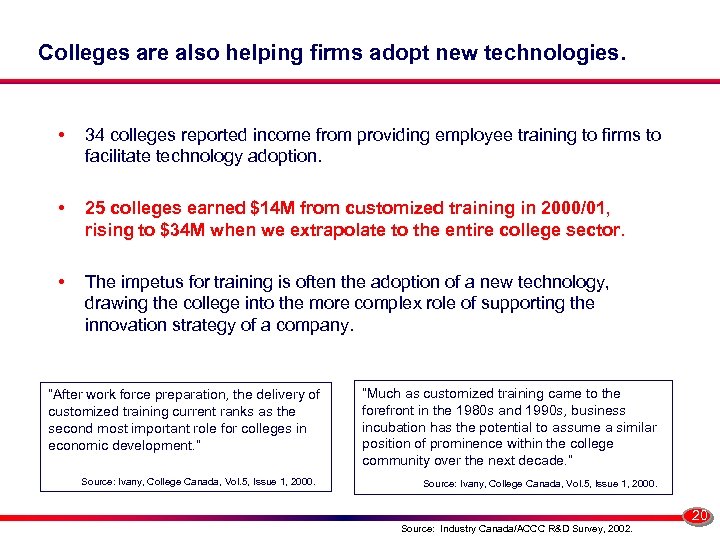 Colleges are also helping firms adopt new technologies. • 34 colleges reported income from providing employee training to firms to facilitate technology adoption. • 25 colleges earned $14 M from customized training in 2000/01, rising to $34 M when we extrapolate to the entire college sector. • The impetus for training is often the adoption of a new technology, drawing the college into the more complex role of supporting the innovation strategy of a company. “After work force preparation, the delivery of customized training current ranks as the second most important role for colleges in economic development. ” Source: Ivany, College Canada, Vol. 5, Issue 1, 2000. “Much as customized training came to the forefront in the 1980 s and 1990 s, business incubation has the potential to assume a similar position of prominence within the college community over the next decade. ” Source: Ivany, College Canada, Vol. 5, Issue 1, 2000. Source: Industry Canada/ACCC R&D Survey, 2002. 20
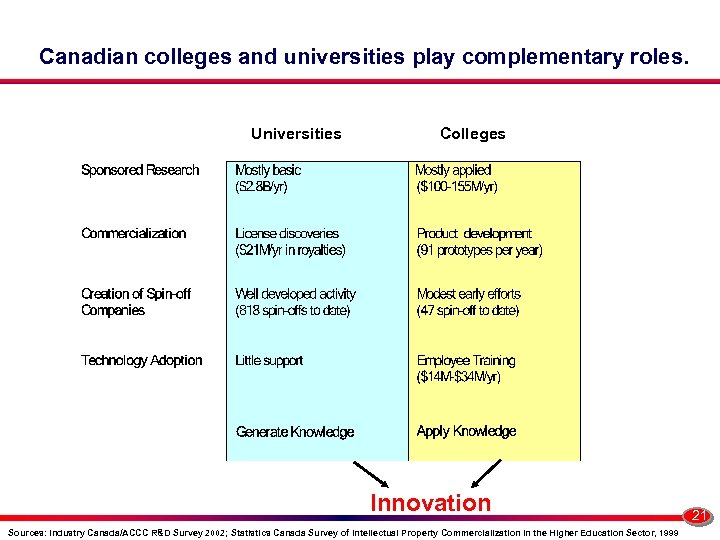 Canadian colleges and universities play complementary roles. Universities Colleges Innovation Sources: Industry Canada/ACCC R&D Survey 2002; Statistics Canada Survey of Intellectual Property Commercialization in the Higher Education Sector, 1999 21
 III) Players and Levers 22
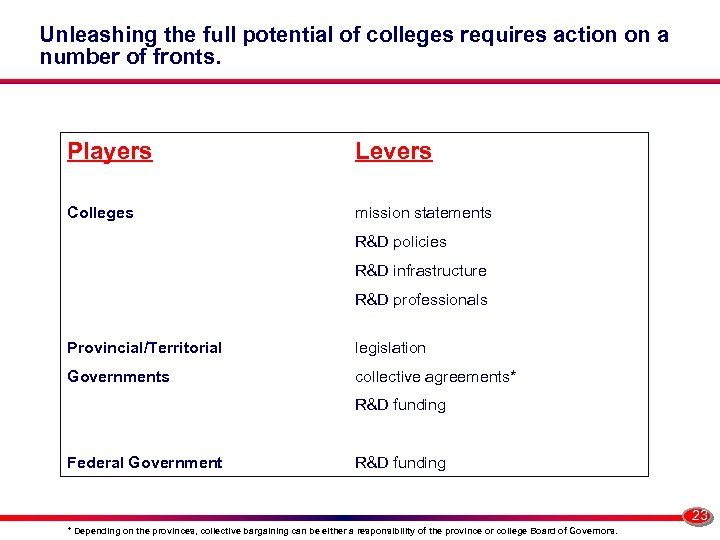 Unleashing the full potential of colleges requires action on a number of fronts. Players Levers Colleges mission statements R&D policies R&D infrastructure R&D professionals Provincial/Territorial legislation Governments collective agreements* R&D funding Federal Government R&D funding 23 * Depending on the provinces, collective bargaining can be either a responsibility of the province or college Board of Governors.
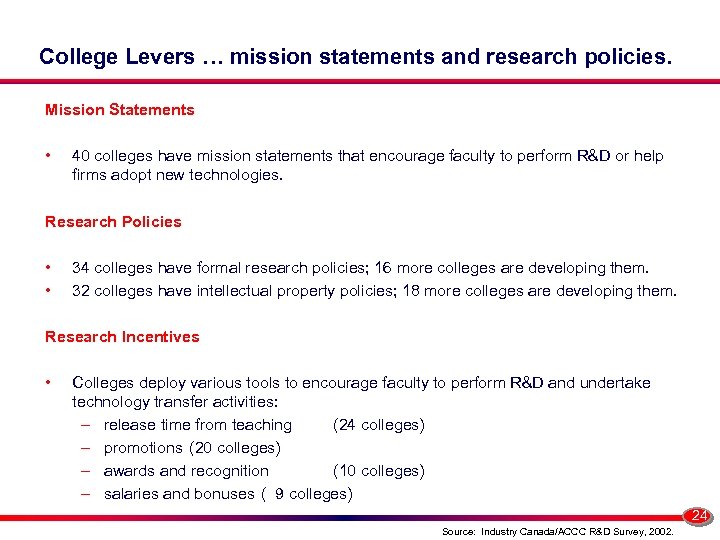 College Levers … mission statements and research policies. Mission Statements • 40 colleges have mission statements that encourage faculty to perform R&D or help firms adopt new technologies. Research Policies • • 34 colleges have formal research policies; 16 more colleges are developing them. 32 colleges have intellectual property policies; 18 more colleges are developing them. Research Incentives • Colleges deploy various tools to encourage faculty to perform R&D and undertake technology transfer activities: – release time from teaching (24 colleges) – promotions (20 colleges) – awards and recognition (10 colleges) – salaries and bonuses ( 9 colleges) 24 Source: Industry Canada/ACCC R&D Survey, 2002.
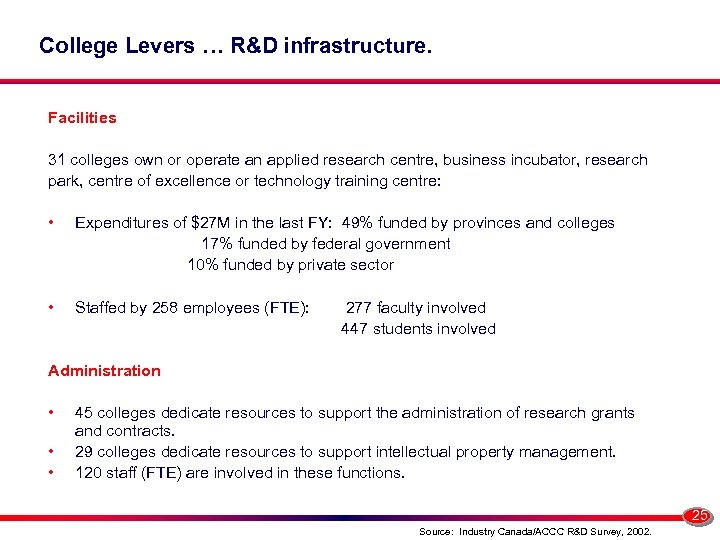 College Levers … R&D infrastructure. Facilities 31 colleges own or operate an applied research centre, business incubator, research park, centre of excellence or technology training centre: • Expenditures of $27 M in the last FY: 49% funded by provinces and colleges 17% funded by federal government 10% funded by private sector • Staffed by 258 employees (FTE): 277 faculty involved 447 students involved Administration • • • 45 colleges dedicate resources to support the administration of research grants and contracts. 29 colleges dedicate resources to support intellectual property management. 120 staff (FTE) are involved in these functions. 25 Source: Industry Canada/ACCC R&D Survey, 2002.
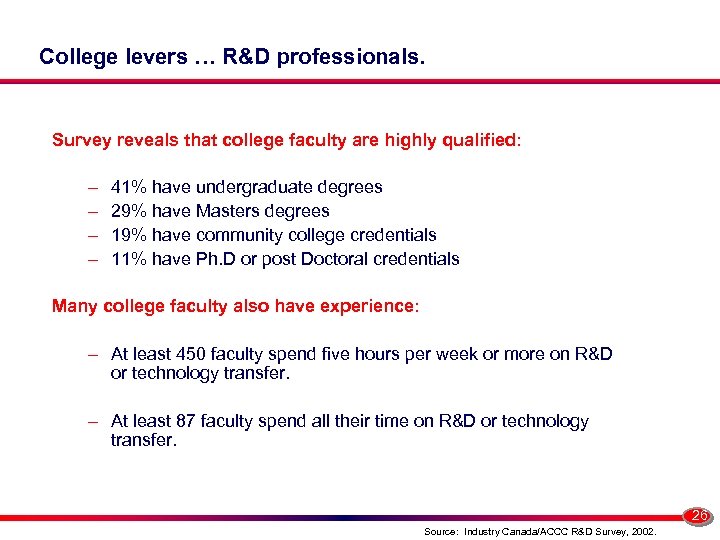 College levers … R&D professionals. Survey reveals that college faculty are highly qualified: – – 41% have undergraduate degrees 29% have Masters degrees 19% have community college credentials 11% have Ph. D or post Doctoral credentials Many college faculty also have experience: – At least 450 faculty spend five hours per week or more on R&D or technology transfer. – At least 87 faculty spend all their time on R&D or technology transfer. 26 Source: Industry Canada/ACCC R&D Survey, 2002.
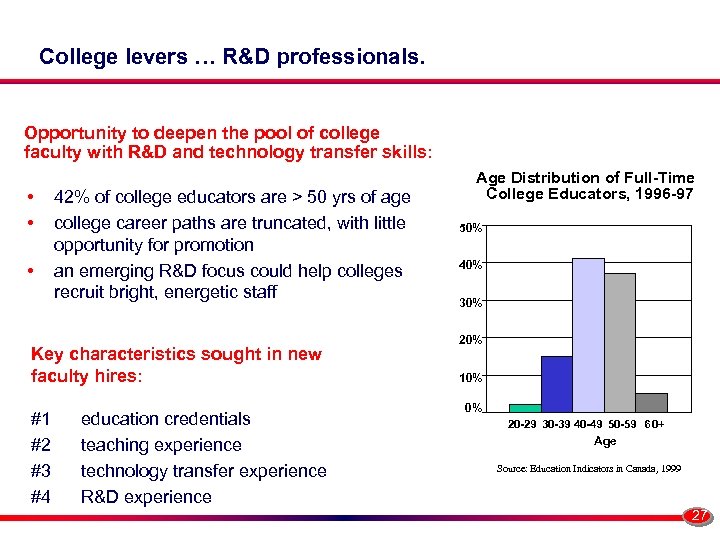 College levers … R&D professionals. Opportunity to deepen the pool of college faculty with R&D and technology transfer skills: • • • 42% of college educators are > 50 yrs of age college career paths are truncated, with little opportunity for promotion an emerging R&D focus could help colleges recruit bright, energetic staff Key characteristics sought in new faculty hires: #1 #2 #3 #4 education credentials teaching experience technology transfer experience R&D experience Age Distribution of Full-Time College Educators, 1996 -97 50% 40% 30% 20% 10% 0% 20 -29 30 -39 40 -49 50 -59 60+ Age Source: Education Indicators in Canada, 1999 27
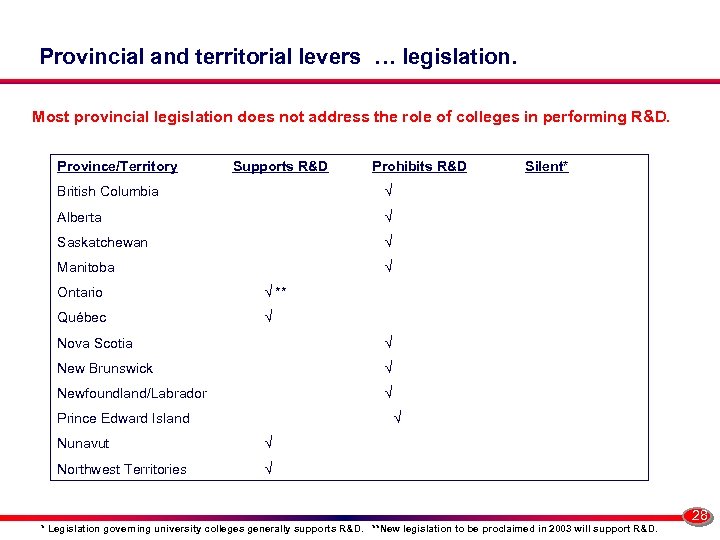 Provincial and territorial levers … legislation. Most provincial legislation does not address the role of colleges in performing R&D. Province/Territory Supports R&D Prohibits R&D British Columbia Alberta Saskatchewan Manitoba Silent* Ontario ** Québec Nova Scotia New Brunswick Newfoundland/Labrador Prince Edward Island Nunavut Northwest Territories 28 * Legislation governing university colleges generally supports R&D. **New legislation to be proclaimed in 2003 will support R&D. Except
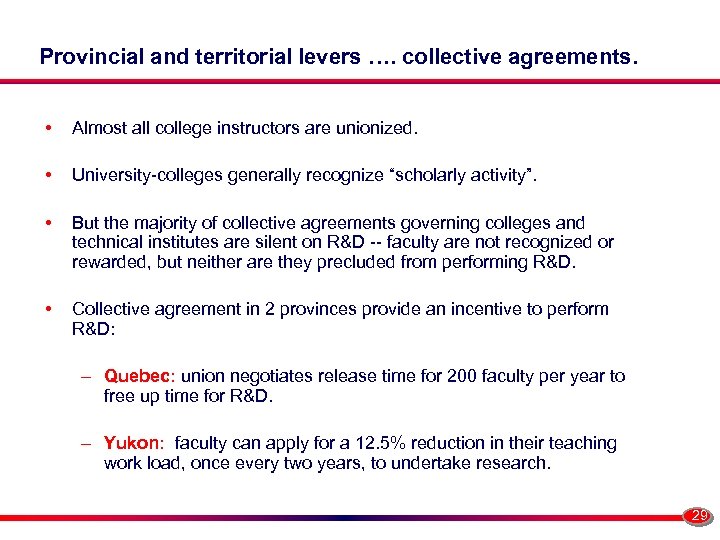 Provincial and territorial levers …. collective agreements. • Almost all college instructors are unionized. • University-colleges generally recognize “scholarly activity”. • But the majority of collective agreements governing colleges and technical institutes are silent on R&D -- faculty are not recognized or rewarded, but neither are they precluded from performing R&D. • Collective agreement in 2 provinces provide an incentive to perform R&D: – Quebec: union negotiates release time for 200 faculty per year to free up time for R&D. – Yukon: faculty can apply for a 12. 5% reduction in their teaching work load, once every two years, to undertake research. 29
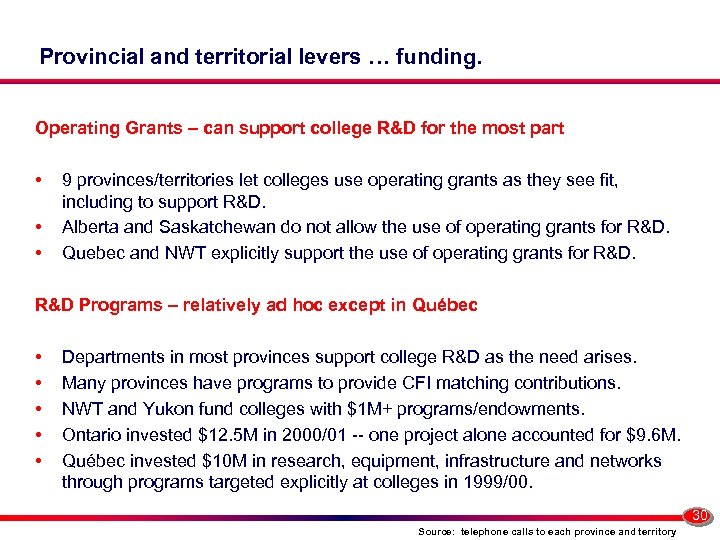 Provincial and territorial levers … funding. Operating Grants – can support college R&D for the most part • • • 9 provinces/territories let colleges use operating grants as they see fit, including to support R&D. Alberta and Saskatchewan do not allow the use of operating grants for R&D. Quebec and NWT explicitly support the use of operating grants for R&D Programs – relatively ad hoc except in Québec • • • Departments in most provinces support college R&D as the need arises. Many provinces have programs to provide CFI matching contributions. NWT and Yukon fund colleges with $1 M+ programs/endowments. Ontario invested $12. 5 M in 2000/01 -- one project alone accounted for $9. 6 M. Québec invested $10 M in research, equipment, infrastructure and networks through programs targeted explicitly at colleges in 1999/00. 30 Source: telephone calls to each province and territory
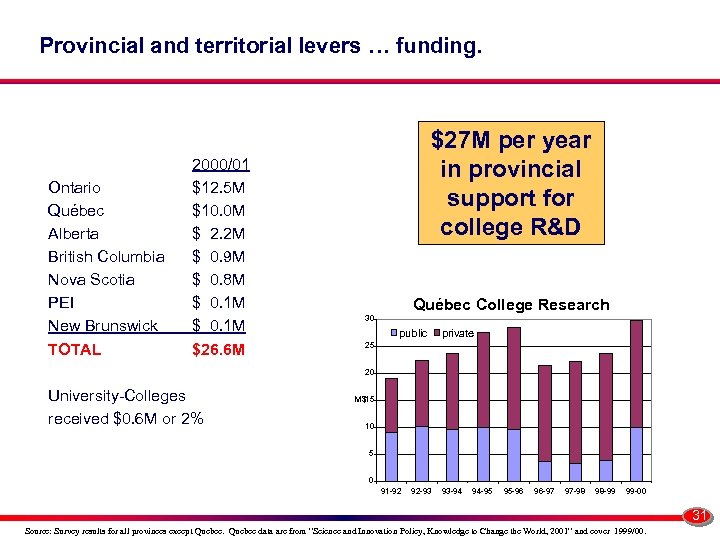 Provincial and territorial levers … funding. Ontario Québec Alberta British Columbia Nova Scotia PEI New Brunswick TOTAL 2000/01 $12. 5 M $10. 0 M $ 2. 2 M $ 0. 9 M $ 0. 8 M $ 0. 1 M $26. 6 M $27 M per year in provincial support for college R&D Québec College Research 30 public private 25 20 University-Colleges received $0. 6 M or 2% M$15 10 5 0 91 -92 92 -93 93 -94 94 -95 95 -96 96 -97 97 -98 98 -99 99 -00 31 Source: Survey results for all provinces except Quebec data are from “Science and Innovation Policy, Knowledge to Change the World, 2001” and cover 1999/00.
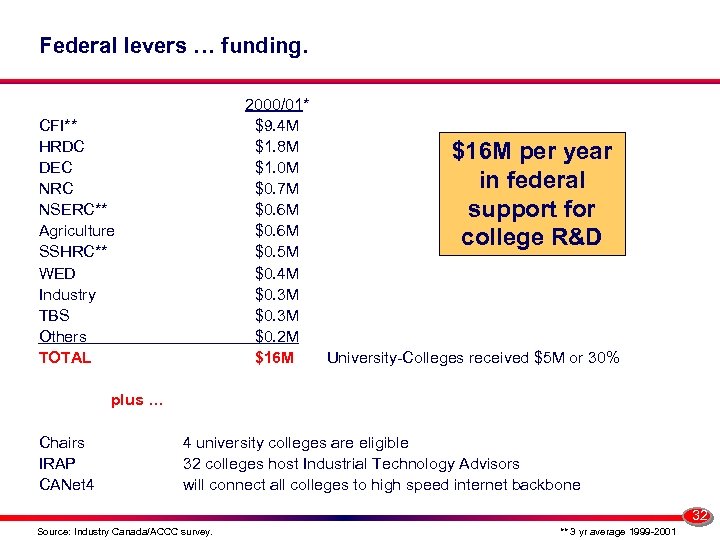 Federal levers … funding. 2000/01* $9. 4 M $1. 8 M $1. 0 M $0. 7 M $0. 6 M $0. 5 M $0. 4 M $0. 3 M $0. 2 M $16 M CFI** HRDC DEC NRC NSERC** Agriculture SSHRC** WED Industry TBS Others TOTAL $16 M per year in federal support for college R&D University-Colleges received $5 M or 30% plus … Chairs IRAP CANet 4 4 university colleges are eligible 32 colleges host Industrial Technology Advisors will connect all colleges to high speed internet backbone 32 Source: Industry Canada/ACCC survey. ** 3 yr average 1999 -2001
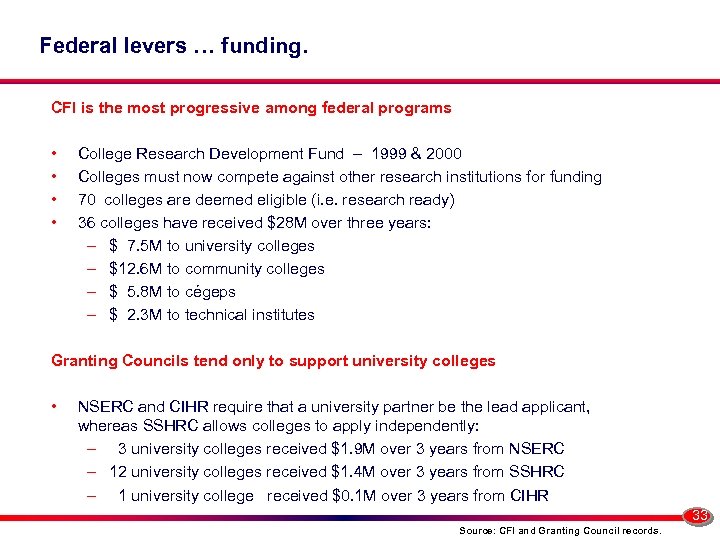 Federal levers … funding. CFI is the most progressive among federal programs • • College Research Development Fund – 1999 & 2000 Colleges must now compete against other research institutions for funding 70 colleges are deemed eligible (i. e. research ready) 36 colleges have received $28 M over three years: – $ 7. 5 M to university colleges – $12. 6 M to community colleges – $ 5. 8 M to cégeps – $ 2. 3 M to technical institutes Granting Councils tend only to support university colleges • NSERC and CIHR require that a university partner be the lead applicant, whereas SSHRC allows colleges to apply independently: – 3 university colleges received $1. 9 M over 3 years from NSERC – 12 university colleges received $1. 4 M over 3 years from SSHRC – 1 university college received $0. 1 M over 3 years from CIHR 33 Source: CFI and Granting Council records.
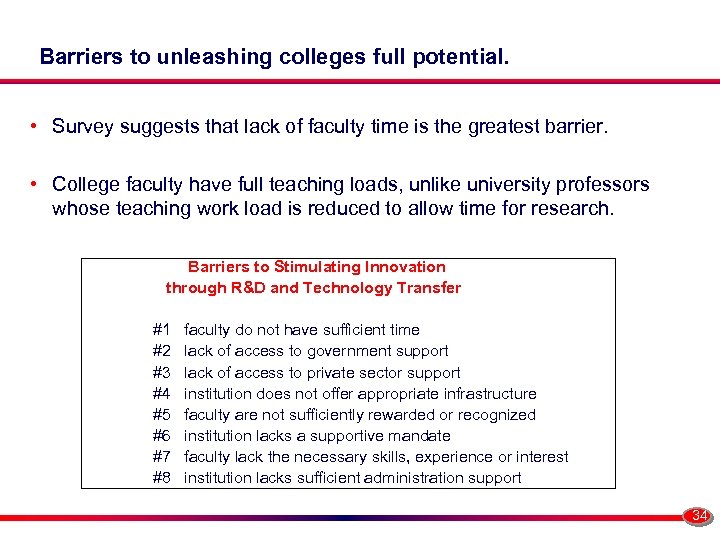 Barriers to unleashing colleges full potential. • Survey suggests that lack of faculty time is the greatest barrier. • College faculty have full teaching loads, unlike university professors whose teaching work load is reduced to allow time for research. Barriers to Stimulating Innovation through R&D and Technology Transfer #1 #2 #3 #4 #5 #6 #7 #8 faculty do not have sufficient time lack of access to government support lack of access to private sector support institution does not offer appropriate infrastructure faculty are not sufficiently rewarded or recognized institution lacks a supportive mandate faculty lack the necessary skills, experience or interest institution lacks sufficient administration support 34
 IV) The Way Forward 35
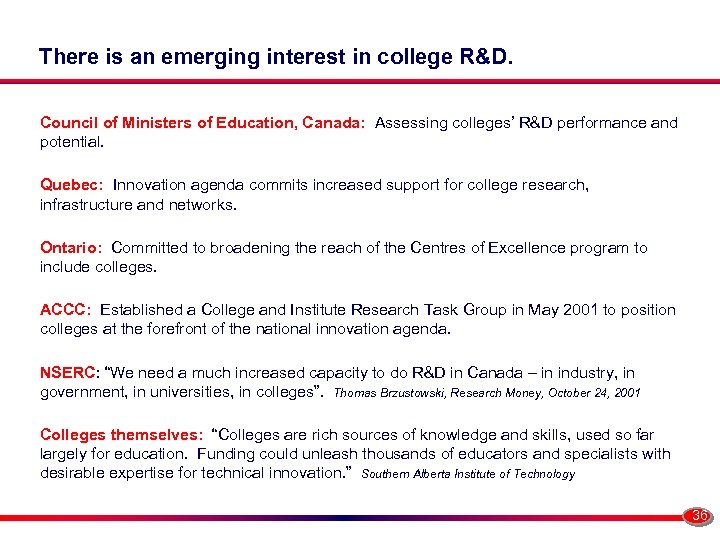 There is an emerging interest in college R&D. Council of Ministers of Education, Canada: Assessing colleges’ R&D performance and potential. Quebec: Innovation agenda commits increased support for college research, infrastructure and networks. Ontario: Committed to broadening the reach of the Centres of Excellence program to include colleges. ACCC: Established a College and Institute Research Task Group in May 2001 to position colleges at the forefront of the national innovation agenda. NSERC: “We need a much increased capacity to do R&D in Canada – in industry, in government, in universities, in colleges”. Thomas Brzustowski, Research Money, October 24, 2001 Colleges themselves: “Colleges are rich sources of knowledge and skills, used so far largely for education. Funding could unleash thousands of educators and specialists with desirable expertise for technical innovation. ” Southern Alberta Institute of Technology 36
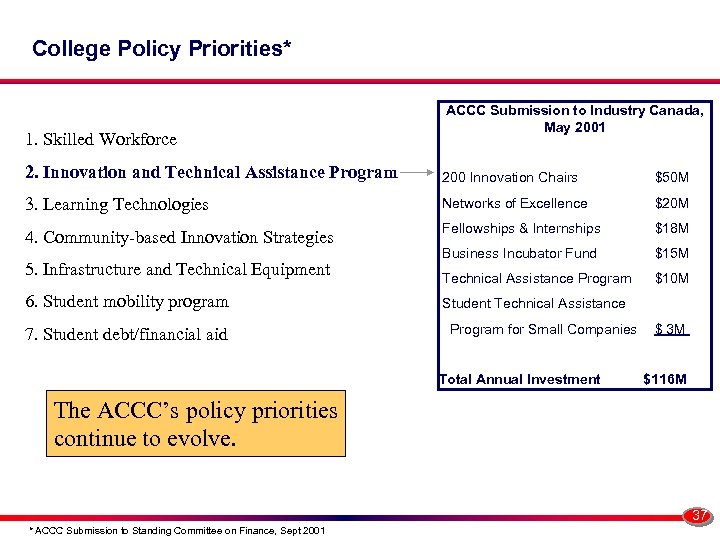 College Policy Priorities* 1. Skilled Workforce ACCC Submission to Industry Canada, May 2001 2. Innovation and Technical Assistance Program 200 Innovation Chairs $50 M 3. Learning Technologies Networks of Excellence $20 M 4. Community-based Innovation Strategies Fellowships & Internships $18 M Business Incubator Fund $15 M Technical Assistance Program $10 M 5. Infrastructure and Technical Equipment 6. Student mobility program 7. Student debt/financial aid Student Technical Assistance Program for Small Companies Total Annual Investment $ 3 M $116 M The ACCC’s policy priorities continue to evolve. 37 * ACCC Submission to Standing Committee on Finance, Sept 2001