


 Скачать презентацию COLLEGE OF EDUCATION AND HUMAN SERVICES Educator Preparation
a0c46bb53df1ce6991f2cf76b12fc694.ppt
- Количество слайдов: 18
 COLLEGE OF EDUCATION AND HUMAN SERVICES Educator Preparation
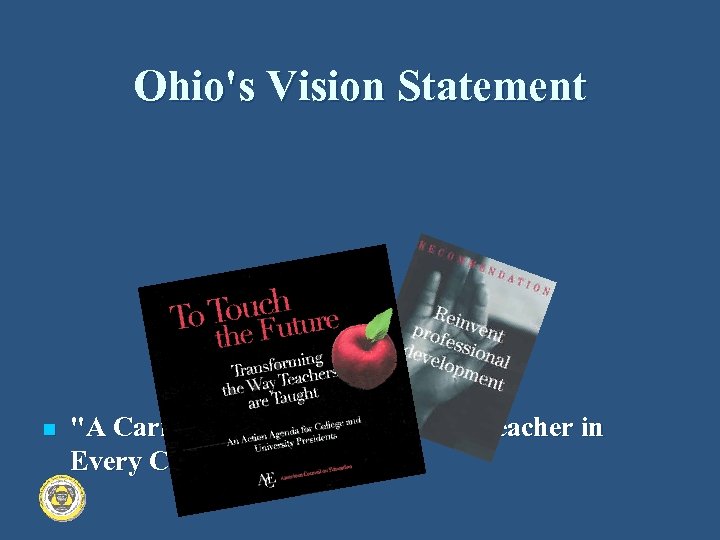 Ohio's Vision Statement n "A Caring, Competent, Qualified Teacher in Every Classroom"
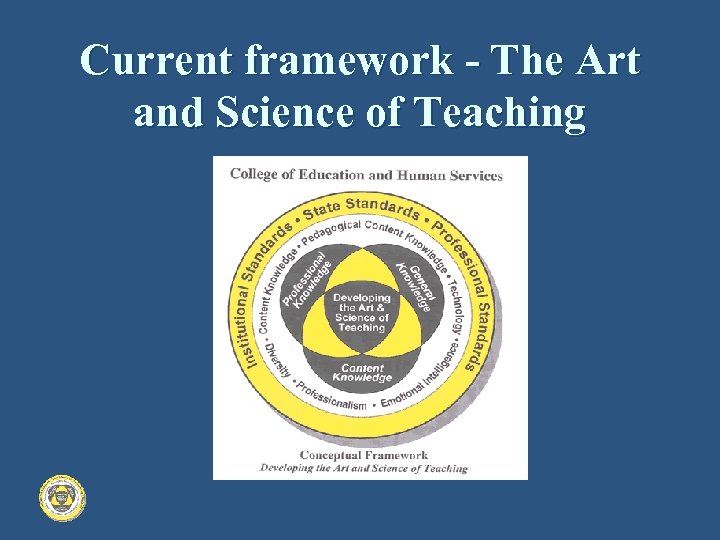 Current framework ‑ The Art and Science of Teaching
 What is Licensure? • A set of programs that meet the new state requirements for teacher preparation. • Students receiving a license as opposed to a certificate will have to complete a Master’s degree (or equivalent) within 10 years to keep their license. (Those who receive a certificate will NEVER have to earn a Master’s degree in order to keep their certificate. )
 New Licensure • New Licensure ‑ changing from certification to licensure • • Performance‑based Outcome/Expectations Completion of an ODE Approved Teacher Preparation Program Success on PRAXIS II ‑ PLT and Content exams Recommendation by Institution for Initial Licensure
 New Licensure (continued) • New Licensure ‑ change from certification to licensure • • Two Year Provisional Entry Year Program ‑ Ohio FIRST Success on PRAXIS III Performance Assessment Five Year Professional License (5 yr. renewal cycle for career)
 Current Structure for Teacher Education at WSU Initial Programs Early Childhood Education – 4 yr program Undergraduate: ages 3 -8, Grades PK – 3 Middle Childhood – 5 yr program Undergraduate +: ages 9 – 14, Grades 4 – 9 Adolescent to Young Adult – 5 yr program Undergraduate +: ages 12 – 21, Grades 7 – 12 Multiage Programs - Grades PK - 12 Example: Foreign Language
 Current Structure for Teacher Education at WSU Advanced Programs Examples Include: n Intervention Specialist: Mild/moderate and Gifted n Classroom Teacher: Library Media School Librarian n Teacher & Supervisor: Computer Technology Computer Teachers and Administrative Specialists
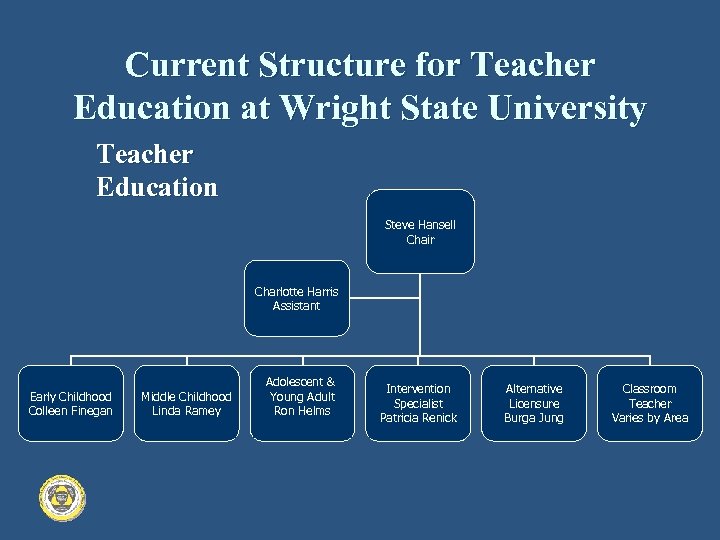 Current Structure for Teacher Education at Wright State University Teacher Education Steve Hansell Chair Charlotte Harris Assistant Early Childhood Colleen Finegan Middle Childhood Linda Ramey Adolescent & Young Adult Ron Helms Intervention Specialist Patricia Renick Alternative Licensure Burga Jung Classroom Teacher Varies by Area
 Early Childhood Education BSEd degree leading to Ohio licensure Program Advisor – Dr. Colleen Finegan (grades Pre. K-3) Phase I (part 1): EDE 221 and EDE 223 (1 credit hour each) 180 -200 practicum hours total Focus: Regular & Special Education Phase I (part 2): EDE 225 (1 credit hour) 80 -100 practicum hours Focus: Preschool/Kindergarten Phase I (part 3): EDE 227 (1 credit hour) 120 -150 practicum hours Focus: Classroom Management & Assessment
 Phase II (part 1): EDE 321 (1 credit hour) 120 -150 practicum hours Focus: Language Arts and Social Studies Phase II (part 2): EDE 323 (1 credit hour) 120 -150 practicum hours Focus: Mathematics & Science Phase III: EDE 419 (10 -12 credit hours) Internship all day, everyday The program is designed so that Phase II and Phase III (full-time practicum) experiences will be in the same placement (barring extenuating circumstances).
 • MC/AYA • Phase II • First Semester • In an urban or suburban setting for one public school semester where they spend every morning in the building and all day Friday. During this semester they will have a mini lead teaching experience.
 MC/AYA Phase II Second Semester In opposite setting culturally diverse/suburban. Where ever they were the first semester in opposite setting. This involves every morning for ten weeks, then ten weeks all day of lead teaching. During the first eight weeks interns are there for mornings only they will become familiar with setting and prepare to take over as lead teacher.
 What Does This Mean As A Field Placement Site? • We would like to ask you to become a field placement site which means you will agree to place ECE students and/or MC/AYA. Faculty input in the decision is necessary. We would like you to discuss it as soon as possible and get back to Raymond Swann or. Donna Cole.
 Phase II Benefits • Each week - extra hands to help them reach students that they find difficult to reach. • Time to consider if you want to keep this student as a student teacher the following quarter. • Relationship between in service and preservice is started. • Pathwise training will be offered for clinical teacher. Enables them to work with own students better, mentor preservice teachers, earn LPDC credits or LPDC? ? ? Credit for renewal. • New requirement for being a mentor to a first year student.
 Student Teacher Benefits • Small reinnumeration • Being the most influential person in a new teacher’s life. • Benefit for the K-12 students. Provides more hands. • Lead teaching instead of student teaching. Coops do not have to leave classroom so teacher can become support for children.
 Intern Benefits In classroom for a semester. . • More mature student than Undergraduate. • Secondary have content strength because they have a degree in content area. Middle Level have two concentration areas. • Public School educators are called Clinical Faculty Member and are entitled to benefits at the university. Clinical Faculty might be asked to be an instructor for course work. Access to ERC, computer lab, library, Nutter Center. • Get rennumeration fee
 Closing Comments and Questions