


 Скачать презентацию College Career Ready A Conceptual Framework for
750be2c8e32f29d09ffe2aebae671a28.ppt
- Количество слайдов: 28
 College & Career Ready: A Conceptual Framework for Increasing Engagement, Achievement and Transition James R. Stone III Director National Research Center for Career and Technical Education
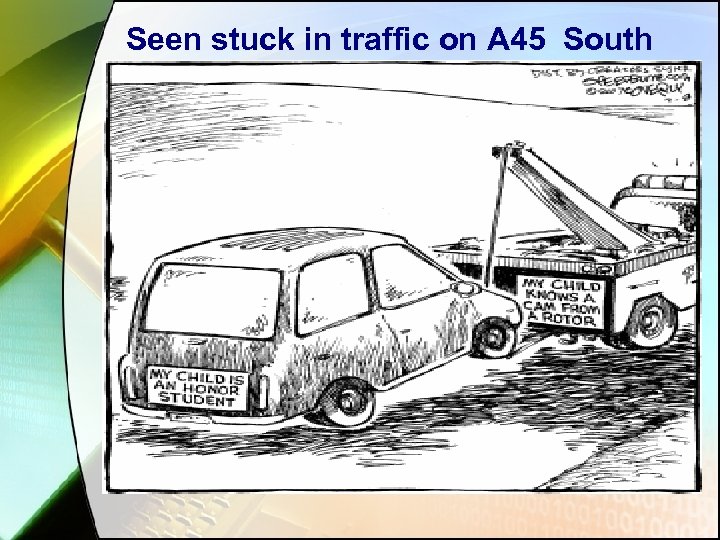 Seen stuck in traffic on A 45 South
 Two Key Questions: 1. What is the appropriate mix of academic, occupational and technical skills required for the emerging labor market? 2. How can schools help students develop these skills?
 Defining College & Career Ready Whatever skills needed to succeed in credit bearing CC courses (Tucker, NCEE) Being ready for college means that a high school graduate has the knowledge and skills necessary to qualify for and succeed in entry-level, credit-bearing college courses without the need for remedial coursework. (Achieve Inc) 4 years of math, English; 3 years of science & social science (College Board) Skills needed for living-wage, entry level jobs are same as skill needed to succeed in college (ADP)
 The Education Challenge. Engagement - Completing secondary education; completing postsecondary credential. Achievement - test scores and industry recognized credentials. Transition - to continued education and training and/or the workplace
 THE EMERGING AMERICAN WORKPLACE
 More STEM or. . . S&E occupations make up only about onetwentieth (5%) of all workers (5. 3% in 2018), Urban Institute, 2007 435, 000 U. S. citizens and permanent residents a year graduated with bachelor's, master's, and doctoral degrees in science and engineering. Over the same period, there were about 150, 000 jobs added annually to the science and engineering workforce. . http: //www. businessweek. com/print/smallbiz/content/oct 2007/sb 20071 025_827398. htm
 Murray said that none of the companies she has talked with has suggested that there is a shortage of qualified chemists or life scientists. She said that employers’ greatest concern “is not numbers, it is training. ” She cited the example of managers who told her they could interview hundreds of candidates for an organic chemistry position but wish they knew how to identify those candidates who “can behave collaboratively” and have the other broad competencies discussed at the workshop. She argued that the degree to which scientists have these other capabilities “really seems to be the problem. ” IS THERE A SHORTAGE OF SCIENTISTS? National Research Council. (2008). Research on Future Skill Demands: A Workshop Summary. Margaret Hilton, Rapporteur. Center for Education, Division of Behavioral and Social Sciences and Education. Washington, DC: The National Academies Press.
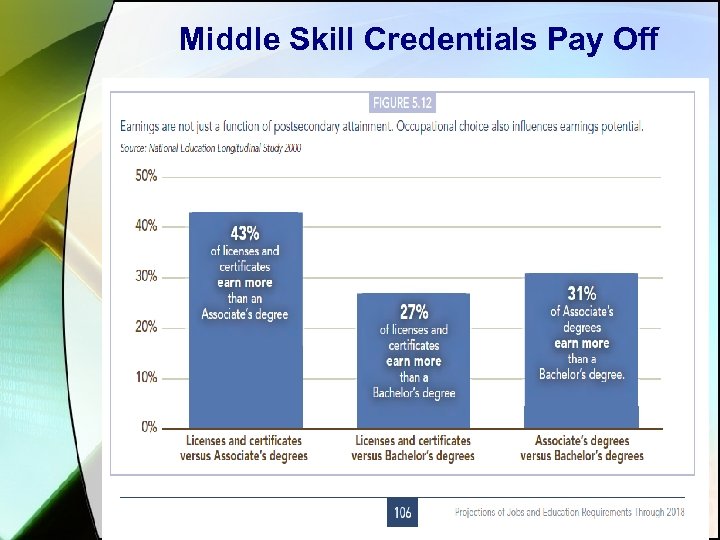 Middle Skill Credentials Pay Off
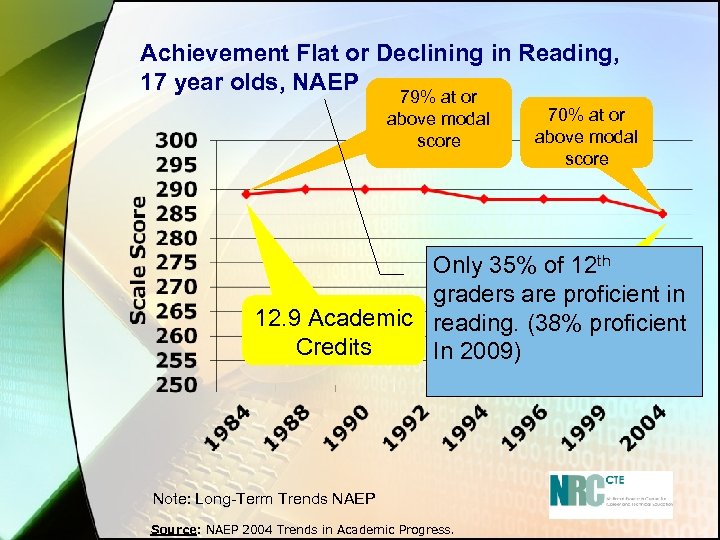 Achievement Flat or Declining in Reading, 17 year olds, NAEP 79% at or above modal score 70% at or above modal score Only 35% of 12 th graders are proficient in 19 Academic 12. 9 Academic reading. (38% proficient Credits In 2009) Note: Long-Term Trends NAEP Source: NAEP 2004 Trends in Academic Progress.
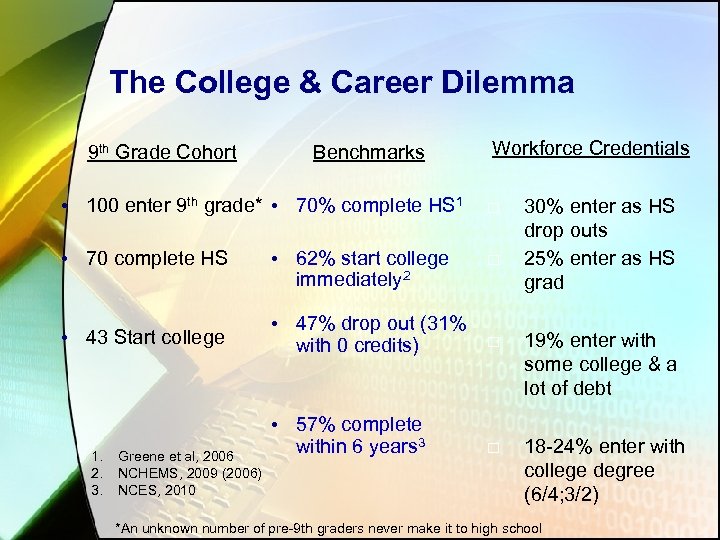 The College & Career Dilemma 9 th Grade Cohort Benchmarks Workforce Credentials • 100 enter 9 th grade* • 70% complete HS 1 o • 70 complete HS o • 43 Start college • 62% start college immediately 2 • 47% drop out (31% with 0 credits) o 19% enter with some college & a lot of debt o 18 -24% enter with college degree (6/4; 3/2) • 57% complete 1. 2. 3. Greene et al, 2006 NCHEMS, 2009 (2006) NCES, 2010 within 6 years 3 30% enter as HS drop outs 25% enter as HS grad *An unknown number of pre-9 th graders never make it to high school
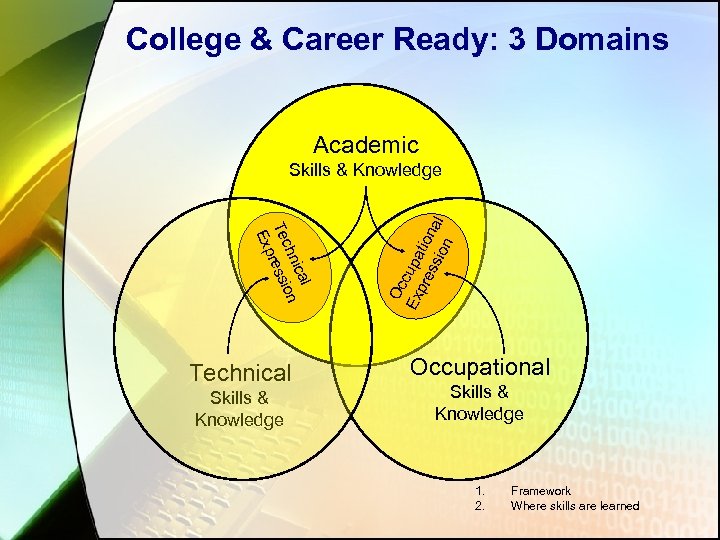 College & Career Ready: 3 Domains Academic cal hni on Tec ressi Exp Technical Skills & Knowledge Oc Ex cupa pre tio ssi nal on Skills & Knowledge Occupational Skills & Knowledge 1. 2. Framework Where skills are learned
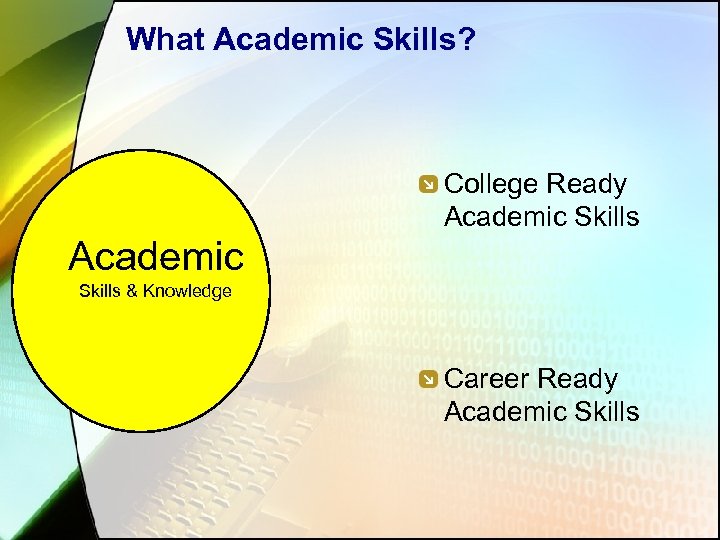 What Academic Skills? College Ready Academic Skills & Knowledge Career Ready Academic Skills
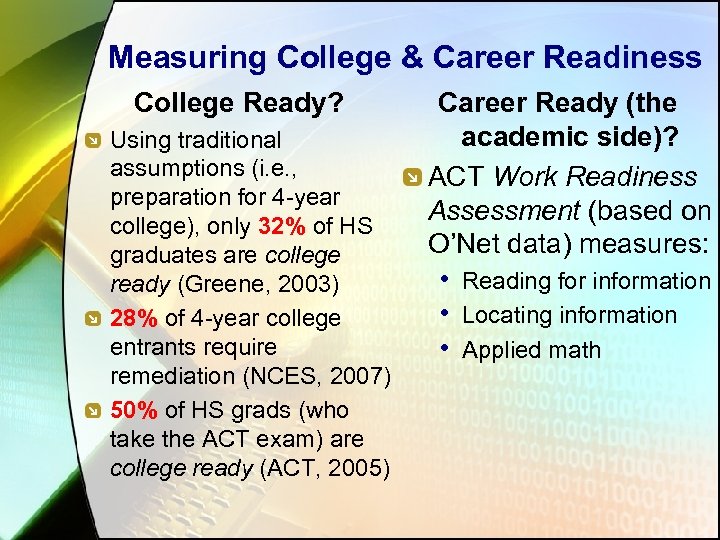 Measuring College & Career Readiness College Ready? Using traditional assumptions (i. e. , preparation for 4 -year college), only 32% of HS graduates are college ready (Greene, 2003) 28% of 4 -year college entrants require remediation (NCES, 2007) 50% of HS grads (who take the ACT exam) are college ready (ACT, 2005) Career Ready (the academic side)? ACT Work Readiness Assessment (based on O’Net data) measures: • Reading for information • Locating information • Applied math
 ACADEMIC SKILLS IN THE WORKPLACE
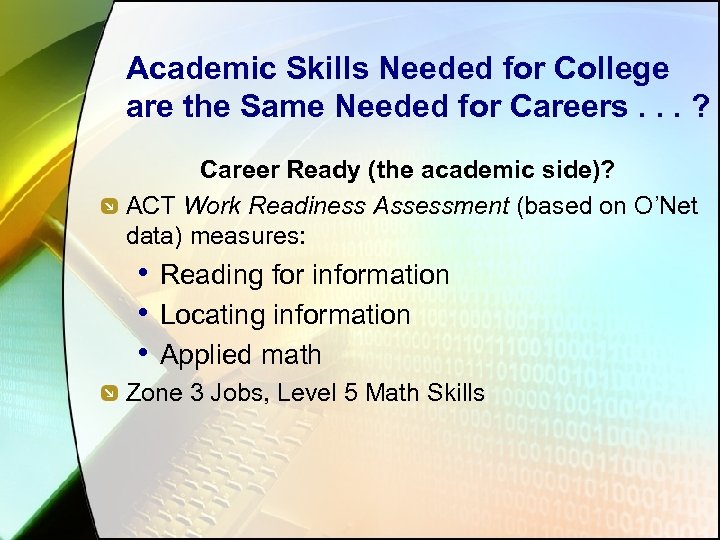 Academic Skills Needed for College are the Same Needed for Careers. . . ? Career Ready (the academic side)? ACT Work Readiness Assessment (based on O’Net data) measures: • Reading for information • Locating information • Applied math Zone 3 Jobs, Level 5 Math Skills
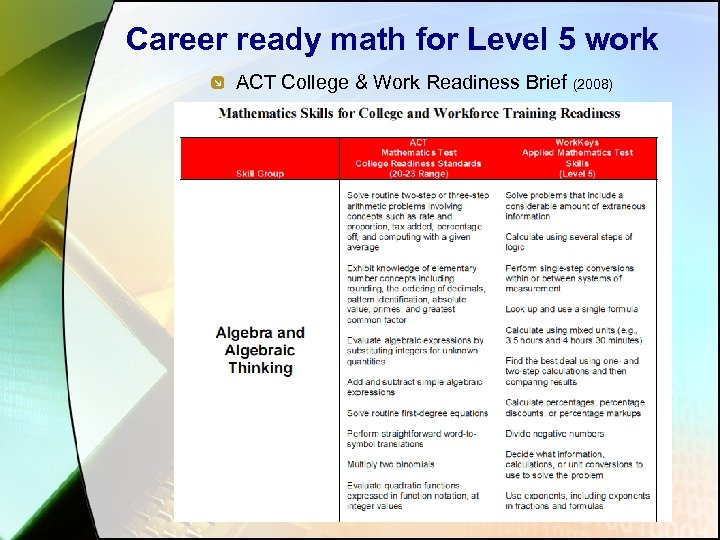 Career ready math for Level 5 work ACT College & Work Readiness Brief (2008)
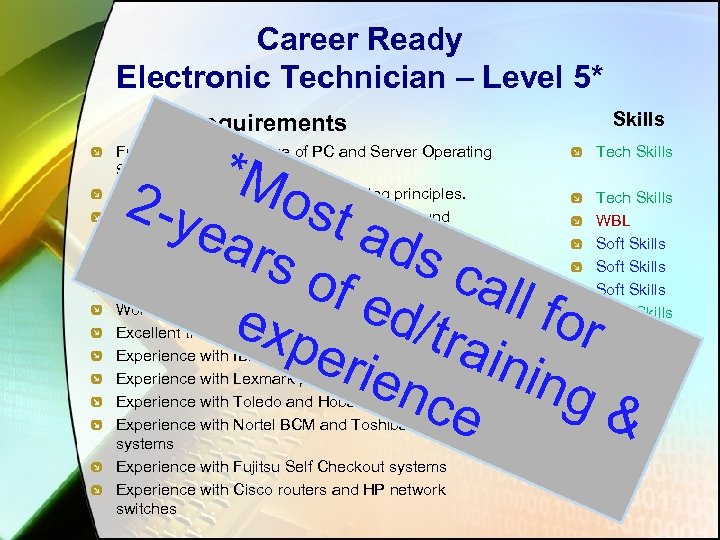 Career Ready Electronic Technician – Level 5* Requirements Skills *Mo 2 -y st a ear ds so cal f ed l fo exp /tra r erie inin nce g& Fundamental knowledge of PC and Server Operating Systems. Fundamental knowledge of networking principles. Strong Electronics and Mechanical background Highly motivated and energetic Strong communication skills and work ethic Strong organizational skills Working knowledge of Microsoft Office applications Excellent troubleshooting skills Experience with IBM POS equipment Experience with Lexmark printers Experience with Toledo and Hobart scale systems Experience with Nortel BCM and Toshiba CTX systems Experience with Fujitsu Self Checkout systems Experience with Cisco routers and HP network switches Tech Skills WBL Soft Skills Tech Skills WBL WBL
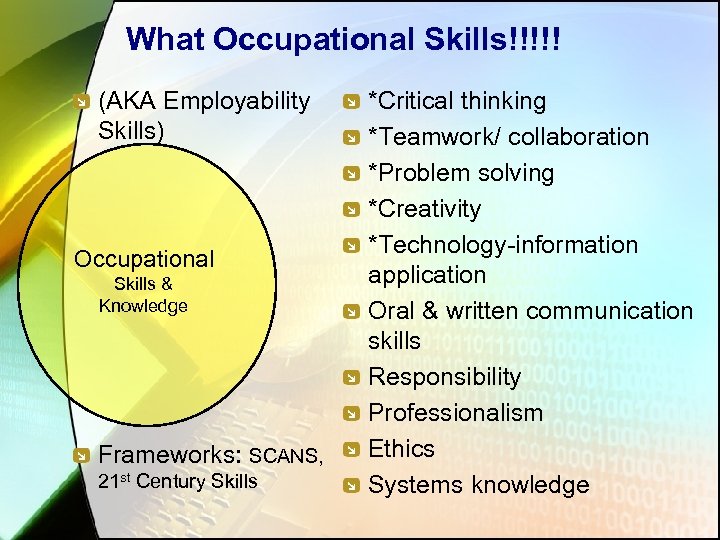 What Occupational Skills!!!!! (AKA Employability Skills) Occupational Skills & Knowledge Frameworks: SCANS, 21 st Century Skills *Critical thinking *Teamwork/ collaboration *Problem solving *Creativity *Technology-information application Oral & written communication skills Responsibility Professionalism Ethics Systems knowledge
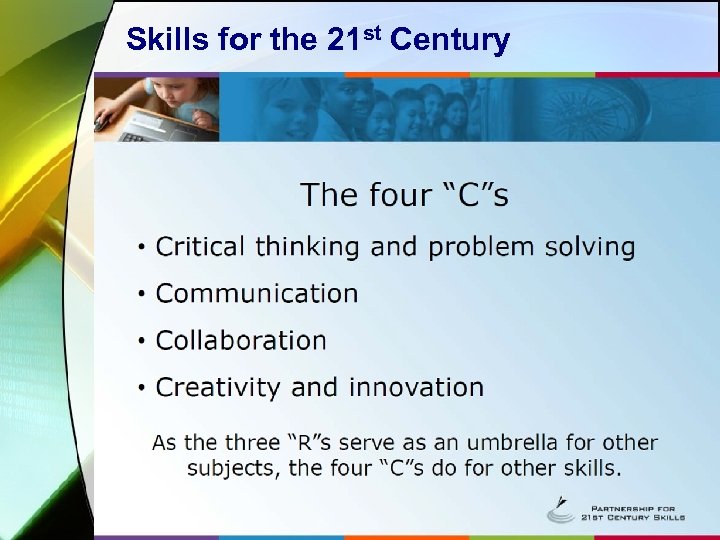 Skills for the 21 st Century
 What technical skills Immediate specific job skills* Industry certifications 132 available through HS programs (n=4 states) Technical Knowledge & Skills * Learning for jobs (OECD)
 The Road to an American Solution
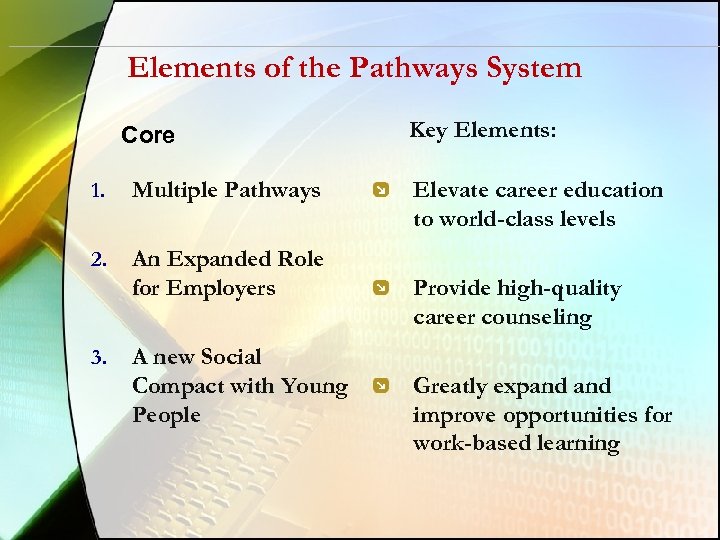 Elements of the Pathways System Core 1. Multiple Pathways 2. An Expanded Role for Employers 3. A new Social Compact with Young People Key Elements: Elevate career education to world-class levels Provide high-quality career counseling Greatly expand improve opportunities for work-based learning
 Programs of Study (USDE) Incorporates secondary education and postsecondary education elements; Includes coherent and rigorous content aligned with challenging academic standards and relevant career and technical content in a coordinated, non-duplicative progression of courses that align secondary to postsecondary education; Leads to an industry-recognized credential or certificate at the postsecondary level or an associate or baccalaureate degree; and May include opportunity for secondary education students to gain postsecondary education credits through dual or concurrent enrollment programs or other means.
 STRATEGIES Systems CAREER PATHWAYS CAREER ACADEMIES CAREER THEMED HIGH SCHOOLS Pedagogy CURRICULUM INTEGRATION WORK BASED LEARNING CAREER-TECHNICAL STUDENT ORGANIZATIONS (CTSO) CAREER GUIDANCE
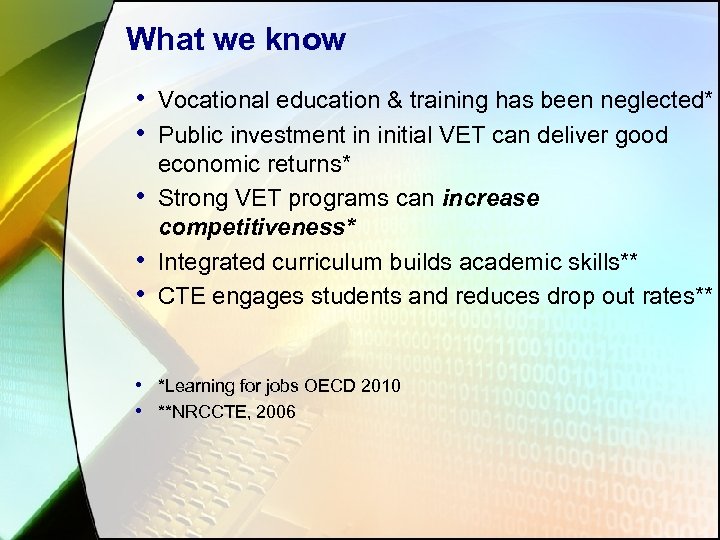 What we know • Vocational education & training has been neglected* • Public investment in initial VET can deliver good • • • economic returns* Strong VET programs can increase competitiveness* Integrated curriculum builds academic skills** CTE engages students and reduces drop out rates** • *Learning for jobs OECD 2010 • **NRCCTE, 2006
 High school is the last education opportunity paid for wholly by the public. It’s purpose has to be to do the best it can to provide all who leave it the foundation necessary to enter, or further prepare for, adult life. Barton, 2006
 WWW. NRCCTE. ORG JAMES. STONE@NRCCTE. ORG