 Скачать презентацию College Algebra Fifth Edition James Stewart Lothar Redlin
b87befb46833069a364aaf952bd68cf2.ppt
- Количество слайдов: 75




College Algebra Fifth Edition James Stewart Lothar Redlin Saleem Watson

1 Equations and Inequalities
1. 2 Modeling with Equations
Modeling with Equations Many problems in the sciences, economics, finance, medicine, and numerous other fields can be translated into algebra problems. • This is one reason that algebra is so useful.
Modeling with Equations In this section, we use equations as mathematical models to solve real-life problems.

Making and Using Models
Guidelines for Modeling with Equations We will use the following guidelines to help us set up equations that model situations described in words. 1. 2. 3. 4. Identify the variable. Translate from words to algebra. Set up the model. Solve the equation and check your answer.
Guideline 1 Identify the variable. • Identify the quantity that the problem asks you to find. • This quantity can usually be determined by a careful reading of the question posed at the end of the problem. • Then, introduce notation for the variable. • Call this x or some other letter.
Guideline 2 Translate from words to algebra. • Read each sentence in the problem again, and express all the quantities mentioned in the problem in terms of the variable you defined in Step 1. • To organize this information, it is sometimes helpful to draw a diagram or make a table.
Guideline 3 Set up the model. • Find the crucial fact in the problem that gives a relationship between the expressions you listed in Step 2. • Set up an equation (or model) that expresses this relationship.
Guideline 4 Solve the equation and check your answer. 1. Solve the equation. 2. Check your answer. 3. Express it as a sentence that answers the question posed in the problem.
Guidelines for Modeling with Equations The following example illustrates how these guidelines are used to translate a “word problem” into the language of algebra.
E. g. 1—Renting a Car A car rental company charges $30 a day and 15¢ a mile for renting a car. Helen rents a car for two days and her bill comes to $108. • How many miles did she drive?
E. g. 1—Renting a Car We are asked to find the number of miles Helen has driven. • So, we let: x = number of miles driven
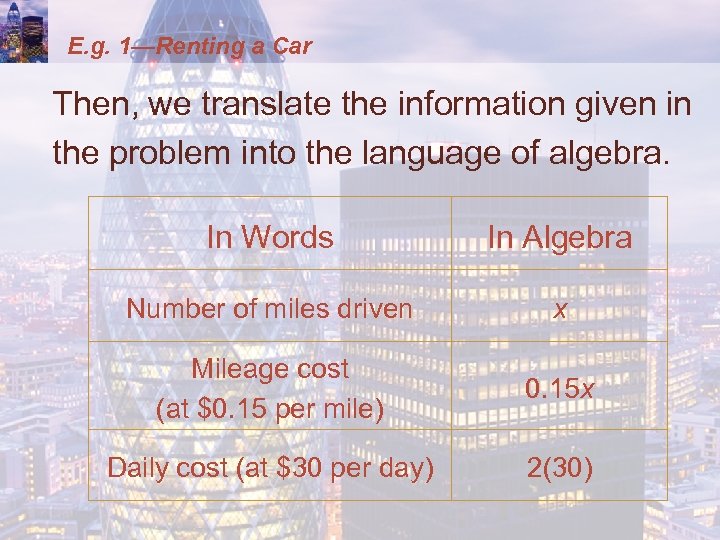
E. g. 1—Renting a Car Then, we translate the information given in the problem into the language of algebra. In Words In Algebra Number of miles driven x Mileage cost (at $0. 15 per mile) 0. 15 x Daily cost (at $30 per day) 2(30)
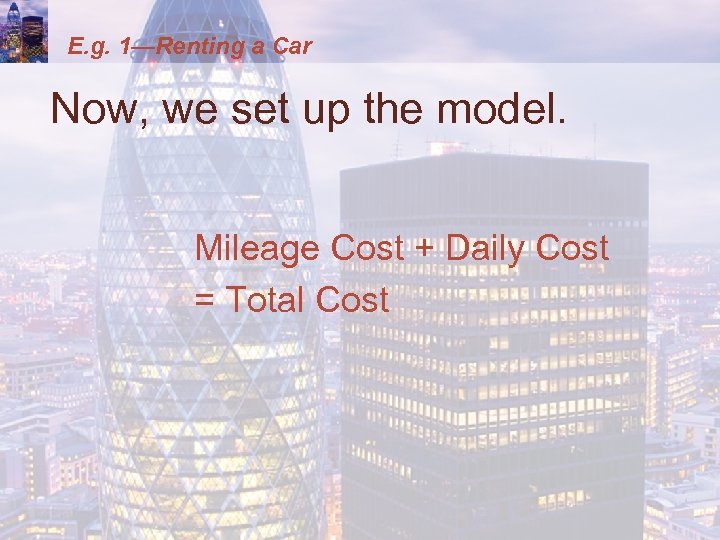
E. g. 1—Renting a Car Now, we set up the model. Mileage Cost + Daily Cost = Total Cost
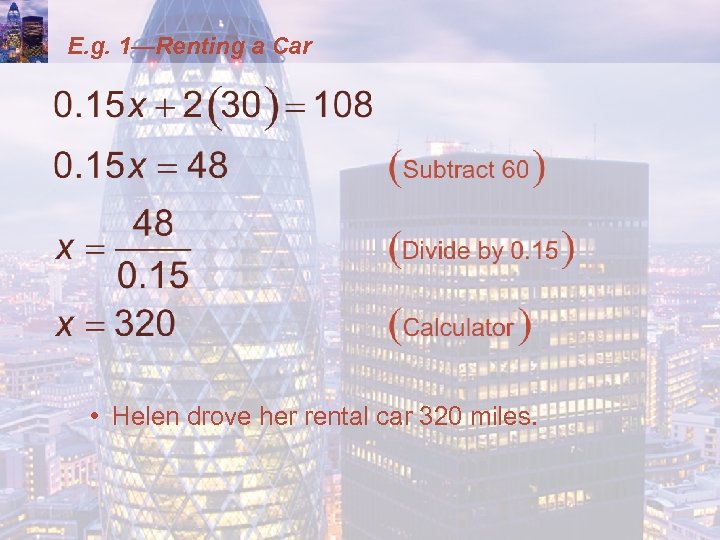
E. g. 1—Renting a Car • Helen drove her rental car 320 miles.
Constructing Models In the examples and exercises that follow, we construct equations that model problems in many different real-life situations.

Problems About Interest
Problems About Interest When you borrow money from a bank or when the bank “borrows” you money by keeping it for you in a savings account: • The borrower in each case must pay for the privilege of using the money. • The fee that is paid is called interest.
Interest The most basic type of interest is simple interest. • It is just an annual percentage of the total amount borrowed and deposited.
Simple Interest The amount of a loan or deposit is called the principal P. The annual percentage paid for the use of this money is the interest rate r. We will use: • The variable t to stand for the number of years that the money is on deposit. • The variable I to stand for the total interest earned.
Simple Interest The following simple interest formula gives the amount of interest I earned when a principal P is deposited for t years at an interest rate r. I = Prt • When using this formula, remember to convert r from a percentage to a decimal. • For example, in decimal form, 5% is 0. 05. So at an interest rate of 5%, the interest paid on a $1000 deposit over a 3 -year period is I = Prt = 1000(0. 05)(3) = $150.
E. g. 2—Interest on an Investment Mary inherits $100, 000 and invests it in two certificates of deposit. • One certificate pays 6% and the other pays 4½% simple interest annually. • If Mary’s total interest is $5025 per year, how much money is invested at each rate?
E. g. 2—Interest on an Investment The problem asks for the amount she has invested at each rate. • So, we let: x = the amount invested at 6% • As Mary’s total inheritance is $100, 000, it follows that she invested 100, 000 – x at 4½%.
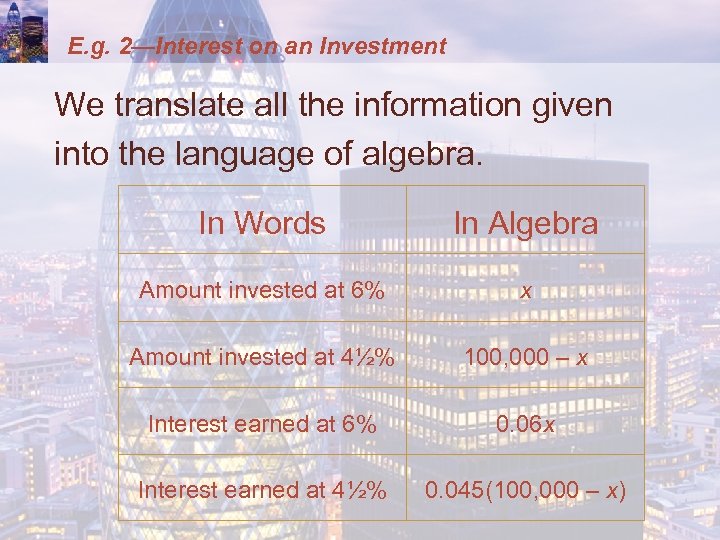
E. g. 2—Interest on an Investment We translate all the information given into the language of algebra. In Words In Algebra Amount invested at 6% x Amount invested at 4½% 100, 000 – x Interest earned at 6% 0. 06 x Interest earned at 4½% 0. 045(100, 000 – x)
E. g. 2—Interest on an Investment We use the fact that Mary’s total interest is $5025 to set up the model. Interest at 6% + Interest at 4½% = Total Interest
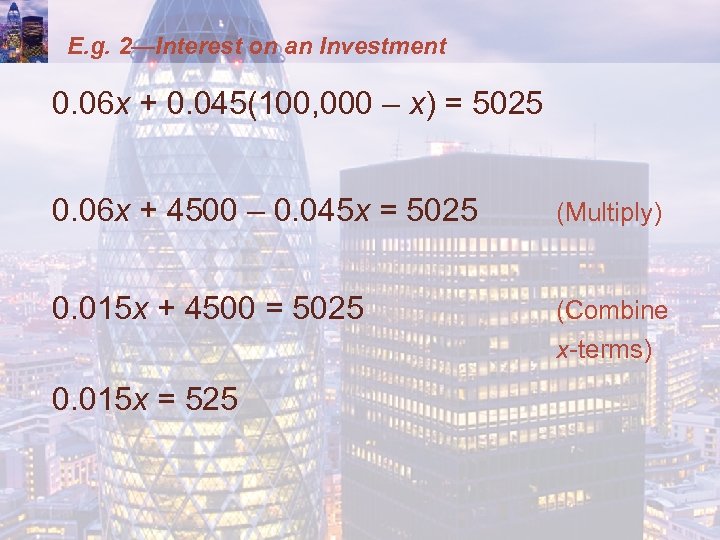
E. g. 2—Interest on an Investment 0. 06 x + 0. 045(100, 000 – x) = 5025 0. 06 x + 4500 – 0. 045 x = 5025 (Multiply) 0. 015 x + 4500 = 5025 (Combine x-terms) 0. 015 x = 525
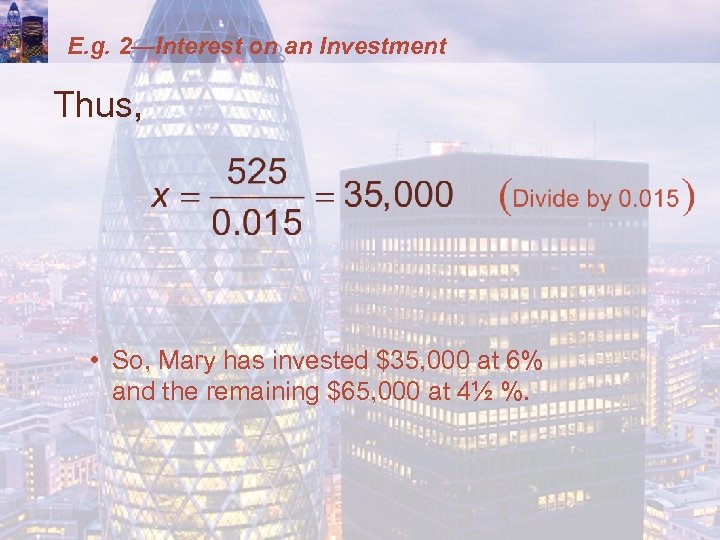
E. g. 2—Interest on an Investment Thus, • So, Mary has invested $35, 000 at 6% and the remaining $65, 000 at 4½ %.
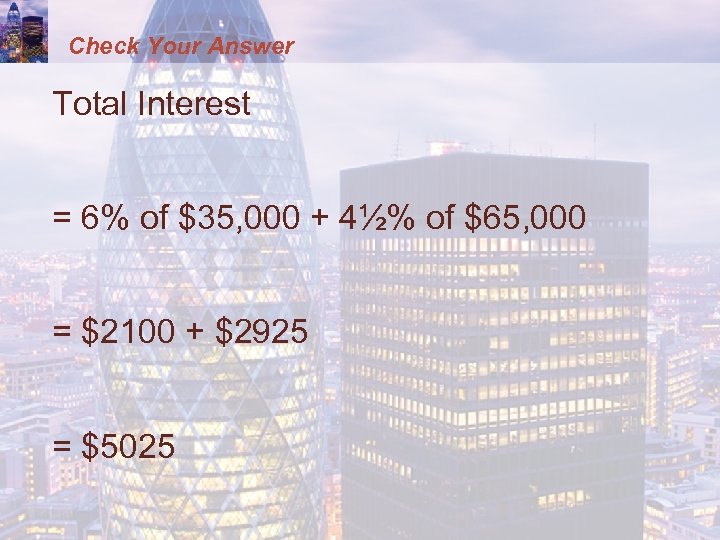
Check Your Answer Total Interest = 6% of $35, 000 + 4½% of $65, 000 = $2100 + $2925 = $5025
Problems About Area or Length
Modeling a Physical Situation When we use algebra to model a physical situation, we must sometimes use basic formulas from geometry. For example, we may need • A formula for an area or a perimeter • A formula that relates the sides of similar triangles • The Pythagorean Theorem
Modeling a Physical Situation Most of these formulas are listed in the front endpapers of this book. • The next two examples use these geometric formulas to solve real-world problems.
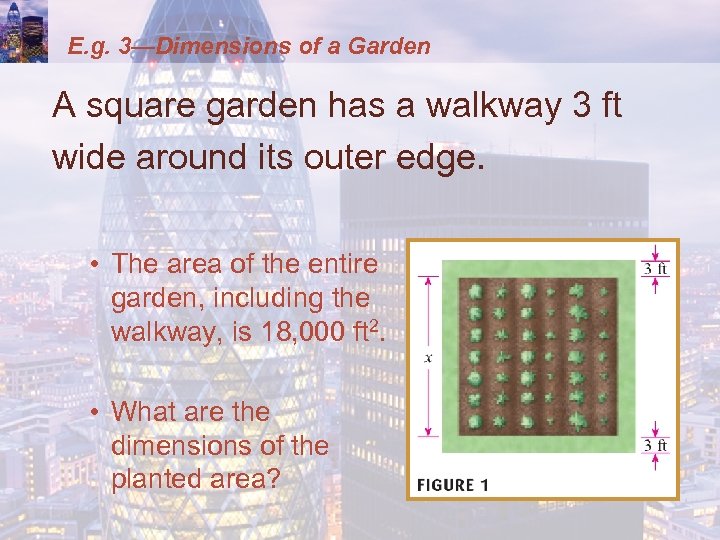
E. g. 3—Dimensions of a Garden A square garden has a walkway 3 ft wide around its outer edge. • The area of the entire garden, including the walkway, is 18, 000 ft 2. • What are the dimensions of the planted area?
E. g. 3—Dimensions of a Garden We are asked to find the length and width of the planted area. • So, let: x = the length of the planted area
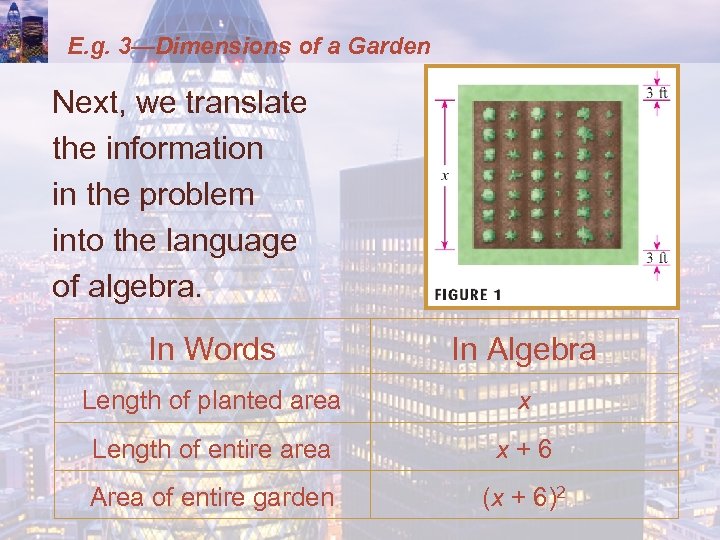
E. g. 3—Dimensions of a Garden Next, we translate the information in the problem into the language of algebra. In Words In Algebra Length of planted area x Length of entire area x+6 Area of entire garden (x + 6)2
E. g. 3—Dimensions of a Garden Now, we set up the model. Area of entire garden = 18, 000 ft 2
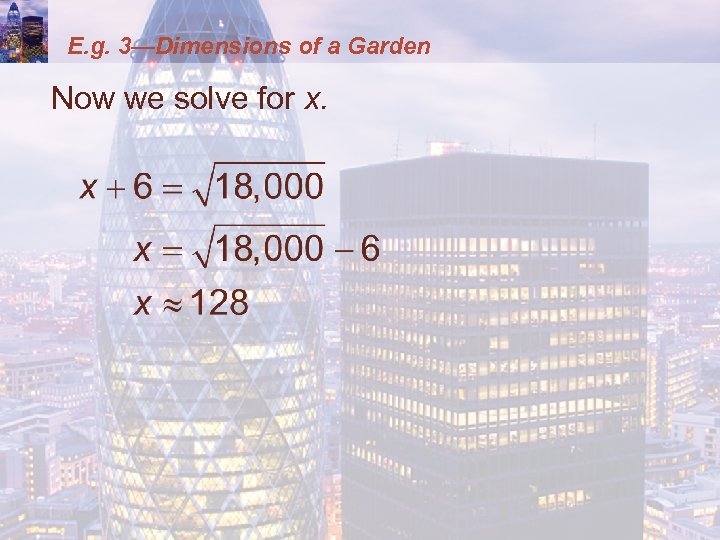
E. g. 3—Dimensions of a Garden Now we solve for x.
E. g. 3—Dimensions of a Garden The planted area of the garden is about: 128 ft by 128 ft
E. g. 4—Height of Building Using Similar Triangles A man 6 ft tall wishes to find the height of a certain four-story building. • He measures its shadow and finds it to be 28 ft long, while his own shadow is 3½ ft long. • How tall is the building?
E. g. 4—Height of Building Using Similar Triangles The problem asks for the height of the building. • So, let: h = the height of the building
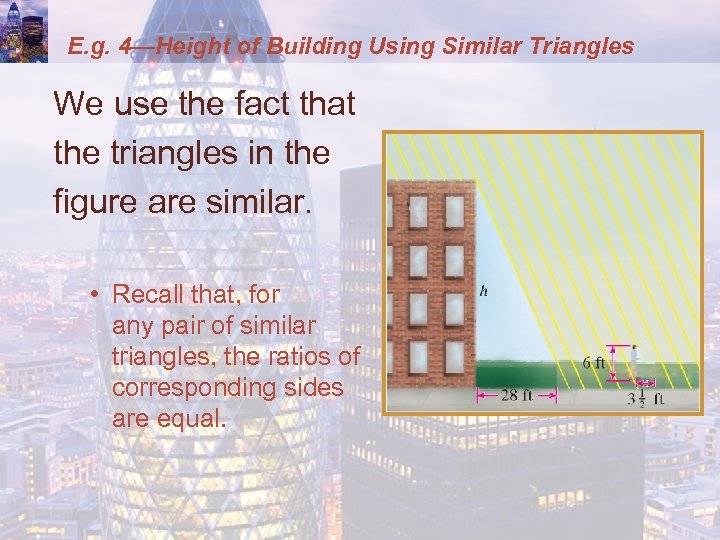
E. g. 4—Height of Building Using Similar Triangles We use the fact that the triangles in the figure are similar. • Recall that, for any pair of similar triangles, the ratios of corresponding sides are equal.
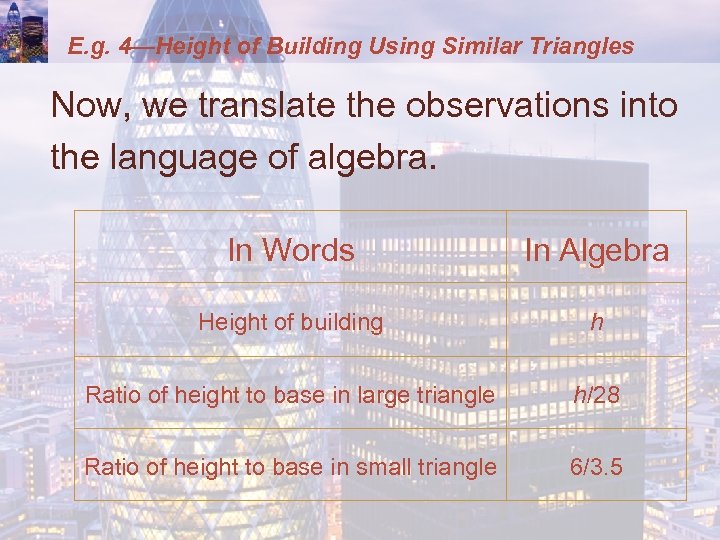
E. g. 4—Height of Building Using Similar Triangles Now, we translate the observations into the language of algebra. In Words In Algebra Height of building h Ratio of height to base in large triangle h/28 Ratio of height to base in small triangle 6/3. 5
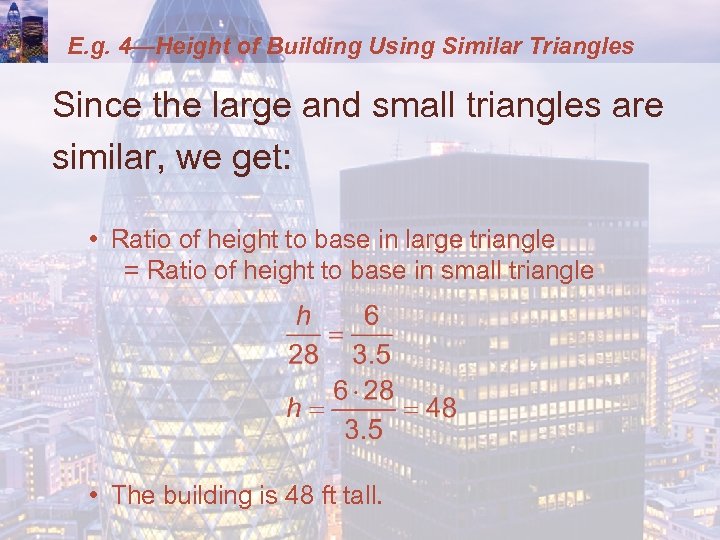
E. g. 4—Height of Building Using Similar Triangles Since the large and small triangles are similar, we get: • Ratio of height to base in large triangle = Ratio of height to base in small triangle • The building is 48 ft tall.

Problems About Mixtures
Problems About Mixtures Many real-world problems involving mixing different types of substances. For example, • Construction workers may mix concert, gravel, and sand. • Fruit juice from a concentrate may involve mixing different types of juices.
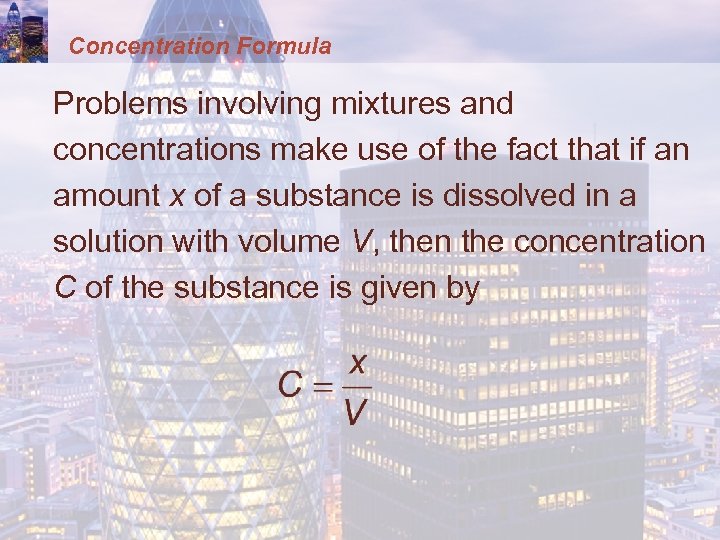
Concentration Formula Problems involving mixtures and concentrations make use of the fact that if an amount x of a substance is dissolved in a solution with volume V, then the concentration C of the substance is given by
Concentration So if 10 g of sugar is dissolved in 5 L of water, then the sugar concentration if C = 10/5 = 2 g/L
Mixture Problems Solving a mixture problem usually requires us to analyze the amount x of the substance that is in the solution. • When we solve for x in this equation, we see that x = CV • Note that in many mixture problems the concentration C is expressed as a percentage.
E. g. 5—Mixtures and Concentration A manufacturer of soft drinks advertises their orange soda as “naturally flavored, ” although it contains only 5% orange juice. • A new federal regulation stipulates that, to be called “natural, ” a drink must contain at least 10% fruit juice. • How much pure orange juice must this manufacturer add to 900 gal of orange soda to conform to the new regulation?
E. g. 5—Mixtures and Concentration The problem asks for the amount of pure orange juice to be added. • So, let: x = the amount (in gallons) of pure orange juice to be added
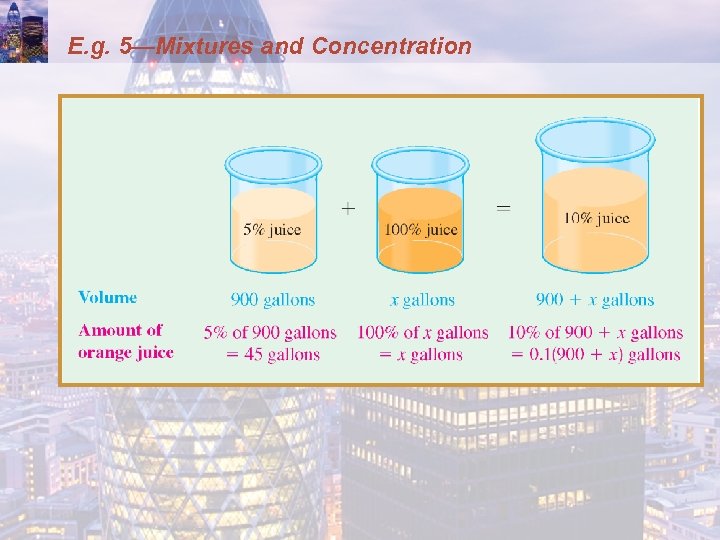
E. g. 5—Mixtures and Concentration In any problem of this type—in which two different substances are to be mixed— drawing a diagram helps us organize the given information.
E. g. 5—Mixtures and Concentration
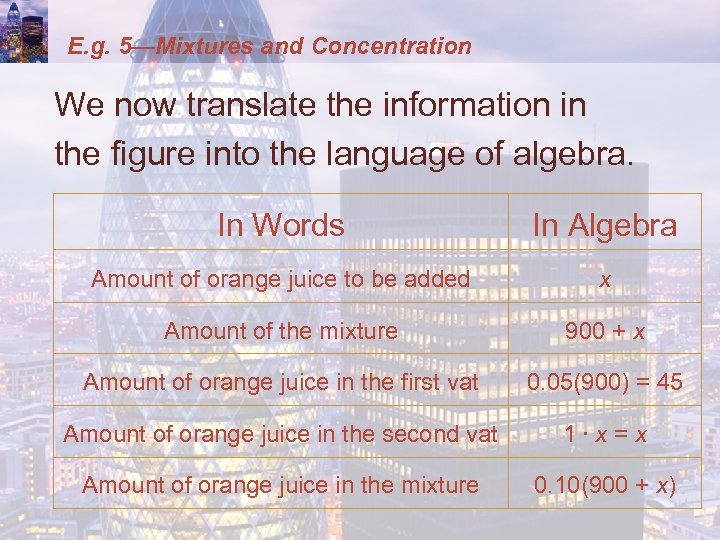
E. g. 5—Mixtures and Concentration We now translate the information in the figure into the language of algebra. In Words In Algebra Amount of orange juice to be added x Amount of the mixture 900 + x Amount of orange juice in the first vat 0. 05(900) = 45 Amount of orange juice in the second vat 1∙x=x Amount of orange juice in the mixture 0. 10(900 + x)
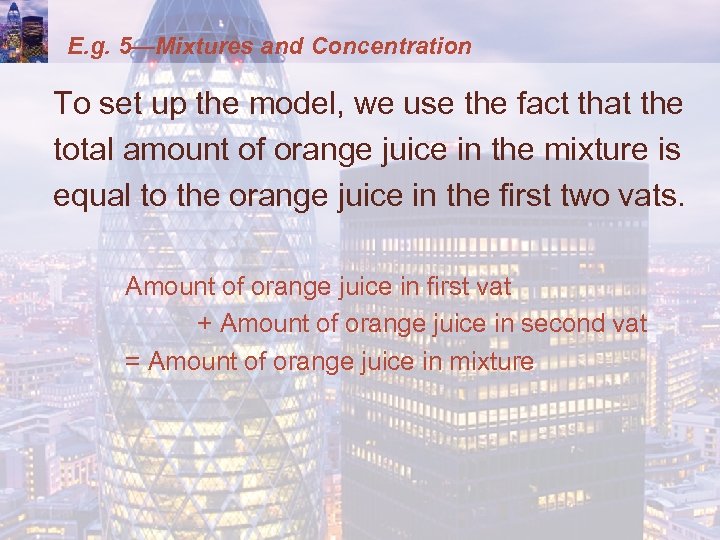
E. g. 5—Mixtures and Concentration To set up the model, we use the fact that the total amount of orange juice in the mixture is equal to the orange juice in the first two vats. Amount of orange juice in first vat + Amount of orange juice in second vat = Amount of orange juice in mixture
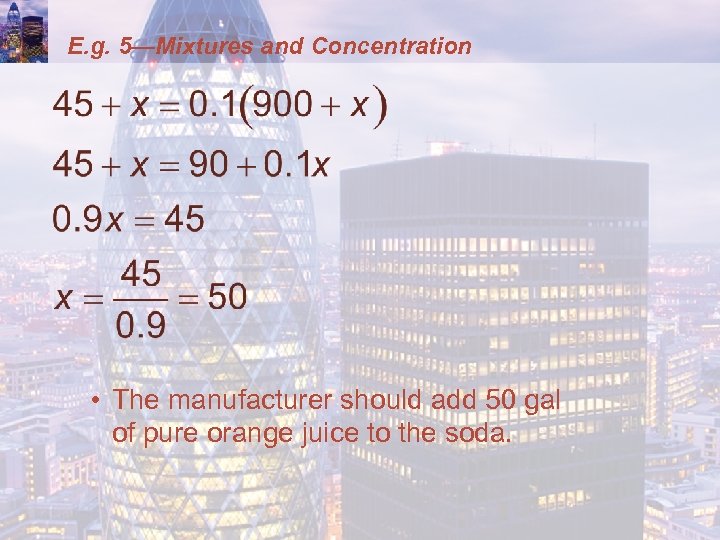
E. g. 5—Mixtures and Concentration • The manufacturer should add 50 gal of pure orange juice to the soda.
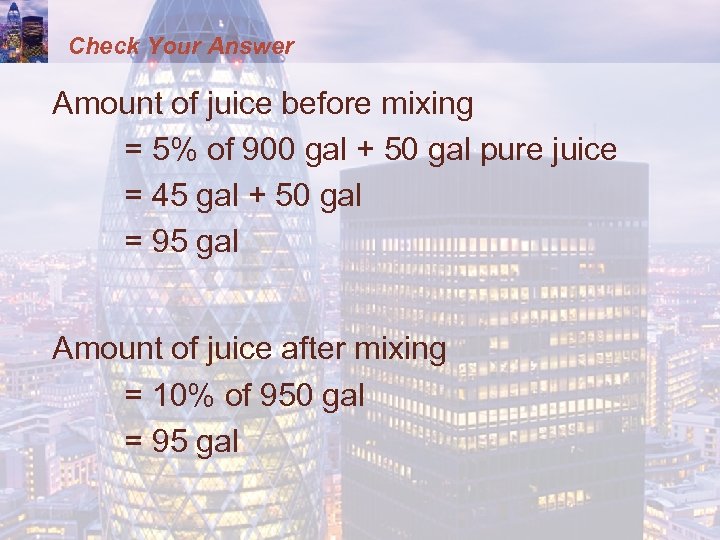
Check Your Answer Amount of juice before mixing = 5% of 900 gal + 50 gal pure juice = 45 gal + 50 gal = 95 gal Amount of juice after mixing = 10% of 950 gal = 95 gal

Problems About the Time Needed to Do a Job
Time Needed to Do a Job When solving a problem that involves determining how long it takes several workers to complete a job: • We use the fact that if a person or machine takes H time units to complete the task, then in one time unit the fraction of the task that has been completed is 1/H. • For example, if a worker takes 5 hours to mow a lawn, then in 1 hour the worker will mow 1/5 of the lawn.
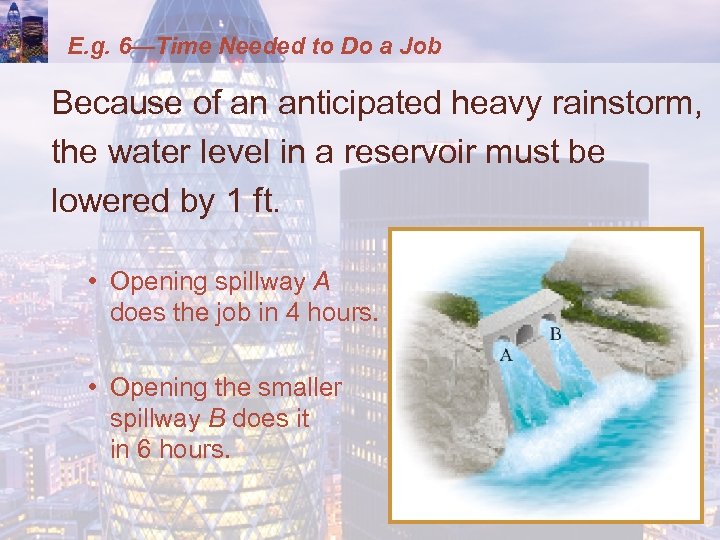
E. g. 6—Time Needed to Do a Job Because of an anticipated heavy rainstorm, the water level in a reservoir must be lowered by 1 ft. • Opening spillway A does the job in 4 hours. • Opening the smaller spillway B does it in 6 hours.
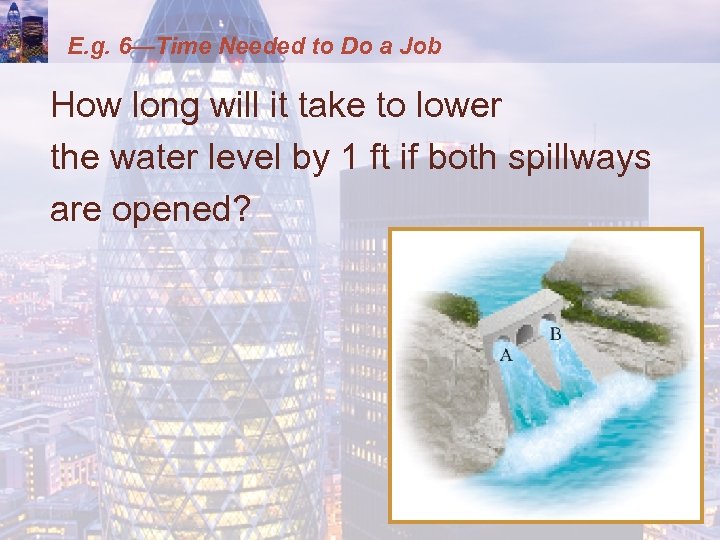
E. g. 6—Time Needed to Do a Job How long will it take to lower the water level by 1 ft if both spillways are opened?
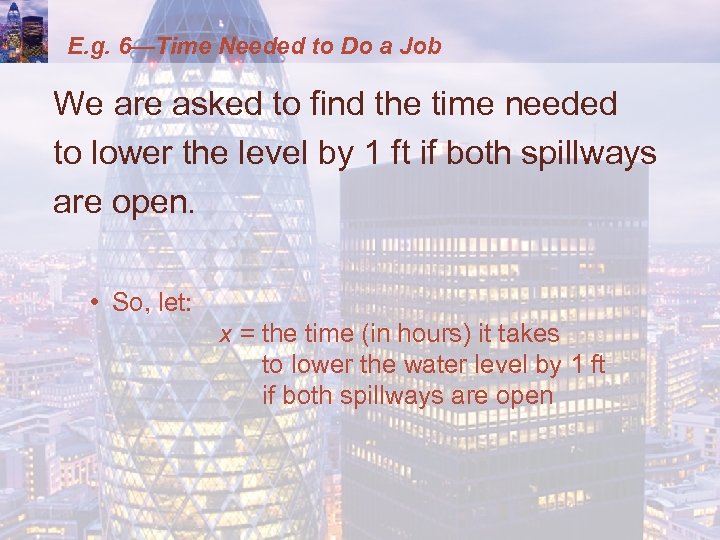
E. g. 6—Time Needed to Do a Job We are asked to find the time needed to lower the level by 1 ft if both spillways are open. • So, let: x = the time (in hours) it takes to lower the water level by 1 ft if both spillways are open
E. g. 6—Time Needed to Do a Job Finding an equation relating x to the other quantities in this problem is not easy. • Certainly, x is not simply 4 + 6. • That would mean that, together, the two spillways require longer to lower the water level than either spillway alone.
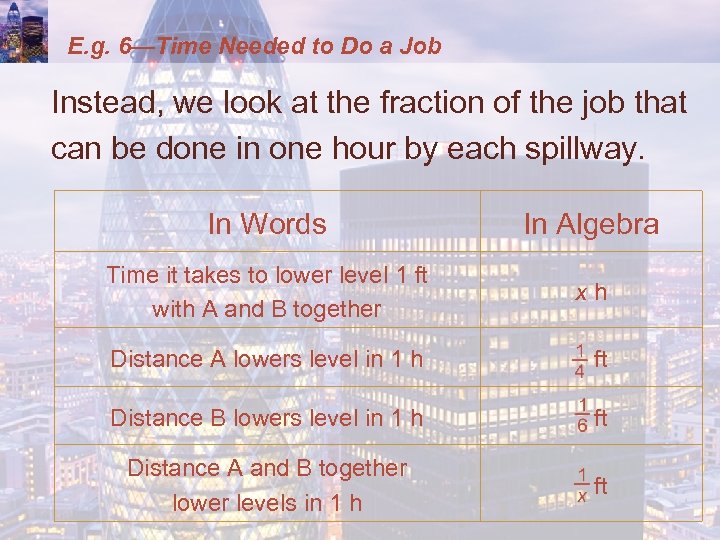
E. g. 6—Time Needed to Do a Job Instead, we look at the fraction of the job that can be done in one hour by each spillway. In Words In Algebra Time it takes to lower level 1 ft with A and B together xh Distance A lowers level in 1 h ft Distance B lowers level in 1 h ft Distance A and B together lower levels in 1 h ft
E. g. 6—Time Needed to Do a Job Now, we set up the model. Fraction done by A + Fraction done by B = Fraction done by both
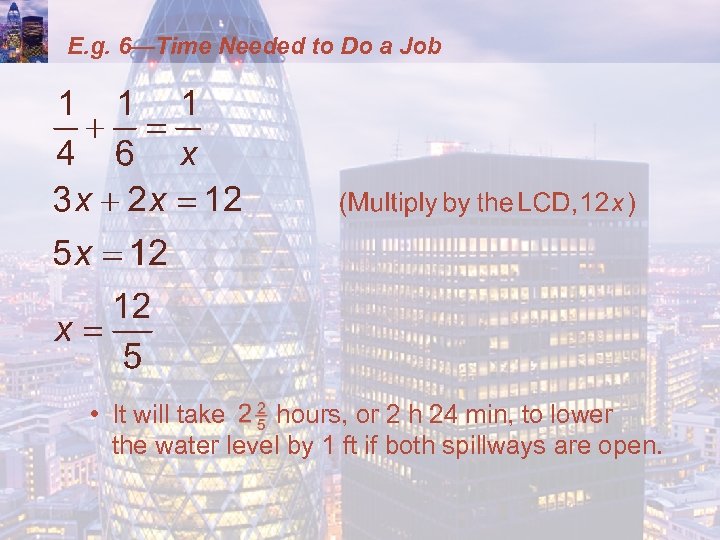
E. g. 6—Time Needed to Do a Job • It will take hours, or 2 h 24 min, to lower the water level by 1 ft if both spillways are open.
Problems About Distance, Rate, and Time
Distance, Speed, and Time The next example deals with distance, rate (speed), and time. • The formula to keep in mind here is: distance = rate x time where the rate is either the constant speed or average speed of a moving object. • For example, driving at 60 mi/h for 4 hours takes you a distance of 60 ∙ 4 = 240 mi.
E. g. 7—A Distance-Speed-Time Problem Bill left his house at 2: 00 P. M. and rode his bicycle down Main Street at a speed of 12 mi/h. • When his friend Mary arrived at his house at 2: 10 P. M. , Bill’s mother told her the direction in which Bill had gone. • Mary cycled after him at a speed of 16 mi/h. • At what time did Mary catch up with Bill?
E. g. 7—A Distance-Speed-Time Problem We are asked to find the time that it took Mary to catch up with Bill. • So, let: t = the time (in hours) it took Mary to catch up with Bill
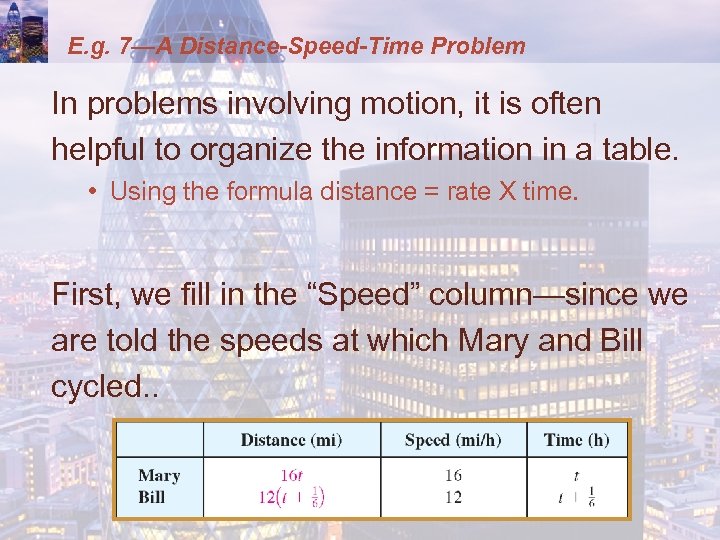
E. g. 7—A Distance-Speed-Time Problem In problems involving motion, it is often helpful to organize the information in a table. • Using the formula distance = rate X time. First, we fill in the “Speed” column—since we are told the speeds at which Mary and Bill cycled. .
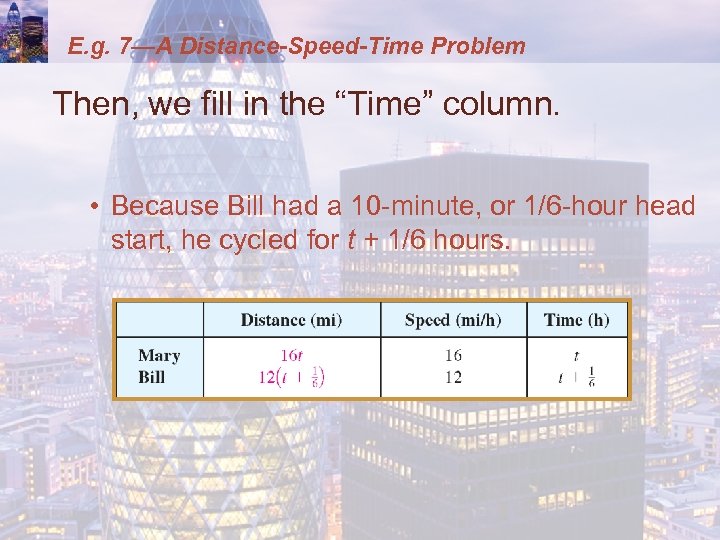
E. g. 7—A Distance-Speed-Time Problem Then, we fill in the “Time” column. • Because Bill had a 10 -minute, or 1/6 -hour head start, he cycled for t + 1/6 hours.
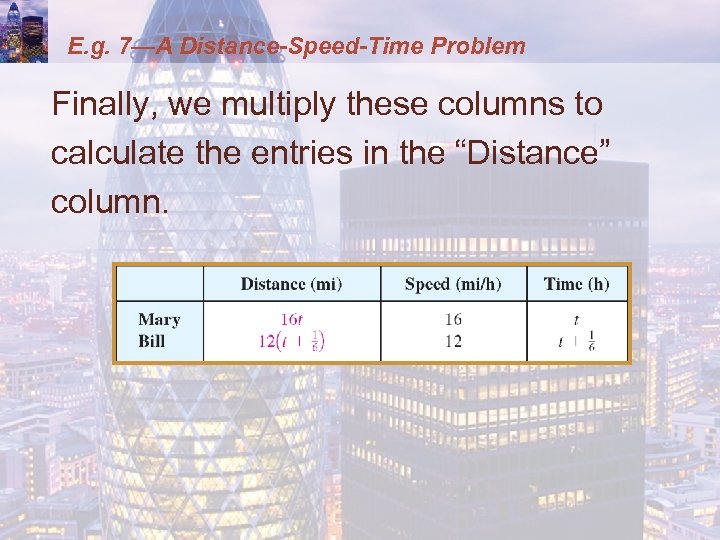
E. g. 7—A Distance-Speed-Time Problem Finally, we multiply these columns to calculate the entries in the “Distance” column.
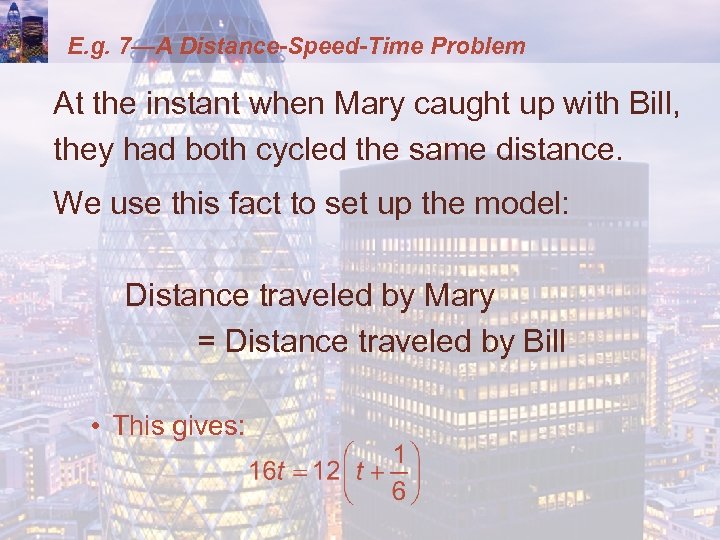
E. g. 7—A Distance-Speed-Time Problem At the instant when Mary caught up with Bill, they had both cycled the same distance. We use this fact to set up the model: Distance traveled by Mary = Distance traveled by Bill • This gives:
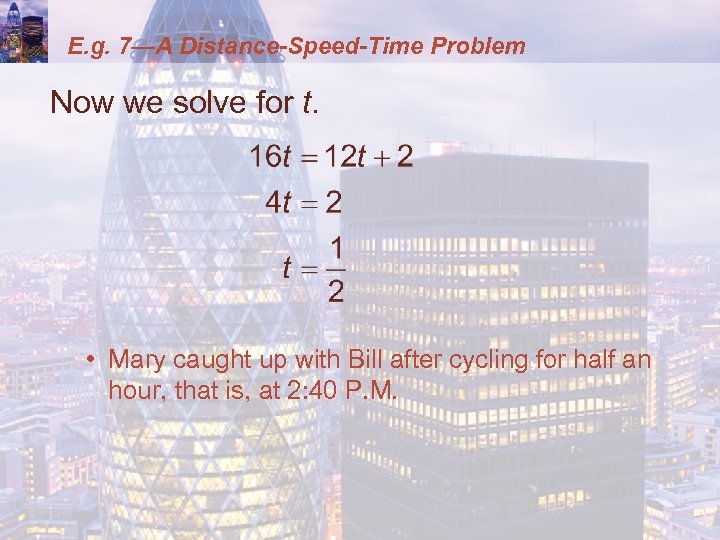
E. g. 7—A Distance-Speed-Time Problem Now we solve for t. • Mary caught up with Bill after cycling for half an hour, that is, at 2: 40 P. M.
Скачать презентацию College Algebra Fifth Edition James Stewart Lothar Redlin
b87befb46833069a364aaf952bd68cf2.ppt