


 Скачать презентацию Collective phenomena in non-central nuclear collision Sergei A
277bfe7ab727bf5be66dbda16b8a0745.ppt
- Количество слайдов: 23
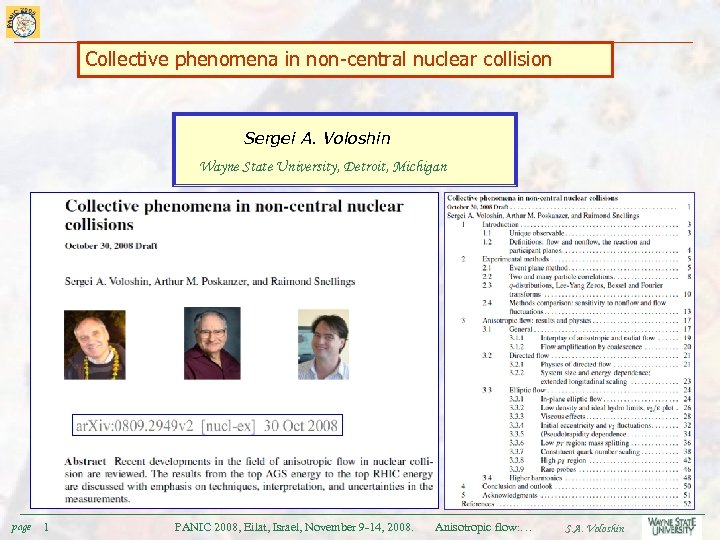 Collective phenomena in non-central nuclear collision Sergei A. Voloshin Wayne State University, Detroit, Michigan page 1 PANIC 2008, Eilat, Israel, November 9 -14, 2008. Anisotropic flow: … S. A. Voloshin
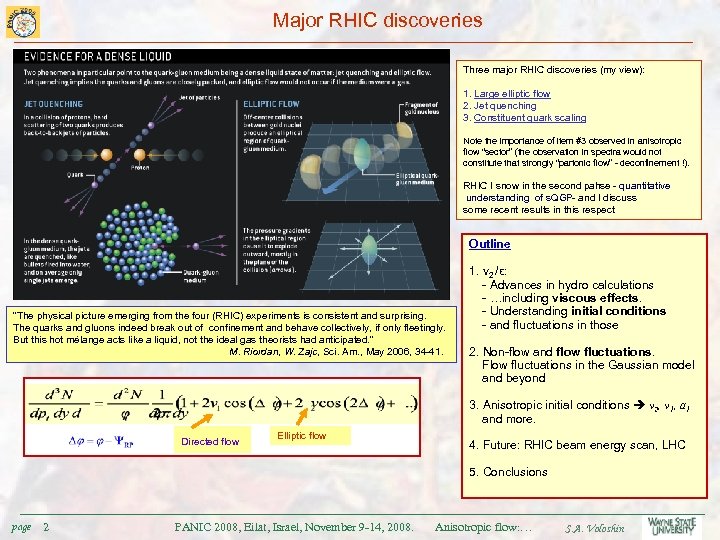 Major RHIC discoveries Three major RHIC discoveries (my view): 1. Large elliptic flow 2. Jet quenching 3. Constituent quark scaling Note the importance of item #3 observed in anisotropic flow “sector” (the observation in spectra would not constitute that strongly “partonic flow” - deconfinement !). RHIC I snow in the second pahse - quantitative understanding of s. QGP- and I discuss some recent results in this respect Outline “The physical picture emerging from the four (RHIC) experiments is consistent and surprising. The quarks and gluons indeed break out of confinement and behave collectively, if only fleetingly. But this hot mélange acts like a liquid, not the ideal gas theorists had anticipated. ” M. Riordan, W. Zajc, Sci. Am. , May 2006, 34 -41. 1. v 2 /ε: - Advances in hydro calculations - …including viscous effects. - Understanding initial conditions - and fluctuations in those 2. Non-flow and flow fluctuations. Flow fluctuations in the Gaussian model and beyond 3. Anisotropic initial conditions v 2, v 1, a 1 and more. Directed flow Elliptic flow 4. Future: RHIC beam energy scan, LHC 5. Conclusions page 2 PANIC 2008, Eilat, Israel, November 9 -14, 2008. Anisotropic flow: … S. A. Voloshin
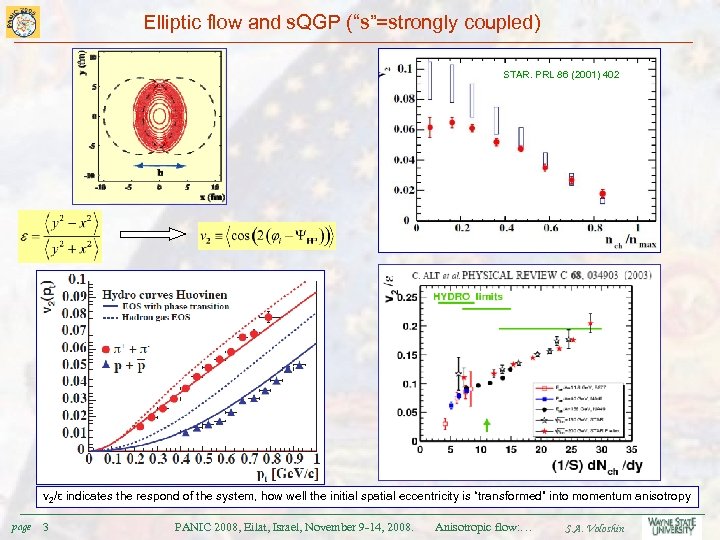 Elliptic flow and s. QGP (“s”=strongly coupled) STAR. PRL 86 (2001) 402 v 2/ε indicates the respond of the system, how well the initial spatial eccentricity is “transformed” into momentum anisotropy page 3 PANIC 2008, Eilat, Israel, November 9 -14, 2008. Anisotropic flow: … S. A. Voloshin
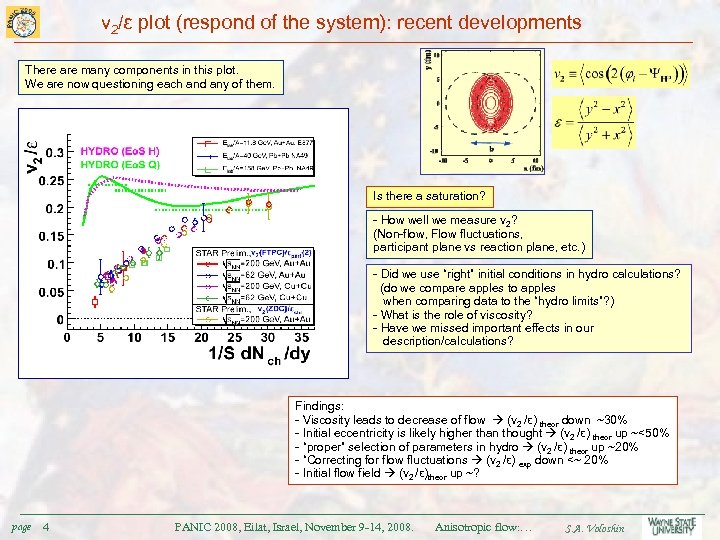 v 2/ε plot (respond of the system): recent developments There are many components in this plot. We are now questioning each and any of them. Is there a saturation? - How well we measure v 2? (Non-flow, Flow fluctuations, participant plane vs reaction plane, etc. ) - Did we use “right” initial conditions in hydro calculations? (do we compare apples to apples when comparing data to the “hydro limits”? ) - What is the role of viscosity? - Have we missed important effects in our description/calculations? Findings: - Viscosity leads to decrease of flow (v 2 /ε) theor down ~30% - Initial eccentricity is likely higher than thought (v 2 /ε) theor up ~<50% - “proper” selection of parameters in hydro (v 2 /ε) theor up ~20% - “Correcting for flow fluctuations (v 2 /ε) exp down <~ 20% - Initial flow field (v 2 /ε)theor up ~? page 4 PANIC 2008, Eilat, Israel, November 9 -14, 2008. Anisotropic flow: … S. A. Voloshin
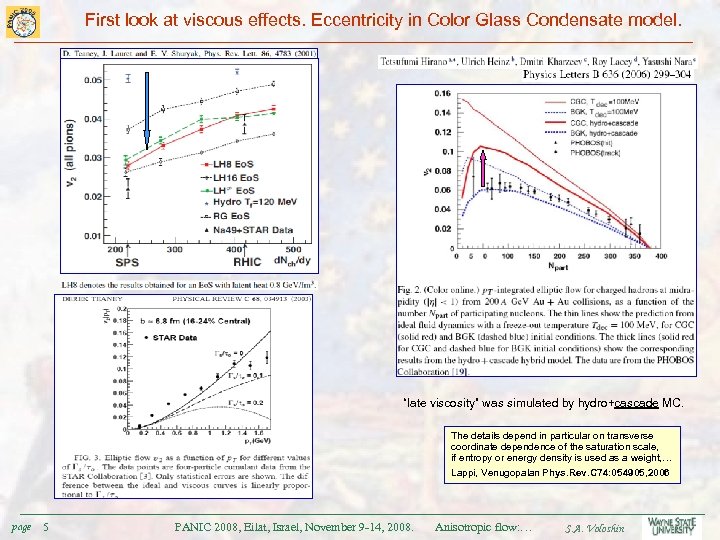 First look at viscous effects. Eccentricity in Color Glass Condensate model. “late viscosity” was simulated by hydro+cascade MC. The details depend in particular on transverse coordinate dependence of the saturation scale, if entropy or energy density is used as a weight, … Lappi, Venugopalan Phys. Rev. C 74: 054905, 2006 page 5 PANIC 2008, Eilat, Israel, November 9 -14, 2008. Anisotropic flow: … S. A. Voloshin
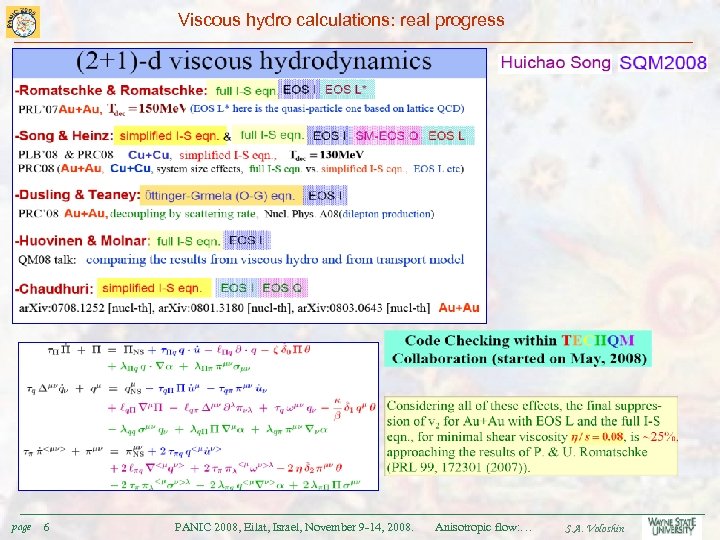 Viscous hydro calculations: real progress page 6 PANIC 2008, Eilat, Israel, November 9 -14, 2008. Anisotropic flow: … S. A. Voloshin
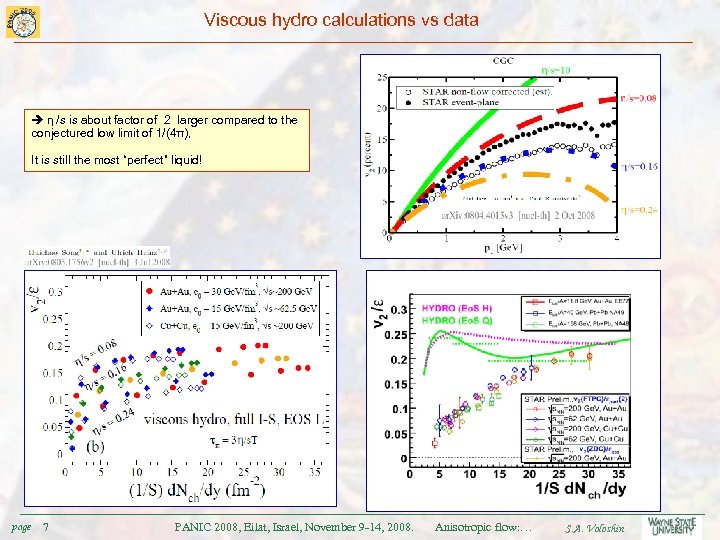 Viscous hydro calculations vs data η /s is about factor of 2 larger compared to the conjectured low limit of 1/(4π), It is still the most “perfect” liquid! page 7 PANIC 2008, Eilat, Israel, November 9 -14, 2008. Anisotropic flow: … S. A. Voloshin
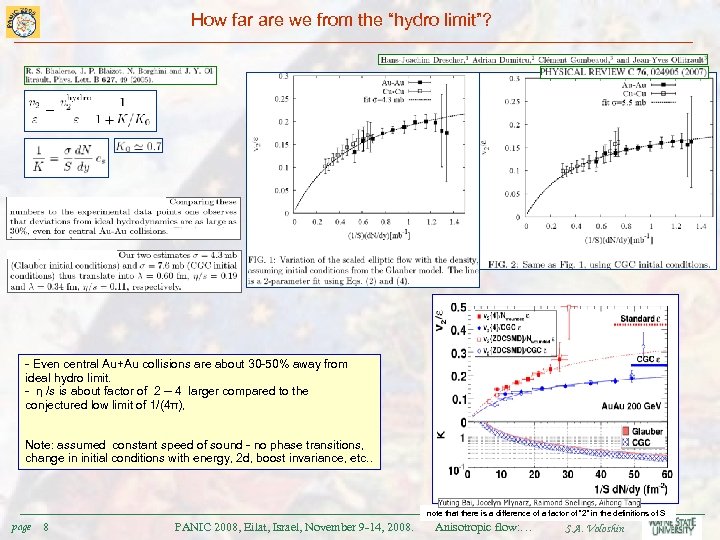 How far are we from the “hydro limit”? - Even central Au+Au collisions are about 30 -50% away from ideal hydro limit. - η /s is about factor of 2 -- 4 larger compared to the conjectured low limit of 1/(4π), Note: assumed constant speed of sound - no phase transitions, change in initial conditions with energy, 2 d, boost invariance, etc. . note that there is a difference of a factor of “ 2” in the definitions of S page 8 PANIC 2008, Eilat, Israel, November 9 -14, 2008. Anisotropic flow: … S. A. Voloshin
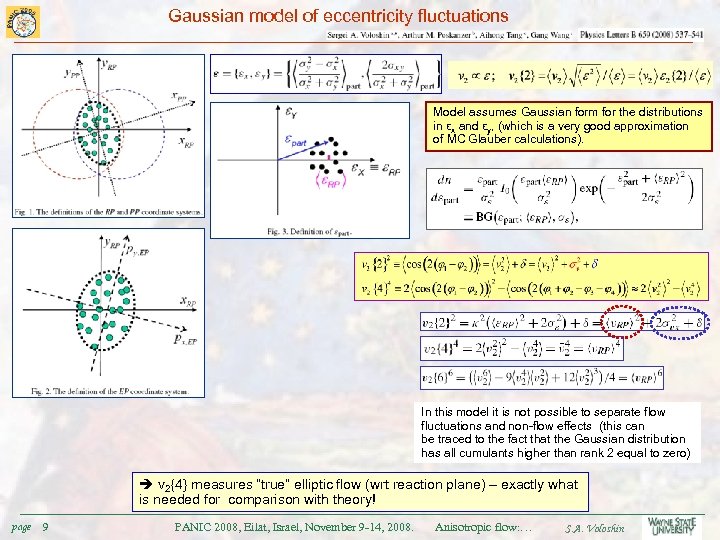 Gaussian model of eccentricity fluctuations Model assumes Gaussian form for the distributions in εx and εy, (which is a very good approximation of MC Glauber calculations). In this model it is not possible to separate flow fluctuations and non-flow effects (this can be traced to the fact that the Gaussian distribution has all cumulants higher than rank 2 equal to zero) v 2{4} measures “true” elliptic flow (wrt reaction plane) – exactly what is needed for comparison with theory! page 9 PANIC 2008, Eilat, Israel, November 9 -14, 2008. Anisotropic flow: … S. A. Voloshin
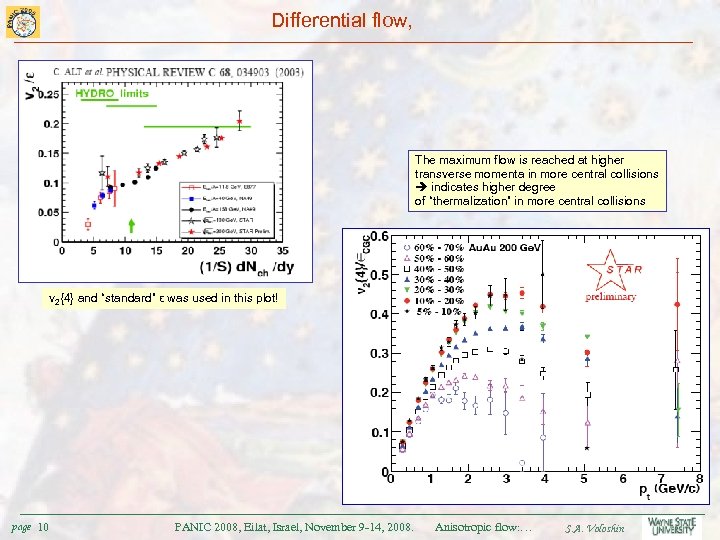 Differential flow, The maximum flow is reached at higher transverse momenta in more central collisions indicates higher degree of “thermalization” in more central collisions v 2{4} and “standard” ε was used in this plot! page 10 PANIC 2008, Eilat, Israel, November 9 -14, 2008. Anisotropic flow: … S. A. Voloshin
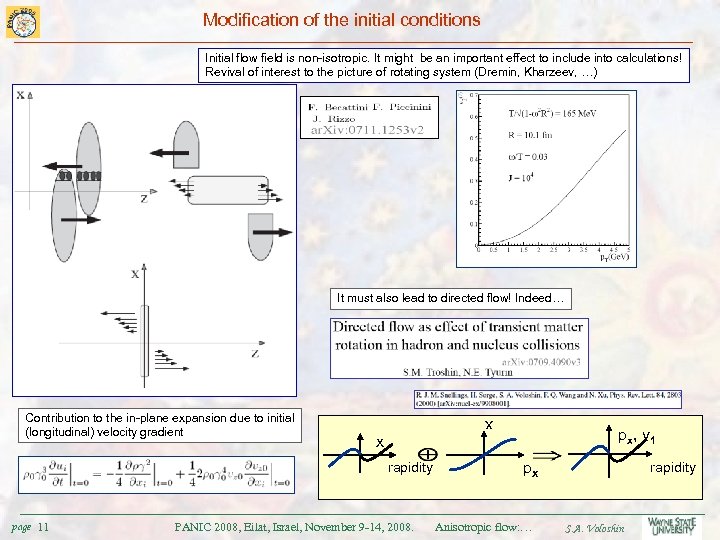 Modification of the initial conditions Initial flow field is non-isotropic. It might be an important effect to include into calculations! Revival of interest to the picture of rotating system (Dremin, Kharzeev, …) It must also lead to directed flow! Indeed… x Contribution to the in-plane expansion due to initial (longitudinal) velocity gradient x rapidity page 11 PANIC 2008, Eilat, Israel, November 9 -14, 2008. px , v 1 px Anisotropic flow: … rapidity S. A. Voloshin
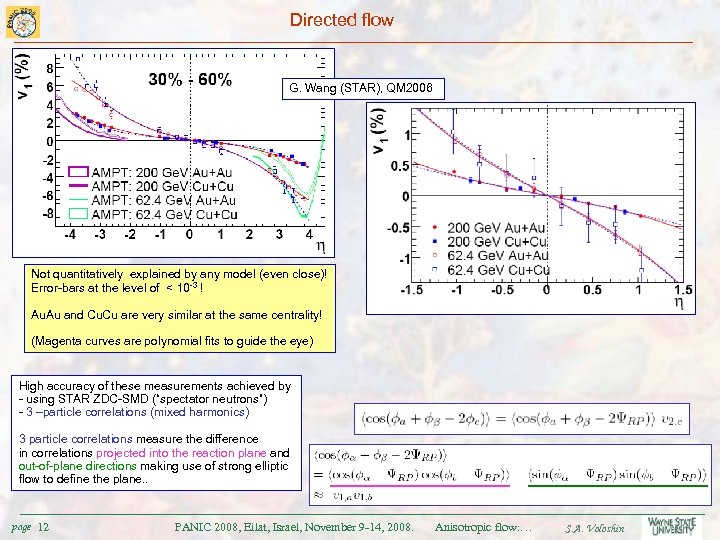 Directed flow G. Wang (STAR), QM 2006 Not quantitatively explained by any model (even close)! Error-bars at the level of < 10 -3 ! Au. Au and Cu. Cu are very similar at the same centrality! (Magenta curves are polynomial fits to guide the eye) High accuracy of these measurements achieved by - using STAR ZDC-SMD (“spectator neutrons”) - 3 –particle correlations (mixed harmonics) 3 particle correlations measure the difference in correlations projected into the reaction plane and out-of-plane directions making use of strong elliptic flow to define the plane. . page 12 PANIC 2008, Eilat, Israel, November 9 -14, 2008. Anisotropic flow: … S. A. Voloshin
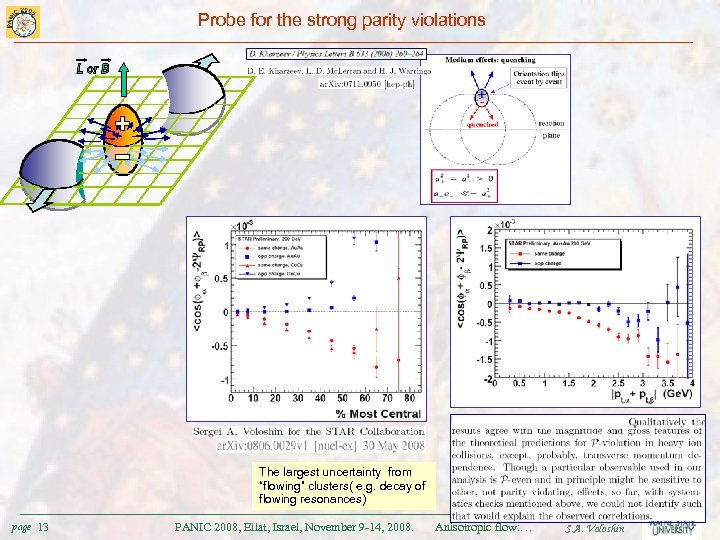 Probe for the strong parity violations The largest uncertainty from “flowing” clusters( e. g. decay of flowing resonances) page 13 PANIC 2008, Eilat, Israel, November 9 -14, 2008. Anisotropic flow: … S. A. Voloshin
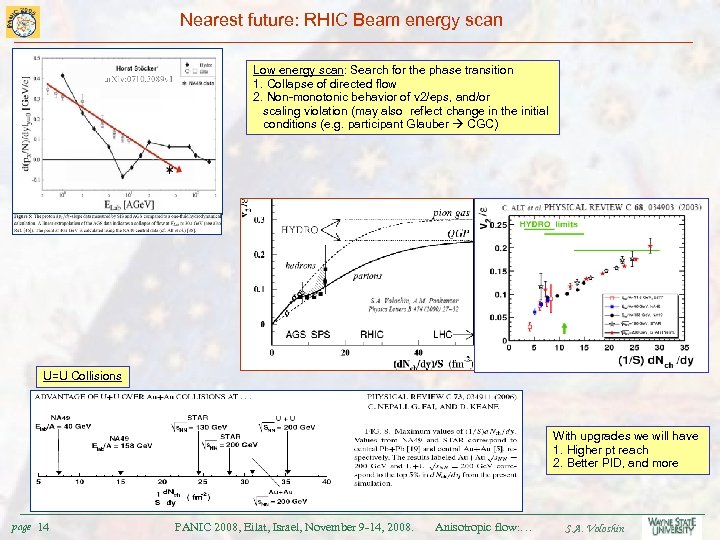 Nearest future: RHIC Beam energy scan Low energy scan: Search for the phase transition 1. Collapse of directed flow 2. Non-monotonic behavior of v 2/eps, and/or scaling violation (may also reflect change in the initial conditions (e. g. participant Glauber CGC) U=U Collisions With upgrades we will have 1. Higher pt reach 2. Better PID, and more page 14 PANIC 2008, Eilat, Israel, November 9 -14, 2008. Anisotropic flow: … S. A. Voloshin
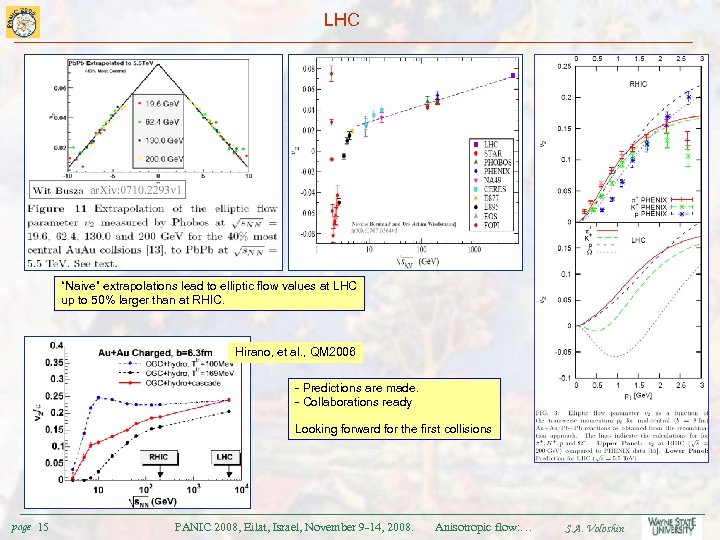 LHC “Naive” extrapolations lead to elliptic flow values at LHC up to 50% larger than at RHIC. Hirano, et al. , QM 2006 - Predictions are made. - Collaborations ready Looking forward for the first collisions page 15 PANIC 2008, Eilat, Israel, November 9 -14, 2008. Anisotropic flow: … S. A. Voloshin
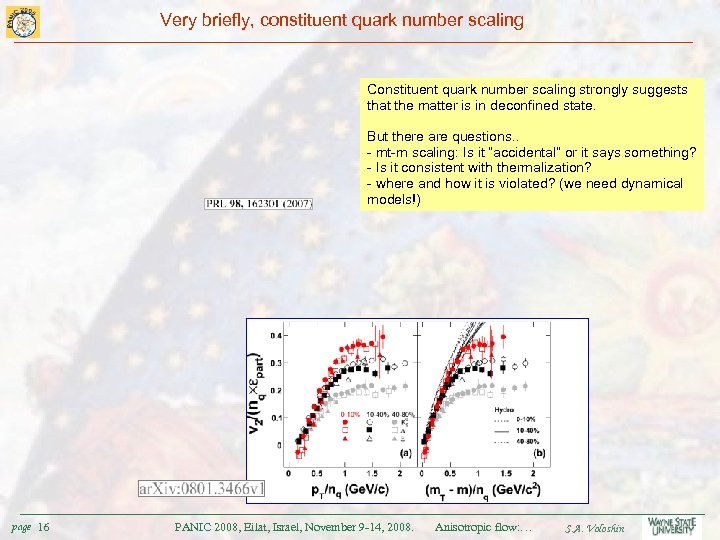 Very briefly, constituent quark number scaling Constituent quark number scaling strongly suggests that the matter is in deconfined state. But there are questions. . - mt-m scaling: Is it “accidental” or it says something? - Is it consistent with thermalization? - where and how it is violated? (we need dynamical models!) page 16 PANIC 2008, Eilat, Israel, November 9 -14, 2008. Anisotropic flow: … S. A. Voloshin
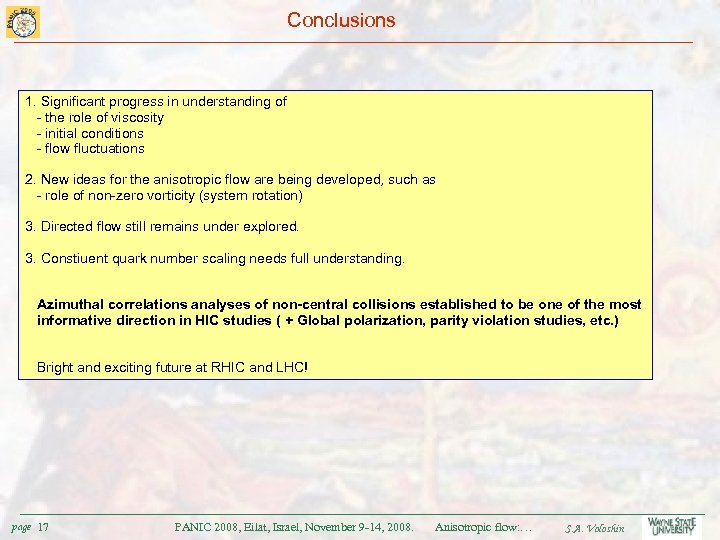 Conclusions 1. Significant progress in understanding of - the role of viscosity - initial conditions - flow fluctuations 2. New ideas for the anisotropic flow are being developed, such as - role of non-zero vorticity (system rotation) 3. Directed flow still remains under explored. 3. Constiuent quark number scaling needs full understanding. Azimuthal correlations analyses of non-central collisions established to be one of the most informative direction in HIC studies ( + Global polarization, parity violation studies, etc. ) Bright and exciting future at RHIC and LHC! page 17 PANIC 2008, Eilat, Israel, November 9 -14, 2008. Anisotropic flow: … S. A. Voloshin
 Backup slides page 18 PANIC 2008, Eilat, Israel, November 9 -14, 2008. Anisotropic flow: … S. A. Voloshin
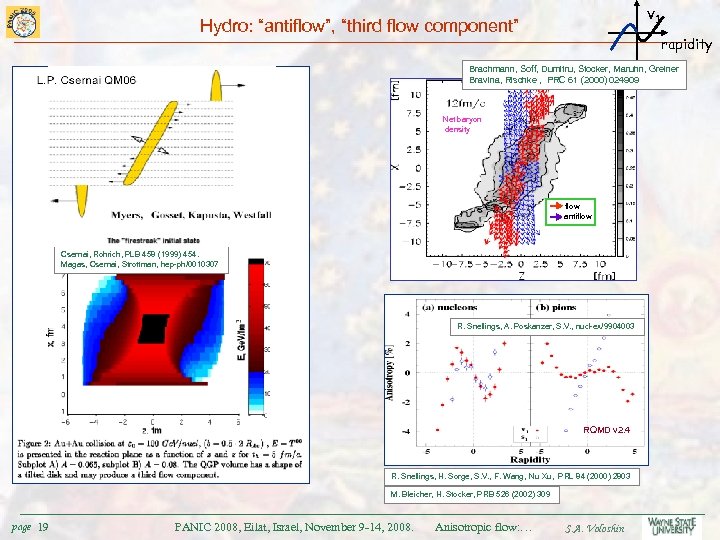 v 1 Hydro: “antiflow”, “third flow component” rapidity Brachmann, Soff, Dumitru, Stocker, Maruhn, Greiner Bravina, Rischke , PRC 61 (2000) 024909 Net baryon density flow antiflow Csernai, Rohrich, PLB 458 (1999) 454. Magas, Csernai, Strottman, hep-ph/0010307 R. Snellings, A. Poskanzer, S. V. , nucl-ex/9904003 RQMD v 2. 4 R. Snellings, H. Sorge, S. V. , F. Wang, Nu Xu, PRL 84 (2000) 2803 M. Bleicher, H. Stocker, PRB 526 (2002) 309 page 19 PANIC 2008, Eilat, Israel, November 9 -14, 2008. Anisotropic flow: … S. A. Voloshin
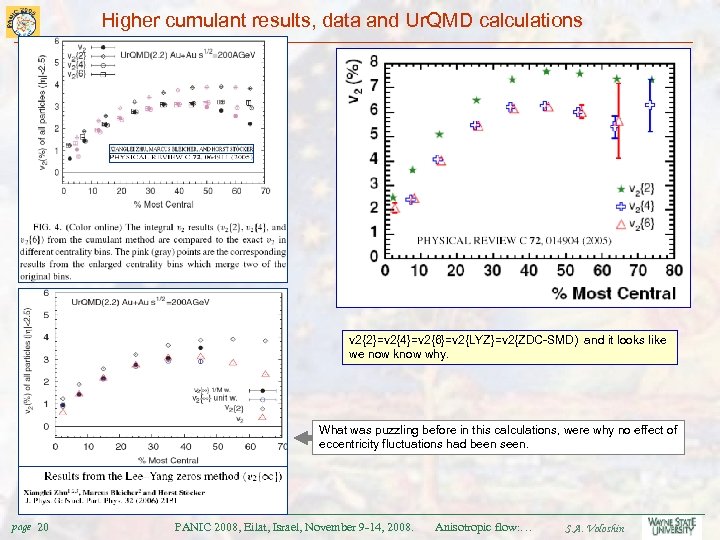 Higher cumulant results, data and Ur. QMD calculations v 2{2}=v 2{4}=v 2{6}=v 2{LYZ}=v 2{ZDC-SMD) and it looks like we now know why. What was puzzling before in this calculations, were why no effect of eccentricity fluctuations had been seen. page 20 PANIC 2008, Eilat, Israel, November 9 -14, 2008. Anisotropic flow: … S. A. Voloshin
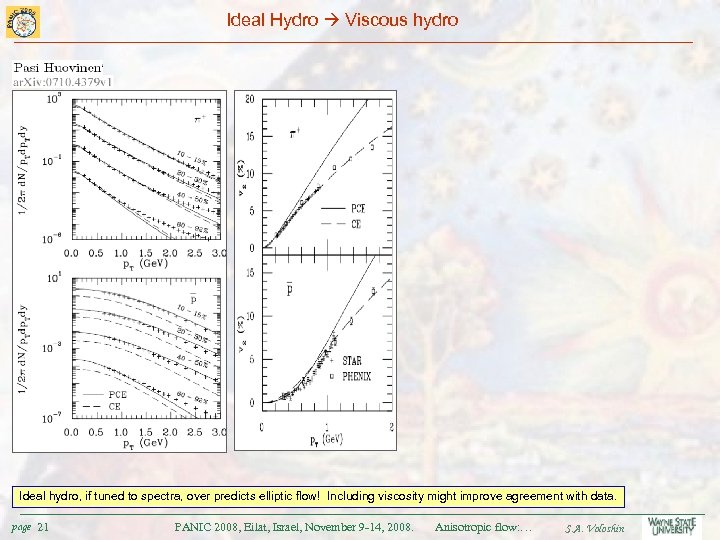 Ideal Hydro Viscous hydro Ideal hydro, if tuned to spectra, over predicts elliptic flow! Including viscosity might improve agreement with data. page 21 PANIC 2008, Eilat, Israel, November 9 -14, 2008. Anisotropic flow: … S. A. Voloshin
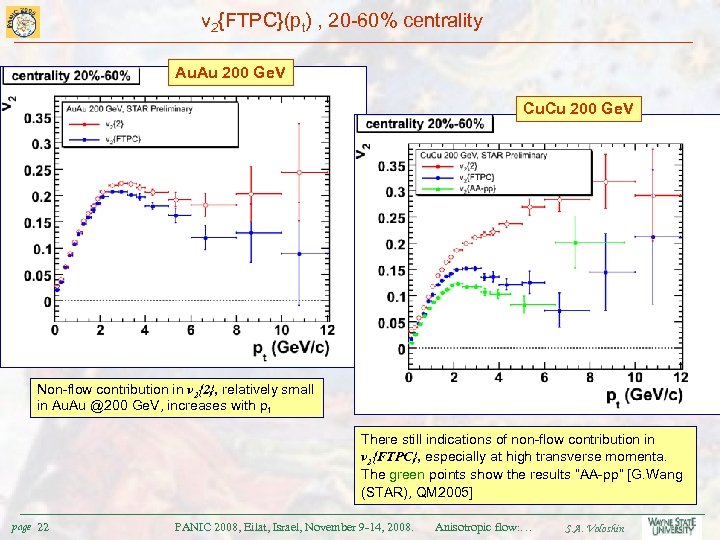 v 2{FTPC}(pt) , 20 -60% centrality Au. Au 200 Ge. V Cu. Cu 200 Ge. V Non-flow contribution in v 2{2}, relatively small in Au. Au @200 Ge. V, increases with pt There still indications of non-flow contribution in v 2{FTPC}, especially at high transverse momenta. The green points show the results “AA-pp” [G. Wang (STAR), QM 2005] page 22 PANIC 2008, Eilat, Israel, November 9 -14, 2008. Anisotropic flow: … S. A. Voloshin
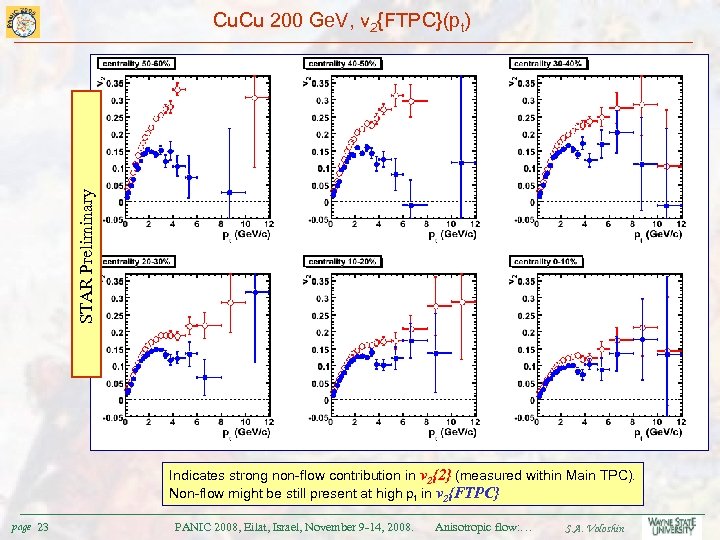 STAR Preliminary Cu. Cu 200 Ge. V, v 2{FTPC}(pt) Indicates strong non-flow contribution in v 2{2} (measured within Main TPC). Non-flow might be still present at high pt in v 2{FTPC} page 23 PANIC 2008, Eilat, Israel, November 9 -14, 2008. Anisotropic flow: … S. A. Voloshin