 Скачать презентацию Collective bargaining trends May 2008 ETUC Palermo
fa6649445d86e1266ba8085fa5bd414b.ppt
- Количество слайдов: 32



Collective bargaining trends May 2008 ETUC – Palermo
Overview • Part I: – Wages – Minimum wages – Bargaining systems – Flexibility/security reforms • Part II: Economic outlook, inflationary price shocks: What response from collective bargaining strategies?
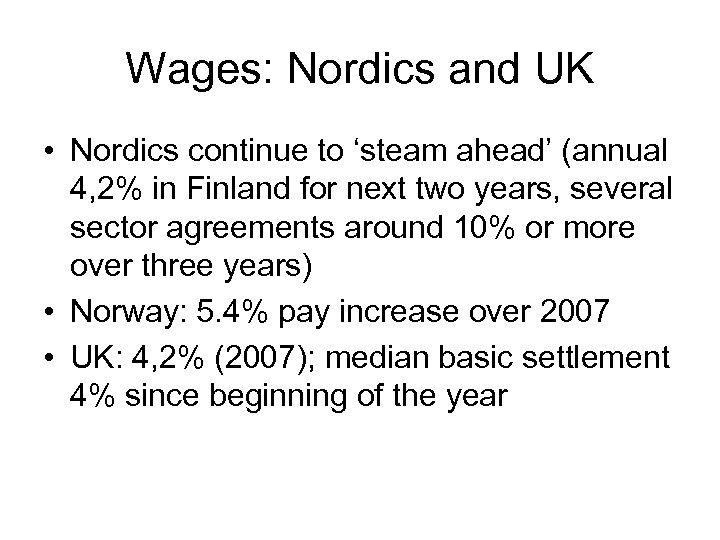
Wages: Nordics and UK • Nordics continue to ‘steam ahead’ (annual 4, 2% in Finland for next two years, several sector agreements around 10% or more over three years) • Norway: 5. 4% pay increase over 2007 • UK: 4, 2% (2007); median basic settlement 4% since beginning of the year
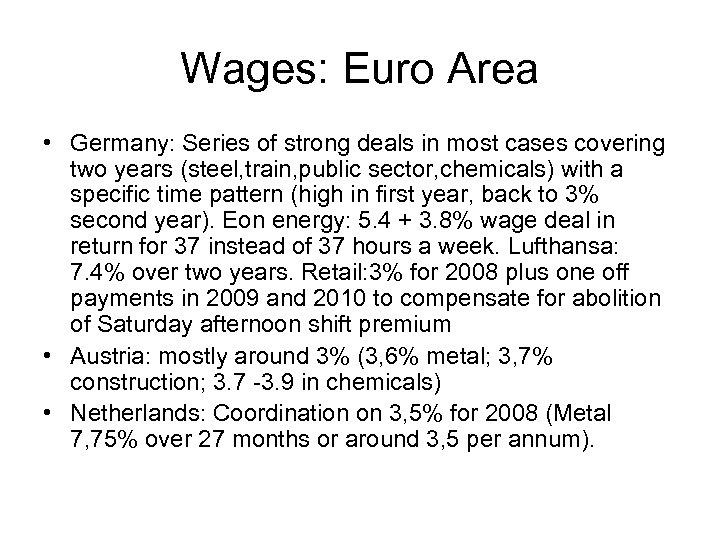
Wages: Euro Area • Germany: Series of strong deals in most cases covering two years (steel, train, public sector, chemicals) with a specific time pattern (high in first year, back to 3% second year). Eon energy: 5. 4 + 3. 8% wage deal in return for 37 instead of 37 hours a week. Lufthansa: 7. 4% over two years. Retail: 3% for 2008 plus one off payments in 2009 and 2010 to compensate for abolition of Saturday afternoon shift premium • Austria: mostly around 3% (3, 6% metal; 3, 7% construction; 3. 7 -3. 9 in chemicals) • Netherlands: Coordination on 3, 5% for 2008 (Metal 7, 75% over 27 months or around 3, 5 per annum).
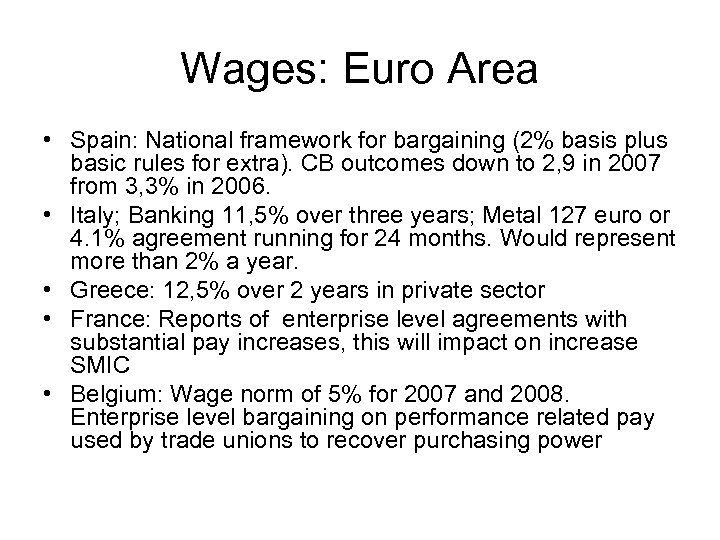
Wages: Euro Area • Spain: National framework for bargaining (2% basis plus basic rules for extra). CB outcomes down to 2, 9 in 2007 from 3, 3% in 2006. • Italy; Banking 11, 5% over three years; Metal 127 euro or 4. 1% agreement running for 24 months. Would represent more than 2% a year. • Greece: 12, 5% over 2 years in private sector • France: Reports of enterprise level agreements with substantial pay increases, this will impact on increase SMIC • Belgium: Wage norm of 5% for 2007 and 2008. Enterprise level bargaining on performance related pay used by trade unions to recover purchasing power
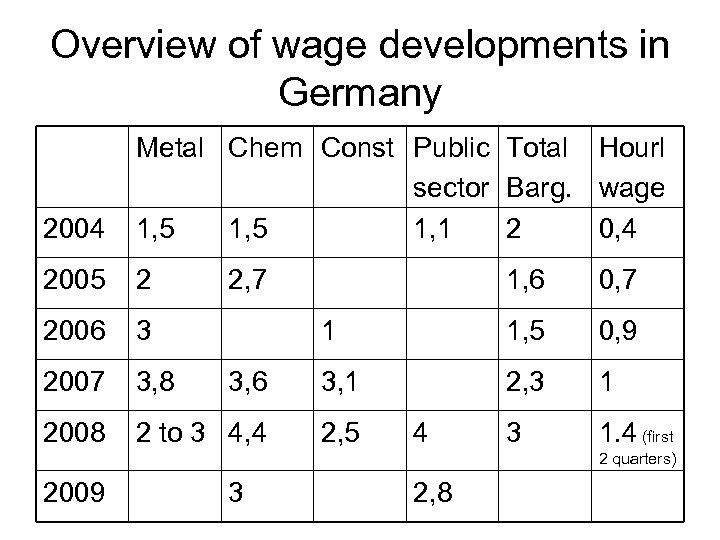
Overview of wage developments in Germany 2004 Metal Chem Const Public Total Hourl sector Barg. wage 1, 5 1, 1 2 0, 4 2005 2 2006 3 2007 3, 8 2008 2, 7 1, 6 0, 7 1 1, 5 0, 9 3, 6 3, 1 2, 3 1 2 to 3 4, 4 2, 5 3 1. 4 (first 4 2 quarters) 2009 3 2, 8
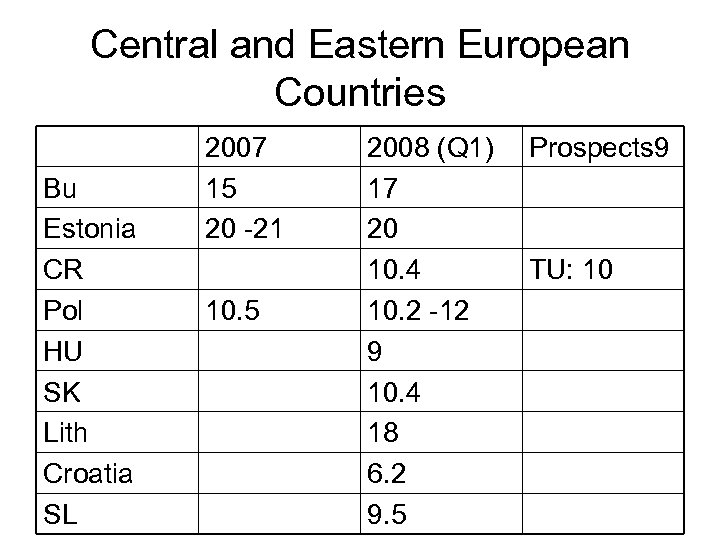
Central and Eastern European Countries Bu Estonia CR Pol HU SK Lith Croatia SL 2007 15 20 -21 10. 5 2008 (Q 1) 17 20 10. 4 10. 2 -12 9 10. 4 18 6. 2 9. 5 Prospects 9 TU: 10
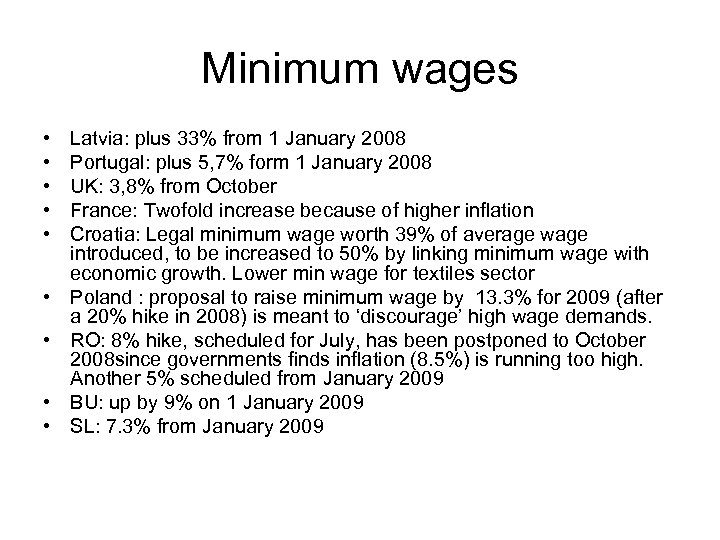
Minimum wages • • • Latvia: plus 33% from 1 January 2008 Portugal: plus 5, 7% form 1 January 2008 UK: 3, 8% from October France: Twofold increase because of higher inflation Croatia: Legal minimum wage worth 39% of average wage introduced, to be increased to 50% by linking minimum wage with economic growth. Lower min wage for textiles sector Poland : proposal to raise minimum wage by 13. 3% for 2009 (after a 20% hike in 2008) is meant to ‘discourage’ high wage demands. RO: 8% hike, scheduled for July, has been postponed to October 2008 since governments finds inflation (8. 5%) is running too high. Another 5% scheduled from January 2009 BU: up by 9% on 1 January 2009 SL: 7. 3% from January 2009
Wage bargaining systems • France: Obligation for companies to negotiate on pay rates each year. New proposals: Outcome of negotiations linked to cuts in employer social security contributions; Tax promotion of profit participation schemes • France: Review of minimum wage system to reasses the link with price trends/ introduce a ‘junior’ SMIC • Germany: Row over a gender pay gap of 22%. Engineering : Agreements allowing workers over 55 to cut working time in half with a 30% reduction in pay up for renewal in 2009, major discussion between Ig. Metall and employers. • Germany: Profit sharing limited to one third of companies and to traditional pay bonuses agreed with enterprise council. . Government has increased tax incentives for employee ownership
Wage bargaining systems • Italy: Trade unions want wage negotiations to be based on – realistic inflation forecasts/ review clauses if inflation exceeds the forecast – penalties if pay settlements are unreasonably delayed – sector pay + working conditions to be negotiated every 3 years (now 2 years for pay, 4 years for work conditions. ) – Additional company level pay bargaining wellcome, for SME’s there should be possibility to have joint agreements covering different companies in the same area. • Netherlands: threat to beef up wage demands in (20%!) firms targeted by private equity/ where CEO pay explodes (Government proposes 30% tax on golden parachutes for CEO’s)
Wage bargaining systems • Spain: – Business defends indexation clauses, saying wage growth would otherwise be higher. – Nevertheless, employers plus government want to make system of collective bargaining more ‘flexible’ – Central Bank: High inflation (4. 8% May 2008) jeopardizes model of wage moderation • Bulgaria: Coverage of CB spreading (now 40% of all workers) • Hungary: workers liable for the cost of court cases they loose • Lithuania: Strikes can be called after half of workers agrees (previously two thirds); Work stoppages of two hours or less do not need prior vote anymore)
Wage bargaining systems • Sweden: 1938 Basic agreement rediscussed. Aim: to get politicians out of the labour market, with employers wanting more flexibility in firing, rules on industrial conflict and solidarity strikes • Finland: Employers opt out of centralised negoatiations; sector-bysector bargaining offers more scope for flexibility and productivity improvements. Real facts: Recent bargaing round delivers pay gains of 5. 5% plus greater risk of strikes. Government drafts 2009 budget linking tax cuts to wage moderation in a central agreement to be concluded end 2009. • Greece: System of national bargaining under threat: – By signing 6. 5% deal for its company workers, National bank blocks sector agreement in banking and is accused of undermining model of industry level bargaining in Greece – Government plans law to preclude collective bargaining at loss-making state enterprises, new staff getting lower work conditions, permitted ceilings for collective redundancies in private sector to be raised (now 2% of staff in concerns over 200 workers).
Wage bargaining systems • Poland: Trade union representatives breaching Trade Union Act no longer face criminal prosecution and possible imprisonment. • Slovenia: Two year national framework on pay (5. 2% to offset higher inflation over 2007; 3. 9% increase in starting and minimum pay; another 2. 3% in August 2009; January 2010 additional pay increase if inflation has exceeded 2. 7%).
Flexibility/security reforms • Czech Rep: Proposal to cut minimum notice from 2 to 1 month, increase severance pay and trial period (now 3 months). Employees on the other hand can ‘buy out’ their notice period (5 months). • Tri –partite Agreement in Estonia : Reduce severance payment from four months (depending on tenure) to one month; In return: benefit of 70% of previous wage for first 100 days, after that 50% (40% for resignations). Some political resistance (‘unaffordable’) • Portugal: Amended 2003 Labour Code : Dismissal procedures to be simplified (criterium of ‘just cause’ remains), longer reference periods for average weekly working hours, 36 hour spells of workers in a three day period.
Flexi-security reforms • France: Social agreement (new way to end employment contract with mutual agreement, more trial periods) • France: Agreement on trade union representation, used/abused by government to flexibilise and prolong working time. • Finland: Gov proposal to give temporary workers right to obtain written details of essential work conditions in user company/right to employee representation/ period works counts in trial period when temp’s get a permanent contract. • Italy: – July 2007 agreement (36 months limit to fixed term contracts, to be implemented in full? ) – New directives from Labour minister to limit abuse of project contracts and fake independants (Criteria such as extent to make independent decisions, integration into the business; sales and secretarial staff certainly unsuited for parasubordinate statute) – New government: Reinstates on call contracts
Flexi-security reforms • Ireland: Drive from trade unions for equal pay for agency workers (accepting a 6 week ‘grace’ period). • UK: – Tri partite agreement on TAW accepting a 12 weeks’ grace period for equal pay/excluding extra legal pension and sick pay provisions/ a national body to negotiate more exceptions to the ‘equal pay’ principle – Plan to extend right to flexible working hours for parents with children up to 16 years of age, to extend maternity leave to 12 months, to give employees the right to ask for time off for training, to outlaw ‘gagging clauses’ that forbid employees from discussing wages with one another (link with gender pay gap). – TUC calling for restoration of trade union rights and freedoms
Flexi-security reforms • Netherlands: – FNV against non-competion clauses. – Bakker commission report: Employer to pay for 6 months’ of pay after termination of the job. Funds on ‘lifespan plans’ to be converted into a ‘work budget’ to train and provide extra income to dismissed workers during their unemployment spell. Dismissals would no longer by referred to courts or regional labour office. Unemployment benefit to be reduced from 38 months to one year. – Employers using TAW form unregistered agencies liabe lfor payment of minimum wage and taxes
Flexi-security reforms • Latvia: Tax clamp on fake self employed • Slovakia: H and S extended to sub contractors and independants with no staff on their own. • Switserland: Three year collective agreement covering TAW’s (sets minimum pay levels, medical insurance, collective representation rights) • Poland: Compensation for unfair dismissal to be increased to sic time’s monthly pay
Wages, inflation, economic policy • Argumentation from ECB: Inflationary wage price spirals • Indexation still exists (BE, Lux, Spain, SL, Malta, Cyprus): 16% of euro area workers • Mainly in public sector (and minimum wage systems), functioning as a reference for the rest of the economy
Part II • Economic outlook, inflationary price shocks: What response from collective bargaining strategies ?
Elements of a potential stability conflict in the making … • Revival of collective bargaining strength and acceleration of wage growth … • …at a time when the economy is hit by inflationary shocks … • …revives central banks’ memories of inflationary wage-price spirals (‘back to the seventies’) and gives them an excuse to put the brakes on the economy in order to obtain wage moderation
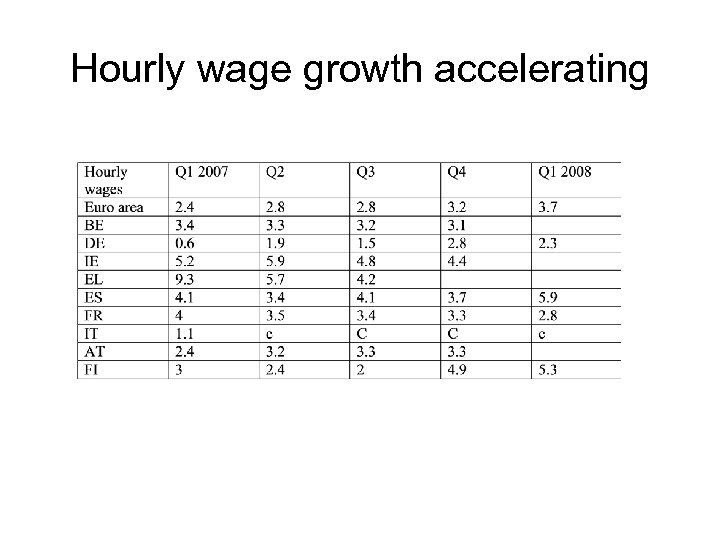
Hourly wage growth accelerating
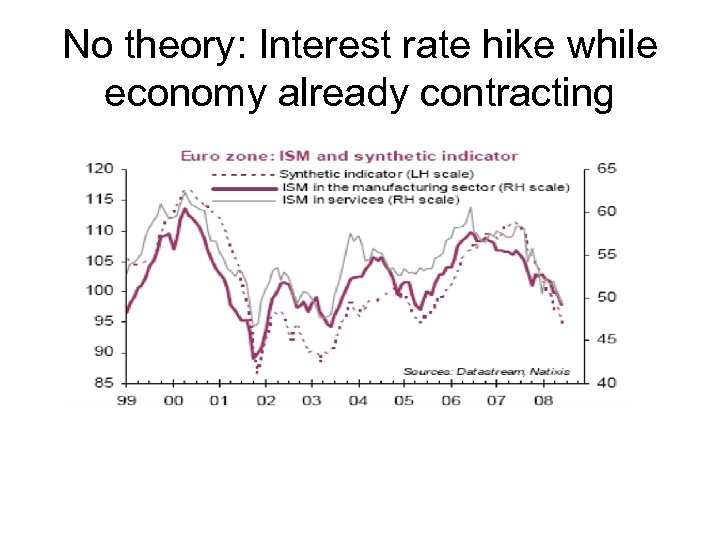
No theory: Interest rate hike while economy already contracting
The ETUC’s reply : In general • Re appraise the role of wages • A stop to thinking of wages as the single buffer against all sorts of shocks • Instead, wages should be seen as a key driver of overall demand economic growth. Indeed, other drivers such as debt financed ‘booms and busts’ or export led ‘beggar thy neighbour’ policies have now reached their limits • This implies stringer collective bargaining and stronger coordination of collective bargaining in order to avoid undercutting and inflationary second round effects
The ETUC’s reply in particular • Wage campaign demanding a stable/fair share of wages in GDP • Messages to ECB via press: – Ongoing acceleration of wages is still compatible with price stability…. (3. 7% wage increase in Q 1 2008 in line with 2% inflation target plus 1. 5% trend productivity growth) – …and this will remain the case (many wage deals already set wage growth well into 2009, resulting in a a deceleration of collectively bargained wages, even Bundesbank says so) Letter to heads of governments: « Instead of letting ECB to its own devices, talk to us « (Idea behind is to coordinate wages and economic policies)
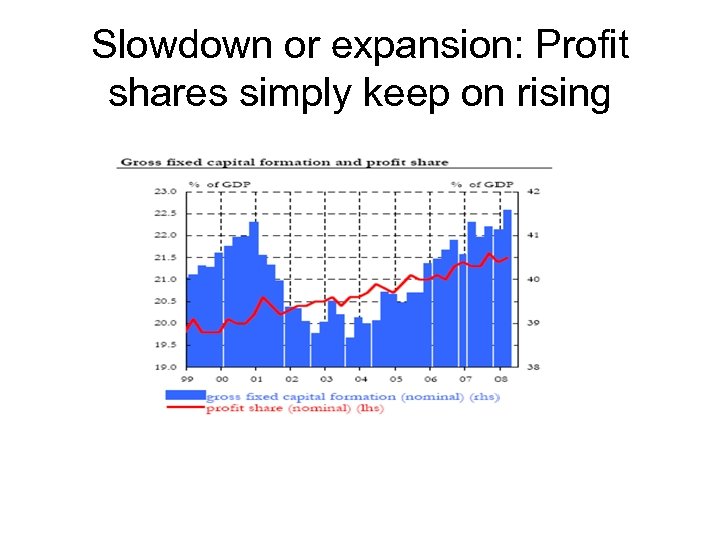
Slowdown or expansion: Profit shares simply keep on rising
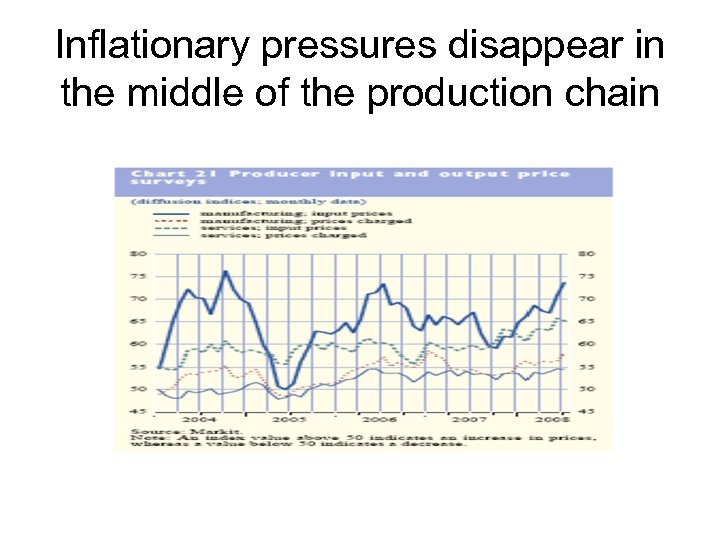
Inflationary pressures disappear in the middle of the production chain

The timing and the agenda that is coming up • • • 12 and 13 September Ecfin Macro Economic Dialogue meetings 1 and 2 October Wage conference 22 October: Informal discussion with ECB Idea of a joint declaration on the economic outlook is resurging • What strategy for the ETUC?
Taking on the central banks • A bargaining strategy to increase the share of wages and recapture some of the share of profits: IG-Metall might be going for this • Risks – ECB to trigger a major crisis – Conservative/nationally divided politicians embark again on a ‘beggar thy neighbour’ strategy. To do so, workers rights and trade union rights and freedoms are weakened further (flexibility, working time, industrial action) – End result may be: trend wage growth diving below 2% throughout euro area/Europe; longer unpaid working time; increased precariousness – Moreover: Is the strategy likely to be implemented in the first place? Substantial negative wage drift in Germany. Economic situation in Spain not brilliant.
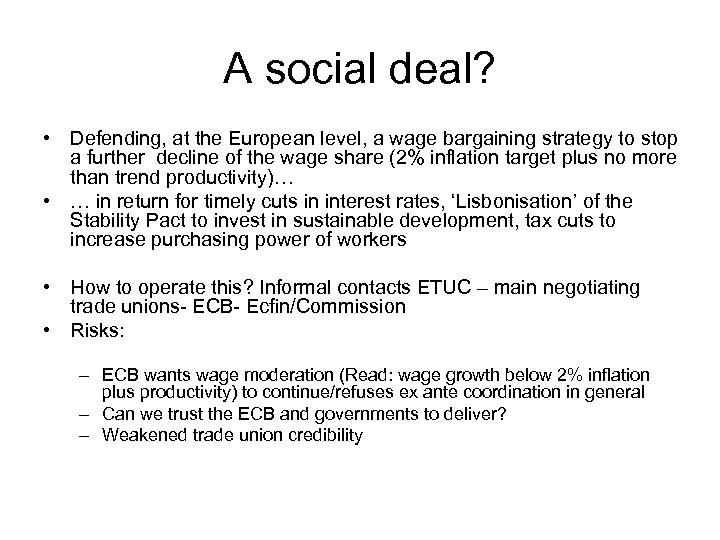
A social deal? • Defending, at the European level, a wage bargaining strategy to stop a further decline of the wage share (2% inflation target plus no more than trend productivity)… • … in return for timely cuts in interest rates, ‘Lisbonisation’ of the Stability Pact to invest in sustainable development, tax cuts to increase purchasing power of workers • How to operate this? Informal contacts ETUC – main negotiating trade unions- ECB- Ecfin/Commission • Risks: – ECB wants wage moderation (Read: wage growth below 2% inflation plus productivity) to continue/refuses ex ante coordination in general – Can we trust the ECB and governments to deliver? – Weakened trade union credibility
In any case…. • Close exchange of information between trade union centers and ETUC/ European industry federation is crucial in the coming period…. .
Discussion Bright ideas are most wellcome…
Скачать презентацию Collective bargaining trends May 2008 ETUC Palermo
fa6649445d86e1266ba8085fa5bd414b.ppt