


 Скачать презентацию Collecting High Quality Outcome Data Part 1 Copyright
ca5e1c4f7dcd3b0457eaaedcf4171c62.ppt
- Количество слайдов: 36
 Collecting High Quality Outcome Data: Part 1 Copyright © 2012 by JBS International, Inc. Developed by JBS International for the Corporation for National & Community Service
 Collecting High Quality Outcome Data: Part 1 Learning Objectives By the end of this module, you will be able to: • Recognize the benefits of collecting high-quality data • Use theory of change to think about measurement • Identify and evaluate merits of data sources and instruments • Describe some uses of data collection methods, and evaluate their merits 2
 Collecting High Quality Outcome Data: Part 1 Module Overview • Determining what information is needed: Theory of change as a guide to measurement • Collecting data that answers the measurement question: Data source, method, instrument • Summary of key points; additional resources A note about terminology: Programs and projects are used interchangeably. 3
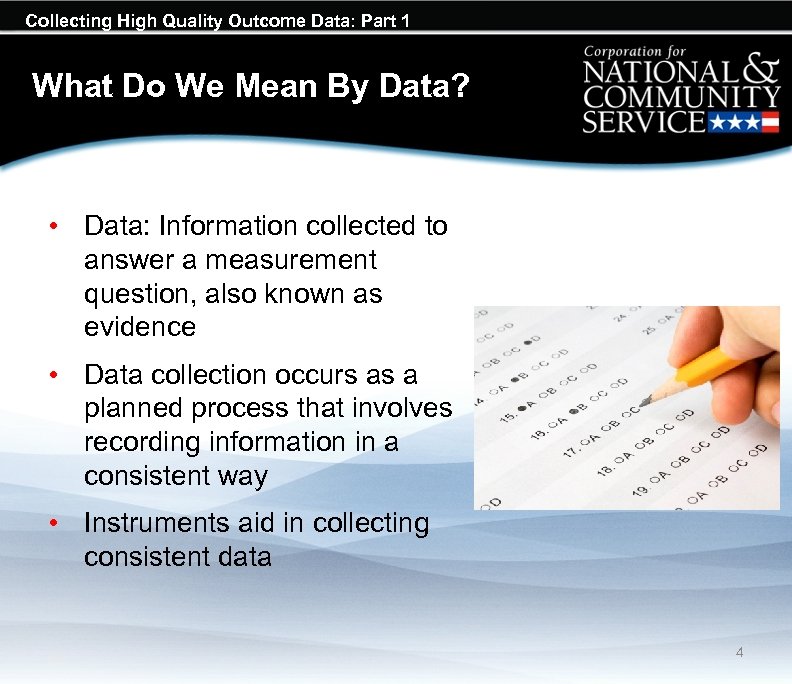 Collecting High Quality Outcome Data: Part 1 What Do We Mean By Data? • Data: Information collected to answer a measurement question, also known as evidence • Data collection occurs as a planned process that involves recording information in a consistent way • Instruments aid in collecting consistent data 4
 Collecting High Quality Outcome Data: Part 1 Ensuring Data Quality: Reliability, Validity, Bias • Reliability is the ability of a method or instrument to yield consistent results under the same conditions. • Validity is the ability of a method or instrument to measure accurately. • Bias involves systematic distortion of results stemming from how data are collected and how instruments are designed. 5
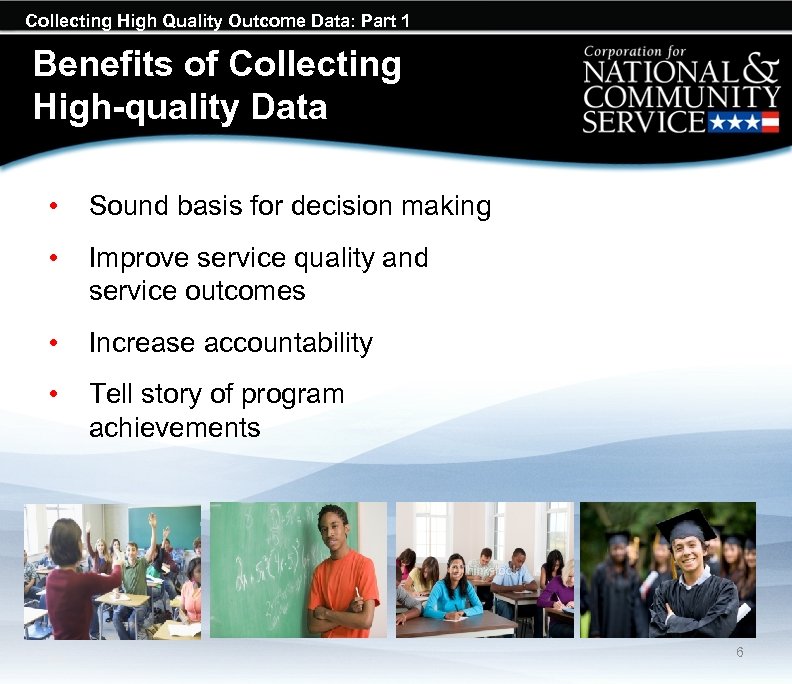 Collecting High Quality Outcome Data: Part 1 Benefits of Collecting High-quality Data • Sound basis for decision making • Improve service quality and service outcomes • Increase accountability • Tell story of program achievements 6
 Collecting High Quality Outcome Data: Part 1 Theory of Change – Review • Cause-and-effect relationship between a community problem/need an outcome intended using a specific intervention • A program or project’s theory of change identifies the outcome that will be measured to gauge the success of the intervention in meeting the community problem/need Community Problem/Need Specific Intervention Intended Outcome Evidence • Guides choice of intervention • Supports cause-effect relationship 7
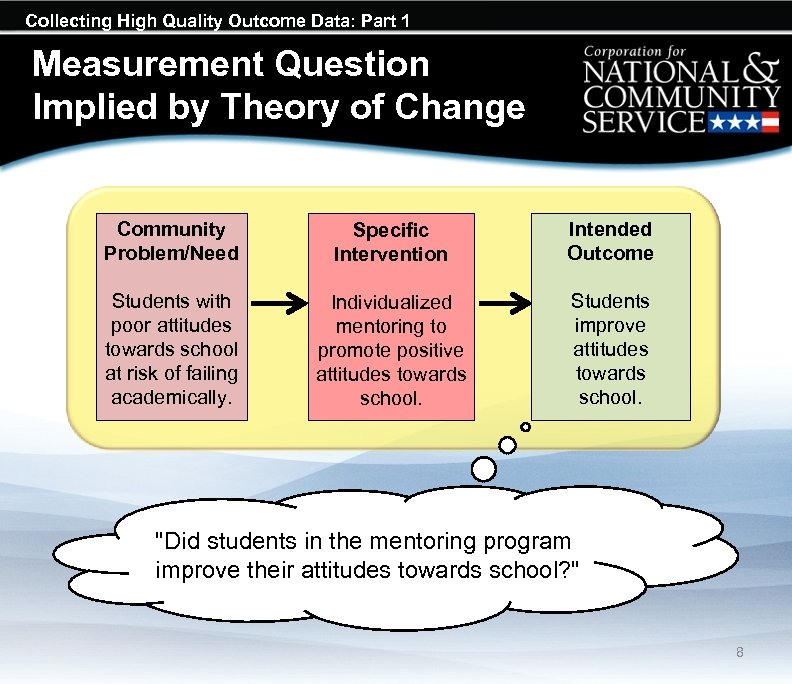 Collecting High Quality Outcome Data: Part 1 Measurement Question Implied by Theory of Change Community Problem/Need Specific Intervention Intended Outcome Students with poor attitudes towards school at risk of failing academically. Individualized mentoring to promote positive attitudes towards school. Students improve attitudes towards school. "Did students in the mentoring program improve their attitudes towards school? " 8
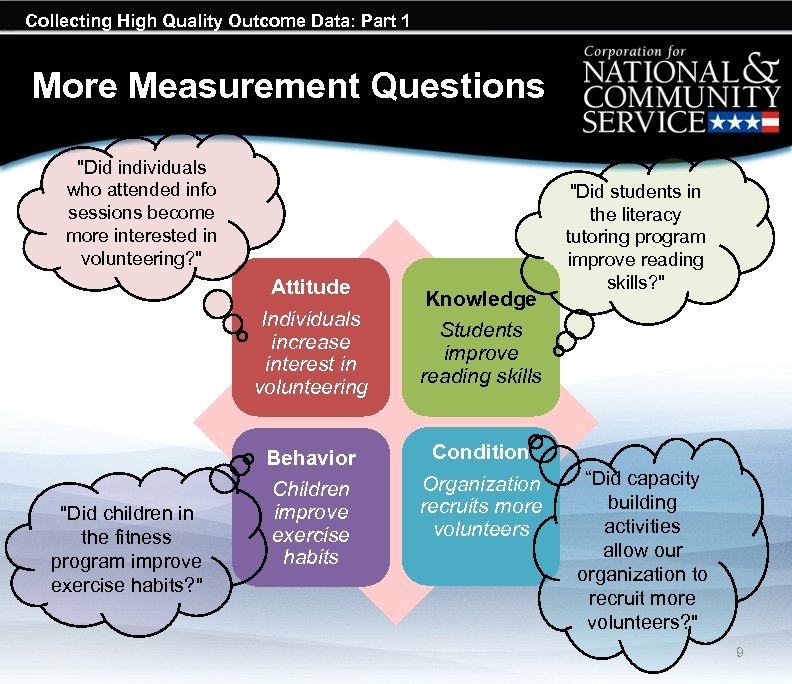 Collecting High Quality Outcome Data: Part 1 More Measurement Questions "Did individuals who attended info sessions become more interested in volunteering? " Attitude Individuals increase interest in volunteering "Did children in the fitness program improve exercise habits? " Behavior Children improve exercise habits Knowledge Students improve reading skills Condition Organization recruits more volunteers "Did students in the literacy tutoring program improve reading skills? " “Did capacity building activities allow our organization to recruit more volunteers? " 9
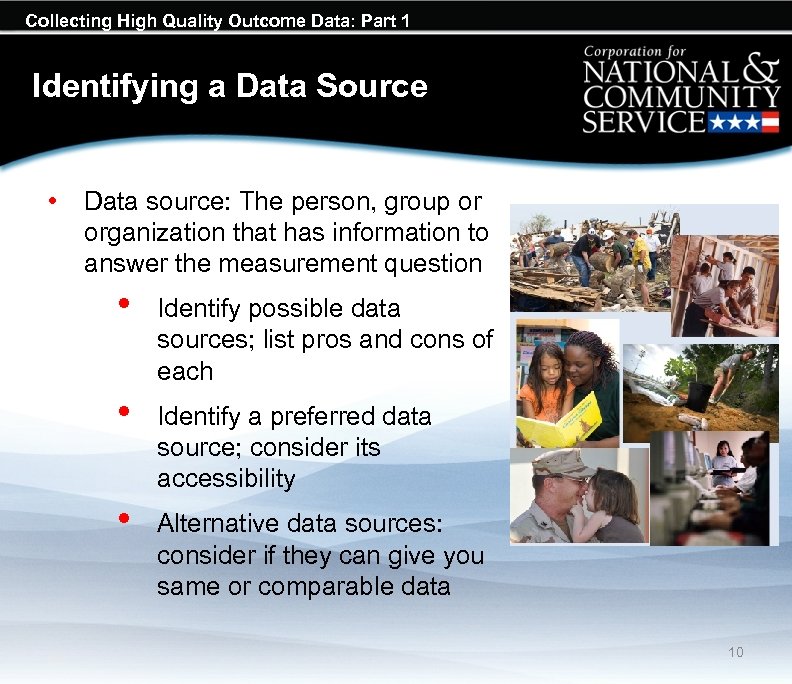 Collecting High Quality Outcome Data: Part 1 Identifying a Data Source • Data source: The person, group or organization that has information to answer the measurement question • Identify possible data sources; list pros and cons of each • Identify a preferred data source; consider its accessibility • Alternative data sources: consider if they can give you same or comparable data 10
 Collecting High Quality Outcome Data: Part 1 Data source and type of outcome Depends partly on the type of change you want to measure - attitude, knowledge, behavior, or conditions. • Data on changes in attitudes or knowledge usually come directly from persons experiencing these changes. Attitude Knowledge Behavior Condition • Data on changes in behavior or conditions can come from either persons experiencing these changes or from other observers. 11
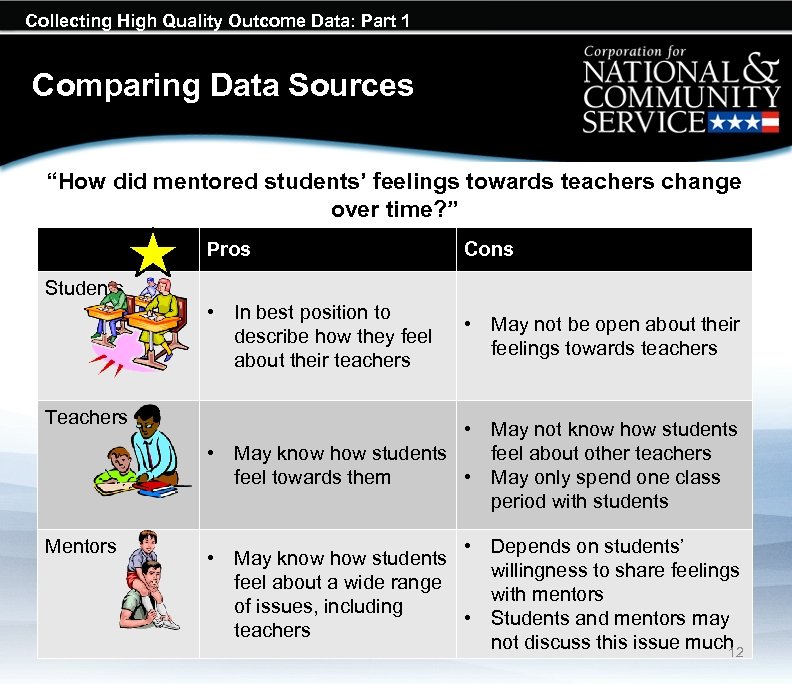 Collecting High Quality Outcome Data: Part 1 Comparing Data Sources “How did mentored students’ feelings towards teachers change over time? ” Pros Cons • In best position to describe how they feel about their teachers • May not be open about their feelings towards teachers Students Teachers Mentors • May not know how students • May know how students feel about other teachers feel towards them • May only spend one class period with students • • May know how students feel about a wide range of issues, including • teachers Depends on students’ willingness to share feelings with mentors Students and mentors may not discuss this issue much 12
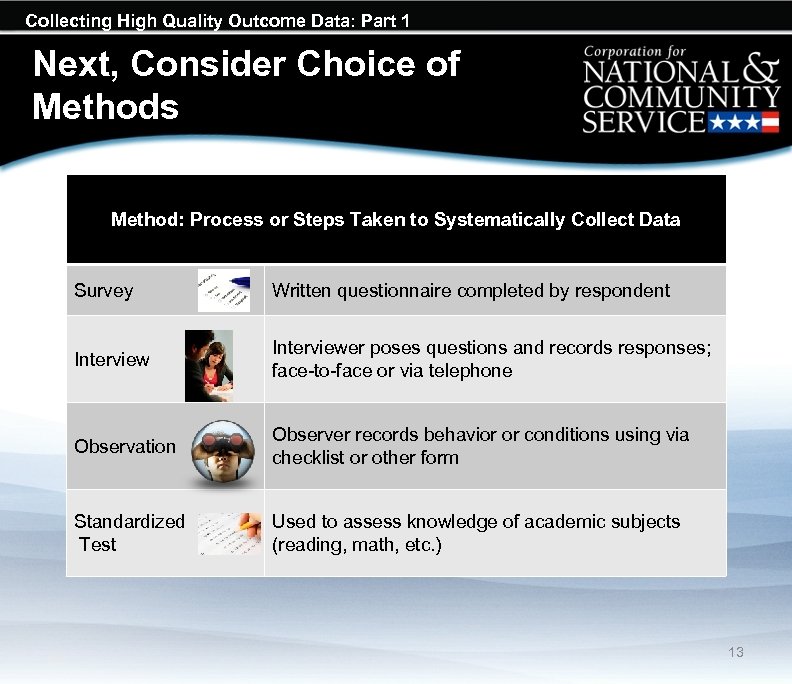 Collecting High Quality Outcome Data: Part 1 Next, Consider Choice of Methods Method: Process or Steps Taken to Systematically Collect Data Survey Written questionnaire completed by respondent Interviewer poses questions and records responses; face-to-face or via telephone Observation Observer records behavior or conditions using via checklist or other form Standardized Test Used to assess knowledge of academic subjects (reading, math, etc. ) 13
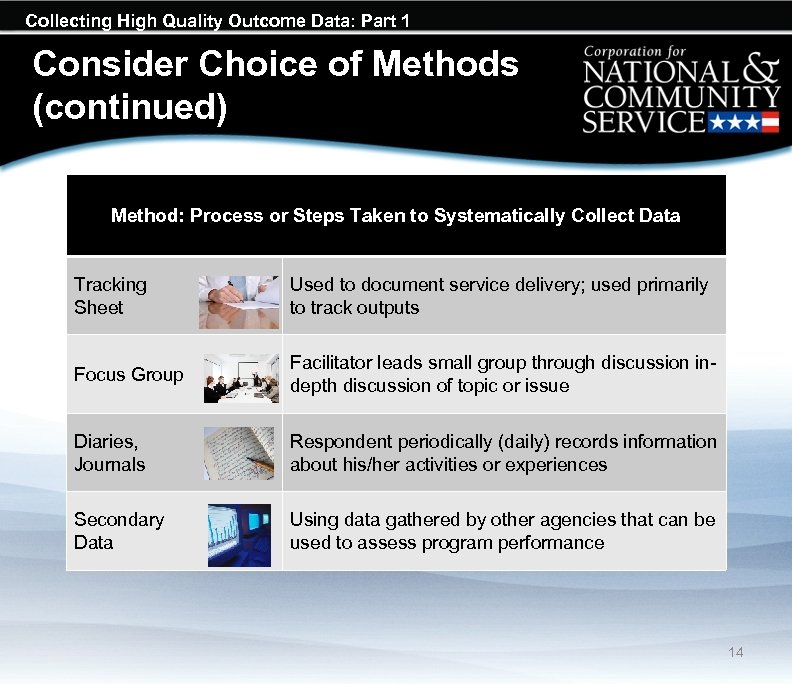 Collecting High Quality Outcome Data: Part 1 Consider Choice of Methods (continued) Method: Process or Steps Taken to Systematically Collect Data Tracking Sheet Used to document service delivery; used primarily to track outputs Focus Group Facilitator leads small group through discussion indepth discussion of topic or issue Diaries, Journals Respondent periodically (daily) records information about his/her activities or experiences Secondary Data Using data gathered by other agencies that can be used to assess program performance 14
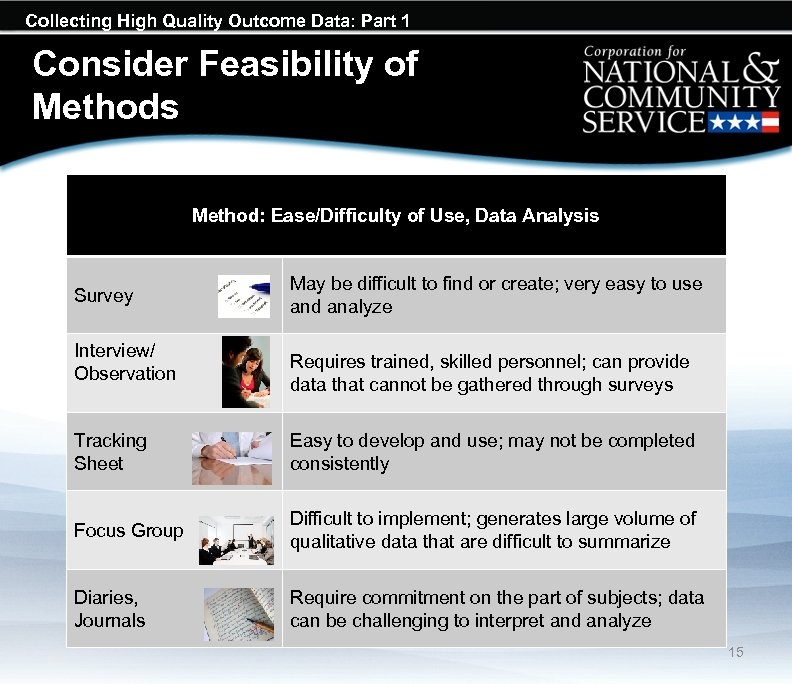 Collecting High Quality Outcome Data: Part 1 Consider Feasibility of Methods Method: Ease/Difficulty of Use, Data Analysis Survey Interview/ Observation May be difficult to find or create; very easy to use and analyze Requires trained, skilled personnel; can provide data that cannot be gathered through surveys Tracking Sheet Easy to develop and use; may not be completed consistently Focus Group Difficult to implement; generates large volume of qualitative data that are difficult to summarize Diaries, Journals Require commitment on the part of subjects; data can be challenging to interpret and analyze 15
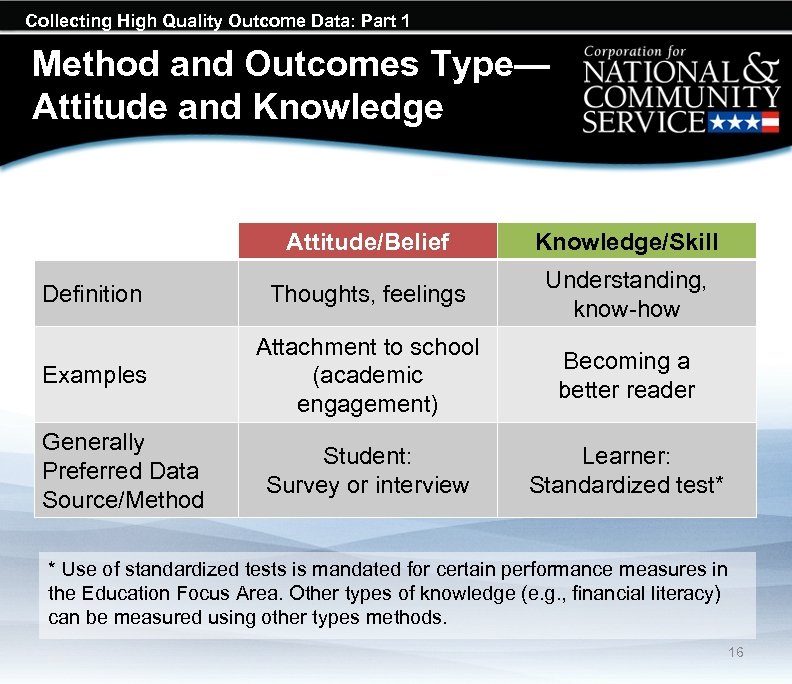 Collecting High Quality Outcome Data: Part 1 Method and Outcomes Type— Attitude and Knowledge Attitude/Belief Knowledge/Skill Definition Thoughts, feelings Understanding, know-how Examples Attachment to school (academic engagement) Becoming a better reader Student: Survey or interview Learner: Standardized test* Generally Preferred Data Source/Method * Use of standardized tests is mandated for certain performance measures in the Education Focus Area. Other types of knowledge (e. g. , financial literacy) can be measured using other types methods. 16
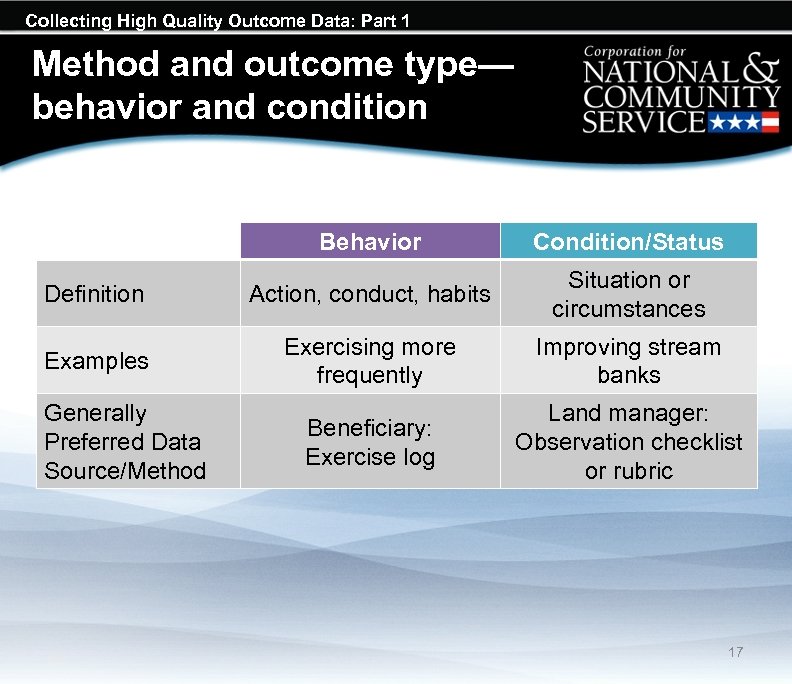 Collecting High Quality Outcome Data: Part 1 Method and outcome type— behavior and condition Behavior Condition/Status Definition Action, conduct, habits Situation or circumstances Examples Exercising more frequently Improving stream banks Beneficiary: Exercise log Land manager: Observation checklist or rubric Generally Preferred Data Source/Method 17
 Collecting High Quality Outcome Data: Part 1 Where to Find Instruments • For CNCS priorities and performance measures, look for instruments by goal and focus area • Go to https: //www. nationalserviceresources. org/npm/hom e • Programs and projects can look anywhere they like to find instruments: • Use Internet search engines • Talk to others within you professional network to find out what they are using • Look at evidence for intervention – how measured before? 18
 Collecting High Quality Outcome Data: Part 1 Evaluating Instruments • Pre-post measurement is preferable to post-only • Can the instrument measure the outcome? • • • Appropriate for your intervention? Appropriate for your beneficiaries? How many questions measure the outcome? • Single question low-quality data • Series of questions: Too long or complex? • • Instrument should not exceed 2 pages Do questions cover all relevant aspects of your intervention? Can questions not specific to your intervention be removed? 19
 Collecting High Quality Outcome Data: Part 1 Define Outcome Dimensions: The main aspects, features, or characteristics that define an outcome and that should be taken into account for measurement to be valid Example: Increased attachment to school: • Feelings about being in school • Feelings about doing school work • Feelings towards teachers • Feelings towards students 20
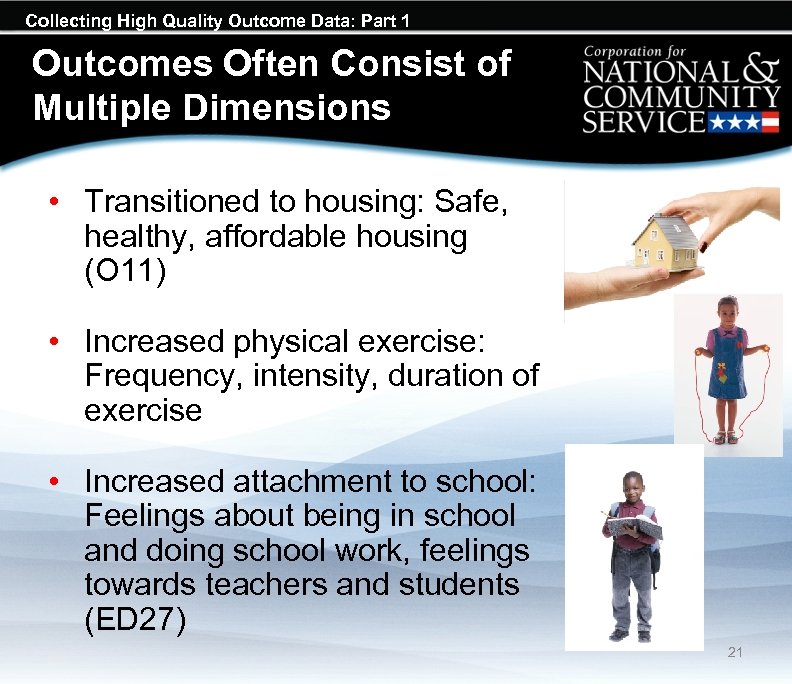 Collecting High Quality Outcome Data: Part 1 Outcomes Often Consist of Multiple Dimensions • Transitioned to housing: Safe, healthy, affordable housing (O 11) • Increased physical exercise: Frequency, intensity, duration of exercise • Increased attachment to school: Feelings about being in school and doing school work, feelings towards teachers and students (ED 27) 21
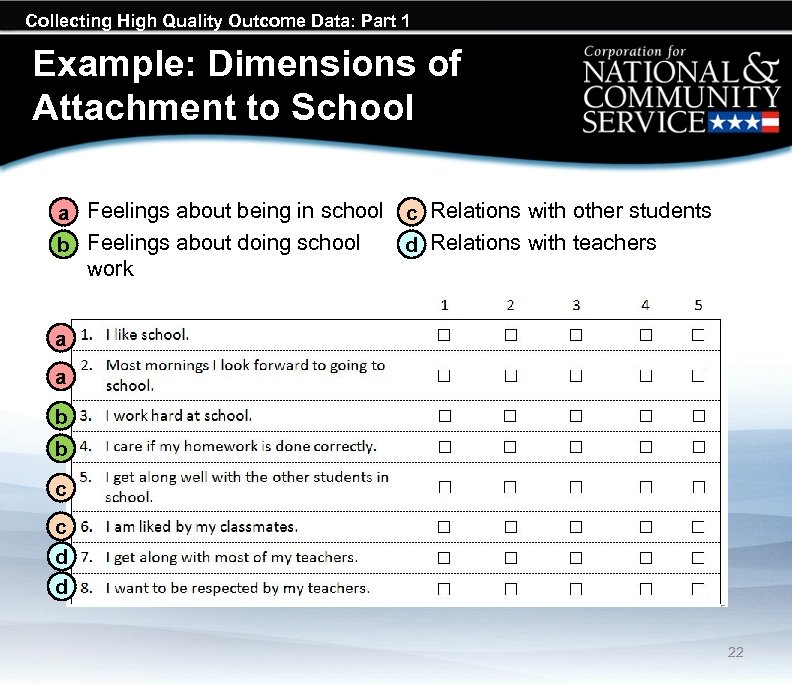 Collecting High Quality Outcome Data: Part 1 Example: Dimensions of Attachment to School a. Feelings about being in school c. Relations with other students a c b. Feelings about doing school d. Relations with teachers b d work a a b b c c d d 22
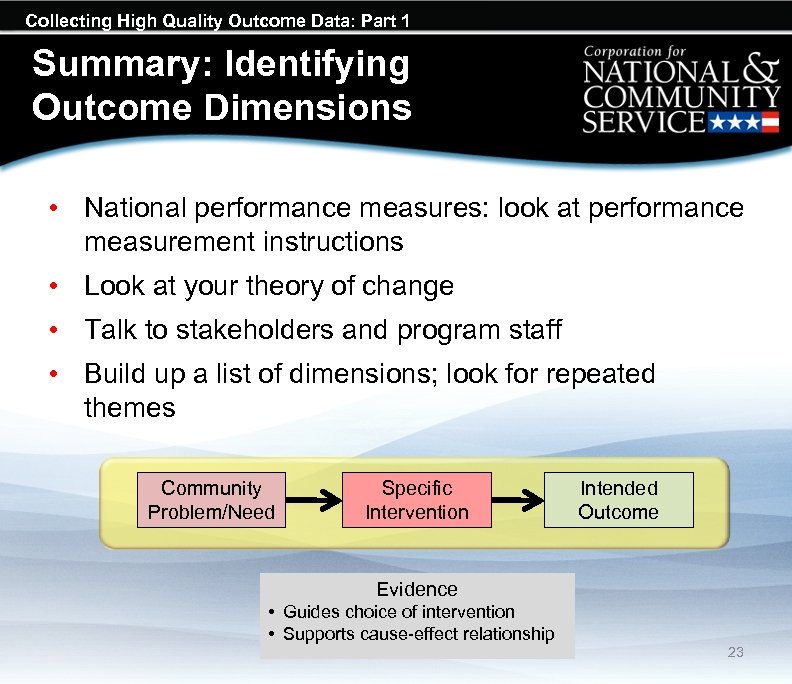 Collecting High Quality Outcome Data: Part 1 Summary: Identifying Outcome Dimensions • National performance measures: look at performance measurement instructions • Look at your theory of change • Talk to stakeholders and program staff • Build up a list of dimensions; look for repeated themes Community Problem/Need Specific Intervention Intended Outcome Evidence • Guides choice of intervention • Supports cause-effect relationship 23
 Collecting High Quality Outcome Data: Part 1 Instrument Design Issues • Crowded layout • Double-barreled questions • Biased or “leading” questions • Questions that are too abstract • Questions that use unstructured responses inappropriately • Response options that overlap or contain gaps • Unbalanced scales 24
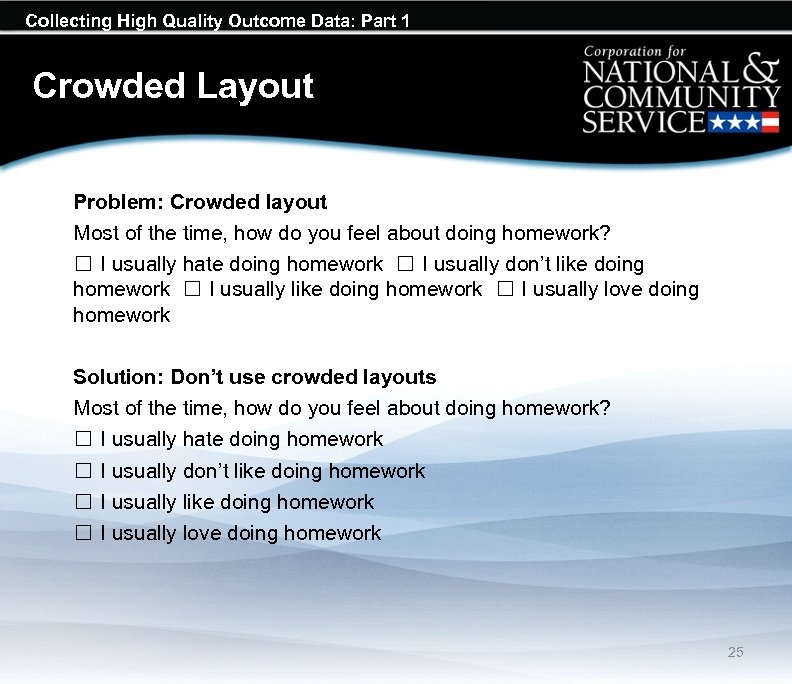 Collecting High Quality Outcome Data: Part 1 Crowded Layout Problem: Crowded layout Most of the time, how do you feel about doing homework? ☐ I usually hate doing homework ☐ I usually don’t like doing homework ☐ I usually love doing homework Solution: Don’t use crowded layouts Most of the time, how do you feel about doing homework? ☐ I usually hate doing homework ☐ I usually don’t like doing homework ☐ I usually love doing homework 25
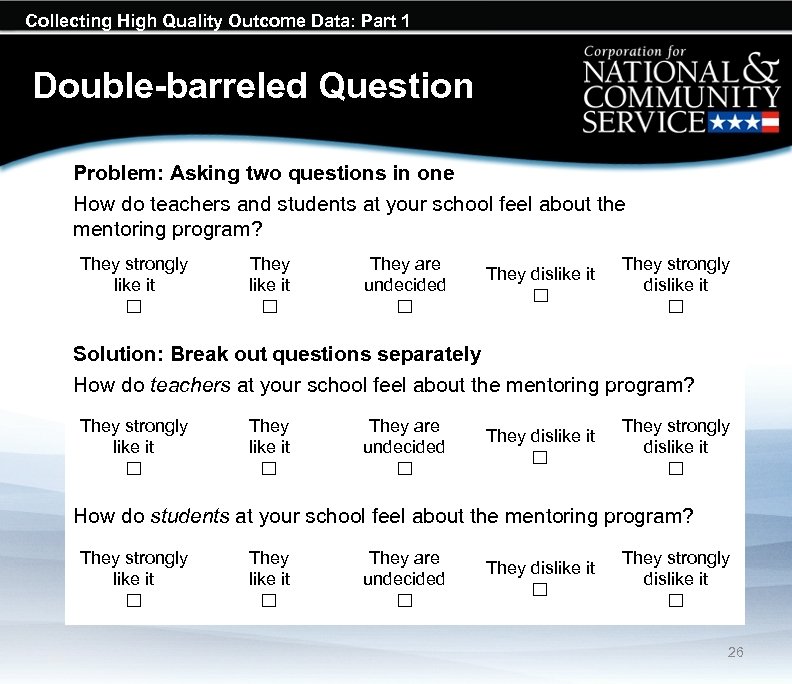 Collecting High Quality Outcome Data: Part 1 Double-barreled Question Problem: Asking two questions in one How do teachers and students at your school feel about the mentoring program? They strongly like it ☐ They are undecided ☐ They dislike it ☐ They strongly dislike it ☐ Solution: Break out questions separately How do teachers at your school feel about the mentoring program? They strongly dislike it ☐ How do students at your school feel about the mentoring program? They strongly like it ☐ They are undecided ☐ They dislike it ☐ They strongly dislike it ☐ 26
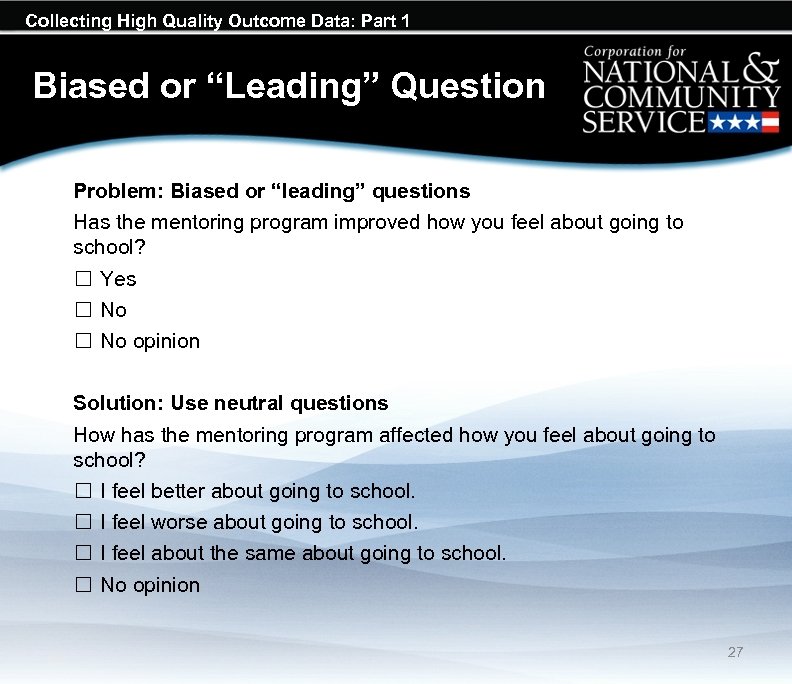 Collecting High Quality Outcome Data: Part 1 Biased or “Leading” Question Problem: Biased or “leading” questions Has the mentoring program improved how you feel about going to school? ☐ Yes ☐ No opinion Solution: Use neutral questions How has the mentoring program affected how you feel about going to school? ☐ I feel better about going to school. ☐ I feel worse about going to school. ☐ I feel about the same about going to school. ☐ No opinion 27
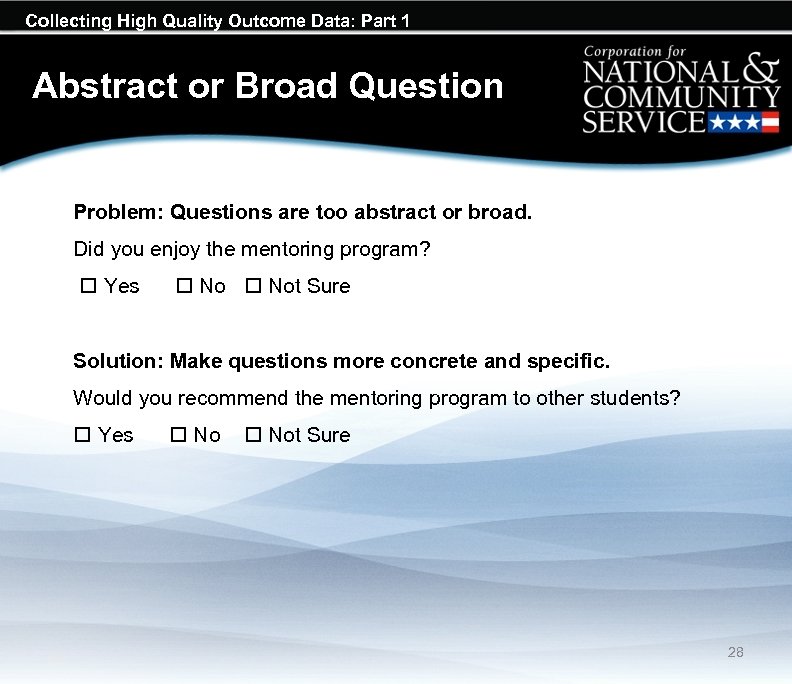 Collecting High Quality Outcome Data: Part 1 Abstract or Broad Question Problem: Questions are too abstract or broad. Did you enjoy the mentoring program? Yes No Not Sure Solution: Make questions more concrete and specific. Would you recommend the mentoring program to other students? Yes No Not Sure 28
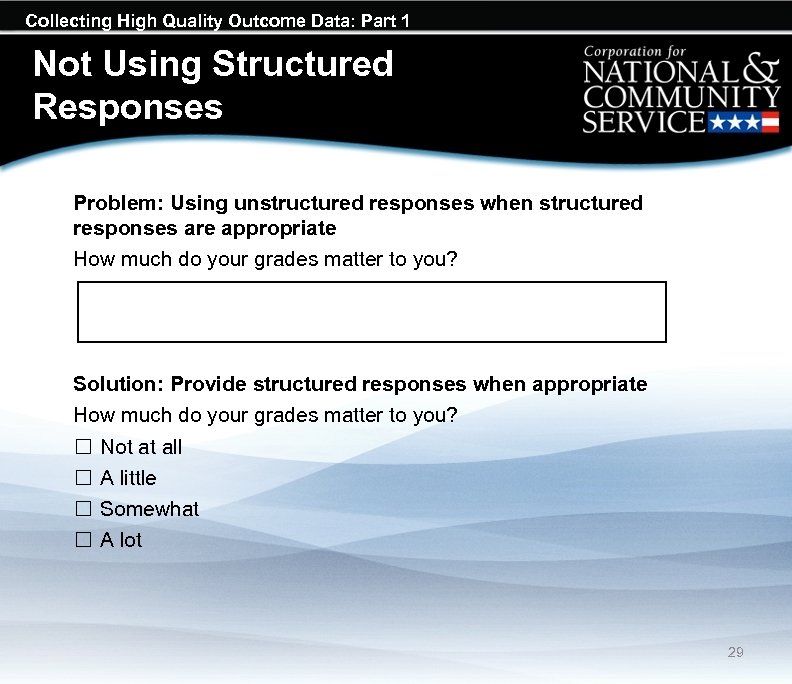 Collecting High Quality Outcome Data: Part 1 Not Using Structured Responses Problem: Using unstructured responses when structured responses are appropriate How much do your grades matter to you? Solution: Provide structured responses when appropriate How much do your grades matter to you? ☐ Not at all ☐ A little ☐ Somewhat ☐ A lot 29
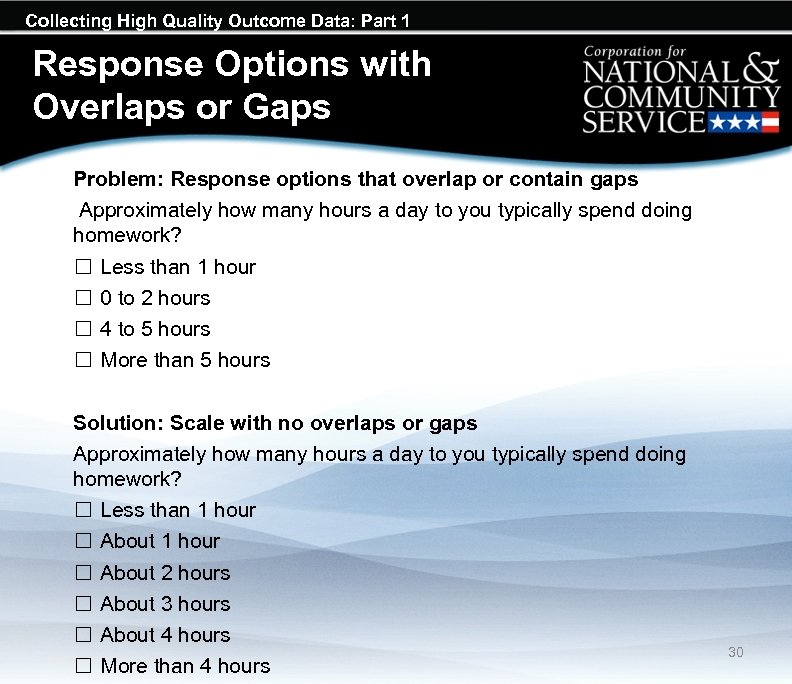 Collecting High Quality Outcome Data: Part 1 Response Options with Overlaps or Gaps Problem: Response options that overlap or contain gaps Approximately how many hours a day to you typically spend doing homework? ☐ Less than 1 hour ☐ 0 to 2 hours ☐ 4 to 5 hours ☐ More than 5 hours Solution: Scale with no overlaps or gaps Approximately how many hours a day to you typically spend doing homework? ☐ Less than 1 hour ☐ About 2 hours ☐ About 3 hours ☐ About 4 hours ☐ More than 4 hours 30
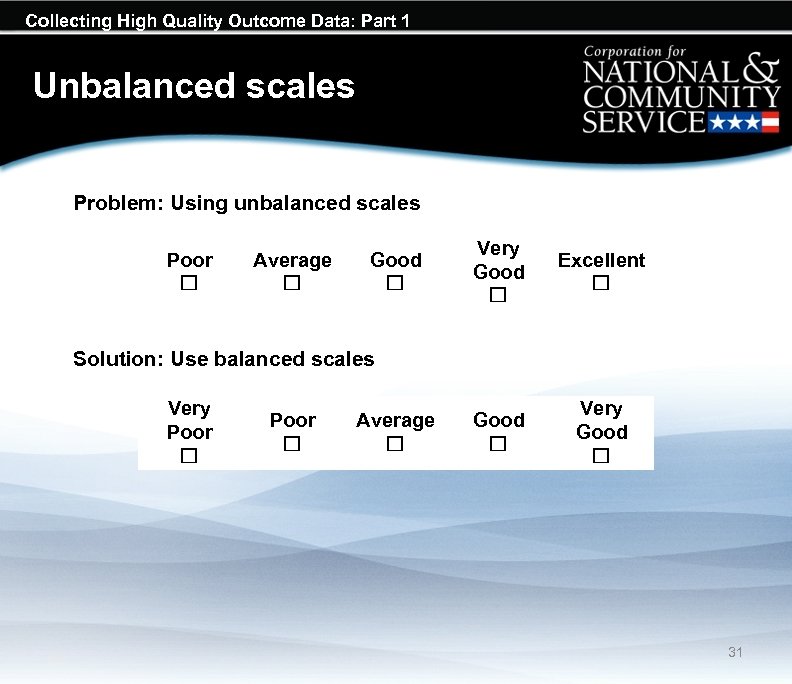 Collecting High Quality Outcome Data: Part 1 Unbalanced scales Problem: Using unbalanced scales Poor ☐ Average ☐ Good ☐ Very Good ☐ Excellent ☐ Good ☐ Very Good ☐ Solution: Use balanced scales Very Poor ☐ Average ☐ 31
 Collecting High Quality Outcome Data: Part 1 What else to look for in selecting an instrument • Can the instrument work in your context? • Does the instrument use simple and clear language? • Is the instrument appropriate for the age, education, literacy, and language preferences of respondents? 32
 Collecting High Quality Outcome Data: Part 1 What else to look for in selecting an instrument, continued • Does the instrument rely mostly on multiple choice questions? • Is the ready for use, or does it need to be modified? • How will you extract information from the instrument to address performance measurement targets? 33
 Collecting High Quality Outcome Data: Part 1 Summary of key points • The benefits of collecting high-quality data include providing a sound basis for decision making, improving service quality and outcomes, increasing accountability, and telling your story in a more compelling way. • Your theory of change, and the key measurement question embedded in it, is a useful a guide to measurement. • The type of outcome to be measured influences decisions about data sources, methods, and instruments. 34
 Collecting High Quality Outcome Data: Part 1 Summary of key points • Knowing the pros and cons of a data sources is helpful for choosing one and for designing an appropriate measurement process. • CNCS provides sample instruments for most national performance measures. In addition, programs are permitted to look anywhere to find instruments that meet their needs. • High-quality outcome measurement often requires using an instrument that can capture multiple dimensions of the outcome. Instruments should also be free from other design problems. 35
 Collecting High Quality Outcome Data: Part 1 Additional resources • CNCS Performance Measurement o https: //www. nationalserviceresources. org/npm/home • Instrument Formatting Checklist o www. nationalservice. gov/resources/files/Instrument_Devel opment_Checklist_and_Sample. pdf • Practicum Materials o http: //www. nationalservice. gov/resources/npm/corecurriculum 36