


 Скачать презентацию Collecting and Entering Data for Nonpoint Sources Melinda
22d0124acb297e921ca3c95dd4ba321b.ppt
- Количество слайдов: 25
 Collecting and Entering Data for Nonpoint Sources Melinda Ronca-Battista and Angelique Luedeker ITEP/TAMS Center 1
 Common Nonpoint Sources Most Reservations Have These Sources Residential Heating Commercial Heating Paved Road Dust Unpaved Road Dust Gas Stations (can be inventoried as nonpoint or point) Can use these sources as starters for nonpoint section of EI These sources are the focus of this presentation 2
 Gathering Data Local data sources are usually the most accurate Examples: tribal housing offices, local businesses, surveys If you are not able to obtain data from local sources, there are options of obtaining data from national sources, such as the U. S. Census Bureau Usually, you can find these data online The next slides focus on collecting data for residential heating as an example Apply what you learn from this example to collect and enter data for other sources 3
 Residential Heating Data Collection-Step 1 1. Determine what fuels are used, each fuel type is a different source in TEISS and your EI a. Local sources options: Check with the tribal housing office Use local knowledge, e. g. what fuel do you or your family, friends, coworkers use for heating? National source option if local data cannot be obtained or local data is incomplete: b. Look online at U. S. Census Bureau data: http: //factfinder 2. census. gov 4
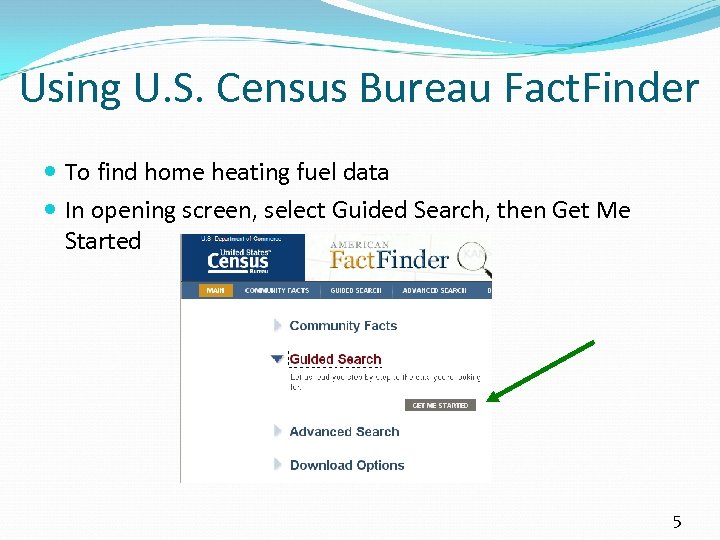 Using U. S. Census Bureau Fact. Finder To find home heating fuel data In opening screen, select Guided Search, then Get Me Started 5
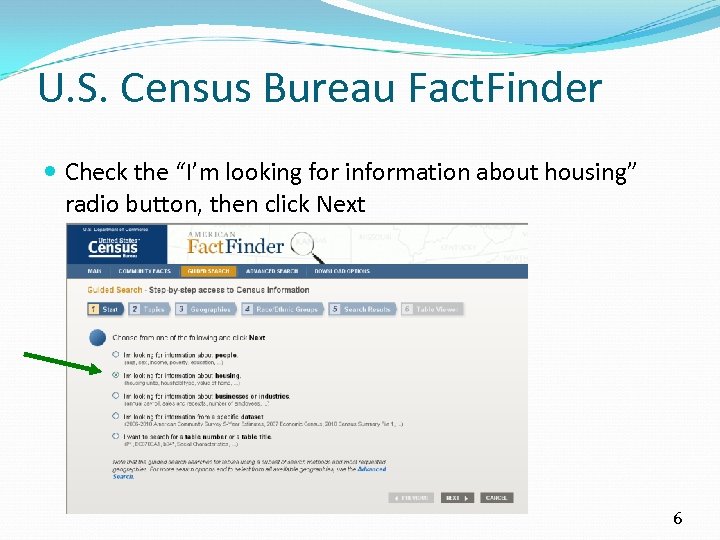 U. S. Census Bureau Fact. Finder Check the “I’m looking for information about housing” radio button, then click Next 6
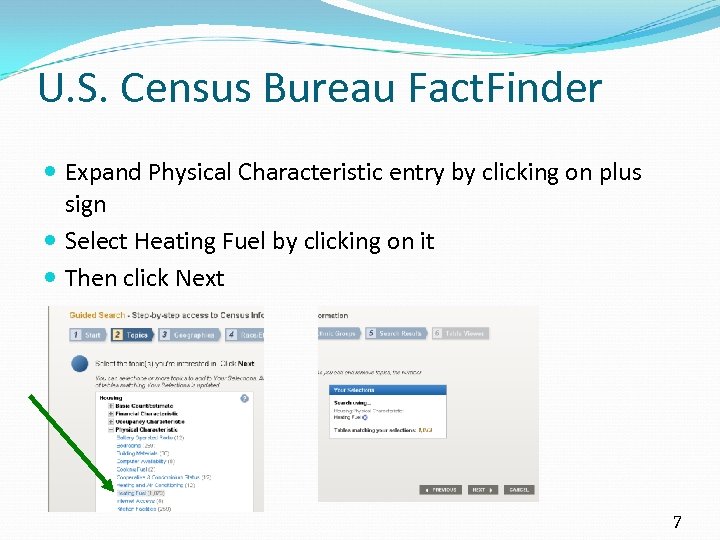 U. S. Census Bureau Fact. Finder Expand Physical Characteristic entry by clicking on plus sign Select Heating Fuel by clicking on it Then click Next 7
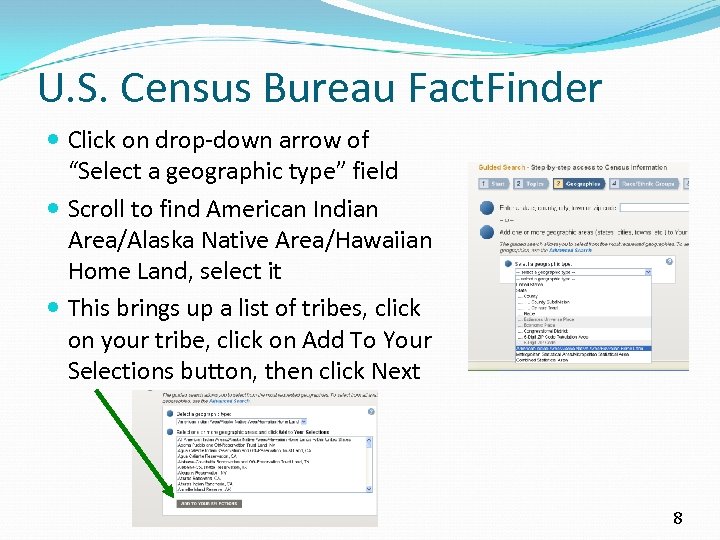 U. S. Census Bureau Fact. Finder Click on drop-down arrow of “Select a geographic type” field Scroll to find American Indian Area/Alaska Native Area/Hawaiian Home Land, select it This brings up a list of tribes, click on your tribe, click on Add To Your Selections button, then click Next 8
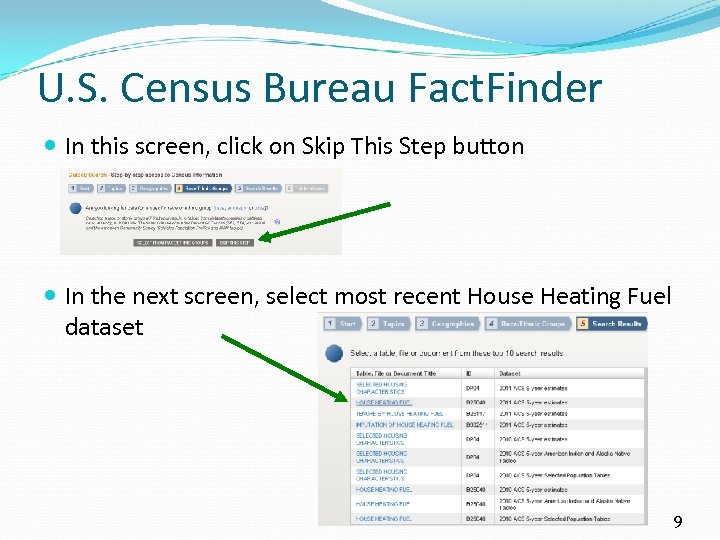 U. S. Census Bureau Fact. Finder In this screen, click on Skip This Step button In the next screen, select most recent House Heating Fuel dataset 9
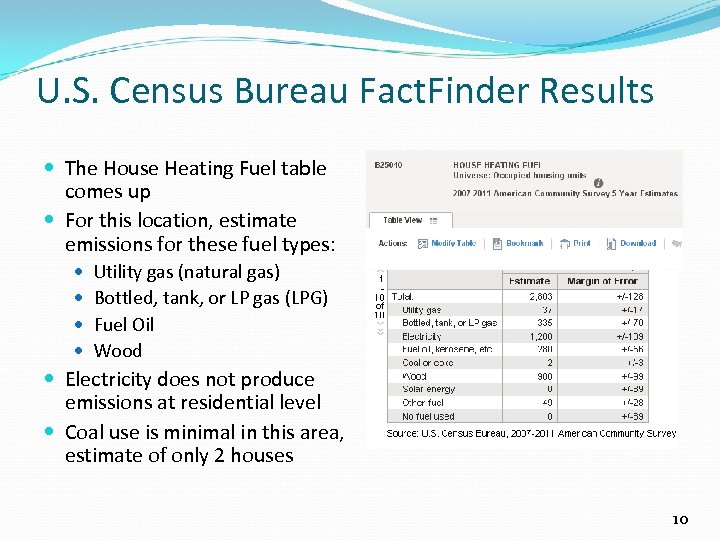 U. S. Census Bureau Fact. Finder Results The House Heating Fuel table comes up For this location, estimate emissions for these fuel types: Utility gas (natural gas) Bottled, tank, or LP gas (LPG) Fuel Oil Wood Electricity does not produce emissions at residential level Coal use is minimal in this area, estimate of only 2 houses 10
 Residential Heating Data Collection-Step 2 2. Look at TEISS calculators to determine what data you need to collect Ø At a minimum, each heating source calculator asks for amount of fuel used reservation wide Remember to check units asked for in calculator Ø Use the Print Blank option Ø If not clear on what to enter into a field, check source documents referenced on opening screen of calculator It is a good idea to read source documents before using calculator 11
 Residential Heating Data Collection-Step 3 3. Determine quantity of each fuel used reservation wide a. Local sources options: Check with tribal housing office or local fuel suppliers Conduct a survey You might survey a few houses and use average response as representative of the reservation per household value b. National source option if local data cannot be obtained: Use 2009 Energy Information Administration (EIA) data: http: //www. eia. gov/consumption/residential/data/2009/index. cfm? view=consumption#fuel-consumption 12
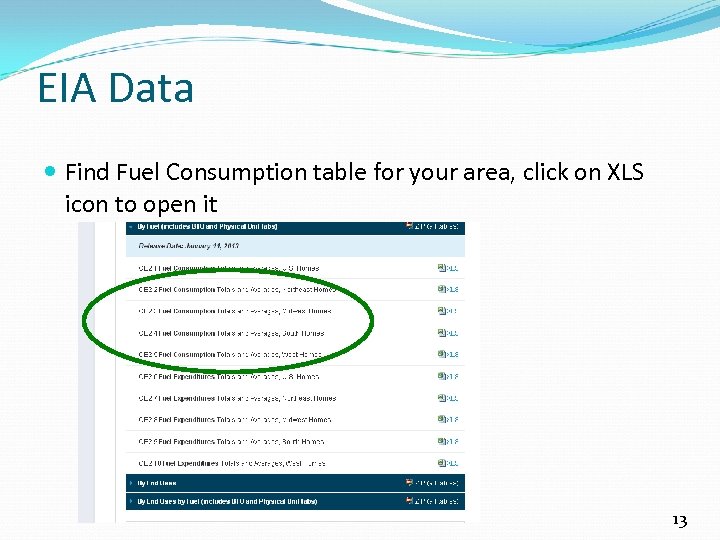 EIA Data Find Fuel Consumption table for your area, click on XLS icon to open it 13
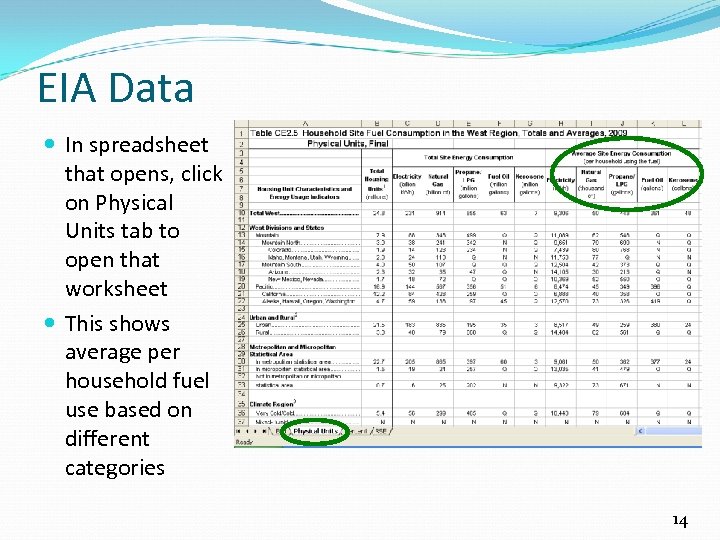 EIA Data In spreadsheet that opens, click on Physical Units tab to open that worksheet This shows average per household fuel use based on different categories 14
 Example: Natural Gas, Mostly Local Data Called local natural gas company and asked several questions Q: In 2011 (inventory year), how much gas was sold to reservation households? A: 900, 000 cubic feet of gas Q: What is the heating value of the gas you sell? A: 980 Q: Can you specify the units of that value? A: BTU/ft 3 Q: What is the sulfur content of the gas you sell? A: I do not know 15
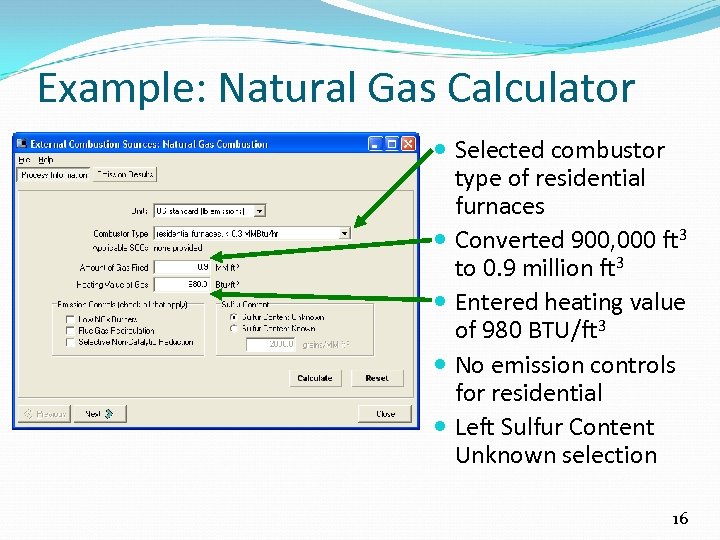 Example: Natural Gas Calculator Selected combustor type of residential furnaces Converted 900, 000 ft 3 to 0. 9 million ft 3 Entered heating value of 980 BTU/ft 3 No emission controls for residential Left Sulfur Content Unknown selection 16
 Example: Woodstoves, Some Local Data Surveyed 100 households on how much wood burned annually per household, received 50 responses Entered responses into spreadsheet to calculate annual average wood consumption per household of 1. 2 cords House Heating Fuel table from U. S. Census reports 900 households on the reservation heat with wood Calculated reservation wide annual wood consumption for residential heating as 1080 cords 900 households x 1. 2 cords/household = 1080 cords 17
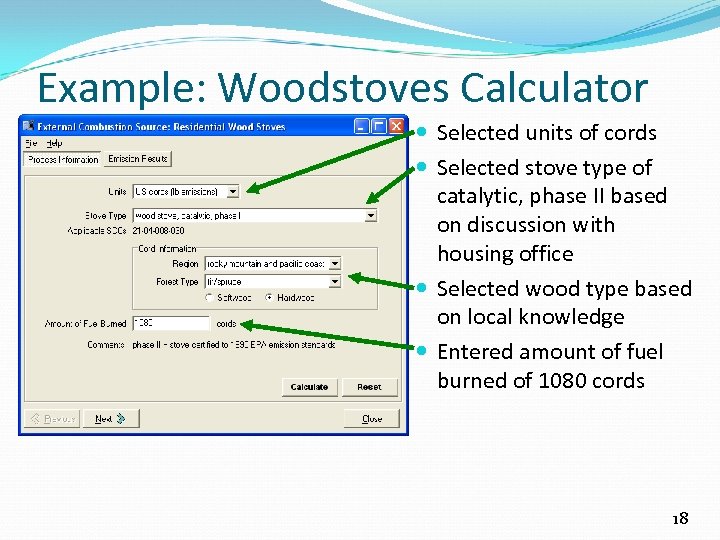 Example: Woodstoves Calculator Selected units of cords Selected stove type of catalytic, phase II based on discussion with housing office Selected wood type based on local knowledge Entered amount of fuel burned of 1080 cords 18
 Example: LPG , No Local Data House Heating Fuel table from U. S. Census reports 335 households on the reservation heat with LPG EIA Data For this example, the reservation is located in Idaho EIA data reports a Q for Idaho LPG household consumption, meaning data withheld Instead use value for Climate Region of Very Cold/Cold of 604 gallons/household Calculated reservation wide annual LPG consumption for residential heating as 202, 340 gallons 335 households x 604 gal/household = 202, 340 gallons 19
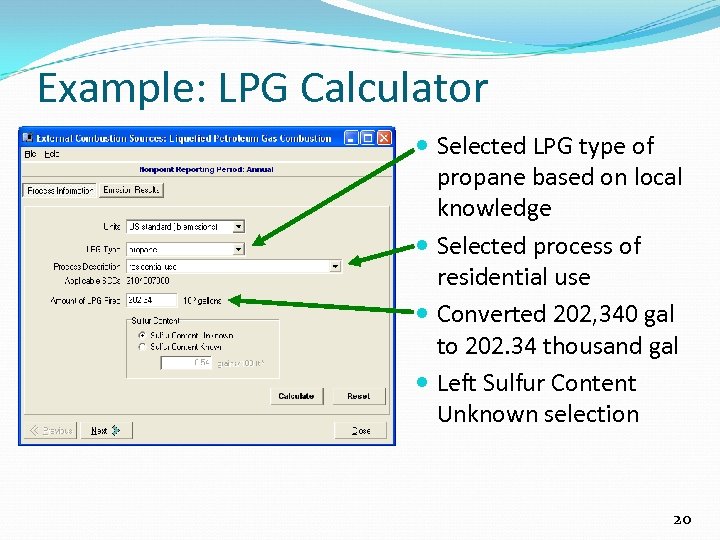 Example: LPG Calculator Selected LPG type of propane based on local knowledge Selected process of residential use Converted 202, 340 gal to 202. 34 thousand gal Left Sulfur Content Unknown selection 20
 Internet Data for Other Sources Remember, local data is usually more accurate Commercial Heating The EIA also has commercial data at http: //www. eia. gov/consumption/commercial/data/2003/i ndex. cfm? view=consumption Includes energy intensity data for some fuel types, for example, Table C 35 shows average gallons/square foot values for fuel oil If you know the square footage of the building, you could estimate the fuel usage 21
 Internet Data for Other Sources (cont. ) Road Dust Vehicle Miles Travelled (VMT) = Average Daily Traffic (ADT) x road length (miles) x 365 days/year Bureau of Indian Affairs (BIA) Indian Reservation Roads (IRR) Inventory has VMT data: https: //itims. bia. gov/reports. shtml For other roads, check state Department of Transportation or Department of Motor Vehicles websites for traffic count data Data for reservation roads might not be available, but might be able to estimate traffic counts based on roads that are near Traffic counts usually reported as average daily counts Estimate total road lengths from maps for VMT calculation 22
 Internet Data for Other Sources (cont. ) Gas Stations The EIA has data on gasoline sales volumes by state at http: //www. eia. gov/dnav/pet_cons_refmg_d_nus_VTC _mgalpd_a. htm Select state of interest in Area field Select Annual-Thousand Gallons per Day in Period-Unit field Select Through Retail Outlets in Sales Type field Calculates thousand gallons of gasoline sold per day, needs to be multiplied by 365 days/year to get annual value Value needs to be scaled down to reservation level based on some allocation, such as the ratio of reservation population to state population. This is a rough estimation method 23
 Homework due in 10 days: In the TEISS project that you started for your reservation during EI Fundamentals, start a new inventory year Enter the year that you plan on collecting data for Start with blank inventory year, do not copy data from 2011 inventory year Collect data for a nonpoint source in your list of sources to include in your EI If you cannot collect local data, estimate data from internet sources Remember, you can always update your data in TEISS if you can collect local data at some point 24
 Homework (continued) Enter the source into the new year of your TEISS project Use the appropriate TEISS calculator to estimate emissions for this source Email a TEISS report showing data entered to instructors Demonstration 25