


 Скачать презентацию Collapse How Societies Choose to Fail or Succeed
a4b880f434a38cc26bc859a83fec82f0.ppt
- Количество слайдов: 9
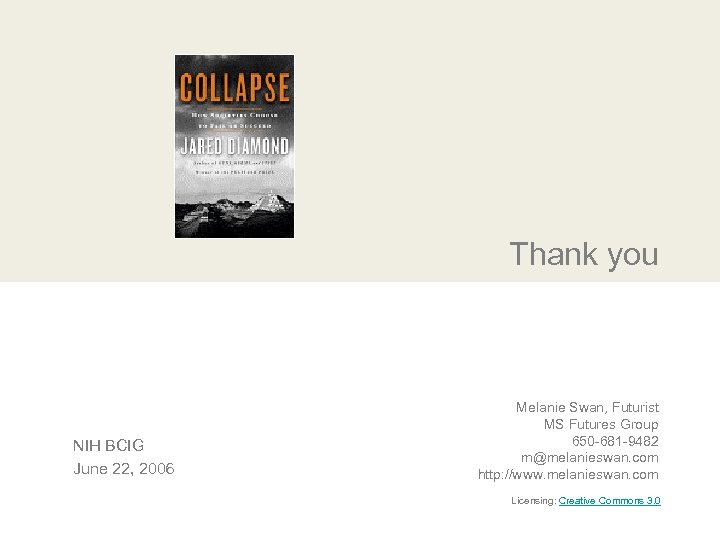
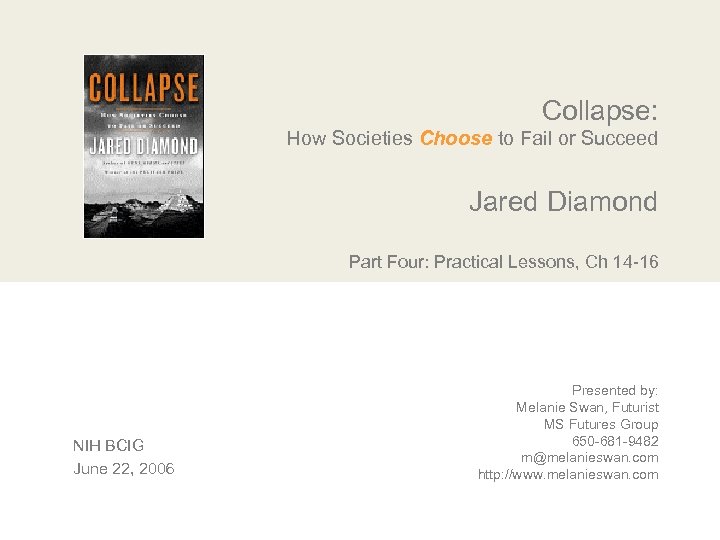 Collapse: How Societies Choose to Fail or Succeed Jared Diamond Part Four: Practical Lessons, Ch 14 -16 NIH BCIG June 22, 2006 Presented by: Melanie Swan, Futurist MS Futures Group 650 -681 -9482 m@melanieswan. com http: //www. melanieswan. com
 Overview Ch 14: Why do some societies make disastrous decisions? § Ch 15: Big businesses and the environment: different conditions, different outcomes § Ch 16: The world as a polder: what does it all mean to us today? § Tipping point choices: societal and individual § What can I as an individual do? § § Summary NIH BCIG June 22, 2006 1
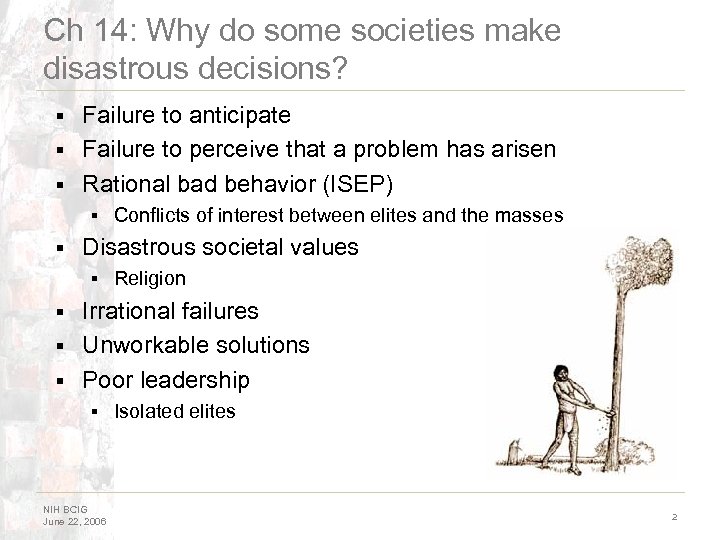 Ch 14: Why do some societies make disastrous decisions? Failure to anticipate § Failure to perceive that a problem has arisen § Rational bad behavior (ISEP) § § § Conflicts of interest between elites and the masses Disastrous societal values § Religion Irrational failures § Unworkable solutions § Poor leadership § § NIH BCIG June 22, 2006 Isolated elites 2
 Ch 15: Big businesses and the environment: different conditions, different outcomes Resource extraction § Non-renewable: depletion and damage from extraction § Oil: Pertamina (Indonesia) vs. Chevron (Papua New Guinea) § Hardrock mining § § Renewable: sustainable harvest strategies are possible Logging and the Forest Stewardship Council § Seafood and the Marine Stewardship Council § § Conclusion § NIH BCIG June 22, 2006 Public is responsible for the behavior of big business (short supply chains help) 3
 Ch 16: The world as a polder: what does it all mean to us today? § The most serious problems § Loss of natural resources § Half world’s forests gone Ceilings on energy, freshwater and photosynthesis § Harmful substances: chemicals, species and gases § Increase in human population § The past and the present are different § Reasons for hope § Problems are human-caused and not intractable § Problem stage is perceptible not crisis-level § Globalization § Increasing public environmental thinking worldwide § NIH BCIG June 22, 2006 4
 Tipping point choices: societal and individual § Long-term planning § § Successful: US air pollutant reduction, Asian tropical diseases and China, Bangladesh family planning Willingness to reconsider core values Unsuccessful: Norse did not rethink European, Christian, pastoral § Successful: Tikopia Islanders expunged pigs, Britain and France as former world powers, Japan abandoned military tradition, Russia abandoned communism § Can the US forsake isolationism and consumerism? § NIH BCIG June 22, 2006 5
 What can I as an individual do? § Politically Vote § Communicate thoughts to legislative leaders once a month § § Economically § Buy or don’t buy as a consumer § Example: demand for FSC-certified wood products exceeds supply Be an activist (embarrassment more powerful than force) § Vacation in environmentally-principled locales § § Socially § § Dialogue these issues in your social circles Philanthropically § NIH BCIG June 22, 2006 Support environmental causes (FSC, WWF, Zero Population Growth, Trout Unlimited, etc. ) 6
 Summary § Societies have made and still make poor decisions regarding environmental resources for many reasons § Big business is the lever for extracting environmental resources and must be governed by the public § Humanity rapidly advancing on a non-sustainable course § § Resource consumption dramatically exceeds replacement and full demand is understated As societies and individuals, we must engage in longterm planning and (painfully) rethinking of core values NIH BCIG June 22, 2006 7
 Thank you NIH BCIG June 22, 2006 Melanie Swan, Futurist MS Futures Group 650 -681 -9482 m@melanieswan. com http: //www. melanieswan. com Licensing: Creative Commons 3. 0