 Скачать презентацию Collaborative Poetry Workshop k b LÏha LjÑn m Kolkata Jan
207a1411fa1a0089585d9555cf62117d.ppt
- Количество слайдов: 30



Collaborative Poetry Workshop ®k±b. LÏha¡ LjÑn¡m¡ Kolkata, Jan 3, 2009 Pat Clifford, Aryanil Mukherjee & future contributors
LÒf (Coll-Po)? e¡ÏL LÒfe¡ ? What is Coll-Po ? What is collaborative poetry ? L¡®L hmÏR "®k±b. LÏha¡' ? How old or new is it ? La ea¤e ? La f¤l®e¡ ? How much collaborative poetry exists ? La. V¡ ®k±b. LÏha¡l Lb¡ Bjl¡ S¡Ïe ? The need for collaborative poetry ®L¡e fË®u¡Se ®b®L ®k±b. LÏha¡ ? Is collaborative poetry “co-operative poetry” ? "®k±b. LÏha¡' ÏL "pjh¡u£ LÏha¡' ?
Japanese Coll-Po : : RENGA / ®l ¡ S¡f¡®el ®q. Cu¡e l¡S®aÄ (794 1185) fËbj "®l ¡' ®m. M¡ quz HL¡Ïd. L LÏhl ®m. M¡ Ïn. Lm Rœ (p¡d¡lea 36 R®œ ®no) ®k. M¡®e fË®aÉL LÏh c¤ Rœ Ïm. M®aez HC Rœ®L S¡f¡e£ i¡o¡u "L¤' h®mz q¡CL¤ MÉ¡a ®p¡ÏS J h¡®n¡ "®l ¡' Ïm®M®Rez ®l ¡ fËLªÏadj£Ñ LÏha¡z "L¡®pe' HL dl®Zl SeÏfËu ®l ¡ ®k. M¡®e Ïeuj¡e¤haÑ®e fËÏa c¤ R®œ ÏWL c¤ h¡l ®L¡e g¤®ml fËp J ÏWL Ïaeh¡l Qy¡®cl fËp B®pz B®S¡ S¡f¡®e ®l ¡ ®m. M¡ quz fÏÕQ®j. Jz Renga comes from Japan and is the earliest form of collaborative poetry known to us. It probably originated in the Heian period (794 -1185). Famous haikuists Soji and Basho wrote Renga’s. A Renga is written in two stanzas (ku) usually upto a chain of 36 stanzas by several poets. Kasen is a popular form – nature poems where in each section a flower gets mentioned exactly twice and the moon thrice. Renga’s are still written in Japan today and also in the West. The largest collection of English-language renga is Werner
waka / Ju¡L¡-l S¾j ®l ¡l k¤®NCz S¡f¡Ïe LÏh®cl ®m. M¡ ÏQ®e LÏha¡ "L¡eÚÏn' l ®b®L S¡f¡Ïel¡ Ïe®S®cl ®k±b. LÏha¡®L Bm¡c¡ Ll®a HC e¡j. Ll. Z L®lz Q¡l l. L®jl Ju¡L¡l Lb¡ ®n¡e¡ k¡u a¡ˆ¡ (®R¡V LÏha¡), ®Q¡L¡ (c£OÑ LÏha¡), ®p®c¡L¡ (j¡b¡ ®O¡l¡®e¡ LÏha¡) J L¡a¡Ea¡ (V¤L®l¡ LÏha¡)z Ju¡L¡ LÏha¡u R¾cq£e, fwÏš²q£ez h¡LÉhå ÏeiÑlz Ïhn na®Ll HLSe E®õM®k¡NÉ S¡f¡Ïe LÏh j¡p¡JL¡ ÏnÏL a¡ˆ¡ Ïe®u A®e. L L¡S L®l®Rez Waka developed in the Renga era. It was used to identify Japanese coll-po from the Chinese kanshi some Japanese poets wrote. Usually of 4 types – tanka (short poem), choka (long poem), sedoka (headspinning poem) and katauta (fragment poem). Waka poems have no rhyme/rhythm/lines. It is phrase-based. In the 20 th century, Japanese poet Masaoka Shiki worked on the tanka extensively.
The First Western Renga 4 Western poets met in Paris in the spring of 1969 with a goal to write the “First Western Renga”. Edoardo Sanguineti (Italy), Octavio Paz (Mexico), Charles Tomlinson (British) and Jacques Rouboud (France)
French Coll-Po : : Ralentir Travaux (Slow Under Construction) Over a period of 5 days in 1930 several collaborative poems were written by André Breton, Paul Éluard and René Char. These are great examples of pure surrealist poetry. These poems were translated in the 1990 s into English by Keith Waldrop (Slow Under Construction)
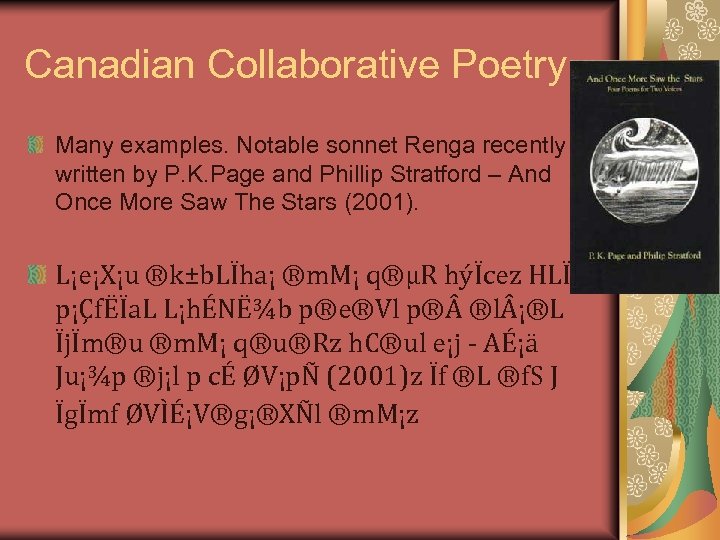
Canadian Collaborative Poetry Many examples. Notable sonnet Renga recently written by P. K. Page and Phillip Stratford – And Once More Saw The Stars (2001). L¡e¡X¡u ®k±b. LÏha¡ ®m. M¡ q®µR hýÏcez HLÏV p¡ÇfËÏa. L L¡hÉN˾b p®e®Vl p® ®l ¡®L ÏjÏm®u ®m. M¡ q®u®Rz h. C®ul e¡j AÉ¡ä Ju¡¾p ®j¡l p cÉ ØV¡pÑ (2001)z Ïf ®L ®f. S J ÏgÏmf ØVÌÉ¡V®g¡®XÑl ®m. M¡z
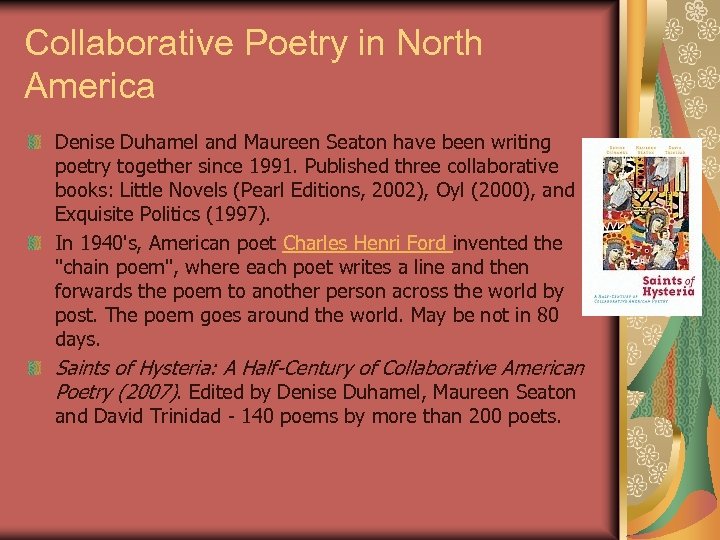
Collaborative Poetry in North America Denise Duhamel and Maureen Seaton have been writing poetry together since 1991. Published three collaborative books: Little Novels (Pearl Editions, 2002), Oyl (2000), and Exquisite Politics (1997). In 1940's, American poet Charles Henri Ford invented the "chain poem", where each poet writes a line and then forwards the poem to another person across the world by post. The poem goes around the world. May be not in 80 days. Saints of Hysteria: A Half-Century of Collaborative American Poetry (2007). Edited by Denise Duhamel, Maureen Seaton and David Trinidad - 140 poems by more than 200 poets.
Ten Commandments for a successful collaborative experience Denise Duhamel/ Maureen Seaton Thou shalt trust thy collaborator's art with thy whole heart. Thou shalt trust thy collaborator's judgment with thy whole mind. Thou shalt trust thy collaborator's integrity with thy whole spirit. Honor thy own voice. Honor thy collaborator's spouse. Thou shalt not be an egotistical asshole. Thou shalt not covet all the glory. Thou shalt love the same foods as your collaborator. Thou shalt eat and tire at the same time. Above all, honor the muse.
Collaborative Projects from the past Kenneth Koch and Allen Ginsberg read collaborative poetry at the Poetry Project at St. Mark's Church (NYC) in the 1960 s. Two New York school poets John Ashbery and James Schuyler wrote a comic fiction – A Nest of Ninnies (1969)
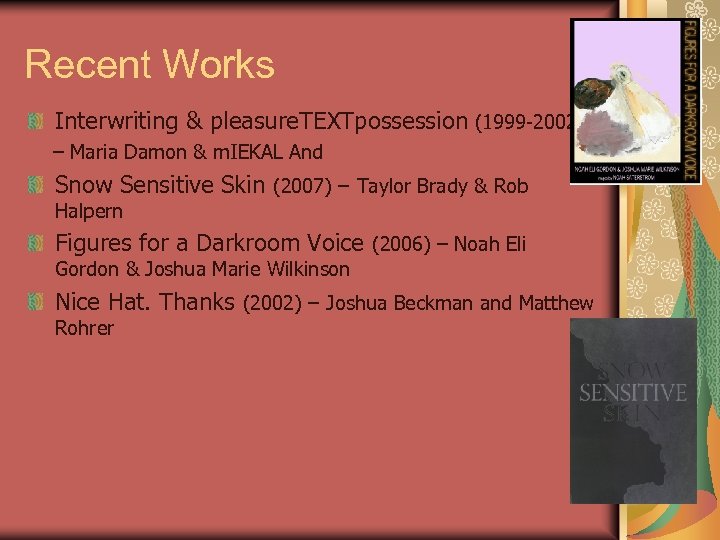
Recent Works Interwriting & pleasure. TEXTpossession (1999 -2002) – Maria Damon & m. IEKAL And Snow Sensitive Skin (2007) – Taylor Brady & Rob Halpern Figures for a Darkroom Voice (2006) – Noah Eli Gordon & Joshua Marie Wilkinson Nice Hat. Thanks (2002) – Joshua Beckman and Matthew Rohrer
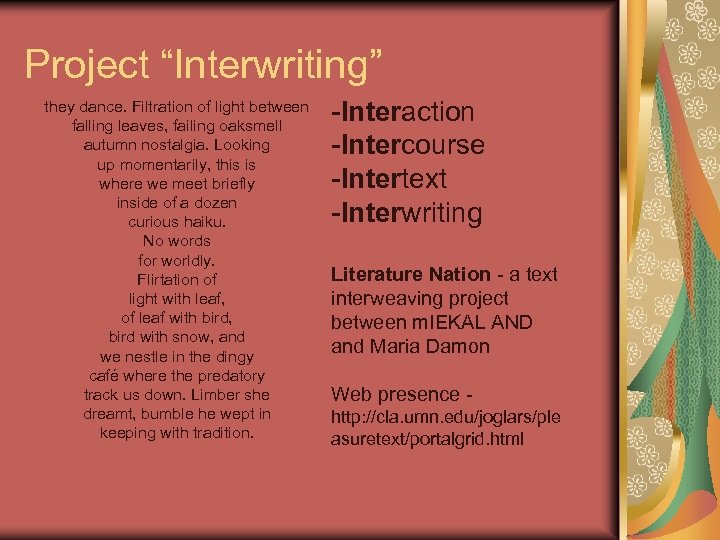
Project “Interwriting” they dance. Filtration of light between falling leaves, failing oaksmell autumn nostalgia. Looking up momentarily, this is where we meet briefly inside of a dozen curious haiku. No words for worldly. Flirtation of light with leaf, of leaf with bird, bird with snow, and we nestle in the dingy café where the predatory track us down. Limber she dreamt, bumble he wept in keeping with tradition. -Interaction -Intercourse -Intertext -Interwriting Literature Nation - a text interweaving project between m. IEKAL AND and Maria Damon Web presence http: //cla. umn. edu/joglars/ple asuretext/portalgrid. html
Language Poetry Historic, social, experimental and critical An avant garde 70’s and 80’s. (It’s over. ) Bruce Andrews, Barrett Watten, Carla Harryman, Ron Silliman, Lyn Hejinian, Rae Armantrout, Charles Bernstein and more San Francisco and New York based
Language Multi-Authorship Political Action: “Revolutionary moment calls for multi-authored discourse” Focus attention on the Subject Legend – Bernstein, Mc. Caffery, Andrews, Silliman, Di. Palma The Wide Road – Harryman and Hejinian The Grand Piano – Collective Autobiography
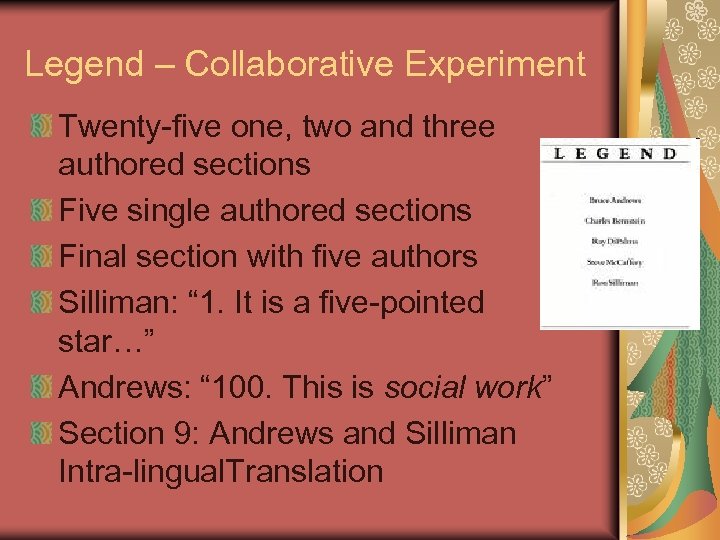
Legend – Collaborative Experiment Twenty-five one, two and three authored sections Five single authored sections Final section with five authors Silliman: “ 1. It is a five-pointed star…” Andrews: “ 100. This is social work” Section 9: Andrews and Silliman Intra-lingual. Translation
ASDA Poetry Factory “ASDA” is an Arabic word. It means “echoes”. fËÏadÄÏez This is a poetry magazine from contemporary Iraq where they publish a collaborative poetry forum. ®p. C ®g¡l¡®jl e¡j LÏha¡ L¡l. M¡e¡z BlÏh i¡o¡l L¡NSz ÏWL ÏLi¡®h HM¡®e ®k±b. LÏha¡ ®m. M¡ q®u®R Bj¡®cl AS¡e¡z Cl¡Lk¤®Ül g®m L¡NSÏV HMe AÏeuÏjaz
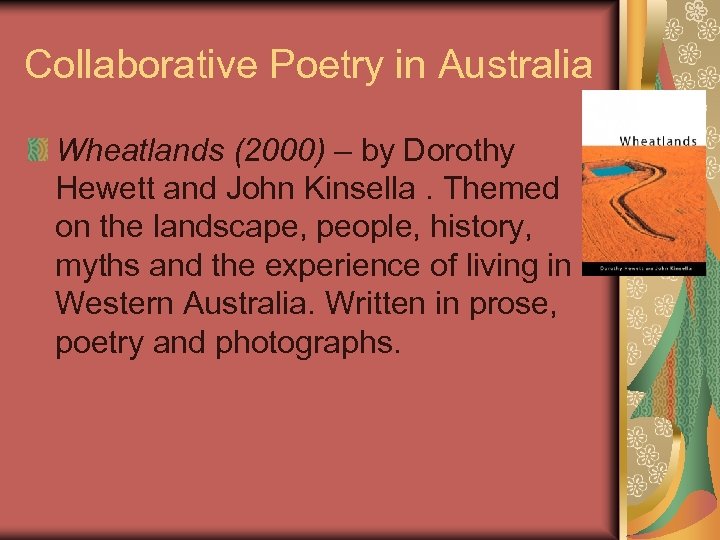
Collaborative Poetry in Australia Wheatlands (2000) – by Dorothy Hewett and John Kinsella. Themed on the landscape, people, history, myths and the experience of living in Western Australia. Written in prose, poetry and photographs.
A Strange Collaboration farout_library_software – A book of collaborative poems by Maged Zaher and Pam Brown. Maged sent Pam a submission to Jacket Magazine, of which Pam is associate editor. But Maged forgot to enclose the poem. In an effort to atone, Maged proposed a collaboration between them; this collaboration was to last for a year and a half and comprise the poems published in this chapbook. The collaboration is seamless; even Pam attests she could no longer tell whose writing was whose as she proof-read. Among the poems' subjects: change, constant change of jobs, friends, cities, and of course the software with which we mark time's passing. Source : Tin. Fish Press
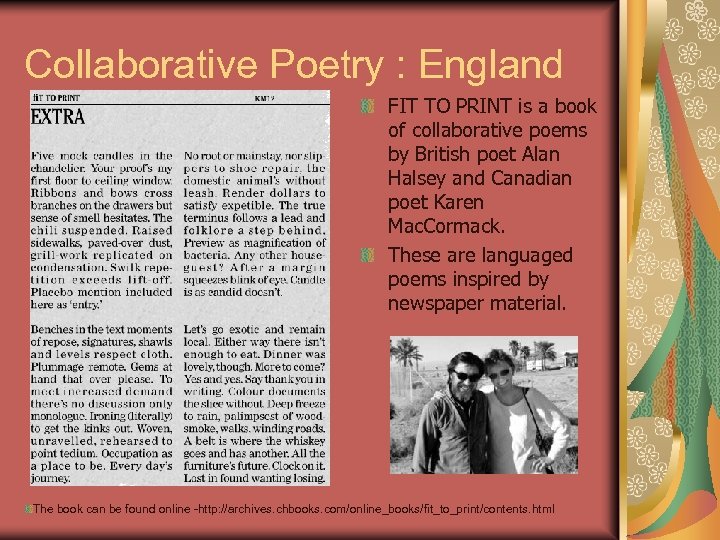
Collaborative Poetry : England FIT TO PRINT is a book of collaborative poems by British poet Alan Halsey and Canadian poet Karen Mac. Cormack. These are languaged poems inspired by newspaper material. The book can be found online -http: //archives. chbooks. com/online_books/fit_to_print/contents. html
h¡wm¡l pjh¡u£ LÏha¡ Co-operative Poetry in India (Bengali) S¡e¤u¡¢ll i¡he¡ Thoughts of January (1995) – by Samir Roychowdhury & Santanu Bandyopadhyay based on the mystery of number 14 and other thoughts triggered by any word j¡c m M¡ L¢ha¡ Poems written in Madol (24 -25 July m -2004) – A Kabitapakshik Writer’s workshop – Based on interactions during two days stay together. contributors: Prabhat Chowdhury Naser Hossain Amitava Maitra Shubhasis Gangopadhyay Gouranga Mitra Rudra Kingshuk Rimi De Pinaki Samanta Pradip Chakraborty Satyasadhan Chael Indrani Duttapanna Snehasis Mukhopadhyay Swarup Chakraborty Timirkanti Barun Sarkar Anupam Mukhopadhyay Soumitra Roy contributed by : Santanu Bandopadhyay
h¡wm¡l pjh¡u£ LÏha¡ Co-operative Poetry in India (Bengali) pjh¡u£ L¢ha¡ Co-operative Poetry Collection (2004) by Rudra Kingshuk & Kamalika Mitra pjh¡u£ L¢ha¡ Co-operative Poetry (2005) by Rudra Kingshuk & Shubhasis Gangopadhyay L¢ha¡ f¡¢r. L – Kabita Pakshik Journal (2004 -2005) – paired poems contributed by : Santanu Bandopadhyay
h¡wm¡l pjh¡u£ LÏha¡ Co-operative Poetry in India (Bengali) h¡wm¡ i¡o¡u L¢ha¡l L¡S fËL «a A bÑ j‰m. L¡ hÉCzdjÑj‰m, jep¡j‰m, Qä£j‰m fËi «¢al. Qe¡…¢mz k¢c. J Hl A e. L¡w n fc. LaÑ¡ cle¡j f¡Ju¡ k¡u ah¤ N¡V¡ L¡ hÉlhý Awn. C ¢h¢iæ L¢hl ¢j¢mai¡ hl. Qe¡ z HC d¡l¡ ¢LR¥ Awn QkÑ¡fc H M¡ m. J c N j‰m. L¡hÉ…¢ml j a a¡ Ha Ja fË¡aeuz ¡ The “Mangal Kabya” [Blissful Poetry] represents a complete collection of a genre of narrative early Bengali poetry that reflected social changes and emerging ethical frameworks in pre-colonial Bengal. Many parts of these poems that are part of a larger series are written collaboratively. Traces of collaborative writing can be found in even earlier texts, like the Charyapadas [earliest available samples of Bengali lyrical poetry (Buddhist), 1100 AD].
h¡wm¡l pjh¡u£ LÏha¡ Co-operative Poetry in India (Bengali) pjh¡u£ L¢ha¡ l. Qe¡ fËp ‰Aø¡cn Ee¢hwn na¡ë£l h¡wm¡ L¢hu¡m cl. Lb¡J E õMLl¡ k a f¡ lz j¤MÉ N¡u. L HLSe q m. J L¢hu¡m clc m. HL¡¢d. L , fc. LaÑ¡ b¡L aek¡l¡ ±bi¡ hj¤MÉ N¡ u el k SeÉ L¢h. N¡e l. Qe¡ Ll aez Musical/Poetic Duels (kabir larhaai) were popular in Bengal in the 19 th century. These poet/singers had bands and were patronized by Bengali aristrocrats. The shows were held in public. These bands contained multiple lyricists who would compose collaboratively in both impromptu and pre-meditative modes. 50 60 Hl cn L ±b L¢ha¡NË¿Û fËL¡¢na q u R k a h p…¢mlpjh¡u£ üi¡h aa. V¡ fËLV euz Ec¡ql. Z ül©f pçcn AnÄ¡ l¡q 70 cn Ll 17 Se L¢hl HLœ £ k¡fefÜ¢al L¢ha¡z Some loosely collaborative collections of Bengali poetry came out in the 1950 -60 s. One important exception was Saptadash Ashbaarohee (17 Equestrians) – A collection of “lifestyle poems” by 17 young poets of Bengal.
Multilingual/Multicultural Collaborative Poetry hýi¡Ïo. L/hýp¡w×LªÏa. L ®k±b LÏha¡ Airborn – Octavio Paz & Charles Tomlinson (Spanish/English) George Oppen – Buddhadeb Bose translative collaboration (Bengali/English) Recent collaborations between two poetry magazines from Brazil and Vietnam led to a common collaborative poetry issue in Portugese and Vietnamese.
George Oppen, Buddhadeva Bose and Transcreation SSÑ A®fe, h¤Ü®ch hp¤ J Ae¤pªSe Buddhadeb Bose Well known, editor of Kabita (1935 -61) Poetry is “conceived in the soul” George Oppen Objectivist Poet, Pulitzer Prize (1969) Poetry “confident in itself and in its materials” Similarities Politics were inescapable Distrustful of a “furious and bitter bohemia”
George Oppen, Buddhadeva Bose and Transcreation SSÑ A®fe, h¤Ü®ch hp¤ J Ae¤pªSe New York - 1961 Bose teaching at Brooklyn College Oppen returned from exile in Mexico, has not published since blacklist Translation Exercise Bose: Sceptical of translation, help with To Memory and Still Life Oppen: Transcreations appear in Oppen’s first book, The Materials
George Oppen, Buddhadeva Bose and Transcreation SSÑ A®fe, h¤Ü®ch hp¤ J Ae¤pªSe Oppen’s Methods Heavy emphasis on source texts: cutting layering and quotation Michael Davidson: “Palim-texts” – work always in process “Daybooks” – constructed Ethical concerns, interpersonal tone
Airborn / Hijos del Airo In 1979 the Mexican poet Octavio Paz and his English fellow poet and translator Charles Tomlinson wrote a series of bilingual sonnets -'Airborn' As Charles Tomlinson writes, 'These collaborative poems were the result of a meeting, early one summer in Gloucestershire, when, out of the many words we had thought and spoken, we chose "house" and "day" as the words for a future postal meditation in sonnet form. '
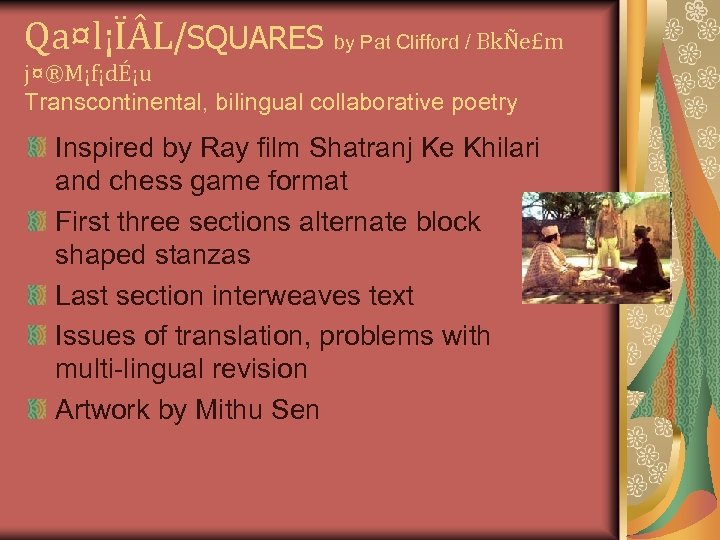
Qa¤l¡Ï L/SQUARES by Pat Clifford / BkÑe£m j¤®M¡f¡dÉ¡u Transcontinental, bilingual collaborative poetry Inspired by Ray film Shatranj Ke Khilari and chess game format First three sections alternate block shaped stanzas Last section interweaves text Issues of translation, problems with multi-lingual revision Artwork by Mithu Sen
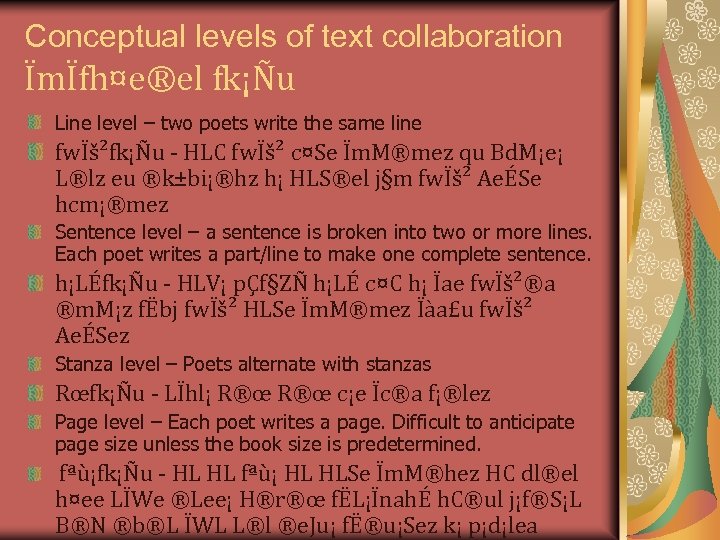
Conceptual levels of text collaboration ÏmÏfh¤e®el fk¡Ñu Line level – two poets write the same line fwÏš²fk¡Ñu HLC fwÏš² c¤Se Ïm. M®mez qu Bd. M¡e¡ L®lz eu ®k±bi¡®hz h¡ HLS®el j§m fwÏš² AeÉSe hcm¡®mez Sentence level – a sentence is broken into two or more lines. Each poet writes a part/line to make one complete sentence. h¡LÉfk¡Ñu HLV¡ pÇf§ZÑ h¡LÉ c¤C h¡ Ïae fwÏš²®a ®m. M¡z fËbj fwÏš² HLSe Ïm. M®mez Ïàa£u fwÏš² AeÉSez Stanza level – Poets alternate with stanzas Rœfk¡Ñu LÏhl¡ R®œ c¡e Ïc®a f¡®lez Page level – Each poet writes a page. Difficult to anticipate page size unless the book size is predetermined. fªù¡fk¡Ñu HL HL fªù¡ HL HLSe Ïm. M®hez HC dl®el h¤ee LÏWe ®Lee¡ H®r®œ fËL¡ÏnahÉ h. C®ul j¡f®S¡L B®N ®b®L ÏWL L®l ®e. Ju¡ fË®u¡Sez k¡ p¡d¡lea
Скачать презентацию Collaborative Poetry Workshop k b LÏha LjÑn m Kolkata Jan
207a1411fa1a0089585d9555cf62117d.ppt