 Скачать презентацию COLLABORATIVE LINKS BETWEEN ACADEMIC RESEARCH INSTITUTIONS AND
4cce9209a9c3708a54119f3ed8c2c472.ppt
- Количество слайдов: 40



COLLABORATIVE LINKS BETWEEN ACADEMIC & RESEARCH INSTITUTIONS AND INDUSTRY FOR STIMULATING TECHNOLOGICAL INNOVATION AND ECONOMIC DEVELOPMENT: NEED FOR SCIENCE & TECHNOLOGY POLICY INITIATIVES AND NETWORKING AMONGST NAM AND OTHER DEVELOPING COUNTRIES By: M. Bandyopadhyay, NAM S&T Centre 1
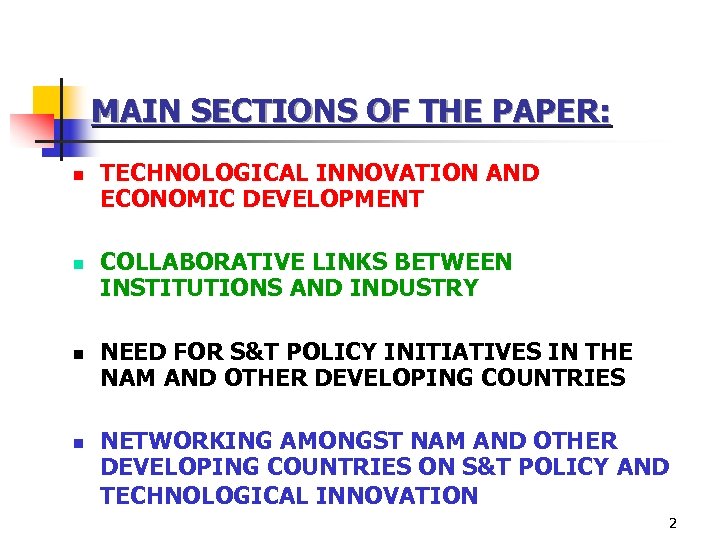
MAIN SECTIONS OF THE PAPER: n n TECHNOLOGICAL INNOVATION AND ECONOMIC DEVELOPMENT COLLABORATIVE LINKS BETWEEN INSTITUTIONS AND INDUSTRY NEED FOR S&T POLICY INITIATIVES IN THE NAM AND OTHER DEVELOPING COUNTRIES NETWORKING AMONGST NAM AND OTHER DEVELOPING COUNTRIES ON S&T POLICY AND TECHNOLOGICAL INNOVATION 2
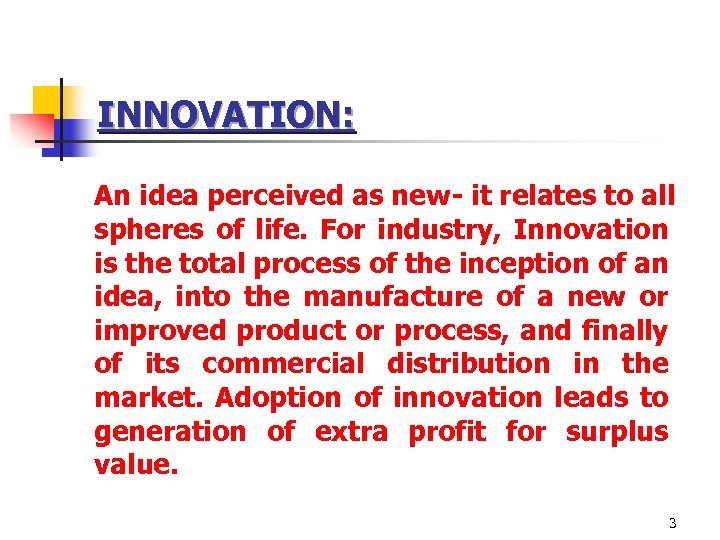
INNOVATION: An idea perceived as new- it relates to all spheres of life. For industry, Innovation is the total process of the inception of an idea, into the manufacture of a new or improved product or process, and finally of its commercial distribution in the market. Adoption of innovation leads to generation of extra profit for surplus value. 3
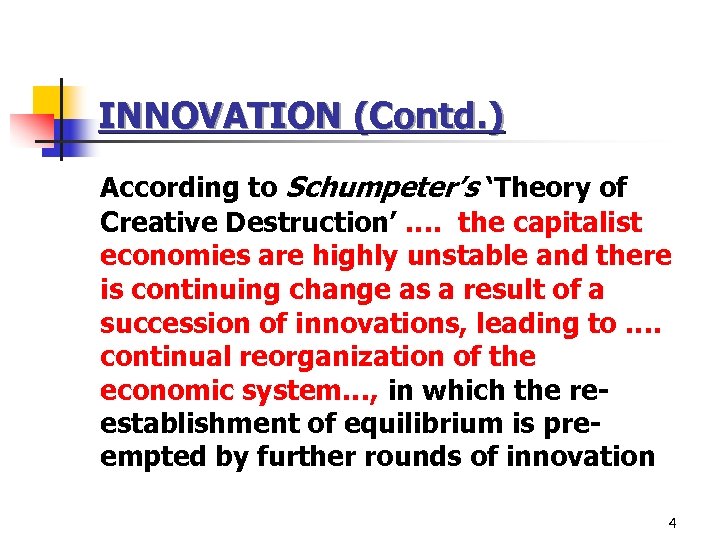
INNOVATION (Contd. ) According to Schumpeter’s ‘Theory of Creative Destruction’ …. the capitalist economies are highly unstable and there is continuing change as a result of a succession of innovations, leading to …. continual reorganization of the economic system…, in which the reestablishment of equilibrium is preempted by further rounds of innovation 4
INVENTION AND INNOVATION: 5
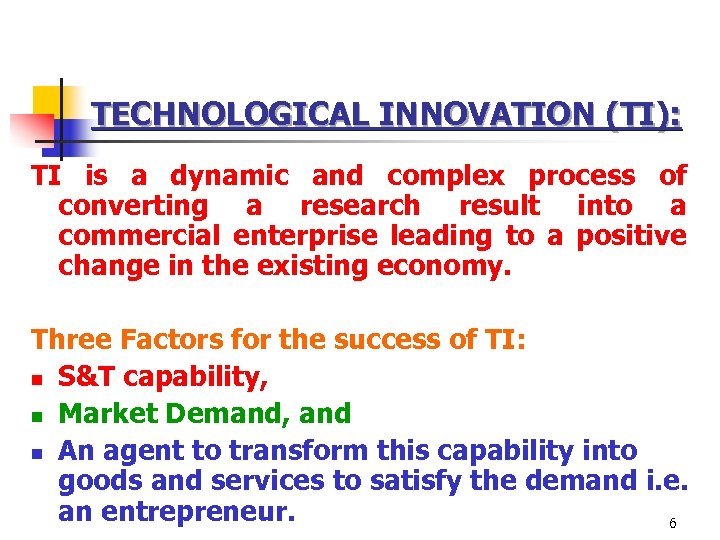
TECHNOLOGICAL INNOVATION (TI): TI is a dynamic and complex process of converting a research result into a commercial enterprise leading to a positive change in the existing economy. Three Factors for the success of TI: n S&T capability, n Market Demand, and n An agent to transform this capability into goods and services to satisfy the demand i. e. an entrepreneur. 6
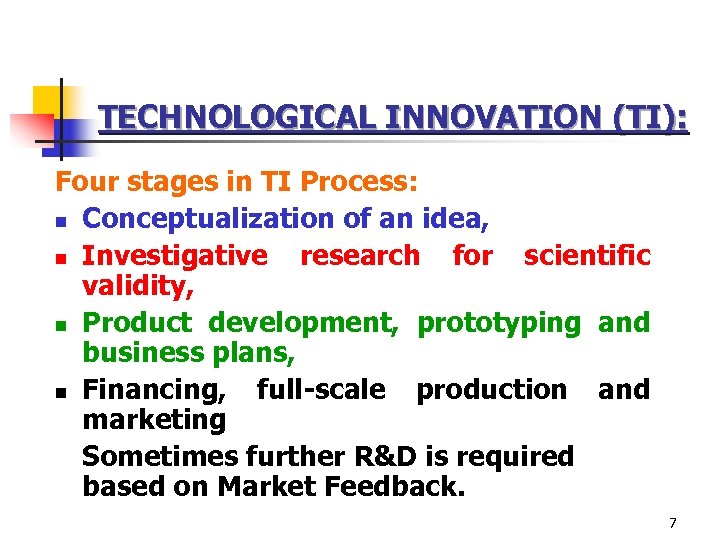
TECHNOLOGICAL INNOVATION (TI): Four stages in TI Process: n Conceptualization of an idea, n Investigative research for scientific validity, n Product development, prototyping and business plans, n Financing, full-scale production and marketing Sometimes further R&D is required based on Market Feedback. 7
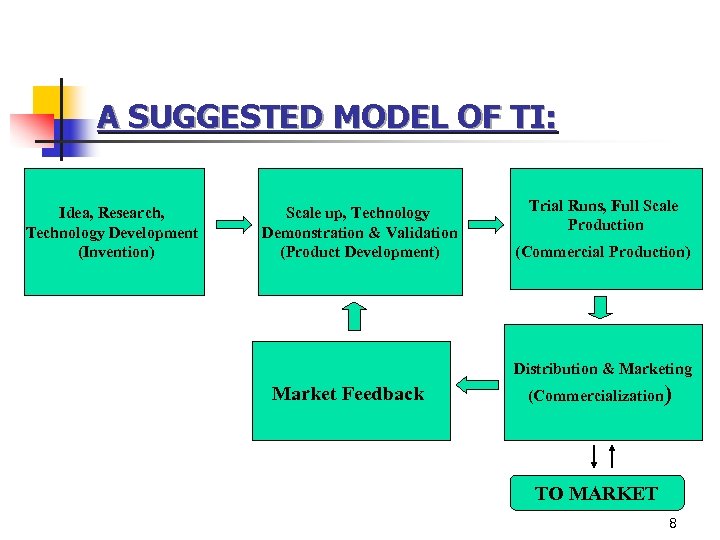
A SUGGESTED MODEL OF TI: Idea, Research, Technology Development (Invention) Scale up, Technology Demonstration & Validation (Product Development) Trial Runs, Full Scale Production (Commercial Production) Distribution & Marketing Market Feedback (Commercialization) TO MARKET 8
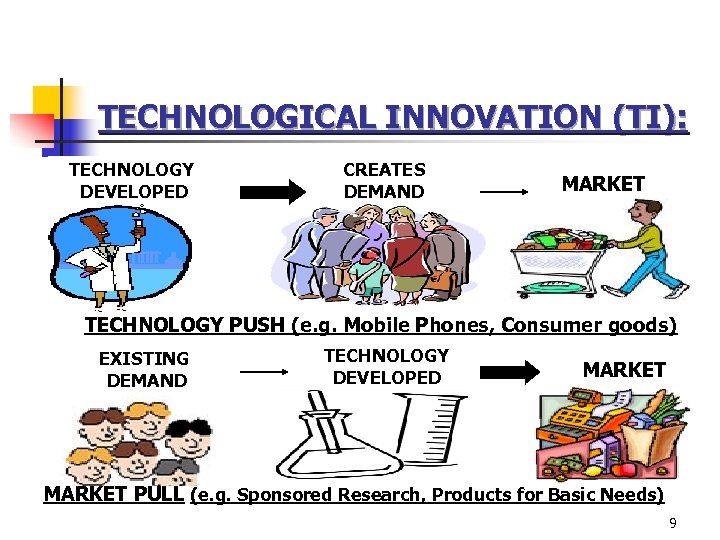
TECHNOLOGICAL INNOVATION (TI): TECHNOLOGY DEVELOPED CREATES DEMAND MARKET TECHNOLOGY PUSH (e. g. Mobile Phones, Consumer goods) EXISTING DEMAND TECHNOLOGY DEVELOPED MARKET PULL (e. g. Sponsored Research, Products for Basic Needs) 9
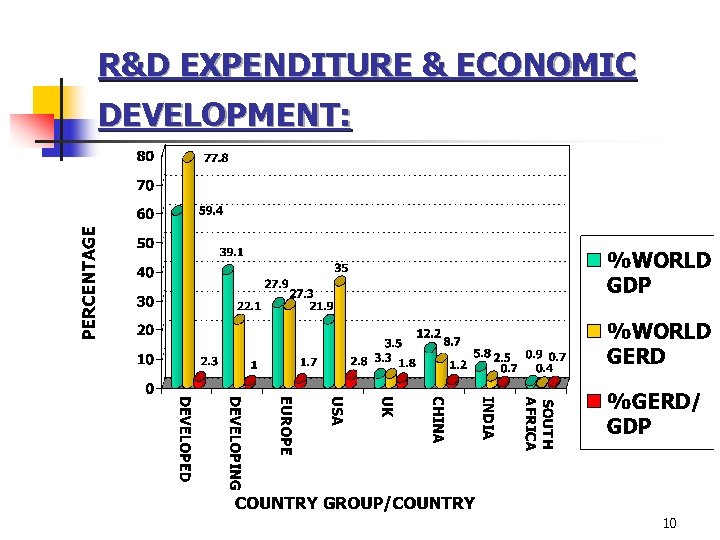
R&D EXPENDITURE & ECONOMIC DEVELOPMENT: 10
INSTITUTION-INDUSTRY LINKS: Due to positive impact of technological development on economic progress, it is imperative for S&T institutions to establish collaborative links with industry to facilitate Technological Innovation and Economic development. 11
INSTITUTION-INDUSTRY LINKS (Contd. ) “Triple Helix” theory suggests: n n An institutional set up of university, industry and government. Institutions should form direct links with industry to maximize capitalization of knowledge. 12
WHAT IS AN INSTITUTION-INDUSTRY LINK ? n n A kind of public-private partnership, A bridge between academics and business, Supports collaborative activities between an institution and industry, May be as a cooperative agreement, grant or procurement arrangements, professional or student internship & exchange, technology business incubator or S&T park. 13
CONSTRAINTS IN LINKAGE: n n Common perception: Universities -‘ivory towers of knowledge’. Public Research Laboratories - ‘black holes of public funding’. Institution and Industry Lack Mutual Trust. Institutions-Fear threats to academic freedom, Lack of financial resources. Industry Doubt ability of academics in problem-solving. 14
MOTIVATIONS OF INDUSTRY: n n n n Saving of Cost. Inadequate in-house R&D. Development of Standards Access to new areas of expertise. Strategic benefits & opportunities. Participation in public programmes. Access to public sector markets. Contd…. 15
MOTIVATIONS OF INDUSTRY (Contd. ) : n n n Internal problems. Carrying out trials. Access to equipment Testing and Calibration. Student projects. Use of facilities. 16
MOTIVATIONS OF INSTITUTIONS: n n n Commercial exploitation of Research outputs. Additional income for the Institution. Improving the image of institution before society. Improving employment opportunity for outgoing graduates. Financial incentives to researchers/ inventors. Promoting knowledge based entrepreneurship and spin-off firms. 17
TYPES OF INSTITUTION-INDUSTRY LINKS: n n General Support Link: Non-research sponsorship, Links with business clubs, Industry membership in Research Centres. Education & Training Links: Course development for industry, Student sponsorship, Faculty endowment. R&D Links: Sponsored Research, Joint Research. Commercialization of Institution Infrastructure: Consultancy, Conference facilities, Patenting & licensing of research ideas, Creation of spin-off companies. 18
CLASSIFICATION OF LINK MECHANISMS: I. n n n Institution-based link mechanisms-Linkages as extensions of institutions: e. g. Industrial Liaison Office (ILO). Technology Transfer Office (TTO). Research Contract. Consulting Agreement. Affiliate Programme. Research Consortia. Industry Cooperative. Technology Brokerage Company. Teaching Company Scheme. Exchange of Personnel. University based Institutes. Etc. 19
CLASSIFICATION OF LINK MECHANISMS (Contd. ): II. n n n Linkages through Creation of Additional Organizational Infrastructure, e. g. Cooperative Research Centre of Excellence. Advanced Technology Centre. Incubation Centre. Technology Incubator/ Business Incubator. Etc. 20
CLASSIFICATION OF LINK MECHANISMS (Contd. ): III. Property based initiatives in/around institutions with investment by institutions, industry, government, Venture Capital Funding agency, either solely or jointly e. g. § Science Park (e. g. Cambridge, Warwick, Aston in UK) § Innovation Centre (e. g. BIG, Germany) n Technology Park (e. g. Adelaide, Australia) n Research Park (e. g. Heriot-Watt, UK) n Industrial Park (e. g. Silicon Valley, Route 128, USA) n High Technology Developments n Technopoles (e. g. Sophia Antipolis, France) n University Company, etc. 21
S&T Policies in NAM & other Developing Countries: Problems and Constraints : n n Policies mainly focused on Research in Basic Sciences. While formulating S&T Policy, real tech. requirements of Productive sector & economic conditions not taken into account. Inadequate and under-trained Human Resources to design own S&T Policies. Lack experience of S&T Policy formulation and implementation. 22
Need for S&T Policy Orientation in NAM & other Developing Countries: Should have a strategically designed S&T Policy commensurate with challenges of globalized society. n Institutions should establish strategic collaboration with industry for stimulating TI & accelerating economic development. § Diff. approaches for diff. instns based on size & facilities and for different countries based on level of S&T capabilities and infrastructure. n Clear perspective planning, discipline, motivation, commitment, energy & resources & right kind of people supported through a set of policy initiatives. n 23
Suggested S&T Policy Initiatives in NAM & Other Developing Countries: A. Increase in Investment on S&T: n n Adequate allocation of funds for S&T Capacity building, R&D and HRD; Funding for organizational infrastructure for Linkages; Support for technology transfer activities of the institutions; Venture Capital funding with liberal lending terms. 24
Suggested S&T Policy Initiatives (Contd. ): B. Motivating the Industry: n Encourage Private sector investment in instns on R&D and tech transfer by appr. policy measures. Financial subsidy on expenditure for participation in government R&D projects & in-house development work. Tax rebates and incentives to sponsor R&D projects in instns, for in-house R&D and exp on mfr. activities in selected high technology areas. Duty exemption for import for R&D. Awards and recognition on industrial technology development, innovation and entrepreneurship. 25
Suggested S&T Policy Initiatives (Contd. ): C. Motivating the Institutions: § Provide encouragement and flexibility for TI and TT activities; Provide support to establish linkage infrastructures; Allow institutions to take part in commercial activities, in equities, start companies; Set explicit and equitable rules on sharing income from industry work. 26
Suggested S&T Policy Initiatives (Contd. ): D. Motivating Institute Personnel and HRD: n Provide Training & Retraining of personnel; n Allow accepting assignments from industry; n Have flexible rules on- owning property, taking equity in companies, receiving commercial income, patent law, conditions for IPR; n Adopt Policy to Reverse Brain Drain; 27
Suggested S&T Policy Initiatives (Contd. ): E. Choice of Technology & Promotion of Technology based Enterprises: n n n Use a mix of intermediate & appropriate technologies and high & leading edge technologies; Build indigenous technological capability, Import modern technologies selectively; Adopt Policy measures for promoting small technology based enterprises. 28
Suggested S&T Policy Initiatives (Contd. ): F. Other Policy Measures: n n Strengthen National S&T Information System; Establish National System on Standardization, quality control and accreditation; Adopt appropriate IPR Law & awareness program; Establish a network of academic and research institutions and S&T Policy experts. Platform of NAM S&T Centre may be utilized. 29
NETWORKING AMONGST NAM & OTHER DEVELOPING COUNTRIES ON S&T Policy and TI: n n Developing independent capabilities on S&T policy- Cost intensive and time consuming. So developing countries should cooperate amongst themselves in sharing of info & expertise, training progs & jt projects on S&T policy formulation, tech transfer and TI. For this, a network of S&T policy makers, tech transfer professionals, institutions & government agencies be created. Vast pool of S&T institutions and experts, trainers and resource persons associated with NAM S&T Centre should be made use of. 30
OBJECTIVES AND FUNCTIONS OF NAM S&T CENTRE n n n n PROMOTION OF COLLABRN AMONG S&T PERSONS & ORGNS OF NAM & OTHER DEVELOPING COUNTRIES, ESTABLISHMENT OF LINKS BETWEENN NATIONAL AND REGIONAL CENTRES, ACTING AS A CLEARING HOUSE OF INFORMATION REG TECH CAPABILITIES OF COUNTRIES TO PROMOTE TECH COOPERATION & TECH TRANSFER, MAINTAINING A REGISTRY OF S&T EXPERTS, IMPLEMENTING JOINT R&D PROJECTS & TRG PROG, PREPARATION OF STATE-OF-THE-ART REPORTS. COOPERATION WITH UN & UN AGENCIES & NGOs. 31
PRIORITY AREAS OF NAM S&T CENTRE n n n n ADV MATARIALS SCIENCE & ENGG AGR BIOTECHNOLOGY BIO-SAFETY & BIOETHICAL ISSUES CONSTRUCTION ENGG. ECOLOGY, ENVIRONMENT & BIODIVERSITY FOOD PROCESSING. ICT. IPR. n n n n MICROELECTRONICS. NATURAL DISASTER MANAGEMENT SCIENCE POPULARISN NON-CONVENTIONAL ENERGY SOURCES TECHNOLOGICAL INNOVATION. S&T FOR SOCIETY/WOMEN. S&T POLICY. TECHNOLOGY TRANSFER. 32
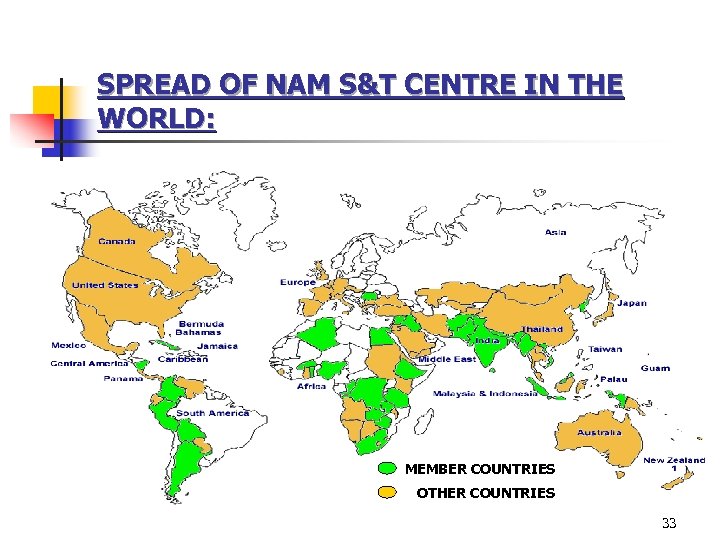
SPREAD OF NAM S&T CENTRE IN THE WORLD: MEMBER COUNTRIES OTHER COUNTRIES 33
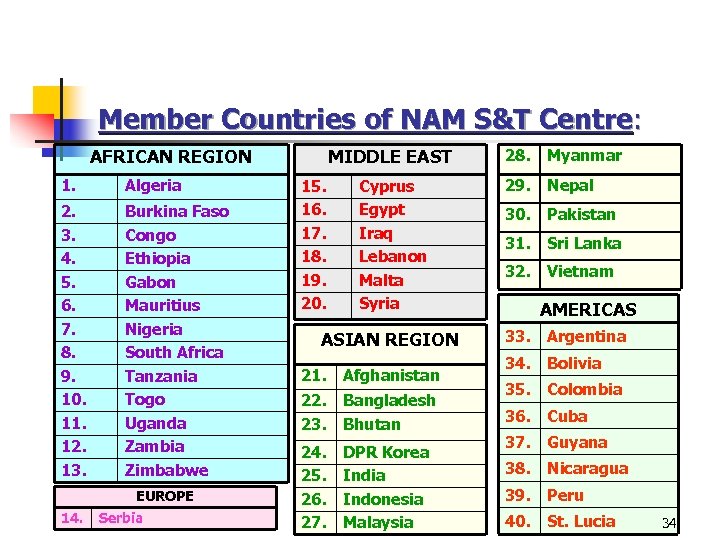
Member Countries of NAM S&T Centre: AFRICAN REGION 1. Algeria 2. 3. 4. 5. 6. 7. 8. 9. 10. 11. 12. 13. Burkina Faso Congo Ethiopia Gabon Mauritius Nigeria South Africa Tanzania Togo Uganda Zambia Zimbabwe EUROPE 14. Serbia MIDDLE EAST 28. Myanmar Cyprus Egypt Iraq Lebanon Malta Syria 29. Nepal 30. Pakistan 31. Sri Lanka 32. Vietnam ASIAN REGION 33. Argentina 34. Bolivia 35. Colombia 36. Cuba 37. Guyana 38. Nicaragua 39. Peru 40. St. Lucia 15. 16. 17. 18. 19. 20. 21. Afghanistan 22. 23. Bangladesh Bhutan 24. 25. 26. 27. DPR Korea India Indonesia Malaysia AMERICAS 34
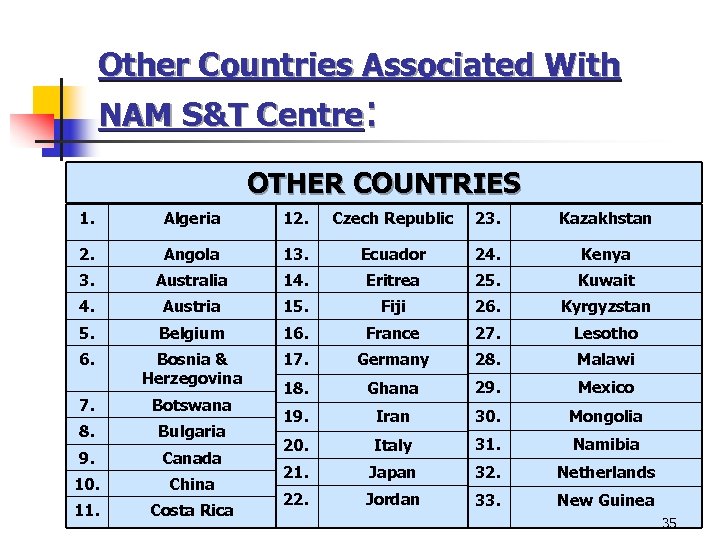
Other Countries Associated With NAM S&T Centre: OTHER COUNTRIES 1. Algeria 12. Czech Republic 23. Kazakhstan 2. Angola 13. Ecuador 24. Kenya 3. Australia 14. Eritrea 25. Kuwait 4. Austria 15. Fiji 26. Kyrgyzstan 5. Belgium 16. France 27. Lesotho 6. Bosnia & Herzegovina 17. Germany 28. Malawi 18. Ghana 29. Mexico 19. Iran 30. Mongolia 20. Italy 31. Namibia 21. Japan 32. Netherlands 22. Jordan 33. New Guinea 7. Botswana 8. Bulgaria 9. Canada 10. China 11. Costa Rica 35
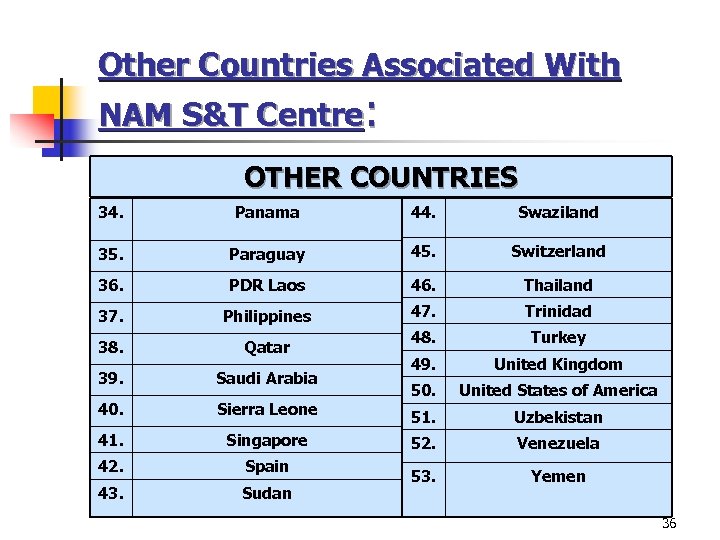
Other Countries Associated With NAM S&T Centre: OTHER COUNTRIES 34. Panama 44. Swaziland 35. Paraguay 45. Switzerland 36. PDR Laos 46. Thailand 37. Philippines 47. Trinidad 38. Qatar 48. Turkey 39. Saudi Arabia 49. United Kingdom 40. Sierra Leone 50. United States of America 51. Uzbekistan 41. Singapore 52. Venezuela 42. Spain 43. Sudan 53. Yemen 36
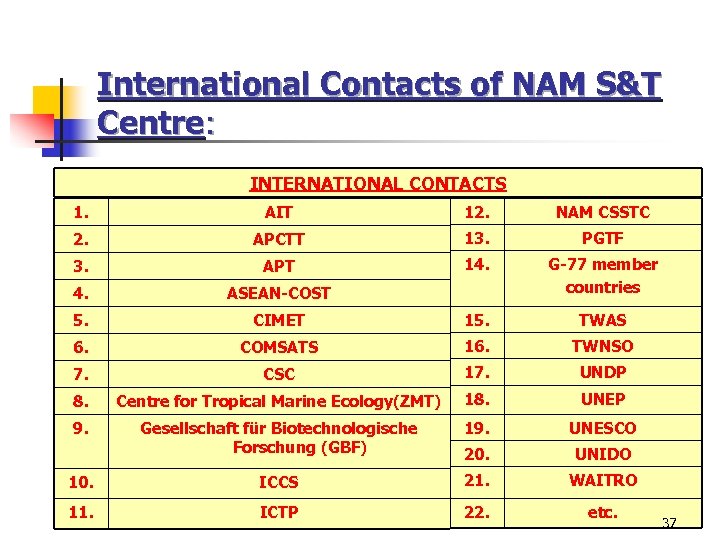
International Contacts of NAM S&T Centre: INTERNATIONAL CONTACTS 1. AIT 12. NAM CSSTC 2. APCTT 13. PGTF 3. APT 14. ASEAN-COST G-77 member countries 5. CIMET 15. TWAS 6. COMSATS 16. TWNSO 7. CSC 17. UNDP 8. Centre for Tropical Marine Ecology(ZMT) 18. UNEP 9. Gesellschaft für Biotechnologische Forschung (GBF) 19. UNESCO 20. UNIDO 10. ICCS 21. WAITRO 11. ICTP 22. etc. 37
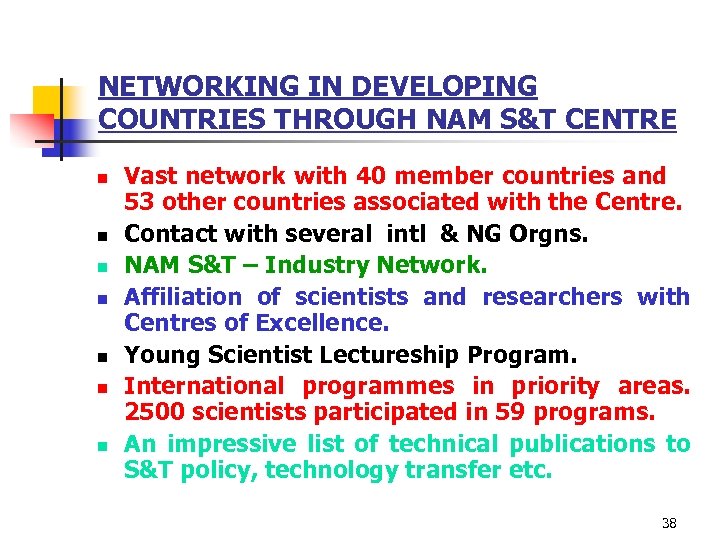
NETWORKING IN DEVELOPING COUNTRIES THROUGH NAM S&T CENTRE n n n n Vast network with 40 member countries and 53 other countries associated with the Centre. Contact with several intl & NG Orgns. NAM S&T – Industry Network. Affiliation of scientists and researchers with Centres of Excellence. Young Scientist Lectureship Program. International programmes in priority areas. 2500 scientists participated in 59 programs. An impressive list of technical publications to S&T policy, technology transfer etc. 38
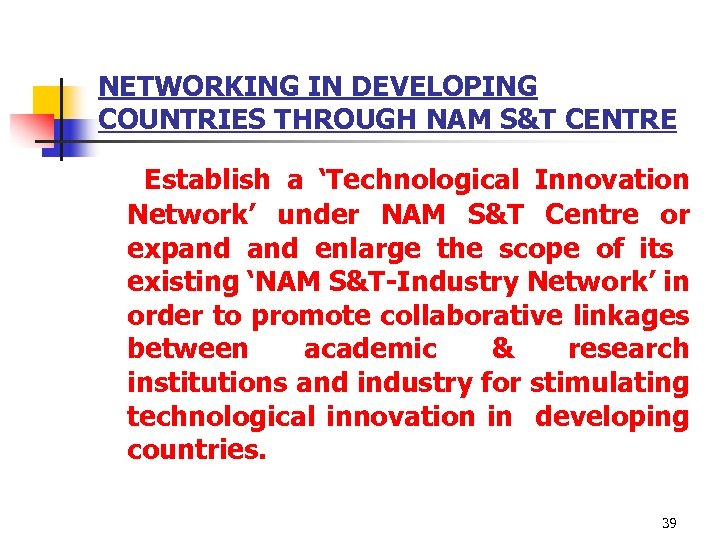
NETWORKING IN DEVELOPING COUNTRIES THROUGH NAM S&T CENTRE Establish a ‘Technological Innovation Network’ under NAM S&T Centre or expand enlarge the scope of its existing ‘NAM S&T-Industry Network’ in order to promote collaborative linkages between academic & research institutions and industry for stimulating technological innovation in developing countries. 39

THANK YOU 40
Скачать презентацию COLLABORATIVE LINKS BETWEEN ACADEMIC RESEARCH INSTITUTIONS AND
4cce9209a9c3708a54119f3ed8c2c472.ppt