 Скачать презентацию Collaborative Filtering A Tutorial William W Cohen Center
1dbe07d9142652a5e3a20058f0ee78b8.ppt
- Количество слайдов: 97



Collaborative Filtering: A Tutorial William W. Cohen Center for Automated Learning and Discovery Carnegie Mellon University
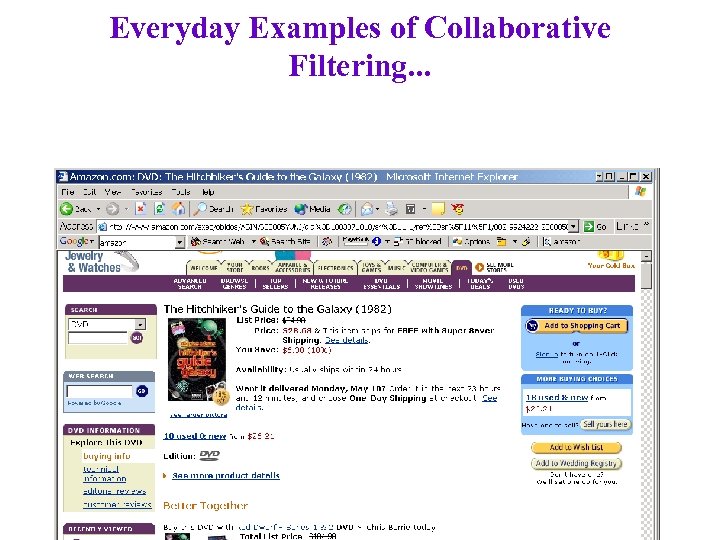
Everyday Examples of Collaborative Filtering. . .
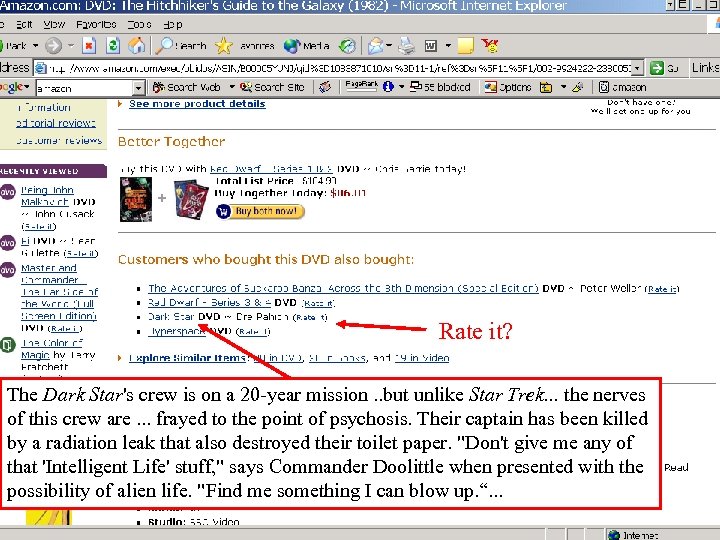
Rate it? The Dark Star's crew is on a 20 -year mission. . but unlike Star Trek. . . the nerves of this crew are. . . frayed to the point of psychosis. Their captain has been killed by a radiation leak that also destroyed their toilet paper. "Don't give me any of that 'Intelligent Life' stuff, " says Commander Doolittle when presented with the possibility of alien life. "Find me something I can blow up. “. . .
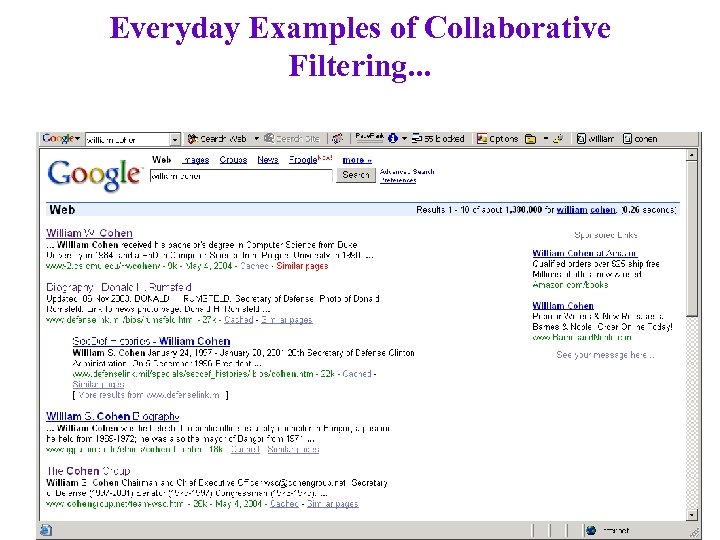
Everyday Examples of Collaborative Filtering. . .
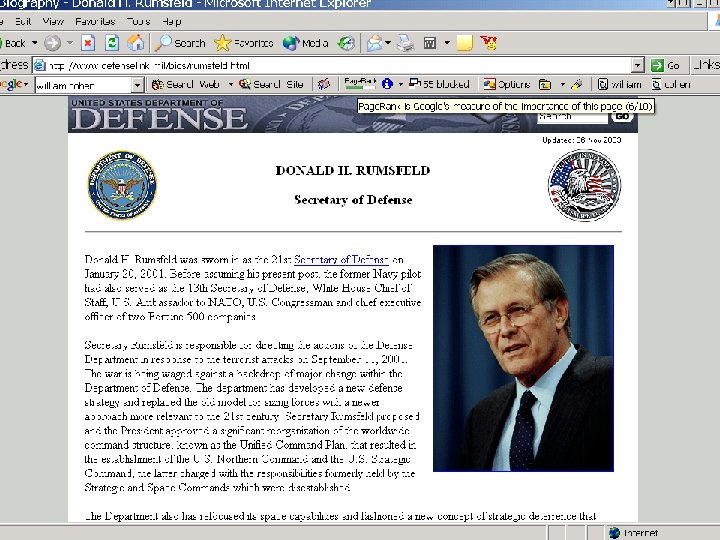
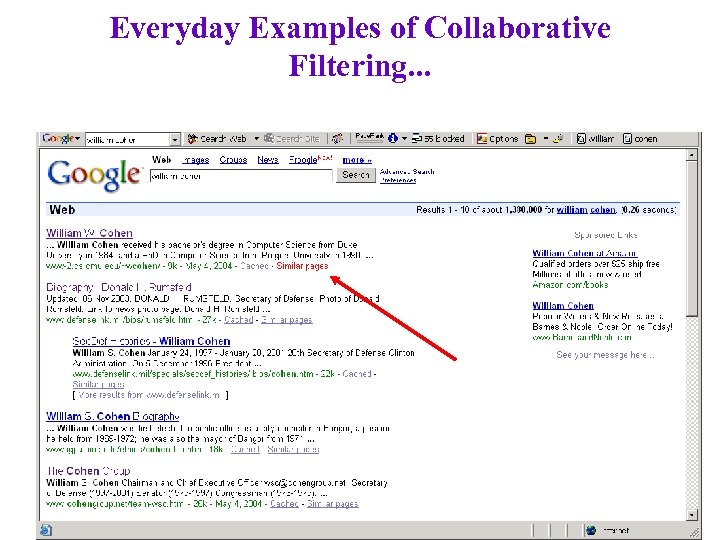
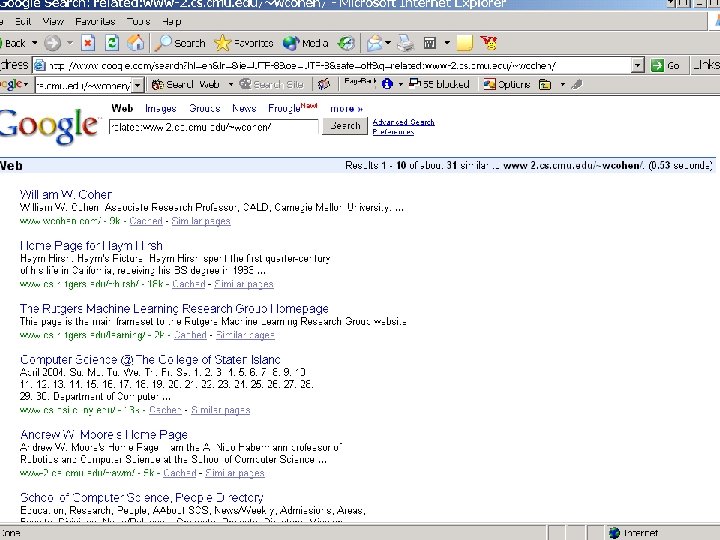
Everyday Examples of Collaborative Filtering. . .
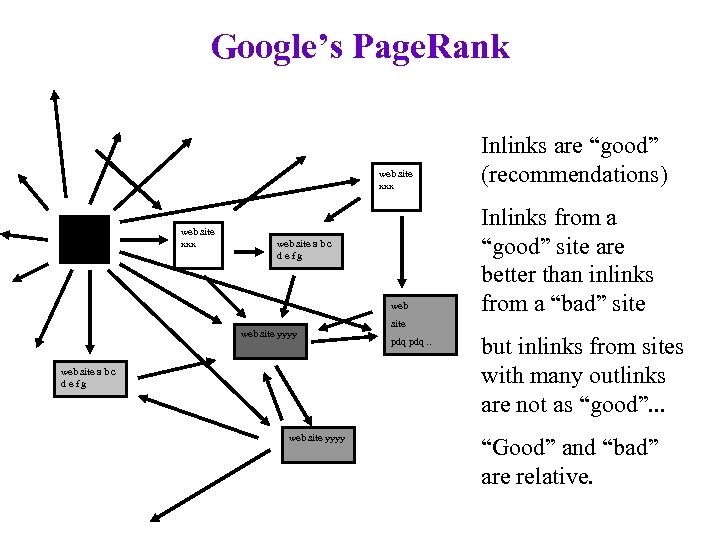
Google’s Page. Rank web site xxx web site a b c defg web site yyyy Inlinks are “good” (recommendations) Inlinks from a “good” site are better than inlinks from a “bad” site pdq. . but inlinks from sites with many outlinks are not as “good”. . . “Good” and “bad” are relative.
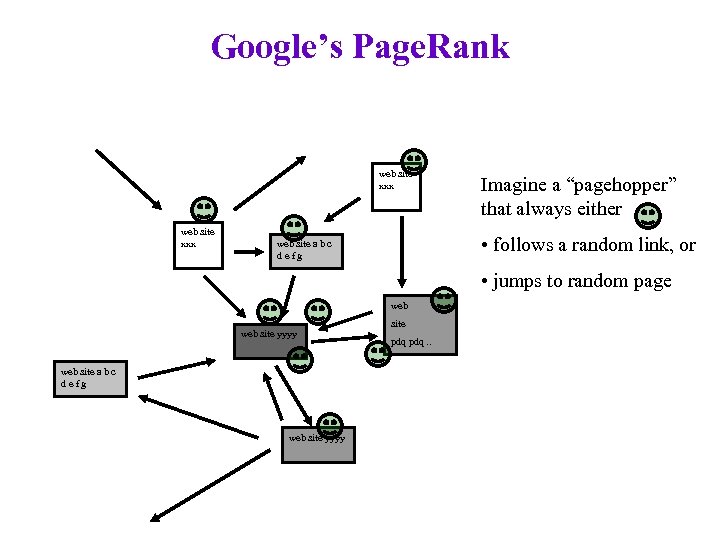
Google’s Page. Rank web site xxx Imagine a “pagehopper” that always either • follows a random link, or web site a b c defg • jumps to random page web site yyyy web site a b c defg web site yyyy site pdq. .
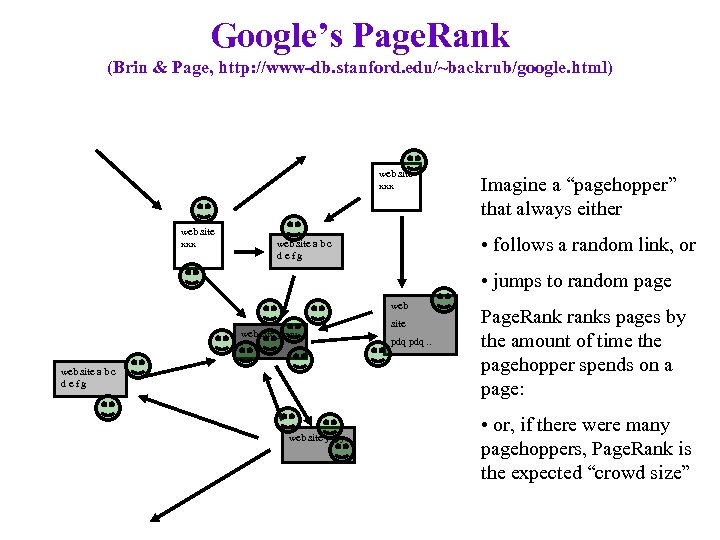
Google’s Page. Rank (Brin & Page, http: //www-db. stanford. edu/~backrub/google. html) web site xxx Imagine a “pagehopper” that always either • follows a random link, or web site a b c defg • jumps to random page web site yyyy web site a b c defg web site yyyy site pdq. . Page. Rank ranks pages by the amount of time the pagehopper spends on a page: • or, if there were many pagehoppers, Page. Rank is the expected “crowd size”
Everyday Examples of Collaborative Filtering. . . • • • Bestseller lists Top 40 music lists The “recent returns” shelf at the library Unmarked but well-used paths thru the woods The printer room at work Many weblogs “Read any good books lately? ”. . Common insight: personal tastes are correlated: – If Alice and Bob both like X and Alice likes Y then Bob is more likely to like Y – especially (perhaps) if Bob knows Alice
Outline • Non-systematic survey of some CF systems – – CF as basis for a virtual community memory-based recommendation algorithms visualizing user-user via item distances CF versus content filtering • Algorithms for CF • CF with different inputs – true ratings – assumed/implicit ratings • Conclusions/Summary
Bell. Core’s Movie. Recommender • Recommending And Evaluating Choices In A Virtual Community Of Use. Will Hill, Larry Stead, Mark Rosenstein and George Furnas, Bellcore; CHI 1995 By virtual community we mean "a group of people who share characteristics and interact in essence or effect only". In other words, people in a Virtual Community influence each other as though they interacted but they do not interact. Thus we ask: "Is it possible to arrange for people to share some of the personalized informational benefits of community involvement without the associated communications costs? "
Movie. Recommender Goals Recommendations should: • simultaneously ease and encourage rather than replace social processes. . should make it easy to participate while leaving in hooks for people to pursue more personal relationships if they wish. • be for sets of people not just individuals. . . multi-person recommending is often important, for example, when two or more people want to choose a video to watch together. • be from people not a black box machine or so-called "agent". • tell how much confidence to place in them, in other words they should include indications of how accurate they are.
Bell. Core’s Movie. Recommender • Participants sent email to videos@bellcore. com • System replied with a list of 500 movies to rate on a 1 -10 scale (250 random, 250 popular) – Only subset need to be rated • New participant P sends in rated movies via email • System compares ratings for P to ratings of (a random sample of) previous users • Most similar users are used to predict scores for unrated movies (more later) • System returns recommendations in an email message.
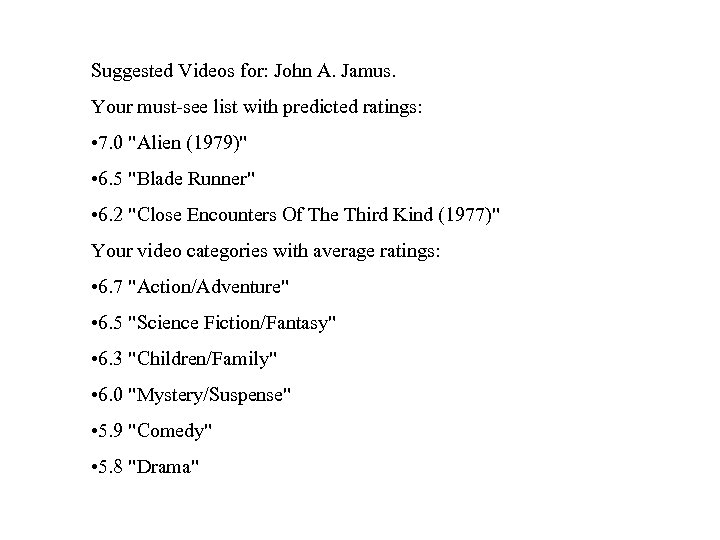
Suggested Videos for: John A. Jamus. Your must-see list with predicted ratings: • 7. 0 "Alien (1979)" • 6. 5 "Blade Runner" • 6. 2 "Close Encounters Of The Third Kind (1977)" Your video categories with average ratings: • 6. 7 "Action/Adventure" • 6. 5 "Science Fiction/Fantasy" • 6. 3 "Children/Family" • 6. 0 "Mystery/Suspense" • 5. 9 "Comedy" • 5. 8 "Drama"
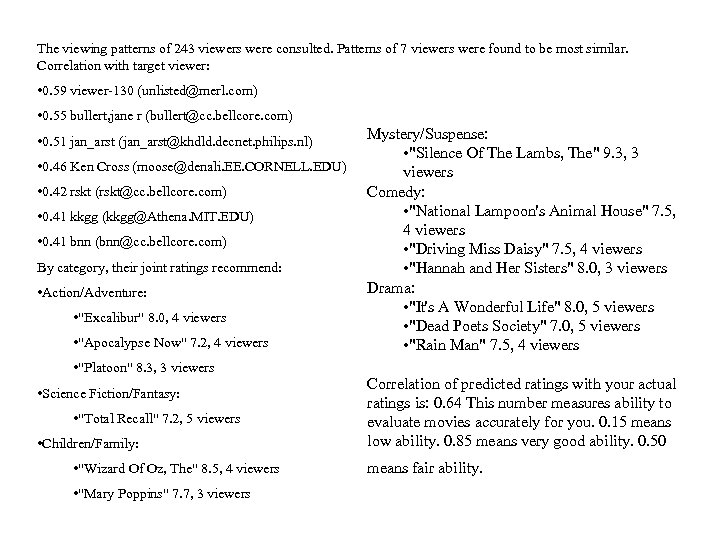
The viewing patterns of 243 viewers were consulted. Patterns of 7 viewers were found to be most similar. Correlation with target viewer: • 0. 59 viewer-130 (unlisted@merl. com) • 0. 55 bullert, jane r (bullert@cc. bellcore. com) • 0. 51 jan_arst (jan_arst@khdld. decnet. philips. nl) • 0. 46 Ken Cross (moose@denali. EE. CORNELL. EDU) • 0. 42 rskt (rskt@cc. bellcore. com) • 0. 41 kkgg (kkgg@Athena. MIT. EDU) • 0. 41 bnn (bnn@cc. bellcore. com) By category, their joint ratings recommend: • Action/Adventure: • "Excalibur" 8. 0, 4 viewers • "Apocalypse Now" 7. 2, 4 viewers • "Platoon" 8. 3, 3 viewers • Science Fiction/Fantasy: • "Total Recall" 7. 2, 5 viewers • Children/Family: • "Wizard Of Oz, The" 8. 5, 4 viewers • "Mary Poppins" 7. 7, 3 viewers Mystery/Suspense: • "Silence Of The Lambs, The" 9. 3, 3 viewers Comedy: • "National Lampoon's Animal House" 7. 5, 4 viewers • "Driving Miss Daisy" 7. 5, 4 viewers • "Hannah and Her Sisters" 8. 0, 3 viewers Drama: • "It's A Wonderful Life" 8. 0, 5 viewers • "Dead Poets Society" 7. 0, 5 viewers • "Rain Man" 7. 5, 4 viewers Correlation of predicted ratings with your actual ratings is: 0. 64 This number measures ability to evaluate movies accurately for you. 0. 15 means low ability. 0. 85 means very good ability. 0. 50 means fair ability.
Bell. Core’s Movie. Recommender • Evaluation: – Withhold 10% of the ratings of each user to use as a test set – Measure correlation between predicted ratings and actual ratings for test-set movie/user pairs
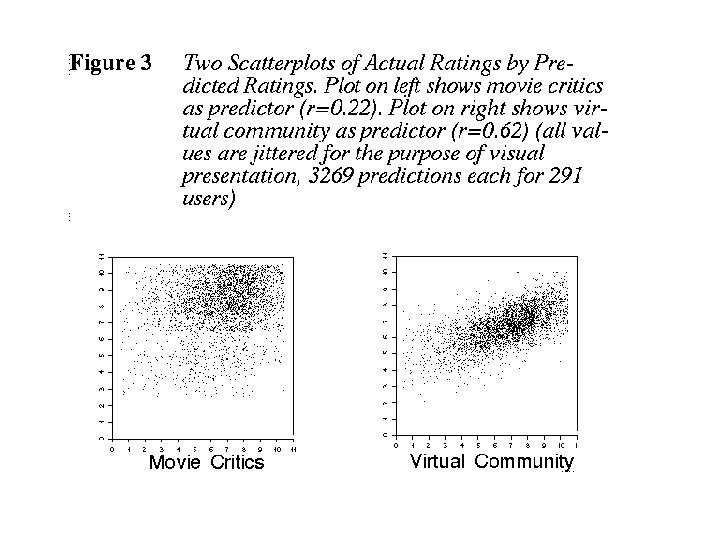
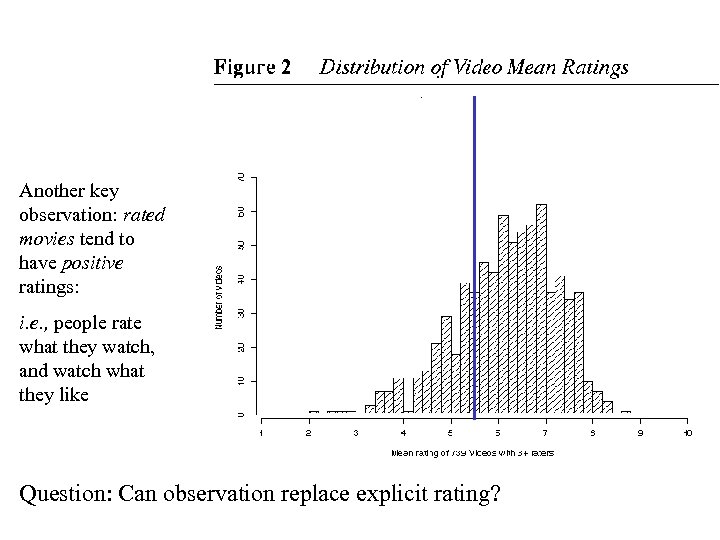
Another key observation: rated movies tend to have positive ratings: i. e. , people rate what they watch, and watch what they like Question: Can observation replace explicit rating?
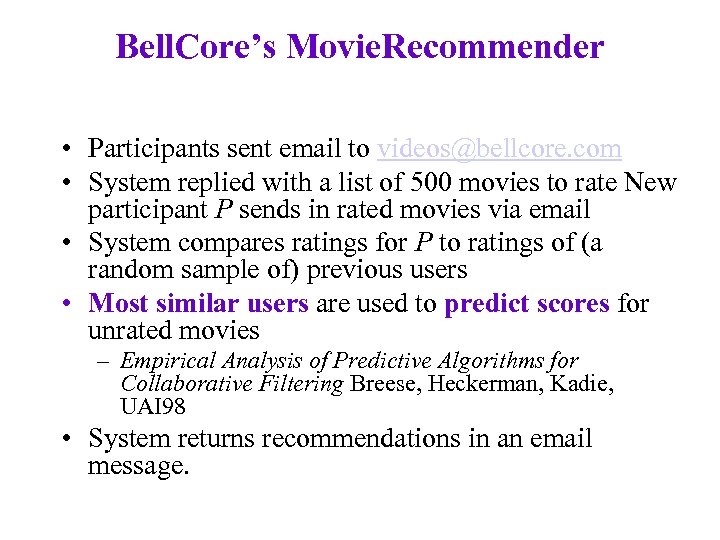
Bell. Core’s Movie. Recommender • Participants sent email to videos@bellcore. com • System replied with a list of 500 movies to rate New participant P sends in rated movies via email • System compares ratings for P to ratings of (a random sample of) previous users • Most similar users are used to predict scores for unrated movies – Empirical Analysis of Predictive Algorithms for Collaborative Filtering Breese, Heckerman, Kadie, UAI 98 • System returns recommendations in an email message.
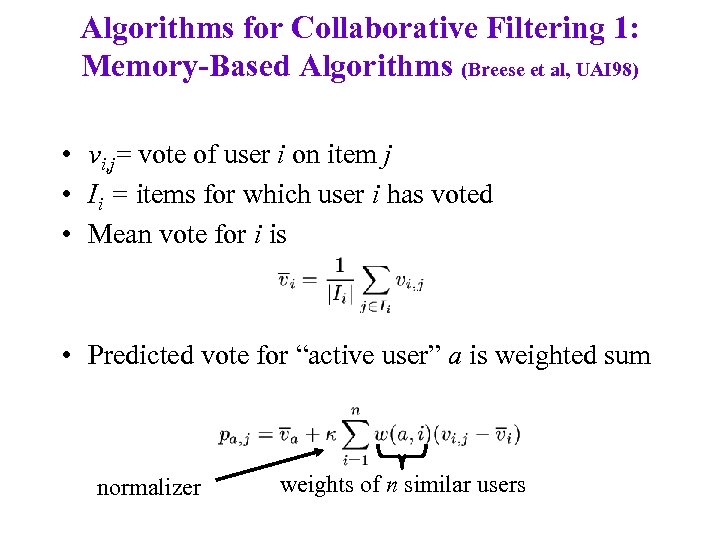
Algorithms for Collaborative Filtering 1: Memory-Based Algorithms (Breese et al, UAI 98) • vi, j= vote of user i on item j • Ii = items for which user i has voted • Mean vote for i is • Predicted vote for “active user” a is weighted sum normalizer weights of n similar users
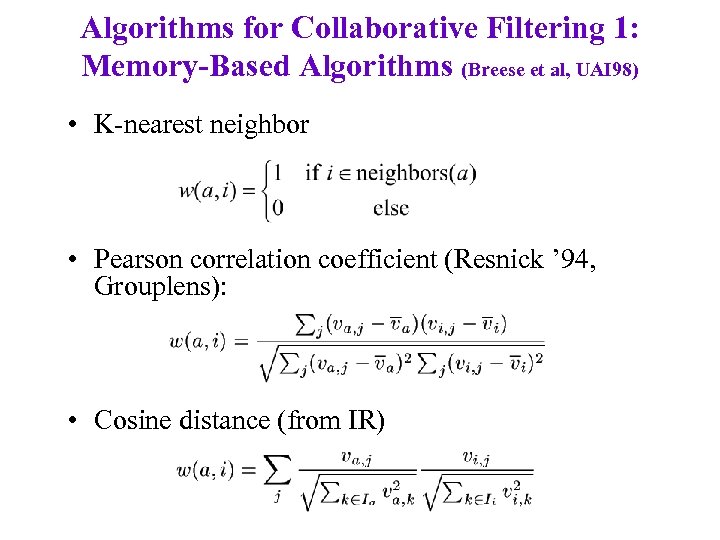
Algorithms for Collaborative Filtering 1: Memory-Based Algorithms (Breese et al, UAI 98) • K-nearest neighbor • Pearson correlation coefficient (Resnick ’ 94, Grouplens): • Cosine distance (from IR)
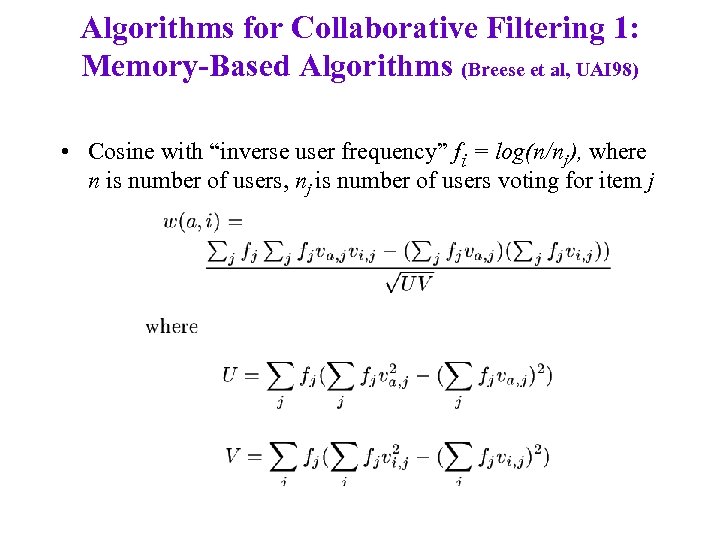
Algorithms for Collaborative Filtering 1: Memory-Based Algorithms (Breese et al, UAI 98) • Cosine with “inverse user frequency” fi = log(n/nj), where n is number of users, nj is number of users voting for item j
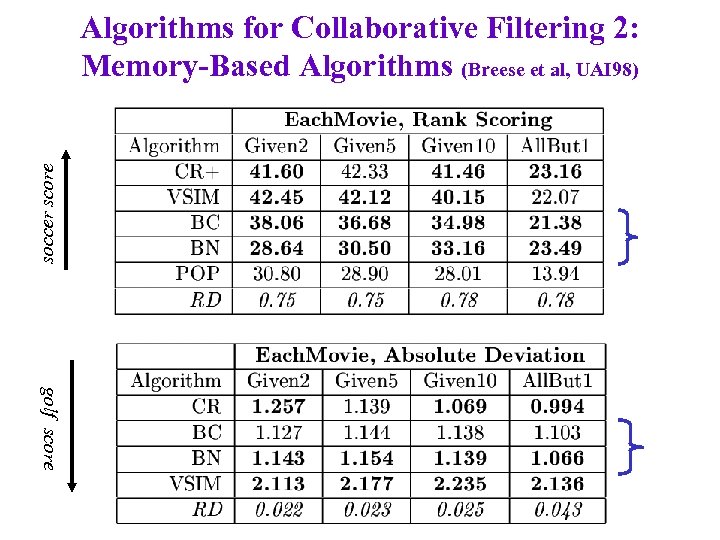
Algorithms for Collaborative Filtering 1: Memory-Based Algorithms (Breese et al, UAI 98) • Evaluation: – split users into train/test sets – for each user a in the test set: • split a’s votes into observed (I) and to-predict (P) • measure average absolute deviation between predicted and actual votes in P • predict votes in P, and form a ranked list • assume (a) utility of k-th item in list is max(va, j-d, 0), where d is a “default vote” (b) probability of reaching rank k drops exponentially in k. Score a list by its expected utility Ra – average Ra over all test users
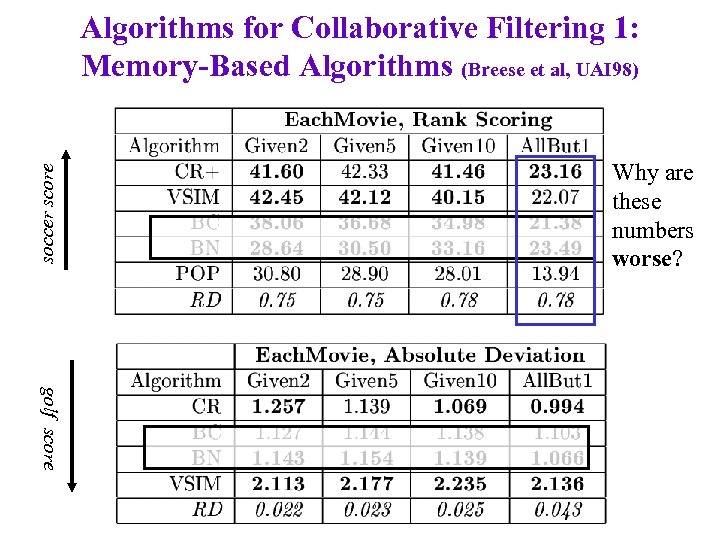
soccer score Algorithms for Collaborative Filtering 1: Memory-Based Algorithms (Breese et al, UAI 98) Why are these numbers worse? golf score
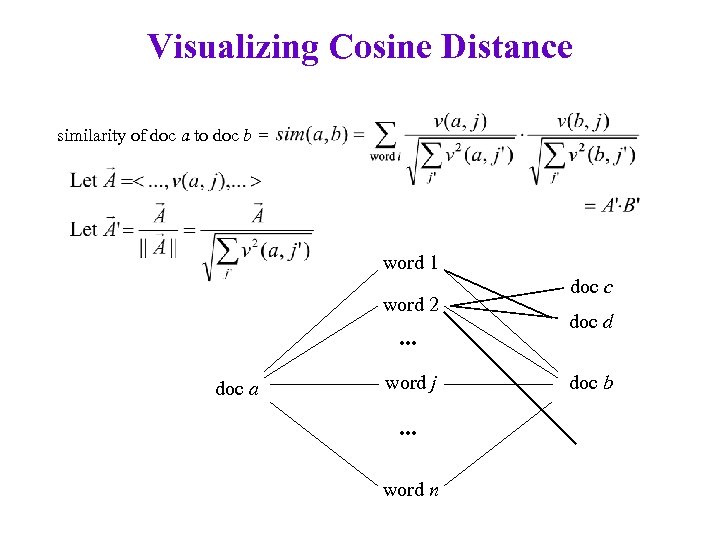
Visualizing Cosine Distance similarity of doc a to doc b = word 1 word 2 . . . doc a word j . . . word n doc c doc d doc b
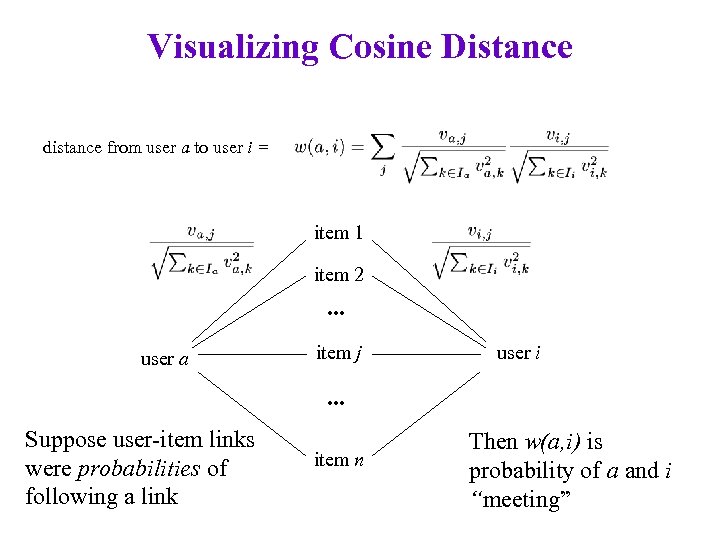
Visualizing Cosine Distance distance from user a to user i = item 1 item 2 . . . user a item j user i . . . Suppose user-item links were probabilities of following a link item n Then w(a, i) is probability of a and i “meeting”
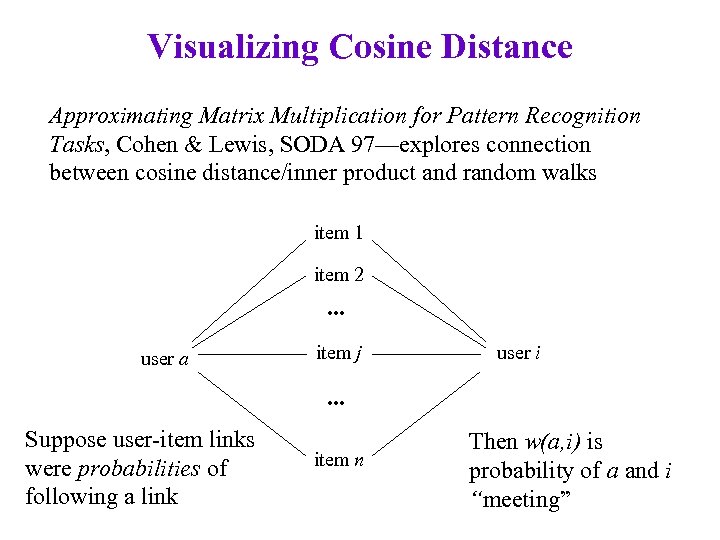
Visualizing Cosine Distance Approximating Matrix Multiplication for Pattern Recognition Tasks, Cohen & Lewis, SODA 97—explores connection between cosine distance/inner product and random walks item 1 item 2 . . . user a item j user i . . . Suppose user-item links were probabilities of following a link item n Then w(a, i) is probability of a and i “meeting”
Outline • Non-systematic survey of some CF systems – CF as basis for a virtual community – memory-based recommendation algorithms – visualizing user-user via item distances – CF versus content filtering • Algorithms for CF • CF with different inputs – true ratings – assumed/implicit ratings
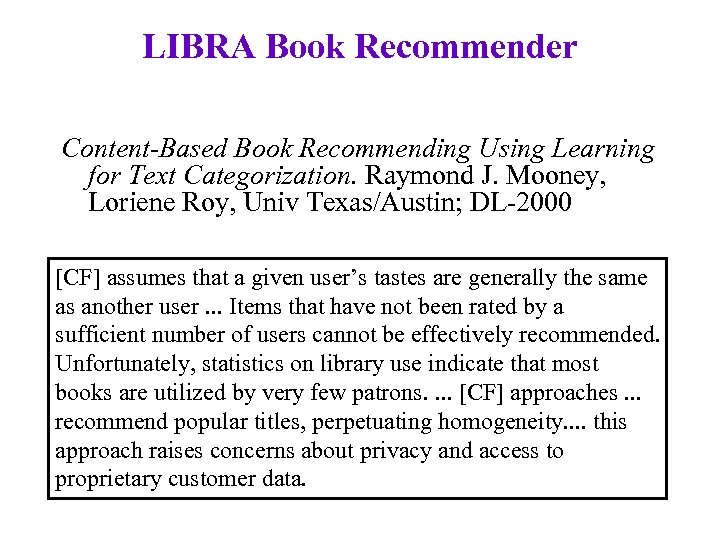
LIBRA Book Recommender Content-Based Book Recommending Using Learning for Text Categorization. Raymond J. Mooney, Loriene Roy, Univ Texas/Austin; DL-2000 [CF] assumes that a given user’s tastes are generally the same as another user. . . Items that have not been rated by a sufficient number of users cannot be effectively recommended. Unfortunately, statistics on library use indicate that most books are utilized by very few patrons. . [CF] approaches. . . recommend popular titles, perpetuating homogeneity. . this approach raises concerns about privacy and access to proprietary customer data.
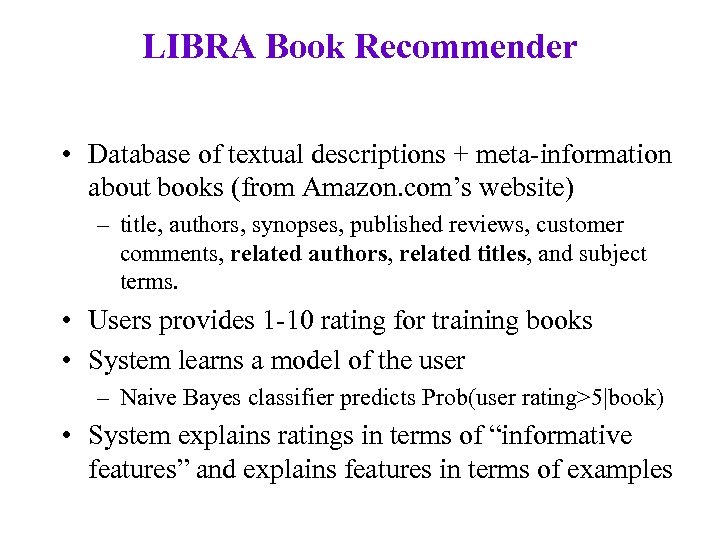
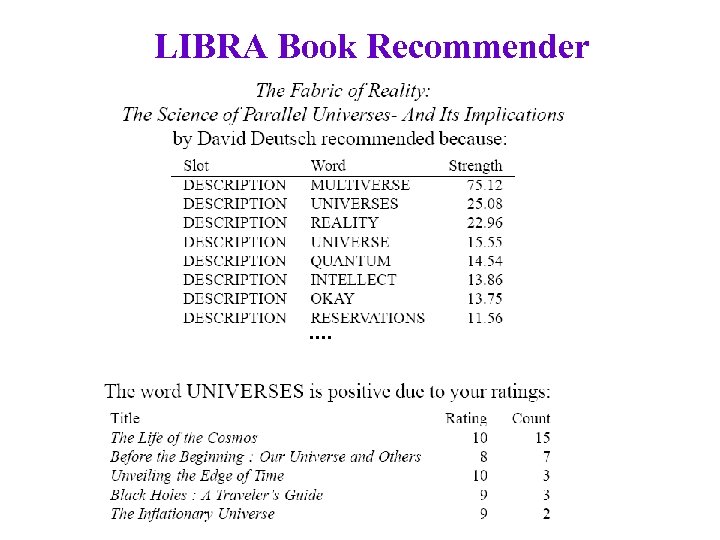
LIBRA Book Recommender • Database of textual descriptions + meta-information about books (from Amazon. com’s website) – title, authors, synopses, published reviews, customer comments, related authors, related titles, and subject terms. • Users provides 1 -10 rating for training books • System learns a model of the user – Naive Bayes classifier predicts Prob(user rating>5|book) • System explains ratings in terms of “informative features” and explains features in terms of examples
LIBRA Book Recommender . .
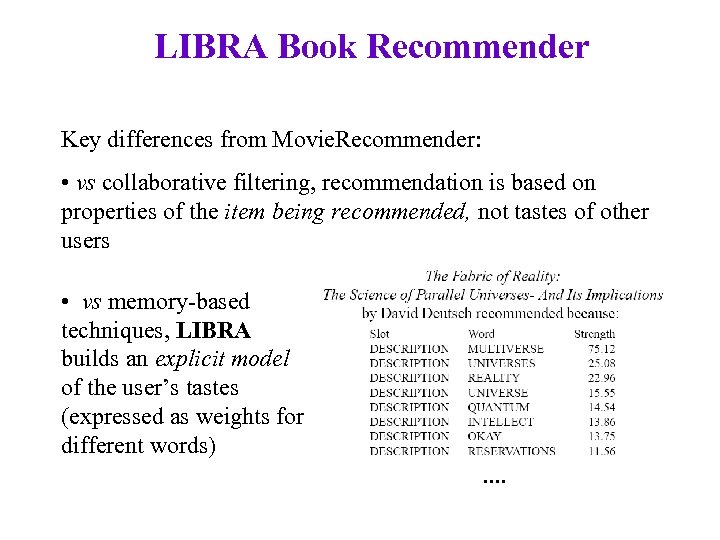
LIBRA Book Recommender Key differences from Movie. Recommender: • vs collaborative filtering, recommendation is based on properties of the item being recommended, not tastes of other users • vs memory-based techniques, LIBRA builds an explicit model of the user’s tastes (expressed as weights for different words). .
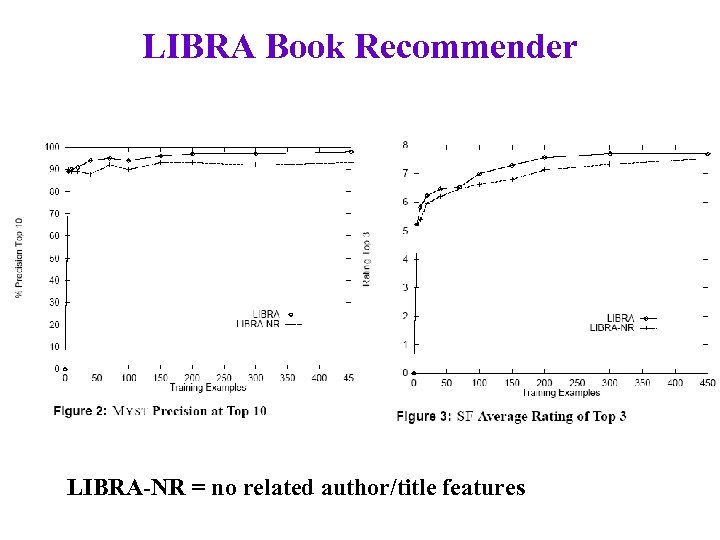
LIBRA Book Recommender LIBRA-NR = no related author/title features
Collaborative + Content Filtering (Basu et al, AAAI 98; Condliff et al, AI-STATS 99)
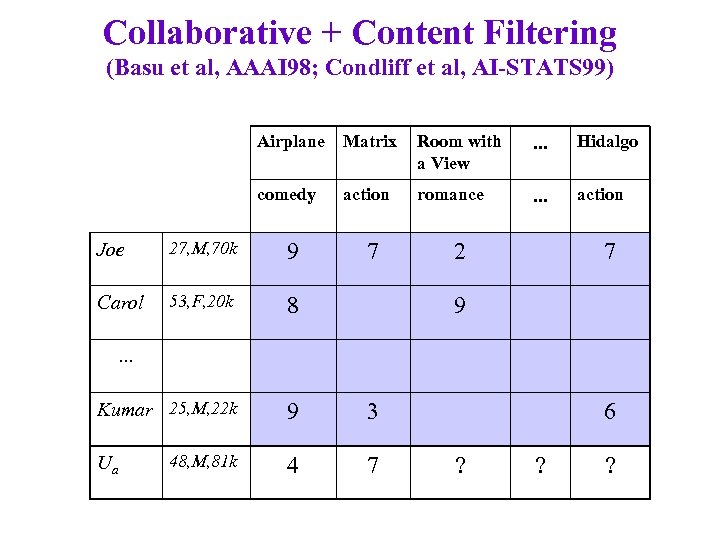
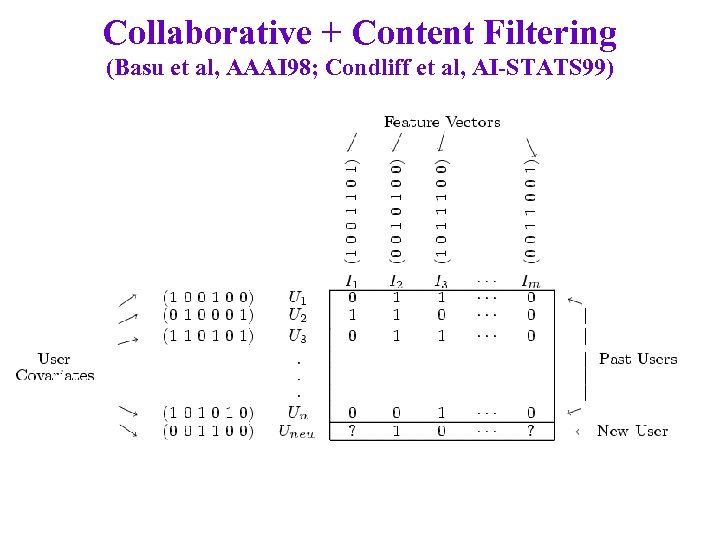
Collaborative + Content Filtering (Basu et al, AAAI 98; Condliff et al, AI-STATS 99) Airplane Matrix Room with a View . . . Hidalgo comedy action romance . . . action Joe 27, M, 70 k 9 Carol 53, F, 20 k 8 Kumar 25, M, 22 k 9 3 48, M, 81 k 4 7 7 2 7 9 . . . Ua 6 ? ? ?
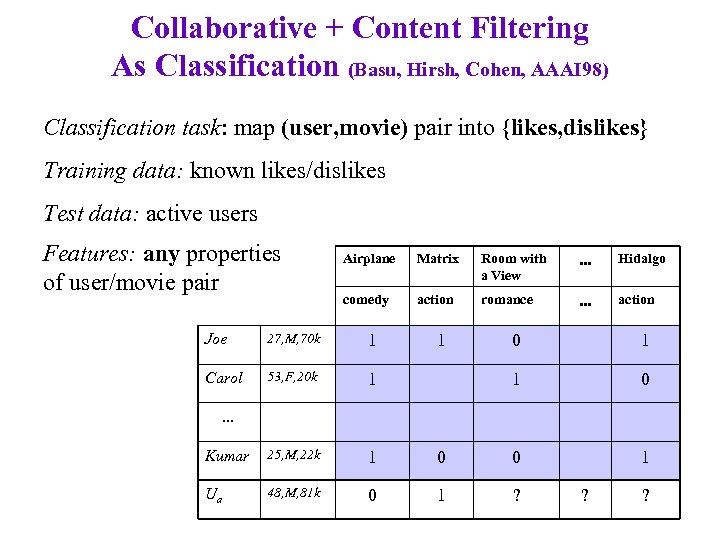
Collaborative + Content Filtering As Classification (Basu, Hirsh, Cohen, AAAI 98) Classification task: map (user, movie) pair into {likes, dislikes} Training data: known likes/dislikes Test data: active users Features: any properties of user/movie pair Airplane Matrix Room with a View . . . Hidalgo comedy action romance . . . action Joe 27, M, 70 k 1 Carol 53, F, 20 k 1 Kumar 25, M, 22 k 1 Ua 48, M, 81 k 0 1 1 0 0 0 1 1 ? . . . ? ?
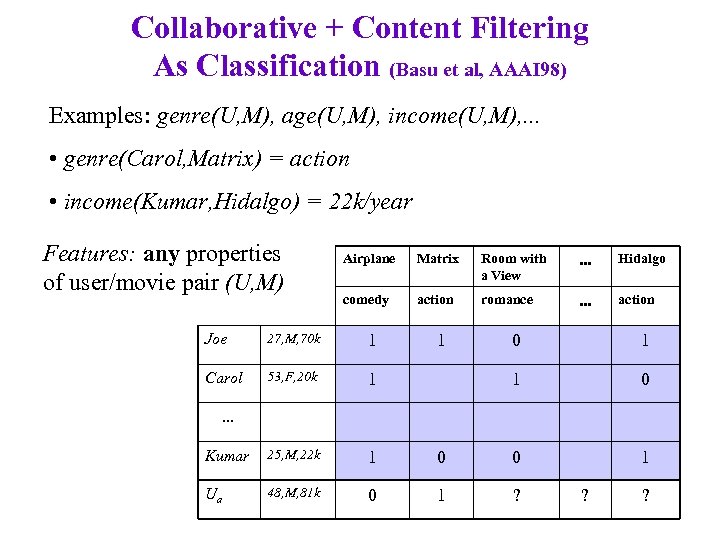
Collaborative + Content Filtering As Classification (Basu et al, AAAI 98) Examples: genre(U, M), age(U, M), income(U, M), . . . • genre(Carol, Matrix) = action • income(Kumar, Hidalgo) = 22 k/year Features: any properties of user/movie pair (U, M) Airplane Matrix Room with a View . . . Hidalgo comedy action romance . . . action Joe 27, M, 70 k 1 Carol 53, F, 20 k 1 Kumar 25, M, 22 k 1 Ua 48, M, 81 k 0 1 1 0 0 0 1 1 ? . . . ? ?
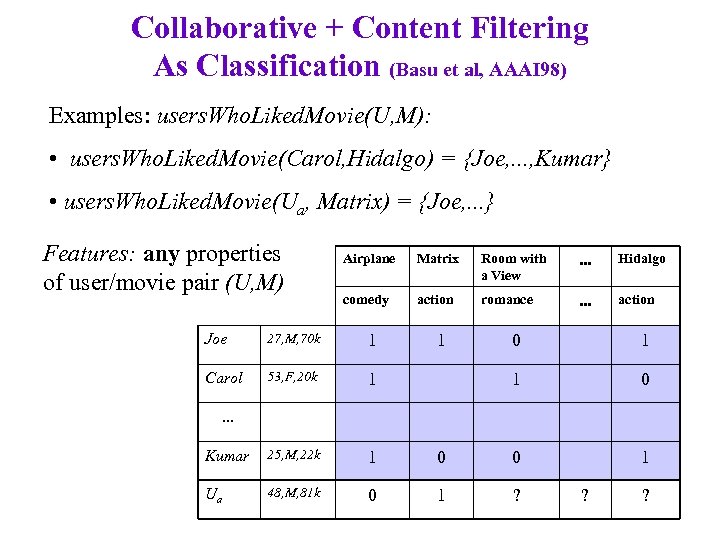
Collaborative + Content Filtering As Classification (Basu et al, AAAI 98) Examples: users. Who. Liked. Movie(U, M): • users. Who. Liked. Movie(Carol, Hidalgo) = {Joe, . . . , Kumar} • users. Who. Liked. Movie(Ua, Matrix) = {Joe, . . . } Features: any properties of user/movie pair (U, M) Airplane Matrix Room with a View . . . Hidalgo comedy action romance . . . action Joe 27, M, 70 k 1 Carol 53, F, 20 k 1 Kumar 25, M, 22 k 1 Ua 48, M, 81 k 0 1 1 0 0 0 1 1 ? . . . ? ?
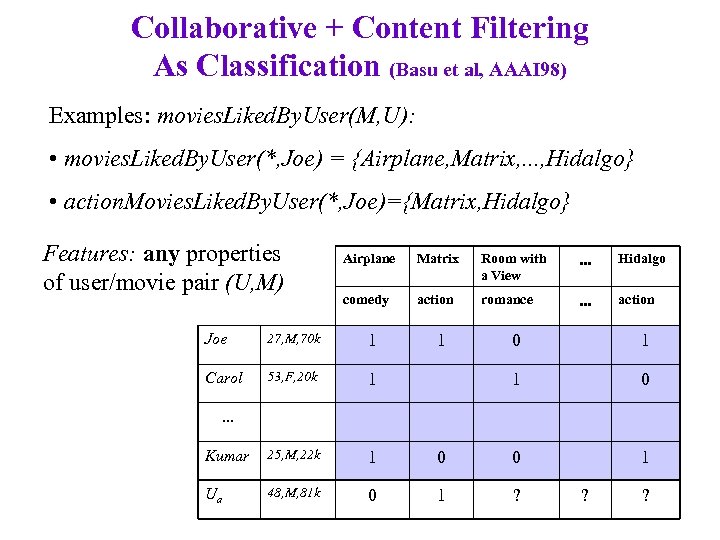
Collaborative + Content Filtering As Classification (Basu et al, AAAI 98) Examples: movies. Liked. By. User(M, U): • movies. Liked. By. User(*, Joe) = {Airplane, Matrix, . . . , Hidalgo} • action. Movies. Liked. By. User(*, Joe)={Matrix, Hidalgo} Features: any properties of user/movie pair (U, M) Airplane Matrix Room with a View . . . Hidalgo comedy action romance . . . action Joe 27, M, 70 k 1 Carol 53, F, 20 k 1 Kumar 25, M, 22 k 1 Ua 48, M, 81 k 0 1 1 0 0 0 1 1 ? . . . ? ?
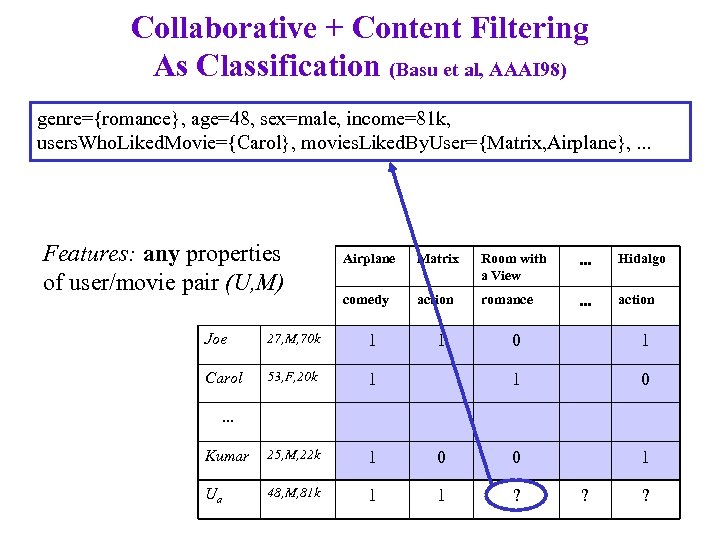
Collaborative + Content Filtering As Classification (Basu et al, AAAI 98) genre={romance}, age=48, sex=male, income=81 k, users. Who. Liked. Movie={Carol}, movies. Liked. By. User={Matrix, Airplane}, . . . Features: any properties of user/movie pair (U, M) Airplane Matrix Room with a View . . . Hidalgo comedy action romance . . . action Joe 27, M, 70 k 1 Carol 53, F, 20 k 1 Kumar 25, M, 22 k 1 Ua 48, M, 81 k 1 1 0 0 0 1 1 ? . . . ? ?
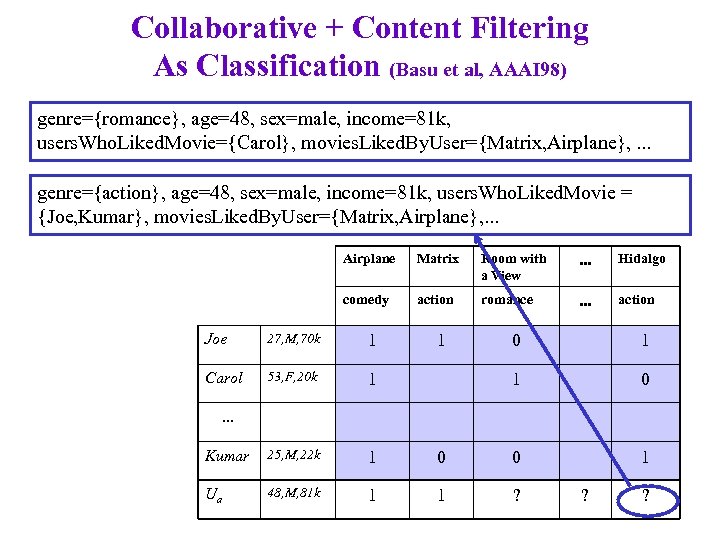
Collaborative + Content Filtering As Classification (Basu et al, AAAI 98) genre={romance}, age=48, sex=male, income=81 k, users. Who. Liked. Movie={Carol}, movies. Liked. By. User={Matrix, Airplane}, . . . genre={action}, age=48, sex=male, income=81 k, users. Who. Liked. Movie = {Joe, Kumar}, movies. Liked. By. User={Matrix, Airplane}, . . . Airplane Matrix Room with a View . . . Hidalgo comedy action romance . . . action Joe 27, M, 70 k 1 Carol 53, F, 20 k 1 Kumar 25, M, 22 k 1 Ua 48, M, 81 k 1 1 0 0 0 1 1 ? . . . ? ?
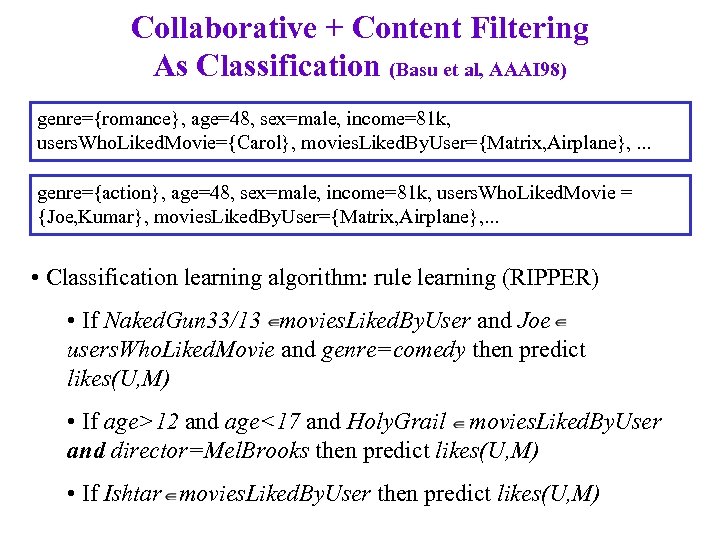
Collaborative + Content Filtering As Classification (Basu et al, AAAI 98) genre={romance}, age=48, sex=male, income=81 k, users. Who. Liked. Movie={Carol}, movies. Liked. By. User={Matrix, Airplane}, . . . genre={action}, age=48, sex=male, income=81 k, users. Who. Liked. Movie = {Joe, Kumar}, movies. Liked. By. User={Matrix, Airplane}, . . . • Classification learning algorithm: rule learning (RIPPER) • If Naked. Gun 33/13 movies. Liked. By. User and Joe users. Who. Liked. Movie and genre=comedy then predict likes(U, M) • If age>12 and age<17 and Holy. Grail movies. Liked. By. User and director=Mel. Brooks then predict likes(U, M) • If Ishtar movies. Liked. By. User then predict likes(U, M)
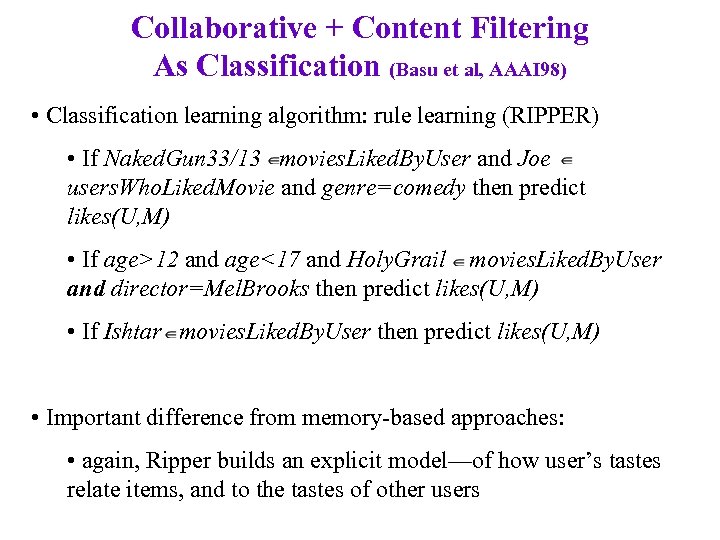
Collaborative + Content Filtering As Classification (Basu et al, AAAI 98) • Classification learning algorithm: rule learning (RIPPER) • If Naked. Gun 33/13 movies. Liked. By. User and Joe users. Who. Liked. Movie and genre=comedy then predict likes(U, M) • If age>12 and age<17 and Holy. Grail movies. Liked. By. User and director=Mel. Brooks then predict likes(U, M) • If Ishtar movies. Liked. By. User then predict likes(U, M) • Important difference from memory-based approaches: • again, Ripper builds an explicit model—of how user’s tastes relate items, and to the tastes of other users
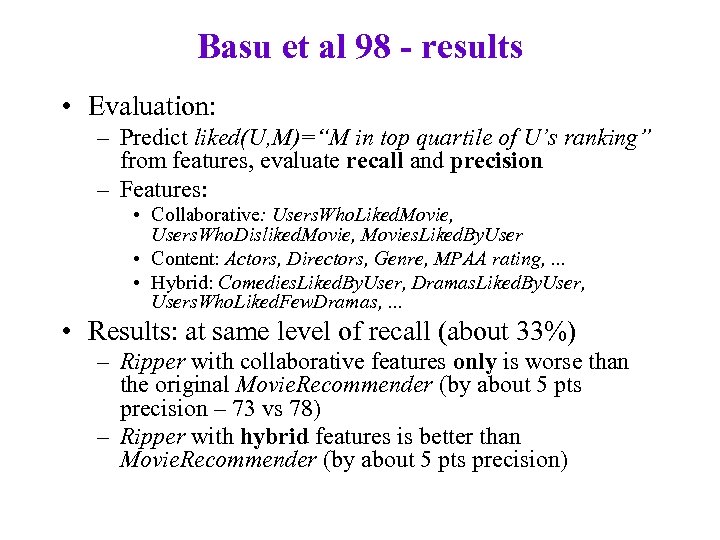
Basu et al 98 - results • Evaluation: – Predict liked(U, M)=“M in top quartile of U’s ranking” from features, evaluate recall and precision – Features: • Collaborative: Users. Who. Liked. Movie, Users. Who. Disliked. Movie, Movies. Liked. By. User • Content: Actors, Directors, Genre, MPAA rating, . . . • Hybrid: Comedies. Liked. By. User, Dramas. Liked. By. User, Users. Who. Liked. Few. Dramas, . . . • Results: at same level of recall (about 33%) – Ripper with collaborative features only is worse than the original Movie. Recommender (by about 5 pts precision – 73 vs 78) – Ripper with hybrid features is better than Movie. Recommender (by about 5 pts precision)
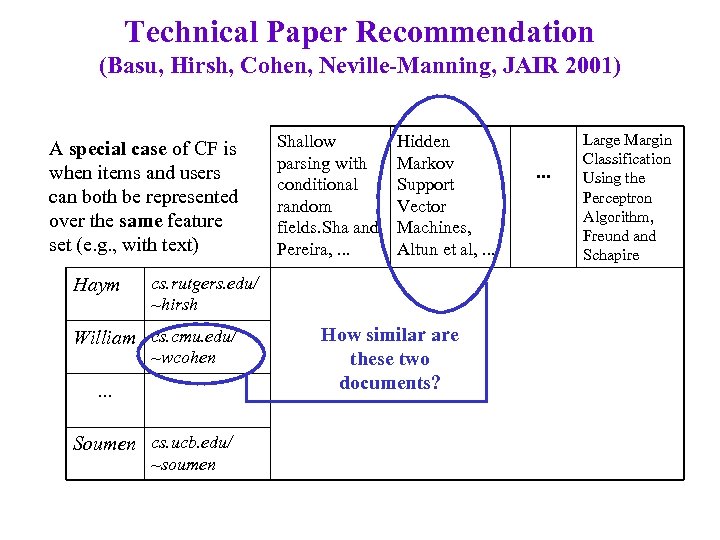
Technical Paper Recommendation (Basu, Hirsh, Cohen, Neville-Manning, JAIR 2001) A special case of CF is when items and users can both be represented over the same feature set (e. g. , with text) Haym Shallow parsing with conditional random fields. Sha and Pereira, . . . Hidden Markov Support Vector Machines, Altun et al, . . . cs. rutgers. edu/ ~hirsh William cs. cmu. edu/ ~wcohen . . . Soumen cs. ucb. edu/ ~soumen How similar are these two documents? . . . Large Margin Classification Using the Perceptron Algorithm, Freund and Schapire
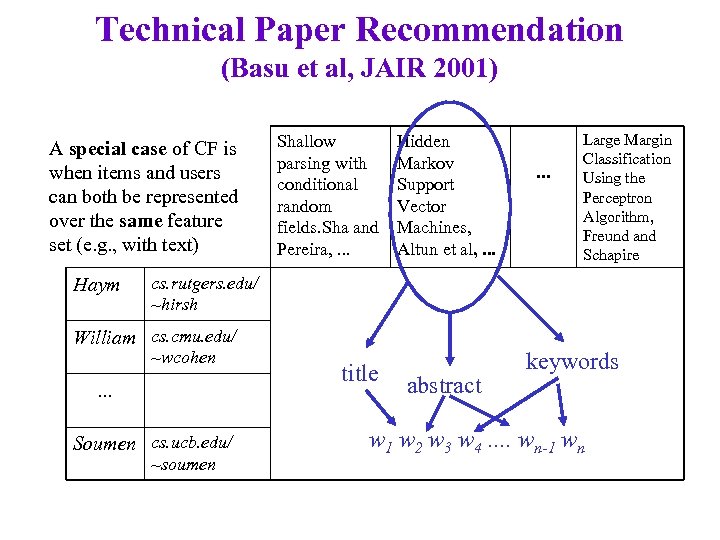
Technical Paper Recommendation (Basu et al, JAIR 2001) A special case of CF is when items and users can both be represented over the same feature set (e. g. , with text) Haym Shallow parsing with conditional random fields. Sha and Pereira, . . . Hidden Markov Support Vector Machines, Altun et al, . . . Large Margin Classification Using the Perceptron Algorithm, Freund and Schapire cs. rutgers. edu/ ~hirsh William cs. cmu. edu/ ~wcohen . . . Soumen cs. ucb. edu/ ~soumen title abstract keywords w 1 w 2 w 3 w 4. . wn-1 wn
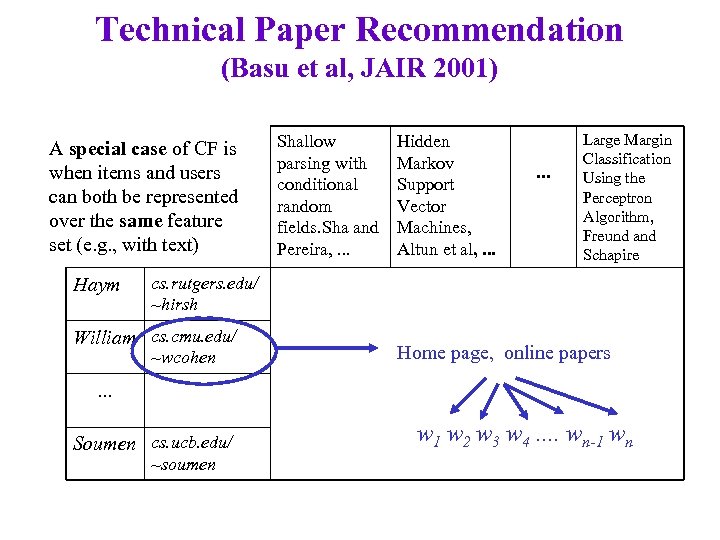
Technical Paper Recommendation (Basu et al, JAIR 2001) A special case of CF is when items and users can both be represented over the same feature set (e. g. , with text) Haym Shallow parsing with conditional random fields. Sha and Pereira, . . . Hidden Markov Support Vector Machines, Altun et al, . . . Large Margin Classification Using the Perceptron Algorithm, Freund and Schapire cs. rutgers. edu/ ~hirsh William cs. cmu. edu/ ~wcohen Home page, online papers . . . Soumen cs. ucb. edu/ ~soumen w 1 w 2 w 3 w 4. . wn-1 wn
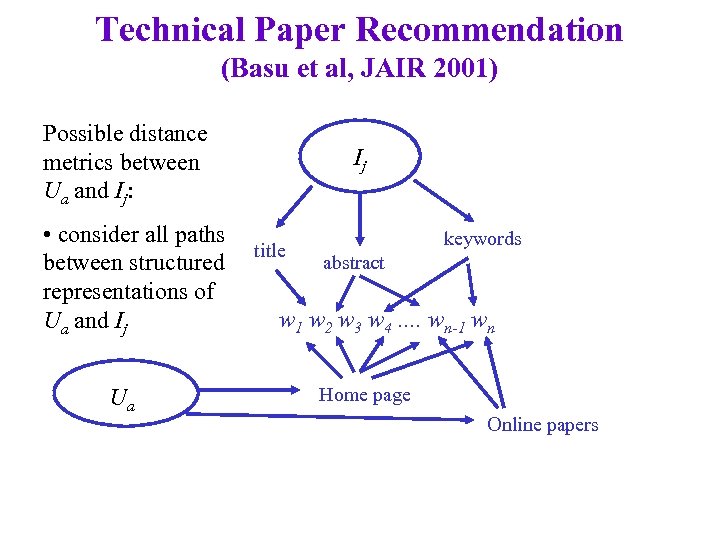
Technical Paper Recommendation (Basu et al, JAIR 2001) Possible distance metrics between Ua and Ij: • consider all paths between structured representations of Ua and Ij Ua Ij title keywords abstract w 1 w 2 w 3 w 4. . wn-1 wn Home page Online papers
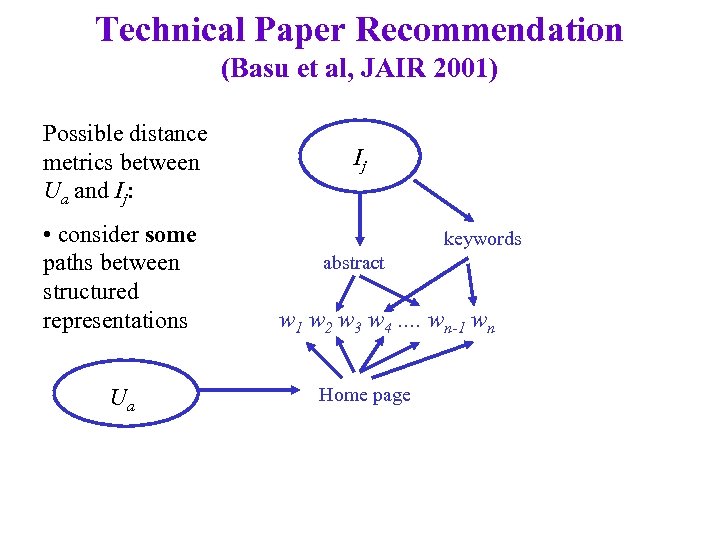
Technical Paper Recommendation (Basu et al, JAIR 2001) Possible distance metrics between Ua and Ij: • consider some paths between structured representations Ua Ij keywords abstract w 1 w 2 w 3 w 4. . wn-1 wn Home page
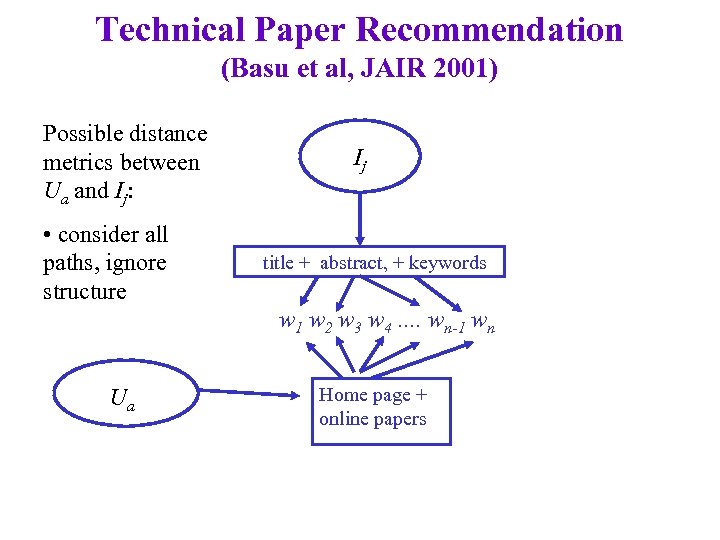
Technical Paper Recommendation (Basu et al, JAIR 2001) Possible distance metrics between Ua and Ij: • consider all paths, ignore structure Ij title + abstract, + keywords w 1 w 2 w 3 w 4. . wn-1 wn Ua Home page + online papers
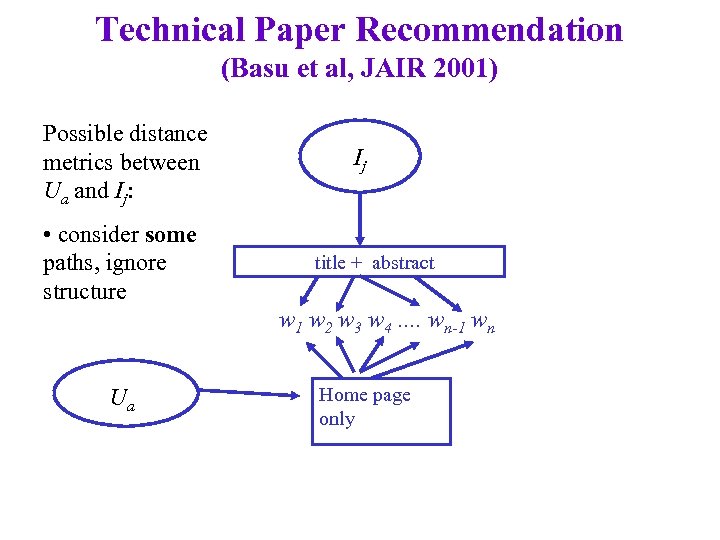
Technical Paper Recommendation (Basu et al, JAIR 2001) Possible distance metrics between Ua and Ij: • consider some paths, ignore structure Ij title + abstract w 1 w 2 w 3 w 4. . wn-1 wn Ua Home page only
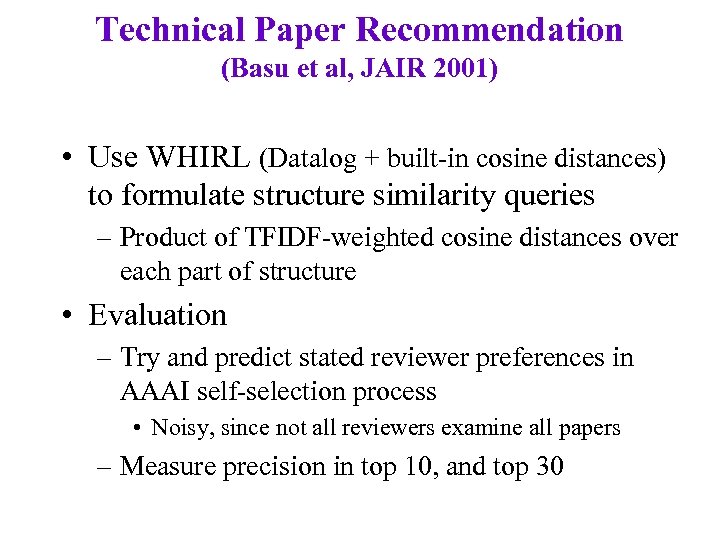
Technical Paper Recommendation (Basu et al, JAIR 2001) • Use WHIRL (Datalog + built-in cosine distances) to formulate structure similarity queries – Product of TFIDF-weighted cosine distances over each part of structure • Evaluation – Try and predict stated reviewer preferences in AAAI self-selection process • Noisy, since not all reviewers examine all papers – Measure precision in top 10, and top 30
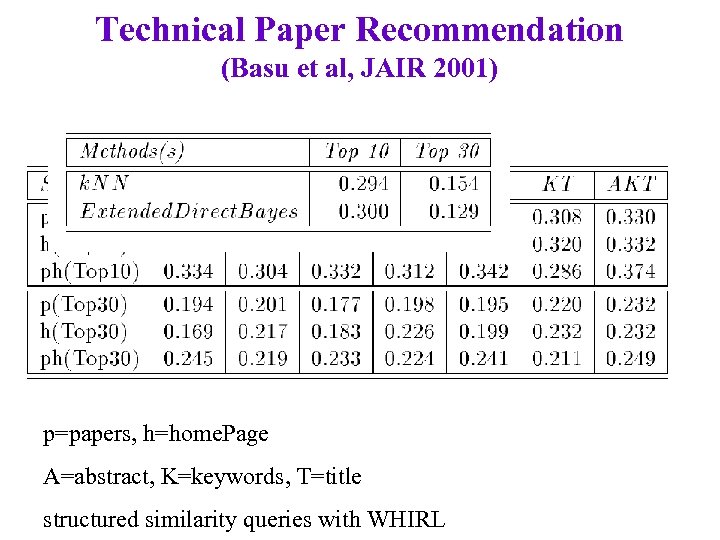
Technical Paper Recommendation (Basu et al, JAIR 2001) p=papers, h=home. Page A=abstract, K=keywords, T=title structured similarity queries with WHIRL
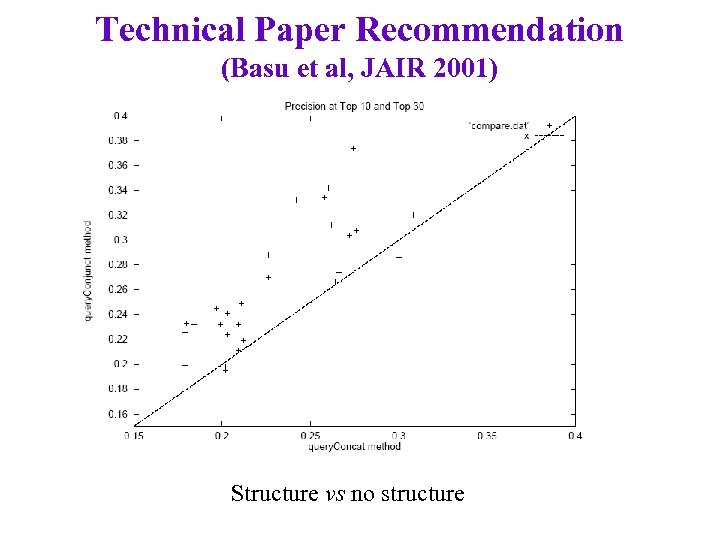
Technical Paper Recommendation (Basu et al, JAIR 2001) Structure vs no structure
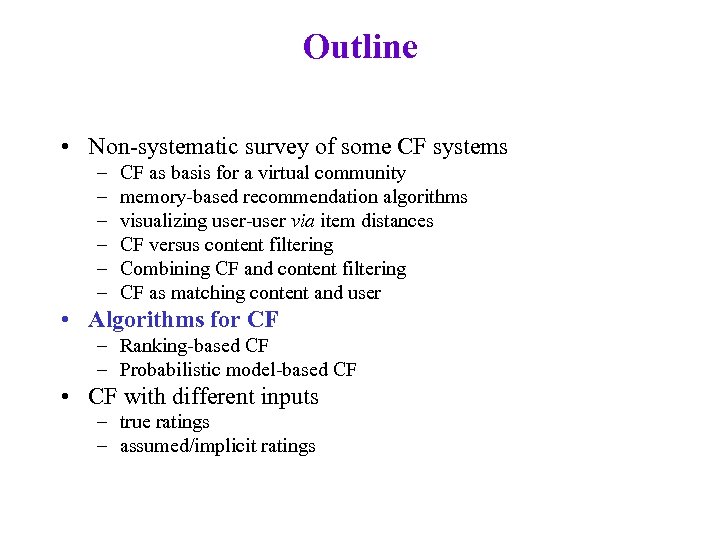
Outline • Non-systematic survey of some CF systems – – – CF as basis for a virtual community memory-based recommendation algorithms visualizing user-user via item distances CF versus content filtering Combining CF and content filtering CF as matching content and user • Algorithms for CF – Ranking-based CF – Probabilistic model-based CF • CF with different inputs – true ratings – assumed/implicit ratings
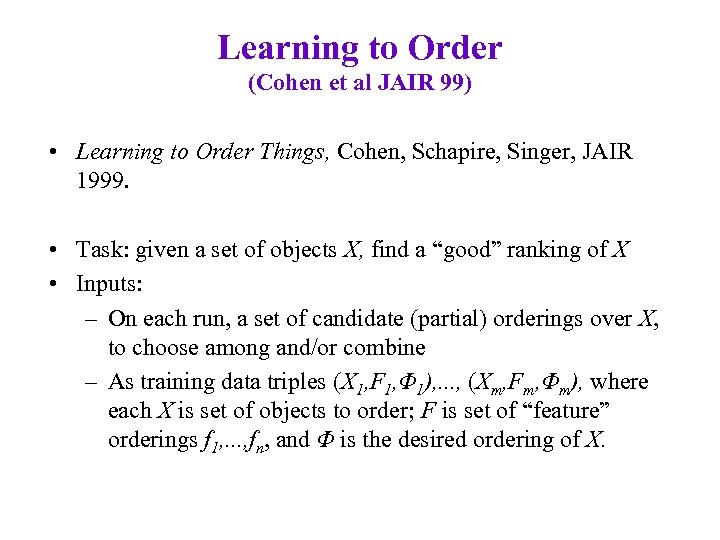
Learning to Order (Cohen et al JAIR 99) • Learning to Order Things, Cohen, Schapire, Singer, JAIR 1999. • Task: given a set of objects X, find a “good” ranking of X • Inputs: – On each run, a set of candidate (partial) orderings over X, to choose among and/or combine – As training data triples (X 1, F 1, Φ 1), . . . , (Xm, Fm, Φm), where each X is set of objects to order; F is set of “feature” orderings f 1, . . . , fn, and Φ is the desired ordering of X.
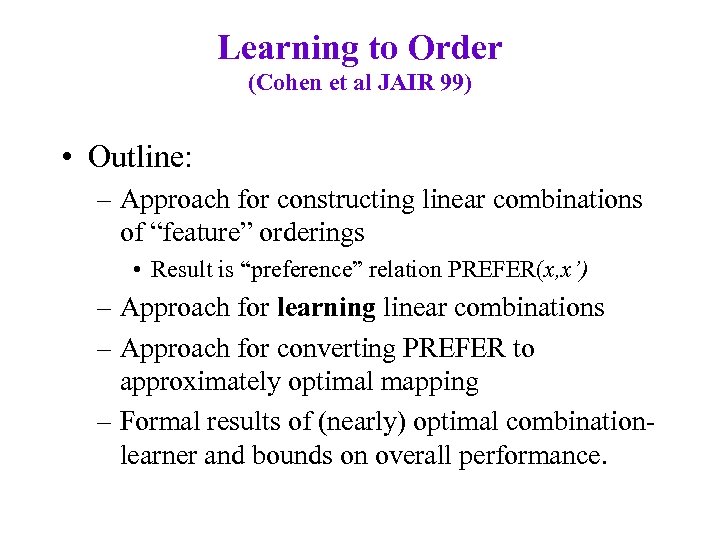
Learning to Order (Cohen et al JAIR 99) • Outline: – Approach for constructing linear combinations of “feature” orderings • Result is “preference” relation PREFER(x, x’) – Approach for learning linear combinations – Approach for converting PREFER to approximately optimal mapping – Formal results of (nearly) optimal combinationlearner and bounds on overall performance.
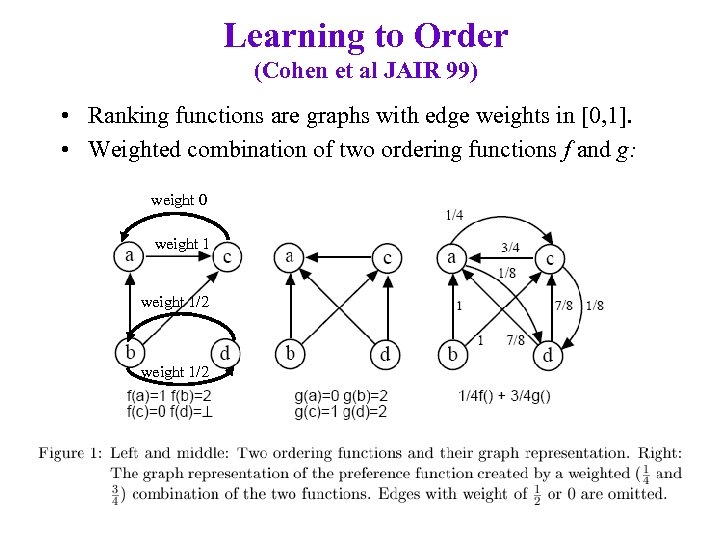
Learning to Order (Cohen et al JAIR 99) • Ranking functions are graphs with edge weights in [0, 1]. • Weighted combination of two ordering functions f and g: weight 0 weight 1/2
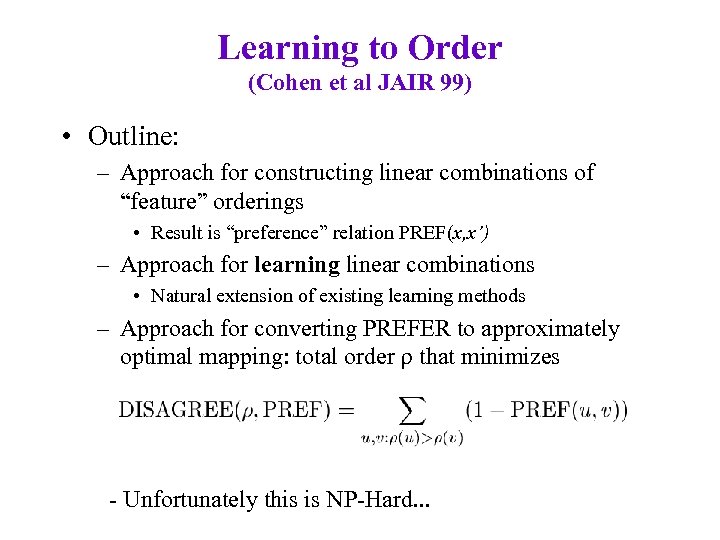
Learning to Order (Cohen et al JAIR 99) • Outline: – Approach for constructing linear combinations of “feature” orderings • Result is “preference” relation PREF(x, x’) – Approach for learning linear combinations • Natural extension of existing learning methods – Approach for converting PREFER to approximately optimal mapping: total order ρ that minimizes - Unfortunately this is NP-Hard. . .
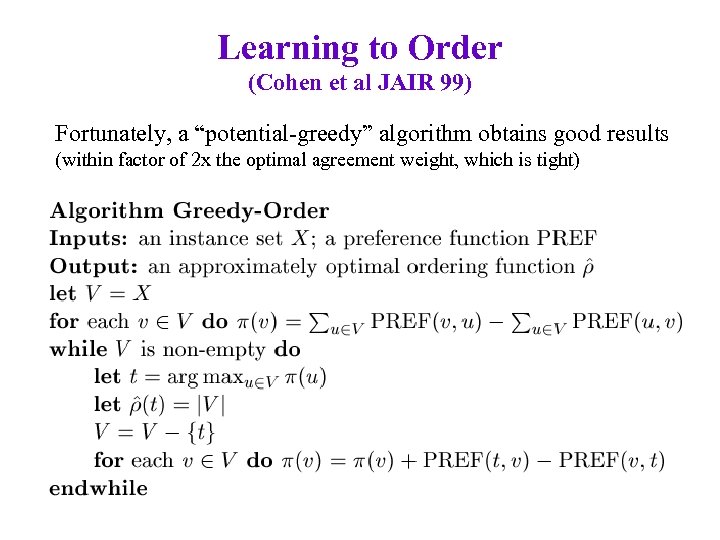
Learning to Order (Cohen et al JAIR 99) Fortunately, a “potential-greedy” algorithm obtains good results (within factor of 2 x the optimal agreement weight, which is tight)
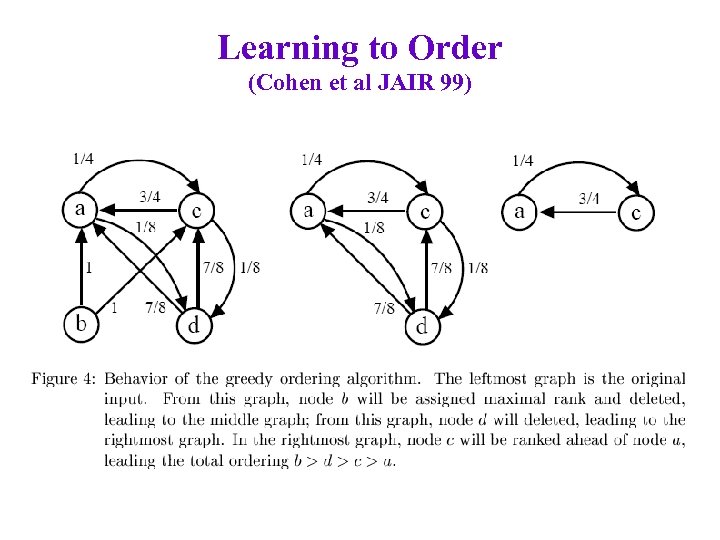
Learning to Order (Cohen et al JAIR 99)
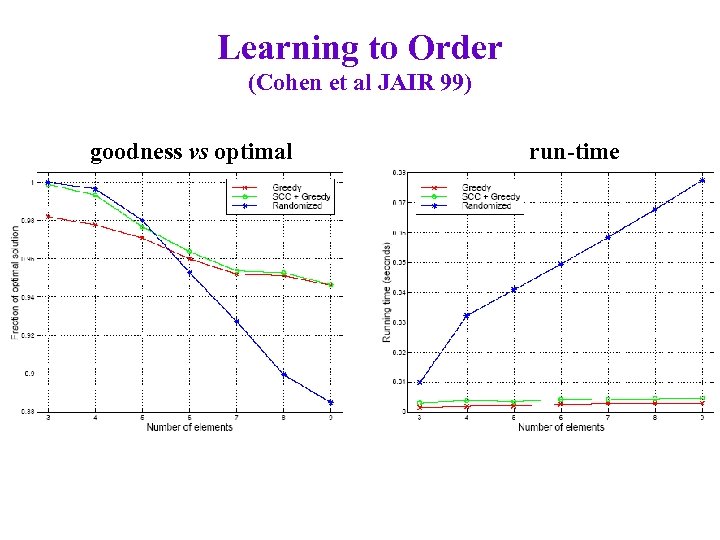
Learning to Order (Cohen et al JAIR 99) goodness vs optimal run-time
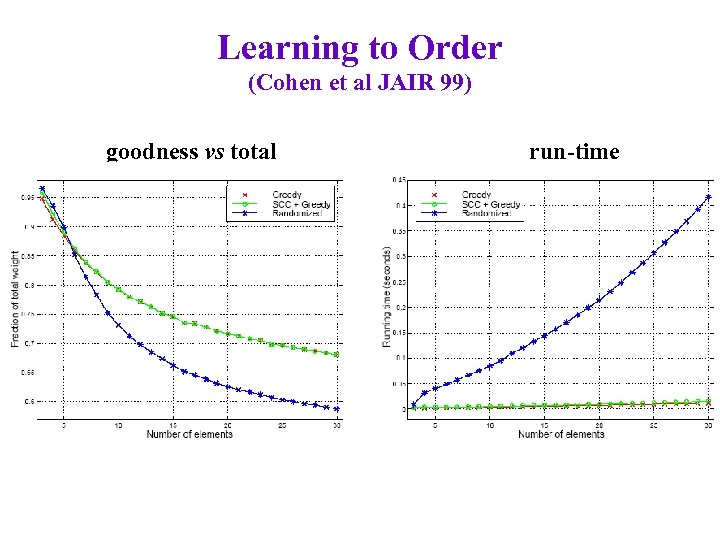
Learning to Order (Cohen et al JAIR 99) goodness vs total run-time
Learning to Order for CF (Freund, Iyer, Schapire, Singer JMLR 01) • A flaw in rating-based CF data – users tend to rate on different scales – this makes ratings hard to aggregate and transfer • A solution: – disbelieve (ignore) a user’s absolute ratings – believe (use in training) relative values • e. g. , if user rates item j 1 at “ 5” and item j 2 as “ 8” then believe j 1 is preferred to j 2. – i. e. , treat CF as a problem of learning to rank items.
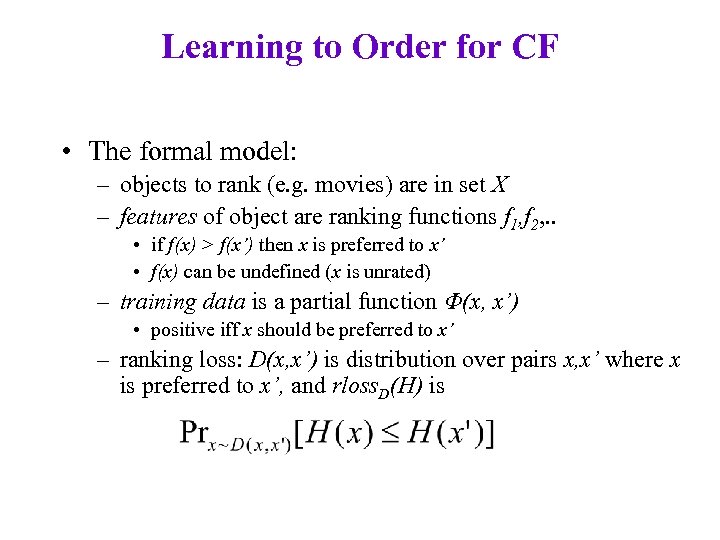
Learning to Order for CF • The formal model: – objects to rank (e. g. movies) are in set X – features of object are ranking functions f 1, f 2, . . • if f(x) > f(x’) then x is preferred to x’ • f(x) can be undefined (x is unrated) – training data is a partial function Φ(x, x’) • positive iff x should be preferred to x’ – ranking loss: D(x, x’) is distribution over pairs x, x’ where x is preferred to x’, and rloss. D(H) is
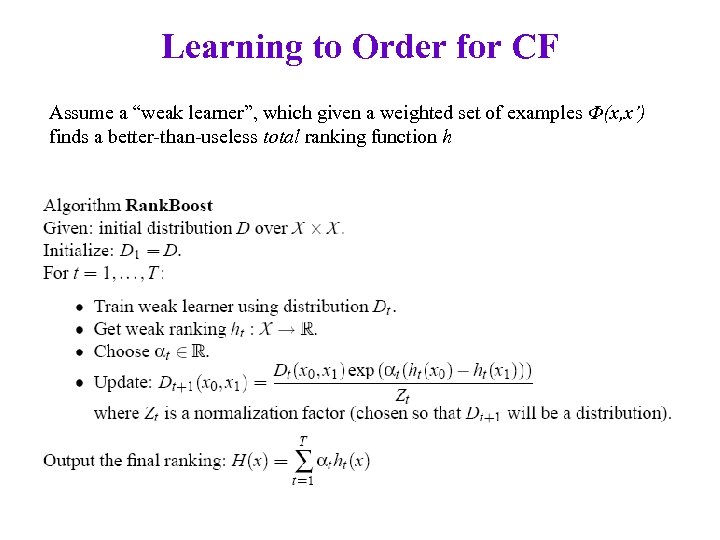
Learning to Order for CF Assume a “weak learner”, which given a weighted set of examples Φ(x, x’) finds a better-than-useless total ranking function h
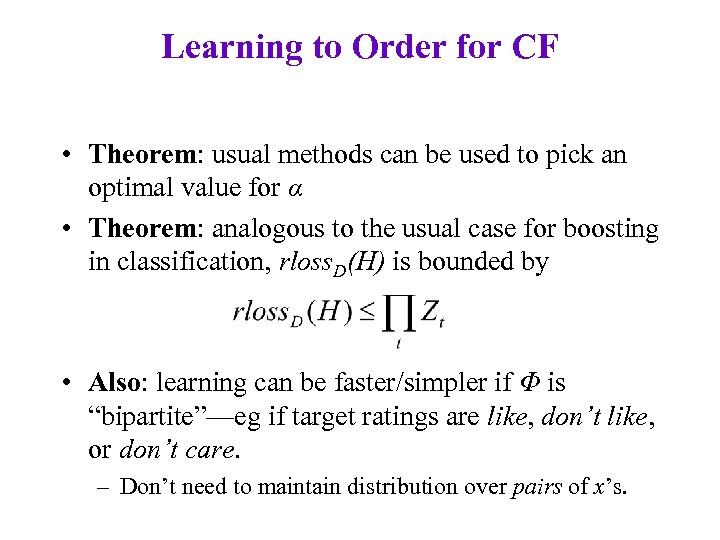
Learning to Order for CF • Theorem: usual methods can be used to pick an optimal value for α • Theorem: analogous to the usual case for boosting in classification, rloss. D(H) is bounded by • Also: learning can be faster/simpler if Φ is “bipartite”—eg if target ratings are like, don’t like, or don’t care. – Don’t need to maintain distribution over pairs of x’s.
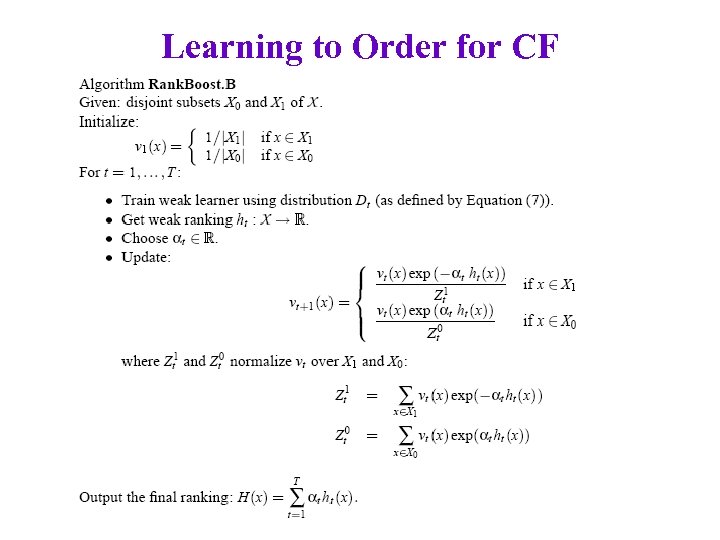
Learning to Order for CF
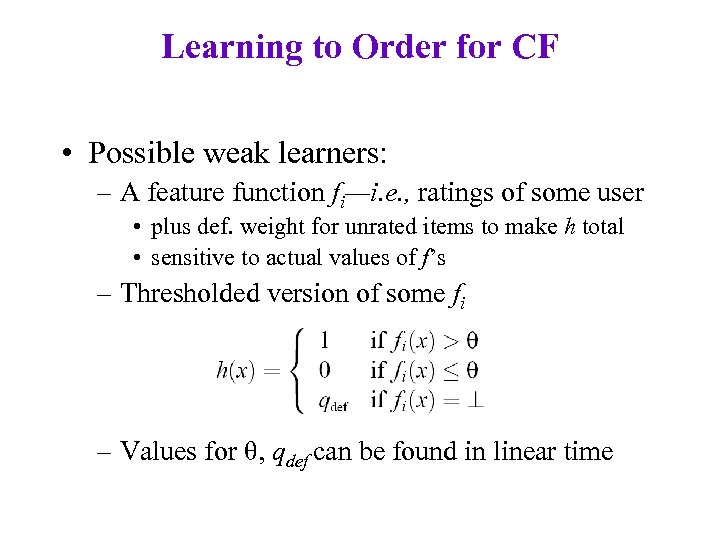
Learning to Order for CF • Possible weak learners: – A feature function fi—i. e. , ratings of some user • plus def. weight for unrated items to make h total • sensitive to actual values of f’s – Thresholded version of some fi – Values for θ, qdef can be found in linear time
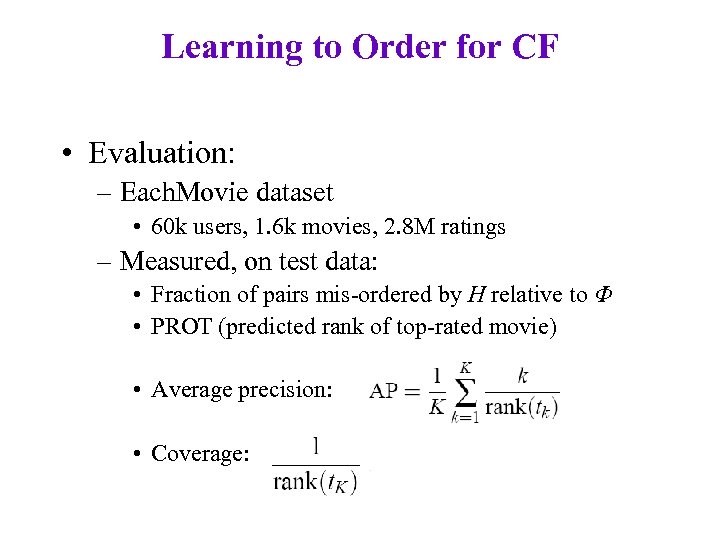
Learning to Order for CF • Evaluation: – Each. Movie dataset • 60 k users, 1. 6 k movies, 2. 8 M ratings – Measured, on test data: • Fraction of pairs mis-ordered by H relative to Φ • PROT (predicted rank of top-rated movie) • Average precision: • Coverage:
Learning to Order for CF • Evaluation: compared Rank. Boost with – VSIM (as in Breese et al) – 1 -NN (predict using “closest” neighbor to Ua, using rloss on known ratings as distance) – Linear regression (as in Bellcore’s Movie. Recommender) – Vary • number of features (aka users, community size, . . . ) • feature density (movies ranked per community member) • feedback density (movies ranked per target user)
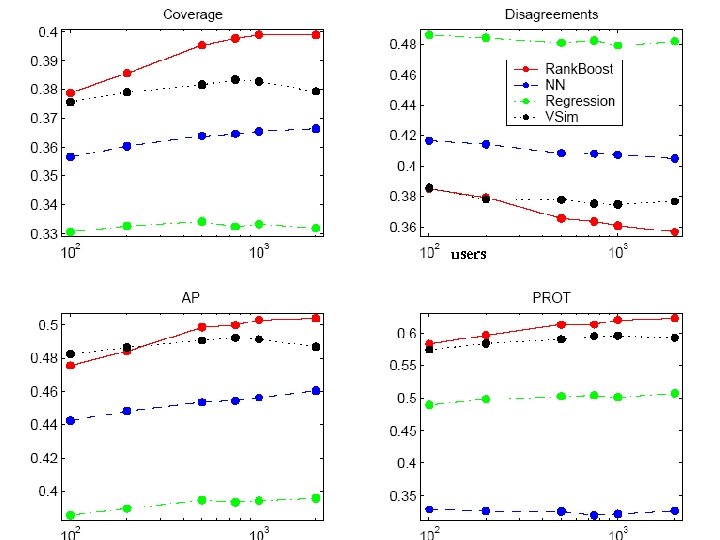
users
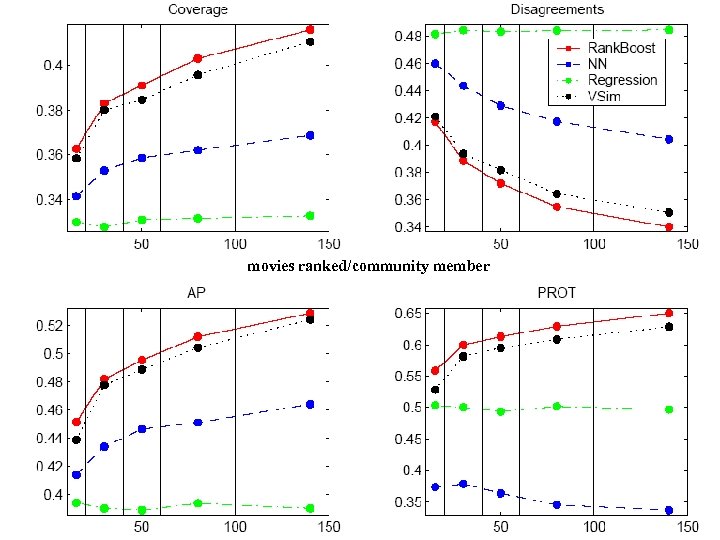
movies ranked/community member
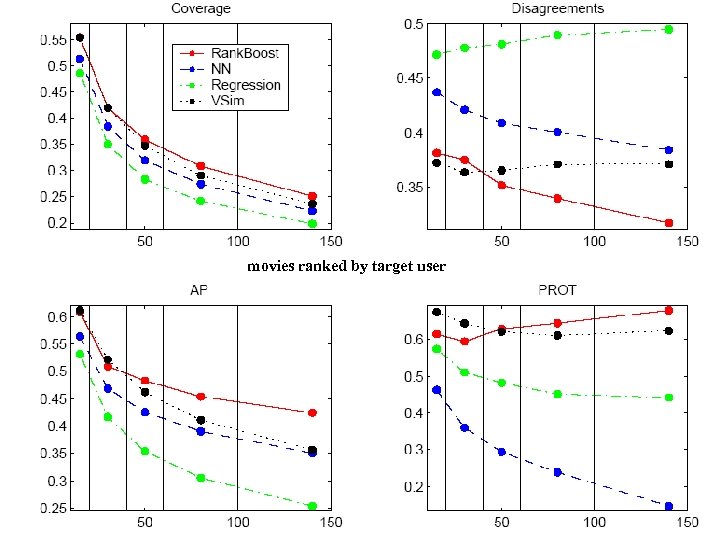
movies ranked by target user
Outline • Non-systematic survey of some CF systems – – – CF as basis for a virtual community memory-based recommendation algorithms visualizing user-user via item distances CF versus content filtering Combining CF and content filtering CF as matching content and user • Algorithms for CF – Ranking-based CF – Probabilistic model-based CF • CF with different inputs – true ratings – assumed/implicit ratings
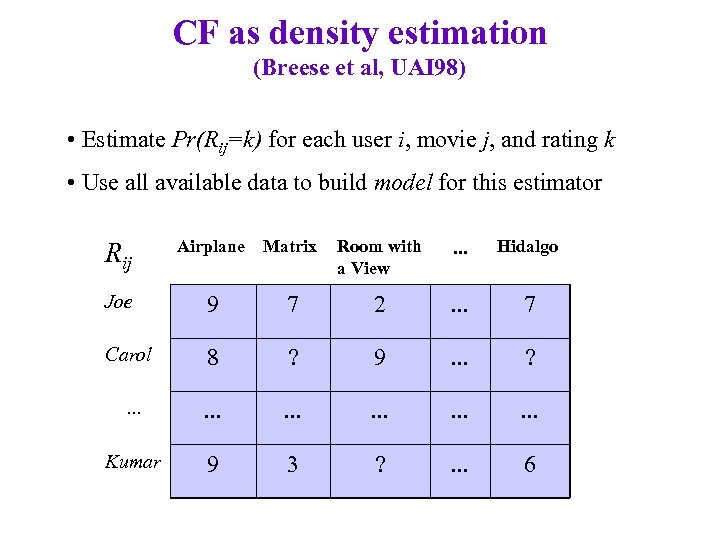
CF as density estimation (Breese et al, UAI 98) • Estimate Pr(Rij=k) for each user i, movie j, and rating k • Use all available data to build model for this estimator Rij Airplane Matrix Room with a View . . . Hidalgo Joe 9 7 2 . . . 7 Carol 8 ? 9 . . . ? . . . . Kumar 9 3 ? . . . 6
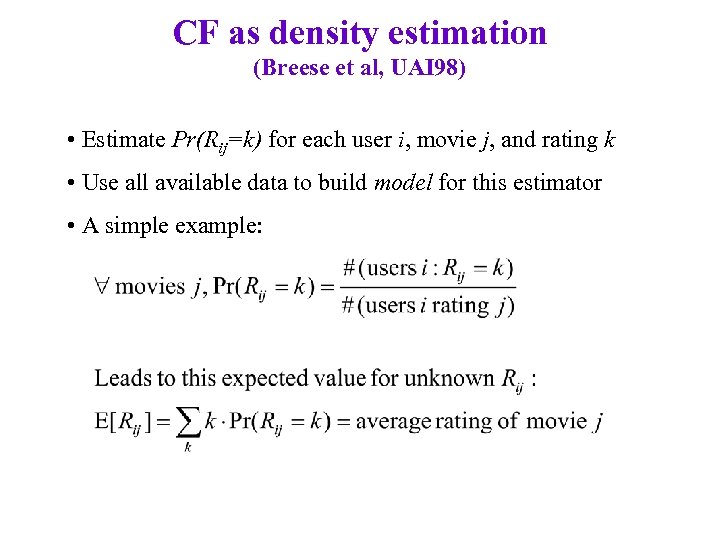
CF as density estimation (Breese et al, UAI 98) • Estimate Pr(Rij=k) for each user i, movie j, and rating k • Use all available data to build model for this estimator • A simple example:
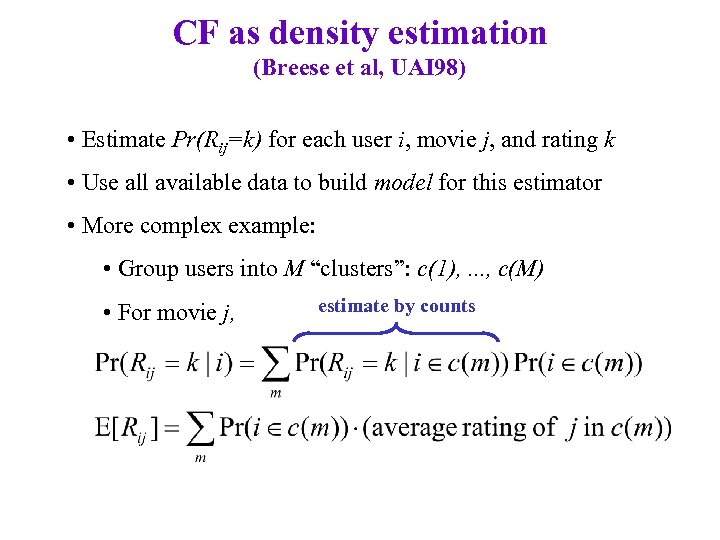
CF as density estimation (Breese et al, UAI 98) • Estimate Pr(Rij=k) for each user i, movie j, and rating k • Use all available data to build model for this estimator • More complex example: • Group users into M “clusters”: c(1), . . . , c(M) • For movie j, estimate by counts
CF as density estimation: BC (Breese et al, UAI 98) • Group users into clusters using Expectation-Maximization: • Randomly initialize Pr(Rm, j=k) for each m (i. e. , initialize the clusters differently somehow) • E-Step: Estimate Pr(user i in cluster m) for each i, m • M-Step: Find maximum likelihood (ML) estimator for Rij within each cluster m • Use ratio of #(users i in cluster m with rating Rij=k) to #(user i in cluster m ), weighted by Pr(i in m) from E-step • Repeat E-step, M-step until convergence
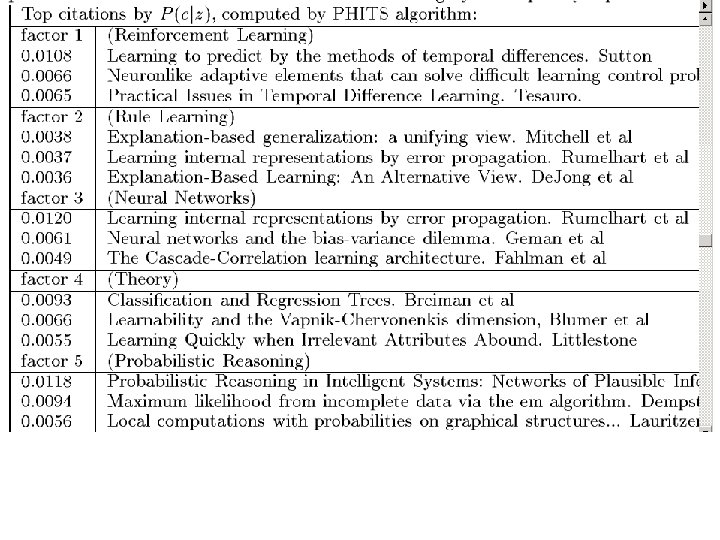
CF as density estimation: BC (Breese et al, UAI 98) • Aside: clustering-based density estimation is closely related to Page. Rank/HITS style web page recommendation. • Learning to Probabilistically Recognize Authoritative Documents, Cohn & Chang, ICML-2000. • Let observed bibliographies be community “users”, and papers “items” to recommend • Cluster bibliographies into “factors” (subcommunities, user clusters) • Find top-ranked papers for each “factor” (top movies for each subcommunity/cluster) • These are “authoritative” (likely to be cited)
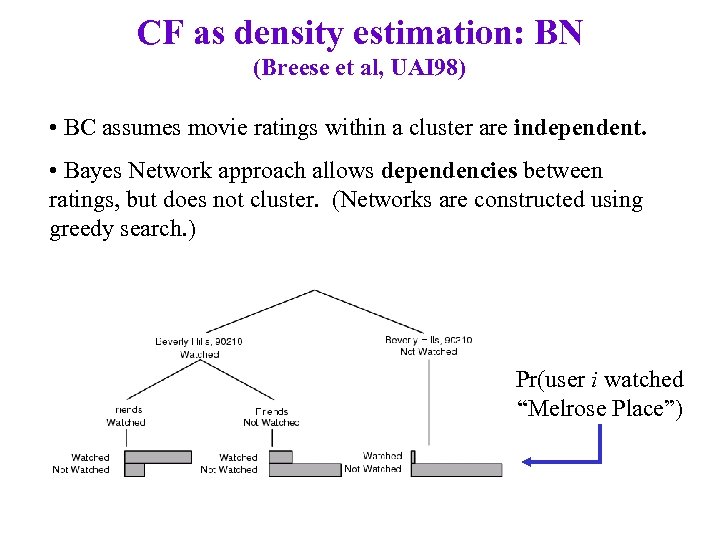
CF as density estimation: BN (Breese et al, UAI 98) • BC assumes movie ratings within a cluster are independent. • Bayes Network approach allows dependencies between ratings, but does not cluster. (Networks are constructed using greedy search. ) Pr(user i watched “Melrose Place”)
soccer score Algorithms for Collaborative Filtering 2: Memory-Based Algorithms (Breese et al, UAI 98) golf score
Datasets are different. . . fewer items to recommend fewer votes/user
soccer score Results on MS Web & Nielson’s
Outline • Non-systematic survey of some CF systems – – – CF as basis for a virtual community memory-based recommendation algorithms visualizing user-user via item distances CF versus content filtering Combining CF and content filtering CF as matching content and user • Algorithms for CF – Ranking-based CF – Probabilistic model-based CF – Probabilistic memory-based CF? • CF with different inputs – true ratings – assumed/implicit ratings
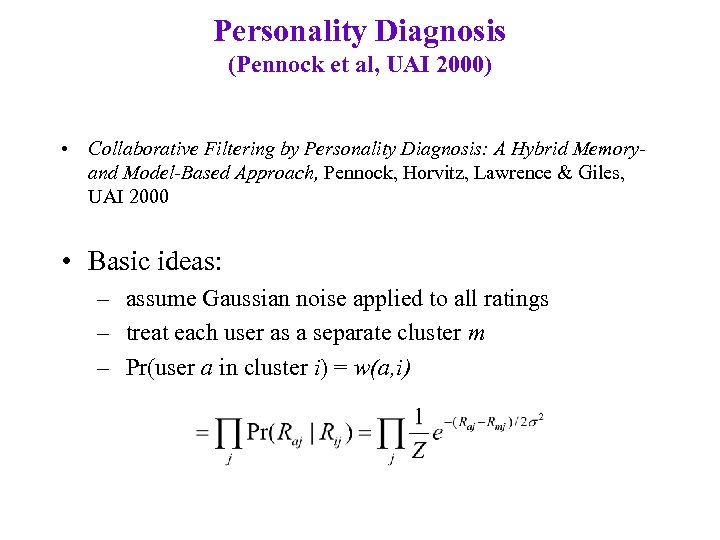
Personality Diagnosis (Pennock et al, UAI 2000) • Collaborative Filtering by Personality Diagnosis: A Hybrid Memoryand Model-Based Approach, Pennock, Horvitz, Lawrence & Giles, UAI 2000 • Basic ideas: – assume Gaussian noise applied to all ratings – treat each user as a separate cluster m – Pr(user a in cluster i) = w(a, i)
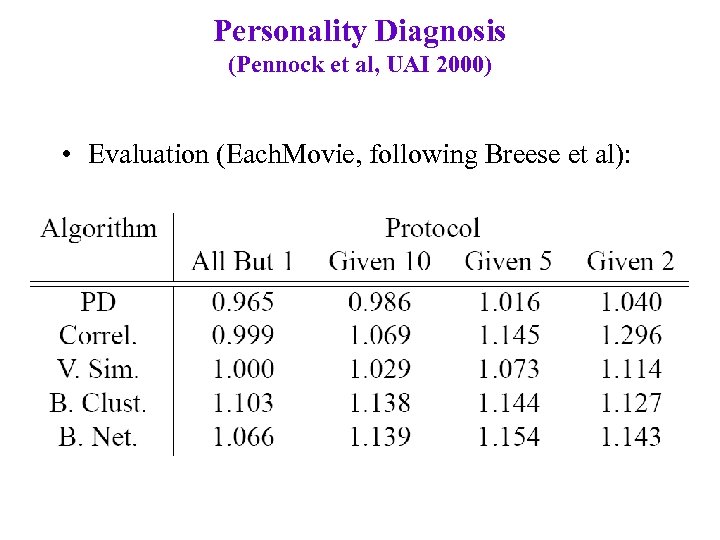
Personality Diagnosis (Pennock et al, UAI 2000) • Evaluation (Each. Movie, following Breese et al):
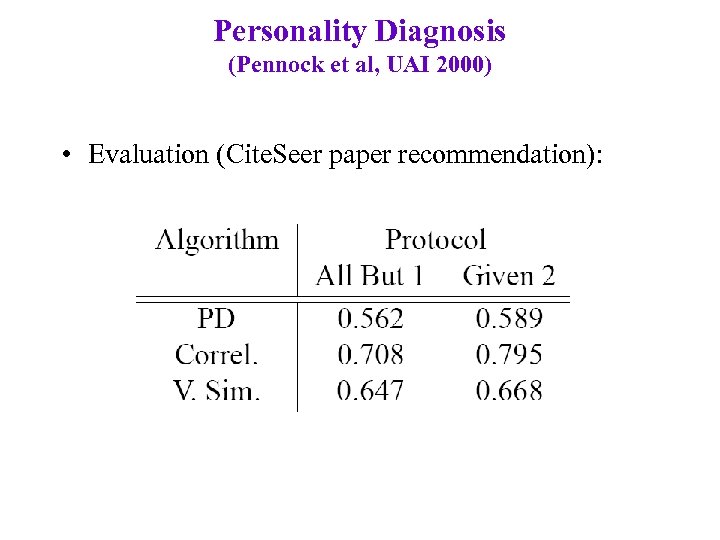
Personality Diagnosis (Pennock et al, UAI 2000) • Evaluation (Cite. Seer paper recommendation):
Outline • Non-systematic survey of some CF systems – – – CF as basis for a virtual community memory-based recommendation algorithms visualizing user-user via item distances CF versus content filtering Combining CF and content filtering CF as matching content and user • Algorithms for CF – Ranking-based CF – Probabilistic model-based CF – Probabilistic memory-based CF • CF with different inputs – true ratings – assumed/implicit ratings – ratings inferred from Web pages
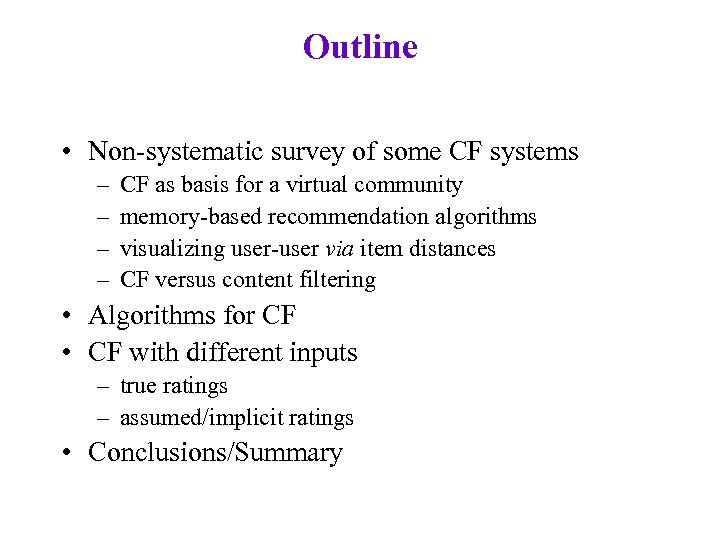
Outline • Non-systematic survey of some CF systems – – CF as basis for a virtual community memory-based recommendation algorithms visualizing user-user via item distances CF versus content filtering • Algorithms for CF • CF with different inputs – true ratings – assumed/implicit ratings • Conclusions/Summary
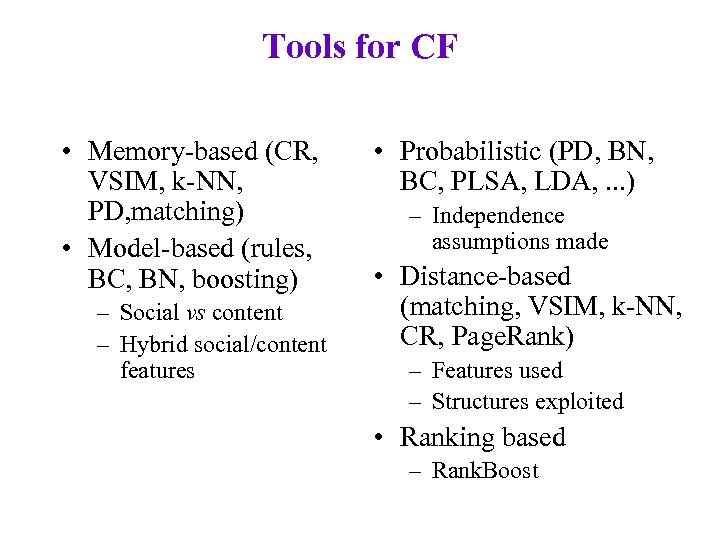
Tools for CF • Memory-based (CR, VSIM, k-NN, PD, matching) • Model-based (rules, BC, BN, boosting) – Social vs content – Hybrid social/content features • Probabilistic (PD, BN, BC, PLSA, LDA, . . . ) – Independence assumptions made • Distance-based (matching, VSIM, k-NN, CR, Page. Rank) – Features used – Structures exploited • Ranking based – Rank. Boost
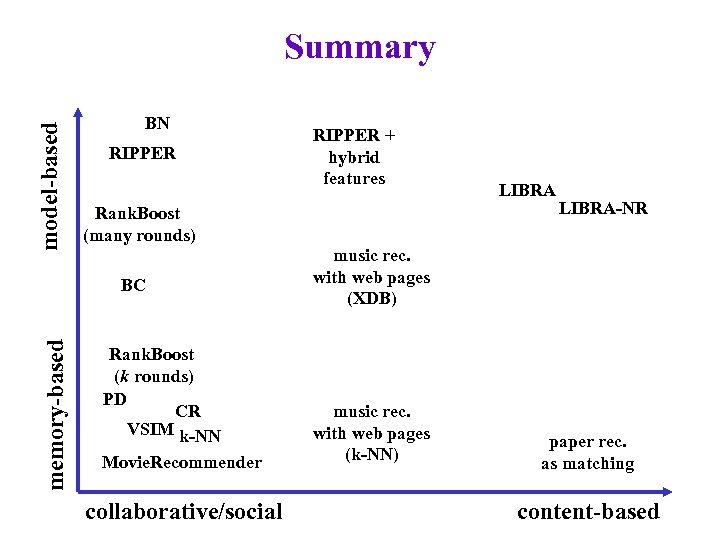
model-based Summary BN RIPPER Rank. Boost (many rounds) BC memory-based RIPPER + hybrid features Rank. Boost (k rounds) PD CR VSIM k-NN Movie. Recommender collaborative/social LIBRA-NR music rec. with web pages (XDB) music rec. with web pages (k-NN) paper rec. as matching content-based
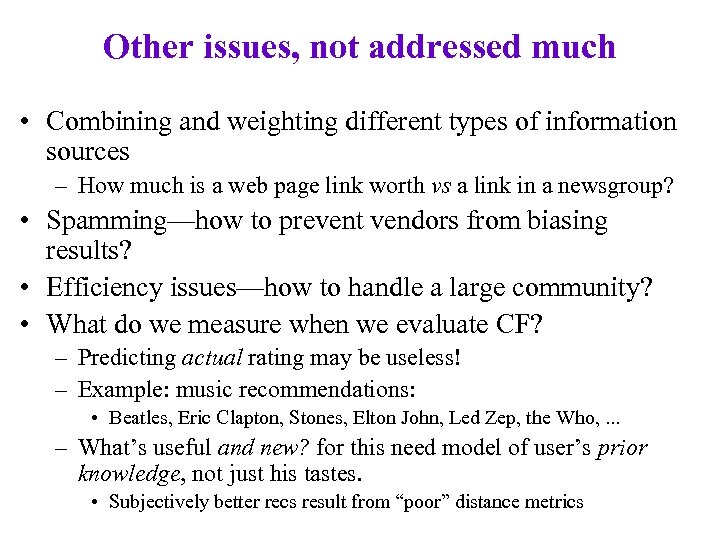
Other issues, not addressed much • Combining and weighting different types of information sources – How much is a web page link worth vs a link in a newsgroup? • Spamming—how to prevent vendors from biasing results? • Efficiency issues—how to handle a large community? • What do we measure when we evaluate CF? – Predicting actual rating may be useless! – Example: music recommendations: • Beatles, Eric Clapton, Stones, Elton John, Led Zep, the Who, . . . – What’s useful and new? for this need model of user’s prior knowledge, not just his tastes. • Subjectively better recs result from “poor” distance metrics
Final Comments • CF is one of a handful of learning-related tools that have had broadly visible impact: – Google, TIVO, Amazon, personal radio stations, . . . • Critical tool for finding “consensus information” present in a large community (or large corpus of web pages, or large DB of purchase records, . . ) – Similar in some respects to Q/A with corpora • Science is relatively-well established – in certain narrow directions, on a few datasets • Set of applications still being expanded • Some resources: – http: //www. sims. berkeley. edu/resources/collab/ – http: //www. cs. umn. edu/Research/Group. Lens/ – http: //www. cis. upenn. edu/~ungar/CF/
Скачать презентацию Collaborative Filtering A Tutorial William W Cohen Center
1dbe07d9142652a5e3a20058f0ee78b8.ppt