 Скачать презентацию Collaborating to Enhance Academics in Living-Learning Communities What
ecd54905e7341214cd2b01d9d0ebfd84.ppt
- Количество слайдов: 12



Collaborating to Enhance Academics in Living-Learning Communities What questions, challenges, ideas do you have about Learning Communities and academic enhancement? June 14, 2007 Russ Gill, Jeff Stein
Overview 1) Background/Identity 2) Partnerships 3) Academic Results 4) Questions LEARNING COMMUNITIES An Academic Affairs & Residence Life Collaboration
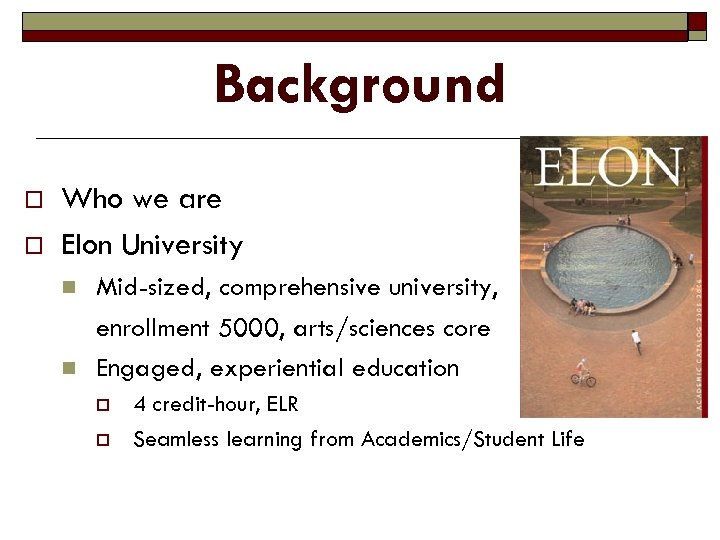
Background o o Who we are Elon University n n Mid-sized, comprehensive university, enrollment 5000, arts/sciences core Engaged, experiential education o o 4 credit-hour, ELR Seamless learning from Academics/Student Life
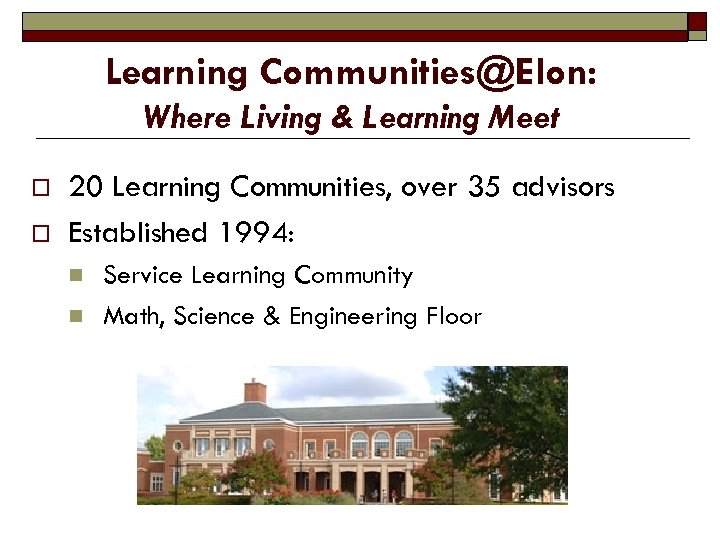
Learning Communities@Elon: Where Living & Learning Meet o o 20 Learning Communities, over 35 advisors Established 1994: n n Service Learning Community Math, Science & Engineering Floor
Elon’s RLC Mission Statement Learning Communities provide a rich variety of intentional communities designed to connect students, faculty & staff to support students’ academic, personal & social development & success through: 1. Integration of in-class & out-of-class learning 2. Academic & social programs that foster closeknit residential communities, 3. Social and academic support networks.
Partnership Challenges o Primarily Residence Life Project & Planning n n n Faculty isolation, burn out Theme communities, limited academic or departmental connection Student Affairs language, focus Limited budget, common spaces Unclear expectations
Partnership Solutions 1 o Inclusive Philosophy & Programs n n n LC Syllabus & Learning Objectives New faculty handbook LC’s as cohorts learning together, recruitment tools, extension of classroom Emphasize student-faculty engagement Working towards P&T, reassign time Provost-University strategic plan, budgeting
Partnership Solutions 2 o Inclusive, or Seamless, Staffing n n n Russ Gill, Faculty Fellow Nancy Harris, Associate Dean Arts & Sciences Learning Community Jeff Stein, English Dept. LC Contracts with departments, chairs, academic deans, Residence Life More systematic faculty development, models, etc.
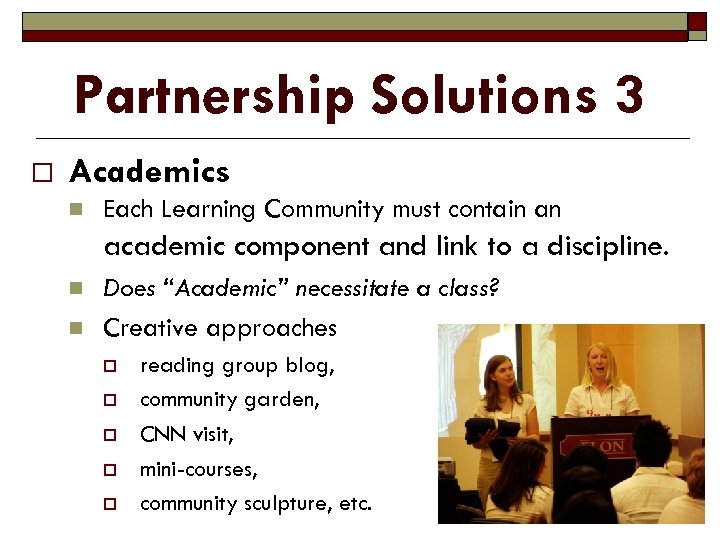
Partnership Solutions 3 o Academics n Each Learning Community must contain an academic component and link to a discipline. n n Does “Academic” necessitate a class? Creative approaches o o o reading group blog, community garden, CNN visit, mini-courses, community sculpture, etc.
Results o o o Linked courses: core 1 st year courses New LC applications focused on learning goals New LC halls with common space, faculty-in-residence Attention from Academic Affairs, University budget & priorities, faculty meetings Each LC must meet a unique departmental goal or student need. Start with learning outcomes & syllabi— naturally leads to knowledge/skill development
Discussion/Questions 1. 2. 3. 4. What does the academic component of your RLC program look like? How have you defined “academic” besides traditional classes? What do Learning Communities contribute to your campus? What causes students to buy into/support your RLC’s?
Russ Gill Professor of English, RLC Faculty Fellow, Distinguished University Professor (336) 278 -5629 gillruss@elon. edu Jeff Stein Asst. Dean of Students for Residence Life & Service Learning, Asst. Professor (336) 278 -7300 jstein@elon. edu
Скачать презентацию Collaborating to Enhance Academics in Living-Learning Communities What
ecd54905e7341214cd2b01d9d0ebfd84.ppt