 Скачать презентацию Cohort III International Pain Policy Fellows Opioid Availability
1b1bf50aae71d73afb26b7869550d021.ppt
- Количество слайдов: 26



Cohort III International Pain Policy Fellows Opioid Availability Action Planning Worksheet Madison, Wisconsin, USA 6 – 10 August 2012 University of Wisconsin Pain & Policy Studies Group World Health Organization Collaborating Center for Pain Policy and Palliative Care
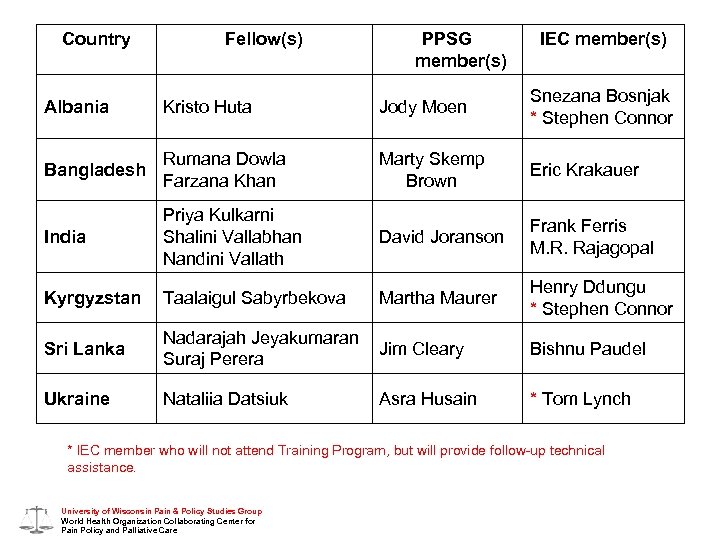
Country Fellow(s) PPSG member(s) IEC member(s) Albania Kristo Huta Jody Moen Snezana Bosnjak * Stephen Connor Bangladesh Rumana Dowla Farzana Khan Marty Skemp Brown Eric Krakauer India Priya Kulkarni Shalini Vallabhan Nandini Vallath David Joranson Frank Ferris M. R. Rajagopal Kyrgyzstan Taalaigul Sabyrbekova Martha Maurer Henry Ddungu * Stephen Connor Sri Lanka Nadarajah Jeyakumaran Suraj Perera Jim Cleary Bishnu Paudel Ukraine Nataliia Datsiuk Asra Husain * Tom Lynch * IEC member who will not attend Training Program, but will provide follow-up technical assistance. University of Wisconsin Pain & Policy Studies Group World Health Organization Collaborating Center for Pain Policy and Palliative Care
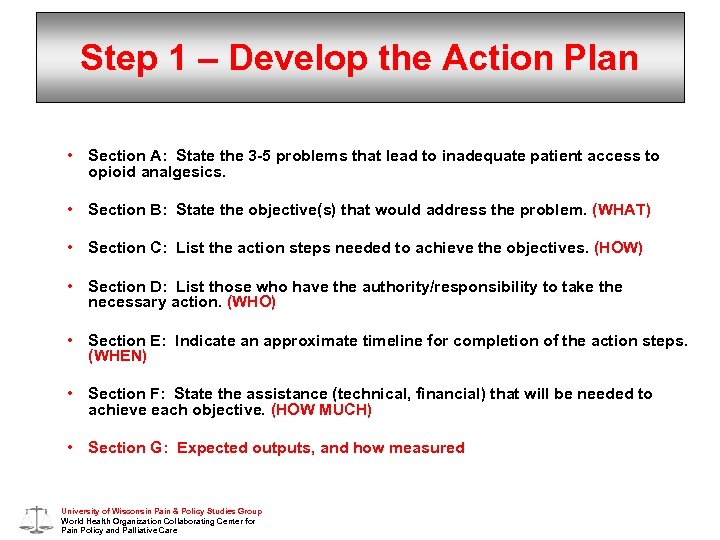
Step 1 – Develop the Action Plan • Section A: State the 3 -5 problems that lead to inadequate patient access to opioid analgesics. • Section B: State the objective(s) that would address the problem. (WHAT) • Section C: List the action steps needed to achieve the objectives. (HOW) • Section D: List those who have the authority/responsibility to take the necessary action. (WHO) • Section E: Indicate an approximate timeline for completion of the action steps. (WHEN) • Section F: State the assistance (technical, financial) that will be needed to achieve each objective. (HOW MUCH) • Section G: Expected outputs, and how measured University of Wisconsin Pain & Policy Studies Group World Health Organization Collaborating Center for Pain Policy and Palliative Care
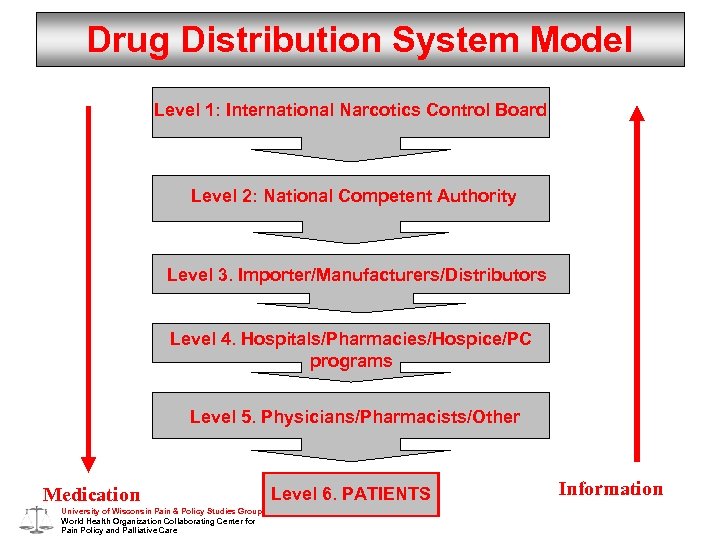
Drug Distribution System Model Level 1: International Narcotics Control Board Level 2: National Competent Authority Level 3. Importer/Manufacturers/Distributors Level 4. Hospitals/Pharmacies/Hospice/PC programs Level 5. Physicians/Pharmacists/Other Medication University of Wisconsin Pain & Policy Studies Group World Health Organization Collaborating Center for Pain Policy and Palliative Care Level 6. PATIENTS Information

Action Plan for: Kyrgyz Republic Prepared by: Taalaigul Sabyrbekova Martha Maurer Henry Ddungu Stephen Connor 10 August 2012 University of Wisconsin Pain & Policy Studies Group World Health Organization Collaborating Center for Pain Policy and Palliative Care
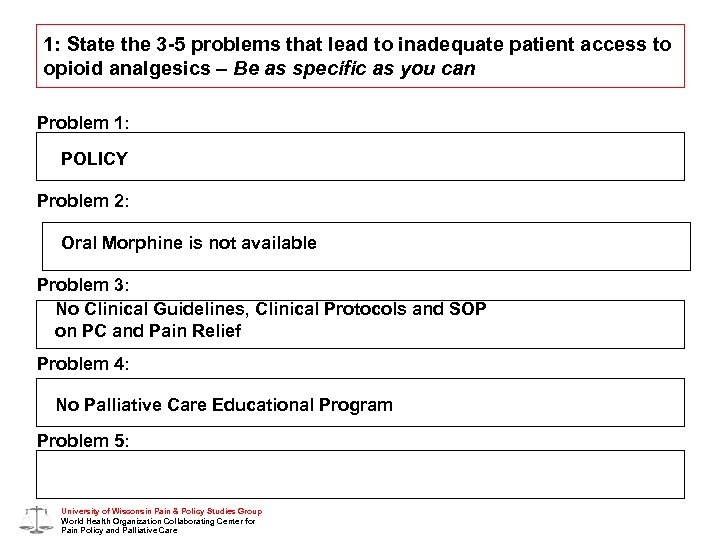
1: State the 3 -5 problems that lead to inadequate patient access to opioid analgesics – Be as specific as you can Problem 1: POLICY Problem 2: Oral Morphine is not available Problem 3: No Clinical Guidelines, Clinical Protocols and SOP on PC and Pain Relief Problem 4: No Palliative Care Educational Program Problem 5: University of Wisconsin Pain & Policy Studies Group World Health Organization Collaborating Center for Pain Policy and Palliative Care
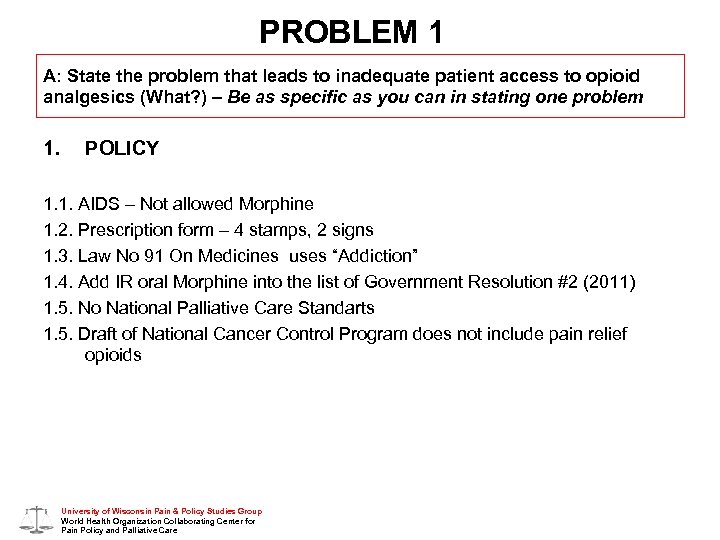
PROBLEM 1 A: State the problem that leads to inadequate patient access to opioid analgesics (What? ) – Be as specific as you can in stating one problem 1. POLICY 1. 1. AIDS – Not allowed Morphine 1. 2. Prescription form – 4 stamps, 2 signs 1. 3. Law No 91 On Medicines uses “Addiction” 1. 4. Add IR oral Morphine into the list of Government Resolution #2 (2011) 1. 5. No National Palliative Care Standarts 1. 5. Draft of National Cancer Control Program does not include pain relief opioids University of Wisconsin Pain & Policy Studies Group World Health Organization Collaborating Center for Pain Policy and Palliative Care
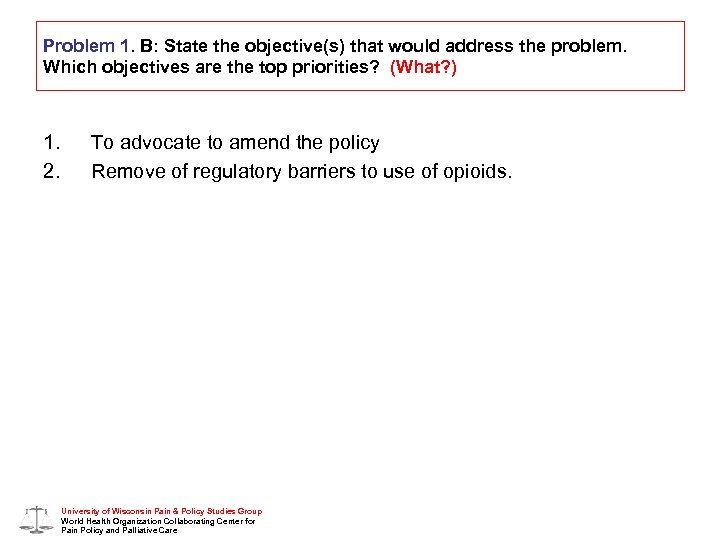
Problem 1. B: State the objective(s) that would address the problem. Which objectives are the top priorities? (What? ) 1. 2. To advocate to amend the policy Remove of regulatory barriers to use of opioids. University of Wisconsin Pain & Policy Studies Group World Health Organization Collaborating Center for Pain Policy and Palliative Care
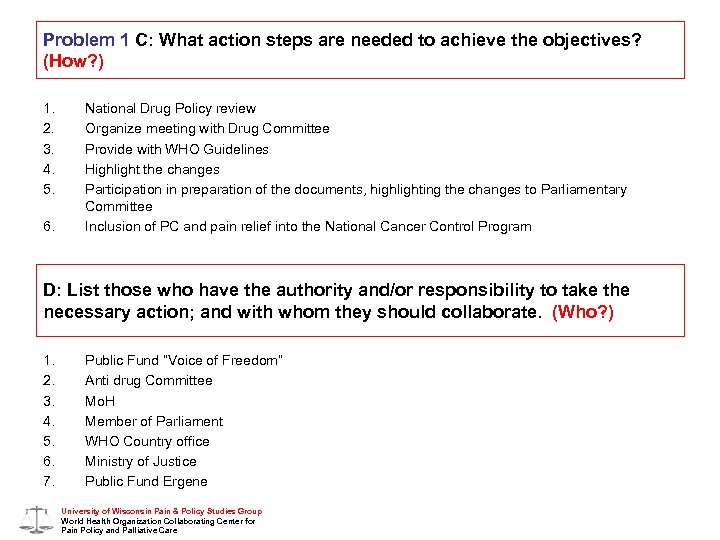
Problem 1 C: What action steps are needed to achieve the objectives? (How? ) 1. 2. 3. 4. 5. 6. National Drug Policy review Organize meeting with Drug Committee Provide with WHO Guidelines Highlight the changes Participation in preparation of the documents, highlighting the changes to Parliamentary Committee Inclusion of PC and pain relief into the National Cancer Control Program D: List those who have the authority and/or responsibility to take the necessary action; and with whom they should collaborate. (Who? ) 1. 2. 3. 4. 5. 6. 7. Public Fund “Voice of Freedom” Anti drug Committee Mo. H Member of Parliament WHO Country office Ministry of Justice Public Fund Ergene University of Wisconsin Pain & Policy Studies Group World Health Organization Collaborating Center for Pain Policy and Palliative Care
Problem 1 E: Timeline for completion of action steps. (When? ) 1. 2. 2. 3. 4. National Drug Policy review and Highlight the changes – 2 months Organize meeting with Drug Committee – on November 2012 Participation in preparation of the documents, highlighting the changes to Parliamentary Committee – November- March 2013 Present to the Parliament – March 2013 Getting approval from Parliament - ? F: What assistance (technical, financial) will be needed to achieve each objective under part “B”? (How much? ) 1. 2. PPSG Soros Foundation University of Wisconsin Pain & Policy Studies Group World Health Organization Collaborating Center for Pain Policy and Palliative Care
Problem 1 G: Expected outputs, and how measured 1. 2. 3. Policy amended Presence of approved regulations Policy reviewed University of Wisconsin Pain & Policy Studies Group World Health Organization Collaborating Center for Pain Policy and Palliative Care
PROBLEM 2 A: State the problem that leads to inadequate patient access to opioid analgesics (What? ) – Be as specific as you can in stating one problem Oral Morphine is not available University of Wisconsin Pain & Policy Studies Group World Health Organization Collaborating Center for Pain Policy and Palliative Care
Problem 2. B: State the objective(s) that would address the problem. Which objectives are the top priorities? (What? ) To make oral morphine available and accessible in sufficient amounts in Kyrgyzstan University of Wisconsin Pain & Policy Studies Group World Health Organization Collaborating Center for Pain Policy and Palliative Care
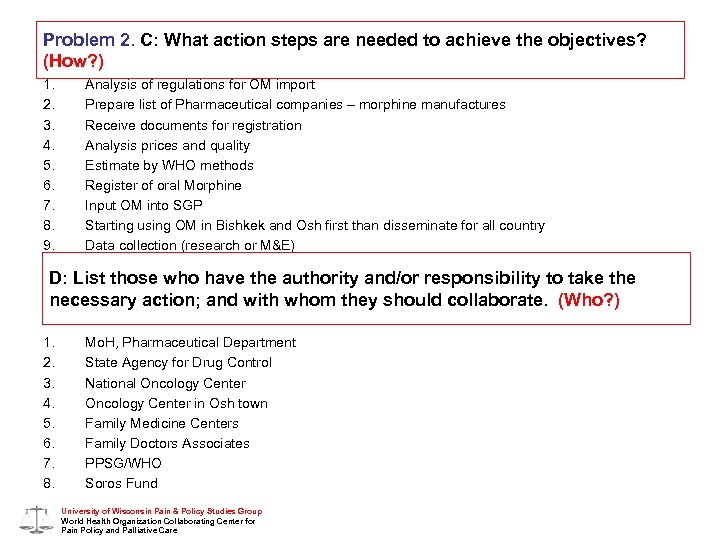
Problem 2. C: What action steps are needed to achieve the objectives? (How? ) 1. 2. 3. 4. 5. 6. 7. 8. 9. Analysis of regulations for OM import Prepare list of Pharmaceutical companies – morphine manufactures Receive documents for registration Analysis prices and quality Estimate by WHO methods Register of oral Morphine Input OM into SGP Starting using OM in Bishkek and Osh first than disseminate for all country Data collection (research or M&E) D: List those who have the authority and/or responsibility to take the necessary action; and with whom they should collaborate. (Who? ) 1. 2. 3. 4. 5. 6. 7. 8. Mo. H, Pharmaceutical Department State Agency for Drug Control National Oncology Center in Osh town Family Medicine Centers Family Doctors Associates PPSG/WHO Soros Fund University of Wisconsin Pain & Policy Studies Group World Health Organization Collaborating Center for Pain Policy and Palliative Care
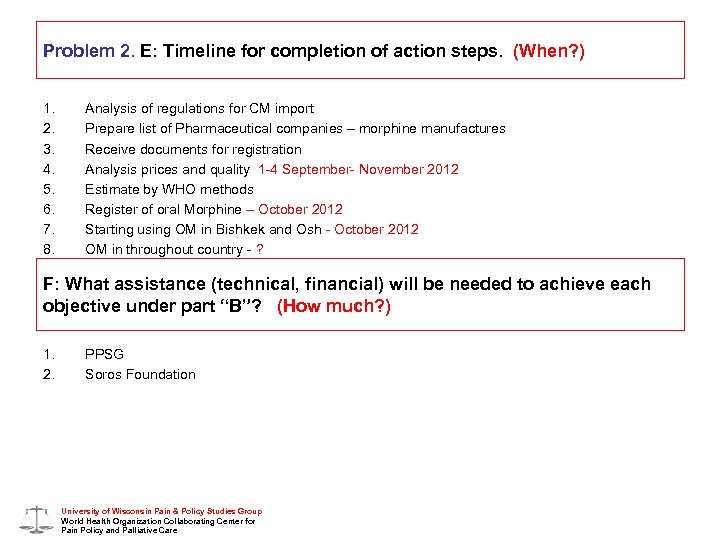
Problem 2. E: Timeline for completion of action steps. (When? ) 1. 2. 3. 4. 5. 6. 7. 8. Analysis of regulations for CM import Prepare list of Pharmaceutical companies – morphine manufactures Receive documents for registration Analysis prices and quality 1 -4 September- November 2012 Estimate by WHO methods Register of oral Morphine – October 2012 Starting using OM in Bishkek and Osh - October 2012 OM in throughout country - ? F: What assistance (technical, financial) will be needed to achieve each objective under part “B”? (How much? ) 1. 2. PPSG Soros Foundation University of Wisconsin Pain & Policy Studies Group World Health Organization Collaborating Center for Pain Policy and Palliative Care
Problem 2 G: Expected outputs, and how measured 1. Oral Morphine will available and accessible 1. 1. OM registered 1. 2. Quantity of OM consumed University of Wisconsin Pain & Policy Studies Group World Health Organization Collaborating Center for Pain Policy and Palliative Care
PROBLEM 3 A: State the problem that leads to inadequate patient access to opioid analgesics (What? ) – Be as specific as you can in stating one problem No Clinical Guidelines, Clinical Protocols and SOP on PC and Pain Relief University of Wisconsin Pain & Policy Studies Group World Health Organization Collaborating Center for Pain Policy and Palliative Care
Problem 3. B: State the objective(s) that would address the problem. Which objectives are the top priorities? (What? ) To ensure PC is understood and provided in streamlined way to guarantee quality service delivery at all Heath Care Levels in KR University of Wisconsin Pain & Policy Studies Group World Health Organization Collaborating Center for Pain Policy and Palliative Care
Problem 3. C: What action steps are needed to achieve the objectives? (How? ) Develop Clinical Guidelines, Clinical Protocols and SOP on PC and Pain Relief - Identify the existing guidelines - Adapting to KR - Getting approval of Mo. H - Publishing - Implementation and dissemination among health care workers throughout country D: List those who have the authority and/or responsibility to take the necessary action; and with whom they should collaborate. (Who? ) 1. 2. 3. 4. 5. 6. 7. KMSIP and CME Mo. H National Oncology Center in Osh town PPSG FSK Public Fund Ergene University of Wisconsin Pain & Policy Studies Group World Health Organization Collaborating Center for Pain Policy and Palliative Care
Problem 3. E: Timeline for completion of action steps. (When? ) 1. Develop Clinical Guidelines – September 30, 2012 Clinical Protocols and SOP on PC and Pain Relief – December 15, 2012 - Identify the existing guidelines - Adapting to KR - Getting approval of Mo. H - Publishing -Implementation and dissemination among health care workers throughout country - Ongoing process 2. Develop PC National Standards - ? F: What assistance (technical, financial) will be needed to achieve each objective under part “B”? (How much? ) 1. 2. 3. 4. 5. Evidence based Center of the Mo. H KSMIP and CME National Oncology Center PPSG Soros Foundation University of Wisconsin Pain & Policy Studies Group World Health Organization Collaborating Center for Pain Policy and Palliative Care
Problem 3 G: Expected outputs, and how measured 1. Clinical Guidelines, Clinical Protocols and SOP on PC and Pain Relief will developed 2. PC National Standards will be developed Number of published CG, CP Number of educated health workers University of Wisconsin Pain & Policy Studies Group World Health Organization Collaborating Center for Pain Policy and Palliative Care
PROBLEM 4 A: State the problem that leads to inadequate patient access to opioid analgesics (What? ) – Be as specific as you can in stating one problem - No Palliative Care Educational Program: for health workers for population for special group University of Wisconsin Pain & Policy Studies Group World Health Organization Collaborating Center for Pain Policy and Palliative Care
Problem 4. B: State the objective(s) that would address the problem. Which objectives are the top priorities? (What? ) 1. Develop and implement educational programs into under and postgraduate medical institutions (Development of an academic program that prepares physicians and nurses to specialize in palliative care. Possibly a diploma program or fellowship and certification) 2. Develop and implement public awareness campaign on pain relief University of Wisconsin Pain & Policy Studies Group World Health Organization Collaborating Center for Pain Policy and Palliative Care
Problem 4. 1. 2. 3. 4. 5. C: What action steps are needed to achieve the objectives? (How? ) Incorporation of palliative care issues into major pre-graduation curricula (KSMA, KRSU, medical faculty of Osh state University) and post-graduate curricula for upgrading qualification of doctors, nurses, social workers в (KSMI and CME) Training of family members, development of patients schools, development of peer to peer education Expansion of the role of public health in development and implementation of solutions of physical, psychological problems emerging in progression of an incurable disease Development and incorporation of palliative care educational programs for social workers, members of patients’ families Conducting of media campaigns on PC D: List those who have the authority and/or responsibility to take the necessary action; and with whom they should collaborate. (Who? ) 1. 2. 3. 4. 5. 6. 7. 8. 9. Mo. H Ministry of Education Kyrgyz State Medical Academy Kyrgyz Russian Slavonic University Medical faculty of Osh state University Kyrgyz State Medical Institute and CME Social Workers Association National TV and Radio NGO and PP Union University of Wisconsin Pain & Policy Studies Group World Health Organization Collaborating Center for Pain Policy and Palliative Care
Problem 4. E: Timeline for completion of action steps. (When? ) 1. 2. 3. Develop/adapt educational program – 6 months Implement educational programs into under and postgraduate medical institutions – September 2013 Develop and implement public awareness campaign on pain relief - since September 2012 -? F: What assistance (technical, financial) will be needed to achieve each objective under part “B”? (How much? ) 1. 2. 3. 4. KSMIP and CME National Oncology Center PPSG Soros Foundation University of Wisconsin Pain & Policy Studies Group World Health Organization Collaborating Center for Pain Policy and Palliative Care
Problem 4 G: Expected outputs, and how measured 1. 2. Curriculum will be included into medical school’s educational programs Number of educated doctors, nurses, social workers, students University of Wisconsin Pain & Policy Studies Group World Health Organization Collaborating Center for Pain Policy and Palliative Care
Скачать презентацию Cohort III International Pain Policy Fellows Opioid Availability
1b1bf50aae71d73afb26b7869550d021.ppt