


 Скачать презентацию Coherent Interactions in Ultra Peripheral Collisions at PHENIX
850a4ac453f7d2828bdc1ad8387db407.ppt
- Количество слайдов: 14
 Coherent Interactions in Ultra. Peripheral Collisions at PHENIX • Introduction to Ultra-Peripheral Collisions; Experience from RHIC • PHENIX : first look at Run 4 Au. Au data David Silvermyr, ORNL for the PHENIX collaboration DNP ’ 04
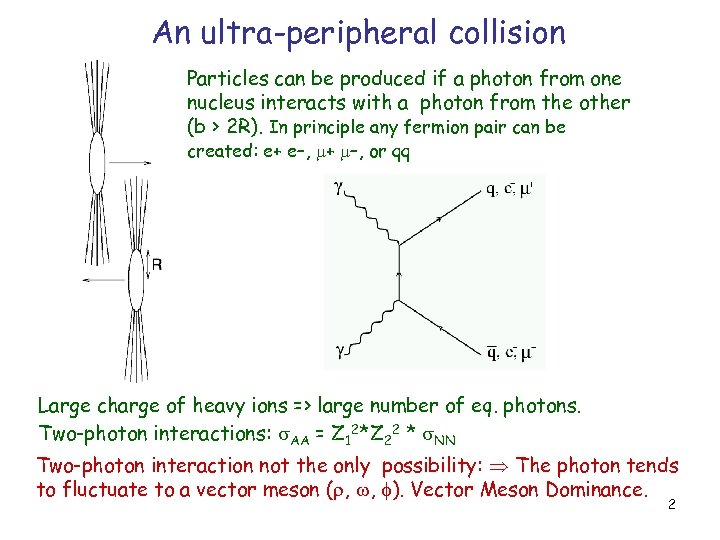 An ultra-peripheral collision Particles can be produced if a photon from one nucleus interacts with a photon from the other (b > 2 R). In principle any fermion pair can be created: e+ e–, + –, or qq Large charge of heavy ions => large number of eq. photons. Two-photon interactions: AA = Z 12*Z 22 * NN Two-photon interaction not the only possibility: The photon tends to fluctuate to a vector meson ( , , ). Vector Meson Dominance. 2
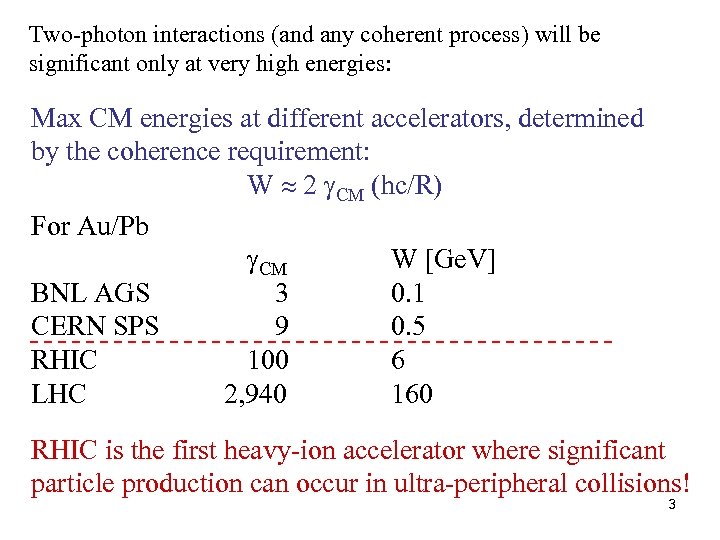 Two-photon interactions (and any coherent process) will be significant only at very high energies: Max CM energies at different accelerators, determined by the coherence requirement: W 2 CM (hc/R) For Au/Pb CM W [Ge. V] BNL AGS 3 0. 1 CERN SPS 9 0. 5 RHIC 100 6 LHC 2, 940 160 RHIC is the first heavy-ion accelerator where significant particle production can occur in ultra-peripheral collisions! 3
![A model [STARLight] predicts cross sections, rapidity and p T distributions of e. g.](https://present5.com/presentation/850a4ac453f7d2828bdc1ad8387db407/image-4.jpg "A model [STARLight] predicts cross sections, rapidity and p T distributions of e. g.") A model [STARLight] predicts cross sections, rapidity and p T distributions of e. g. vector mesons. For Au+Au 200 Ge. V at RHIC: —————— [mb] (req. Xn) —————— 590 (170) 59 ( 17) 39 ( 13) J/ 0. 29 (0. 16) —————— [Baltz, Klein, Nystrand: PRC 60(1999)014903, PRL 89(2002)012301] Cross sections in the 0. 3 -600 mb range! Requiring neutron coinc. lowers by factor 1. 8 – 3. 5. Photonuclear part dominates over + The p. T distribution determined by the nuclear Form Factor, p. T 1/R 4
A model [STARLight] predicts cross sections, rapidity and p T distributions of e. g. vector mesons. For Au+Au 200 Ge. V at RHIC: —————— [mb] (req. Xn) —————— 590 (170) 59 ( 17) 39 ( 13) J/ 0. 29 (0. 16) —————— [Baltz, Klein, Nystrand: PRC 60(1999)014903, PRL 89(2002)012301] Cross sections in the 0. 3 -600 mb range! Requiring neutron coinc. lowers by factor 1. 8 – 3. 5. Photonuclear part dominates over + The p. T distribution determined by the nuclear Form Factor, p. T 1/R 4
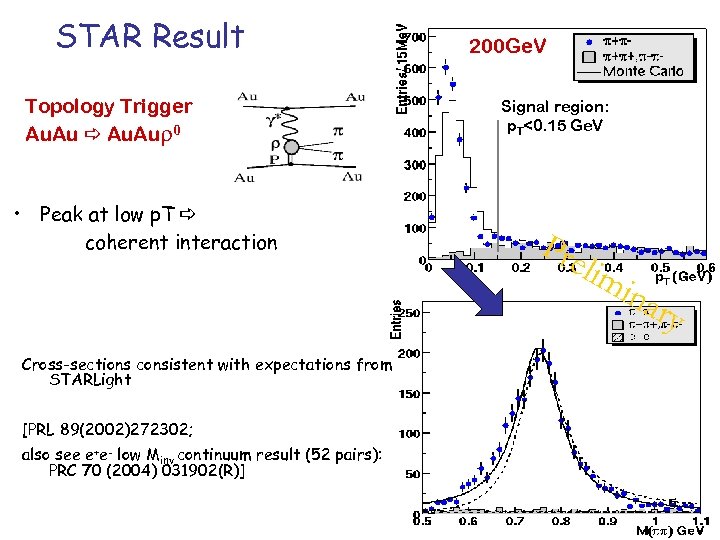 STAR Result Topology Trigger Au. Au a Au. Au 0 • Peak at low p. T a coherent interaction 200 Ge. V Signal region: p. T<0. 15 Ge. V Pre lim ina ry Cross-sections consistent with expectations from STARLight [PRL 89(2002)272302; also see e+e- low Minv continuum result (52 pairs): PRC 70 (2004) 031902(R)] 5
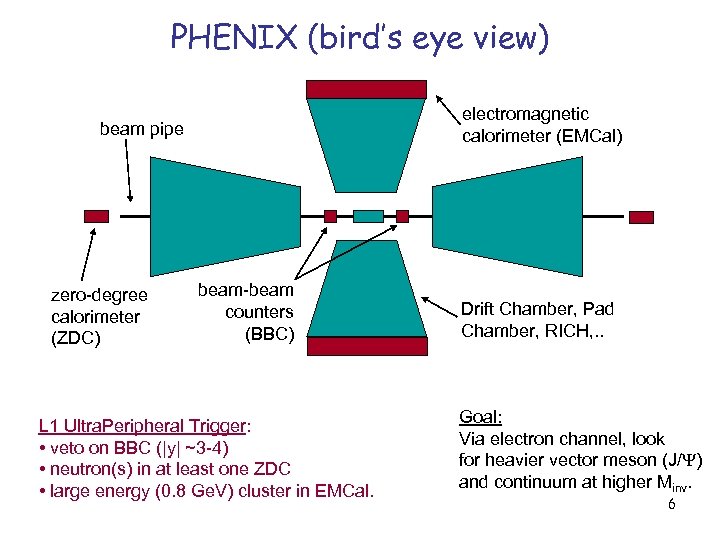 PHENIX (bird’s eye view) electromagnetic calorimeter (EMCal) beam pipe zero-degree calorimeter (ZDC) beam-beam counters (BBC) L 1 Ultra. Peripheral Trigger: • veto on BBC (|y| ~3 -4) • neutron(s) in at least one ZDC • large energy (0. 8 Ge. V) cluster in EMCal. Drift Chamber, Pad Chamber, RICH, . . Goal: Via electron channel, look for heavier vector meson (J/Y) and continuum at higher Minv. 6
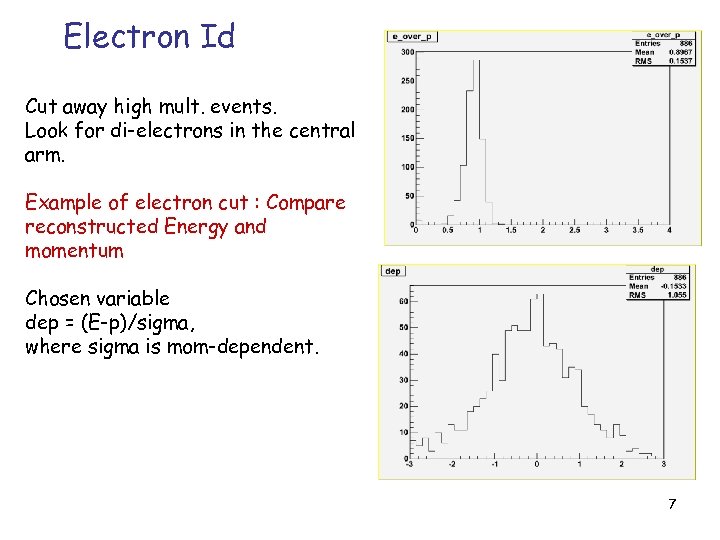 Electron Id Cut away high mult. events. Look for di-electrons in the central arm. Example of electron cut : Compare reconstructed Energy and momentum Chosen variable dep = (E-p)/sigma, where sigma is mom-dependent. 7
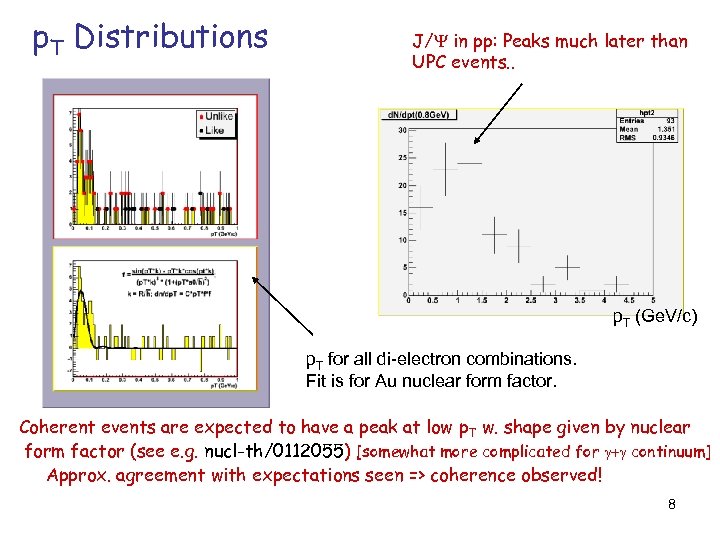 p. T Distributions J/Y in pp: Peaks much later than UPC events. . p. T (Ge. V/c) p. T for all di-electron combinations. Fit is for Au nuclear form factor. Coherent events are expected to have a peak at low p. T w. shape given by nuclear form factor (see e. g. nucl-th/0112055) [somewhat more complicated for + continuum] Approx. agreement with expectations seen => coherence observed! 8
![Minv Distributions [with same electron cuts as for p. T distr. . ] [+](https://present5.com/presentation/850a4ac453f7d2828bdc1ad8387db407/image-9.jpg "Minv Distributions [with same electron cuts as for p. T distr. . ] [+") Minv Distributions [with same electron cuts as for p. T distr. . ] [+ p. T < 150 Me. V coherence requirement] Note that with Eth=0. 8 Ge. V, coherent di-electron acceptance starts at ~1. 6 Ge. V. Hint of J/Y-signal seen? + maybe coherent + -> e+e- as the falling shape? 9
Minv Distributions [with same electron cuts as for p. T distr. . ] [+ p. T < 150 Me. V coherence requirement] Note that with Eth=0. 8 Ge. V, coherent di-electron acceptance starts at ~1. 6 Ge. V. Hint of J/Y-signal seen? + maybe coherent + -> e+e- as the falling shape? 9
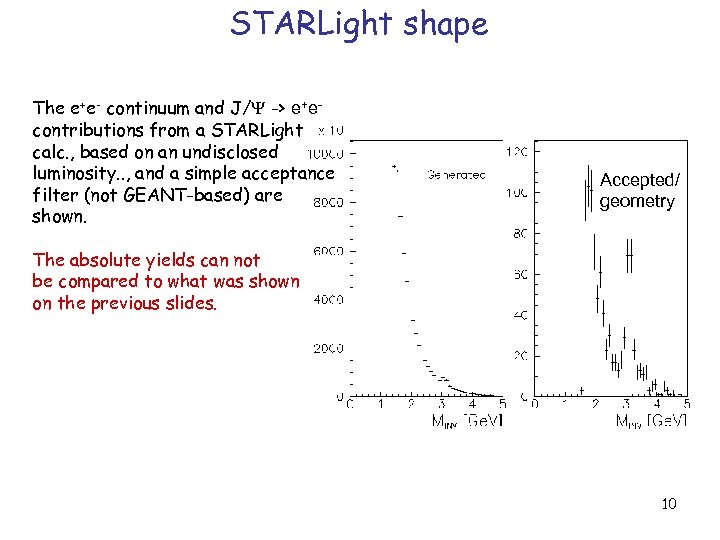 STARLight shape The e+e- continuum and J/Y -> e+econtributions from a STARLight calc. , based on an undisclosed luminosity. . , and a simple acceptance filter (not GEANT-based) are shown. Accepted/ geometry The absolute yields can not be compared to what was shown on the previous slides. 10
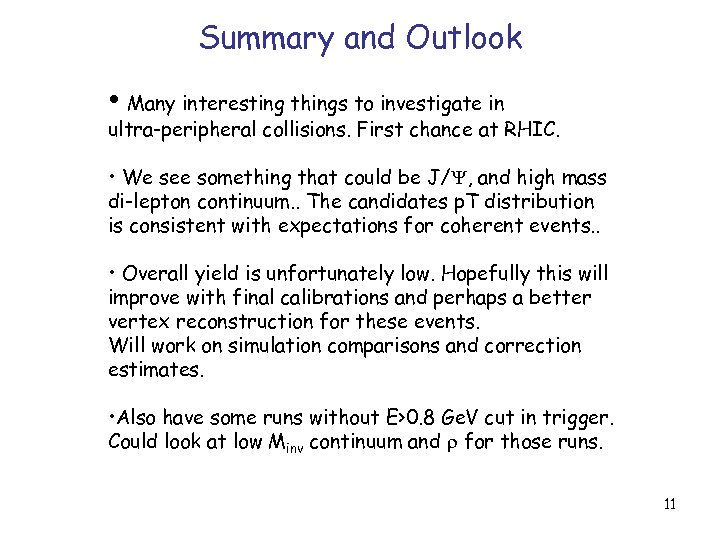 Summary and Outlook • Many interesting things to investigate in ultra-peripheral collisions. First chance at RHIC. • We see something that could be J/Y, and high mass di-lepton continuum. . The candidates p. T distribution is consistent with expectations for coherent events. . • Overall yield is unfortunately low. Hopefully this will improve with final calibrations and perhaps a better vertex reconstruction for these events. Will work on simulation comparisons and correction estimates. • Also have some runs without E>0. 8 Ge. V cut in trigger. Could look at low Minv continuum and for those runs. 11
 Brazil China University of São Paulo, São Paulo Academia Sinica, Taipei, Taiwan China Institute of Atomic Energy, Beijing Peking University, Beijing France LPC, University de Clermont-Ferrand, Clermont-Ferrand Dapnia, CEA Saclay, Gif-sur-Yvette IPN-Orsay, Universite Paris Sud, CNRS-IN 2 P 3, Orsay LLR, Ecòle Polytechnique, CNRS-IN 2 P 3, Palaiseau SUBATECH, Ecòle des Mines at Nantes, Nantes Germany University of Münster, Münster Hungary Central Research Institute for Physics (KFKI), Budapest Debrecen University, Debrecen Eötvös Loránd University (ELTE), Budapest India Banaras Hindu University, Banaras Bhabha Atomic Research Centre, Bombay Israel Weizmann Institute, Rehovot Japan Center for Nuclear Study, University of Tokyo, Tokyo Hiroshima University, Higashi-Hiroshima KEK, Institute for High Energy Physics, Tsukuba Kyoto University, Kyoto Nagasaki Institute of Applied Science, Nagasaki RIKEN, Institute for Physical and Chemical Research, Wako RIKEN-BNL Research Center, Upton, NY Rikkyo University, Tokyo, Japan Tokyo Institute of Technology, Tokyo University of Tsukuba, Tsukuba Waseda University, Tokyo S. Korea Cyclotron Application Laboratory, KAERI, Seoul Kangnung National University, Kangnung Korea University, Seoul Myong Ji University, Yongin City System Electronics Laboratory, Seoul Nat. University, Seoul Yonsei University, Seoul Russia Institute of High Energy Physics, Protovino Joint Institute for Nuclear Research, Dubna Kurchatov Institute, Moscow PNPI, St. Petersburg Nuclear Physics Institute, St. Petersburg State Technical University, St. Petersburg Sweden Lund University, Lund 12 Countries; 58 Institutions; 480 Participants* *as of January USA Abilene Christian University, Abilene, TX Brookhaven National Laboratory, Upton, NY University of California - Riverside, CA University of Colorado, Boulder, CO Columbia University, Nevis Laboratories, Irvington, NY Florida State University, Tallahassee, FL Florida Technical University, Melbourne, FL Georgia State University, Atlanta, GA University of Illinois Urbana Champaign, Urbana-Champaign, IL Iowa State University and Ames Laboratory, Ames, IA Los Alamos National Laboratory, Los Alamos, NM Lawrence Livermore National Laboratory, Livermore, CA University of New Mexico, Albuquerque, NM New Mexico State University, Las Cruces, NM Dept. of Chemistry, Stony Brook Univ. , Stony Brook, NY Dept. Phys. and Astronomy, Stony Brook Univ. , Stony Brook, NY Oak Ridge National Laboratory, Oak Ridge, TN 2004 University of Tennessee, Knoxville, TN 12 Vanderbilt University, Nashville, TN
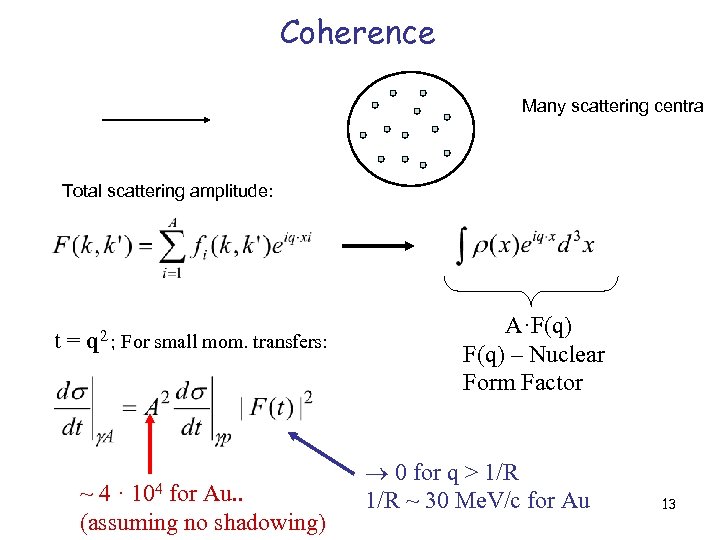 Coherence Many scattering centra Total scattering amplitude: t= q 2 ; For small mom. transfers: ~ 4 · 104 for Au. . (assuming no shadowing) A·F(q) – Nuclear Form Factor 0 for q > 1/R ~ 30 Me. V/c for Au 13
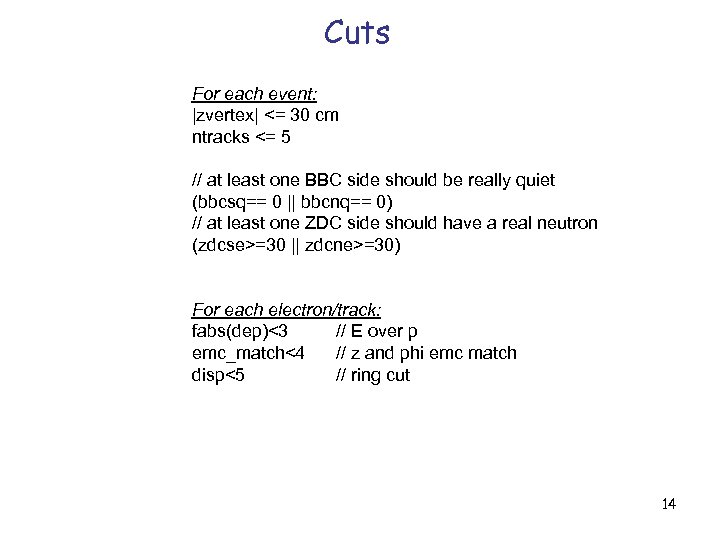 Cuts For each event: |zvertex| <= 30 cm ntracks <= 5 // at least one BBC side should be really quiet (bbcsq== 0 || bbcnq== 0) // at least one ZDC side should have a real neutron (zdcse>=30 || zdcne>=30) For each electron/track: fabs(dep)<3 // E over p emc_match<4 // z and phi emc match disp<5 // ring cut 14