


 Скачать презентацию Cognitively-Inspired Computational Design Methods Jonathan Cagan Dept of
04bb28e97d93b335383221d183b2a99b.ppt
- Количество слайдов: 29
 Cognitively-Inspired Computational Design Methods Jonathan Cagan Dept of Mechanical Engineering and Kenneth Kotovsky Dept of Psychology Carnegie Mellon © 2006, Cagan and Kotovsky
 Context • We can improve the design process by using teachings from cognition within an algorithmic framework – Create new breed of design automation tools – Test design strategies • Secondary benefits include – Test bed to study effect of cognitive decision making on design process – Formal representation of aspects of cognition © 2006, Cagan and Kotovsky
 Agent-Based Design Methods • Inspiration – Multiple members of interdisciplinary team work together to contribute to design solution – Individuals are independent at the micro scale but • Coordinate • Are directed by manager at the macro scale – Enable investigation of effectiveness and efficiency of using cognitive-based strategies in design search • Computation vs thinking © 2006, Cagan and Kotovsky
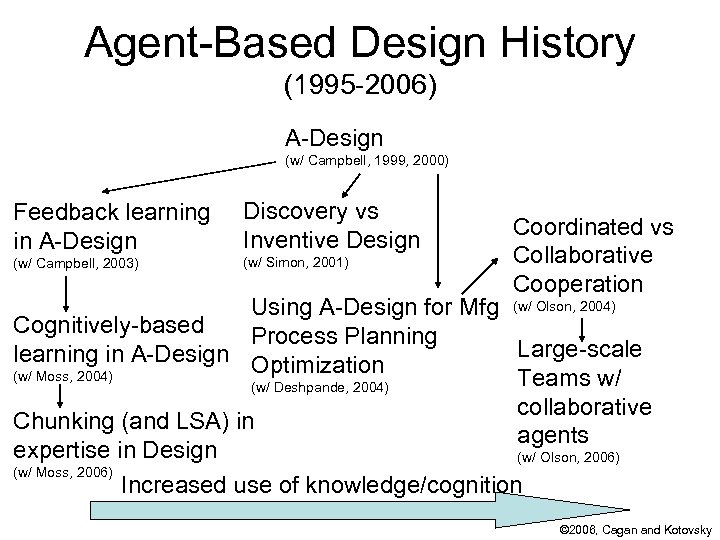 Agent-Based Design History (1995 -2006) A-Design (w/ Campbell, 1999, 2000) Feedback learning in A-Design Discovery vs Inventive Design (w/ Campbell, 2003) (w/ Simon, 2001) Coordinated vs Collaborative Cooperation Using A-Design for Mfg (w/ Olson, 2004) Cognitively-based Process Planning Large-scale learning in A-Design Optimization (w/ Moss, 2004) Teams w/ (w/ Deshpande, 2004) collaborative Chunking (and LSA) in agents expertise in Design (w/ Olson, 2006) (w/ Moss, 2006) Increased use of knowledge/cognition © 2006, Cagan and Kotovsky
 A-Design (w/ M. Campbell) • Dynamic design across multiple design objectives • Deep functional reasoning • Initially explore how much can be gained through computation cycles • Agents represent individual contributions to coupled and non-trivial problem © 2006, Cagan and Kotovsky
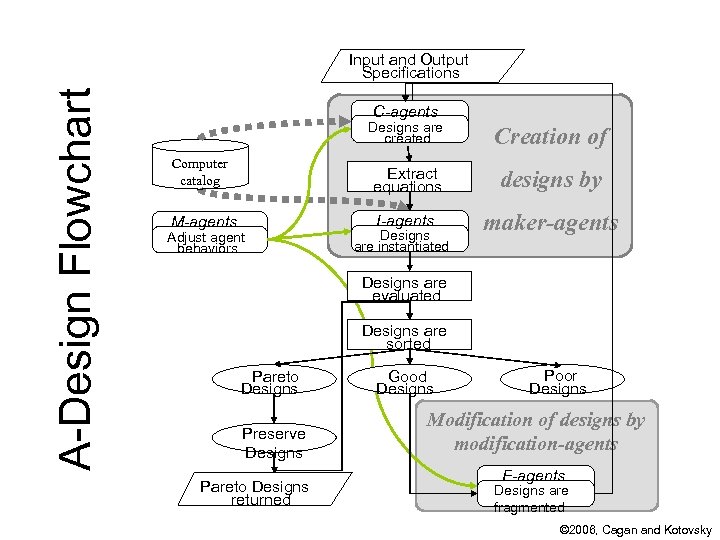 A-Design Flowchart Input and Output Specifications C-agents Designs are created Creation of Computer catalog Extract equations designs by M-agents I-agents maker-agents Adjust agent behaviors Designs are instantiated Designs are evaluated Designs are sorted Pareto Designs Preserve Designs Pareto Designs returned Good Designs Poor Designs Modification of designs by modification-agents F-agents Designs are fragmented © 2006, Cagan and Kotovsky
 Evolutionary Design from Multiple Objectives © 2006, Cagan and Kotovsky
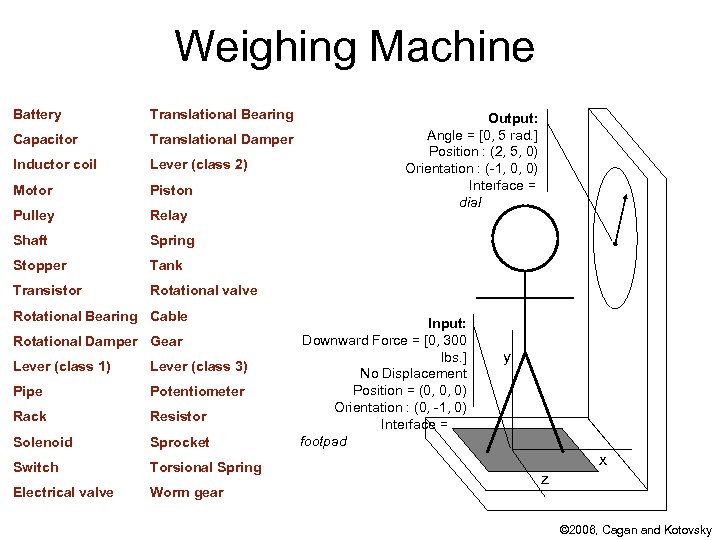 Weighing Machine Battery Translational Bearing Capacitor Translational Damper Inductor coil Lever (class 2) Motor Piston Pulley Relay Shaft Spring Stopper Tank Transistor Rotational valve Rotational Bearing Cable Rotational Damper Gear Lever (class 1) Lever (class 3) Pipe Potentiometer Rack Resistor Solenoid Sprocket Switch Torsional Spring Electrical valve Worm gear Output: Angle = [0, 5 rad. ] Position : (2, 5, 0) Orientation : (-1, 0, 0) Interface = dial Input: Downward Force = [0, 300 lbs. ] No Displacement Position = (0, 0, 0) Orientation : (0, -1, 0) Interface = footpad y x z © 2006, Cagan and Kotovsky
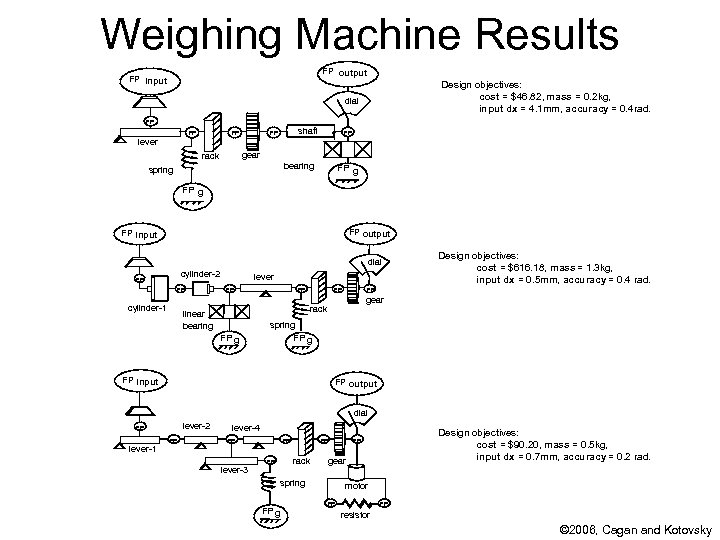 Weighing Machine Results FP output FP input Design objectives: cost = $46. 82, mass = 0. 2 kg, input dx = 4. 1 mm, accuracy = 0. 4 rad. dial FP FP FP shaft FP FP lever gear rack bearing spring FP output FP input dial cylinder-2 FP FP cylinder-1 lever FP FP gear rack linear bearing FP g Design objectives: cost = $616. 18, mass = 1. 3 kg, input dx = 0. 5 mm, accuracy = 0. 4 rad. spring FP input FP output dial lever-2 FP FP lever-4 FP FP FP Design objectives: cost = $90. 20, mass = 0. 5 kg, input dx = 0. 7 mm, accuracy = 0. 2 rad. FP lever-1 rack FP lever-3 gear spring FP g motor FP FP resistor © 2006, Cagan and Kotovsky
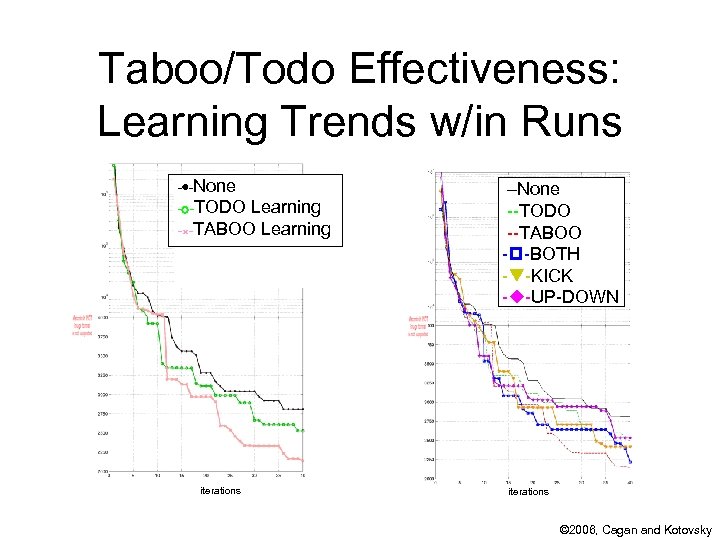 Taboo/Todo Effectiveness: Learning Trends w/in Runs - -None - -TODO Learning - -TABOO Learning iterations –None --TODO --TABOO - -BOTH - -KICK - -UP-DOWN iterations © 2006, Cagan and Kotovsky
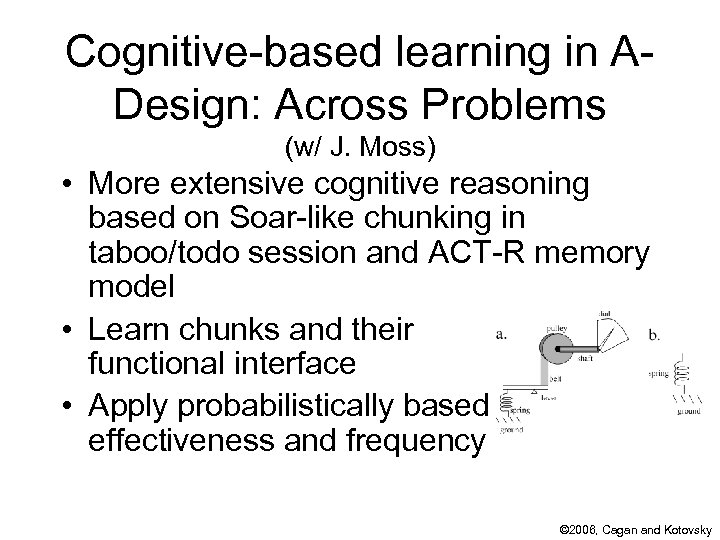 Cognitive-based learning in ADesign: Across Problems (w/ J. Moss) • More extensive cognitive reasoning based on Soar-like chunking in taboo/todo session and ACT-R memory model • Learn chunks and their functional interface • Apply probabilistically based on effectiveness and frequency © 2006, Cagan and Kotovsky
 Cognition for Transfer Across Problems • Both across runs within a problem and across problem descriptions © 2006, Cagan and Kotovsky
 In-Problem Transfer © 2006, Cagan and Kotovsky
 Across-Problem Transfer © 2006, Cagan and Kotovsky
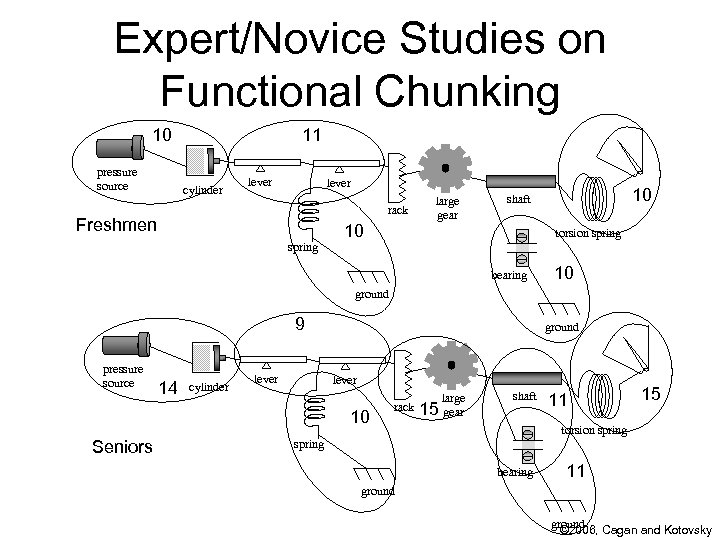 Expert/Novice Studies on Functional Chunking 10 pressure source 11 cylinder lever rack Freshmen spring 10 large gear 10 shaft torsion spring bearing 10 ground 9 pressure source 14 cylinder lever ground lever 10 Seniors rack large 15 gear shaft 11 15 torsion spring bearing 11 ground © 2006, Cagan and Kotovsky
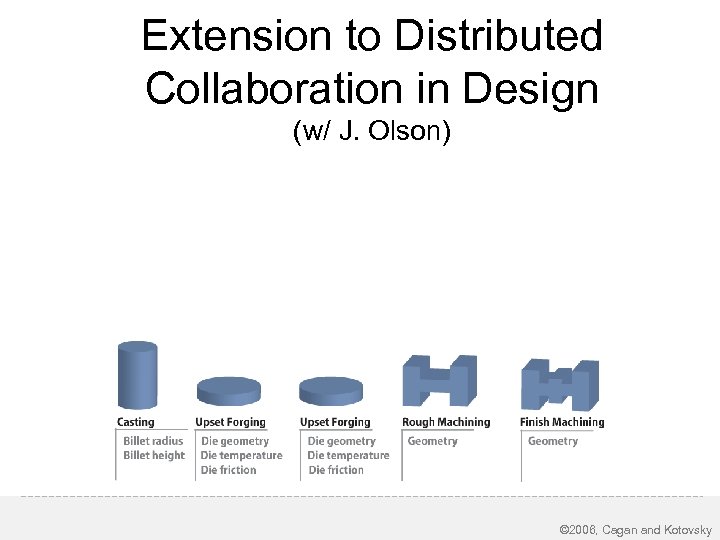 Extension to Distributed Collaboration in Design (w/ J. Olson) © 2006, Cagan and Kotovsky
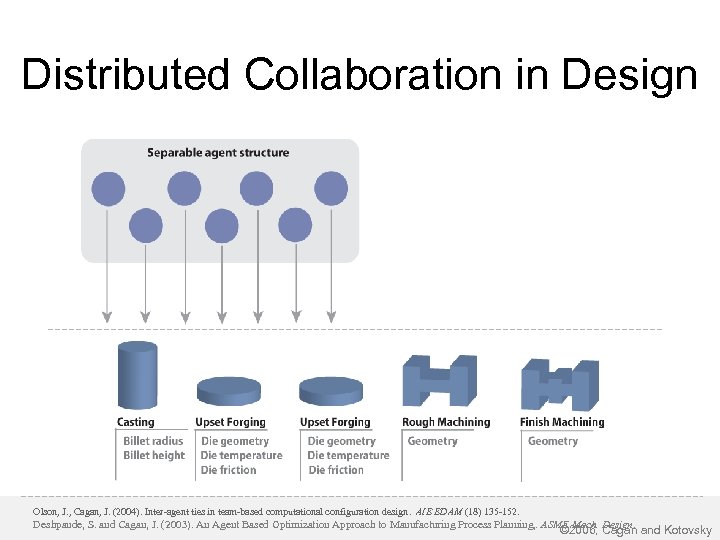 Distributed Collaboration in Design Olson, J. , Cagan, J. (2004). Inter-agent ties in team-based computational configuration design. AIE EDAM (18) 135 -152. Deshpande, S. and Cagan, J. (2003). An Agent Based Optimization Approach to Manufacturing Process Planning, . ASME Mech. Design. © 2006, Cagan and Kotovsky
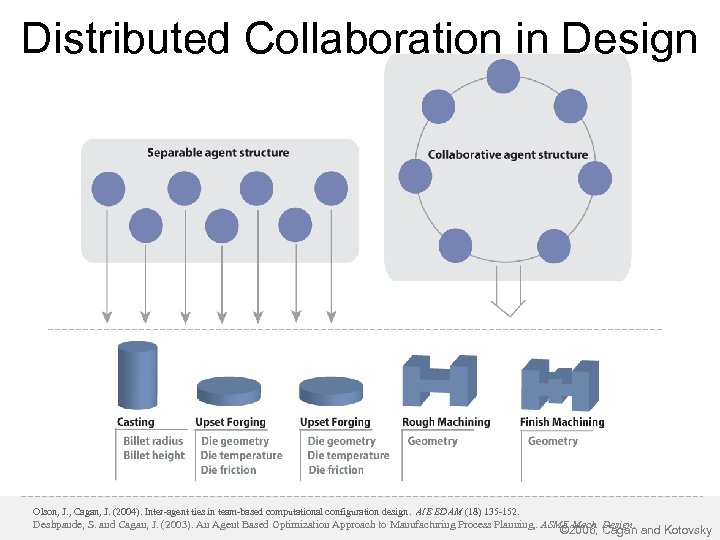 Distributed Collaboration in Design Olson, J. , Cagan, J. (2004). Inter-agent ties in team-based computational configuration design. AIE EDAM (18) 135 -152. Deshpande, S. and Cagan, J. (2003). An Agent Based Optimization Approach to Manufacturing Process Planning, . ASME Mech. Design. © 2006, Cagan and Kotovsky
 Objective function Number of “good” designs identified Number of designs Results Average objective function in final list Collaborative Separable © 2006, Cagan and Kotovsky
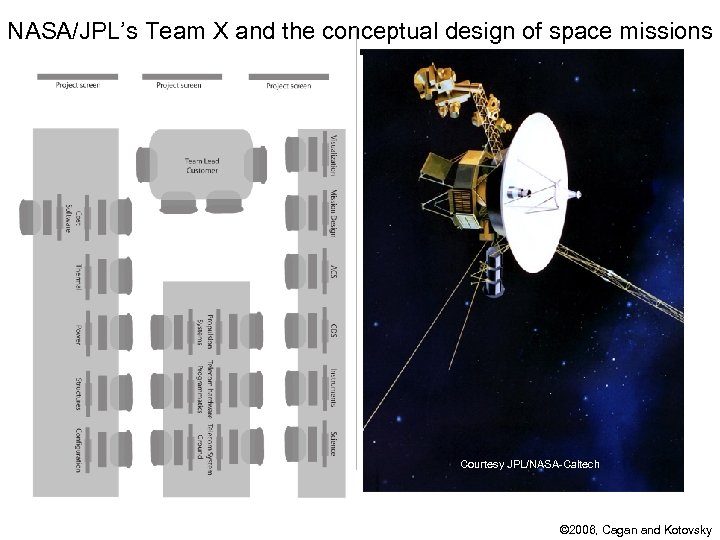 NASA/JPL’s Team X and the conceptual design of space missions Courtesy JPL/NASA-Caltech © 2006, Cagan and Kotovsky
 Simulating Collaborative Design • Multiagent simulation of Team X and conceptual space mission plan – Patterned with social and domain definitions analogous to those populating the actual design environment – Designed to give rise to a collection of interrelationships comparable to those occurring in Team X design sessions © 2006, Cagan and Kotovsky
 Model General Structure 17 Agents, Iterative design loop >100, 000 lines of code (java) • Team environment achieved through distribution and interaction of social and task niches © 2006, Cagan and Kotovsky
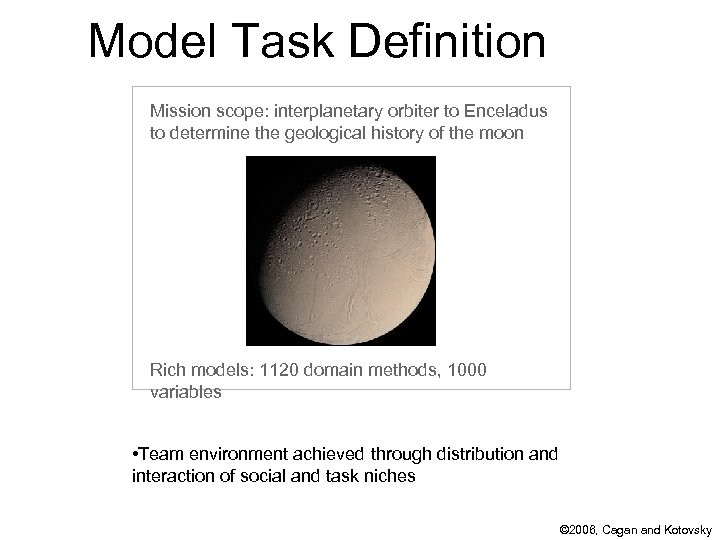 Model Task Definition Mission scope: interplanetary orbiter to Enceladus to determine the geological history of the moon Rich models: 1120 domain methods, 1000 variables • Team environment achieved through distribution and interaction of social and task niches © 2006, Cagan and Kotovsky
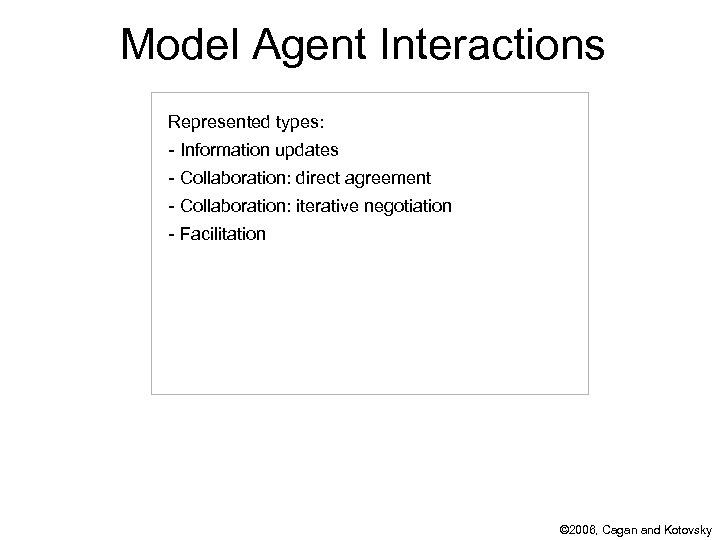 Model Agent Interactions Represented types: - Information updates - Collaboration: direct agreement - Collaboration: iterative negotiation General structure - Facilitation © 2006, Cagan and Kotovsky
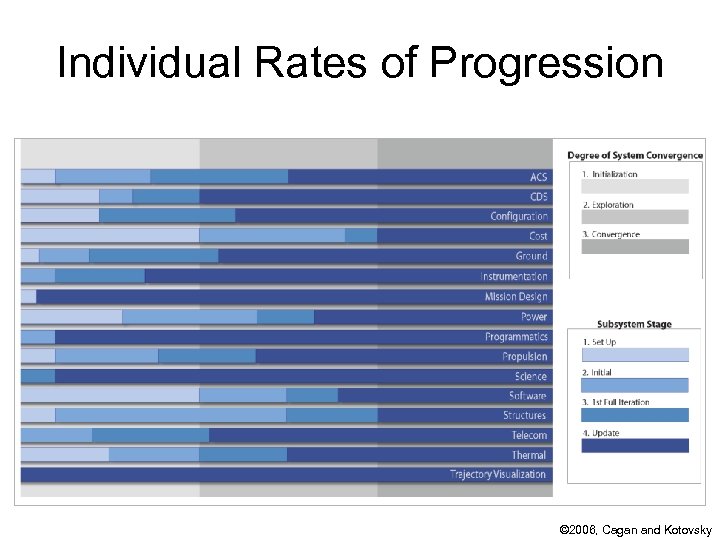 Individual Rates of Progression © 2006, Cagan and Kotovsky
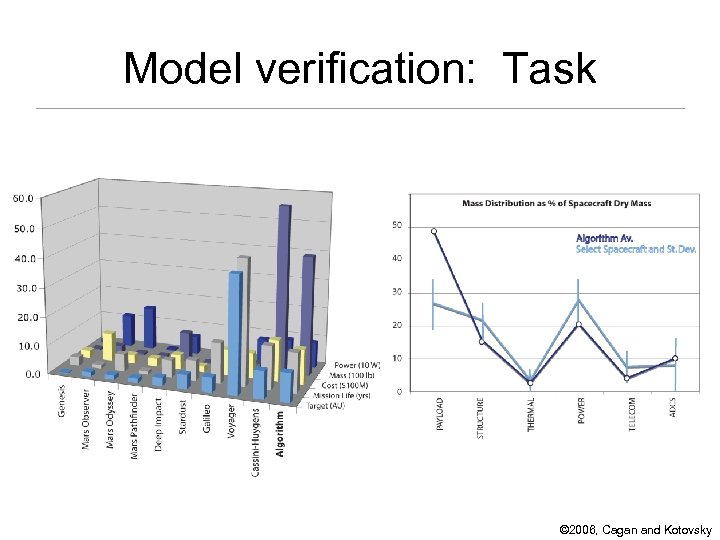 Model verification: Task © 2006, Cagan and Kotovsky
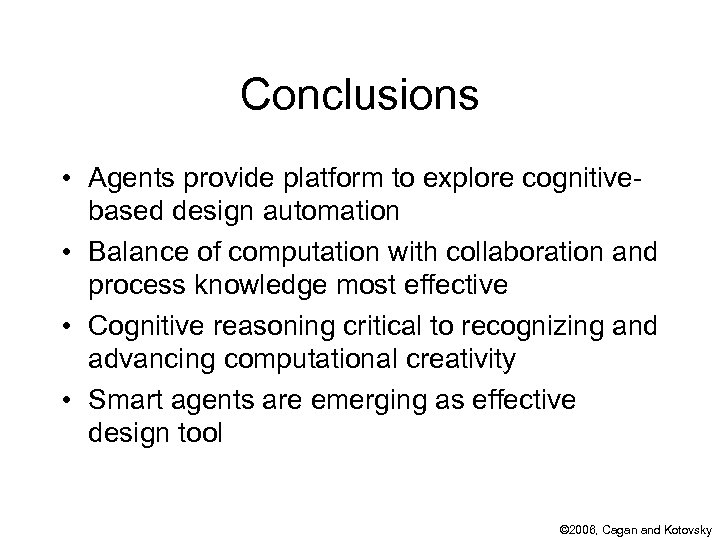 Conclusions • Agents provide platform to explore cognitivebased design automation • Balance of computation with collaboration and process knowledge most effective • Cognitive reasoning critical to recognizing and advancing computational creativity • Smart agents are emerging as effective design tool © 2006, Cagan and Kotovsky
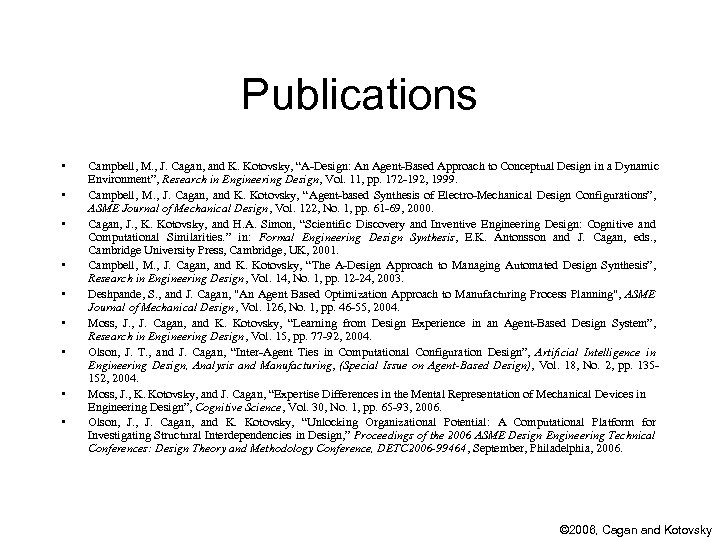 Publications • • • Campbell, M. , J. Cagan, and K. Kotovsky, “A-Design: An Agent-Based Approach to Conceptual Design in a Dynamic Environment”, Research in Engineering Design, Vol. 11, pp. 172 -192, 1999. Campbell, M. , J. Cagan, and K. Kotovsky, “Agent-based Synthesis of Electro-Mechanical Design Configurations”, ASME Journal of Mechanical Design, Vol. 122, No. 1, pp. 61 -69, 2000. Cagan, J. , K. Kotovsky, and H. A. Simon, “Scientific Discovery and Inventive Engineering Design: Cognitive and Computational Similarities. ” in: Formal Engineering Design Synthesis, E. K. Antonsson and J. Cagan, eds. , Cambridge University Press, Cambridge, UK, 2001. Campbell, M. , J. Cagan, and K. Kotovsky, “The A-Design Approach to Managing Automated Design Synthesis”, Research in Engineering Design, Vol. 14, No. 1, pp. 12 -24, 2003. Deshpande, S. , and J. Cagan, "An Agent Based Optimization Approach to Manufacturing Process Planning", ASME Journal of Mechanical Design, Vol. 126, No. 1, pp. 46 -55, 2004. Moss, J. Cagan, and K. Kotovsky, “Learning from Design Experience in an Agent-Based Design System”, Research in Engineering Design, Vol. 15, pp. 77 -92, 2004. Olson, J. T. , and J. Cagan, “Inter-Agent Ties in Computational Configuration Design”, Artificial Intelligence in Engineering Design, Analysis and Manufacturing, (Special Issue on Agent-Based Design), Vol. 18, No. 2, pp. 135152, 2004. Moss, J. , K. Kotovsky, and J. Cagan, “Expertise Differences in the Mental Representation of Mechanical Devices in Engineering Design”, Cognitive Science, Vol. 30, No. 1, pp. 65 -93, 2006. Olson, J. Cagan, and K. Kotovsky, “Unlocking Organizational Potential: A Computational Platform for Investigating Structural Interdependencies in Design, ” Proceedings of the 2006 ASME Design Engineering Technical Conferences: Design Theory and Methodology Conference, DETC 2006 -99464, September, Philadelphia, 2006. © 2006, Cagan and Kotovsky
 Support • National Science Foundation under grant EID-9256665 • Defense Advanced Research Projects Agency (DARPA) and Rome Laboratory, Air Force Materiel Command, USAF, under agreement number F 30602 -96 -2 -0304 • National Defense Science and Engineering Graduate Fellowship • Air Force Office of Scientific Research, Air Force Material Command, USAF, under grant numbers F 49620 -01 -1 -0050 and FA 9620 -04 -1 -0201 © 2006, Cagan and Kotovsky