


 Скачать презентацию Cognitive Technology applications as domestic support for elderly
48ae6a96e3c2524fa4e62c0d828d94cc.ppt
- Количество слайдов: 28
 Cognitive Technology applications as domestic support for elderly people: The PST projects experience Lorenza Tiberio ISTC-CNR [PST] Institute for Cognitive Science and Technology National Research Council of Italy Planning and Scheduling Team http: //pst. istc. cnr. it Workshop on Telematics and Robotics for the Quality of Life of the Elderly – ISTC-CNR – Rome 28 September 2009
 Outline Introduction & Rationale Literature Review Cognitive decline in aging Memory Training Intervention Assistive Technology for Cognition (ATC) About PST Projects Experience Robo. Care The system Design User Evaluation Outcomes of Robo. Care Evaluation Cog. Gym Project Motivation Architecture Current Implementation and future work Conclusions
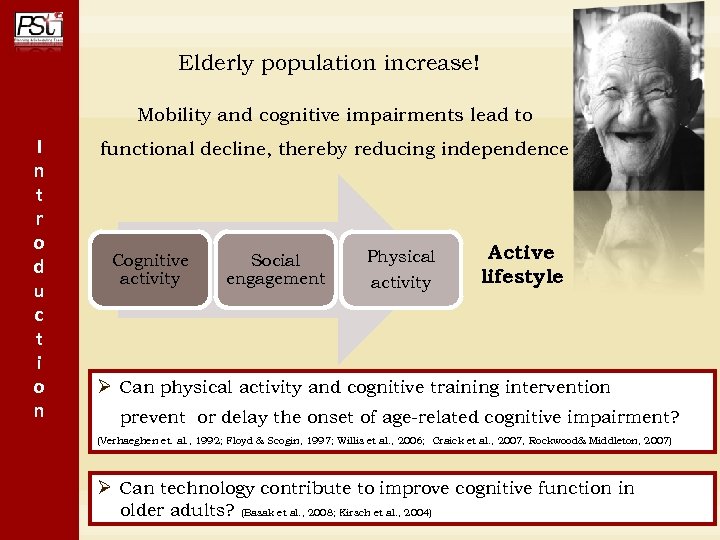 Elderly population increase! Mobility and cognitive impairments lead to I n t r o d u c t i o n functional decline, thereby reducing independence Cognitive activity Social engagement Physical activity Active lifestyle Ø Can physical activity and cognitive training intervention prevent or delay the onset of age-related cognitive impairment? (Verhaeghen et. al. , 1992; Floyd & Scogin, 1997; Willis et al. , 2006; Craick et al. , 2007, Rockwood& Middleton, 2007) Ø Can technology contribute to improve cognitive function in older adults? (Basak et al. , 2008; Kirsch et al. , 2004)
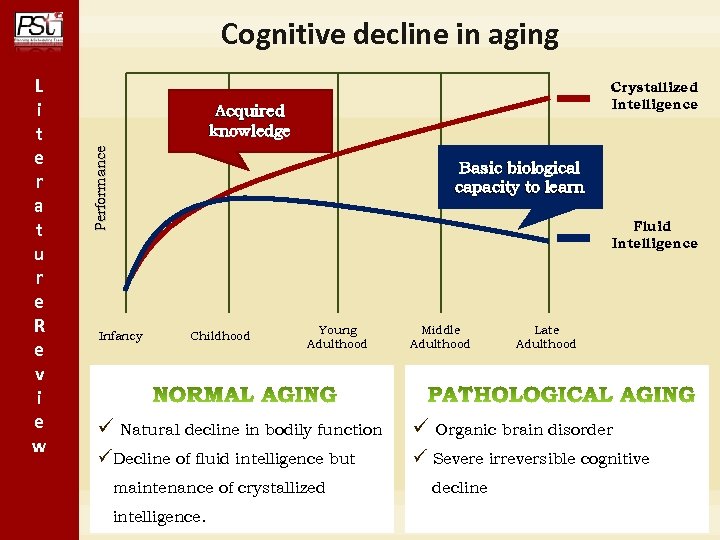 Cognitive decline in aging Crystallized Intelligence Acquired knowledge Performance L i t e r a t u r e R e v i e w Basic biological capacity to learn Fluid Intelligence Infancy Childhood Young Adulthood Middle Adulthood Late Adulthood ü Natural decline in bodily function ü Organic brain disorder üDecline of fluid intelligence but ü Severe irreversible cognitive maintenance of crystallized intelligence. decline
 Memory Training Literature L i t e r a t u r e R e v i e w v. Cognitivetrainingmay have substantial and lasting effectson the cognitiveabilities of older adults (e. g. Ball et all. , 2002; Wolinsky et al. 2006; Park et all. , 2007). v. Recent researches indicate that regularly scheduled cognitive exercisescan not only improvecognitivefunctioning but also , reduce the risk of dementia (Wilson et all. , 2002). v. Traditional training usually consist in simple exercises“paper and pencil” or computerized-basedincluding different tasks (e. g reasoning, recognition, perception, speed of information processing, attention and memory)
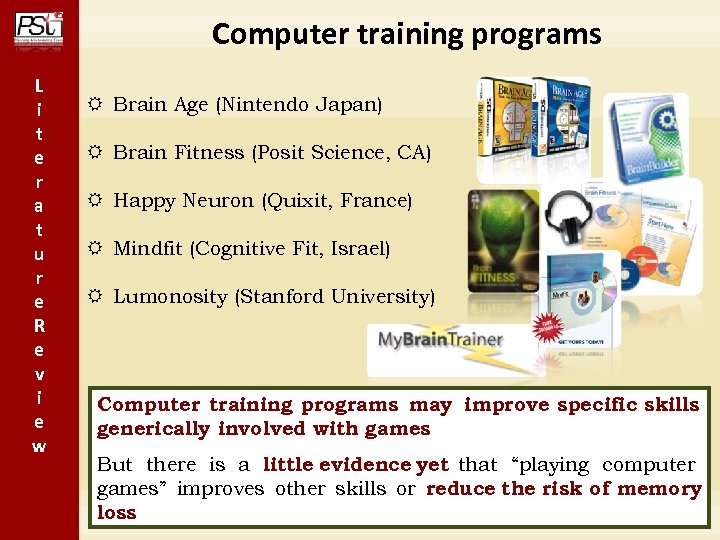 Computer training programs L i t e r a t u r e R e v i e w Brain Age (Nintendo Japan) Brain Fitness (Posit Science, CA) Happy Neuron (Quixit, France) Mindfit (Cognitive Fit, Israel) Lumonosity (Stanford University) Computer training programs may improve specific skills generically involved with games But there is a little evidence yet that “playing computer games” improves other skills or reduce the risk of memory loss
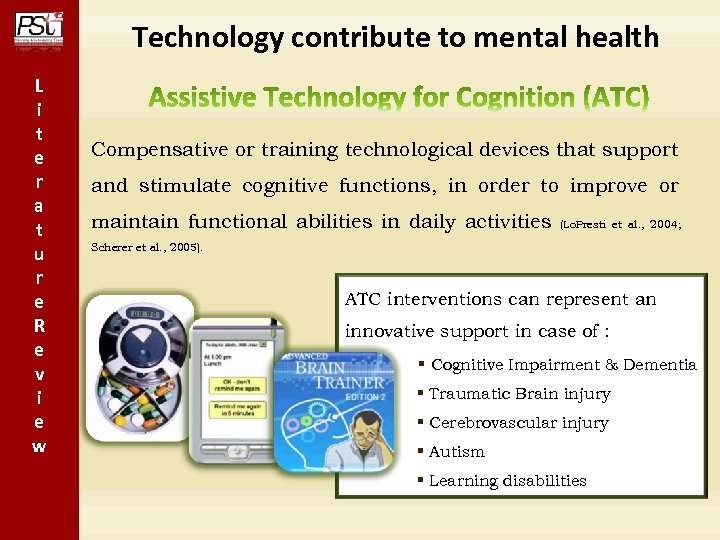 Technology contribute to mental health L i t e r a t u r e R e v i e w Compensative or training technological devices that support and stimulate cognitive functions, in order to improve or maintain functional abilities in daily activities (Lo. Presti et al. , 2004; Scherer et al. , 2005). ATC interventions can represent an innovative support in case of : § Cognitive Impairment & Dementia § Traumatic Brain injury § Cerebrovascular injury § Autism § Learning disabilities
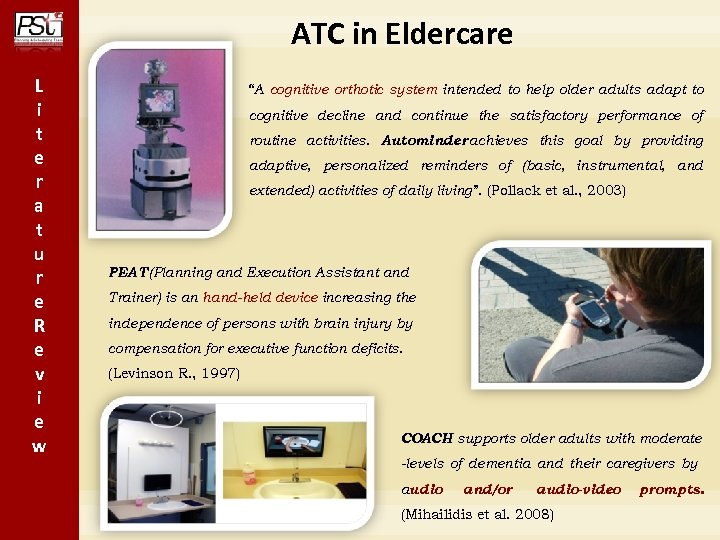 ATC in Eldercare L i t e r a t u r e R e v i e w “A cognitive orthotic system intended to help older adults adapt to cognitive decline and continue the satisfactory performance of routine activities. Autominder achieves this goal by providing adaptive, personalized reminders of (basic, instrumental, and extended) activities of daily living”. (Pollack et al. , 2003) PEAT (Planning and Execution Assistant and Trainer) is an hand-held device increasing the independence of persons with brain injury by compensation for executive function deficits. (Levinson R. , 1997) COACH supports older adults with moderate -levels of dementia and their caregivers by audio and/or audio-video (Mihailidis et al. 2008) prompts.
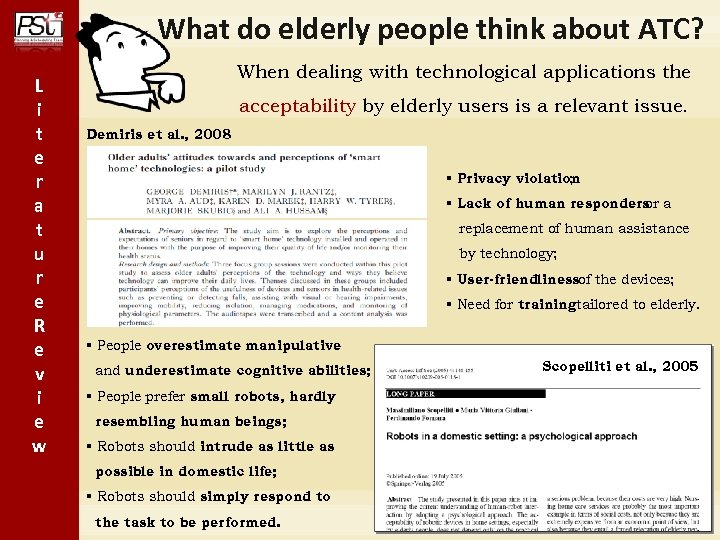 What do elderly people think about ATC? L i t e r a t u r e R e v i e w When dealing with technological applications the acceptability by elderly users is a relevant issue. Demiris et al. , 2008 § Privacy violation ; § Lack of human responders a or replacement of human assistance by technology; § User-friendlinessof the devices; § Need for trainingtailored to elderly. § People overestimate manipulative and underestimate cognitive abilities; § People prefer small robots, hardly resembling human beings; § Robots should intrude as little as possible in domestic life; § Robots should simply respond to the task to be performed. Scopelliti et al. , 2005
 P S T P r o j e c t s E x p e r i e n c e Robo. Care Domestic Environment “The objective of the project is to build a distributed multi-agent system which provides assistance services for elderly users at home. The agents are a highly heterogeneous collection of fixed and mobile robotic, sensory and problem solving components. The project is centered on obtaining a virtual community of human and artificial agents who cooperate in the continuous management of an enclosed environment. ” Quote from the original project proposal (2001)
 Robo. Care: User evaluation P S T P r o j e c t s E x p e r i e n c e Undestanding users’ psychological attitudes and variables affecting acceptability cognitive support system of in domestic environment: Ø Likelihood of the proposed scenarios Ø Utility and acceptability of the system Ø Users’ preferences with respect to proactive and on-demand interaction Ø Influence of psychological variables on acceptability and usefulness
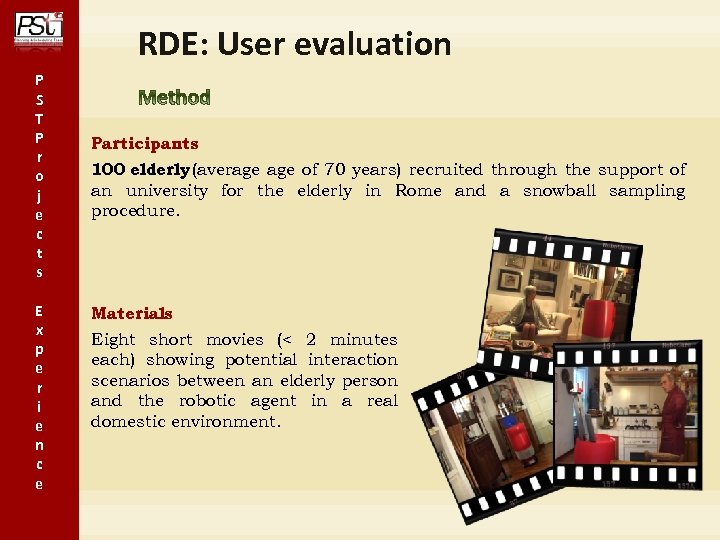 RDE: User evaluation P S T P r o j e c t s E x p e r i e n c e Participants 100 elderly (average of 70 years) recruited through the support of an university for the elderly in Rome and a snowball sampling procedure. Materials Eight short movies (< 2 minutes each) showing potential interaction scenarios between an elderly person and the robotic agent in a real domestic environment.
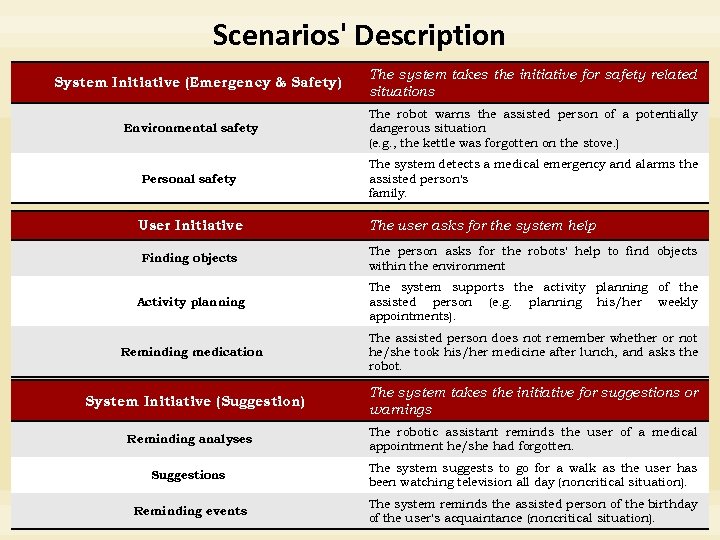 Scenarios' Description System Initiative (Emergency & Safety) The system takes the initiative for safety related situations Environmental safety The robot warns the assisted person of a potentially dangerous situation (e. g. , the kettle was forgotten on the stove. ) Personal safety The system detects a medical emergency and alarms the assisted person's family. User Initiative The user asks for the system help Finding objects The person asks for the robots' help to find objects within the environment Activity planning The system supports the activity planning of the assisted person (e. g. planning his/her weekly appointments). Reminding medication The assisted person does not remember whether or not he/she took his/her medicine after lunch, and asks the robot. System Initiative (Suggestion) The system takes the initiative for suggestions or warnings Reminding analyses The robotic assistant reminds the user of a medical appointment he/she had forgotten. Suggestions The system suggests to go for a walk as the user has been watching television all day (noncritical situation). Reminding events The system reminds the assisted person of the birthday of the user's acquaintance (noncritical situation).
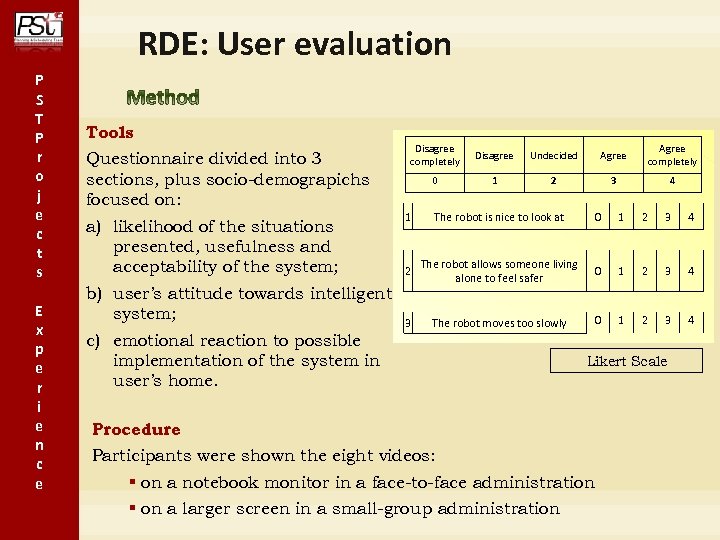 RDE: User evaluation P S T P r o j e c t s E x p e r i e n c e Tools Questionnaire divided into 3 sections, plus socio-demograpichs focused on: a) likelihood of the situations presented, usefulness and acceptability of the system; b) user’s attitude towards intelligent system; c) emotional reaction to possible implementation of the system in user’s home. Disagree completely Disagree Undecided Agree completely 0 1 2 3 4 1 The robot is nice to look at 0 1 2 3 4 2 The robot allows someone living alone to feel safer 0 1 2 3 4 3 The robot moves too slowly 0 1 2 3 4 Likert Scale Procedure Participants were shown the eight videos: § on a notebook monitor in a face-to-face administration § on a larger screen in a small-group administration
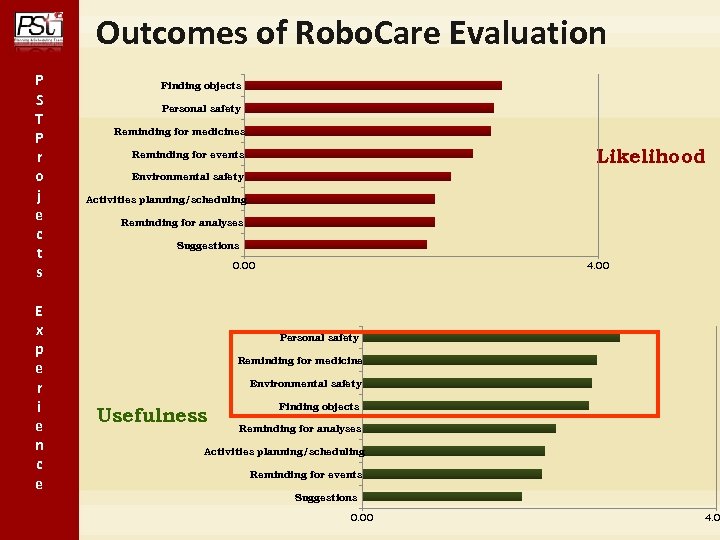 Outcomes of Robo. Care Evaluation P S T P r o j e c t s E x p e r i e n c e Finding objects Personal safety Reminding for medicines Likelihood Reminding for events Environmental safety Activities planning/scheduling Reminding for analyses Suggestions 0. 00 4. 00 Personal safety Reminding for medicine Environmental safety Usefulness Finding objects Reminding for analyses Activities planning/scheduling Reminding for events Suggestions 0. 00 4. 0
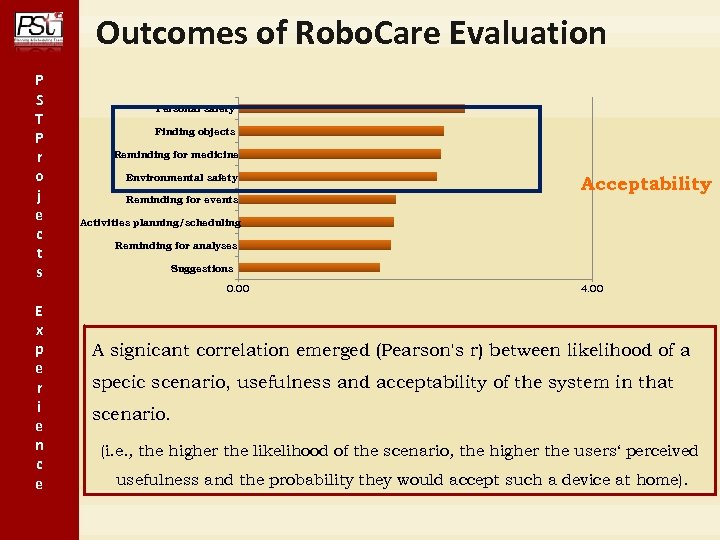 Outcomes of Robo. Care Evaluation P S T P r o j e c t s Personal safety Finding objects Reminding for medicine Environmental safety Reminding for events Activities planning/scheduling Reminding for analyses Suggestions 0. 00 E x p e r i e n c e Acceptability 4. 00 A signicant correlation emerged (Pearson's r) between likelihood of a specic scenario, usefulness and acceptability of the system in that scenario. (i. e. , the higher the likelihood of the scenario, the higher the users‘ perceived usefulness and the probability they would accept such a device at home).
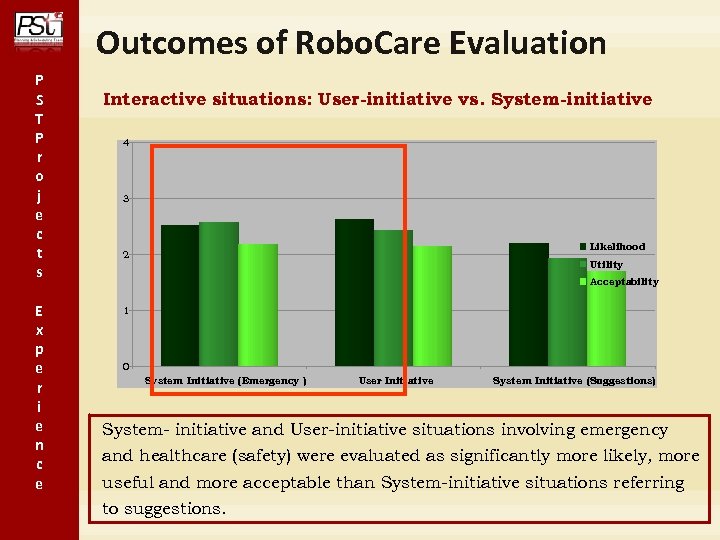 Outcomes of Robo. Care Evaluation P S T P r o j e c t s E x p e r i e n c e Interactive situations: User-initiative vs. System-initiative 4 3 Likelihood 2 Utility Acceptability 1 0 System Initiative (Emergency ) User Initiative System Initiative (Suggestions) System- initiative and User-initiative situations involving emergency and healthcare (safety) were evaluated as significantly more likely, more useful and more acceptable than System-initiative situations referring to suggestions.
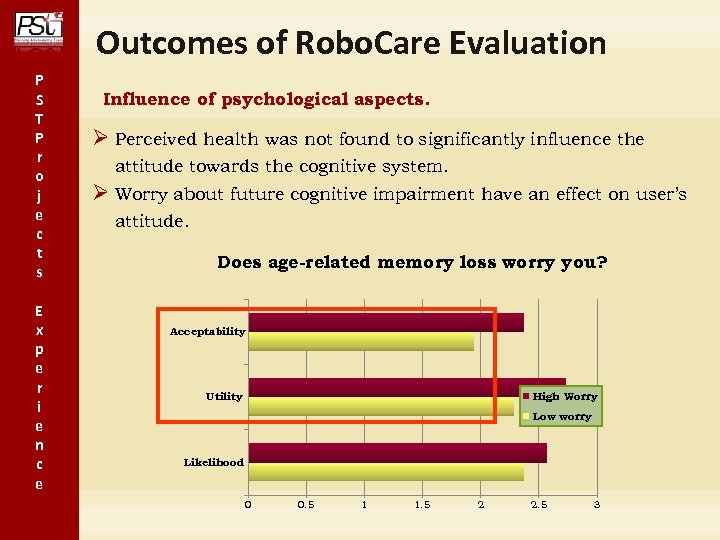 Outcomes of Robo. Care Evaluation P S T P r o j e c t s E x p e r i e n c e Influence of psychological aspects. Ø Perceived health was not found to significantly influence the attitude towards the cognitive system. Ø Worry about future cognitive impairment have an effect on user’s attitude. Does age-related memory loss worry you? Acceptability High Worry Utility Low worry Likelihood 0 0. 5 1 1. 5 2 2. 5 3
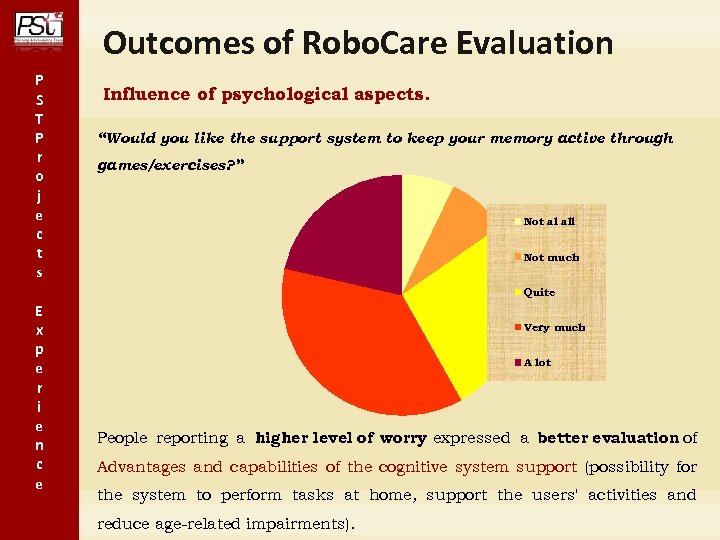 Outcomes of Robo. Care Evaluation P S T P r o j e c t s Influence of psychological aspects. “Would you like the support system to keep your memory active through games/exercises? ” Not al all Not much Quite E x p e r i e n c e Very much A lot People reporting a higher level of worry expressed a better evaluation of Advantages and capabilities of the cognitive system support (possibility for the system to perform tasks at home, support the users' activities and reduce age-related impairments).
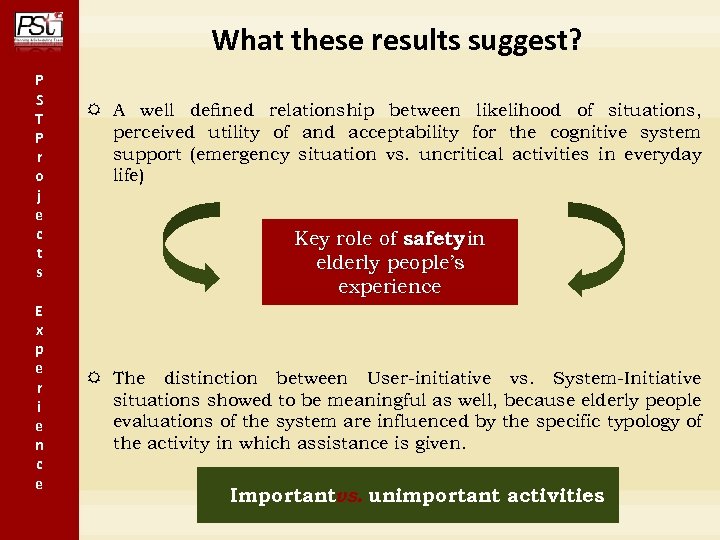 What these results suggest? P S T P r o j e c t s E x p e r i e n c e A well defined relationship between likelihood of situations, perceived utility of and acceptability for the cognitive system support (emergency situation vs. uncritical activities in everyday life) Key role of safety in elderly people’s experience The distinction between User-initiative vs. System-Initiative situations showed to be meaningful as well, because elderly people evaluations of the system are influenced by the specific typology of the activity in which assistance is given. Importantvs. unimportant activities
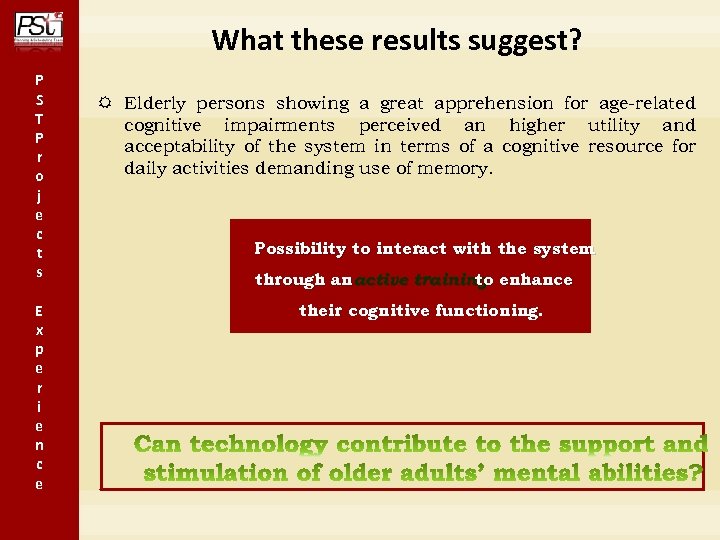 What these results suggest? P S T P r o j e c t s E x p e r i e n c e Elderly persons showing a great apprehension for age-related cognitive impairments perceived an higher utility and acceptability of the system in terms of a cognitive resource for daily activities demanding use of memory. Possibility to interact with the system through an active training enhance to their cognitive functioning.
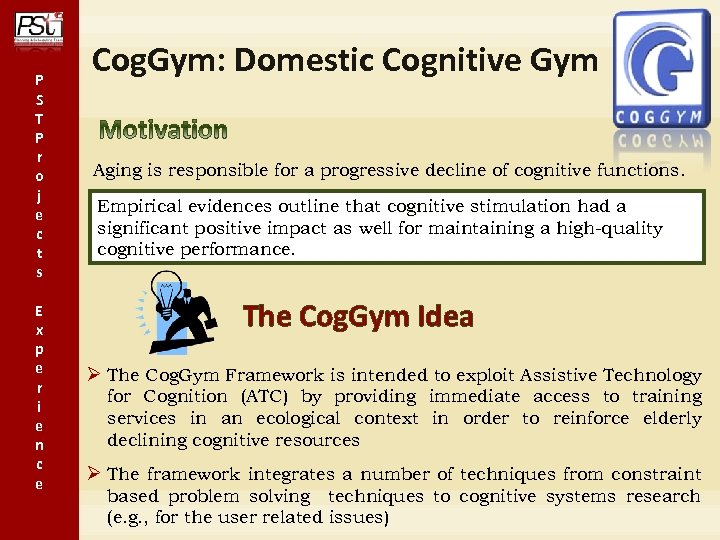 P S T P r o j e c t s E x p e r i e n c e Cog. Gym: Domestic Cognitive Gym Aging is responsible for a progressive decline of cognitive functions. Empirical evidences outline that cognitive stimulation had a significant positive impact as well for maintaining a high-quality cognitive performance. The Cog. Gym Idea Ø The Cog. Gym Framework is intended to exploit Assistive Technology for Cognition (ATC) by providing immediate access to training services in an ecological context in order to reinforce elderly declining cognitive resources Ø The framework integrates a number of techniques from constraint based problem solving techniques to cognitive systems research (e. g. , for the user related issues)
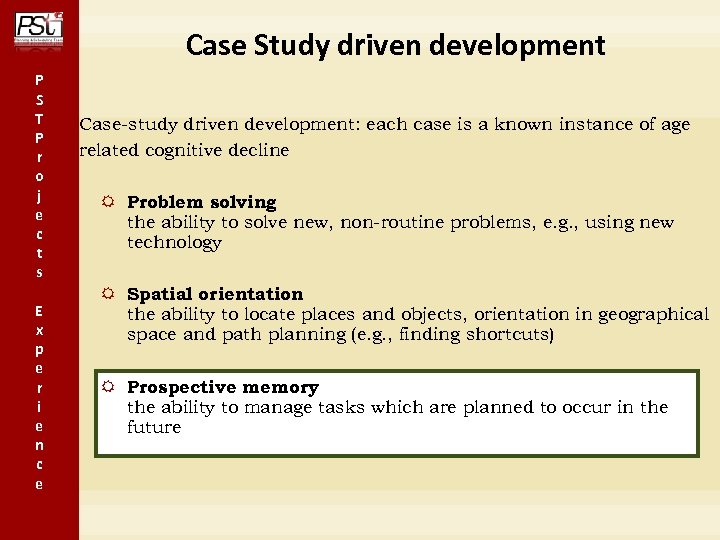 Case Study driven development P S T P r o j e c t s E x p e r i e n c e Case-study driven development: each case is a known instance of age related cognitive decline Problem solving the ability to solve new, non-routine problems, e. g. , using new technology Spatial orientation the ability to locate places and objects, orientation in geographical space and path planning (e. g. , finding shortcuts) Prospective memory the ability to manage tasks which are planned to occur in the future
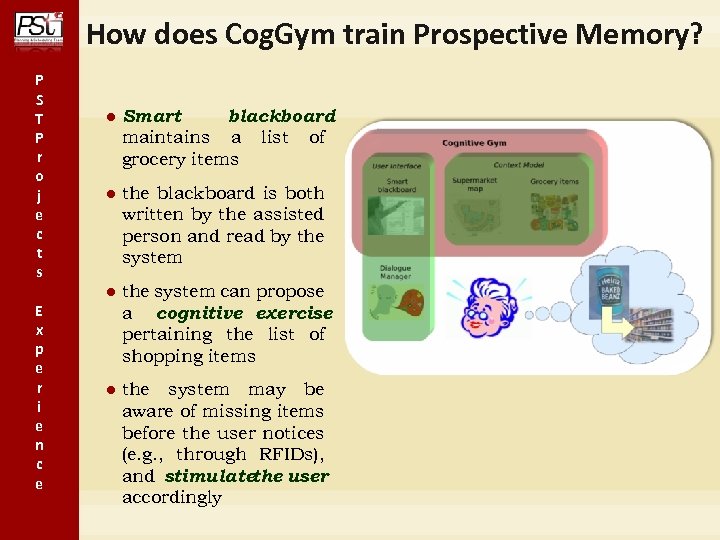 How does Cog. Gym train Prospective Memory? P S T P r o j e c t s Smart blackboard maintains a list of grocery items the blackboard is both written by the assisted person and read by the system E x p e r i e n c e the system can propose a cognitive exercise pertaining the list of shopping items the system may be aware of missing items before the user notices (e. g. , through RFIDs), and stimulatethe user accordingly
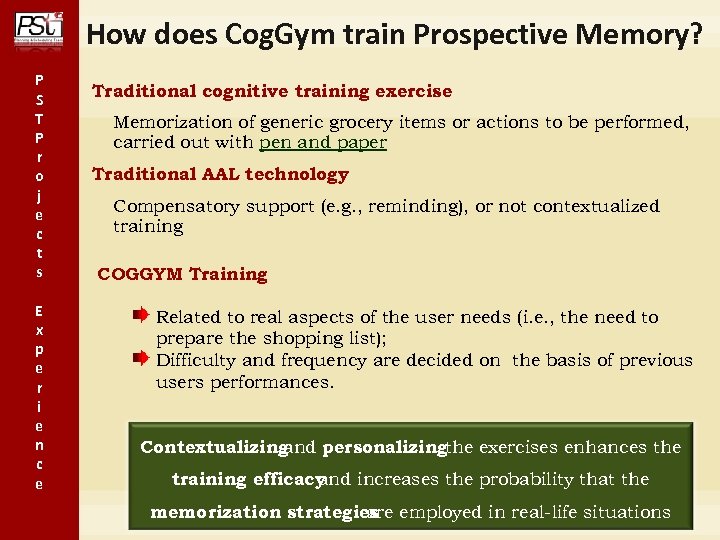 How does Cog. Gym train Prospective Memory? P S T P r o j e c t s E x p e r i e n c e Traditional cognitive training exercise Memorization of generic grocery items or actions to be performed, carried out with pen and paper Traditional AAL technology Compensatory support (e. g. , reminding), or not contextualized training COGGYM Training Related to real aspects of the user needs (i. e. , the need to prepare the shopping list); Difficulty and frequency are decided on the basis of previous users performances. Contextualizing and personalizingthe exercises enhances the training efficacy and increases the probability that the memorization strategies employed in real-life situations are
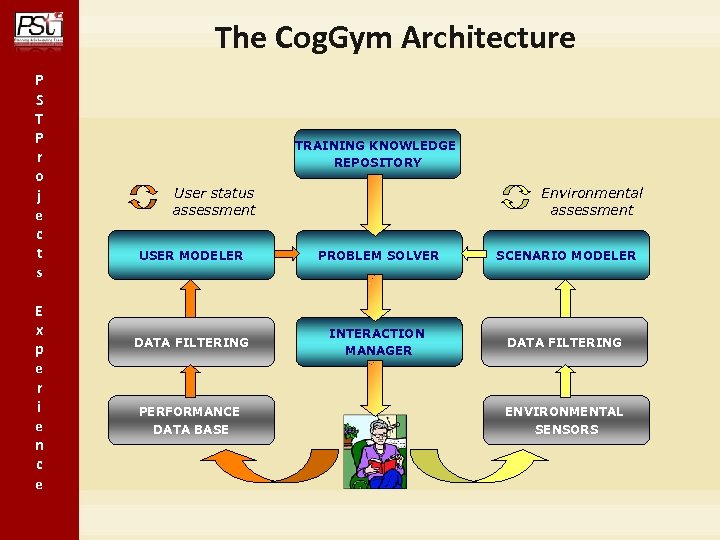 The Cog. Gym Architecture P S T P r o j e c t s E x p e r i e n c e TRAINING KNOWLEDGE REPOSITORY User status assessment Environmental assessment USER MODELER PROBLEM SOLVER SCENARIO MODELER DATA FILTERING INTERACTION MANAGER DATA FILTERING PERFORMANCE DATA BASE ENVIRONMENTAL SENSORS
 Current and future work P S T P r o j e c t s E x p e r i e n c e Improving of prospective memory case: We are adding different types of exercises We are studing wheter alternative modalities would be more suitable for elderly people Testing the software framework on additional cases We plan to include the spatial orientation and problem solving case We plan to adopt the experimental methodology we have developed from Robo. Care Participatory Design and development process together with users (older people, caregivers, gerontologist, computer scientists)
 C o n c l u s o i n s We have presented an overview of recent and current efforts in synthesizing cognitive technology for elderly population integrating heterogeneous AI technologies to obtain innovative interactive systems understanding critical features for user’s involvement and acceptance A multi-disciplinary team of people Robo. Care and Cog. Gym generate from an hybridization of teams that used to work in parallel The obtained flavor is quite unique Even if … a non trivial effort to understand each other is always required.