 Скачать презентацию Cognitive Radio Research at BT Dr Maziar Nekovee
fde1969f48773a8a6c87ec3a0d395259.ppt
- Количество слайдов: 26



Cognitive Radio Research at BT Dr Maziar Nekovee BT Innovate and Design & University College London maziar. nekovee@bt. com © British Telecommunications plc
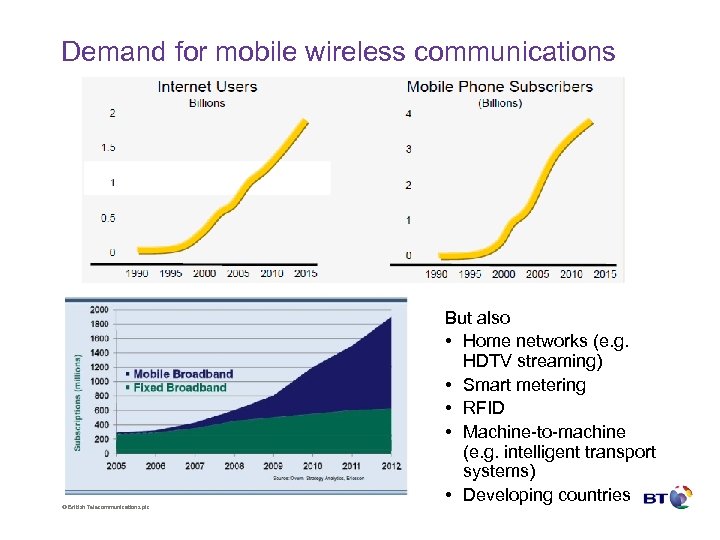
Demand for mobile wireless communications © British Telecommunications plc But also • Home networks (e. g. HDTV streaming) • Smart metering • RFID • Machine-to-machine (e. g. intelligent transport systems) • Developing countries
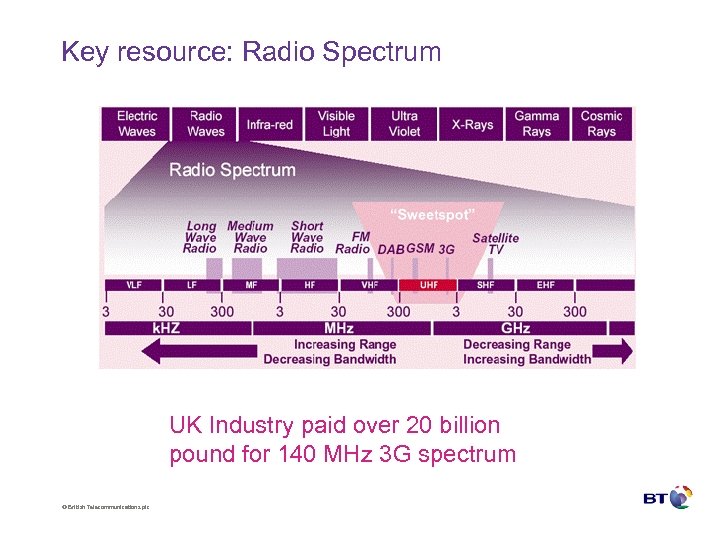
Key resource: Radio Spectrum UK Industry paid over 20 billion pound for 140 MHz 3 G spectrum © British Telecommunications plc
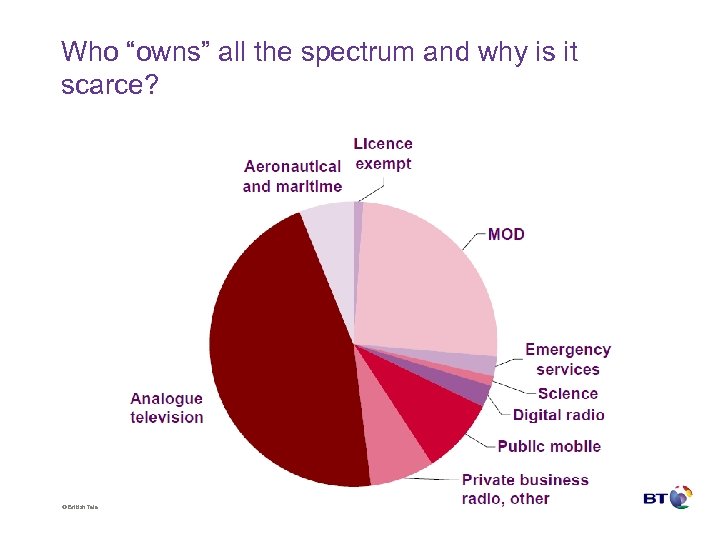
Who “owns” all the spectrum and why is it scarce? © British Telecommunications plc
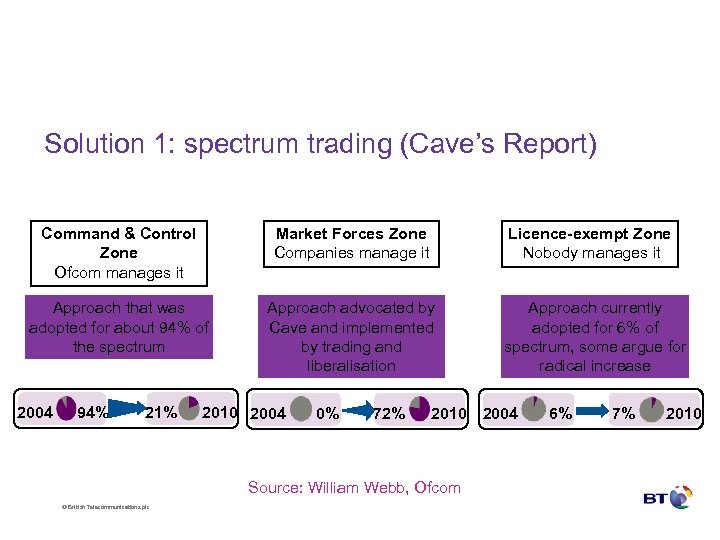
Solution 1: spectrum trading (Cave’s Report) Command & Control Zone Ofcom manages it Market Forces Zone Companies manage it Approach that was adopted for about 94% of the spectrum Approach advocated by Cave and implemented by trading and liberalisation 2004 94% 21% 2010 2004 0% 72% Licence-exempt Zone Nobody manages it 2010 2004 Source: William Webb, Ofcom © British Telecommunications plc Approach currently adopted for 6% of spectrum, some argue for radical increase 6% 7% 2010
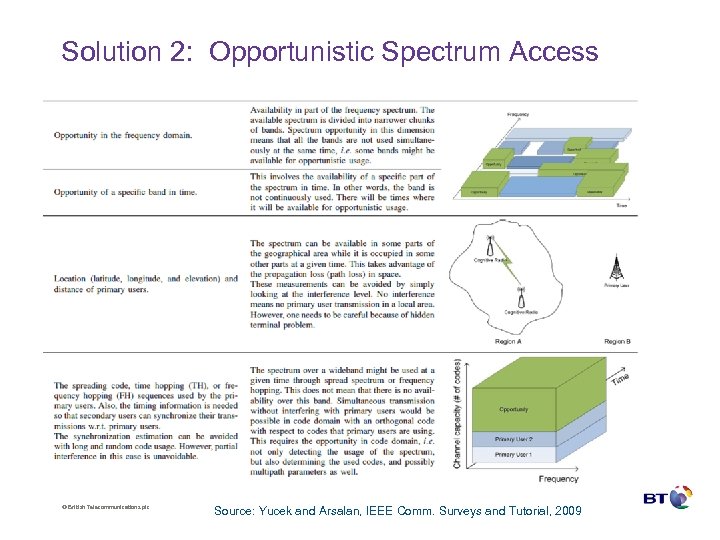
Solution 2: Opportunistic Spectrum Access © British Telecommunications plc Source: Yucek and Arsalan, IEEE Comm. Surveys and Tutorial, 2009
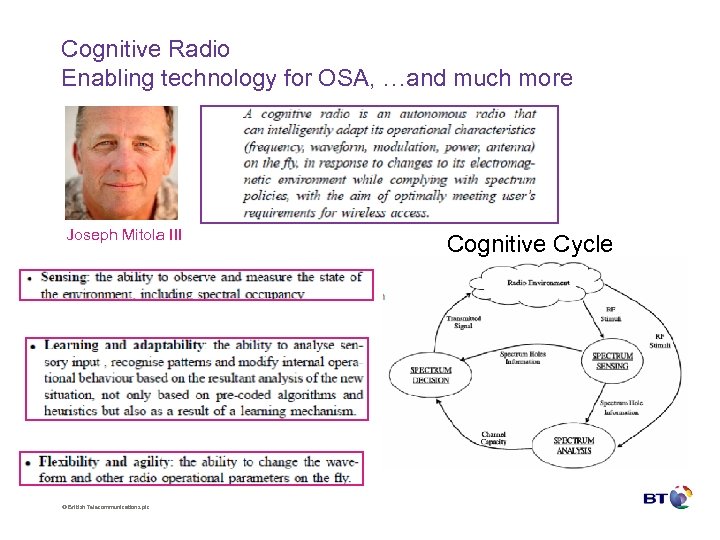
Cognitive Radio Enabling technology for OSA, …and much more Joseph Mitola III © British Telecommunications plc Cognitive Cycle
Cognitive Access to TV White Spaces: Spectrum Opportunity and Technology Challenges © British Telecommunications plc
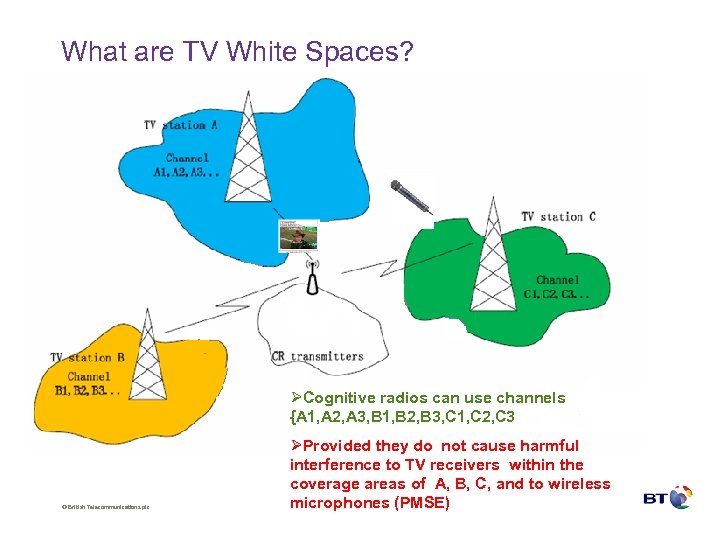
What are TV White Spaces? ØCognitive radios can use channels {A 1, A 2, A 3, B 1, B 2, B 3, C 1, C 2, C 3 © British Telecommunications plc ØProvided they do not cause harmful interference to TV receivers within the coverage areas of A, B, C, and to wireless microphones (PMSE)
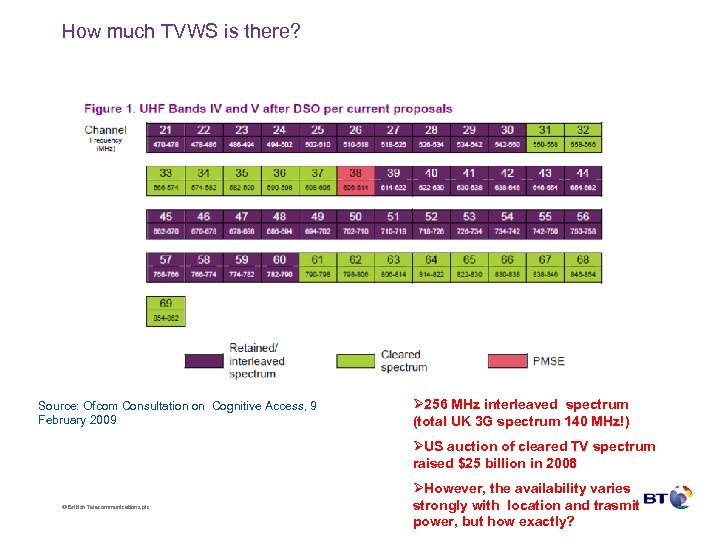
How much TVWS is there? Source: Ofcom Consultation on Cognitive Access, 9 February 2009 Ø 256 MHz interleaved spectrum (total UK 3 G spectrum 140 MHz!) ØUS auction of cleared TV spectrum raised $25 billion in 2008 © British Telecommunications plc ØHowever, the availability varies strongly with location and trasmit power, but how exactly?
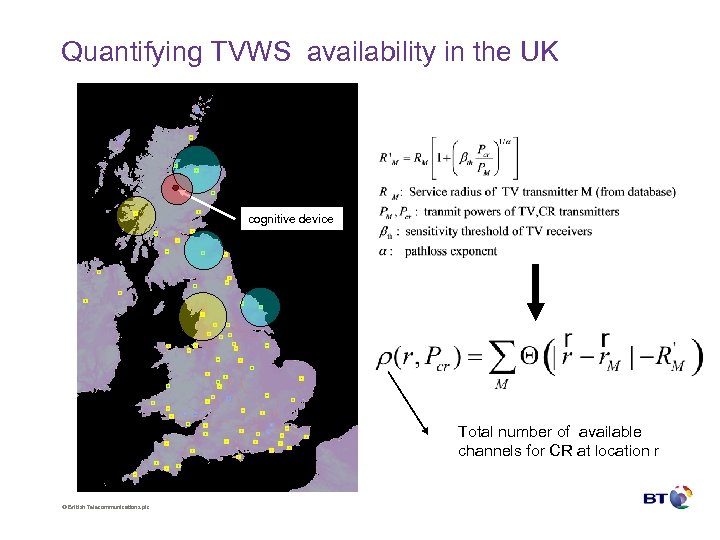
Quantifying TVWS availability in the UK cognitive device Total number of available channels for CR at location r © British Telecommunications plc
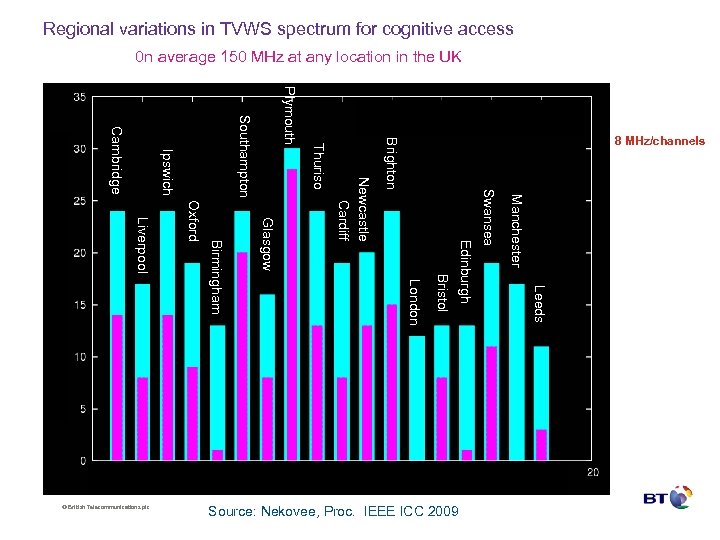
Regional variations in TVWS spectrum for cognitive access 0 n average 150 MHz at any location in the UK Manchester Leeds Edinburgh Bristol London Source: Nekovee, Proc. IEEE ICC 2009 Swansea Brighton Glasgow Birmingham Oxford Liverpool Newcastle Cardiff Thuriso Plymouth Southampton Ipswich Cambridge © British Telecommunications plc 8 MHz/channels
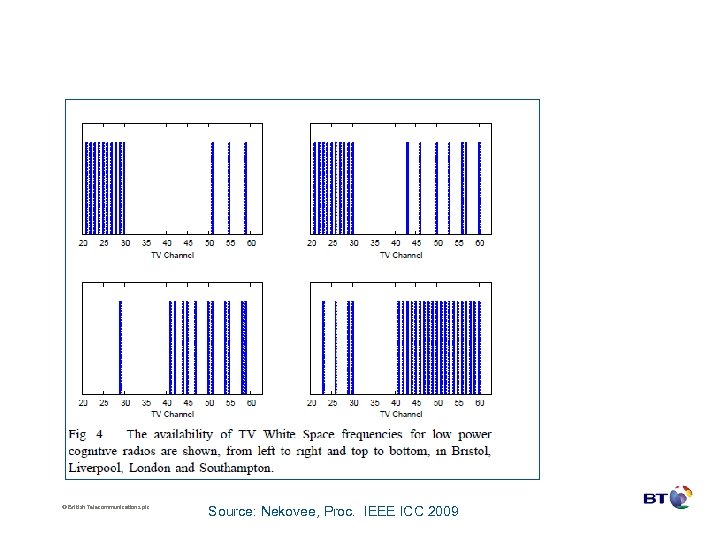
© British Telecommunications plc Source: Nekovee, Proc. IEEE ICC 2009
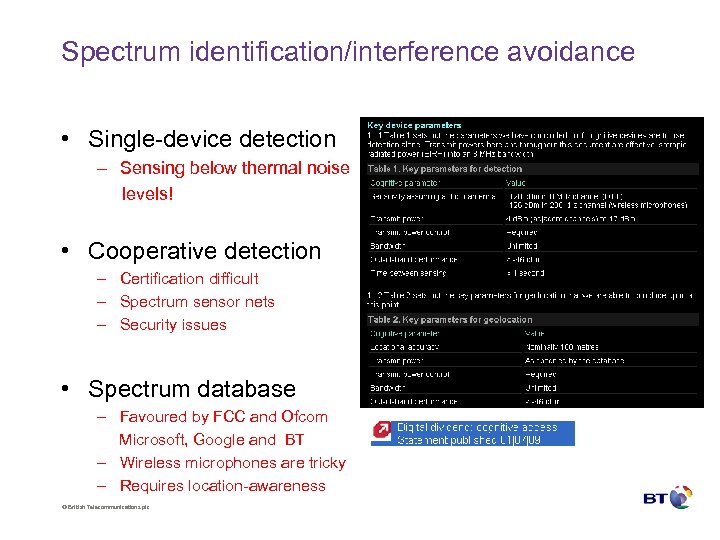
Spectrum identification/interference avoidance • Single-device detection – Sensing below thermal noise levels! • Cooperative detection – Certification difficult – Spectrum sensor nets – Security issues • Spectrum database – Favoured by FCC and Ofcom Microsoft, Google and BT – Wireless microphones are tricky – Requires location-awareness © British Telecommunications plc
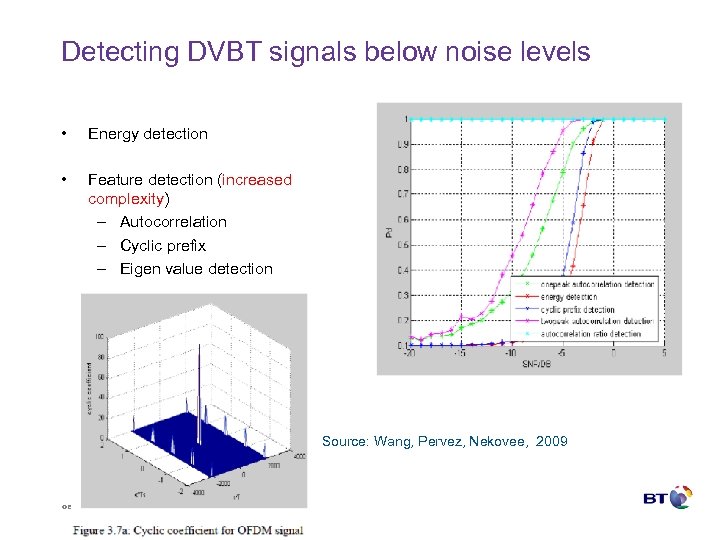
Detecting DVBT signals below noise levels • Energy detection • Feature detection (increased complexity) – Autocorrelation – Cyclic prefix – Eigen value detection Source: Wang, Pervez, Nekovee, 2009 © British Telecommunications plc
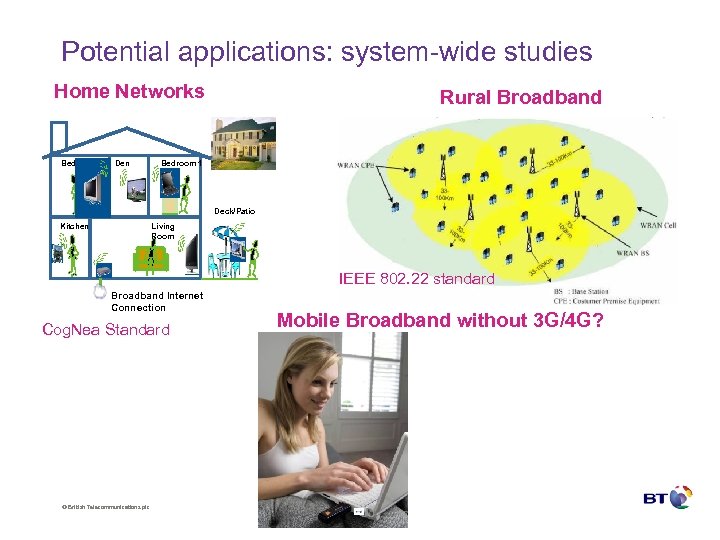
Potential applications: system-wide studies Home Networks Bedroom 2 Den Rural Broadband Bedroom 1 Deck/Patio Kitchen Living Room IEEE 802. 22 standard Broadband Internet Connection Cog. Nea Standard © British Telecommunications plc Mobile Broadband without 3 G/4 G?
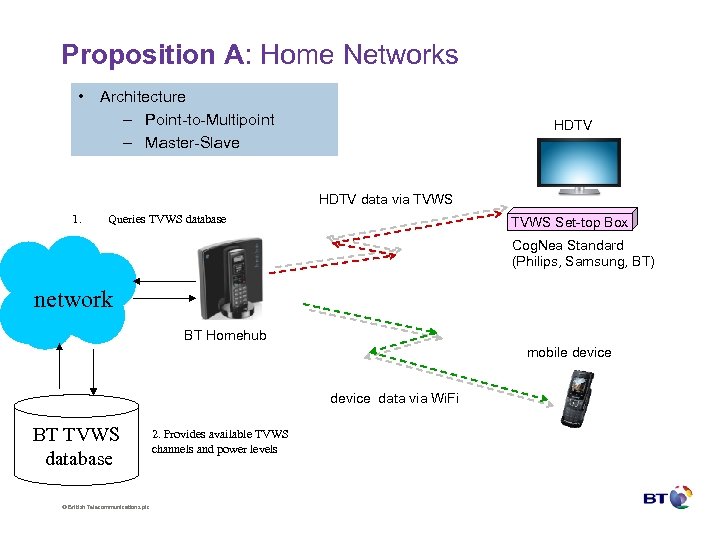
Proposition A: Home Networks • Architecture – Point-to-Multipoint – Master-Slave HDTV data via TVWS 1. Queries TVWS database TVWS Set-top Box Cog. Nea Standard (Philips, Samsung, BT) network BT Homehub mobile device data via Wi. Fi BT TVWS database © British Telecommunications plc 2. Provides available TVWS channels and power levels
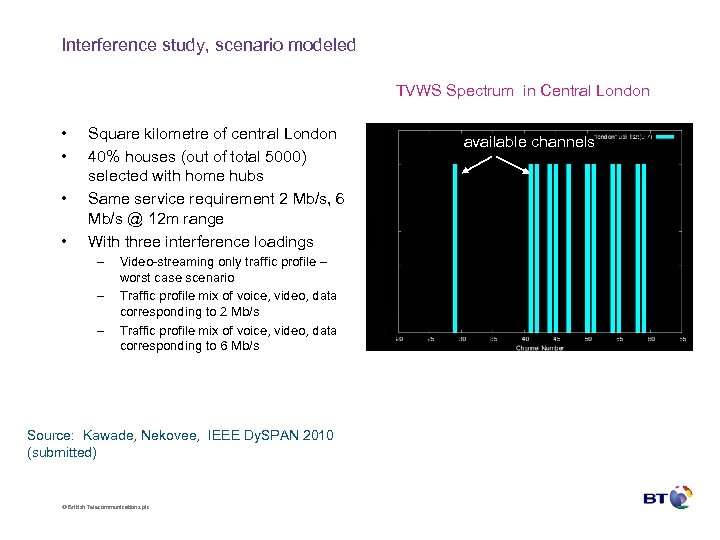
Interference study, scenario modeled TVWS Spectrum in Central London • • Square kilometre of central London 40% houses (out of total 5000) selected with home hubs Same service requirement 2 Mb/s, 6 Mb/s @ 12 m range With three interference loadings – – – Video-streaming only traffic profile – worst case scenario Traffic profile mix of voice, video, data corresponding to 2 Mb/s Traffic profile mix of voice, video, data corresponding to 6 Mb/s Source: Kawade, Nekovee, IEEE Dy. SPAN 2010 (submitted) © British Telecommunications plc available channels
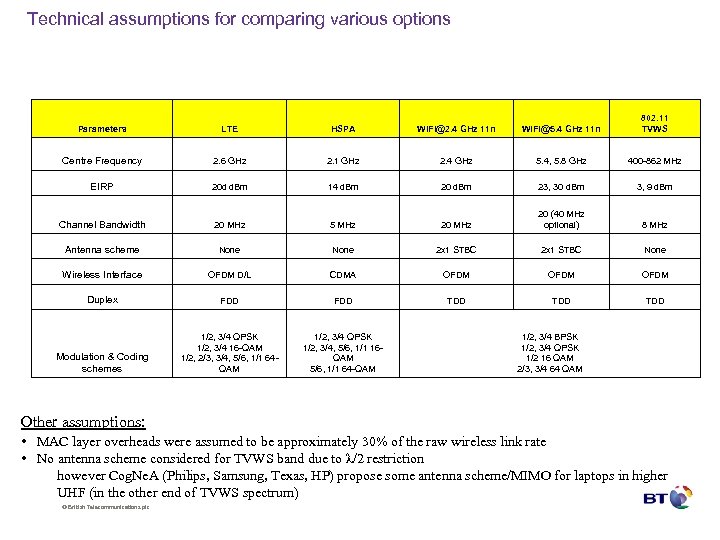
Technical assumptions for comparing various options Parameters LTE HSPA Wi. Fi@2. 4 GHz 11 n Wi. Fi@5. 4 GHz 11 n 802. 11 TVWS Centre Frequency 2. 6 GHz 2. 1 GHz 2. 4 GHz 5. 4, 5. 8 GHz 400 -862 MHz EIRP 20 d d. Bm 14 d. Bm 20 d. Bm 23, 30 d. Bm 3, 9 d. Bm Channel Bandwidth 20 MHz 5 MHz 20 (40 MHz optional) 8 MHz Antenna scheme None 2 x 1 STBC None Wireless Interface OFDM D/L CDMA OFDM Duplex FDD TDD TDD Modulation & Coding schemes 1/2, 3/4 QPSK 1/2, 3/4 16 -QAM 1/2, 2/3, 3/4, 5/6, 1/1 64 QAM 1/2, 3/4 QPSK 1/2, 3/4, 5/6, 1/1 16 QAM 5/6, 1/1 64 -QAM 1/2, 3/4 BPSK 1/2, 3/4 QPSK 1/2 16 QAM 2/3, 3/4 64 QAM Other assumptions: • MAC layer overheads were assumed to be approximately 30% of the raw wireless link rate • No antenna scheme considered for TVWS band due to λ/2 restriction however Cog. Ne. A (Philips, Samsung, Texas, HP) propose some antenna scheme/MIMO for laptops in higher UHF (in the other end of TVWS spectrum) © British Telecommunications plc
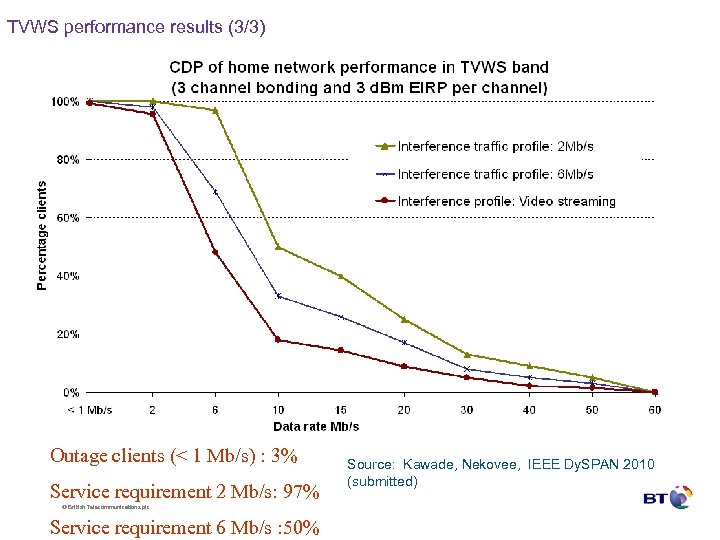
TVWS performance results (3/3) Outage clients (< 1 Mb/s) : 3% Service requirement 2 Mb/s: 97% © British Telecommunications plc Service requirement 6 Mb/s : 50% Source: Kawade, Nekovee, IEEE Dy. SPAN 2010 (submitted)
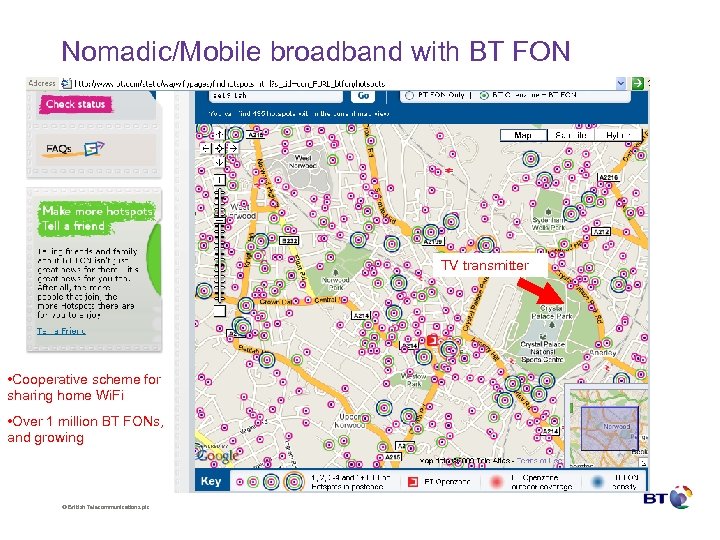
Nomadic/Mobile broadband with BT FON TV transmitter • Cooperative scheme for sharing home Wi. Fi • Over 1 million BT FONs, and growing © British Telecommunications plc
Cognitive Radio: A longer term view © British Telecommunications plc
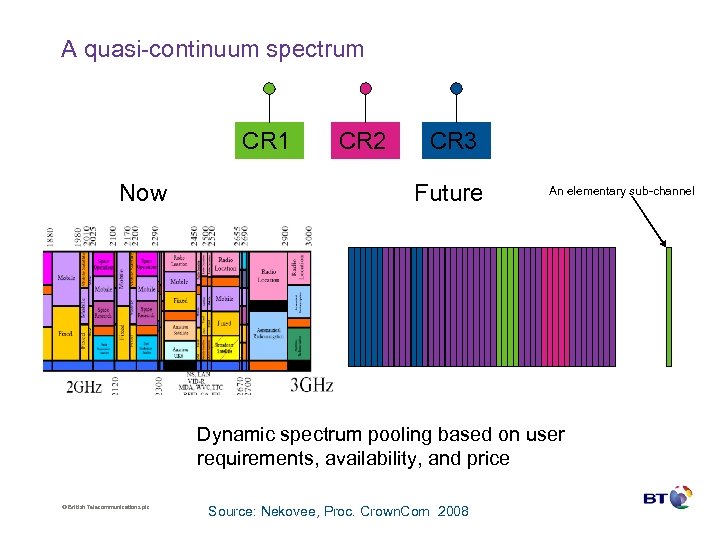
A quasi-continuum spectrum CR 1 Now CR 2 CR 3 Future An elementary sub-channel Dynamic spectrum pooling based on user requirements, availability, and price © British Telecommunications plc Source: Nekovee, Proc. Crown. Com 2008
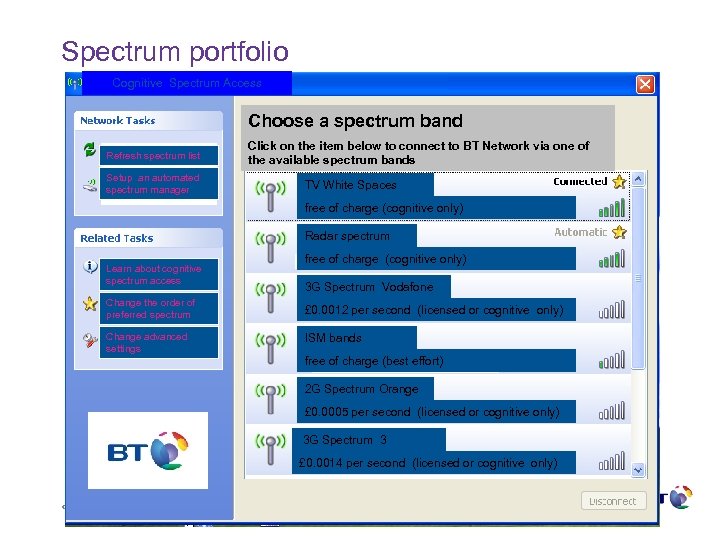
Spectrum portfolio Cognitive Spectrum Access Choose a spectrum band Refresh spectrum list Setup an automated spectrum manager Click on the item below to connect to BT Network via one of the available spectrum bands TV White Spaces free of charge (cognitive only) Radar spectrum Learn about cognitive spectrum access free of charge (cognitive only) 3 G Spectrum Vodafone Change the order of preferred spectrum £ 0. 0012 per second (licensed or cognitive only) Change advanced settings ISM bands free of charge (best effort) 2 G Spectrum Orange £ 0. 0005 per second (licensed or cognitive only) 3 G Spectrum 3 £ 0. 0014 per second (licensed or cognitive only) © British Telecommunications plc
Our research interests/activities • Technologies and models • System-wide issues: multi-user access (etiquette), capacity and • • coverage, Qo. S and mobility Agile modulation (NC-OFDM) and channel bundling techniques Cognitive radio testbed and trials Sensing, antenna arrays and MIMO for cognitive access Cognitive radio +optical communication? Spectrum micro auctions Spectrum databases Application Scenarios • • • Future home networks Mobile/nomadic broadband Smart metering Cognitive Femtocells Cognitive radio in vehicles Collaborations • 2 large FP 7 projects (starts Jan 2010) • Microsoft, Google, BBC, Cog. Nea • Scottish Universities • Open to exploring new ones! © British Telecommunications plc
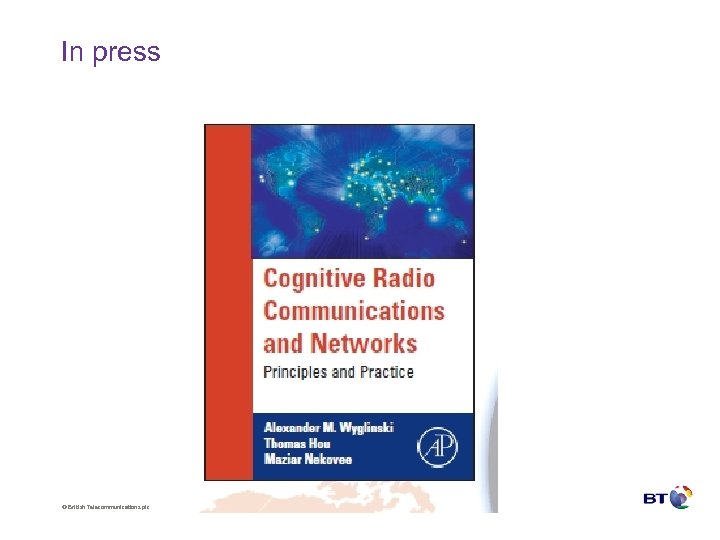
In press © British Telecommunications plc
Скачать презентацию Cognitive Radio Research at BT Dr Maziar Nekovee
fde1969f48773a8a6c87ec3a0d395259.ppt