


 Скачать презентацию Cognitive Radio Jeff Reed reedjh vt edu reedjh crtwireless com
724f9de039422b9b7c074448bbb40703.ppt
- Количество слайдов: 22
 Cognitive Radio Jeff Reed reedjh@vt. edu reedjh@crtwireless. com (540) 231 2972 James Neel James. neel@crtwireless. com (540) 230 -6012 www. crtwireless. com CERDEC February 5, 2008 1 Cognitive Radio Technologies, 2008
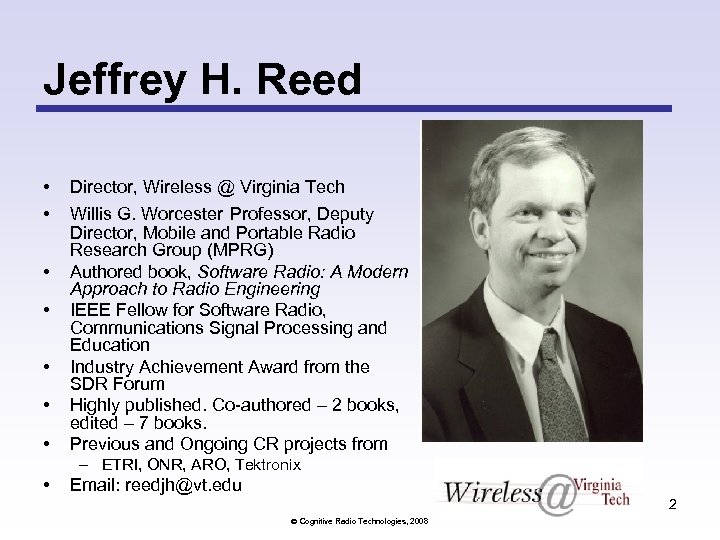 Jeffrey H. Reed • • Director, Wireless @ Virginia Tech Willis G. Worcester Professor, Deputy Director, Mobile and Portable Radio Research Group (MPRG) Authored book, Software Radio: A Modern Approach to Radio Engineering IEEE Fellow for Software Radio, Communications Signal Processing and Education Industry Achievement Award from the SDR Forum Highly published. Co-authored – 2 books, edited – 7 books. Previous and Ongoing CR projects from – ETRI, ONR, ARO, Tektronix • Email: reedjh@vt. edu 2 Cognitive Radio Technologies, 2008
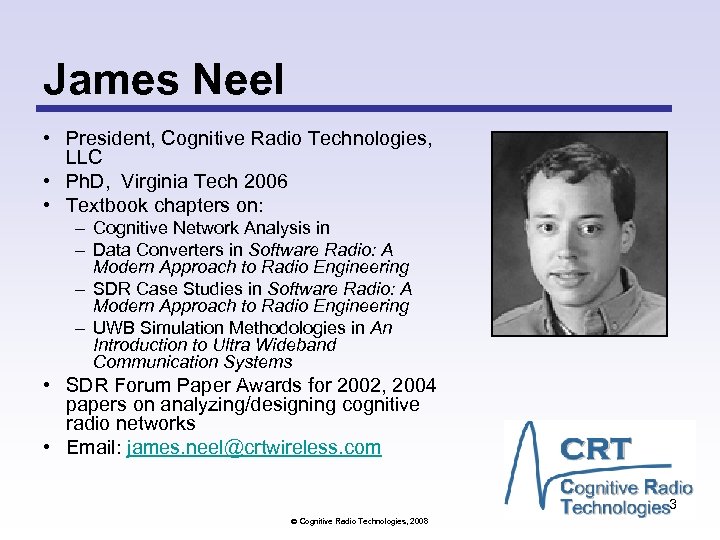 James Neel • President, Cognitive Radio Technologies, LLC • Ph. D, Virginia Tech 2006 • Textbook chapters on: – Cognitive Network Analysis in – Data Converters in Software Radio: A Modern Approach to Radio Engineering – SDR Case Studies in Software Radio: A Modern Approach to Radio Engineering – UWB Simulation Methodologies in An Introduction to Ultra Wideband Communication Systems • SDR Forum Paper Awards for 2002, 2004 papers on analyzing/designing cognitive radio networks • Email: james. neel@crtwireless. com 3 Cognitive Radio Technologies, 2008
 Presentation Overview • (22) Introductory Material – Definitions, applications • (76) Implementation Issues – Architectures, sensing, classification, decisions • (39) Networking Issues – Problems and different approaches to mitigate those problems • (14) Ongoing Efforts – Commercial, University, Military • (19) Conclusions 4 Cognitive Radio Technologies, 2008
 What is a Cognitive Radio? Concepts, Definitions 5 Cognitive Radio Technologies, 2008
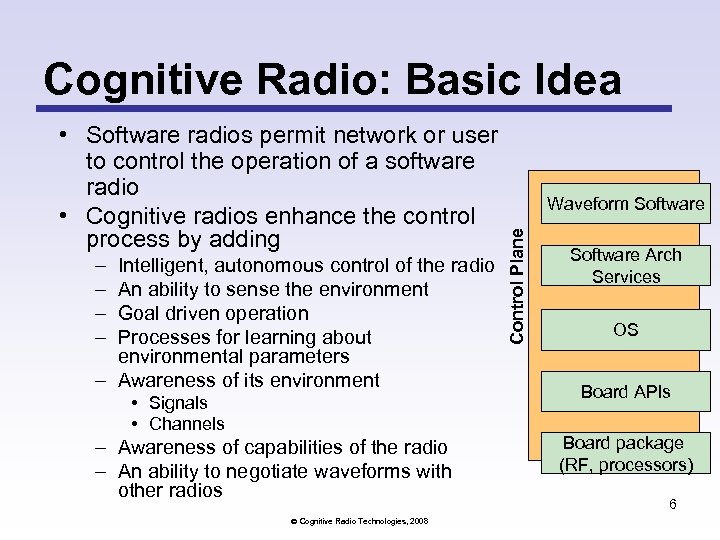 Cognitive Radio: Basic Idea – – Intelligent, autonomous control of the radio An ability to sense the environment Goal driven operation Processes for learning about environmental parameters – Awareness of its environment • Signals • Channels – Awareness of capabilities of the radio – An ability to negotiate waveforms with other radios Cognitive Radio Technologies, 2008 Waveform Software Control Plane • Software radios permit network or user to control the operation of a software radio • Cognitive radios enhance the control process by adding Software Arch Services OS Board APIs Board package (RF, processors) 6
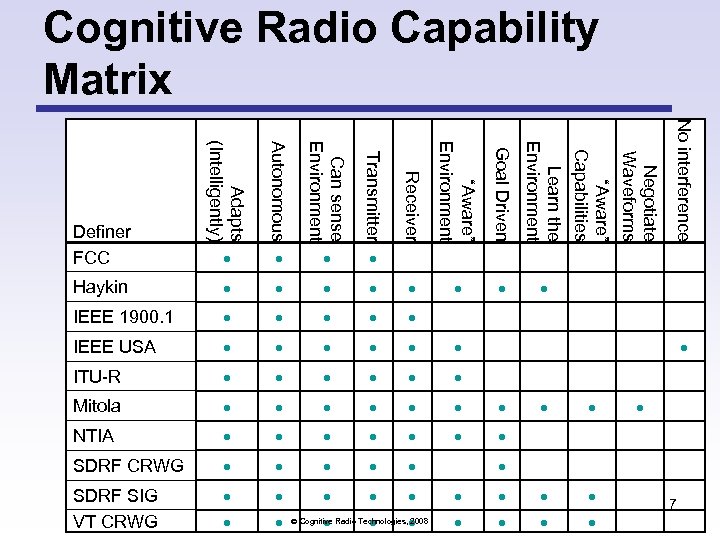 Cognitive Radio Capability Matrix Can sense Environment Transmitter Receiver “Aware” Environment Goal Driven Haykin IEEE 1900. 1 IEEE USA ITU-R Mitola NTIA SDRF CRWG SDRF SIG VT CRWG No interference Autonomous Cognitive Radio Technologies, 2008 Negotiate Waveforms “Aware” Capabilities Learn the Environment Adapts (Intelligently) Definer FCC 7
 Why So Many Definitions? • People want cognitive radio to be something completely different – Wary of setting the hype bar too low – Cognitive radio evolves existing capabilities – Like software radio, benefit comes from the paradigm shift in designing radios • Focus lost on implementation – Wary of setting the hype bar too high – Cognitive is a very value-laden term in the AI community – Will the radio be conscious? • Too much focus on applications – Core capability: radio adapts in response changing operating conditions based on observations and/or experience – Conceptually, cognitive radio is a magic box 8 Cognitive Radio Technologies, 2008
![Conceptual Operation Cognition cycle [Mitola_99] OODA Loop: (continuously) Infer from Context • Observe outside](https://present5.com/presentation/724f9de039422b9b7c074448bbb40703/image-9.jpg "Conceptual Operation Cognition cycle [Mitola_99] OODA Loop: (continuously) Infer from Context • Observe outside") Conceptual Operation Cognition cycle [Mitola_99] OODA Loop: (continuously) Infer from Context • Observe outside world Orient Infer from Radio Model • Orient to infer meaning of Establish Priority observations Normal Pre-process Select Alternate Goals Parse Stimuli • Adjust waveform as Urgent Immediate Plan needed to achieve goal • Implement processes needed to change Learn Observe New waveform States Decide Other processes: (as needed) States User Driven Generate “Best” • Adjust goals (Plan) Autonomous (Buttons) Waveform • Learn about the outside Act world, needs of user, … Outside Allocate Resources 9 Initiate Processes World Cognitive Radio Technologies, 2008 Negotiate Protocols
Conceptual Operation Cognition cycle [Mitola_99] OODA Loop: (continuously) Infer from Context • Observe outside world Orient Infer from Radio Model • Orient to infer meaning of Establish Priority observations Normal Pre-process Select Alternate Goals Parse Stimuli • Adjust waveform as Urgent Immediate Plan needed to achieve goal • Implement processes needed to change Learn Observe New waveform States Decide Other processes: (as needed) States User Driven Generate “Best” • Adjust goals (Plan) Autonomous (Buttons) Waveform • Learn about the outside Act world, needs of user, … Outside Allocate Resources 9 Initiate Processes World Cognitive Radio Technologies, 2008 Negotiate Protocols
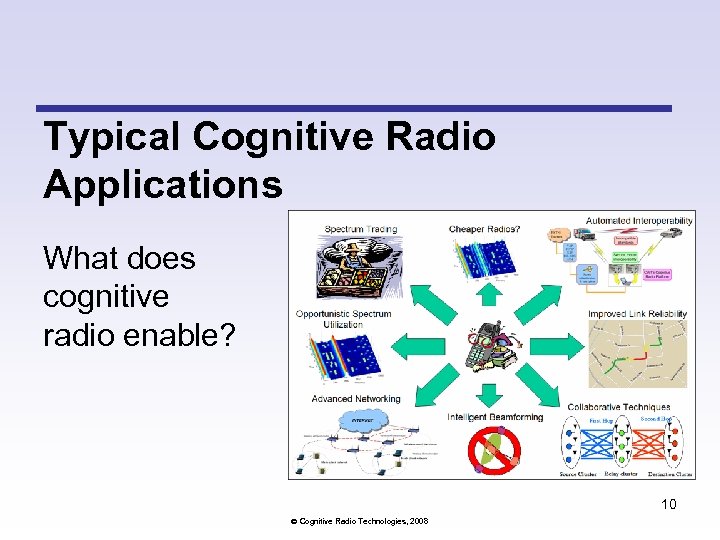 Typical Cognitive Radio Applications What does cognitive radio enable? 10 Cognitive Radio Technologies, 2008
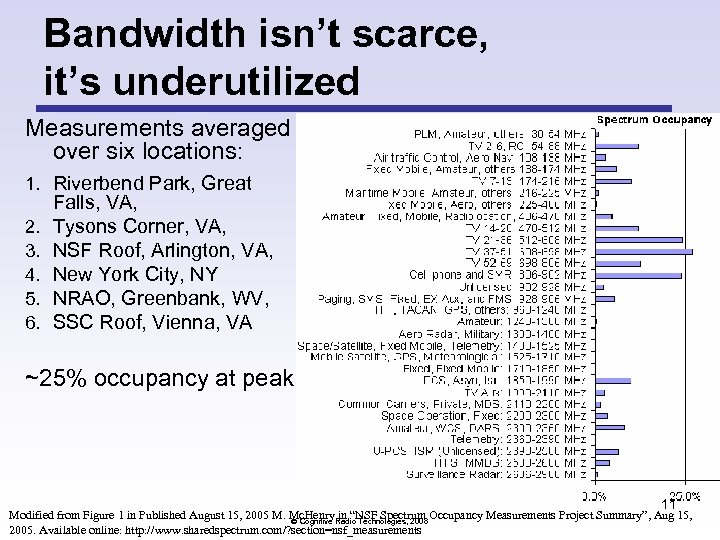 Bandwidth isn’t scarce, it’s underutilized Measurements averaged over six locations: 1. Riverbend Park, Great 2. 3. 4. 5. 6. Falls, VA, Tysons Corner, VA, NSF Roof, Arlington, VA, New York City, NY NRAO, Greenbank, WV, SSC Roof, Vienna, VA ~25% occupancy at peak 11 Modified from Figure 1 in Published August 15, 2005 M. Mc. Henry Radio Technologies, 2008 Occupancy Measurements Project Summary”, Aug 15, in “NSF Spectrum Cognitive 2005. Available online: http: //www. sharedspectrum. com/? section=nsf_measurements
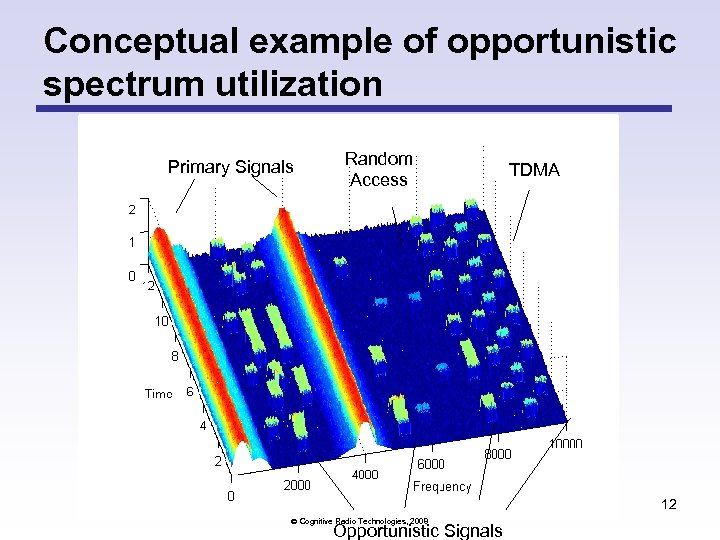 Conceptual example of opportunistic spectrum utilization Primary Signals Random Access TDMA 12 Cognitive Radio Technologies, 2008 Opportunistic Signals
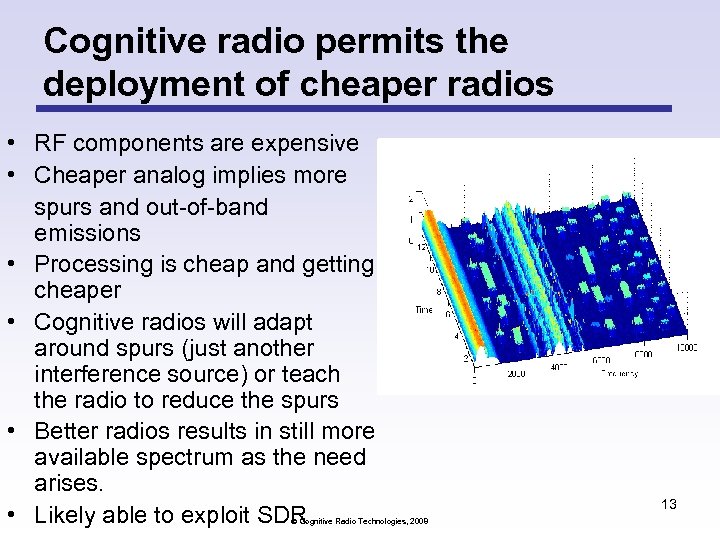 Cognitive radio permits the deployment of cheaper radios • RF components are expensive • Cheaper analog implies more spurs and out-of-band emissions • Processing is cheap and getting cheaper • Cognitive radios will adapt around spurs (just another interference source) or teach the radio to reduce the spurs • Better radios results in still more available spectrum as the need arises. • Likely able to exploit SDR Cognitive Radio Technologies, 2008 13
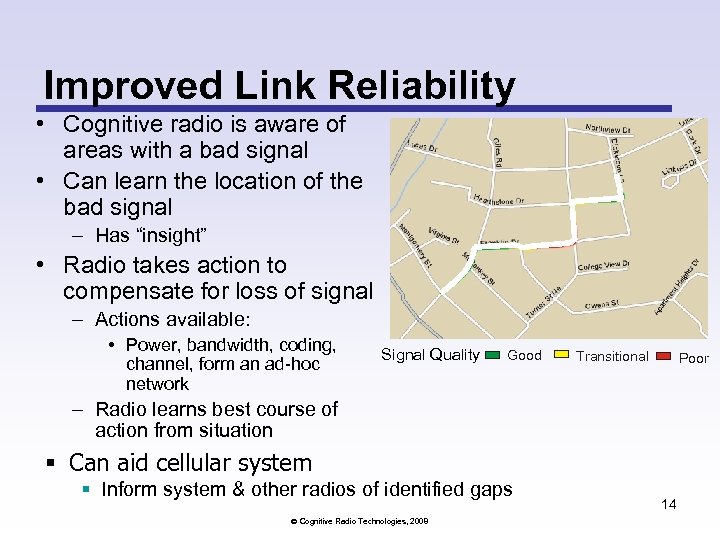 Improved Link Reliability • Cognitive radio is aware of areas with a bad signal • Can learn the location of the bad signal – Has “insight” • Radio takes action to compensate for loss of signal – Actions available: • Power, bandwidth, coding, channel, form an ad-hoc network Signal Quality Good Transitional Poor – Radio learns best course of action from situation § Can aid cellular system § Inform system & other radios of identified gaps Cognitive Radio Technologies, 2008 14
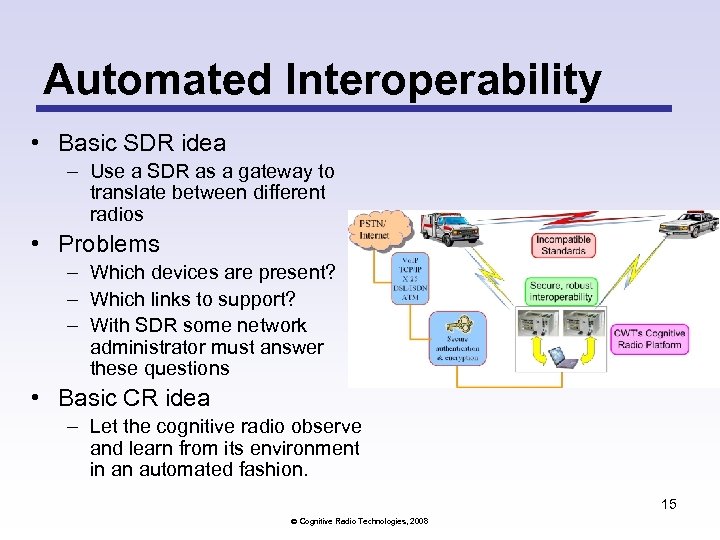 Automated Interoperability • Basic SDR idea – Use a SDR as a gateway to translate between different radios • Problems – Which devices are present? – Which links to support? – With SDR some network administrator must answer these questions • Basic CR idea – Let the cognitive radio observe and learn from its environment in an automated fashion. 15 Cognitive Radio Technologies, 2008
 Spectrum Trading • Underutilized spectrum can be sold to support a high demand service – Currently done in Britain – Permitted in US among public safety users • Currently has a very long time scale (months) • Faster spectrum trading could permit for significant increases in available bandwidth – How to recognize need and availability of additional spectrum? – Environment + context awareness + memory Cognitive Radio Technologies, 2008 16
 Collaborative Radio • A radio that leverages the services of other radios to further its goals or the goals of the networks. • Cognitive radio enables the collaboration process – Identify potential collaborators – Implies observations processes • Classes of collaboration – Distributed processing – Distributed sensing 17 Cognitive Radio Technologies, 2008
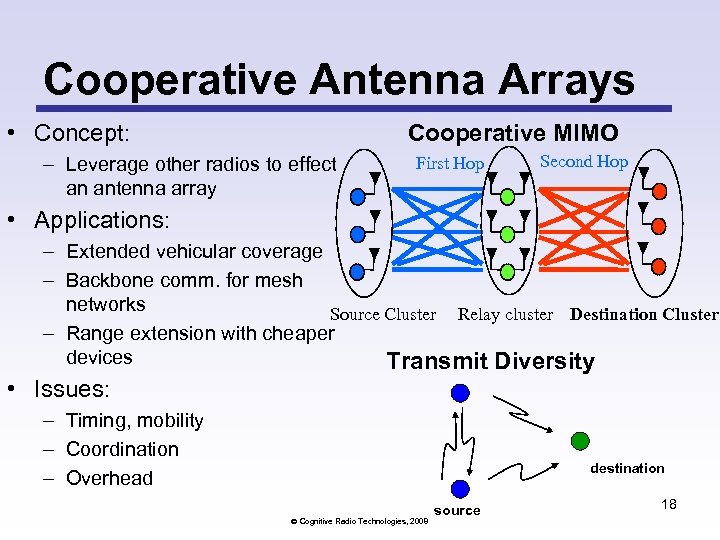 Cooperative Antenna Arrays • Concept: Cooperative MIMO – Leverage other radios to effect an antenna array First Hop Second Hop • Applications: – Extended vehicular coverage – Backbone comm. for mesh networks Source Cluster Relay cluster Destination Cluster – Range extension with cheaper devices Transmit Diversity • Issues: – Timing, mobility – Coordination – Overhead destination Cognitive Radio Technologies, 2008 source 18
 Other Opportunities for Collaborative Radio (1/3) • Distributed processing – Exploit different capabilities on different devices • Maybe even for waveform processing – Bring extra computational power to bear on critical problems • Useful for most collaborative problems • Collaborative sensing – Extend detection range by including observations of other radios • Hidden node mitigation – Improve estimation statistics by incorporating more independent observations – Immediate applicability in 802. 22, likely useful in future adaptive standards 19 Cognitive Radio Technologies, 2008
 Other Opportunities for Collaborative Radio (2/3) • Improved localization – Application of collaborative sensing – Security – Friend finders • Reduced contention MACs – Collaborative scheduling algorithms to reduce collisions – Perhaps of most value to 802. 11 • Some scheduling included in 802. 11 e 20 Cognitive Radio Technologies, 2008
 Other Opportunities for Collaborative Radio (3/3) • Distributed mapping • Theft detection – Gather information relevant to specific locations from mobiles and arrange into useful maps – Coverage maps • Collect and integrate signal strength information from mobiles • If holes are identified and fixed, should be a service differentiator – Devices can learn which other devices they tend to operate in proximity of and unexpected combinations could serve as a security flag (like flagging unexpected uses of credit cards) – Examples: – Congestion maps • Density of mobiles should correlate with traffic (as in automobile) congestion • Customers may be willing to pay for real time traffic information • Car components that expect to see certain mobiles in the car • Laptops that expect to operate with specific mobiles nearby 21 Cognitive Radio Technologies, 2008
 Summary • Cognitive radio evolves the software radio concept to permit intelligent autonomous adaptation of radio parameters – Significant variation in definitions of “cognitive radio” – Question of how “cognitive” the radio is • Numerous new applications enabled – Opportunistic spectrum utilization, collaborative radio, link reliability, advanced network structures • Differing implementation approaches • Many objectives will require development of a cognitive language • In a network, adaptations of cognitive radios interact – Interaction can be mitigated with policy, punishment, cost adjustments, centralization or potential games • Commercial implementations starting to appear – 802. 22, 802. 11 h, y, 802. 16 h – And may have been around for a while (cordless phones with DFS) – Many applications implementable with simple algorithms – Greater flexibility achievable with Cognitive a cognitive engine approach Radio Technologies, 2008 22