 Скачать презентацию Cognitive Perspective z Mental representations of objects and
7fd921b1b8108c3e29c0db2d1a34ff8f.ppt
- Количество слайдов: 56



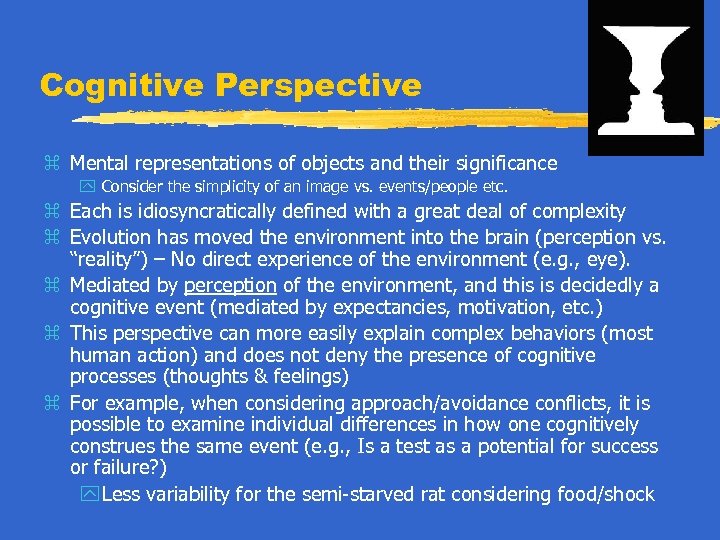
Cognitive Perspective z Mental representations of objects and their significance y Consider the simplicity of an image vs. events/people etc. z Each is idiosyncratically defined with a great deal of complexity z Evolution has moved the environment into the brain (perception vs. “reality”) – No direct experience of the environment (e. g. , eye). z Mediated by perception of the environment, and this is decidedly a cognitive event (mediated by expectancies, motivation, etc. ) z This perspective can more easily explain complex behaviors (most human action) and does not deny the presence of cognitive processes (thoughts & feelings) z For example, when considering approach/avoidance conflicts, it is possible to examine individual differences in how one cognitively construes the same event (e. g. , Is a test as a potential for success or failure? ) y Less variability for the semi-starved rat considering food/shock
Cognitive revolution (1950 s forward) How do we think, perceive, remember, solve, etc. ? Tolman’s latent learning y When learning is not immediately evident or behaviorally observable y Learning occurs in the absence of reinforcement for the behavior or any associative learning (learning from temporal association) y Research on hungry rats with 3 conditions: 1) food when they reach the end of the maze, 2) no food after running the maze, or 3) initially no reinforcement, but later reinforced for running the maze y Dramatic improvement for rats in condition 3 after reinforced and did better than those in condition 1 y So they were learning in earlier trials, despite not being reinforced or showing it behaviorally (forming cognitive maps) x Later replicated in other animals and humans Chomsky’s “preparedness” for learning in children y Linguistics movement (a readiness to learn/acquire speech) y Thought processes are intermediaries between stimulus and response
Cognitive Revolution z George Miller work with human memory y memory is critical to learning as it accounts for whether we remember and how we recall it. y e. g. , learning by chunks: issue of capacity for learning (7+-2), the role of perception in learning (chess pieces for novices & experts), etc. y Considers the computer as a metaphor for the mind z Von Neumann & Mc. Cullough’s use of binary mathematical relations among symbols to reflect the mind y Artificial intelligence, bottom-up and top-down metacognitions y e. g. , Deep Blue as a model for human thinking in chess z In addition to memory, behavior & cognitions are influenced by: y information processing (e. g. , heuristics and biases), y pattern recognition (prototypes), y schema (less agreeable people are more likely to see others as hostile)
George Kelly (1955) z Construct theory z Humans as scientists z Where did your “experiments” begin? z Personal theories = constructs z Used to explain the present and predict the future z “Ask them, they might just tell you. ” (credible approach that emphasizes the subjective appraisals of individuals
Fundamental Postulate and Corollaries z How you represent the environment is affected by the anticipation of events z assume replication; oriented to the future z uniqueness of your construct system z finite number of dichotomous constructs z range of convenience for any construct y If events can’t be explained by any construct, this leads to anxiety z choice of constructs and their ordinal association (you can have any theories, but theories you choose limit what you’ll find)
Kelly’s cognitive complexity z Kelly defined cognitive complexity as having many superordinate (or core) constructs (initiated the cognitive movement) y Patient with single core construct of “Army – not Army” z Greater cognitive complexity is associated with better adaptiveness as it means you have more ways of interpreting events (vs. being very limited in how you view things) z Tetlock & Suedfeld have studied the cognitive complexity of communications and how it predicts conflict. Lower complexity = maladaptive (conflict) y e. g. , examined UN communications between countries and could predict times of conflict
Social learning/cognitive theory z Behavior potential = Behavioral expectancy (regardless of the reinforcing or punishing contingencies, do you expect the consequence? ) X reward value (idiosyncratic value one places on the reinforcer or punisher) y Julian Rotter, 1970 s z Because previous experience necessarily influences expectancy, Rotter’s model necessarily considers the person & situation
Putting cognitive theory to the test, part 1 Can learning occur from modeling in animals? z Modeling/imitation: learning in the absence of reinforcement for either the target or the model z Modeling occurs in species within the great ape lineage y e. g. , fear of snakes in monkeys reared in captivity after exposure to monkeys reared in wild Can modeling occur in species outside the great ape lineage? z Rhesus monkeys ranging in age from 1 to 14 days exposed to human models engaging in simple behaviors like tongue protrusions, mouth opening, lip smacking, etc. y Greater learning for “older” monkeys, and some behaviors acquired more easily (also evidenced individual differences in acquisition) y Evidence for mirror neurons (cells that fire when others perform an action to promote mimicry)
Modeling in humans z Bandura’s social learning theory suggests that modeling requires: y Attention – notice and attend to the behavior y Retention – defining features of the behavior have to be encoded, retained, and recalled y Reproduction – more complex tasks may require rehearsal y Motivation – incentives are typically needed, but they may be internal, or in some cases, absent (highly variable factor) z The bulk of the human data on modeling/imitation is nonexperimental in nature and has focused on areas of great concern (Is violence in our society due to modeling? – see school shootings such as Sandy Hook, 2012; James Holmes, 2012, etc. )
Effects of violent/aggressive models Media coverage as a source of modeling? z Reviews literature on violent TV viewing in childhood (survey research). Huston & Cofer, 1986; also Bushman & Huesmann, 2014 y Prospectively predicts adult aggression. Confounds? y Findings persist after controlling for SES, level of supervision, and aggression as a child. y Effects are growing since 1975 y Effects are strongest when individuals can identify with the models y Less overt effect for adults; a readiness to aggress y Weaker modeling effects for pro-social behavior z Conclusions regarding violent video games: strongest effects when looking at aggression in the lab vs. violence outside the lab y FYI - Violent crimes decrease when violent films are showing (Dahl & Vigna, 2009); Those who like violence are busy!
Putting cognitive theory to the test, part 2 Is there experimental evidence for modeling in humans? z Effects of aggressive models on children (see Bobo doll experiment; Bandura et al. , 1961) y Children randomly assigned to one of 3 conditions: 1) aggressive adult, passive adult, a group with no adult model y Aggressive adult model punched and struck the doll with mallet y Children exposed to the aggressive model engaged in significantly more aggressive behavior with the bobo doll y Males showed more physical aggression, but no gender difference on verbal aggression y Modeling is most effective when it is a similar model z Follow-up study to test effects of reward and punishment y Minimal change in aggression if model was punished y Double the effect if model was rewarded (Bandura et al. , 1963) y How durable are the effects?
Self-efficacy and reciprocal determinism (Bandura) z Self-efficacy – the belief in one’s ability to succeed (mastery, competency, effectiveness) y This belief appears important to expectations for favorable outcomes, and this in turn, impacts motivation, effort, etc. y Can be domain-specific (e. g. , work vs. relationships) z Reciprocal determinism (causality) – behavior is predicted by the person (internal cognitions), their behavior, and the environment y Each factor influences the other y Note: Psychodynamic was fully focused on internal motives and behavioral perspective was fully focused on the environment
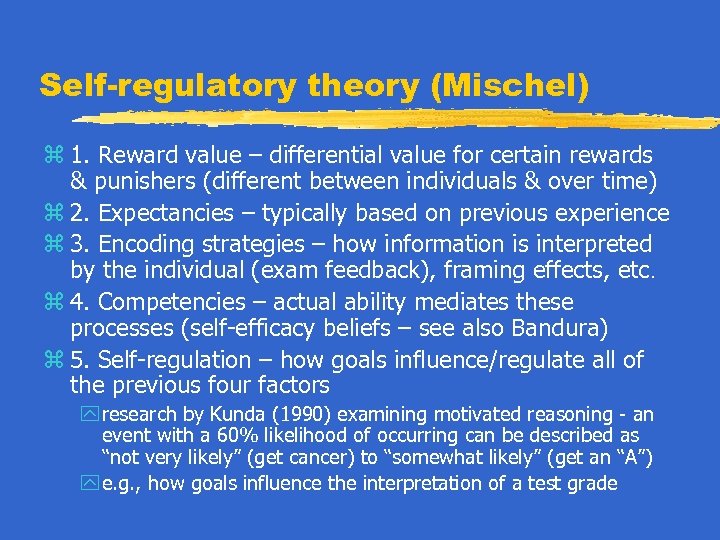
Self-regulatory theory (Mischel) z 1. Reward value – differential value for certain rewards & punishers (different between individuals & over time) z 2. Expectancies – typically based on previous experience z 3. Encoding strategies – how information is interpreted by the individual (exam feedback), framing effects, etc. z 4. Competencies – actual ability mediates these processes (self-efficacy beliefs – see also Bandura) z 5. Self-regulation – how goals influence/regulate all of the previous four factors y research by Kunda (1990) examining motivated reasoning - an event with a 60% likelihood of occurring can be described as “not very likely” (get cancer) to “somewhat likely” (get an “A”) y e. g. , how goals influence the interpretation of a test grade
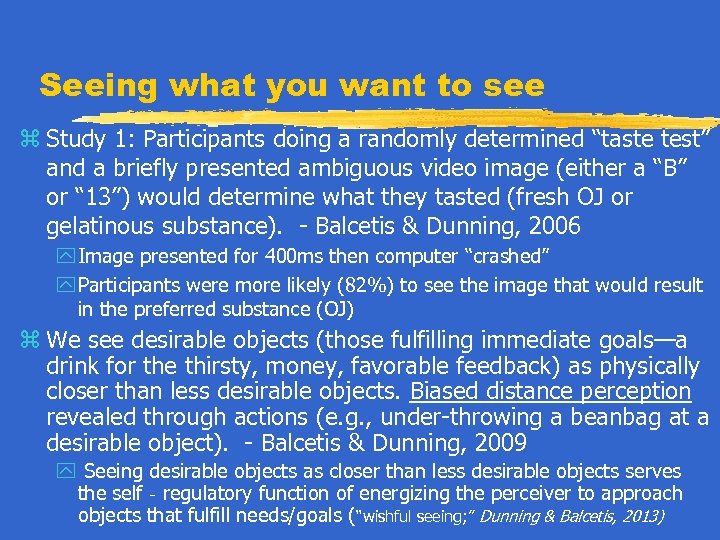
Seeing what you want to see z Study 1: Participants doing a randomly determined “taste test” and a briefly presented ambiguous video image (either a “B” or “ 13”) would determine what they tasted (fresh OJ or gelatinous substance). - Balcetis & Dunning, 2006 y Image presented for 400 ms then computer “crashed” y Participants were more likely (82%) to see the image that would result in the preferred substance (OJ) z We see desirable objects (those fulfilling immediate goals—a drink for the thirsty, money, favorable feedback) as physically closer than less desirable objects. Biased distance perception revealed through actions (e. g. , under-throwing a beanbag at a desirable object). - Balcetis & Dunning, 2009 y Seeing desirable objects as closer than less desirable objects serves the self‐regulatory function of energizing the perceiver to approach objects that fulfill needs/goals (“wishful seeing; ” Dunning & Balcetis, 2013)
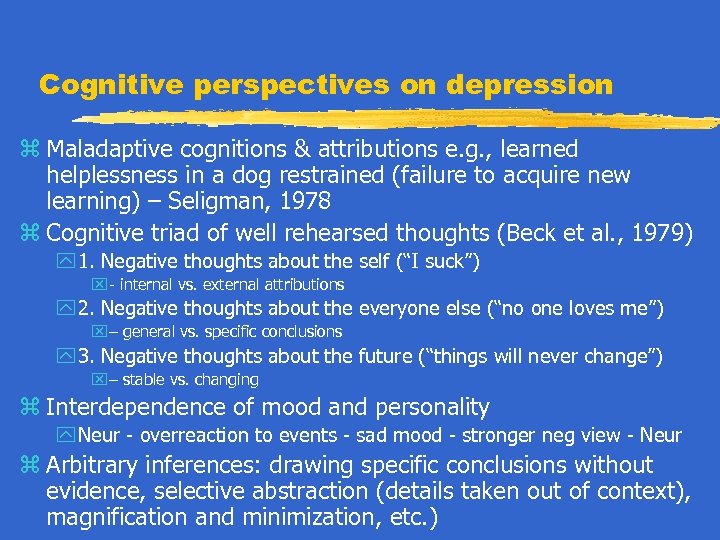
Cognitive perspectives on depression z Maladaptive cognitions & attributions e. g. , learned helplessness in a dog restrained (failure to acquire new learning) – Seligman, 1978 z Cognitive triad of well rehearsed thoughts (Beck et al. , 1979) y 1. Negative thoughts about the self (“I suck”) x - internal vs. external attributions y 2. Negative thoughts about the everyone else (“no one loves me”) x – general vs. specific conclusions y 3. Negative thoughts about the future (“things will never change”) x – stable vs. changing z Interdependence of mood and personality y Neur - overreaction to events - sad mood - stronger neg view - Neur z Arbitrary inferences: drawing specific conclusions without evidence, selective abstraction (details taken out of context), magnification and minimization, etc. )
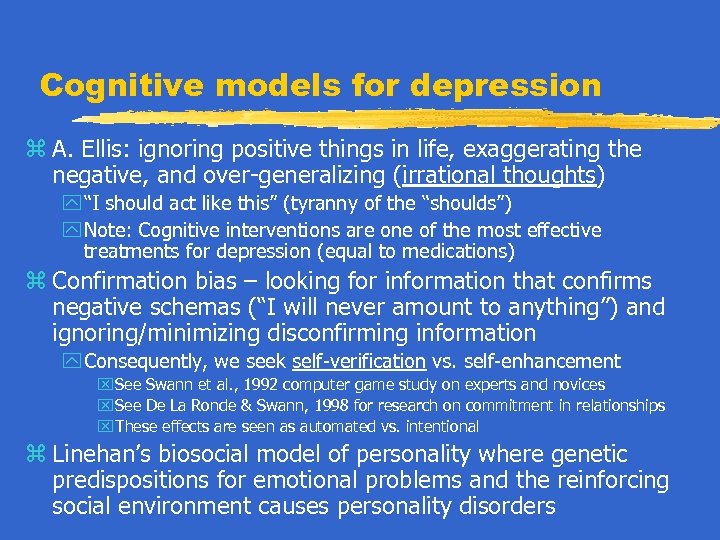
Cognitive models for depression z A. Ellis: ignoring positive things in life, exaggerating the negative, and over-generalizing (irrational thoughts) y “I should act like this” (tyranny of the “shoulds”) y Note: Cognitive interventions are one of the most effective treatments for depression (equal to medications) z Confirmation bias – looking for information that confirms negative schemas (“I will never amount to anything”) and ignoring/minimizing disconfirming information y Consequently, we seek self-verification vs. self-enhancement x See Swann et al. , 1992 computer game study on experts and novices x See De La Ronde & Swann, 1998 for research on commitment in relationships x These effects are seen as automated vs. intentional z Linehan’s biosocial model of personality where genetic predispositions for emotional problems and the reinforcing social environment causes personality disorders
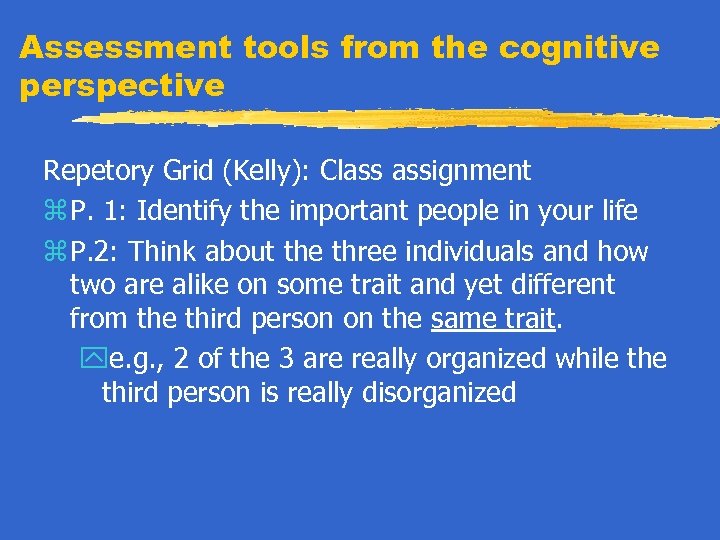
Assessment tools from the cognitive perspective Repetory Grid (Kelly): Class assignment z P. 1: Identify the important people in your life z P. 2: Think about the three individuals and how two are alike on some trait and yet different from the third person on the same trait. ye. g. , 2 of the 3 are really organized while third person is really disorganized
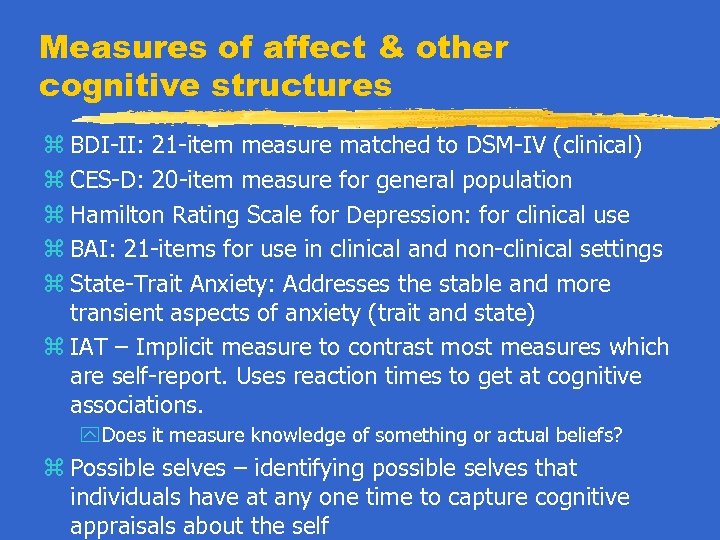
Measures of affect & other cognitive structures z BDI-II: 21 -item measure matched to DSM-IV (clinical) z CES-D: 20 -item measure for general population z Hamilton Rating Scale for Depression: for clinical use z BAI: 21 -items for use in clinical and non-clinical settings z State-Trait Anxiety: Addresses the stable and more transient aspects of anxiety (trait and state) z IAT – Implicit measure to contrast most measures which are self-report. Uses reaction times to get at cognitive associations. y Does it measure knowledge of something or actual beliefs? z Possible selves – identifying possible selves that individuals have at any one time to capture cognitive appraisals about the self
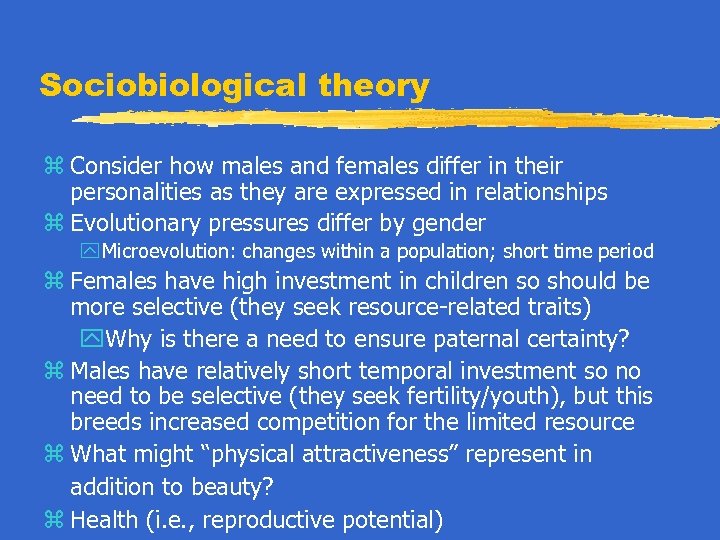
Sociobiological theory z Consider how males and females differ in their personalities as they are expressed in relationships z Evolutionary pressures differ by gender y Microevolution: changes within a population; short time period z Females have high investment in children so should be more selective (they seek resource-related traits) y. Why is there a need to ensure paternal certainty? z Males have relatively short temporal investment so no need to be selective (they seek fertility/youth), but this breeds increased competition for the limited resource z What might “physical attractiveness” represent in addition to beauty? z Health (i. e. , reproductive potential)
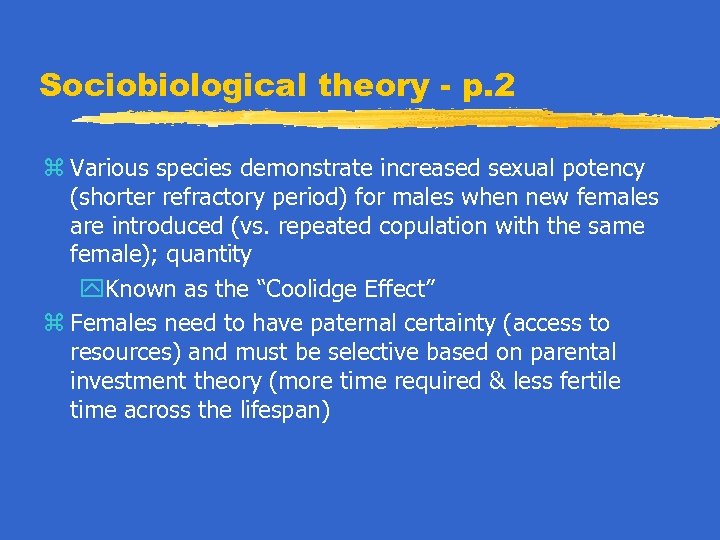
Sociobiological theory - p. 2 z Various species demonstrate increased sexual potency (shorter refractory period) for males when new females are introduced (vs. repeated copulation with the same female); quantity y. Known as the “Coolidge Effect” z Females need to have paternal certainty (access to resources) and must be selective based on parental investment theory (more time required & less fertile time across the lifespan)
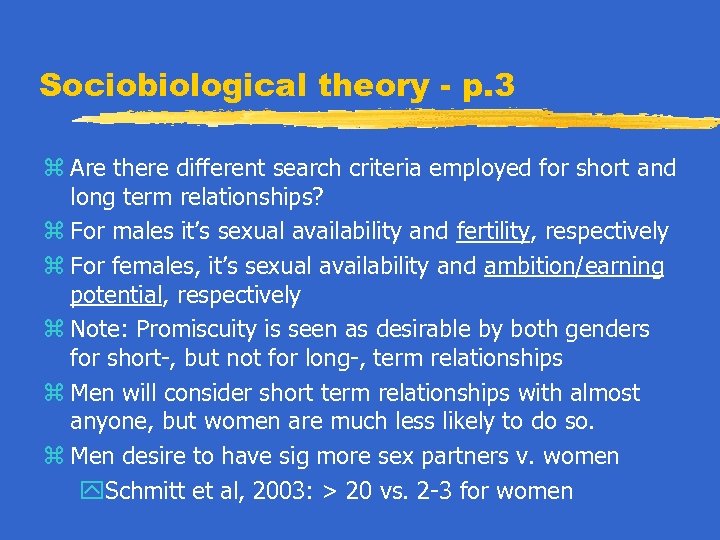
Sociobiological theory - p. 3 z Are there different search criteria employed for short and long term relationships? z For males it’s sexual availability and fertility, respectively z For females, it’s sexual availability and ambition/earning potential, respectively z Note: Promiscuity is seen as desirable by both genders for short-, but not for long-, term relationships z Men will consider short term relationships with almost anyone, but women are much less likely to do so. z Men desire to have sig more sex partners v. women y. Schmitt et al, 2003: > 20 vs. 2 -3 for women
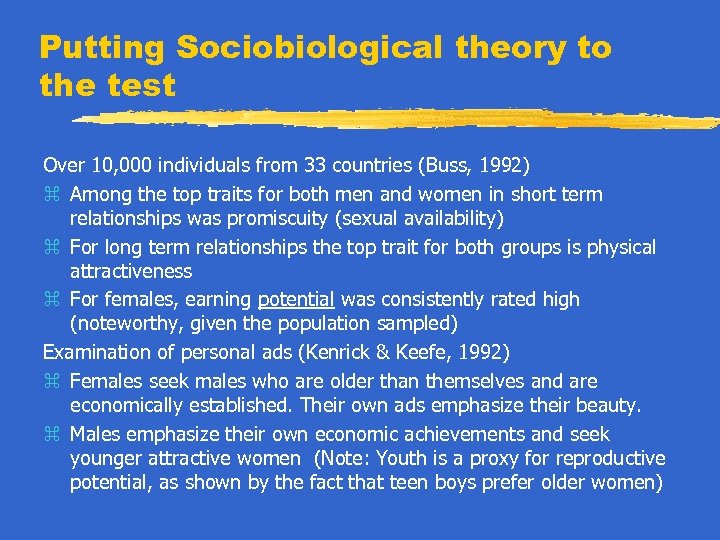
Putting Sociobiological theory to the test Over 10, 000 individuals from 33 countries (Buss, 1992) z Among the top traits for both men and women in short term relationships was promiscuity (sexual availability) z For long term relationships the top trait for both groups is physical attractiveness z For females, earning potential was consistently rated high (noteworthy, given the population sampled) Examination of personal ads (Kenrick & Keefe, 1992) z Females seek males who are older than themselves and are economically established. Their own ads emphasize their beauty. z Males emphasize their own economic achievements and seek younger attractive women (Note: Youth is a proxy for reproductive potential, as shown by the fact that teen boys prefer older women)
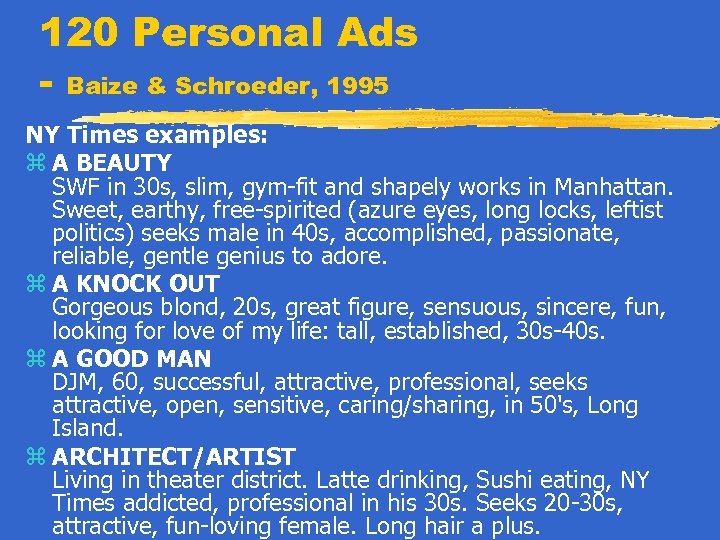
120 Personal Ads - Baize & Schroeder, 1995 NY Times examples: z A BEAUTY SWF in 30 s, slim, gym-fit and shapely works in Manhattan. Sweet, earthy, free-spirited (azure eyes, long locks, leftist politics) seeks male in 40 s, accomplished, passionate, reliable, gentle genius to adore. z A KNOCK OUT Gorgeous blond, 20 s, great figure, sensuous, sincere, fun, looking for love of my life: tall, established, 30 s-40 s. z A GOOD MAN DJM, 60, successful, attractive, professional, seeks attractive, open, sensitive, caring/sharing, in 50's, Long Island. z ARCHITECT/ARTIST Living in theater district. Latte drinking, Sushi eating, NY Times addicted, professional in his 30 s. Seeks 20 -30 s, attractive, fun-loving female. Long hair a plus.
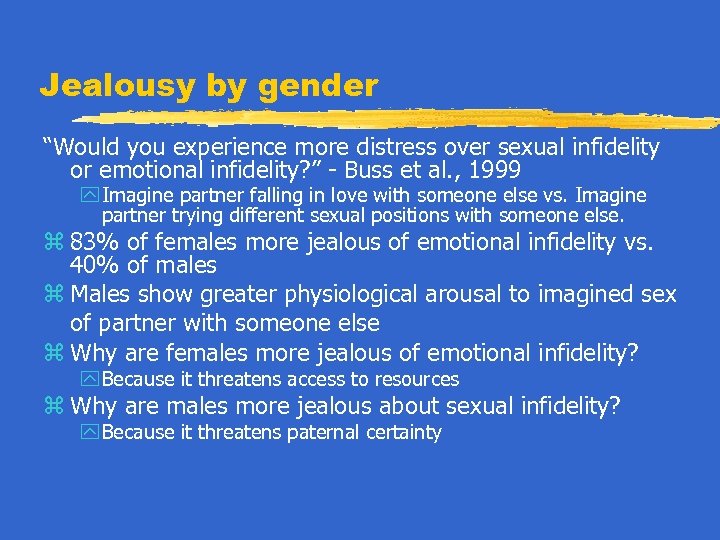
Jealousy by gender “Would you experience more distress over sexual infidelity or emotional infidelity? ” - Buss et al. , 1999 y Imagine partner falling in love with someone else vs. Imagine partner trying different sexual positions with someone else. z 83% of females more jealous of emotional infidelity vs. 40% of males z Males show greater physiological arousal to imagined sex of partner with someone else z Why are females more jealous of emotional infidelity? y Because it threatens access to resources z Why are males more jealous about sexual infidelity? y Because it threatens paternal certainty
More Recent Research z Sperm competition following significant absences in response to female infidelity y Shackelford & Goetz (2007) z The “Florida Study” (2008) examined response rates to 3 requests by gender y. Go on a date, go to my place, have sex z As seen in other mammals, maternal aggression in lactating mothers is higher relative to bottle feeding mothers (competition with the winner administering a loud unpleasant noise to the loser). Lactating mothers did a longer noise relative to bottle feeders who did not differ from women who were never pregnant y Hahn-Holbrook et al. , 2011
Critique of sociobiological theory z Studied almost exclusively in college students z Do dating and mating involve the same motives? z Sociobiological theory (like evolutionary theory) does not predict specific future behavior, it explains events post hoc y this is a major weakness (recall that Freud could likewise explain anything after the fact) y e. g. , long vs. short-necked giraffes z Evolutionary drift - some events are a consequence of adaptive behavior but are not themselves adaptive
Ch. 8: A Trait Approach z Traits as building blocks to describe behavior z Linking traits to behavior z Organizing traits (factors) y. Big Three (Eysenck) y. Big Five (Costa & Mc. Crae) z Person-Situation Debate z Supplementing traits with other approaches y. Goals y. Act-Frequency z Assessing traits
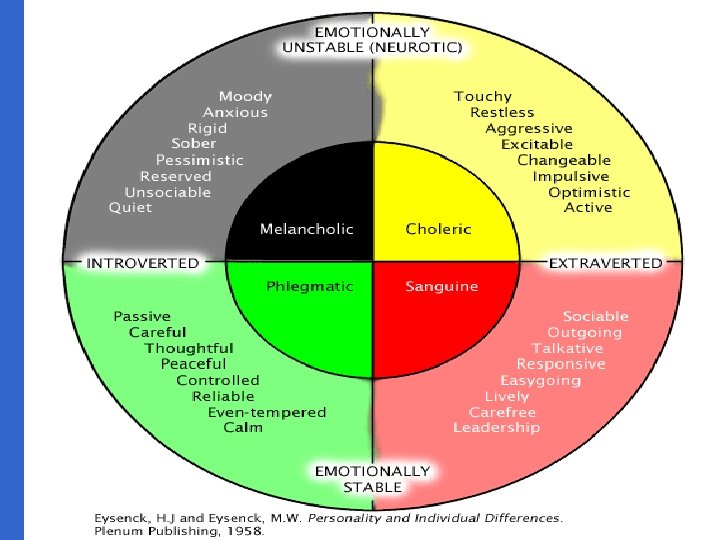
Traits over time: A review z Recall the traits forwarded by Humoral Theory (Hippocrates & Galen) y Sanguine y Choleric y Melancholic y Phlegmatic z Carl Jung y Introversion-Extraversion z Gordon Allport’s trait hierarchy y Cardinal traits y Central traits y Secondary traits
Trait approaches based on body morphology z Palm readings z Criminality (Lombroso) - physical features predict criminality y L’uomo delinquente z Phrenology (Gall) - skull morphology; advances due to: y Localization y Quantification y Standardization
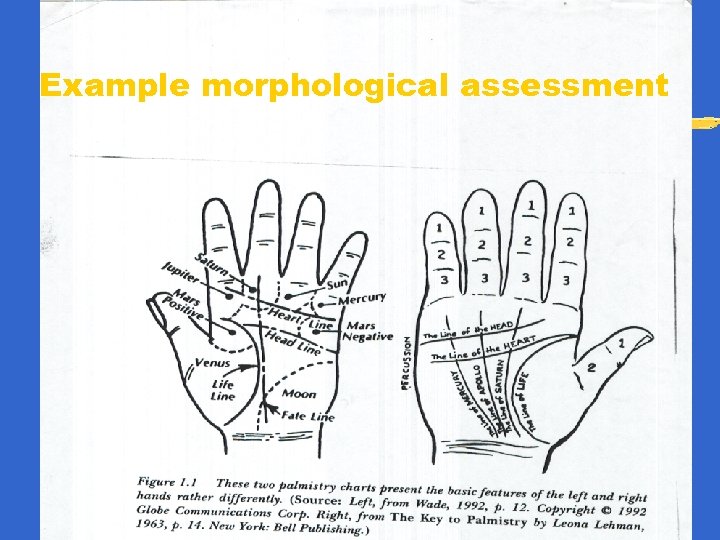
Example morphological assessment
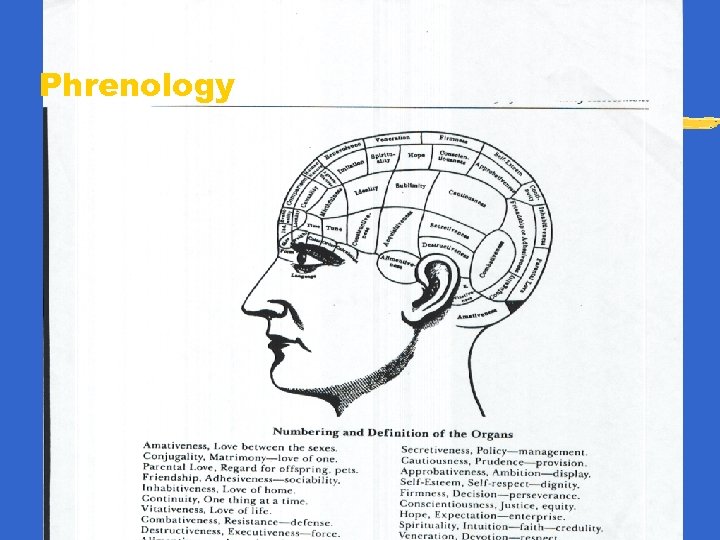
Phrenology
Trait approaches based on body types z Sheldon’s body types (1950); Photos of incoming freshmen 1930 s y Endomorph – jolly/happy, lazy (BMI is inversely corr. with suicide rates, but only for men; “jolly & fat” Mukamal, 2007) y Mesomorph – dominant, athletic y Ectomorph – smart, shy y Based on physical stereotypes. Can stereotypes affect personality? z Not theoretically derived; (cf. pelvic distance & hormonal release during adolescence as it relates to masculine and feminine traits; Schlegal, 1982).
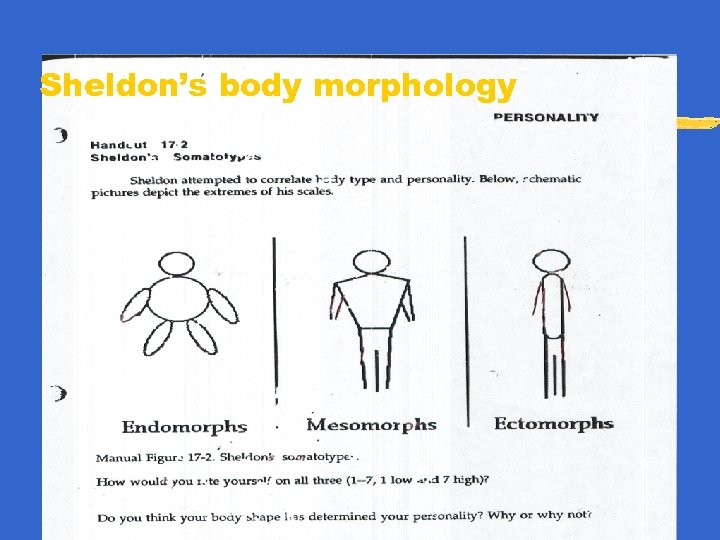
Sheldon’s body morphology
The “success” of trait methods based on morphology z Barnum effect - broad and slightly positive statements; y Most non-standardized, unreliable, and non-validated procedures rely on the Barnum effect y Stock statements - true in all circumstances y Fishing statements – general statements that can be interpreted in many ways (“you’ve experienced a loss”) z Research (Glick, 1985) suggests that people are more likely to believe Barnum-type false feedback vs. real personality FB z Research (Wyman et al. , 2008) suggests that people can differentiate real from bogus personality assessments, but they can’t differentiate real personality readings from bogus astrological readings (likely due to Barnum effect).
Traits emerging from linguistic assessments z Analysis of language (Allport) y Approx. 18, 000 words describing human behavior (subsumed by over 4, 000 trait descriptors) y Lexical hypothesis: By examining the adjectives used to describe human behavior we can determine: x. What is the minimum number of groupings (factors) needed to organize all of these adjectives, and x. What are the best labels for these groupings (factors) z Statistical approach to organizing the adjectives and traits (Cattell) y Factor analysis used to reduce the data xe. g. , Consider your lecture notes or a further summary of the class and how they summarize all the material. x. Number of factors, labels for them, and how they relate to one another
Organizing traits z From 450 B. C. to present z Organizing structure for personality z Eysenck’s three personality “factors” to describe all relevant personality traits y 1. extraversion/introversion -ARAS y 2. neuroticism/emotional stability -limbic system y 3. psychoticism (abnormal personality) /ego strength (tolerate stress, reality focus) y* Only the 1 st two factors apply to non-clinical population - Circumplex model (for the normal population)
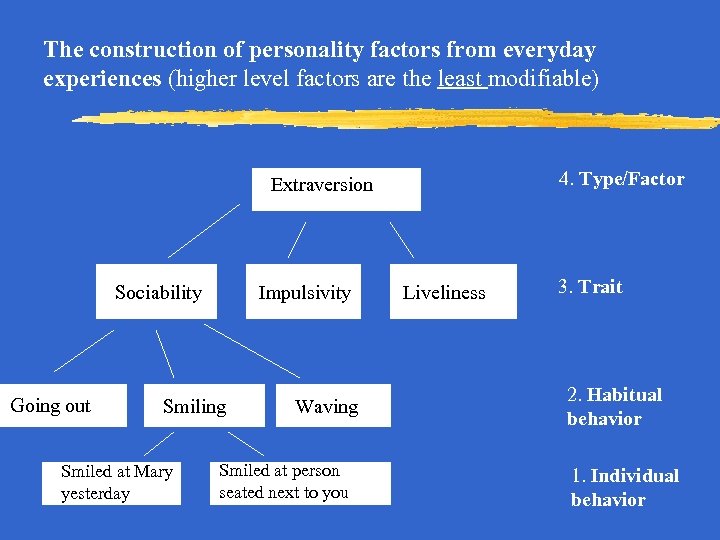
The construction of personality factors from everyday experiences (higher level factors are the least modifiable) 4. Type/Factor Extraversion Sociability Going out Impulsivity Smiling Smiled at Mary yesterday Waving Smiled at person seated next to you Liveliness 3. Trait 2. Habitual behavior 1. Individual behavior
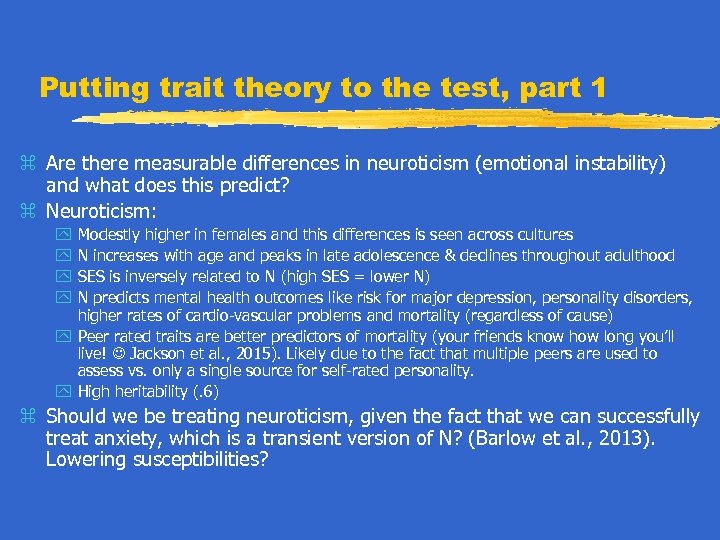
Putting trait theory to the test, part 1 z Are there measurable differences in neuroticism (emotional instability) and what does this predict? z Neuroticism: Modestly higher in females and this differences is seen across cultures N increases with age and peaks in late adolescence & declines throughout adulthood SES is inversely related to N (high SES = lower N) N predicts mental health outcomes like risk for major depression, personality disorders, higher rates of cardio-vascular problems and mortality (regardless of cause) y Peer rated traits are better predictors of mortality (your friends know how long you’ll live! Jackson et al. , 2015). Likely due to the fact that multiple peers are used to assess vs. only a single source for self-rated personality. y High heritability (. 6) y y z Should we be treating neuroticism, given the fact that we can successfully treat anxiety, which is a transient version of N? (Barlow et al. , 2013). Lowering susceptibilities?
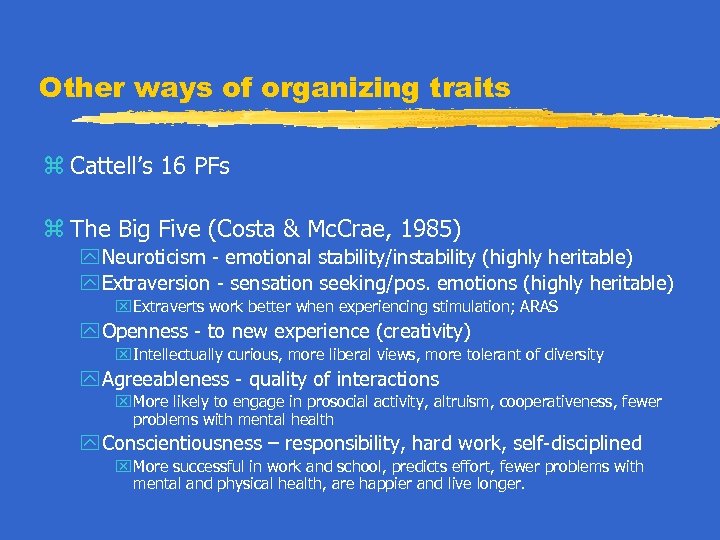
Other ways of organizing traits z Cattell’s 16 PFs z The Big Five (Costa & Mc. Crae, 1985) y Neuroticism - emotional stability/instability (highly heritable) y Extraversion - sensation seeking/pos. emotions (highly heritable) x Extraverts work better when experiencing stimulation; ARAS y Openness - to new experience (creativity) x Intellectually curious, more liberal views, more tolerant of diversity y Agreeableness - quality of interactions x More likely to engage in prosocial activity, altruism, cooperativeness, fewer problems with mental health y Conscientiousness – responsibility, hard work, self-disciplined x More successful in work and school, predicts effort, fewer problems with mental and physical health, are happier and live longer.
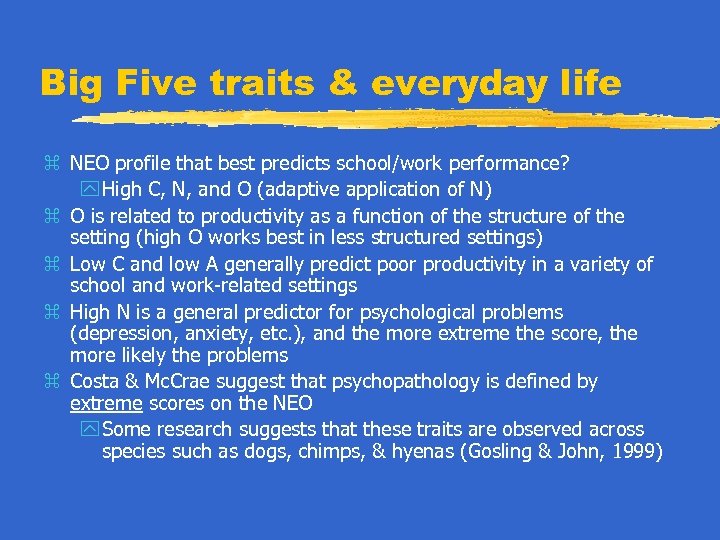
Big Five traits & everyday life z NEO profile that best predicts school/work performance? y High C, N, and O (adaptive application of N) z O is related to productivity as a function of the structure of the setting (high O works best in less structured settings) z Low C and low A generally predict poor productivity in a variety of school and work-related settings z High N is a general predictor for psychological problems (depression, anxiety, etc. ), and the more extreme the score, the more likely the problems z Costa & Mc. Crae suggest that psychopathology is defined by extreme scores on the NEO y Some research suggests that these traits are observed across species such as dogs, chimps, & hyenas (Gosling & John, 1999)
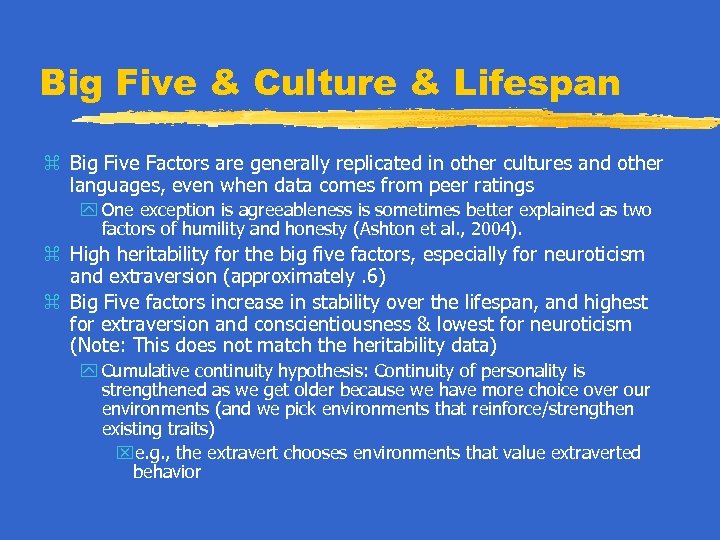
Big Five & Culture & Lifespan z Big Five Factors are generally replicated in other cultures and other languages, even when data comes from peer ratings y One exception is agreeableness is sometimes better explained as two factors of humility and honesty (Ashton et al. , 2004). z High heritability for the big five factors, especially for neuroticism and extraversion (approximately. 6) z Big Five factors increase in stability over the lifespan, and highest for extraversion and conscientiousness & lowest for neuroticism (Note: This does not match the heritability data) y Cumulative continuity hypothesis: Continuity of personality is strengthened as we get older because we have more choice over our environments (and we pick environments that reinforce/strengthen existing traits) xe. g. , the extravert chooses environments that value extraverted behavior
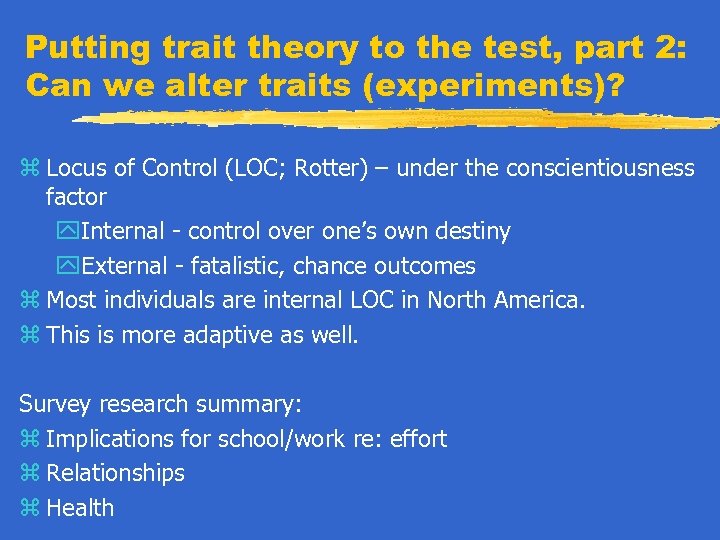
Putting trait theory to the test, part 2: Can we alter traits (experiments)? z Locus of Control (LOC; Rotter) – under the conscientiousness factor y. Internal - control over one’s own destiny y. External - fatalistic, chance outcomes z Most individuals are internal LOC in North America. z This is more adaptive as well. Survey research summary: z Implications for school/work re: effort z Relationships z Health
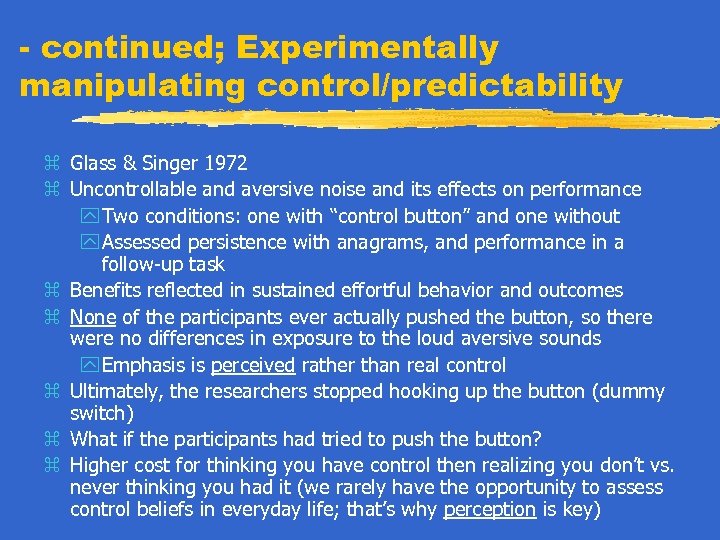
- continued; Experimentally manipulating control/predictability z Glass & Singer 1972 z Uncontrollable and aversive noise and its effects on performance y Two conditions: one with “control button” and one without y Assessed persistence with anagrams, and performance in a follow-up task z Benefits reflected in sustained effortful behavior and outcomes z None of the participants ever actually pushed the button, so there were no differences in exposure to the loud aversive sounds y Emphasis is perceived rather than real control z Ultimately, the researchers stopped hooking up the button (dummy switch) z What if the participants had tried to push the button? z Higher cost for thinking you have control then realizing you don’t vs. never thinking you had it (we rarely have the opportunity to assess control beliefs in everyday life; that’s why perception is key)
- continued; Experimental research on control z Studies in old age homes (Langer, 1983; Rodin, 1986) to assess the effects of predictability and control y 3 conditions (control, predictability, neither) yequal time in all visits, and everyone does so within regular visiting hours ypredicted health and mortality within the next year yimplications/applications? y. Strengths/limitations of this study relative to Glass & Singer (1972) and other survey studies? z Similar research in work settings involving control over how to do tasks; in prisons involving control over TV programming, chair locations (Ruback et al. , 1986; Wener et al. , 1987), health fears (Lecci & Cohen, 2007)
The person situation debate z Mischel shock (Personality and Assessment; Mischel, 1968) y 1. Traits account for only 9% of behavior (correlations of. 30) x. Personality vs. situation debate (data on school children in different settings – predicting behaviors like lying) y 2. Traits are just labels. z Attempts to address the 1 st critique with new measures, but more difficult to counter the 2 nd critique z Modern personality inventories can go beyond 9% (see NEO-PI) z * Problematic to predict a single instance of behavior from general trends (S. Epstein), but we can predict behavioral tendencies z Traits predict best in situations without clear “situational scripts. ” y Situational strength: refers to the clarity of the situational script. xe. g. , first date behavior vs. seventh date behavior y More specific traits also predict better xe. g. , work LOC vs. relationship LOC
Supplementing the Big Five z Act-frequency approach (Buss & Craik, 1983) y Identify actions that reflect the trait of interest y Rate the extent to which each represents the prototype for that trait (prototypicality ratings) z Personal goal assessment: An idiographic approach y The idiosyncratic expression of basic motives (hunger vs. “truffles for the wedding”) y Traits in context (LOC vs. control over the relevant experiences in your life; e. g. , goal to “get married” or “get a degree”)
Gordon Allport (1930) z Consider how traits and motivation (goals) each assess different (unique) aspects of personality z “Havings” and “Doings” of personality (Allport, 1930; Cantor, 1990) y stable features (traits) and more dynamic features (goals) z Traits (havings) can reflect biological predispositions that may limit the opportunities for what one can do. z Goals can determine how their traits manifest in their actions (goals are the doings of personality) z Both predict behavior: Traits predict about 20% of university grades and goals relating to both school and non-school activities can account for an additional 10 -20% (Little, Lecci, & Wadkinson, 1992)
Example assessments: Goal constructs z From more fleeting/transient experiences to life long pursuits y. Current Concerns (Klinger, 1977) y. Personal Projects Analysis (Little, 1983) y. Personal Strivings (Emmons, 1986) y. Life Tasks (Cantor, 1987) y. Goal Systems Assessment Battery (Karoly & Ruehlman, 1995) z Intersection of motivational and cognitive perspectives; “Hot Cognitions”
Illustration of the PPA approach z PPA = Personal projects Analysis (Little, 1983) z Adults average about 14 personal goals z Content may be significant y e. g. , Health goals for hypochondriacs y Most common goal across settings & populations: “lose weight” 5 factors used to interpret the PPA z Meaningfulness (importance, enjoyment) z Efficacy (progress, outcome, skills) z Structure (control, initiation, time adequacy) z Stress (stress, difficulty, challenge) z Social Support (visibility, other’s view)
Meaning-Efficacy trade-off z Molecular goals (time focused & concrete) y high efficacy but low meaningfulness z Molar goals (broad, life long pursuits) y low efficacy but high meaningfulness z Anxiety can be predicted from goals with high meaning & low efficacy z Research on college students and their goals shows that depression is marked by low efficacy & low meaningfulness (Lecci et al. , 1994) z Depression can also be marked by the failure to disengage (Kuhl, 1986) from unsuccessful projects - depression as “information”
Ipsative scoring for the PPA z Ipsative scoring refers to comparisons within the individual (no need for a norm group, though normative scoring can be done) z Goals can be scored by comparing your own score at one time to scores from obtained from another time y Only meaningful if scores can change (traits are supposed to be stable, so any changes on the NEO are considered error in measurement) y Your goals, however, can change. z Goals can also be scored by comparing ratings across different content domains (e. g. , social vs. academic) – look at your scores z Most clinical work and counseling interventions with goals adopt the ipsative scoring procedures (goal of intervention can be perceived changes in the goal system) z Goals can also be scored normatively (see next slide)
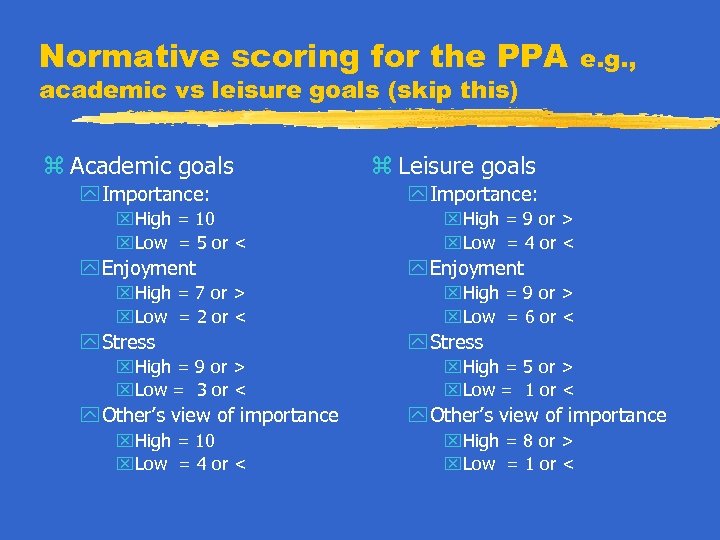
Normative scoring for the PPA academic vs leisure goals (skip this) z Academic goals y Importance: x. High = 10 x. Low = 5 or < y Enjoyment x. High = 7 or > x. Low = 2 or < y Stress x. High = 9 or > x. Low = 3 or < y Other’s view of importance x. High = 10 x. Low = 4 or < e. g. , z Leisure goals y Importance: x. High = 9 or > x. Low = 4 or < y Enjoyment x. High = 9 or > x. Low = 6 or < y Stress x. High = 5 or > x. Low = 1 or < y Other’s view of importance x. High = 8 or > x. Low = 1 or <
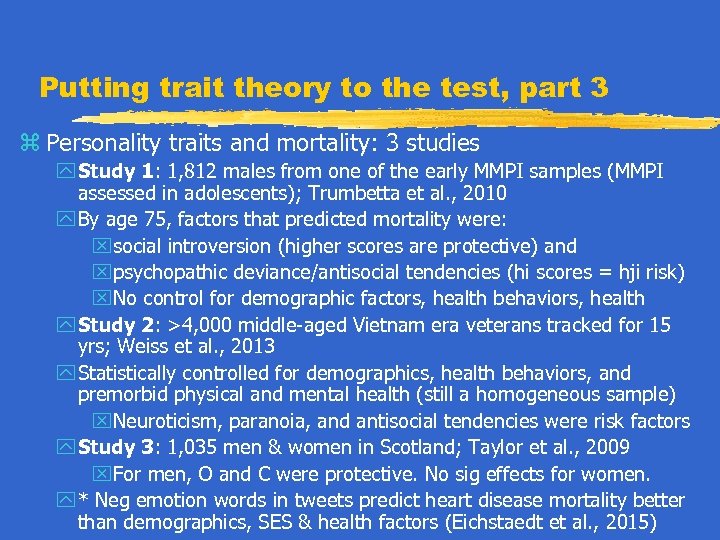
Putting trait theory to the test, part 3 z Personality traits and mortality: 3 studies y Study 1: 1, 812 males from one of the early MMPI samples (MMPI assessed in adolescents); Trumbetta et al. , 2010 y By age 75, factors that predicted mortality were: xsocial introversion (higher scores are protective) and xpsychopathic deviance/antisocial tendencies (hi scores = hji risk) x. No control for demographic factors, health behaviors, health y Study 2: >4, 000 middle-aged Vietnam era veterans tracked for 15 yrs; Weiss et al. , 2013 y Statistically controlled for demographics, health behaviors, and premorbid physical and mental health (still a homogeneous sample) x. Neuroticism, paranoia, and antisocial tendencies were risk factors y Study 3: 1, 035 men & women in Scotland; Taylor et al. , 2009 x. For men, O and C were protective. No sig effects for women. y * Neg emotion words in tweets predict heart disease mortality better than demographics, SES & health factors (Eichstaedt et al. , 2015)
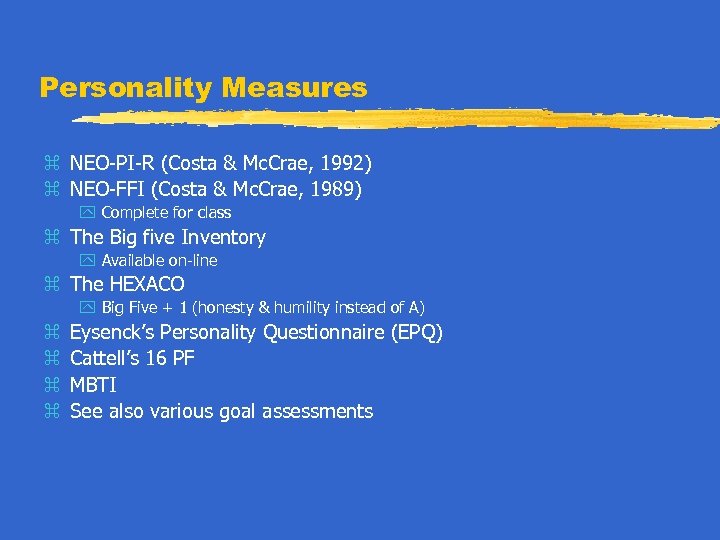
Personality Measures z NEO-PI-R (Costa & Mc. Crae, 1992) z NEO-FFI (Costa & Mc. Crae, 1989) y Complete for class z The Big five Inventory y Available on-line z The HEXACO y Big Five + 1 (honesty & humility instead of A) z z Eysenck’s Personality Questionnaire (EPQ) Cattell’s 16 PF MBTI See also various goal assessments
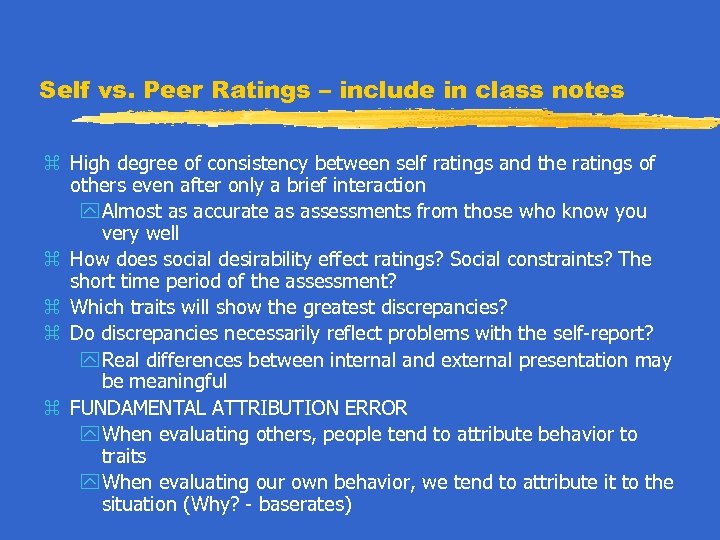
Self vs. Peer Ratings – include in class notes z High degree of consistency between self ratings and the ratings of others even after only a brief interaction y Almost as accurate as assessments from those who know you very well z How does social desirability effect ratings? Social constraints? The short time period of the assessment? z Which traits will show the greatest discrepancies? z Do discrepancies necessarily reflect problems with the self-report? y Real differences between internal and external presentation may be meaningful z FUNDAMENTAL ATTRIBUTION ERROR y When evaluating others, people tend to attribute behavior to traits y When evaluating our own behavior, we tend to attribute it to the situation (Why? - baserates)
Скачать презентацию Cognitive Perspective z Mental representations of objects and
7fd921b1b8108c3e29c0db2d1a34ff8f.ppt