


 Скачать презентацию Cognitive Markers of Hippocampal Deficits in PTSD Mark
e11c7e156b366eb2dd7ce5ae13c8f314.ppt
- Количество слайдов: 20
 Cognitive Markers of Hippocampal Deficits in PTSD Mark A. Gluck Rutgers-Newark, Center for Neuroscience gluck@pavlov. rutgers. edu Collaborators: Scott Orr & Mark Gilbertson (New Hampshire VA) Catherine Myers & Rick Servatius (East Orange, NJ, VA) Einat Levy-Gigi (Rutgers - Newark) CDR Jack Tsao & Lt. Justin Campbell (BUMED) Force Health Protection Future Naval Capability Science and Technology Review July 2010
 Technical Background Validating Cognitive Markers of Hippocampal Deficits in Marines with Post-Traumatic Stress Disorder Builds on Two Prior Studies by Members of our Research Team 1. Hippocampal deficits are the most likely to be pre-existing risk factors for PTSD (Gilbertson et al. , 2002; Kasai et al. , 2008; Pitman et al. , 2006). 2. Two cognitive tasks that were developed at Rutgers can detect mild Hippocampal atrophy (Myers et al. , 2002; Myers, Kluger, et al, 2008) 2
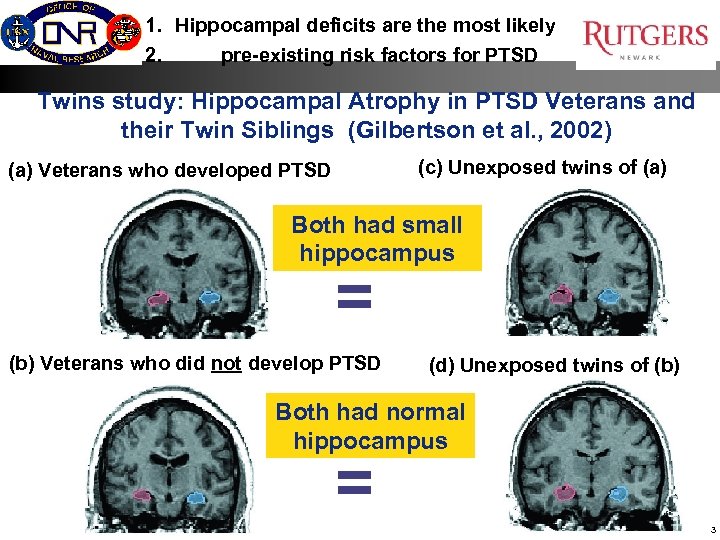 1. Hippocampal deficits are the most likely 2. pre-existing risk factors for PTSD Twins study: Hippocampal Atrophy in PTSD Veterans and their Twin Siblings (Gilbertson et al. , 2002) (c) Unexposed twins of (a) Veterans who developed PTSD Both had small hippocampus = (b) Veterans who did not develop PTSD (d) Unexposed twins of (b) Both had normal hippocampus = 3
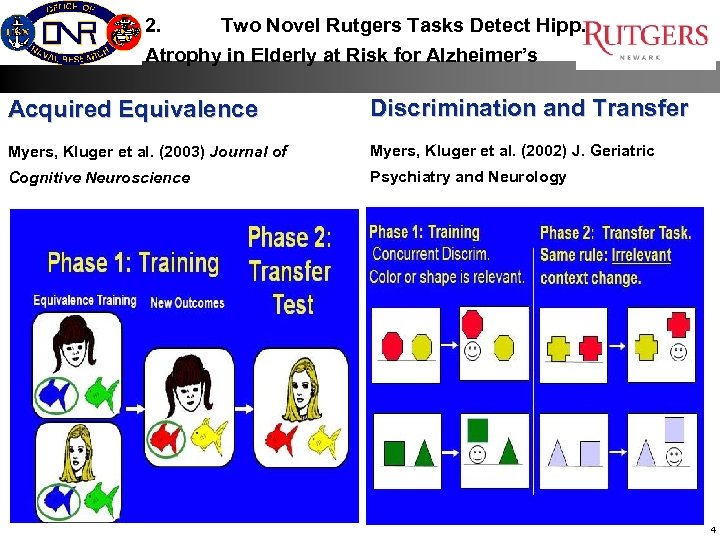 2. Two Novel Rutgers Tasks Detect Hipp. Atrophy in Elderly at Risk for Alzheimer’s Acquired Equivalence Discrimination and Transfer Myers, Kluger et al. (2003) Journal of Myers, Kluger et al. (2002) J. Geriatric Cognitive Neuroscience Psychiatry and Neurology 4
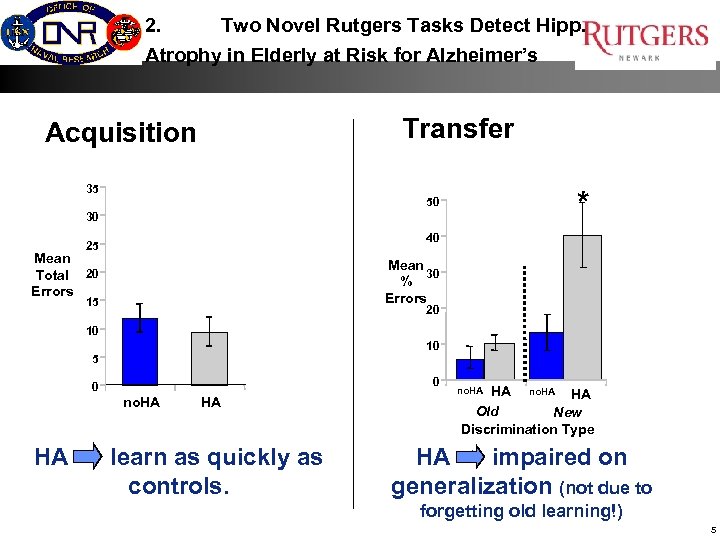 2. Two Novel Rutgers Tasks Detect Hipp. Atrophy in Elderly at Risk for Alzheimer’s Transfer Acquisition 35 * 50 30 40 25 Mean Total 20 Errors Mean 30 % Errors 15 20 10 10 5 0 0 no. HA HA HA => learn as quickly as controls. HA no. HA HA Old New Discrimination Type no. HA HA => impaired on generalization (not due to forgetting old learning!) 5
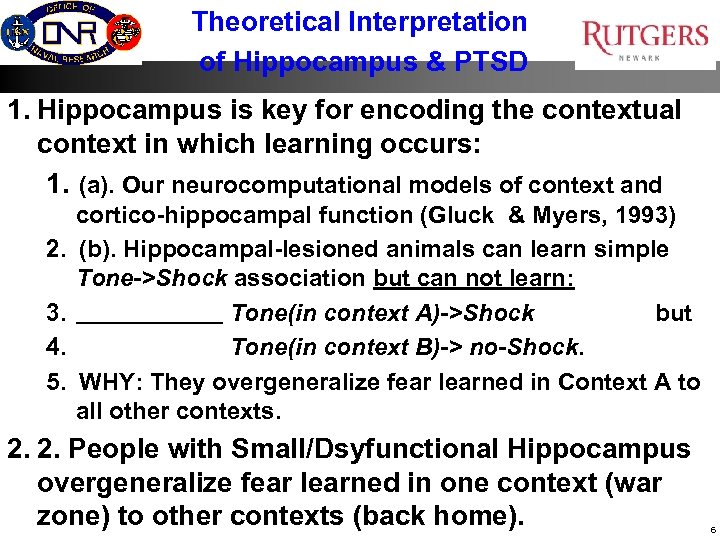 Theoretical Interpretation of Hippocampus & PTSD 1. Hippocampus is key for encoding the contextual context in which learning occurs: 1. (a). Our neurocomputational models of context and 2. 3. 4. 5. cortico-hippocampal function (Gluck & Myers, 1993) (b). Hippocampal-lesioned animals can learn simple Tone->Shock association but can not learn: Tone(in context A)->Shock but Tone(in context B)-> no-Shock. WHY: They overgeneralize fear learned in Context A to all other contexts. 2. 2. People with Small/Dsyfunctional Hippocampus overgeneralize fear learned in one context (war zone) to other contexts (back home). 6
 Technical OBJECTIVES OBJECTIVE: Validate Rutgers Cognitive Markers of Hippocampal Deficits in Marines with Post-Traumatic Stress Disorder 1. Hippocampal deficits are the most likely to be pre-existing risk factors for PTSD (Gilbertson et al. , 2002; Kasai et al. , 2008; Pitman et al. , 2006). 2. Two cognitive tasks that were developed at Rutgers can detect mild Hippocampal atrophy (Myers et al. , 2002; Myers, Kluger, et al, 2008). In our study we will test whether these same tasks will be sensitive to hippocampal deficits among young people with PTSD and/or people at risk for PTSD. 7
 Technical GOALS GOAL: Develop inexpensive, rapid and automated screening for mild deficits in hippocampal-function, a known risk factor for PTSD 1. To be used as indicators of prior risk for developing PTSD as a result of future combat or trauma exposure. 2. Co-indicators of cognitive deficits and risk for stress disorders in individuals with sub-clinical levels of stress. 3. Transition these tasks to fieldable instruments that can be used by Navy medical personnel at US bases and/or in combat-theater situations. 8
 Program Plan and Methods Plan : l l Work with BUMEDto secure permission to test active duty Marines at at MCB Lejeune in North Carolina, MCB Pendleton in San Diego, and/or MCB Hawaii, Kaneohe Bay. Recruit 300 active duty Marines, half with a diagnosis of PTSD and half without PTSD (but with similar levels of combat exposure). Method : l Marines will be tested on two of the Rutgers cognitive tasks as well as a standard battery of neuropsychological assessments l Follow up tests after one and two years intervals 9
 Progress to Date (Prior to Grant Start Date) l Prepared the two cognitive tasks to be used in the experiment l Hired key personnel to lead the project (Levy-Gigi) l Submitted all Rutgers and Navy IRB protocols and approvals l Consolidated a list of neuro-psychological tests l Designed parallel research projects in Israel to test soldiers and policemen with PTSD as well as people short time after they were exposed to trauma 10
 Plans for FY 10/11 June 2010 -December 2010 l Receive all Rutgers and Navy IRB approvals l Meet with Key BUMED and Marine base medical personnel in NC, San Diego, and/or Honolulu to establish access and plans for testing. l Initiate parallel studies in Israel with Israeli Army January 2011 - December 2011 l collecting and analyzing 150 out of 300 marines 11
 Progress to Date Parallel research projects in Israel Aim #1: To validate the cognitive markers among a varied population with different characteristics than the U. S Marine soldiers (service type, environment, culture) Israeli Defense Force (IDF) Key personal: Col. Eyal Fruchter, M. D. - Chief of the Mental Health Department, IDF Israeli Police Force Key personal: Col. Zvi Lenkovsky, M. D- Commander Chief Medical Officer, Israeli Police Aim #2: To conduct a prospective study in which we test people short time after they were exposed to trauma with 1, 2 years follow up Hadassah University Hospital, Jerusalem, Israel Key personal: Arieh Shalev, Head Department of Psychiatry 12
 Parallel research projects in Israel Aim #1: To validate the cognitive markers among a varied population with different characteristics than the U. S Marine soldiers (service type, environment, culture) Israeli Defense Force (IDF) Key personal: Col. Eyal Fruchter, M. D. - Chief of the Mental Health Department, IDF Israeli Police Key personal: Col. Zvi Lenkovsky, M. D- Commander Chief Medical Officer, Israeli Police 13
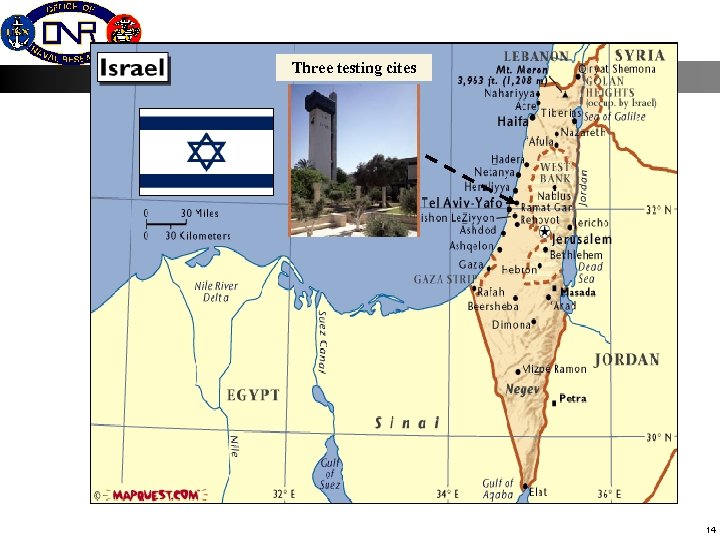 Three testing cites 14
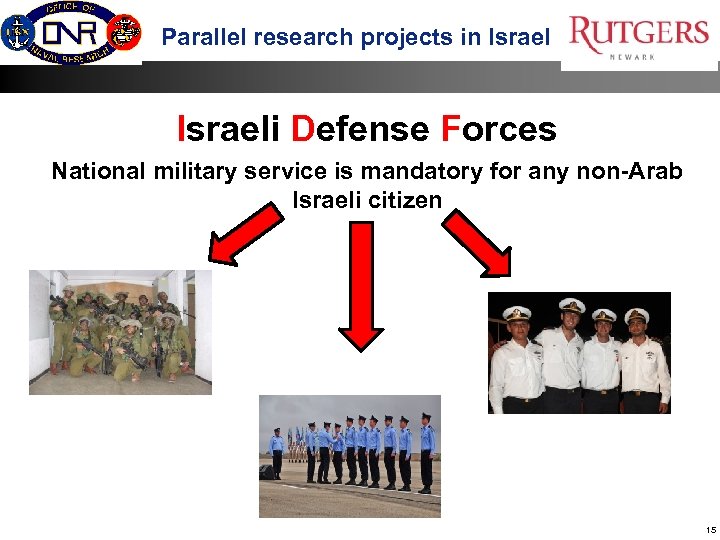 Parallel research projects in Israeli Defense Forces National military service is mandatory for any non-Arab Israeli citizen 15
 The IDF Combat reaction unit Established- 1950 after the 1948 Independent War Main reason for trauma: participating in a combat Patients’ characteristics: l Soldiers from all forces l Off-duty soldiers, 43% active reserve duty l Age: 21 -80 l Gender: 97% men, 3% women 16
 The Israeli Police Service is voluntary Main reason for trauma: continuous policing work Main units: pioneer, criminal identification, border guard Patients’ characteristics: l On-duty policemen l Age: 22 -45 l Gender: 99. 9% men 17
 Parallel research projects in Israel Aim #2: To conduct a prospective study in which we test people short time after they were exposed to trauma with 1, 2 years follow up Hadassah University Hospital, Jerusalem, Israel Key personnel: Arieh Shalev, M. D. Head Department of Psychiatry Selected publications: Shalev AY, Freedman S, Peri T, Brandes D, Sahar T, Orr SP, Pitman RK. Prospective study of Posttraumatic Stress Disorder and Depression Following Trauma. American Journal of Psychiatry, 155: 630 -637, 1998 Shalev AY, Mc. Farlane AC, Yehuda R. (editors) International Handbook of Human Response to Trauma. Kluwer/Plenum Publishers, New York, 2000 Bonne, O. ; Brandes, D. ; Gilboa, A. ; Gomori, J. M. ; Shenton, M. E. ; Pitman, R. K. , and Shalev, A. Y. Longitudinal MRI study of hippocampal volume in trauma survivors with PTSD. Am J Psychiatry. 2001 Aug; 158(8): 12481251 18
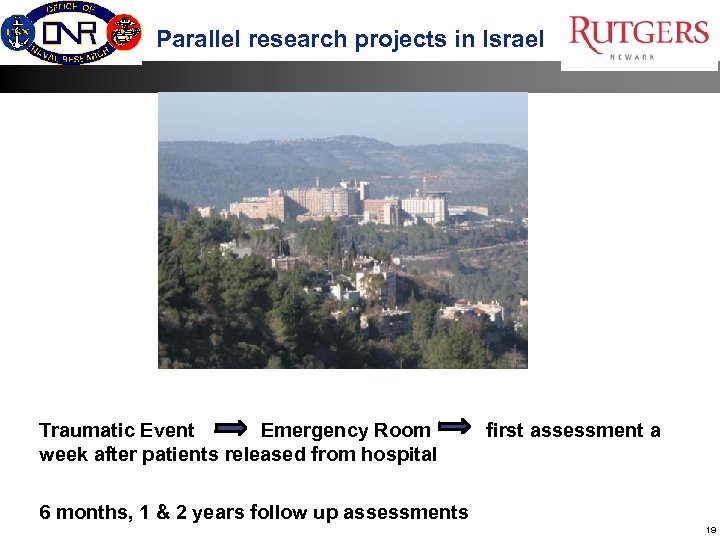 Parallel research projects in Israel Traumatic Event Emergency Room week after patients released from hospital first assessment a 6 months, 1 & 2 years follow up assessments 19
 Technologies to be Delivered l l A validated novel battery of cognitive tasks that identify cognitive phenotype for those at risk for, or suffering from, PTSD-related hippocampal dysfunction. Provide USN with these tools for assessing cognitive impact of disorder, propensity for treatment and recovery, and ultimately a pre-screening tool to identify those most at risk, or resilient, for future PTSD. 20