


 Скачать презентацию Cognitive Approach TEMP 3 Ann Sautkina
Cognitive approach.pptx
- Количество слайдов: 9
 Cognitive Approach TEMP 3 Ann Sautkina
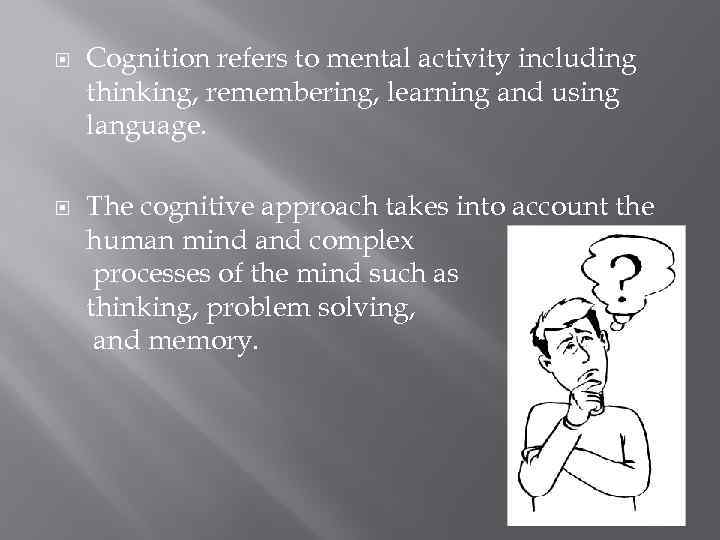 Cognition refers to mental activity including thinking, remembering, learning and using language. The cognitive approach takes into account the human mind and complex processes of the mind such as thinking, problem solving, and memory.
 Memory is an important component of this theory. Information is stored in an organized, meaningful manner; need to relate new information to prior knowledge. Thinking, which varies from situation to situation, will greatly effect how individuals behave in a given situation. Comprehension and perception will allow individuals to interpret information. Motivation of the learner will determine how effectively the information is retained or processed.
 Teachers apply information processing in their classrooms when they help students acquire declarative and procedural knowledge. Schema production is an effective instructional strategy for helping students acquire integrated declarative knowledge and is accomplished in three cyclical steps that involve acquiring information, checking comprehension, and integrating knowledge. Procedural knowledge can be developed in strategies that include review and presentation to activate background knowledge and develop understanding, which is followed by practice that leads to automaticity. Assessment is an essential component of the teaching-learning process. It gives teachers information about students’ understanding and provides students with feedback about their learning progress.
 Major Tasks of a Teacher understand that learners have different backgrounds/experiences which can impact learning outcomes determine the most effective manner in which to organize and structure new information to work with these backgrounds/experiences arrange practice with feedback so that the new information is effectively and efficiently assimilated and /or accommodated with the learner’s cognitive structure
 Types of Learning Best Explained complex forms of learning (reasoning, problemsolving, information-processing) communicate/transfer knowledge in an efficient effective manner: simplification, standardization (knowledge analyzed, decomposed, simplified into basic building blocks; irrelevant information eliminated)
 Factors Influencing Learning environmental conditions practice with corrective feedback processes of mental planning, goal-setting, and organizational strategies way learners attend to, code, transform, rehearse, store and retrieve information learners’ thoughts, beliefs, attitudes, and values
 The cognitive view of learning suggests that information is gathered and processed by our brain. The advantage of such an approach is that it focuses on the individual student and his/her learning process and progress. 'Building Background' helps the learner connect new knowledge or experiences with previous experiences or knowledge. Another benefit is that teachers can organize activities that will help students learn. This means that students benefit because learning will be fun, but they will also be learning more because teaching is designed to enhance learning.
 The disadvantage of this approach is that it involves very frequent assessment of the student's learning and retention, since new experiences build directly upon previous ones. The teacher needs to be constantly evaluating the needs of the student and designing learning activities that address the evolving educational needs and stages of the student. This can become a challenge, entailing a great deal of time, effort, recordkeeping, and flexibility in adjusting lesson plans. The majority of the activities are dictated by each student’s individual level of progress.