 Скачать презентацию Codesign Framework Parts of this lecture are borrowed
354ca804c6aac1b46a7336c272b78470.ppt
- Количество слайдов: 36



Codesign Framework Parts of this lecture are borrowed from lectures of Johan Lilius of TUCS and ASV/LL of UC Berkeley available in their web. Mahapatra-Texas A&M-Spring'04
Embedded Processor Types • General Purpose – Expensive, requires more support logics, unpredictable • Controllers – Control flow dominated, bit-level operation emphasized • Field Programmable Gate Arrays – Configurable, replaces processors and drivers to itself • DSP – Based upon multiply-add module to suit DSP algorithms Mahapatra-Texas A&M-Spring'04 2
Domain specific processors • Network processors – Array processors (16 -256) to process internet packets on a single chip – High-end routers • Media processors – SIMD or vector processor (RISC, VLIW) with multimedia instruction extensions – Digital camera, DVD player etc. Mahapatra-Texas A&M-Spring'04 3
System Design What is System Design? “Is the process of implementing a desired functionality using a set of components” Mahapatra-Texas A&M-Spring'04 4
System Design contd. Step 1 Design must begin with specifying the desired functionality Mahapatra-Texas A&M-Spring'04 5
Specification For precise specification, we need to - think the system to be a collection of simpler subsystems - a method (rules) to compose these pieces Mahapatra-Texas A&M-Spring'04 6
Functions vs. Computation • Functions specify only a relation between two sets of variables (input and output) • Computation describe how the output variables can be derived from the value of input variable ASV/LL UCB 7
Essential Issues • Modeling – System description – System behavior • Validation (verification) • Performance estimation • Partitioning and mapping • Synthesis: – Software synthesis – Hardware synthesis – Interface synthesis Mahapatra-Texas A&M-Spring'04 8
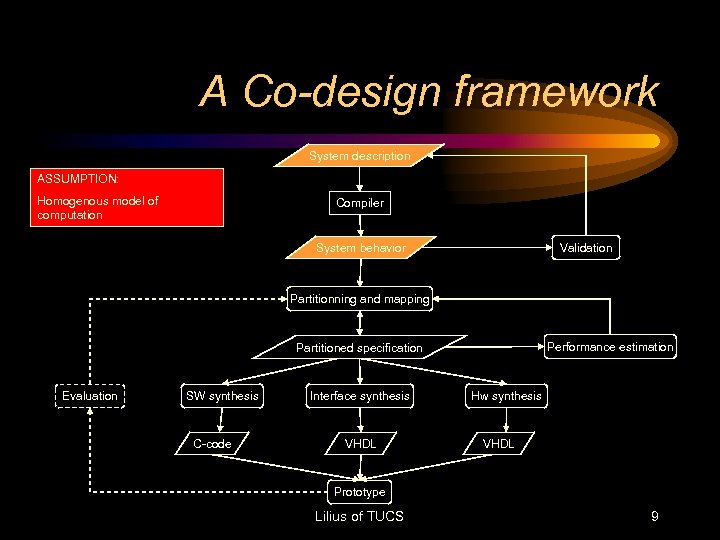
A Co-design framework System description ASSUMPTION: Homogenous model of computation Compiler Validation System behavior Partitionning and mapping Performance estimation Partitioned specification Evaluation SW synthesis C-code Interface synthesis VHDL Hw synthesis VHDL Prototype Lilius of TUCS 9
Model The method or rules to compose the pieces of subsystems to create a system functionality is usually called a Model. Mahapatra-Texas A&M-Spring'04 10
Model should be… • formal : no ambiguity • complete : with sets of properties, performance indices and constraints • comprehensive and easy to modify • natural to understand Mahapatra-Texas A&M-Spring'04 11
Model What is a model? Model is a formal system consisting of objects and composition rules, and is used for describing a system’s characteristics. Mahapatra-Texas A&M-Spring'04 12
Modeling • Modeling digital systems is often complicated by the heterogeneity of its components. • Distinguish between: – models of computation – hardware/software (specification) languages. • A language may imply many models: – UML State Machines: • synchronous behavior within a state machine • asynchronous behavior between state machines Lilius of TUCS 13
Model of Computation • A Mo. C is a framework in which to express what sequence of actions must be taken to complete a computation • An instance of a model of computation is a representation of a function under a particular interpretation of its constituents. • Not necessarily a bijection (almost never!) ASV/LL UCB 14
Models of Computation • Often existing models belong to several categories – Finite state machines: • totally ordered discrete events – Petri nets: • partially ordered events – Synchronous data-flow: • multirate discrete time • partially-ordered events Lilius of TUCS 15
why different Models? • Various models have certain strong properties that might be useful for some applications • Some problems might be un-decidable Mahapatra-Texas A&M-Spring'04 16
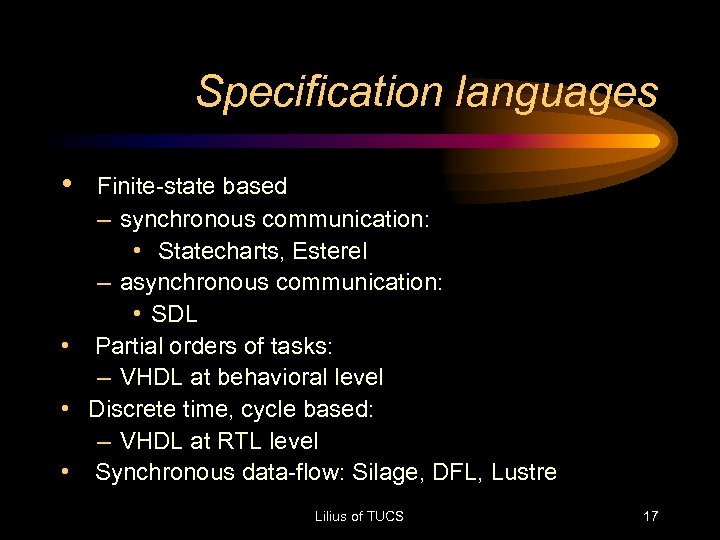
Specification languages • Finite-state based – synchronous communication: • Statecharts, Esterel – asynchronous communication: • SDL • Partial orders of tasks: – VHDL at behavioral level • Discrete time, cycle based: – VHDL at RTL level • Synchronous data-flow: Silage, DFL, Lustre Lilius of TUCS 17
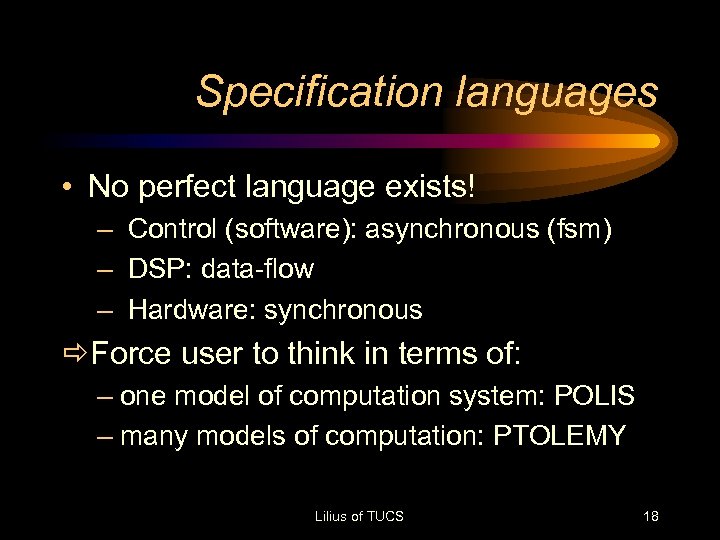
Specification languages • No perfect language exists! – Control (software): asynchronous (fsm) – DSP: data-flow – Hardware: synchronous ðForce user to think in terms of: – one model of computation system: POLIS – many models of computation: PTOLEMY Lilius of TUCS 18
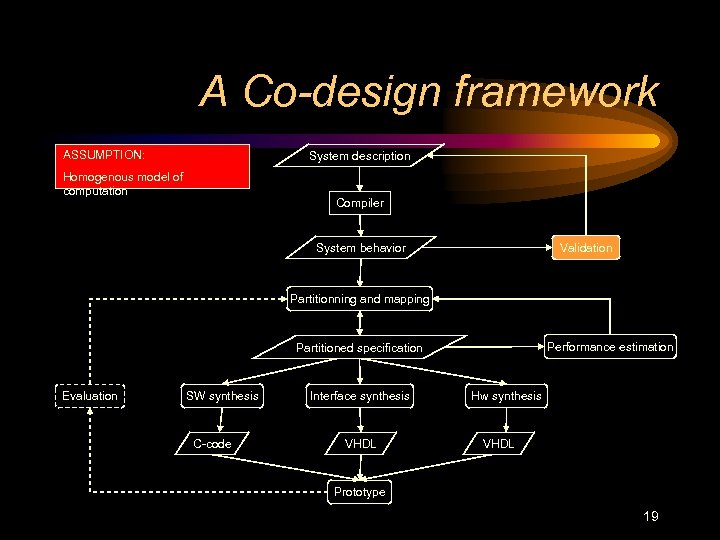
A Co-design framework ASSUMPTION: System description Homogenous model of computation Compiler Validation System behavior Partitionning and mapping Performance estimation Partitioned specification Evaluation SW synthesis C-code Interface synthesis VHDL Hw synthesis VHDL Prototype 19
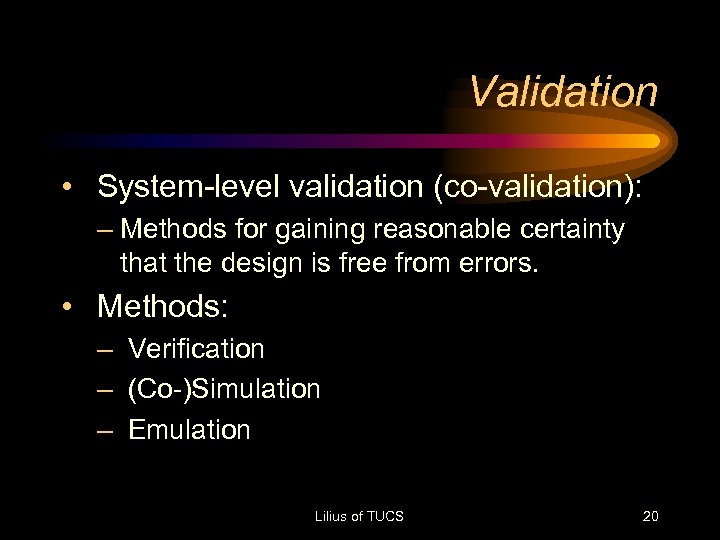
Validation • System-level validation (co-validation): – Methods for gaining reasonable certainty that the design is free from errors. • Methods: – Verification – (Co-)Simulation – Emulation Lilius of TUCS 20
Verification • Specification verification • Is the specification consistent? • Does it have the required properties? • Implementation verification • Have we implemented the specification? • Checking of: • safety: nothing bad ever happens • liveness: something good eventually happens Lilius of TUCS 21
Weakly heterogeneous systems • One or more processors, some dedicated hardware, and several software layers. • Desired features of simulator: • adequate timing accuracy • fast execution • visibility of internal registers for debugging purposes • Problems: • One step in program is equivalent to many steps in hardware ðlong running times ðAvailability of hardware models with the required abstraction level. Mahapatra-Texas A&M-Spring'04 22
Highly heterogeneous systems • Specialized simulators: – PTOLEMY (U. C. Berkeley) Mahapatra-Texas A&M-Spring'04 23
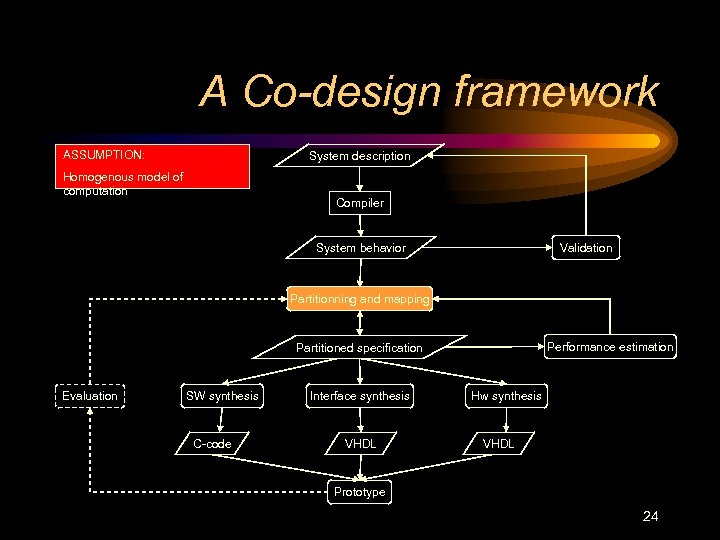
A Co-design framework ASSUMPTION: System description Homogenous model of computation Compiler Validation System behavior Partitionning and mapping Performance estimation Partitioned specification Evaluation SW synthesis C-code Interface synthesis VHDL Hw synthesis VHDL Prototype 24
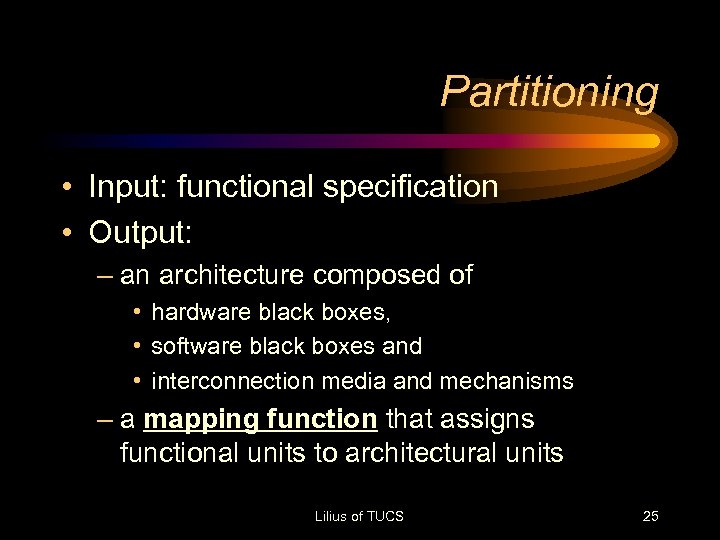
Partitioning • Input: functional specification • Output: – an architecture composed of • hardware black boxes, • software black boxes and • interconnection media and mechanisms – a mapping function that assigns functional units to architectural units Lilius of TUCS 25
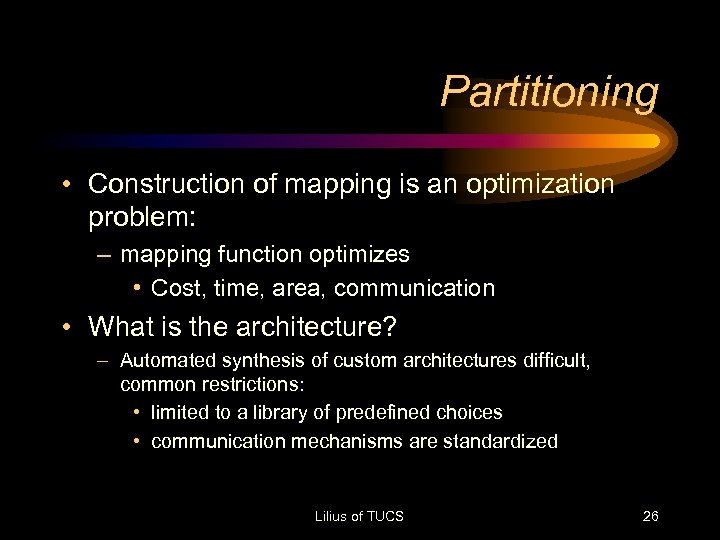
Partitioning • Construction of mapping is an optimization problem: – mapping function optimizes • Cost, time, area, communication • What is the architecture? – Automated synthesis of custom architectures difficult, common restrictions: • limited to a library of predefined choices • communication mechanisms are standardized Lilius of TUCS 26
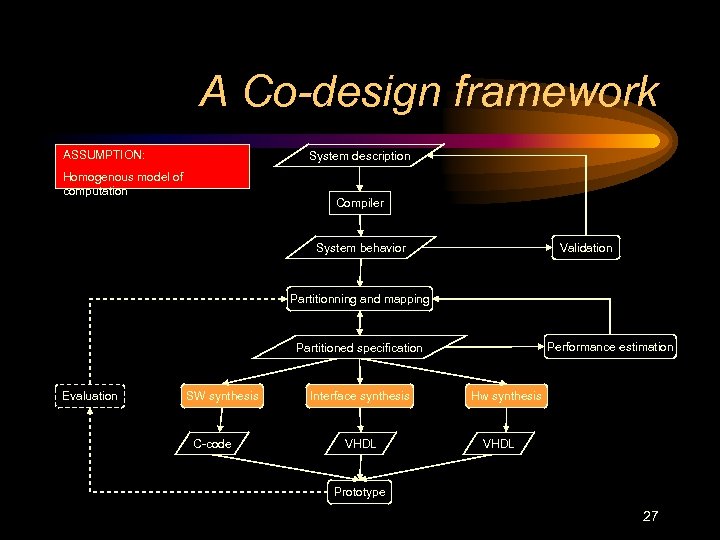
A Co-design framework ASSUMPTION: System description Homogenous model of computation Compiler Validation System behavior Partitionning and mapping Performance estimation Partitioned specification Evaluation SW synthesis C-code Interface synthesis VHDL Hw synthesis VHDL Prototype 27
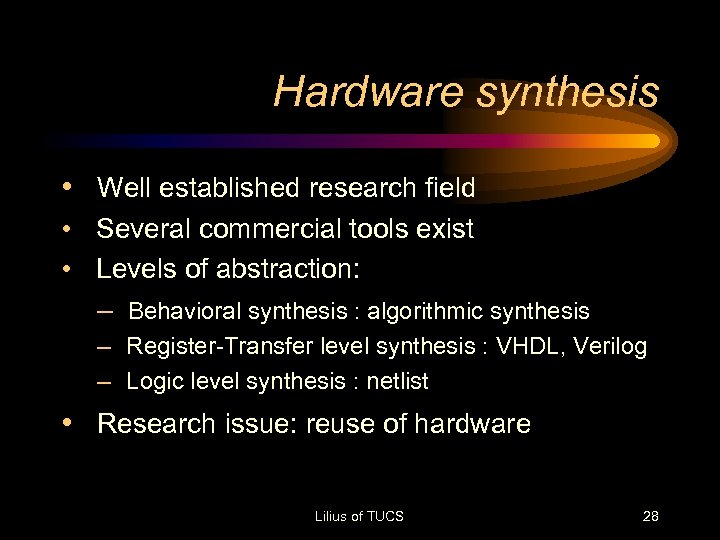
Hardware synthesis • Well established research field • Several commercial tools exist • Levels of abstraction: – Behavioral synthesis : algorithmic synthesis – Register-Transfer level synthesis : VHDL, Verilog – Logic level synthesis : netlist • Research issue: reuse of hardware Lilius of TUCS 28
Software synthesis • Difficult problem for general purpose computing • For embedded system much more constrained: • no swapping devices • no stacks • only polling and static variables • Simple algorithms – Translating FSMs to programs especially simple • Specification consists of concurrent tasks – Problem: How do we find a linear execution order that satisfies the timing constraints? • Use scheduling theory. Lilius of TUCS 29
Interface synthesis • Interface between processor and ASIC – synthesis of software – synthesis of ”glue logic” • Automatic generation of bus interfaces – PCI, VME • Packet routing against wires • Interfacing of sensors and actuators Mahapatra-Texas A&M-Spring'04 30
Existing Tools • Academic: – POLIS: U. C. Berkeley – PTOLEMY: U. C. Berkeley – VULCAN: Stanford U. (Hardware C) – CHINOOK: U. of Washington (VHDL) – COSYMA: U. of Braunschweig (C*) – MEIJE: INRIA and others (Esterel, Lustre, Signal) • Commercial: – Arexys: SDL, VHDL, C – Co. Ware: C/C++ – Laval. Logic: Java to Verilog – Cynlib: C++ to Verilog – Art, Algorithm to RT: C++ to RTL – SUPERLOG: System level description language Mahapatra-Texas A&M-Spring'04 31
Available tools • • Synopsis Tool set including Co. Centric INRIA CADP Xtensa from Tensilica Vx. Works, Montavista RTOS IBM Power. PC development platform Xilinx’s FPGA Express Ptolemy, Polis environment Code Composer from TI Mahapatra-Texas A&M-Spring'04 32
POLIS • Specification: FSM-based languages (Esterel, . . . ) • Internal Representation: CFSM network • Validation: • high-level co-simulation • FSM-based formal verification • Partitioning: by hand, based on co-simulation estimates • Scheduling: classical real-time algorithms • Synthesis: • S-graph-based code synthesis for software • logic synthesis for hardware • Main emphasis on unbiased verifiable specification Mahapatra-Texas A&M-Spring'04 33
PTOLEMY • Specification: Data flow graph • Internal representation: DFG • Validation: multi-paradigm co-simulation (DF, discrete events, . . . ) • Partitioning: greedy, based on scheduling • Scheduling: linear, sorting blocks by ``criticality'' • Synthesis: – DSP code – custom DSP synthesis for hardware • Main emphasis on heterogeneous computation models Mahapatra-Texas A&M-Spring'04 34
Projects • Power aware codesign – Low-Power Scheduling • No. C, Communication synthesis in So. C • DSP algorithms on FPGA • Network & Multimedia processor design • Distributed Embedded systems • Novel design methodology • Your own project Mahapatra-Texas A&M-Spring'04 35
Project (contd. ) • • Pre-proposal Proposal Mid-term Report Final Report Mahapatra-Texas A&M-Spring'04 36
Скачать презентацию Codesign Framework Parts of this lecture are borrowed
354ca804c6aac1b46a7336c272b78470.ppt