 Скачать презентацию Codes for Fault Tolerant Video-on-Demand Servers Shiri Abarbanel
fbbe06ab183f96a990e18c7e67240a7d.ppt
- Количество слайдов: 22



Codes for Fault. Tolerant Video-on-Demand Servers Shiri Abarbanel Lior Baram Dr. Roy Friedman Technion – Israel Institute of Technology MOST Seminar - November 2001
The Problem Smooth provision of Video-on. Demand service in the presence of server failure MOST Seminar - November 2001 2
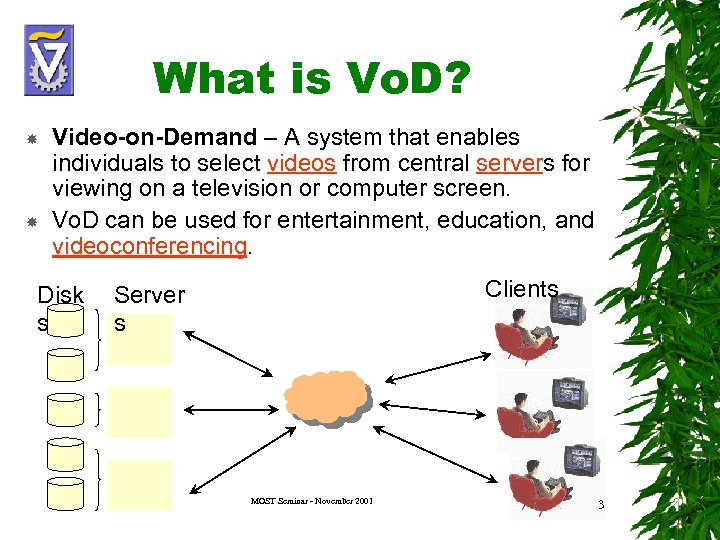
What is Vo. D? Video-on-Demand – A system that enables individuals to select videos from central servers for viewing on a television or computer screen. Vo. D can be used for entertainment, education, and videoconferencing. Disk s Clients Server s MOST Seminar - November 2001 3
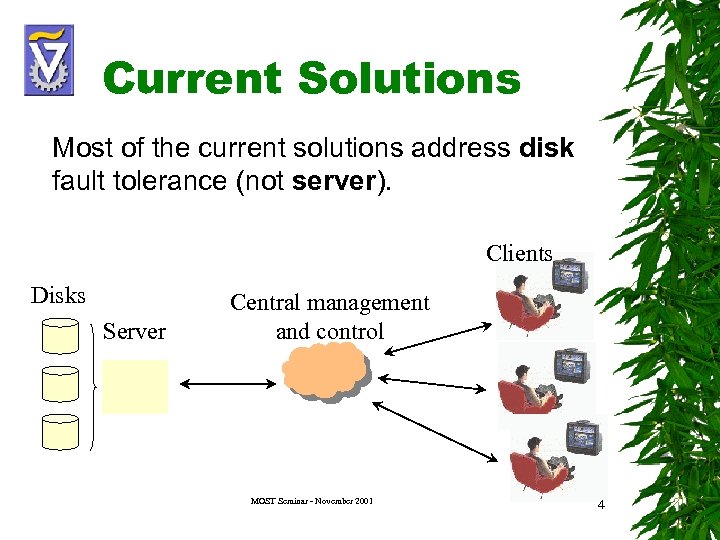
Current Solutions Most of the current solutions address disk fault tolerance (not server). Clients Disks Server Central management and control MOST Seminar - November 2001 4
Current Solutions Examples of multi-disk Vo. D: RAID - Redundant Array of Inexpensive Disks Striping of data across disks to improve performance. Fault tolerance achieved by: – Mirroring – Parity MOST Seminar - November 2001 5
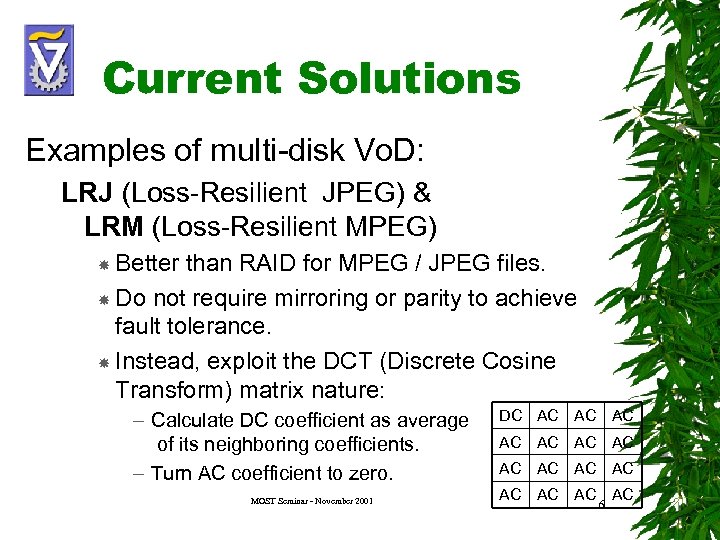
Current Solutions Examples of multi-disk Vo. D: LRJ (Loss-Resilient JPEG) & LRM (Loss-Resilient MPEG) Better than RAID for MPEG / JPEG files. Do not require mirroring or parity to achieve fault tolerance. Instead, exploit the DCT (Discrete Cosine Transform) matrix nature: – Calculate DC coefficient as average of its neighboring coefficients. – Turn AC coefficient to zero. MOST Seminar - November 2001 DC AC AC AC AC 6
Current Solutions Examples of multi-disk Vo. D: Lazy and eager parity-based recovery policies Solves the problem of additional load on the surviving disks in the event of disk failure. Lazy policy – After failure, read future data from the surviving disks. Eager policy – Before failure, read future data. Comparing to RAID: – Reduce load on surviving disks. – Increase Buffer requirements. MOST Seminar - November 2001 7
Current Solutions 2 Solutions that do address Vo. D server fault tolerance: – Tiger File is striped across disks. Mirror copy of data from one disk is striped across several disks of other servers. Requires frequent server failure detections. MOST Seminar - November 2001 8
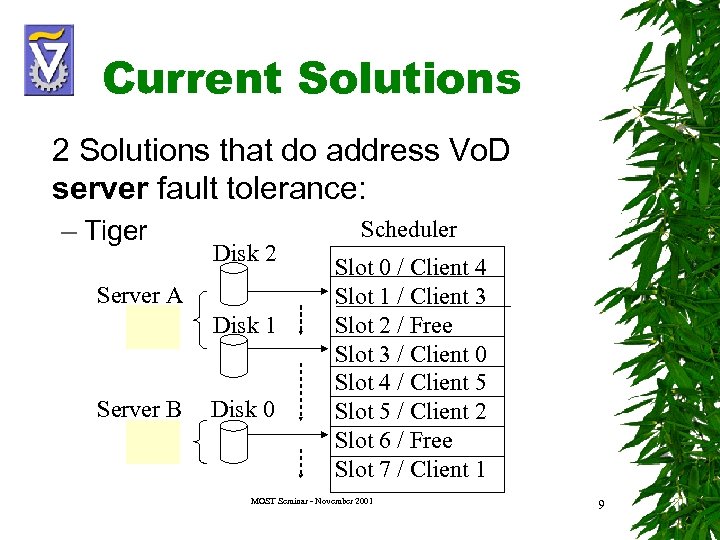
Current Solutions 2 Solutions that do address Vo. D server fault tolerance: – Tiger Disk 2 Server A Disk 1 Server B Disk 0 Scheduler Slot 0 / Client 4 Slot 1 / Client 3 Slot 2 / Free Slot 3 / Client 0 Slot 4 / Client 5 Slot 5 / Client 2 Slot 6 / Free Slot 7 / Client 1 MOST Seminar - November 2001 9
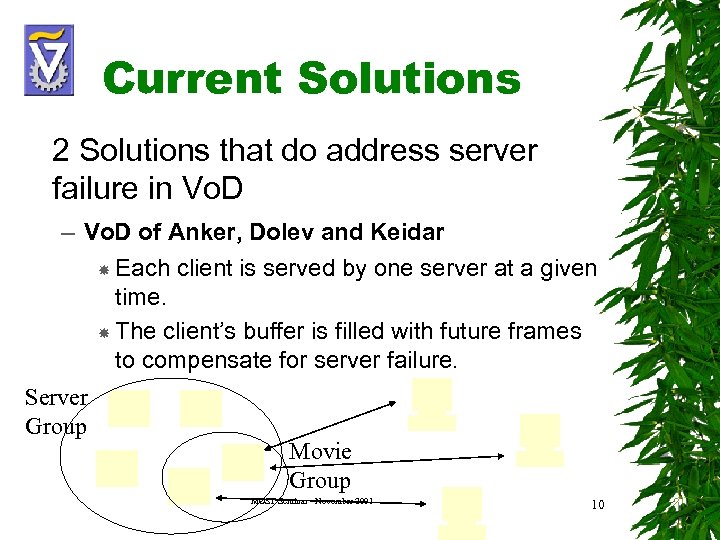
Current Solutions 2 Solutions that do address server failure in Vo. D – Vo. D of Anker, Dolev and Keidar Each client is served by one server at a given time. The client’s buffer is filled with future frames to compensate for server failure. Server Group Movie Group MOST Seminar - November 2001 10
Our Solution 3 models. Performs smooth streaming in the event of server failure. Doesn’t require immediate failure detection. Requires minimal client buffer and network bandwidth overhead. Exploits MPEG and Motion-JPEG special characteristics. MOST Seminar - November 2001 11
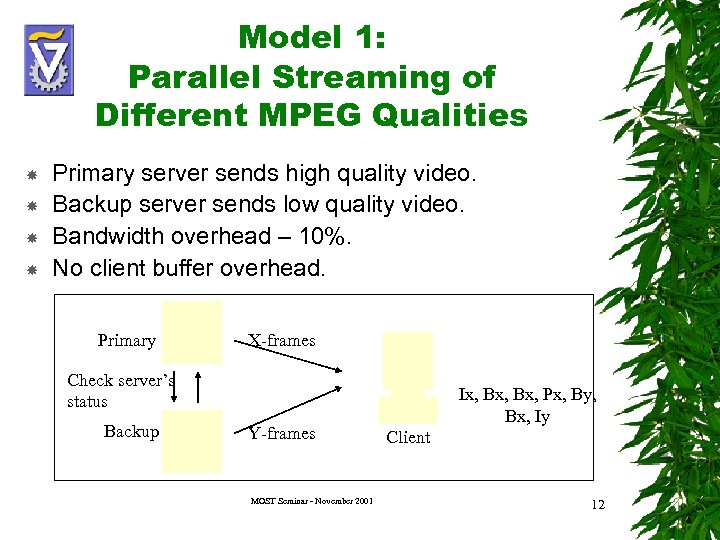
Model 1: Parallel Streaming of Different MPEG Qualities Primary server sends high quality video. Backup server sends low quality video. Bandwidth overhead – 10%. No client buffer overhead. Primary X-frames Check server’s status Backup Y-frames MOST Seminar - November 2001 Ix, Bx, Px, By, Bx, Iy Client 12
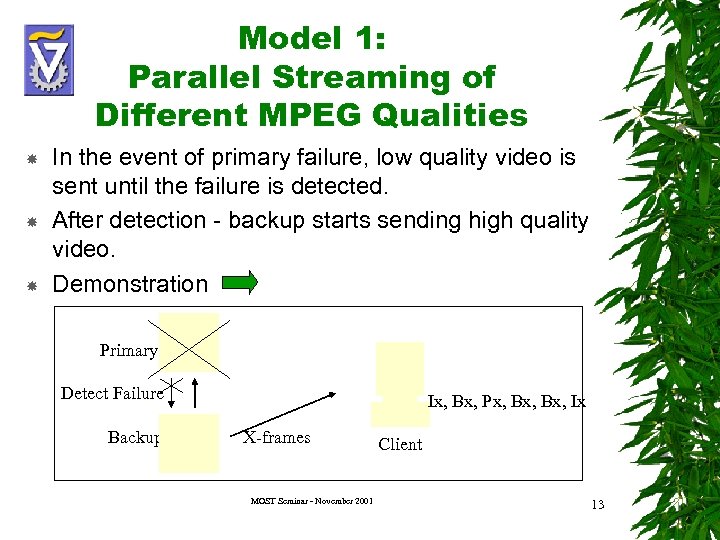
Model 1: Parallel Streaming of Different MPEG Qualities In the event of primary failure, low quality video is sent until the failure is detected. After detection - backup starts sending high quality video. Demonstration Primary Detect Failure Backup Ix, Bx, Px, Bx, Ix X-frames MOST Seminar - November 2001 Client 13
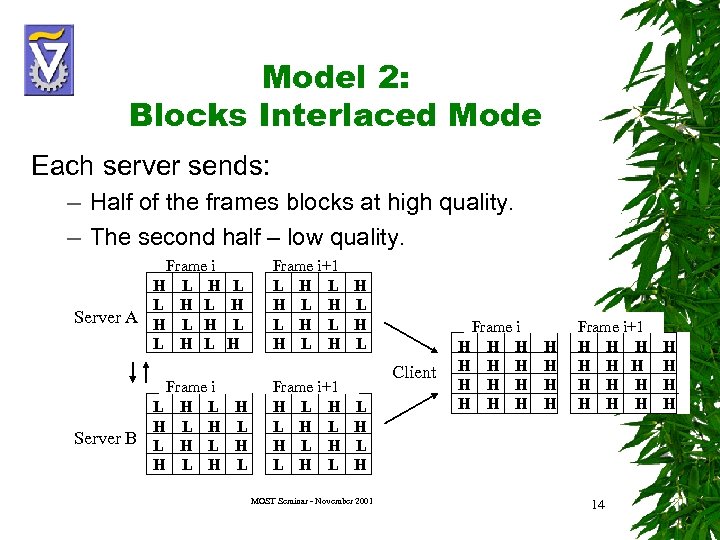
Model 2: Blocks Interlaced Mode Each server sends: – Half of the frames blocks at high quality. – The second half – low quality. Frame i H L H L Server A H L H L Server B L H Frame i L H L H L Frame i+1 L H L H L H Frame i+1 H L H L Client L H MOST Seminar - November 2001 Frame i H H H H Frame i+1 H H H 14 H H
Model 2: Blocks Interlaced Mode If the client receives 2 corresponding frames from the 2 servers, it combines them into one high quality frame. If the client receives a frame from only one server, some degradation in quality is observed for few seconds. Demonstration MOST Seminar - November 2001 15
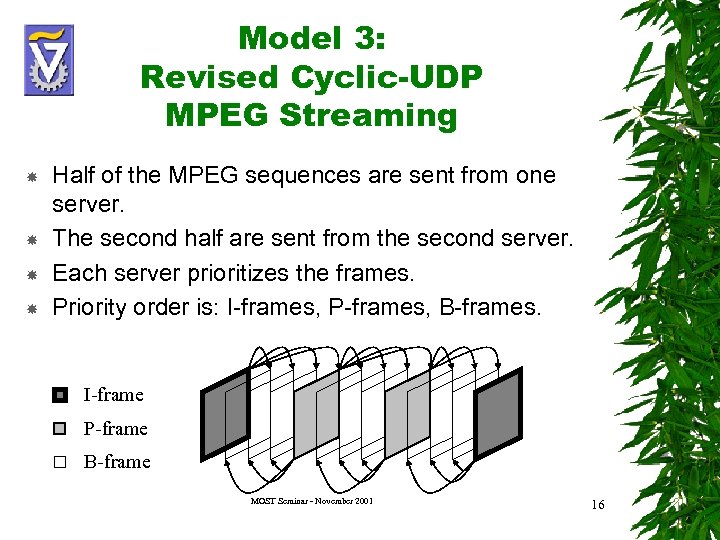
Model 3: Revised Cyclic-UDP MPEG Streaming Half of the MPEG sequences are sent from one server. The second half are sent from the second server. Each server prioritizes the frames. Priority order is: I-frames, P-frames, B-frames. I-frame P-frame B-frame MOST Seminar - November 2001 16
Model 3: Revised Cyclic-UDP MPEG Streaming To prioritize the frames, we revised Smith’s Cyclic. UDP algorithm. What is Cyclic-UDP? – Runs at the application layer on top of UDP, unlike TCP, does not retransmit data unit that did not arrive at the client. – In Cyclic-UDP, data units are ordered in a queue. – Data units at the beginning of the queue have a higher retransmission probability. MOST Seminar - November 2001 17
Model 3: Revised Cyclic-UDP MPEG Streaming Why revise Cyclic-UDP? – Expanding use to multiple servers. – Incorporating server fault tolerance. Revised Cyclic-UDP – Retransmission request is sent when a frame is received before a preceding frame from the same server. – Special waiting mechanism is implemented to tolerate difference in network speed from the two servers. – Retransmission request is sent to both servers. MOST Seminar - November 2001 18
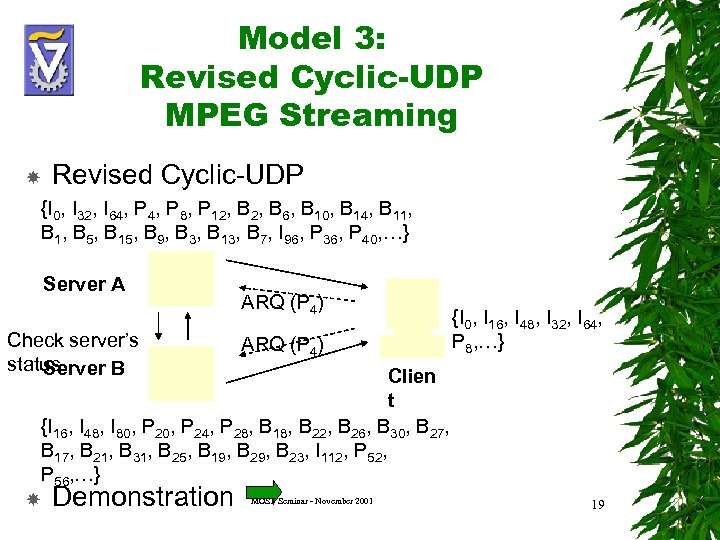
Model 3: Revised Cyclic-UDP MPEG Streaming Revised Cyclic-UDP {I 0, I 32, I 64, P 8, P 12, B 6, B 10, B 14, B 11, B 5, B 15, B 9, B 3, B 13, B 7, I 96, P 36, P 40, …} Server A Check server’s status Server B ARQ (P 4) {I 0, I 16, I 48, I 32, I 64, P 8, …} Clien t {I 16, I 48, I 80, P 24, P 28, B 18, B 22, B 26, B 30, B 27, B 17, B 21, B 31, B 25, B 19, B 23, I 112, P 56, …} Demonstration MOST Seminar - November 2001 19
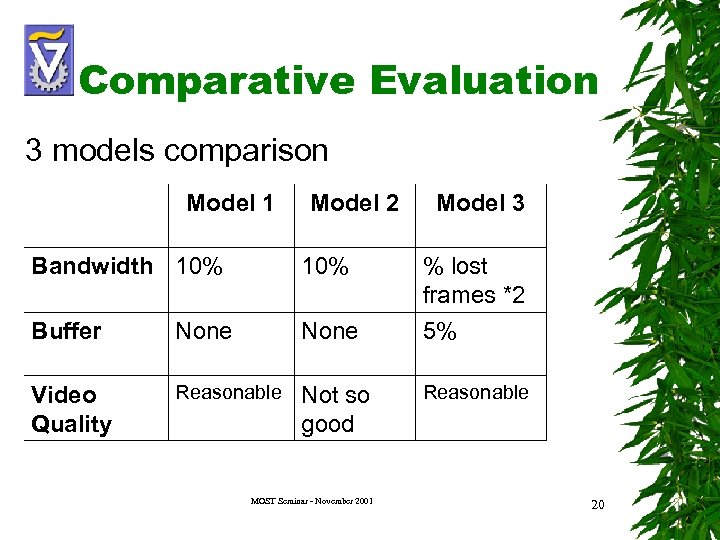
Comparative Evaluation 3 models comparison Model 1 Model 2 Model 3 Bandwidth 10% % lost frames *2 Buffer None 5% Video Quality Reasonable Not so good Reasonable MOST Seminar - November 2001 20
Future Work Scalability: Enhance the models to fit systems with more than 2 servers. Revised model 2: Utilize blocks of previous frame, instead of low quality blocks. Utilization of MPEG-4. MOST Seminar - November 2001 21
Thanks Questions? MOST Seminar - November 2001 22
Скачать презентацию Codes for Fault Tolerant Video-on-Demand Servers Shiri Abarbanel
fbbe06ab183f96a990e18c7e67240a7d.ppt