 Скачать презентацию CODATU XII DECENTRALIZED COOPERATION FOR URBAN TRANSPORT EXPERIENCING
f862eea2766837115709157af2c180c7.ppt
- Количество слайдов: 14



CODATU XII DECENTRALIZED COOPERATION FOR URBAN TRANSPORT: EXPERIENCING DIRECT COOPERATION BETWEEN LOCAL GOVERNMENTS WORLDWIDE 5 -7 July 2006 Lyon (France) SESSION 7 Accessibility: the social dimension of sustainable transport TOWARDS INCLUSIVE CITIES IN SOUTH AFRICA Implementation logjams and emerging approaches through cooperation Christo VENTER Associate Professor christo. venter@up. ac. za University of Pretoria www. codatu. org www. cemt. org 1
Objectives • Implementation logjams • Logjam examples: Accessible transport • Unjamming: Emerging local planning approaches • Unjamming: Intergovernmental coordination • Conclusions 2
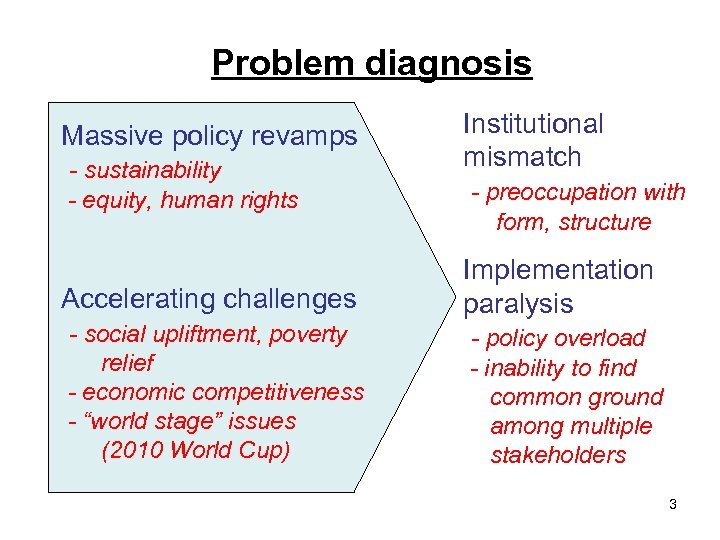
Problem diagnosis Massive policy revamps - sustainability - equity, human rights Institutional mismatch - preoccupation with form, structure Accelerating challenges Implementation paralysis - social upliftment, poverty relief - economic competitiveness - “world stage” issues (2010 World Cup) - policy overload - inability to find common ground among multiple stakeholders 3
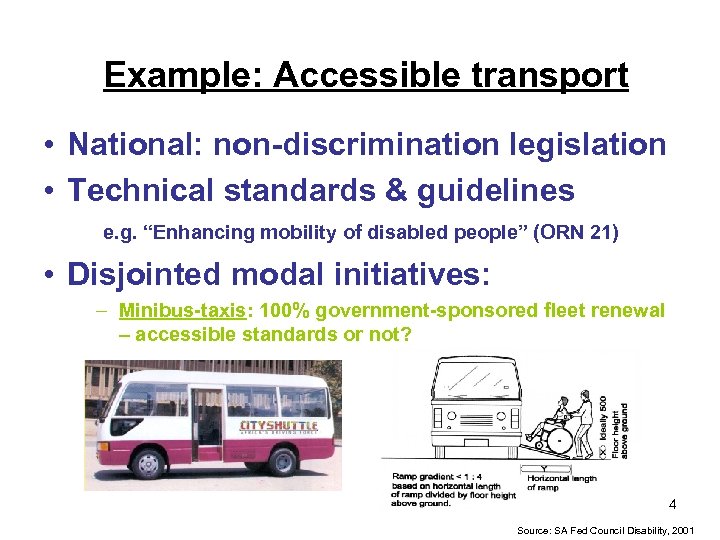
Example: Accessible transport • National: non-discrimination legislation • Technical standards & guidelines e. g. “Enhancing mobility of disabled people” (ORN 21) • Disjointed modal initiatives: – Minibus-taxis: 100% government-sponsored fleet renewal – accessible standards or not? 4 Source: SA Fed Council Disability, 2001
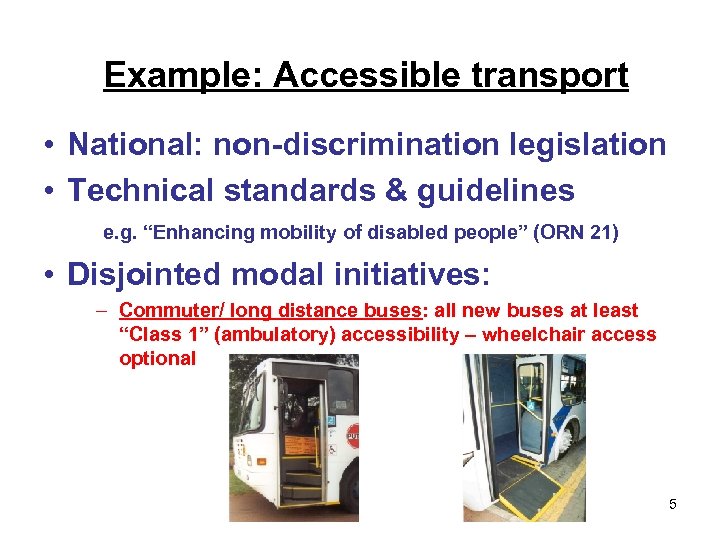
Example: Accessible transport • National: non-discrimination legislation • Technical standards & guidelines e. g. “Enhancing mobility of disabled people” (ORN 21) • Disjointed modal initiatives: – Commuter/ long distance buses: all new buses at least “Class 1” (ambulatory) accessibility – wheelchair access optional 5
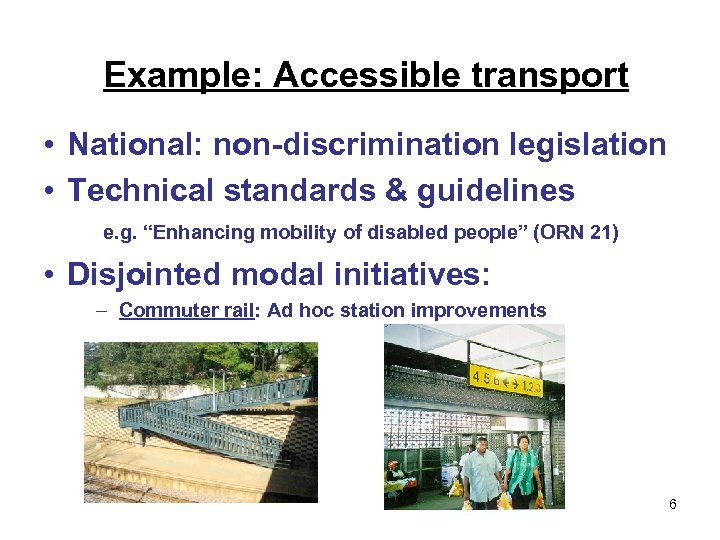
Example: Accessible transport • National: non-discrimination legislation • Technical standards & guidelines e. g. “Enhancing mobility of disabled people” (ORN 21) • Disjointed modal initiatives: – Commuter rail: Ad hoc station improvements 6
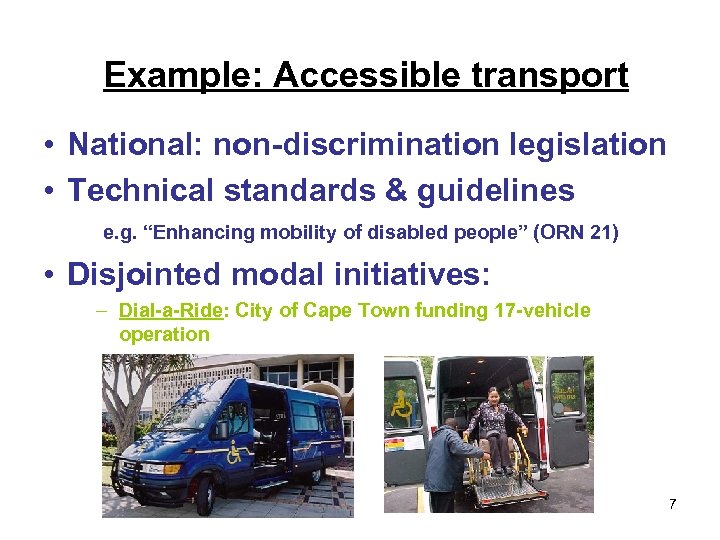
Example: Accessible transport • National: non-discrimination legislation • Technical standards & guidelines e. g. “Enhancing mobility of disabled people” (ORN 21) • Disjointed modal initiatives: – Dial-a-Ride: City of Cape Town funding 17 -vehicle operation 7
Emerging local planning approach • Identification of high priority, strategic public transport networks - Road/rail based, high traffic volumes - All-day, “backbone” service - Partial or complete priority for PT - Supported by feeder networks • Incremental implementation - Route by route - Includes pedestrian infrastructure, PT priority, improved vehicle standards, security, enforcement - Creates focus for accessibility improvements -- full access to support entire trip chain 8
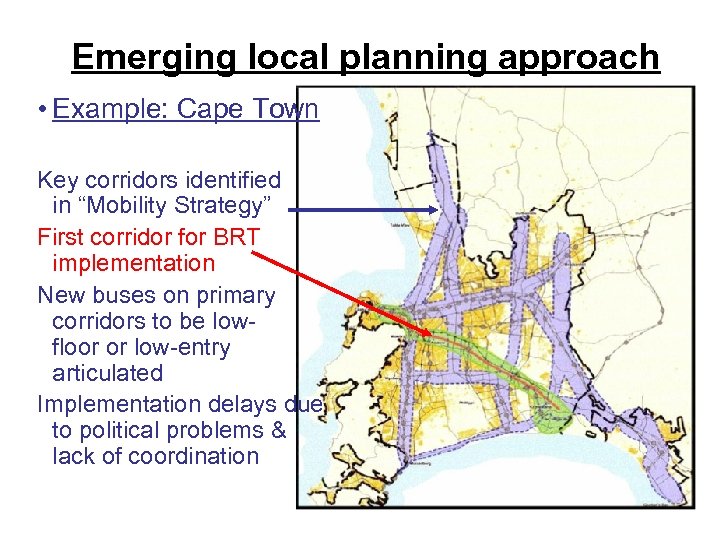
Emerging local planning approach • Example: Cape Town Key corridors identified in “Mobility Strategy” First corridor for BRT implementation New buses on primary corridors to be lowfloor or low-entry articulated Implementation delays due to political problems & lack of coordination 9
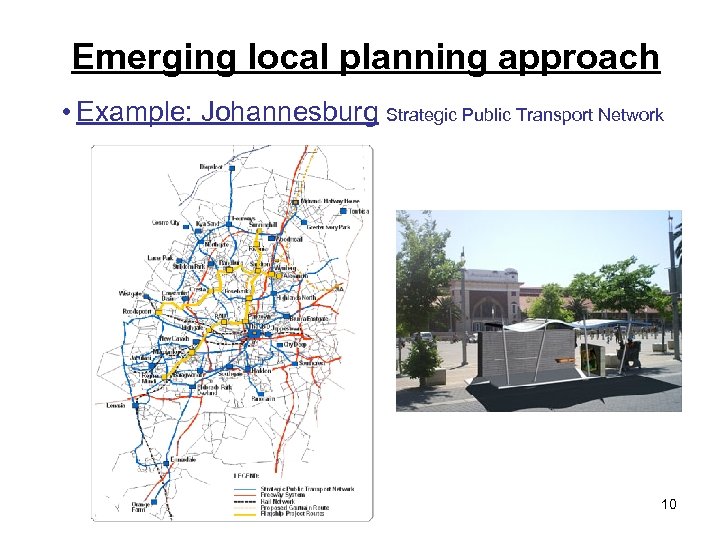
Emerging local planning approach • Example: Johannesburg Strategic Public Transport Network 10
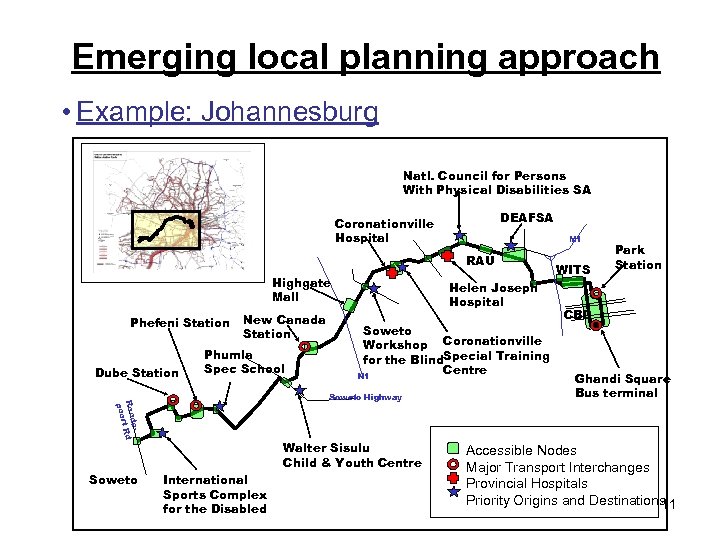
Emerging local planning approach • Example: Johannesburg Natl. Council for Persons With Physical Disabilities SA DEAFSA Coronationville Hospital M 1 RAU Highgate Mall Phefeni Station Dube Station New Canada Station Phumla Spec School Soweto Workshop Coronationville for the Blind. Special Training Centre N 1 Soweto Highway de. Roo Rd rt poo Soweto Helen Joseph Hospital Walter Sisulu Child & Youth Centre International Sports Complex for the Disabled WITS Park Station CBD Ghandi Square Bus terminal Accessible Nodes Major Transport Interchanges Provincial Hospitals Priority Origins and Destinations 11
Emerging model for intergovernmental coordination • Development & adoption of Gauteng Intergovernmental Transport Charter – high-level agreement of objectives, functions, responsibilities among government entities • Key insights: - Success is only achievable through high levels of joint planning & coordination - First need clear identification of functions & responsibilities of various government entities - Then sort out institutional arrangements later (“Form follows function”) - Implementation should be local, unless economies of scale or geographic nature dictates otherwise - Pay attention to political champions 12
Conclusions • Mismatch of institutions with functional requirements of delivery is a key constraint to transport improvement • Some success achieved in first sorting out function, and then designing form to follow function • Incremental planning and deployment of public transport corridors, taking account of – – Infrastructure (especially priority for PT) Operations, regulation & enforcement Accessible trip chains from origin to destination Need for officials/implementers to learn as they do 13
Acknowledgments City of Johannesburg, Bob Stanway, Johannesburg News Agency Gauteng Department of Public transport, Roads & Works, Lisa Seftel & Mar Somaru City of Cape Town, Jim Stanbury CSIR 14
Скачать презентацию CODATU XII DECENTRALIZED COOPERATION FOR URBAN TRANSPORT EXPERIENCING
f862eea2766837115709157af2c180c7.ppt