


 Скачать презентацию Coastal Restoration Project Selection in Louisiana From CWPPRA
e749b9298f5cd30d4e87db4089d84f87.ppt
- Количество слайдов: 31
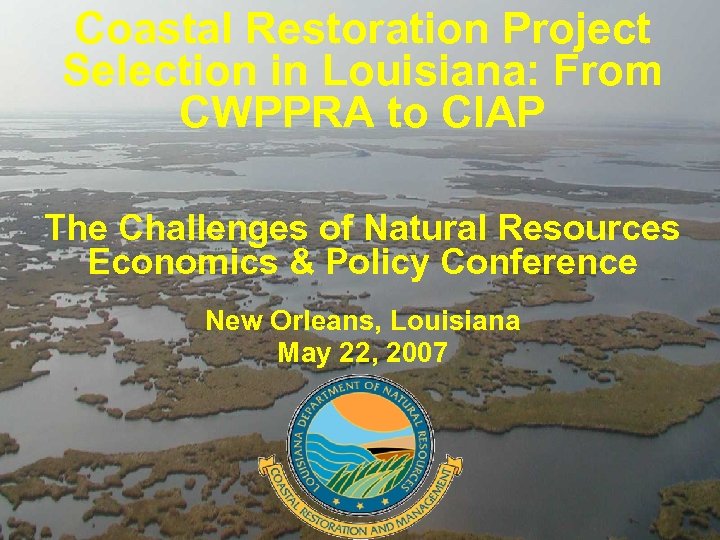 Coastal Restoration Project Selection in Louisiana: From CWPPRA to CIAP The Challenges of Natural Resources Economics & Policy Conference New Orleans, Louisiana May 22, 2007
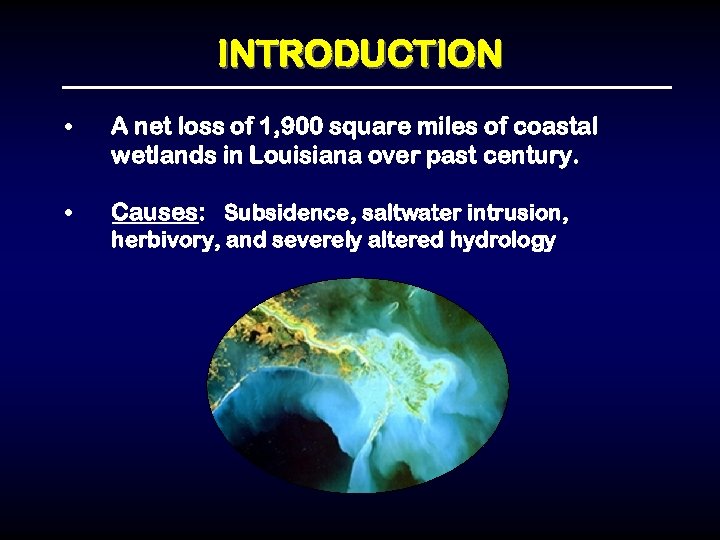 INTRODUCTION • A net loss of 1, 900 square miles of coastal wetlands in Louisiana over past century. • Causes: Subsidence, saltwater intrusion, herbivory, and severely altered hydrology
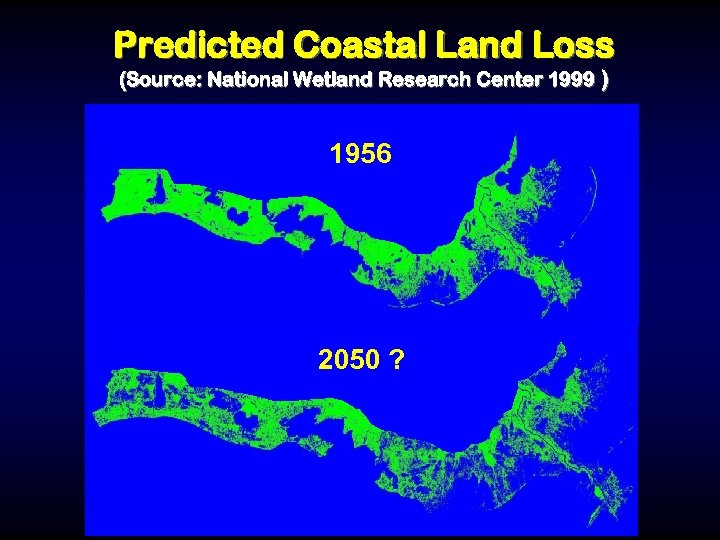 Predicted Coastal Land Loss (Source: National Wetland Research Center 1999 ) 1956 2050 ?
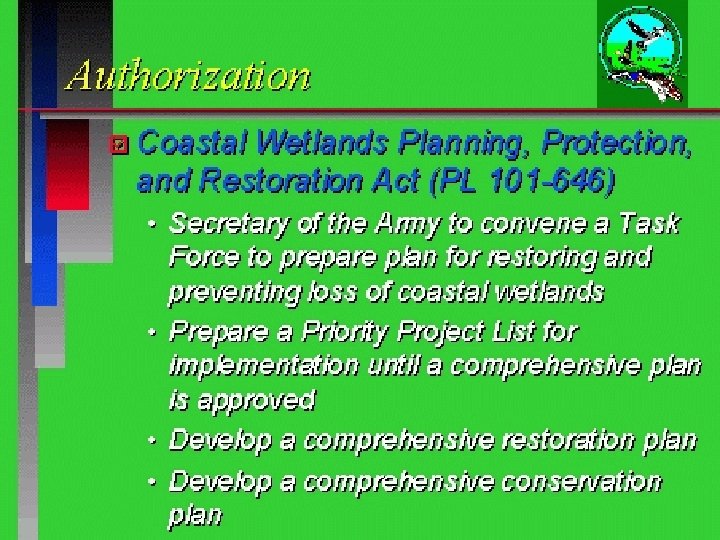
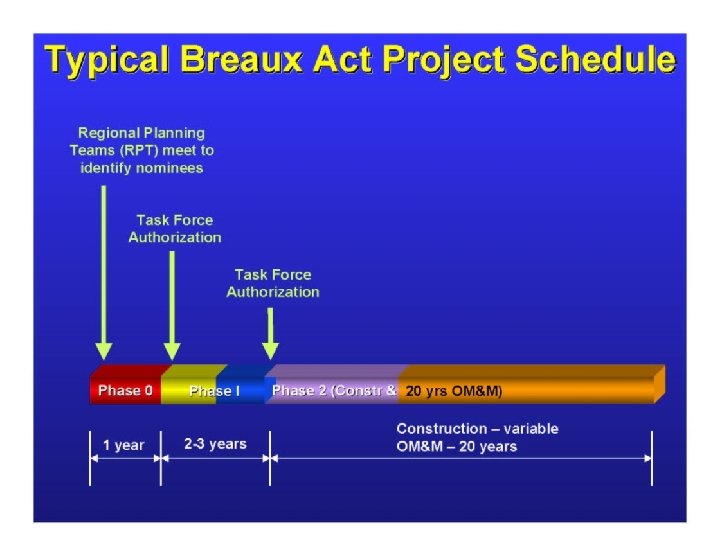
 Action Taken • 1990 Coastal Wetlands Planning, Protection, and Restoration Act (CWPPRA). • 163 CWPPRA projects authorized, with 143 either constructed or in development. • Projects designed to restore and/or protect via vegetative, structural, hydrologic techniques.
 Action Taken • Coastal Impact Assistance Program (CIAP) established by Section 84 of the Energy Policy Act of 2005 • Louisiana allocated approximately $331 million over federal FY 2007 -2010, proposes 18 restoration and 5 infrastructure projects • CIAP allows five authorized uses including – – – Conservation, Protection, or Restoration of Coastal Areas, including wetland Mitigation of Damage to Fish, Wildlife or Natural Resources Mitigation of the impact of Offshore Continental Shelf activities on onshore infrastructure projects or public service needs
 Current Economic Reality? • $14 billion needed for to sustain Coastal La • CWPPRA provides less than 10% of funding • LCA PLAN - $1. 9 Billion ? • Coastal Impact Assistance Program - $510 Million (State 65% and Coastal Parishes 35%) • Restoration Funds from Katrina and Rita? • CWPPRA Reauthorized through 2019 – Coast 2050 Report 1998
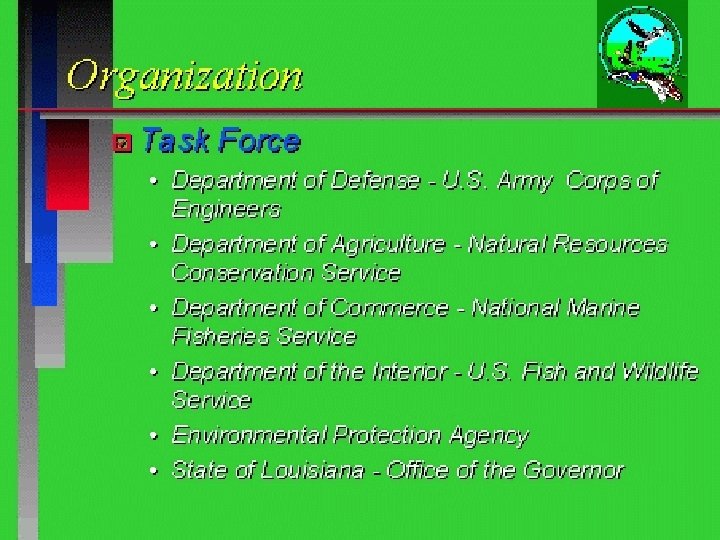
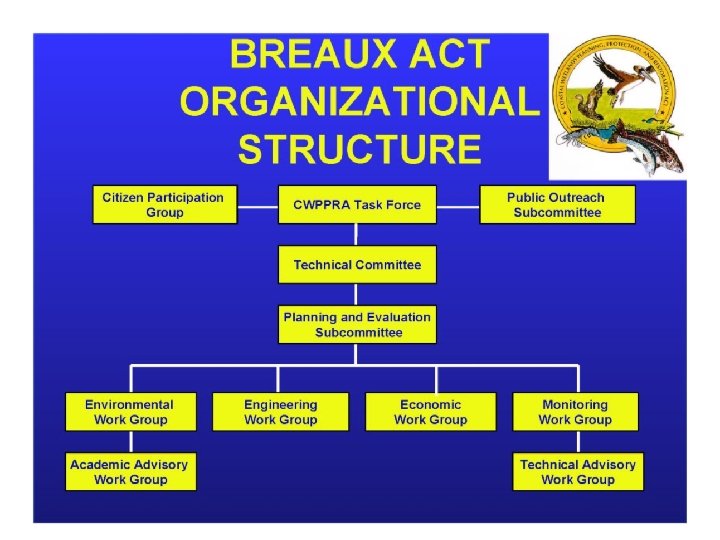
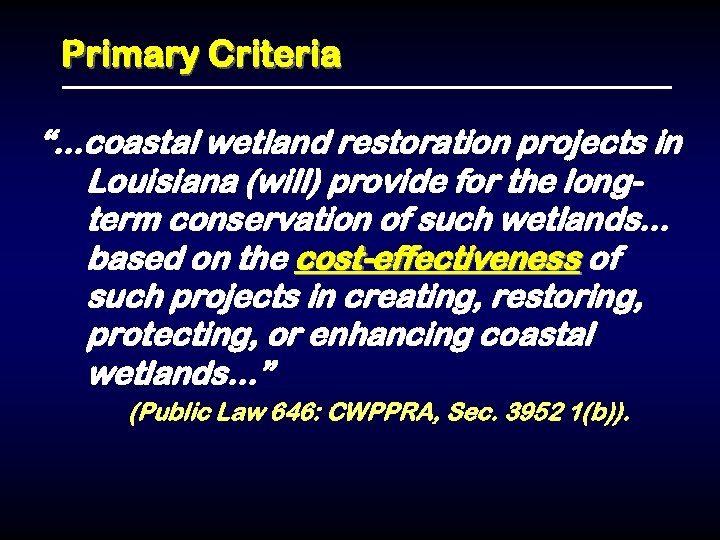 Primary Criteria “. . . coastal wetland restoration projects in Louisiana (will) provide for the longterm conservation of such wetlands. . . based on the cost-effectiveness of such projects in creating, restoring, protecting, or enhancing coastal wetlands. . . ” (Public Law 646: CWPPRA, Sec. 3952 1(b)).
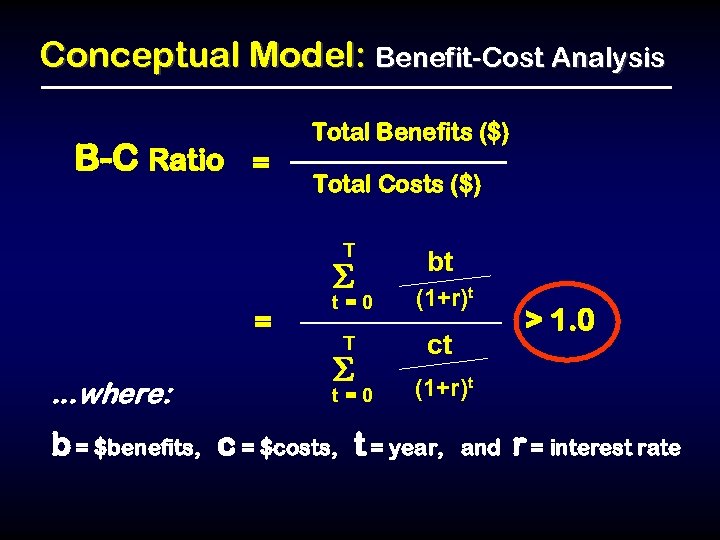 Conceptual Model: Benefit-Cost Analysis B-C Ratio = Total Benefits ($) Total Costs ($) T bt t=0 (1+r)t T ct t=0 (1+r)t =. . . where: b = $benefits, c = $costs, t = year, and > 1. 0 r = interest rate
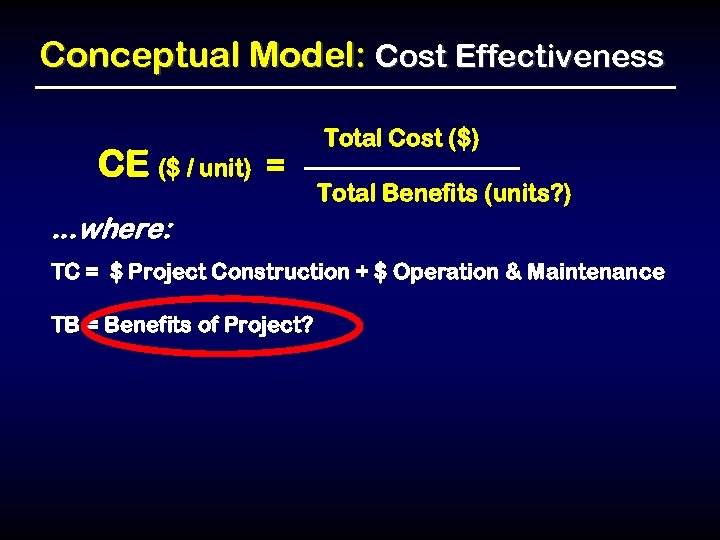 Conceptual Model: Cost Effectiveness CE ($ / unit) = Total Cost ($) Total Benefits (units? ) . . . where: TC = $ Project Construction + $ Operation & Maintenance TB = Benefits of Project?
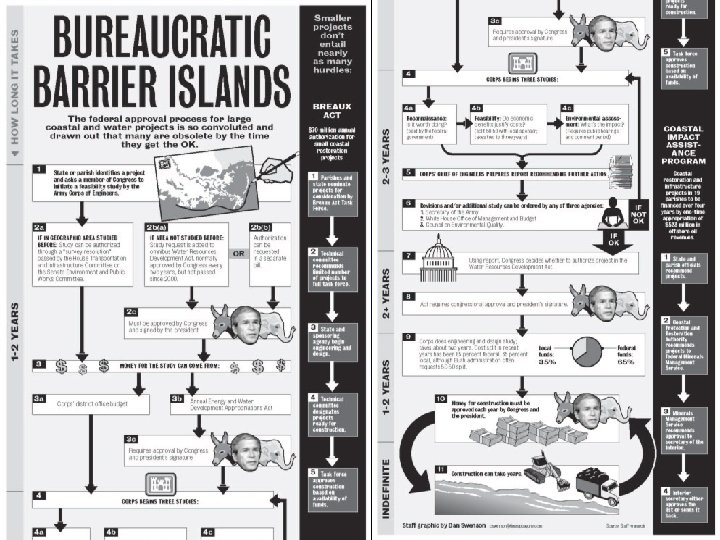
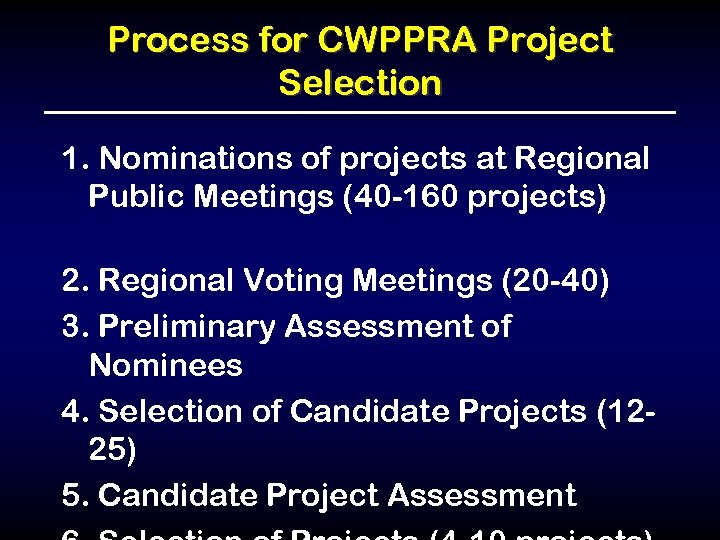 Process for CWPPRA Project Selection 1. Nominations of projects at Regional Public Meetings (40 -160 projects) 2. Regional Voting Meetings (20 -40) 3. Preliminary Assessment of Nominees 4. Selection of Candidate Projects (1225) 5. Candidate Project Assessment
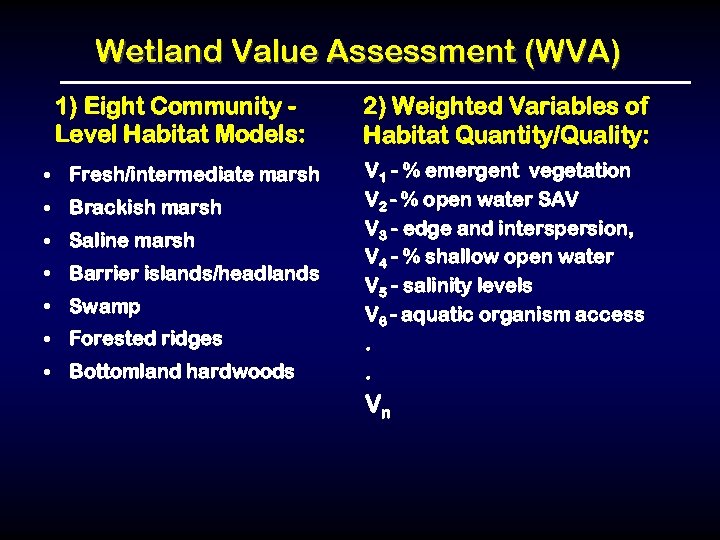 Wetland Value Assessment (WVA) 1) Eight Community Level Habitat Models: 2) Weighted Variables of Habitat Quantity/Quality: • Fresh/intermediate marsh V 1 - % emergent vegetation V 2 - % open water SAV V 3 - edge and interspersion, V 4 - % shallow open water V 5 - salinity levels V 6 - aquatic organism access. . • Brackish marsh • Saline marsh • Barrier islands/headlands • Swamp • Forested ridges • Bottomland hardwoods Vn
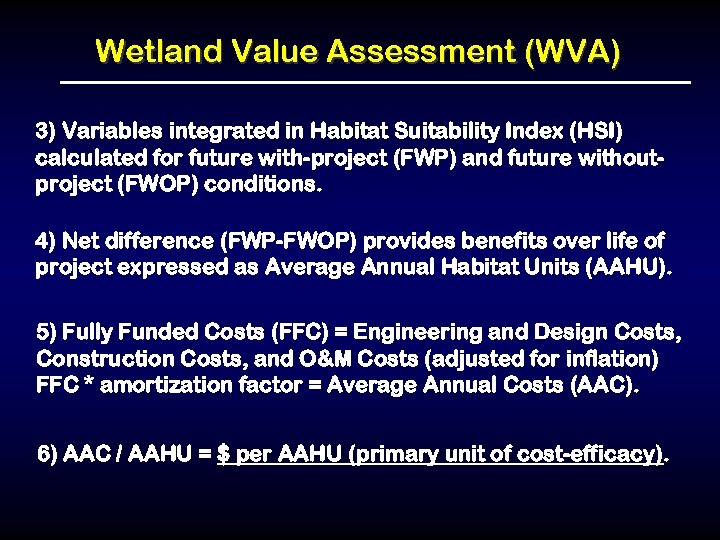 Wetland Value Assessment (WVA) 3) Variables integrated in Habitat Suitability Index (HSI) calculated for future with-project (FWP) and future withoutproject (FWOP) conditions. 4) Net difference (FWP-FWOP) provides benefits over life of project expressed as Average Annual Habitat Units (AAHU). 5) Fully Funded Costs (FFC) = Engineering and Design Costs, Construction Costs, and O&M Costs (adjusted for inflation) FFC * amortization factor = Average Annual Costs (AAC). 6) AAC / AAHU = $ per AAHU (primary unit of cost-efficacy).
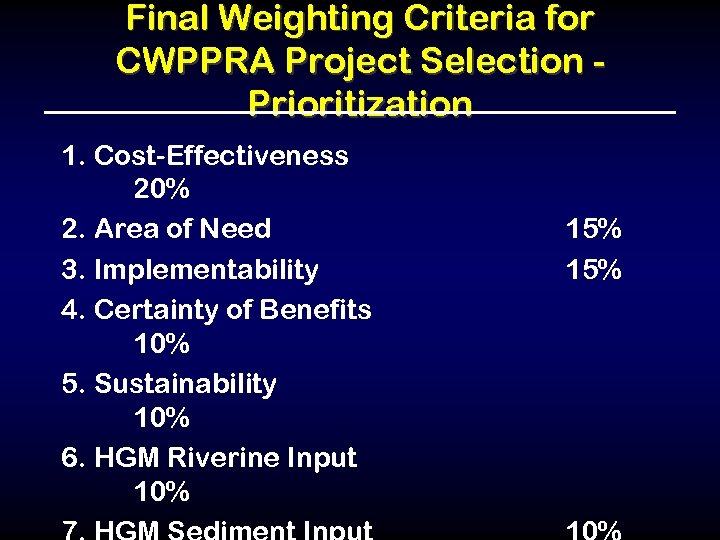 Final Weighting Criteria for CWPPRA Project Selection Prioritization 1. Cost-Effectiveness 20% 2. Area of Need 3. Implementability 4. Certainty of Benefits 10% 5. Sustainability 10% 6. HGM Riverine Input 10% 15%
 Prioritization Scoring – HGM Structure and Function Consistent with hydrogeomorphic objective of maintaining or establishing landscape features critical to a sustainable ecosystem structure & function. Certain landscape features provide critical benefits to maintaining the integrity of the coastal ecosystem. Such features include barrier islands, lake and bay rims/shorelines, cheniers, land bridges and natural levee ridges.
 Prioritization Scoring – HGM Structure and Function 1. The project serves to protect landscape features which are critical to maintaining the integrity of the mapping unit or are part of an ongoing effort to restore a landscape feature deemed critical to a basin or the coast in general (10 points) 2. The project serves to protect any landscape feature described above (5 points) 3. The project does not meet the above criteria (0 points)
 CIAP Plan Development Actions to Date • Established goals, objectives and ranking criteria • Held 5 initial public meetings (February 2006); briefed agencies, parishes, CPRA, Gov’s Coastal Comm. • Worked with 19 coastal parishes on their proposals • Solicited proposals; placed on DNR web site and discussed at regional open house meetings • Conducted technical evaluations of proposals • CIAP Selection Committee chose State-funded projects • Verified that CIAP projects consistent with Master Plan
 Criteria for CIAP Project Selection 1. Is the proposed project free of issues that may impact timely implementation of the project features? 2. Is the proposed project linked to a regional strategy for maintaining established landscape features critical to a sustainable ecosystem structure and function? 3. Does the proposed project protect health and safety or infrastructure of national, state, regional or local significance? 4. How cost effective is the proposed project?
 Criteria for CIAP Project Selection 5. What is the certainty of benefits resulting from impmenetation of the proposed project 6. Does the proposed project address an area of critical conservation/restoration need or a high land loss area? 7. How sustainable are the benefits of the proposed project?
 CIAP Screening & Evaluation of Project Proposals • 337 proposals received for CIAP funds • 253 proposals involved State’s share of CIAP funds; 84 proposals only involved parishes’ share of CIAP funds • Including overlap, at least $3. 8 billion requested in proposals by NGOs, agencies, parishes, and the public, involving only the State’s share ($331 million) of CIAP funds
 Detailed Technical Evaluation of Restoration Proposals • External review of 66 proposals conducted by 11 scientists, led by Dr. Robert Twilley (LSU).
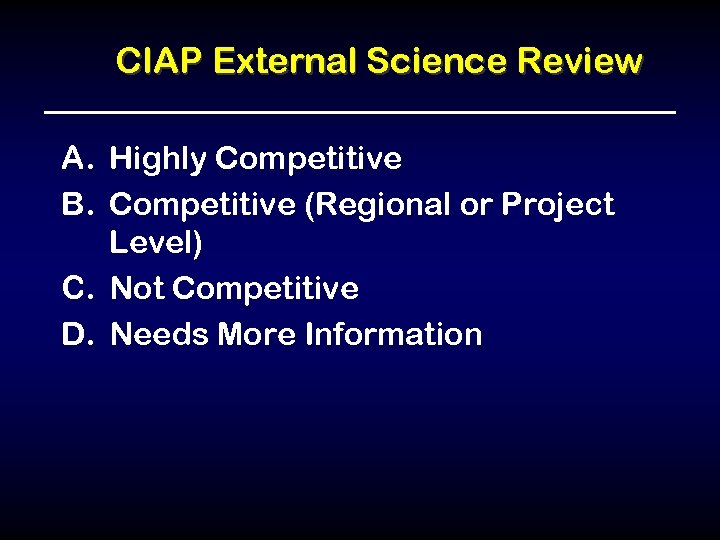 CIAP External Science Review A. Highly Competitive B. Competitive (Regional or Project Level) C. Not Competitive D. Needs More Information
 Detailed Technical Evaluation of Restoration Proposals • DNR technical review panel reviewed proposals (considered science panel rating and other pertinent info) • DNR technical review panel developed preliminary list of projects recommended for State CIAP funding.
 CIAP Project Selection Process • Meeting of CIAP Project Selection Committee: GOCA, DNR, DEQ, DWF, DAF, and DOTD representatives • Selection meeting also included DNR staff, CPRA Integrated Planning Team members, and Dr. Robert Twilley (LSU) • DNR presented project recommendations, related info. • Project Selection Committee chose list of projects for CIAP funding (State’s share)
 Acknowledgments Dr. Rex Caffey (LSU) Ms. Christian Aust (LSU) Mr. Daniel Llewellyn (LDNR) Mr. Christopher P. Knotts, P. E. (LDNR)
 Questions/Comments? For information and updates on the Louisiana CIAP Plan, visit: http: //dnr. louisiana. gov/crm/ciap. asp For information and updates on CWPPRA, visit: http: //www. lacoast. gov/cwppra/index. htm