 Скачать презентацию Co-opetition Barry Nalebuff Yale School of Management New
37631f4c706d822fdceec70cc1252bb7.ppt
- Количество слайдов: 60



Co-opetition Barry Nalebuff Yale School of Management New Haven, CT 06520 Version 5/7/96
Business is War and Peace Cooperation in creating value Competition in dividing it up Not cycles of War, Peace, War. . . Simultaneously War and Peace “You have to compete and cooperate at the same time” Ray Noorda, Novell Co-opetition
Manual for Coopetition Leadership secrets of Attila the Hun? St. Francis of Assisi? How to cooperate without being a saint compete w/o killing the opposition Game Theory
Game Theory l Game theory analyzes the interplay between competition and cooperation l Founders: John von Neumann and Oskar Morgenstern (1944) l The field has been gaining increasing attention » 1994 Nobel Prize » FCC spectrum auctions » Application by management consultants
Are we playing a game? l Everything is a Game l Citibank deciding whether to issue a credit card. Credit card scoring l Engineer versus Manager l Physics and Game Theory Newton’s Third Law
Business as a Game Chess, poker, sports? » Not win-lose » No rule book » People change the game » Game is made up of 5 PARTS » Archimedes lever » Success comes from playing the right game
The Game of Business l Who are the players? » Customers, Suppliers, Competitors Plus l Providers of complementary products and services » » Hardware and software Cars and auto loans VCRs and HBO Intel and Pro. Share
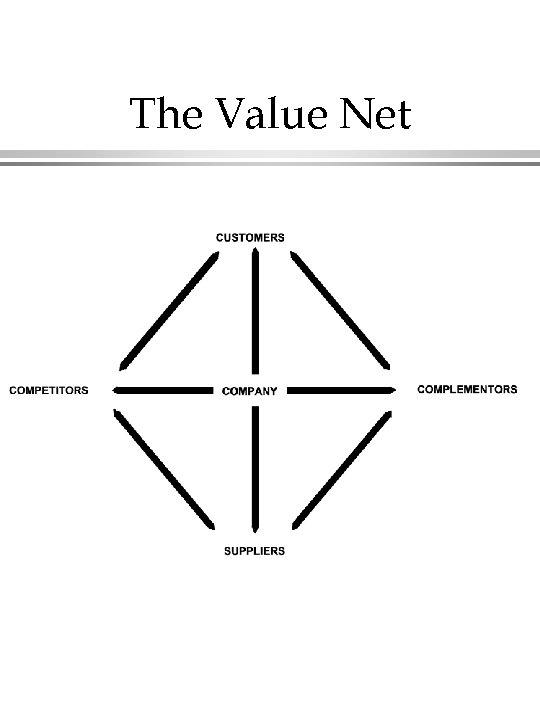
The Value Net
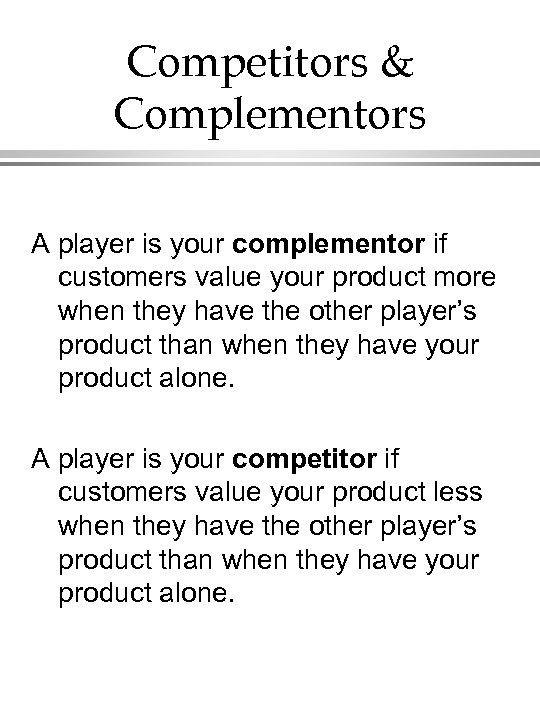
Competitors & Complementors A player is your complementor if customers value your product more when they have the other player’s product than when they have your product alone. A player is your competitor if customers value your product less when they have the other player’s product than when they have your product alone.
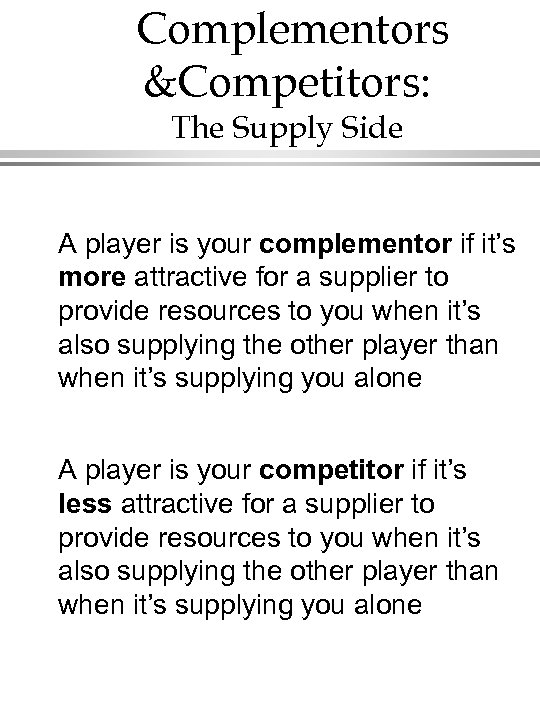
Complementors &Competitors: The Supply Side A player is your complementor if it’s more attractive for a supplier to provide resources to you when it’s also supplying the other player than when it’s supplying you alone A player is your competitor if it’s less attractive for a supplier to provide resources to you when it’s also supplying the other player than when it’s supplying you alone
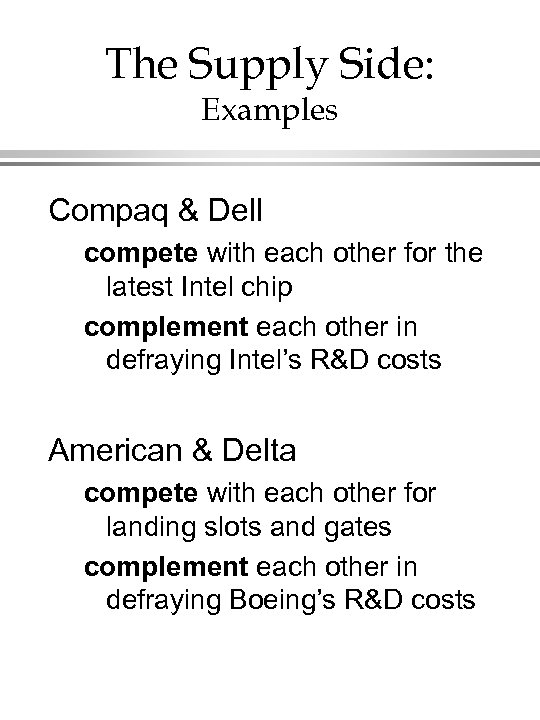
The Supply Side: Examples Compaq & Dell compete with each other for the latest Intel chip complement each other in defraying Intel’s R&D costs American & Delta compete with each other for landing slots and gates complement each other in defraying Boeing’s R&D costs
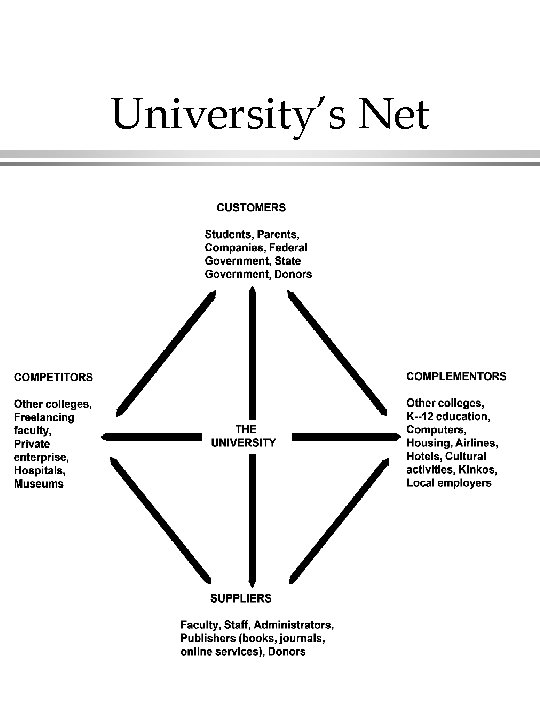
University’s Net
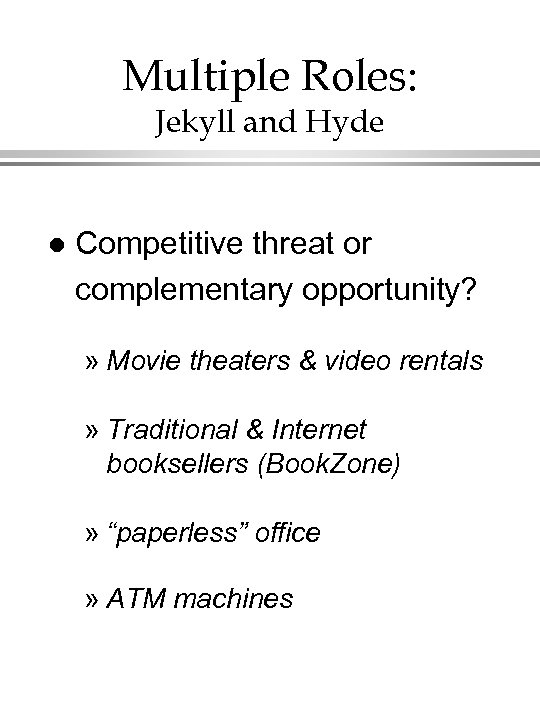
Multiple Roles: Jekyll and Hyde l Competitive threat or complementary opportunity? » Movie theaters & video rentals » Traditional & Internet booksellers (Book. Zone) » “paperless” office » ATM machines
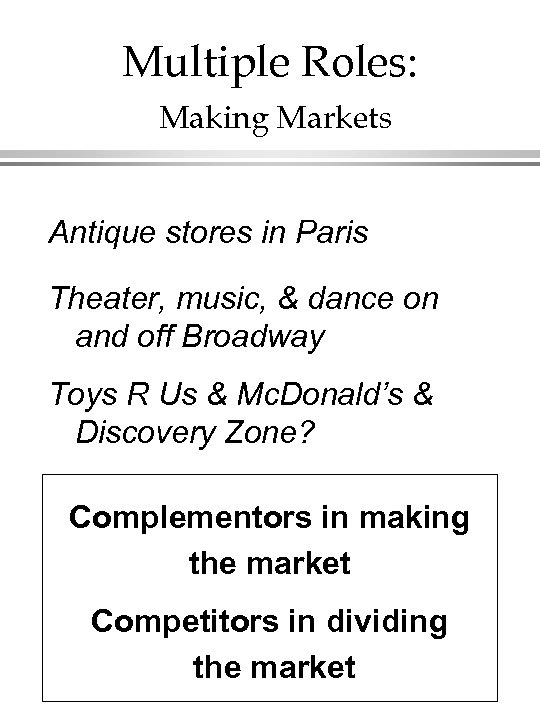
Multiple Roles: Making Markets Antique stores in Paris Theater, music, & dance on and off Broadway Toys R Us & Mc. Donald’s & Discovery Zone? Complementors in making the market Competitors in dividing the market
Friend or Foe? Friends Customers, Suppliers, Complementors Foes Competitors 8
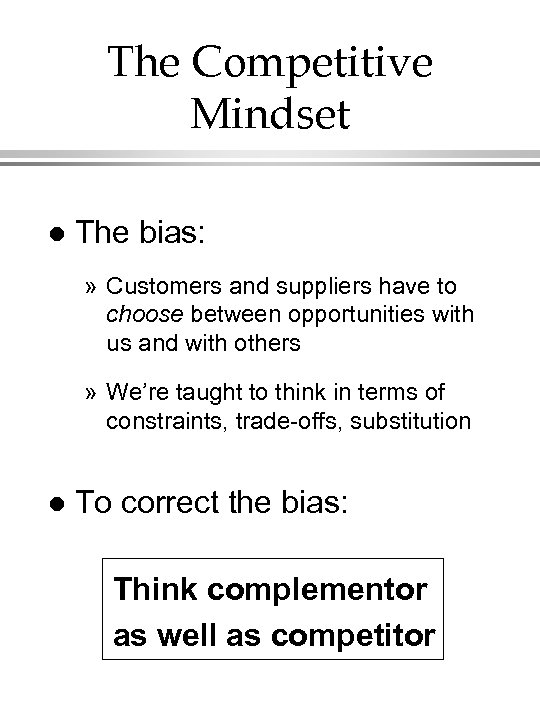
The Competitive Mindset l The bias: » Customers and suppliers have to choose between opportunities with us and with others » We’re taught to think in terms of constraints, trade-offs, substitution l To correct the bias: Think complementor as well as competitor
Using Game Theory l Founders: John von Neumann and Oskar Morgenstern (1944) l Equations vs. Experience l Power--yours and others--is determined by the structure of the game l Added values, Rules, Perceptions, and Boundaries
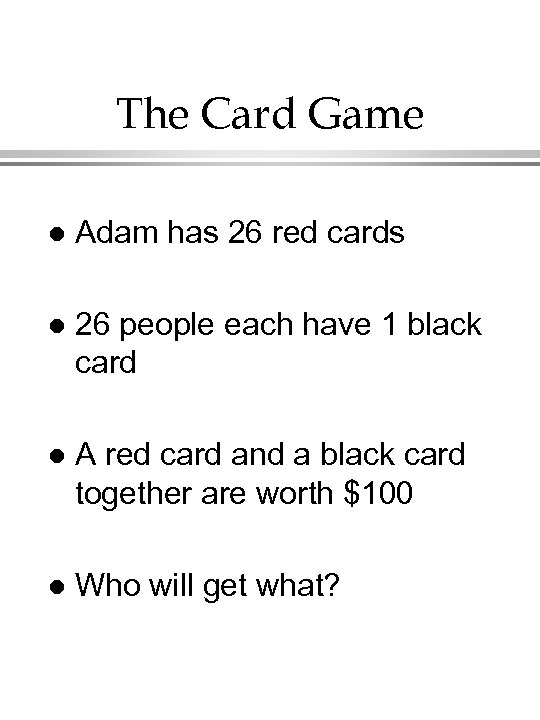
The Card Game l Adam has 26 red cards l 26 people each have 1 black card l A red card and a black card together are worth $100 l Who will get what?
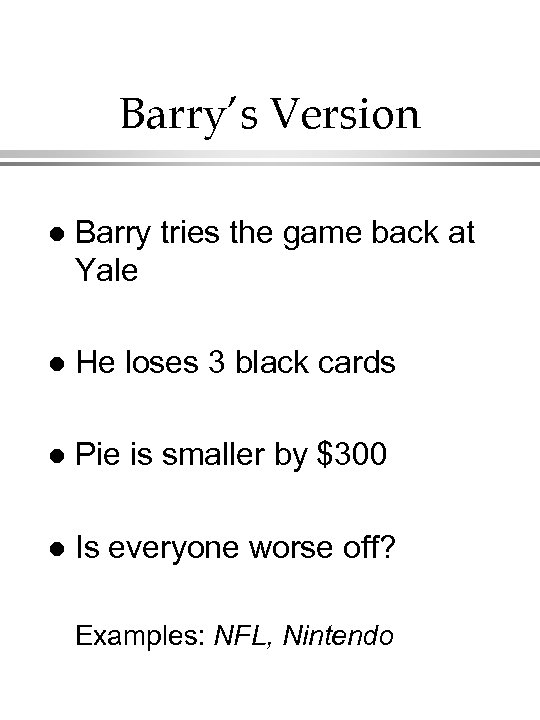
Barry’s Version l Barry tries the game back at Yale l He loses 3 black cards l Pie is smaller by $300 l Is everyone worse off? Examples: NFL, Nintendo
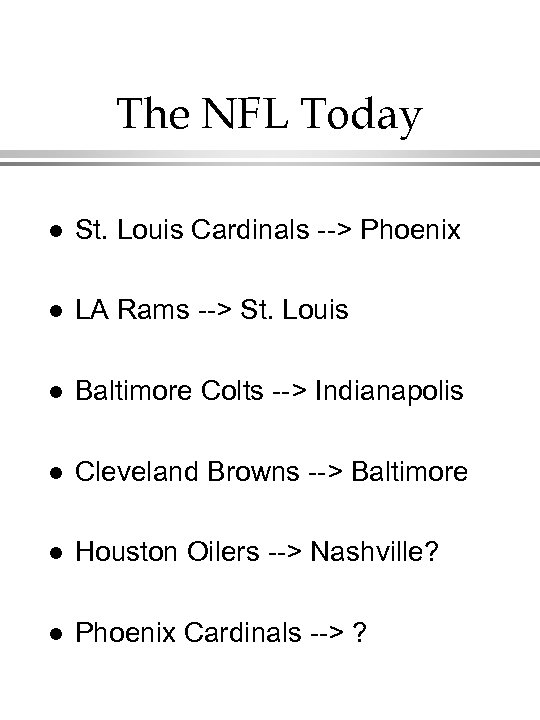
The NFL Today l St. Louis Cardinals --> Phoenix l LA Rams --> St. Louis l Baltimore Colts --> Indianapolis l Cleveland Browns --> Baltimore l Houston Oilers --> Nashville? l Phoenix Cardinals --> ?
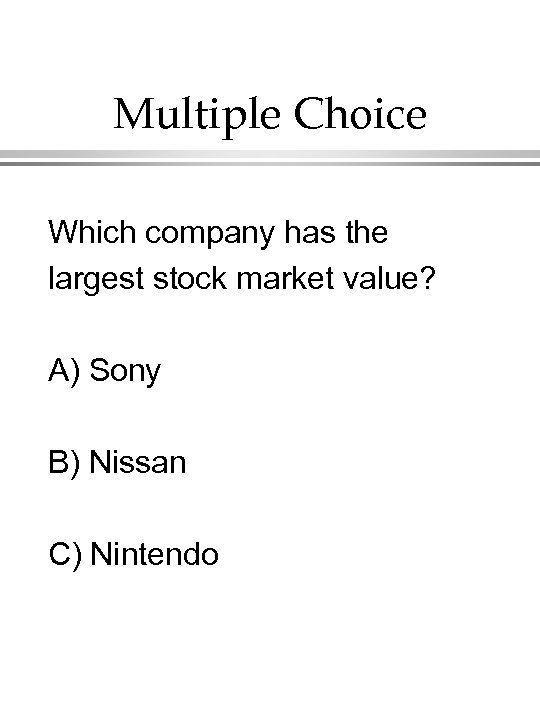
Multiple Choice Which company has the largest stock market value? A) Sony B) Nissan C) Nintendo
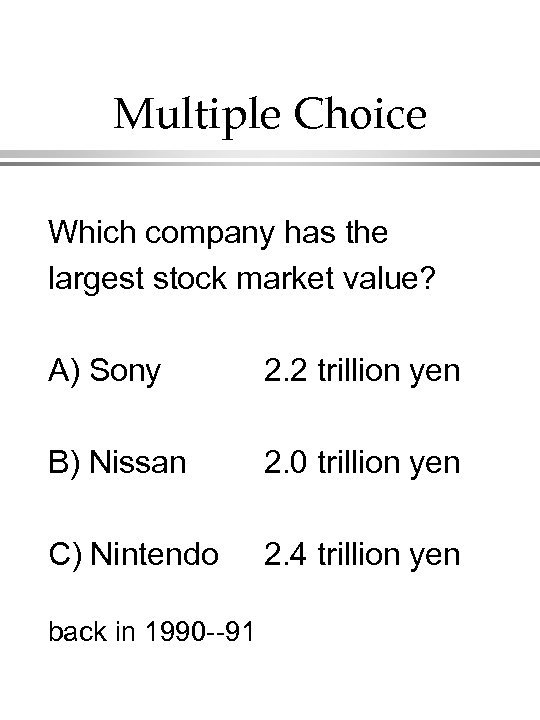
Multiple Choice Which company has the largest stock market value? A) Sony 2. 2 trillion yen B) Nissan 2. 0 trillion yen C) Nintendo 2. 4 trillion yen back in 1990 --91
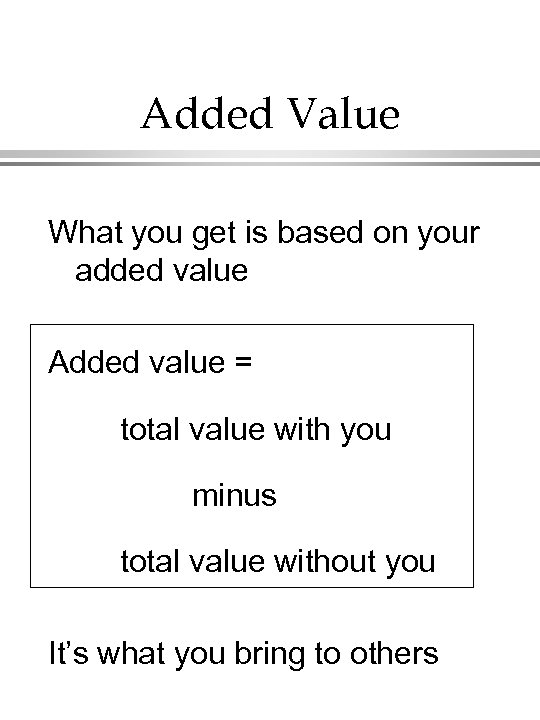
Added Value What you get is based on your added value Added value = total value with you minus total value without you It’s what you bring to others
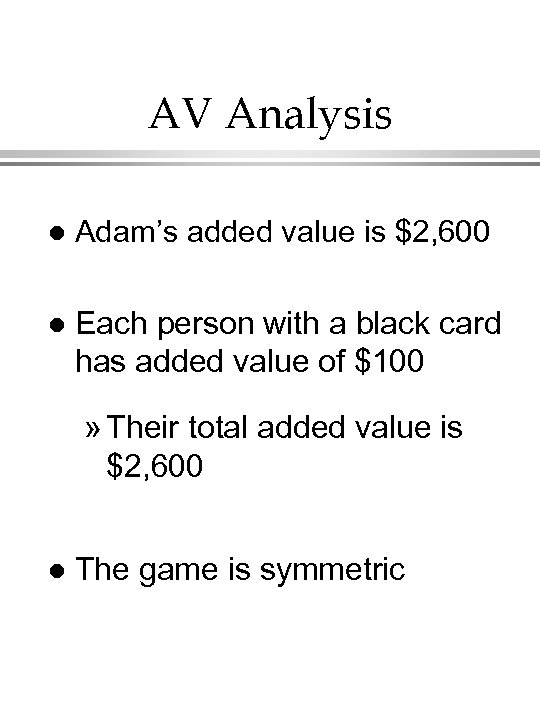
AV Analysis l Adam’s added value is $2, 600 l Each person with a black card has added value of $100 » Their total added value is $2, 600 l The game is symmetric
AV Analysis cont. l Barry’s added value is $2, 300 l But, each black card has zero added value l So, Barry does much better » Bigger piece of smaller pie
What’s Your Added Value? l Egocentric vs. Allocentric l Individual vs. Group l It’s a Wonderful Life l Home Alone
Perception Games l Perceptions are part of the game l Texas Shoot-Out » One side states price » Other side says buy or sell » Shooter or Shootee? l Different valuations
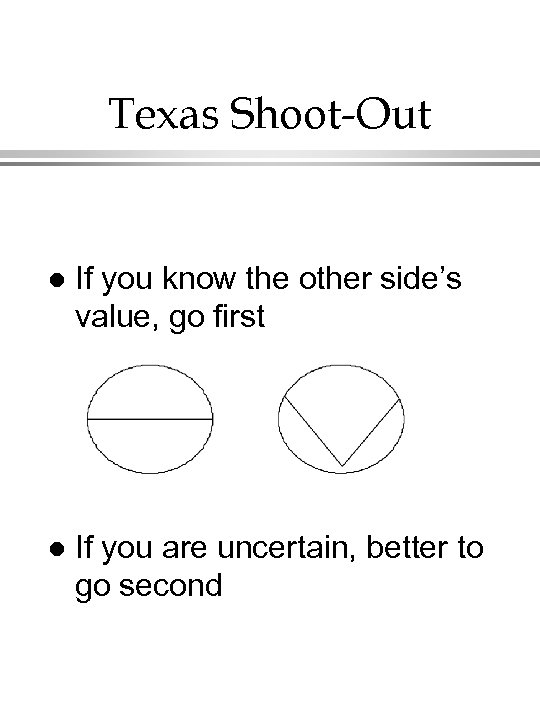
Texas Shoot-Out l If you know the other side’s value, go first l If you are uncertain, better to go second
Boundaries of a Game l One Big Game l Chess l Epson’s Entry in Laser Printers
Allocentrism l Added value » Put yourself in the shoes of others to assess your added value l Rules » Put yourself in the shoes of others to anticipate reactions to your actions l Perceptions » Put yourself in the shoes of others to see how they see the game
Irrationality l Profits are not the only objective Pride, jealousy, fairness matter l l Ignore this, you can both lose Even if you think others are misguided, don’t impose your rationality on them Allocentrism
Change the Game Getting the right mindset. . . “Philosophers have only interpreted the world. The point, however, is to change it”
PARTS l “Changing the rules” is only one of five levers l The elements of a game Players Added values Rules Tactics Scope l PARTS is a complete set of levers: exhaustive, not mutually exclusive l Method to out-of-the-box thinking
Players Becoming a player changes the game » The Heisenberg principle Nutra. Sweet and HSC Gainesville, Norfolk Southern and CSX Mc. Caw, Lin, and Bell. South
Pay Me to Play Competition is valuable: Don't give it away, Get paid to play
How to Get Paid l Cash l Contribution to upfront expenses l Guaranteed sales contract l Last-look l Access to people l Access to information
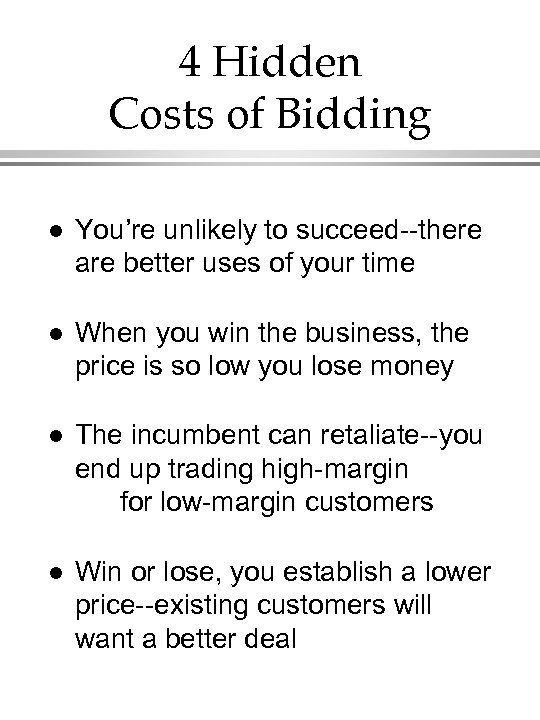
4 Hidden Costs of Bidding l You’re unlikely to succeed--there are better uses of your time l When you win the business, the price is so low you lose money l The incumbent can retaliate--you end up trading high-margin for low-margin customers l Win or lose, you establish a lower price--existing customers will want a better deal
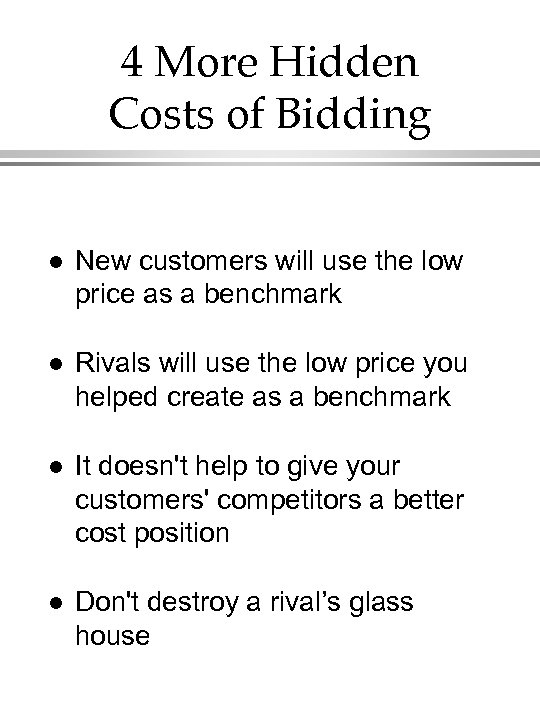
4 More Hidden Costs of Bidding l New customers will use the low price as a benchmark l Rivals will use the low price you helped create as a benchmark l It doesn't help to give your customers' competitors a better cost position l Don't destroy a rival’s glass house
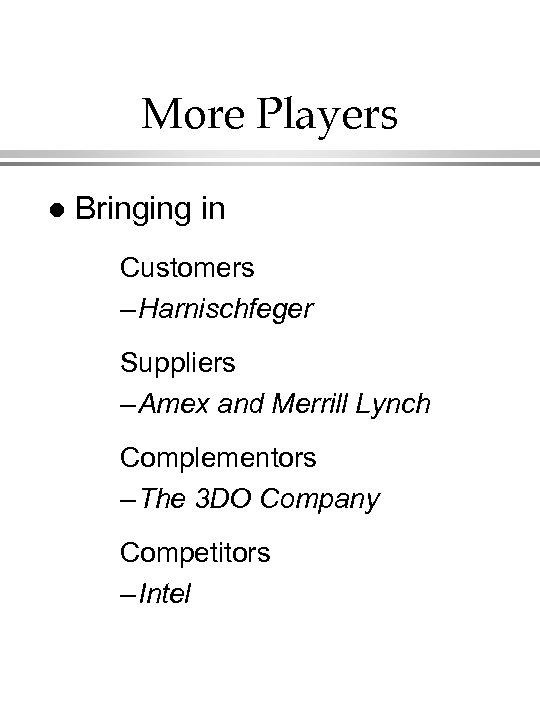
More Players l Bringing in Customers – Harnischfeger Suppliers – Amex and Merrill Lynch Complementors – The 3 DO Company Competitors – Intel
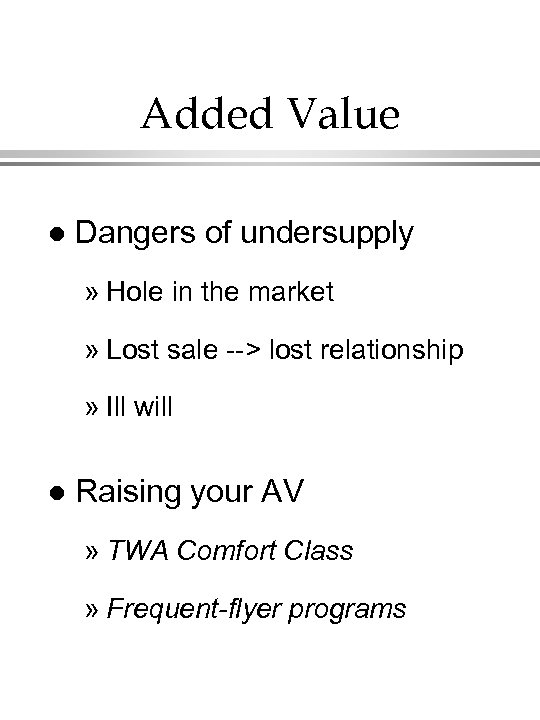
Added Value l Dangers of undersupply » Hole in the market » Lost sale --> lost relationship » Ill will l Raising your AV » TWA Comfort Class » Frequent-flyer programs
Healthy Imitation “If everyone can do it, you can’t make money at it” l Copying products vs. imitating strategy l win-LOSE + LOSE-win lose-lose l win-win + win-win WIN-WIN
Loyalty Create Loyalty By Rewarding It -Say thank you
Saying Thank You l Say thank you in kind, not cash » frequent-flyer; insurance l Save the best thank you for your best customers » cellular phones; teaser rates l Say thank you in a way that builds your business » three-way calling; guest passes
More Thanks l Say you’re going to say thanks » American Express l Allow your competitors to have loyal customers, too l Don’t forget to say thank you, even if you have a monopoly » cable television l Say thanks to your suppliers, too » employee discounts, and more
Rules “When the rules of the game prove unsuitable for victory, the gentlemen of England change the rules. ” l Rules structure negotiations between buyers and sellers l Rules come from » custom » contractual arrangements » the government
Contract Rules l In games with rules, you need to anticipate the reactions to your actions l Games in business do have some rules » Most-favored-customer clauses » Meet-the-competition clauses l How do MFCs change the game? » less incentive to negotiate » guaranteed cost parity
Contract Rules l In games with rules, you need to anticipate the reactions to your actions l Games in business do have some rules » Most-favored-customer clauses » Meet-the-competition clauses l How do MFCs change the game? » less incentive to negotiate » guaranteed cost parity
GM and Ford Cards l To whom do you want to charge a high price? A low price? l What’s in it for GM l What’s in it for Household l Changing dynamics between GM and Ford l Comparison to freq. -flyer programs
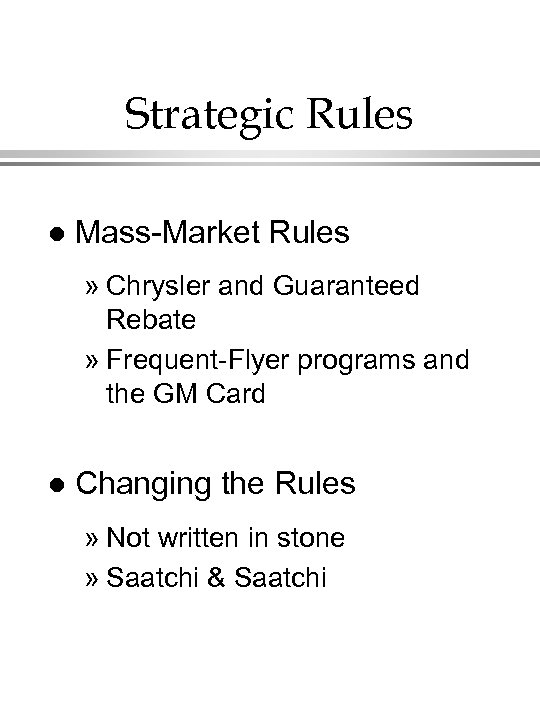
Strategic Rules l Mass-Market Rules » Chrysler and Guaranteed Rebate » Frequent-Flyer programs and the GM Card l Changing the Rules » Not written in stone » Saatchi & Saatchi
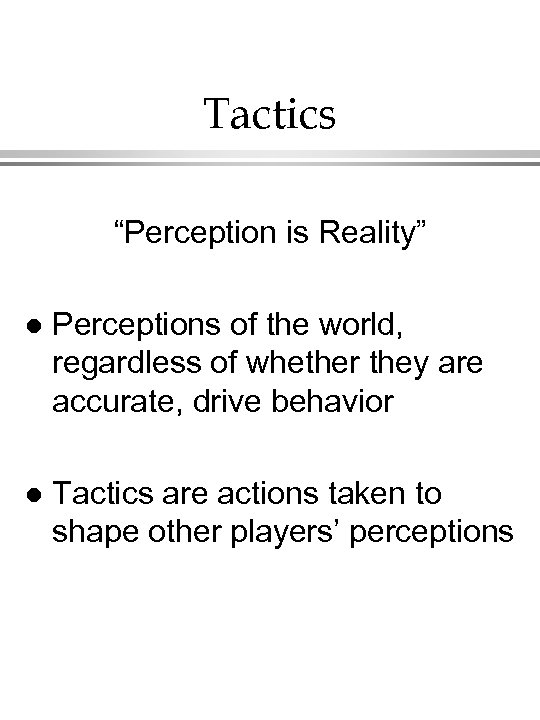
Tactics “Perception is Reality” l Perceptions of the world, regardless of whether they are accurate, drive behavior l Tactics are actions taken to shape other players’ perceptions
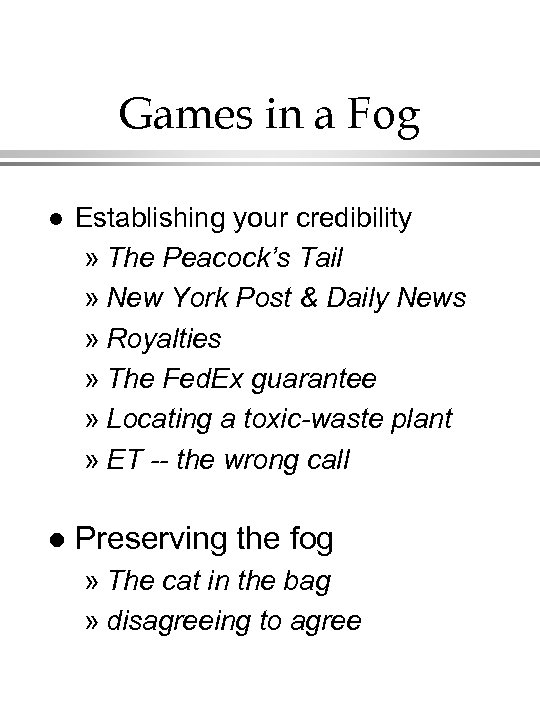
Games in a Fog l Establishing your credibility » The Peacock’s Tail » New York Post & Daily News » Royalties » The Fed. Ex guarantee » Locating a toxic-waste plant » ET -- the wrong call l Preserving the fog » The cat in the bag » disagreeing to agree
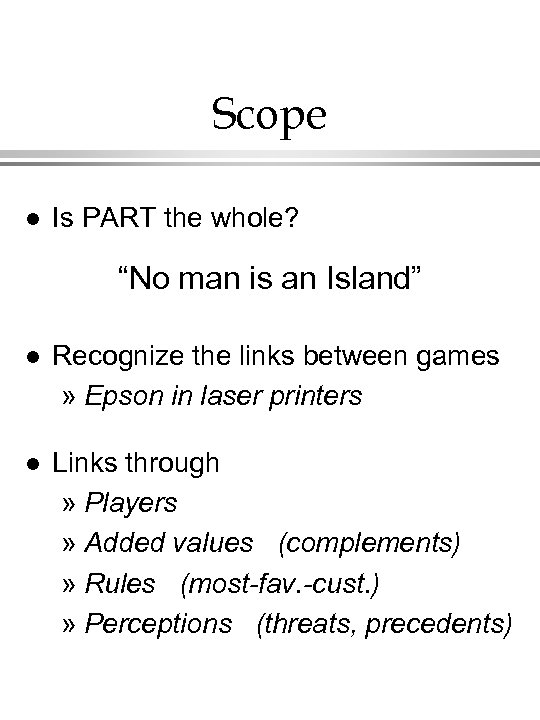
Scope l Is PART the whole? “No man is an Island” l Recognize the links between games » Epson in laser printers l Links through » Players » Added values (complements) » Rules (most-fav. -cust. ) » Perceptions (threats, precedents)
Links between Games l Added value links » “judo strategy” » Sega in 16 -bit video games » Softsoap vs. Ivory l Rules can link games » Long-term contracts » Package discounts l Perceptions can link games » Corpus Christi and Beaumont » Nutra. Sweet in Europe
Think Big There is always a larger game
Changing the Game: Players Questions l What is your Value Net? l What are the opportunities for cooperation and competition? l Would you like to change the cast? What new players would you like to bring into the game? l Who stand to gain if you enter? Who stands to lose?
Changing the Game: Added Value Questions l What is your added value? l How can you increase your added value? l Can you create loyal customers and suppliers? l What are the added values of the other players? l Is it in your interest to limit their added values?
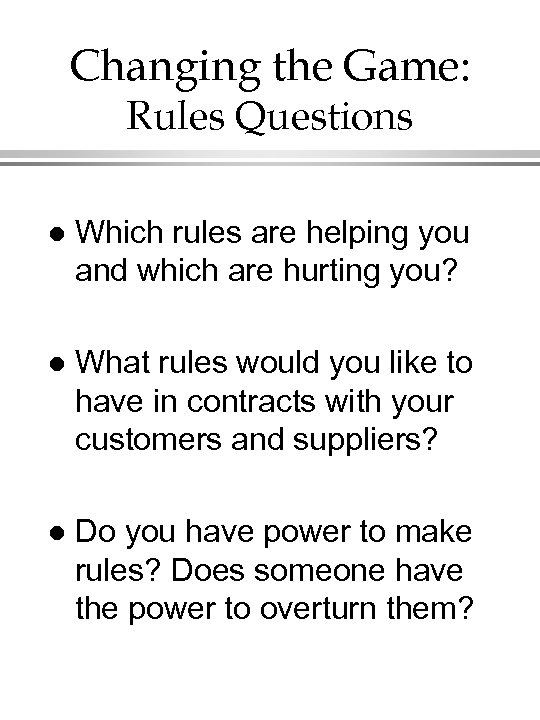
Changing the Game: Rules Questions l Which rules are helping you and which are hurting you? l What rules would you like to have in contracts with your customers and suppliers? l Do you have power to make rules? Does someone have the power to overturn them?
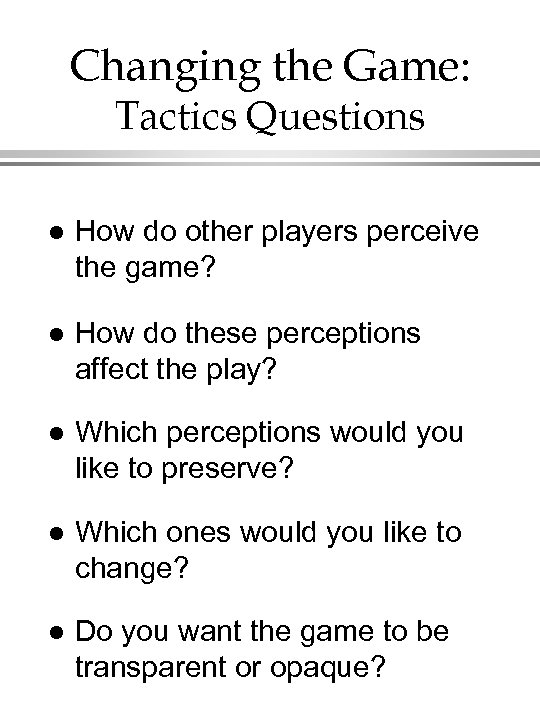
Changing the Game: Tactics Questions l How do other players perceive the game? l How do these perceptions affect the play? l Which perceptions would you like to preserve? l Which ones would you like to change? l Do you want the game to be transparent or opaque?
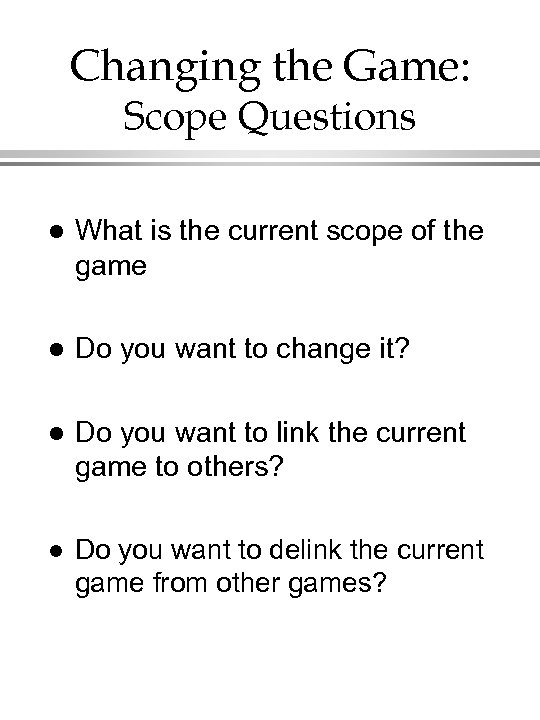
Changing the Game: Scope Questions l What is the current scope of the game l Do you want to change it? l Do you want to link the current game to others? l Do you want to delink the current game from other games?
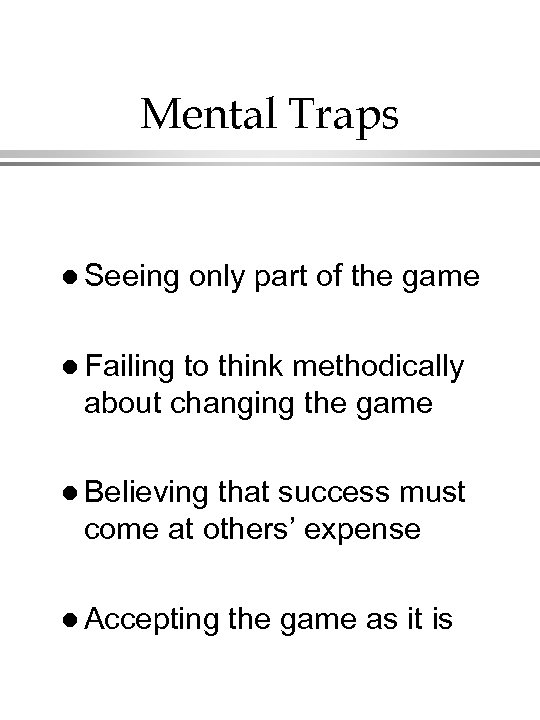
Mental Traps l Seeing only part of the game l Failing to think methodically about changing the game l Believing that success must come at others’ expense l Accepting the game as it is
Скачать презентацию Co-opetition Barry Nalebuff Yale School of Management New
37631f4c706d822fdceec70cc1252bb7.ppt